 ASVAB Camp
Lesson Goal and Exam Relevance
In this lesson you will solve one-variable linear equations and check every answer. You will handle signed and negative coefficients, parentheses, fractions, decimals and variables on both sides, and you will recognize equations with no solution or with infinitely many solutions. You will also turn word problems and formulas into equations and solve them.
Equation solving is one of the most heavily tested Mathematics Knowledge skills. The questions are designed to be done without a calculator, so a clean, reliable step-by-step method is what earns points.
Expressions Versus Equations
An expression is a mathematical phrase such as . It has no equals sign, so it can be simplified or evaluated but not solved. An equation such as
claims that two expressions have the same value. Solving means finding the value of the variable that makes that claim true. Here x = 5 works, because
A linear equation has the variable only to the first power, never squared, and usually has exactly one solution.
Equality as a Balance
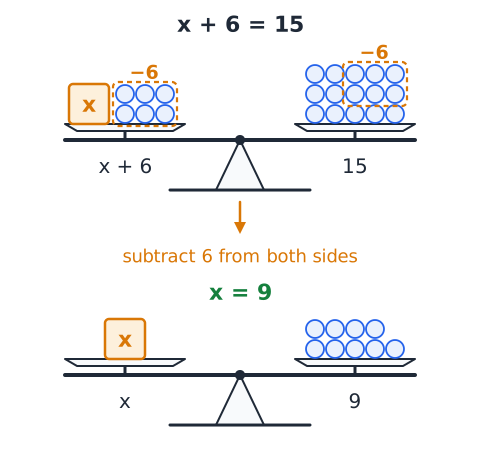
Think of an equation as a balanced scale: the left side and the right side weigh the same. You can add, subtract, multiply or divide by the same amount on both sides, and the scale stays balanced. The one exception is that you may not multiply or divide both sides by zero. For example, if
subtracting 6 from both sides leaves
Whatever you do to one side, you must do to the other, or the new equation will no longer have the same solution.
Inverse Operations and Two-Step Equations
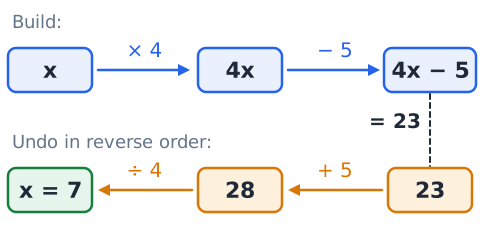
Undo operations in reverse order using their opposites: subtraction undoes addition, and division undoes multiplication. For
first add 5 to get
then divide by 4 to get
Negative Coefficients and Signed Arithmetic
When the coefficient is negative, divide by that negative number, sign included. For
subtract 4 to get
Divide both sides by −3:
Check:
Distribution Before Collecting Terms
If the variable is inside parentheses, distribute first. For
write
Combine Like Terms
Before isolating the variable, combine like terms on each side separately. For example:
The x terms give 5x and the constants give 4, so the equation becomes
Subtract 4 to get
then divide by 5:
Combining first keeps the number of steps small and reduces sign errors.
Variables on Both Sides
When x appears on both sides, move all variable terms to one side and all constants to the other. For
subtract 3x from both sides to get
Add 4 to get
Moving the smaller variable term avoids a negative coefficient.
Equations With Parentheses on Both Sides
Distribute on each side, then gather terms. For
Subtract 2x and add 6:
Check: both sides equal 36.
Fractional Coefficients
When the variable has a fractional coefficient, multiply both sides by the reciprocal of that fraction. For example:
Multiply both sides by :
The reciprocal turns the coefficient into 1 in a single step.
Clearing Several Denominators
With more than one fraction, multiply every term on both sides by the least common denominator. For
the LCD is 6. Multiplying each term gives
Fractions on Both Sides
When a single fraction equals another, you can cross-multiply. For
write
Keep binomial numerators in parentheses.
Decimal Coefficients
Decimals can be cleared by multiplying every term by a power of ten. For
multiply by 10 to get
Use 100 if any term has two decimal places.
No Solution and Infinitely Many Solutions
Sometimes the variable terms cancel completely. If what remains is false, such as
reducing to
the equation is a contradiction and has no solution. If what remains is always true, such as
reducing to
the equation is an identity and every real number is a solution. In both cases, the two sides have the same x coefficient once simplified.
Equivalent Equations and Reversibility
Each legal step, adding, subtracting, multiplying or dividing both sides by the same nonzero number, produces an equivalent equation: one with exactly the same solution set. Because each step can be undone, you can travel from the original equation to the answer and back without gaining or losing solutions. That is why the final line, such as
tells you the solution of the first line. Multiplying by zero is not reversible, which is why it is not allowed: it turns every equation into
Translate Words Into a Linear Equation
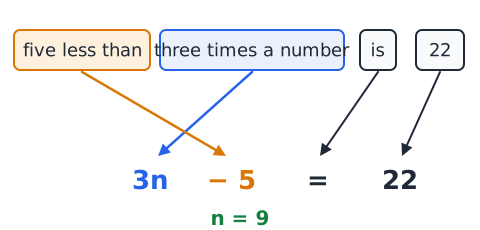
Assign a letter to the unknown, then translate phrases piece by piece: is means equals, of often means multiply, more than means add, and less than means subtract in reverse order. For example, five less than three times a number is 22 becomes
Consecutive Integer Relationships
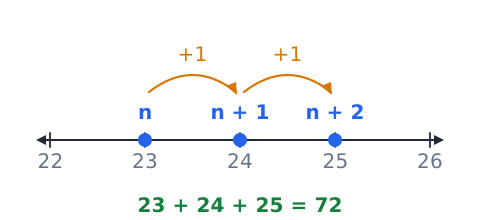
Consecutive integers differ by 1, so call them n, n + 1 and n + 2. Consecutive even or odd integers differ by 2: n, n + 2, n + 4. If three consecutive integers add to 72, then
so n = 23 and the integers are 23, 24 and 25.
Perimeter as a One-Variable Equation
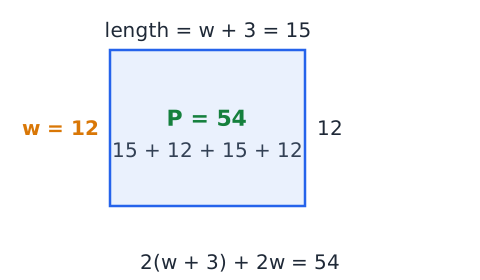
Perimeter is the total distance around a figure. For a rectangle,
Write both dimensions in terms of one variable. If the length is 3 more than the width and the perimeter is 54, then
That gives w = 12 and a length of 15.
Rearranging a Literal Linear Formula
A literal equation has several letters. To solve for one of them, treat the other letters like numbers and use the same inverse operations. From
divide both sides by r to get
From
subtract 2l and divide by 2 to get
Solutions With Fractions or Decimals
Not every answer is a whole number. If
which equals 1.5. If
then:
This is about 2.67. Leave answers as reduced fractions unless the choices are decimals, and convert carefully when matching an answer choice.
Choose an Efficient Solving Route
There is often a shortcut. If one side is a multiple of the coefficient outside the parentheses, divide first instead of distributing:
Dividing both sides by 5 gives
with no distribution needed. When fractions appear, clear them at the start. When x is on both sides, move the smaller x term so the coefficient stays positive. On multiple-choice items, you can also plug answer choices into the equation, starting with a middle value.
Substitution as a Mandatory Check
Always check by substituting your answer into the original equation, not a later step, because an error in an early step will carry through. If both sides give the same number, the answer is right. For example, if you solve
and get x = 5, compute
It matches. A check takes seconds and catches most sign and arithmetic slips.
Common Error Diagnostic
If your check fails, look for these causes in order. Did you distribute to every term inside the parentheses? Did you flip every sign after a minus in front of parentheses? Did you multiply every term, including constants, when clearing denominators? Did you keep the sign when dividing by a negative coefficient? Did you apply the operation to both sides? Fix the first failure you find, then check again.
Worked Example 1 — Two-Step Signed Equation
Problem: Solve
Step 1: Get the x-term alone. Undo the + 9 by subtracting 9 from both sides.
Step 2: Undo the multiplication by −2. Divide both sides by −2. A negative divided by a negative is positive.
Answer: x = 4.
Check: Put 4 back into the original equation.
It matches the right side, so x = 4 is correct.
Worked Example 2 — Distribute Then Solve
Problem: Solve
Step 1: Distribute the 6. Multiply it by each term inside the parentheses:
Step 2: Combine the plain numbers on the left side:
Step 3: Undo the subtraction by adding 8 to both sides, so 6x is alone.
Step 4: Undo the multiplication by dividing both sides by 6.
Answer:
Check: Put 5 back in. First
It matches.
Worked Example 3 — Clear Denominators
Problem: Solve
Step 1: Get rid of the fractions. The smallest number that both 4 and 6 divide into is 12, so multiply every term on both sides by 12.
Step 2: Simplify each term:
so the first term is 3x;
so the right side is 2x.
Step 3: Move the x terms to one side by subtracting 2x from both sides.
Step 4: Add 24 to both sides to get x alone.
Answer:
Check: Left side:
Right side:
Both sides equal 4.
Worked Example 4 — Fractional Coefficients
Problem: Solve
Step 1: Undo the + 3 first. Subtract 3 from both sides:
Step 2: To undo multiplying by , multiply both sides by its flip (reciprocal), . On the left,
which leaves just x.
Step 3: Multiply:
Answer:
Check: Two-fifths of 20 means
Add 3:
It matches.
Worked Example 5 — Contradiction Versus Identity
Problem: Decide how many solutions each equation has: (a)
and (b)
Step 1: Distribute in (a):
Step 2: Subtract 6x from both sides. The x terms disappear.
This statement is false, and no value of x can fix it. So (a) has no solution (a contradiction).
Step 3: Distribute in (b):
Then combine
Step 4: Both sides are exactly the same, so the equation is true for every x (an identity).
Answer: (a) has no solution; (b) has infinitely many solutions.
Check: Try x = 0 in (b):
Equal. In (a), x = 0 gives 2 on the left and 5 on the right. Not equal.
Worked Example 6 — Formula Rearrangement
Problem: Solve
for h. Then find h when A = 30 and b = 12.
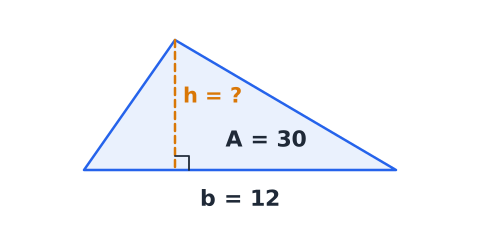
Step 1: Clear the fraction by multiplying both sides by 2. On the right, 2 × = 1.
Step 2: h is being multiplied by b, so divide both sides by b to get h alone.
Step 3: Substitute A = 30 and b = 12. First
Step 4: Divide:
Answer:
and h = 5 when A = 30 and b = 12.
Check: Put the numbers into the original formula: one half of 12 × 5 is one half of 60, which is 30. That equals A.
Worked Example 7 — Geometry Application
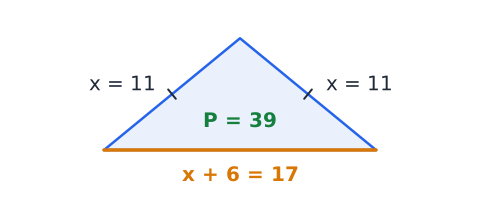
Problem: An isosceles triangle has two equal sides of length x, and the third side is 6 longer than x. The perimeter is 39. Find the sides.
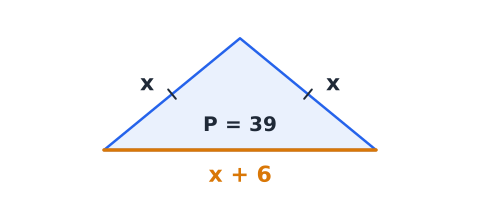
Step 1: The perimeter is the sum of all three sides. Write that as an equation.
Step 2: Combine like terms:
Step 3: Subtract 6 from both sides:
Step 4: Divide both sides by 3:
Step 5: Find the third side:
Answer: The sides are 11, 11 and 17.
Check:
That is the given perimeter, and 17 is indeed 6 more than 11.
Mistakes That Cost MK Points
Applying an operation to only one side breaks the balance; always do the same thing to both sides. Distributing to the first term only, as in writing as , loses part of the product. After a minus sign in front of parentheses, every sign inside must flip, not just the first. When clearing fractions, multiply every term, including whole-number constants. Dividing by a negative coefficient but dropping its sign gives the opposite of the correct answer. Stopping at
without interpreting it misses the no-solution or identity case. Finally, choosing an answer without substituting it back skips the easiest error check you have.
Quick Review: Linear Equations
A linear equation sets two expressions equal and can be solved for its variable. Keep the equation balanced by doing the same operation to both sides. Simplify each side first: distribute, flip signs after a leading minus, and combine like terms. Collect variable terms on one side and constants on the other, then divide by the coefficient, sign included. Clear fractions by multiplying every term by the least common denominator, and clear decimals by multiplying by a power of ten. If the variable cancels and a false statement remains, there is no solution; if a true statement remains, every number is a solution. Translate word problems carefully, rearrange formulas with the same inverse operations, and always check your answer in the original equation.
 English ▾