 ASVAB Camp
Lesson Goal and MK Context
This lesson pulls together the measurement formulas the Mathematics Knowledge test uses most. You will find areas of flat shapes, including composite regions and shapes with holes, and then move to solids: prisms, cylinders, pyramids, cones and spheres.
For each solid you will find volume and surface area, handle open containers and joined shapes, solve a formula backward for a missing dimension, and convert square and cubic units correctly. All work is set up for mental or pencil arithmetic.
Three Different Questions: Boundary, Covering, Capacity
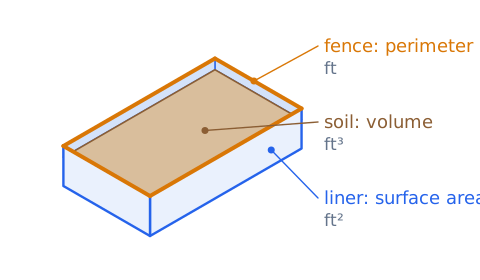
Most measurement problems ask one of three things. How long is the edge? That is perimeter, in plain units. How much material covers the surface? That is area or surface area, in square units. How much fits inside? That is volume, in cubic units.
Picture a raised garden bed: the fence around it is a perimeter, the plastic liner on its sides and bottom is a surface area, and the soil that fills it is a volume. Decide which question you face before choosing a formula.
Why Units Are Squared or Cubed
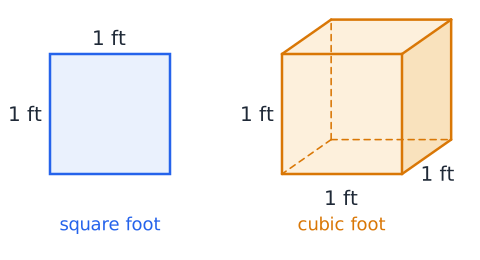
Area multiplies two lengths, so its unit is a length times a length, such as square feet. Volume multiplies three lengths, giving cubic units such as cubic centimeters.
A square foot is a 1 ft by 1 ft tile; a cubic foot is a 1 ft by 1 ft by 1 ft block. The unit tells you what kind of quantity an answer is.
Rectangles and Squares
For a rectangle of length l and width w, and a square of side s:
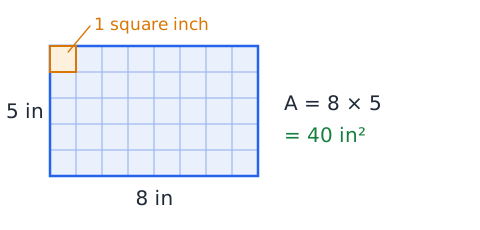
A cutting board 8 inches by 5 inches covers 40 square inches. A square window 7 feet on a side has area 49 square feet. Both lengths must be in the same unit.
Triangles: Base and Perpendicular Height
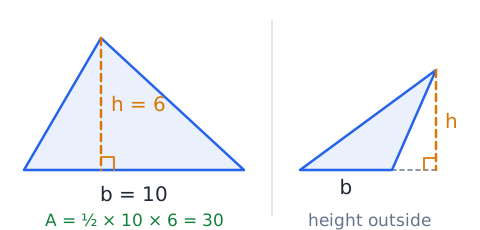
Every triangle is half of a parallelogram with the same base and height:
The height must meet the base, or the line containing it, at a right angle. In a right triangle the two legs serve as base and height. In an obtuse triangle the height may fall outside the shape. A triangle with base 10 and height 6 has area 30.
Parallelograms
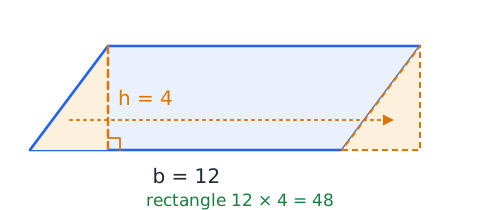
A parallelogram's area is base times perpendicular height, A = bh. Slicing off a triangle from one end and moving it to the other end makes a rectangle with the same base and height.
The slanted side is not the height. A parallelogram with base 12 and height 4 covers 48 square units, whatever its side length.
Trapezoids
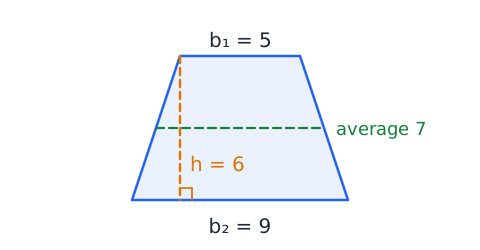
A trapezoid's area uses the average of its two parallel bases times the perpendicular height:
With bases 5 and 9 and height 6, the average base is 7, so the area is 42.
Circle Area as a Prior Skill
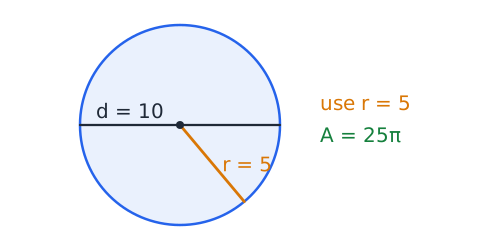
Circle area is needed for cylinders, cones and many composite shapes:
A disk of radius 4 has area 16 pi. If a diameter of 10 is given, use radius 5, for 25 pi. Keep pi in the answer unless the choices are decimals. The circle's boundary is 2 pi r, a length, not an area.
Annuli and Holes in Flat Regions
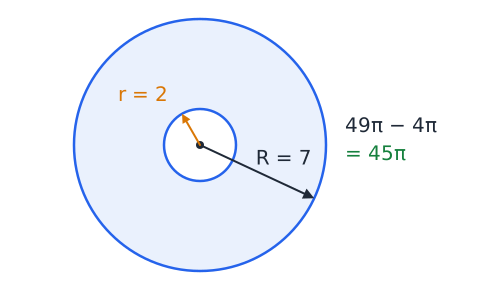
For a flat ring, or any shape with a hole, subtract the hole from the whole. For a ring with outer radius R and inner radius r:
A washer with R of 7 and r of 2 has area pi times 45, or 45 pi.
Composite 2D Shapes: Split or Subtract
A composite region can be found two ways. Split it into rectangles, triangles or other basic pieces that do not overlap, then add. Or surround it with a simple outer shape and subtract the missing pieces.
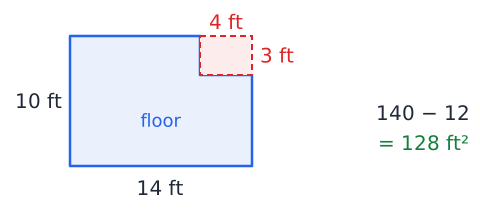
Example: a 14 by 10 foot room has a 4 by 3 foot corner taken by a closet. The floor area is 140 minus 12, or 128 square feet. Use whichever method needs fewer pieces.
Shaded Areas and Multiple Regions
For shaded regions, find the large area and subtract every unshaded piece. Combine identical pieces first.
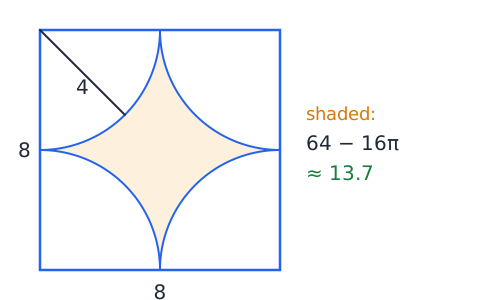
Example: a square of side 8 has a quarter circle of radius 4 drawn in each corner. Four quarter circles make one full circle, 16 pi. The shaded area left is
or about 13.7 square units.
Scale Factors for Flat Area
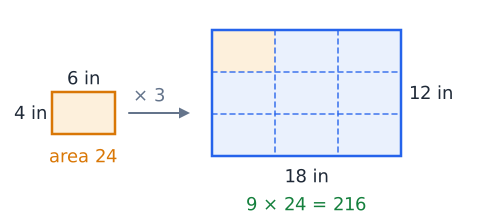
If every length of a flat figure is multiplied by k, its area is multiplied by k squared.
A 4 by 6 inch photo has area 24. Enlarged 3 times, it is 12 by 18, with area 216, which is 9 times 24. Lengths triple, area multiplies by 9.
What Counts as a Three-Dimensional Solid
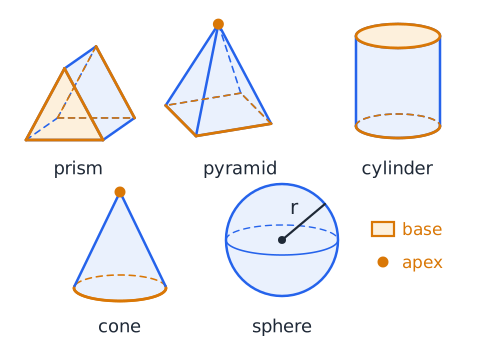
A solid takes up space in three directions: length, width and height. Polyhedra have flat polygon faces meeting along edges and corners, as in prisms and pyramids.
Other solids have curved surfaces: a cylinder has two circular bases and a curved side, a cone has one circular base rising to a point, and a sphere is every point a fixed distance from a center. A prism has two matching parallel bases; a pyramid has one base and a tip called the apex.
Rectangular Prisms: Volume
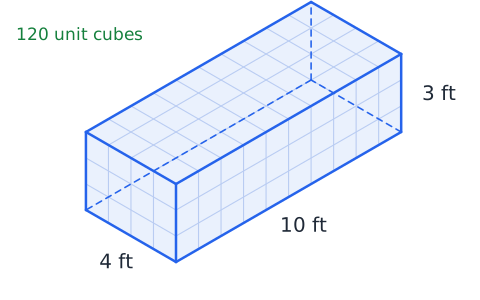
A rectangular box holds length times width times height unit cubes:
A planter 10 by 4 by 3 feet holds 120 cubic feet of soil. A cube with edge s has volume s cubed.
Prisms: Base Area × Height
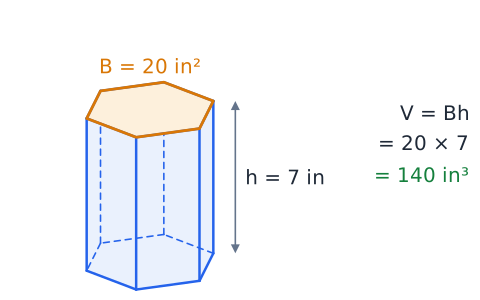
Every prism, whatever the shape of its base, has volume equal to base area times height: V = Bh. Here B is the area of one base and h is the distance between the two bases.
Find B with the matching flat formula first. A prism with a hexagonal base of area 20 square inches and a height of 7 inches holds 140 cubic inches.
Cylinders: Volume
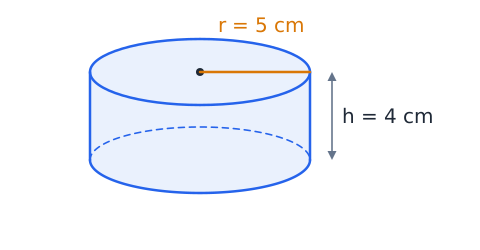
A cylinder is like a prism with a circular base, so its volume is base area times height:
A can with radius 5 cm and height 4 cm holds 25 pi times 4, or 100 pi cubic centimeters. Use the radius, not the diameter.
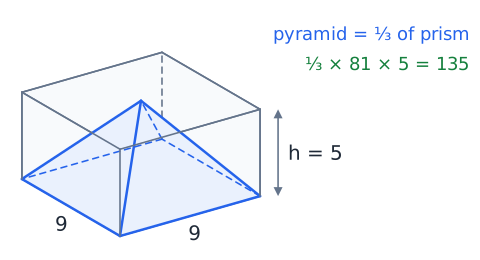
Pyramids: One-Third of a Prism
A pyramid holds exactly one third of the prism with the same base and height:
A pyramid with a 9 by 9 base and height 5 has volume 81 times 5 over 3, or 135 cubic units.
Cones: One-Third of a Cylinder
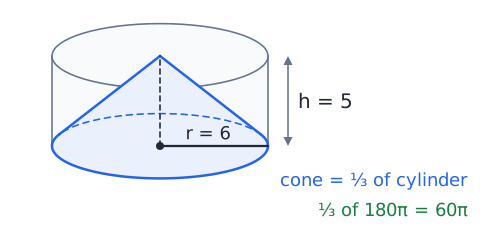
A cone holds one third of the cylinder with the same base and height:
Here h is the straight-up height from base to tip. A cone with radius 6 and height 5 holds one third of 180 pi, or 60 pi.
Spheres: Volume
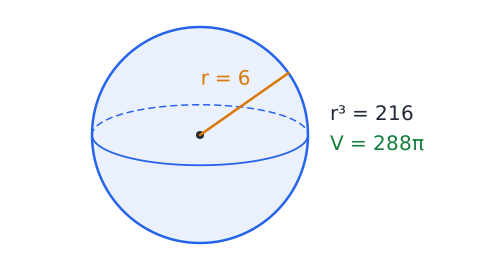
A sphere of radius r has volume
Cube the radius first. For r of 6, r cubed is 216, and four thirds of 216 is 288, so V is 288 pi.
Surface Area From Nets
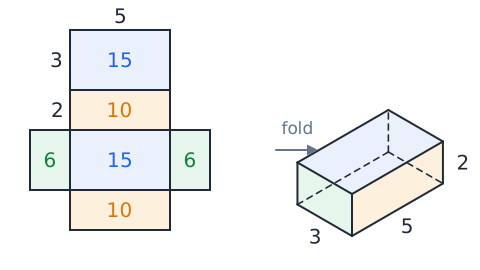
Surface area is the total area of every outside face, as if you wrapped the solid in paper. A net is the solid unfolded flat into connected faces.
Unfolding a box gives six rectangles in matching pairs. Unrolling a cylinder gives two circles and one rectangle. Find each face's area and add them, counting every face exactly once.
Rectangular Prism and Cube Surface Area
A box has three pairs of matching faces, so SA = 2(lw + lh + wh). A box 5 by 3 by 2 has surface area 2 times (15 plus 10 plus 6), or 62. A cube has six equal squares, so SA = 6s squared.
Right Prisms: Lateral Area and Total Surface Area
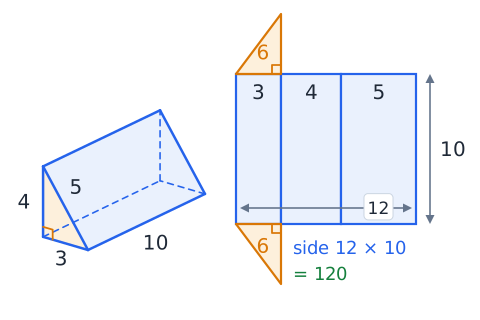
The lateral area of a right prism is the area of its side faces only. Laid flat, the sides form one rectangle whose width is the base perimeter, so lateral area equals perimeter times height.
Total surface area adds the two bases. A prism with a 3-4-5 right triangle base and length 10 has lateral area 12 times 10, or 120. Each base is 6, so the total is 132.
Cylinders: Curved and Total Surface Area
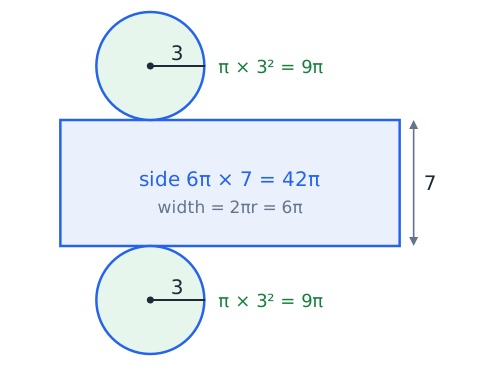
Unrolled, a cylinder's side is a rectangle whose width is the circumference. So the curved area is 2 pi r h. A closed cylinder adds two circular ends:
With r of 3 and h of 7, the side is 42 pi and the total is 60 pi.
Open-Top and Open-Bottom Containers
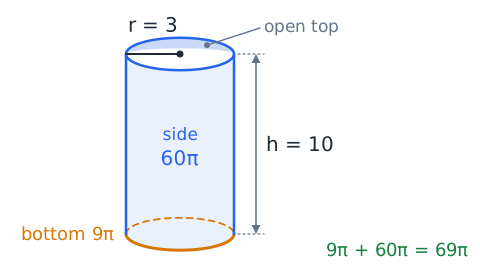
Leave out any face that is missing. An open-top can has one circular base plus the curved side:
A cup with r of 3 and h of 10 needs 9 pi plus 60 pi, or 69 pi. A pipe open at both ends has only the curved side, 2 pi r h. An open box drops its top face.
Pyramids: Surface Area and Slant Height
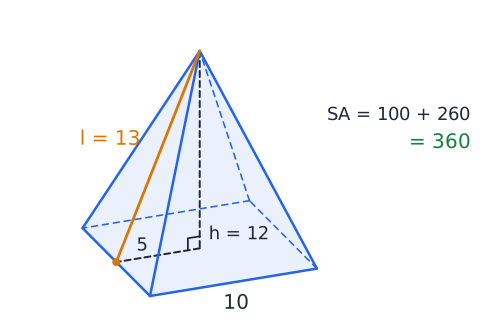
A square pyramid's surface is its base plus four triangles. Each triangle uses the slant height l, measured up the middle of a face, not the vertical height h.
The slant height comes from h and half the base: a base of 10 and height 12 give l of 13, so SA is 100 plus 260, or 360.
Cones: Curved and Total Surface Area
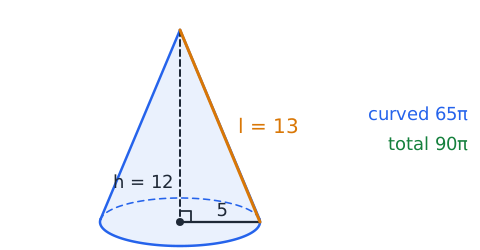
A cone's curved surface uses its slant height l, the distance from the tip down the side to the base edge:
If r is 5 and the height is 12, then l is 13. The curved part is 65 pi and the total is 90 pi.
Spheres: Surface Area
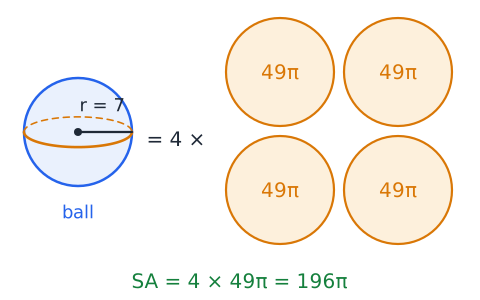
A sphere's surface area is four times the area of its largest circle:
A ball of radius 7 has surface area 196 pi.
Composite Solids: Add and Subtract Volume
Break a composite solid into basic solids. Add volumes of pieces joined together and subtract volumes that are hollowed out.
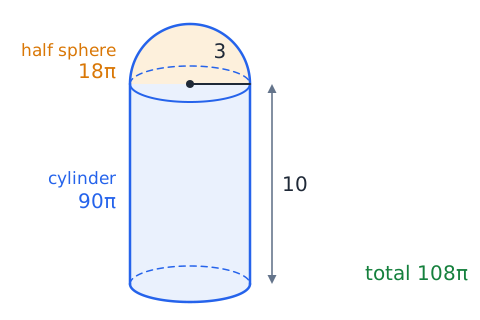
Example: a grain silo is a cylinder of radius 3 and height 10 topped with a half sphere of radius 3. The cylinder holds 90 pi. The half sphere holds half of 36 pi, or 18 pi. Together they hold 108 pi cubic units.
Composite Surface Area: Count Only Exposed Faces
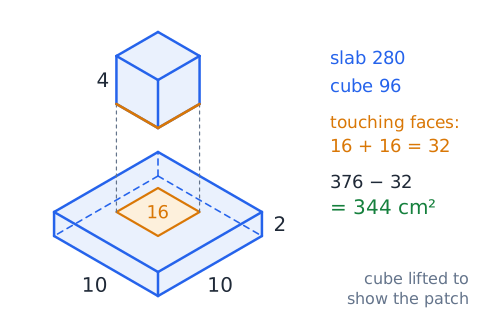
When solids are joined, the touching faces are hidden and must be removed from both pieces.
Example: a 4 cm cube sits on top of a 10 by 10 by 2 cm slab. The slab's area is 280 and the cube's is 96. The cube's bottom and the patch of slab it covers are each 16, so the exposed area is 376 minus 32, or 344.
Unit Conversion: Linear, Square and Cubic
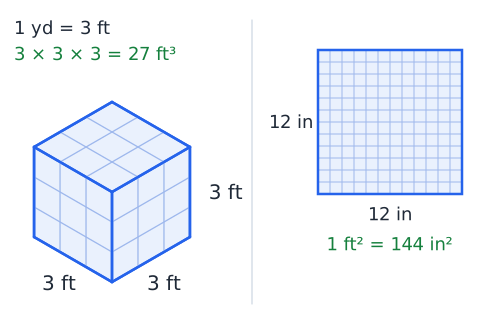
A length factor is squared for area and cubed for volume. Since 1 foot is 12 inches, 1 square foot is 144 square inches and 1 cubic foot is 1728 cubic inches.
Since 1 yard is 3 feet, 1 cubic yard is 27 cubic feet, so 54 cubic feet is 2 cubic yards.
Capacity, Fill Level and Displacement
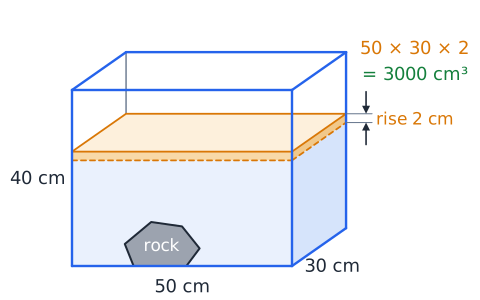
Capacity is the volume a container can hold. In metric units, 1 liter equals 1000 cubic centimeters.
So a tank 50 by 30 by 40 cm holds 60 liters, and filled three fourths of the way it holds 45 liters.
A submerged object pushes the water up by its own volume. If a rock raises the water in that tank by 2 cm, its volume is 50 times 30 times 2, or 3000 cubic centimeters.
Scaling Three-Dimensional Solids
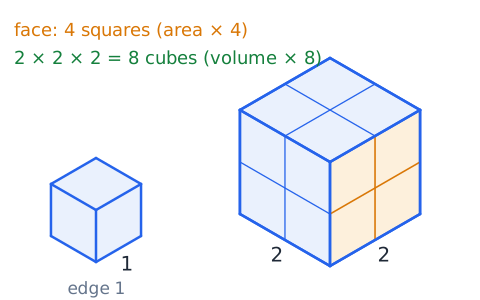
When every length of a solid is multiplied by k, surface area is multiplied by k squared and volume by k cubed:
Doubling all dimensions of a box gives 4 times the paint and 8 times the space. Halving them leaves one eighth of the volume.
Reverse Formulas and Solving for a Dimension
To find a missing dimension, write the formula, substitute what you know, and solve.
Example: a box has volume 180 cubic inches with a 6 by 5 inch base.
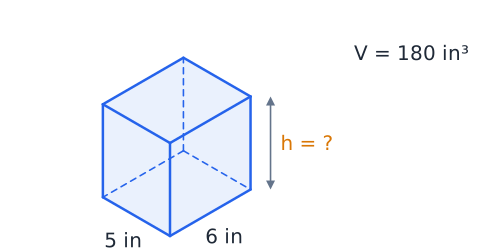
So 30h equals 180 and h is 6 inches.
No-Calculator Area and Volume Routine
First, name the shape and decide whether the question asks for length, area or volume. Second, convert everything to one unit and change diameters to radii. Third, write the formula symbolically, for example
then substitute. Simplify the one-third or one-half with a factor that divides evenly before multiplying. Keep pi as a symbol. Last, check that the units are square for area and cubic for volume, and that the size makes sense.
Formula Recognition and Fast Mental Arithmetic
Spot the pattern: pointed solids, pyramids and cones, carry a one third; spheres carry four thirds for volume and 4 for surface area.
Divide first when you can. Learn squares through 15 and cubes through 6 to save time.
Worked Example 1 — Composite L-Shaped Floor
Problem: A floor is a 16 by 10 foot rectangle with a 6 by 4 foot corner missing. Find its area.
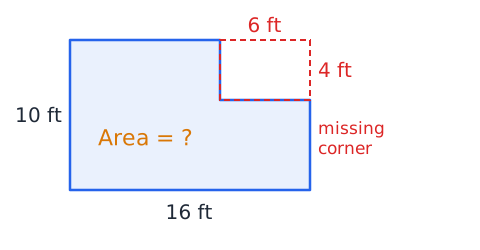
Step 1 (subtract method): Find the area of the full rectangle as if nothing were missing.
Step 2: Find the area of the missing corner.
Step 3: Take the corner away from the full rectangle.
Answer: The floor is 136 square feet.
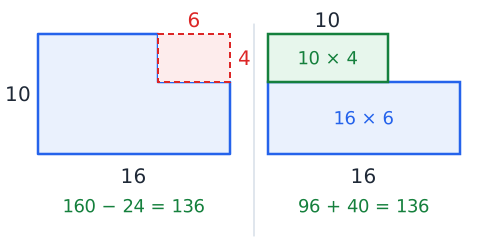
Check (split method): Cut the L into two rectangles instead. One strip is 16 by 6, and the leftover piece is 10 by 4 (because
).
Both methods give 136 square feet, so the answer is confirmed.
Worked Example 2 — Box Volume Versus Surface Area
Problem: A shipping box is 8 by 5 by 4 inches. Find how much it holds (volume) and how much cardboard covers it (surface area).
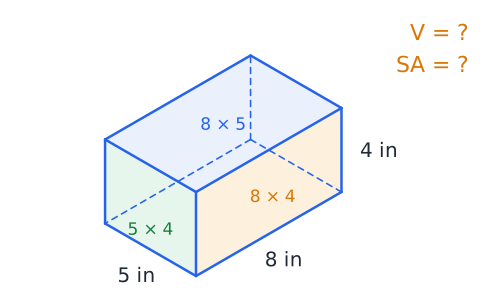
Step 1: Volume is length × width × height. Multiply two numbers at a time:
Step 2: For surface area, find the three different face sizes. A box has two of each.
Step 3: Add the three faces, then double for the matching opposite faces.
Answer: The box holds 160 cubic inches and is covered by 184 square inches of cardboard.
Check: Volume uses cubic units (in³) and surface area uses square units (in²). Different questions, different units. Recount faces:
the faces of a box.
Worked Example 3 — Closed Cylinder
Problem: A closed drum (cylinder) has radius 5 ft and height 9 ft. Find its total surface area.
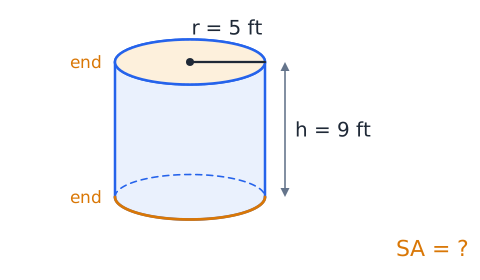
Step 1: The two round ends are circles. Each has area πr², and
Step 2: The curved side unrolls into a rectangle. Its width is the circumference 2πr and its length is the height.
Multiply the numbers:
Step 3: Add the ends and the side.
Answer: The surface area is 140π ft², about 440 ft².
Check: Use the formula SA = 2πr(r + h) = 2π ×
π × 14 = 140π. Same result.
Worked Example 4 — Open-Top Tank
Problem: An open-top tank is 8 ft long, 4 ft wide and 3 ft high. How much sheet metal makes the bottom and four walls?
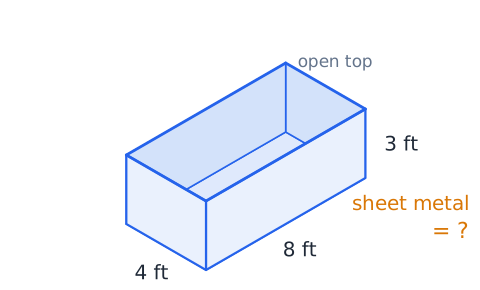
Step 1: Find the bottom, length × width.
Step 2: Find the two long walls. Each is length × height.
Step 3: Find the two short walls. Each is width × height.
Step 4: Add the pieces. There is no top, so do not count it.
Answer: The tank needs 104 square feet of sheet metal.
Check: A closed box would add a top of 32, for 136 square feet. Subtracting that top again gives
Worked Example 5 — Triangular Prism
Problem: A prism has a right triangle base with legs 6 cm and 8 cm and a hypotenuse of 10 cm. Its length is 15 cm. Find its volume and surface area.
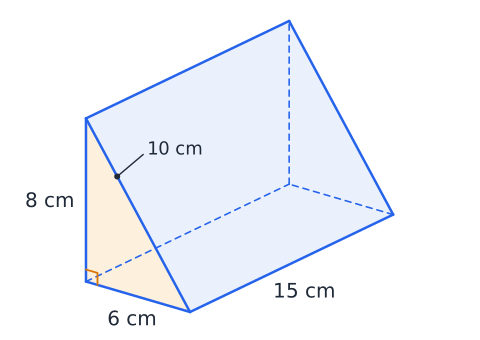
Step 1: Find the triangle's area. In a right triangle the legs are the base and height, so take half of 6 × 8.
Step 2: Volume is base area × length.
Step 3: The three rectangular sides unroll into one long rectangle. Its width is the triangle's perimeter.
Step 4: Add the two triangle ends,
Answer: The volume is 360 cm³ and the surface area is 408 cm².
Check: Add the sides one at a time:
Same side area.
Worked Example 6 — Cone Height Versus Slant Height
Problem: A cone has radius 6 in and slant height 10 in. Find its volume.
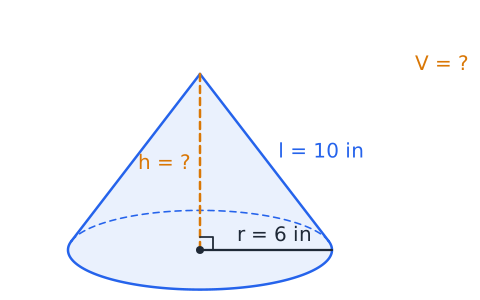
Step 1: The volume formula needs the vertical height h, not the slant height. The radius, height and slant height form a right triangle, with the slant height as the hypotenuse.
Step 2: Solve for h. 10² = 100 and 6² = 36.
Step 3: Use
πr²h with r² = 36 and h = 8.
Divide 36 by 3 first (12), then
Answer: The volume is 96π cubic inches, about 301 in³.
Check: 6-8-10 is a well-known right triangle (double of 3-4-5). The slant height is used for the surface area instead: the curved side is π ×
π.
Worked Example 7 — Square Pyramid
Problem: A square pyramid has a 16 m base edge and a vertical height of 6 m. Find its volume and surface area.
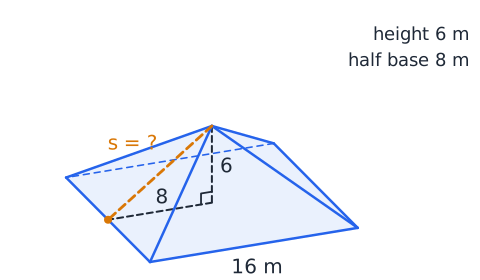
Step 1: Find the base area.
Step 2: Volume is one third of base area × height. Divide 6 by 3 first to get 2.
Step 3: Each triangular face needs the slant height. It is the hypotenuse of a right triangle with legs 8 (half the base) and 6 (the height).
Step 4: Each face is a triangle with base 16 and height 10. There are 4 faces.
Step 5: Add the square base.
Answer: The volume is 512 m³ and the surface area is 576 m².
Check: 6-8-10 is double the 3-4-5 right triangle, so a slant height of 10 makes sense.
Worked Example 8 — Two Joined Cubes
Problem: Two cubes with 5 cm edges are glued face to face. Find the exposed surface area.
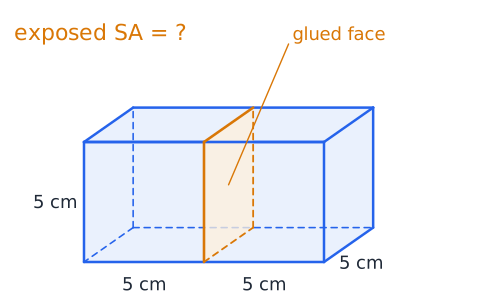
Step 1: Count faces. Each cube has 6 faces, so two cubes have 12.
Step 2: Gluing hides one face on each cube, so 2 faces disappear.
Step 3: Each face is a 5 by 5 square.
Step 4: Multiply the number of exposed faces by the area of one face.
Answer: The exposed surface area is 250 cm².
Check: Together the cubes make a 10 by 5 by 5 box. Its faces are
Worked Example 9 — Scale Change
Problem: A storage tank has volume 15 cubic meters and surface area 40 square meters. Every dimension is doubled. Find the new values.
Step 1: The scale factor is 2, because every length is multiplied by 2.
Step 2: Area uses two lengths multiplied together, so it grows by the scale factor squared.
Step 3: Volume uses three lengths, so it grows by the scale factor cubed.
Answer: The new surface area is 160 m² and the new volume is 120 m³.
Check: Try a 1 m cube. Doubled, it becomes a 2 m cube: each face goes from 1 to 4 square meters (4 times), and the volume goes from 1 to 8 cubic meters (8 times).
Worked Example 10 — Reverse Cylinder Dimension
Problem: A cylinder holds 245π cubic feet and is 5 ft tall. Find its radius.
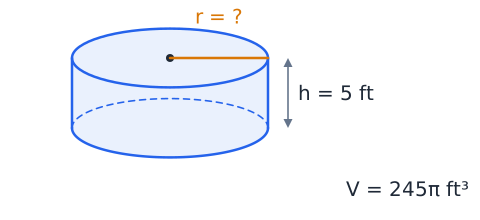
Step 1: Write the volume formula V = πr²h and fill in what you know.
Step 2: Divide both sides by π. It cancels on both sides.
Step 3: Divide both sides by 5 to get r² alone.
Step 4: Take the square root.
Answer: The radius is 7 feet.
Check: π × 7² × 5 = π ×
π. It matches the given volume.
Worked Example 11 — Cubic Unit Conversion
Problem: A slab is 12 ft by 9 ft and 6 inches thick. How many cubic yards of concrete does it need?
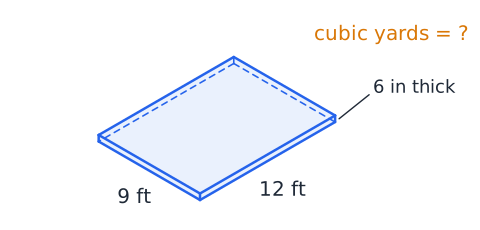
Step 1: Put all lengths in feet. There are 12 inches in a foot, and 6 is half of 12.
Step 2: Volume is length × width × thickness.
and half of 108 is 54.
Step 3: Convert to cubic yards. 1 yard = 3 feet, so 1 cubic yard =
Divide by 27.
Answer: The slab needs 2 cubic yards of concrete.
Check: Work in yards from the start: 12 ft = 4 yd, 9 ft = 3 yd, 6 in = 1/6 yd. Then
cubic yards.
Most Common Traps
Slant height versus height. Volume of a cone or pyramid uses the vertical height; their surface area uses the slant height.
Diameter for radius. Halve the diameter before squaring or cubing.
Missing the one-third. Pointed solids hold one third of the matching prism or cylinder.
Counting faces that are not there. Open tops and glued faces are not part of the surface.
Converting by the linear factor. Square feet to square inches is times 144, and
Scaling volume by k. Volume scales by k cubed, area by k squared.
Wrong units. Area answers are square units; volume answers are cubic.
Final MK Review and Self-Check
Flat area: rectangle lw, triangle half bh, parallelogram bh, trapezoid half the base sum times h, circle pi r squared.
Volume: prism and cylinder are base area times height; pyramid and cone are one third of that.
Surface area adds every exposed face. Scaling by k multiplies area by k squared and volume by k cubed.
Self-check: did you use radius, the right height, consistent units, and the correct unit power?
 English ▾