 ASVAB Camp
Lesson Goal and ASVAB Context
By the end of this lesson you should be able to place and read points on a grid, name the quadrant or axis a point sits on, and move points by reflecting or sliding them. You will also find distances, midpoints, slopes, and intercepts, write and graph line equations, recognize parallel and perpendicular lines, and locate where two lines cross.
These skills support the Mathematics Knowledge (MK) part of the ASVAB, where short coordinate problems reward quick, careful reasoning more than long computation.
The Coordinate Plane
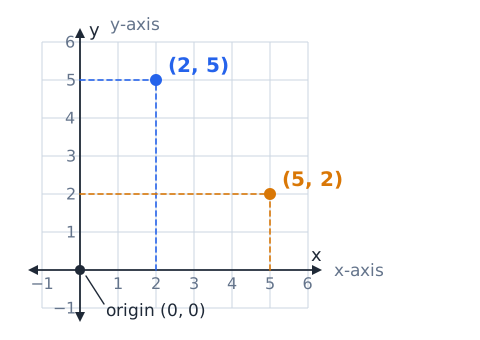
A coordinate plane is built from two number lines that cross at right angles. The horizontal line is the x-axis, the vertical line is the y-axis, and they meet at the origin, (0, 0).
Every point is named by an ordered pair (x, y). The first number tells how far to move left or right from the origin; the second tells how far to move up or down. Order matters: (2, 5) and (5, 2) are different points.
Positive and Negative Directions
On the x-axis, positive values lie to the right of the origin and negative values to the left. On the y-axis, positive values lie above the origin and negative values below. So (-3, -1) means three units left and one unit down.
The Four Quadrants
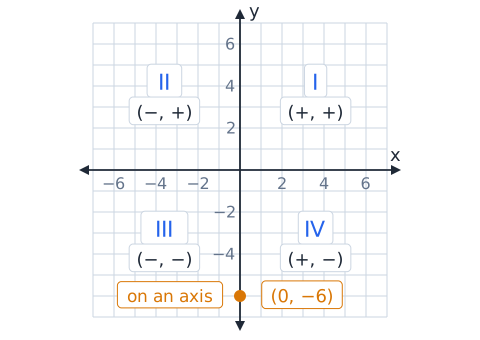
The axes split the plane into four quadrants, numbered counterclockwise from the upper right. Quadrant I has signs (+, +), II has (-, +), III has (-, -), and IV has (+, -). A point with a zero coordinate, such as (0, -6), lies on an axis and belongs to no quadrant.
Reading Graph Scales Carefully
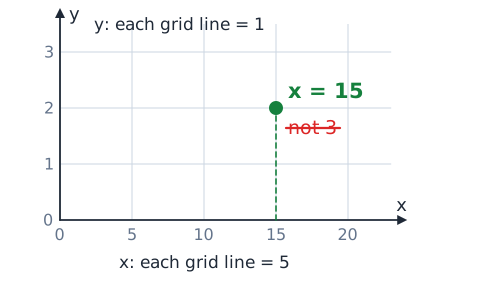
Grid lines do not always stand for one unit. Before reading a point, check the labels on each axis. If every grid line on the x-axis marks 5 units, a point three lines to the right has x = 15, not 3. The two axes may even use different scales, so read each one separately.
Reflections Across the Axes
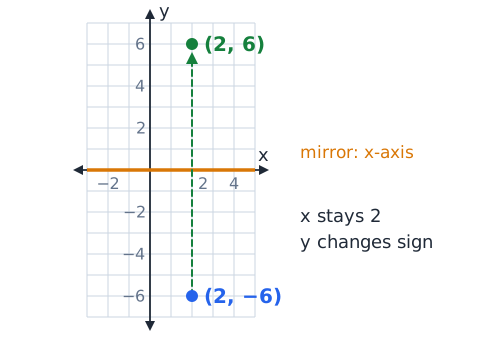
A reflection flips a point over a line like a mirror. Reflecting across the x-axis keeps x and changes the sign of y: (x, y) becomes (x, -y). Reflecting across the y-axis changes the sign of x instead: (x, y) becomes (-x, y). For example, (2, -6) reflected across the x-axis is (2, 6).
Translations in the Plane
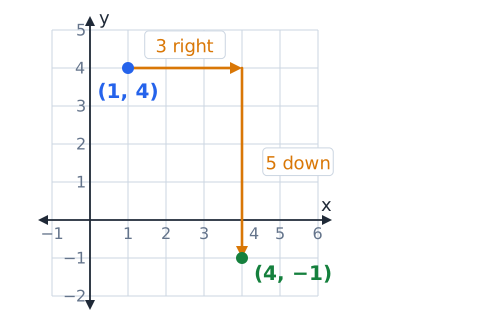
A translation slides a point without flipping or turning it. Moving right adds to x, moving left subtracts from x, moving up adds to y, and moving down subtracts from y. Shifting (1, 4) three units right and five units down gives
Horizontal and Vertical Distance
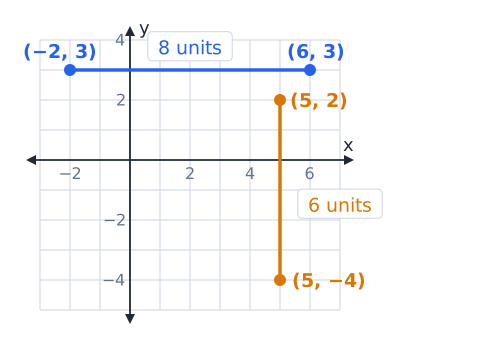
When two points share a y-value, they sit on a horizontal line, and the distance is the difference of the x-values. From (-2, 3) to (6, 3) is
units. When they share an x-value, subtract the y-values: (5, -4) to (5, 2) is 6 units. Distance is never negative.
General Distance Formula
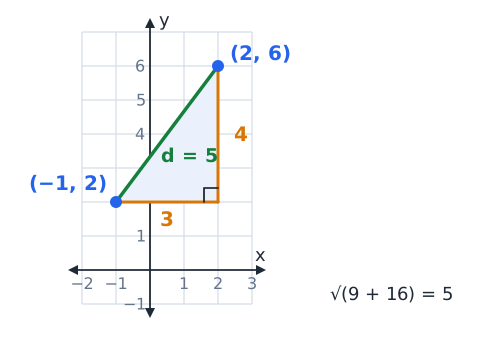
For points that do not line up, use the distance formula, which comes from the Pythagorean theorem:
From (-1, 2) to (2, 6), the changes are 3 and 4, so
Choosing Efficient Distance Methods
First check whether the points share a coordinate; if so, simply subtract. If not, find the horizontal and vertical changes and see whether they match a familiar right-triangle pattern such as 3-4-5, 6-8-10, 5-12-13, or 8-15-17. From (0, 0) to (5, 12) the legs are 5 and 12, so the distance is 13 without any square-root work.
The Midpoint Formula
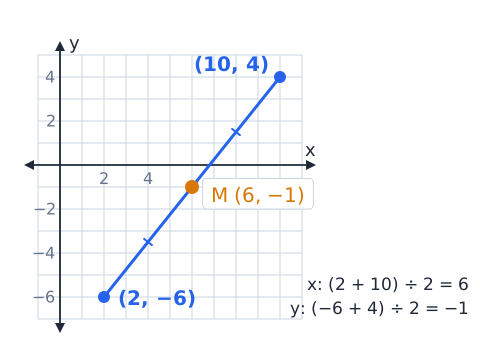
The midpoint is the point exactly halfway between two endpoints. Average the x-values and average the y-values:
For (2, -6) and (10, 4), the midpoint is (6, -1).
Finding an Endpoint From a Midpoint
If you know the midpoint M and one endpoint A, the other endpoint is
coordinate by coordinate. With M = (3, 1) and
Slope as Rise Over Run
Slope measures steepness: how much a line goes up or down for each step to the right.
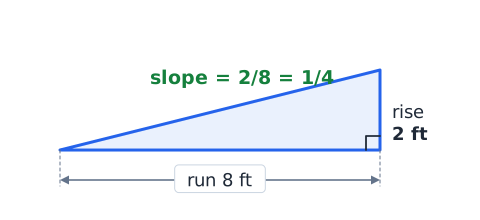
Rise is the vertical change and run is the horizontal change. A ramp that climbs 2 feet over a horizontal stretch of 8 feet has slope
Positive, Negative, Zero and Undefined Slope
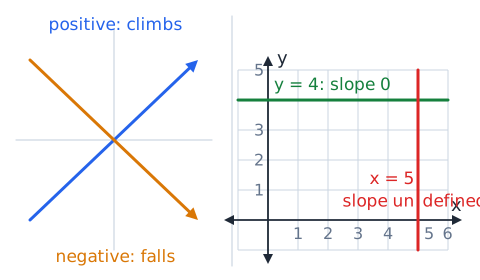
Reading left to right, a line with positive slope climbs and a line with negative slope falls. A horizontal line, such as y = 4, has a rise of 0, so its slope is 0. A vertical line, such as x = 5, has a run of 0; division by zero is impossible, so its slope is undefined, which is not the same as zero.
Slope From Two Points
Given two points, divide the change in y by the change in x:
For (1, -2) and (4, 7):
Subtract in the same order on top and bottom.
Slope From a Graph
Pick two points where the line crosses grid corners exactly, then count. If a line passes through (0, 1) and (3, -1), it drops 2 units while moving 3 units right, so
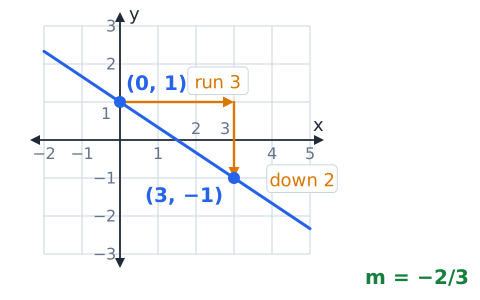
Always check the axis scale before counting.
Slope-Intercept Form
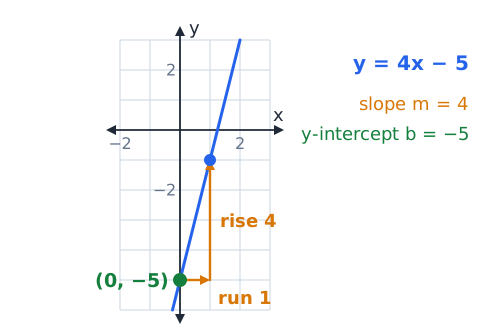
The form y = mx + b shows two facts at once: m is the slope, and b is the y-intercept, where the line crosses the y-axis at (0, b). In
the slope is 4 and the line crosses the y-axis at (0, -5). Solve for y first if the equation is arranged differently.
Interpreting the Y-Intercept
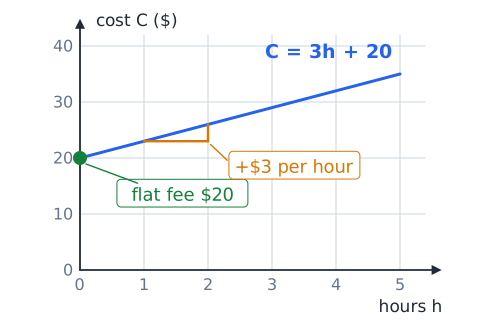
The y-intercept is the output when the input is zero. If renting a pressure washer costs
for h hours, the y-intercept 20 is the flat fee paid even before any time is used, and the slope 3 is the added cost per hour.
Interpreting the X-Intercept
The x-intercept is where a line crosses the x-axis, so y equals 0 there. To find it, set y = 0 and solve. For
gives x = 4, so the x-intercept is (4, 0).
Converting Standard Form
Standard form is Ax + By = C. Solving for y gives a slope of . For
subtract 6x and divide by 3:
The slope is -2 and the y-intercept is (0, 3).
Graphing a Line From Two Points
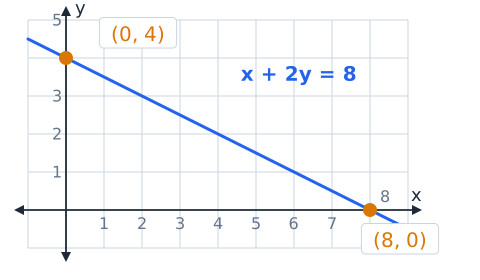
Two points fix a line. For standard form, the intercepts are often the easiest pair. For
setting y = 0 gives (8, 0), and setting x = 0 gives (0, 4). Plot both, draw a straight line through them, and check a third point if time allows.
Finding a Line Equation From Slope and Intercept
When you know the slope and y-intercept, substitute them directly into y = mx + b. A line with slope and y-intercept 6 is
Check: at x = 4,
so (4, 4) is on the line.
Point-Slope Form
If you know a slope m and any point , use
For slope 3 through (1, -2):
which simplifies to
Finding an Equation From Two Points
Find the slope first, then the intercept. For (-1, 4) and (3, -4),
Substitute (-1, 4) into
so b = 2 and the line is
Parallel Lines
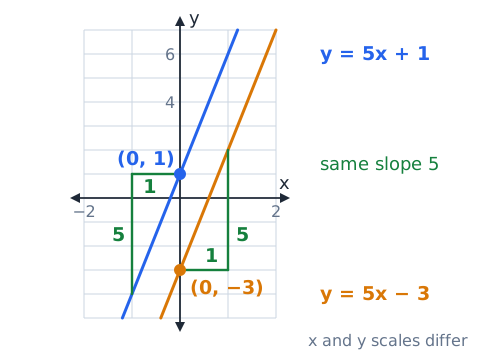
Parallel lines never meet, so they must rise at the same rate: they have equal slopes and different y-intercepts. The lines
are parallel. If an equation is in standard form, rewrite it as y = mx + b before comparing slopes. Two vertical lines are also parallel.
Perpendicular Lines
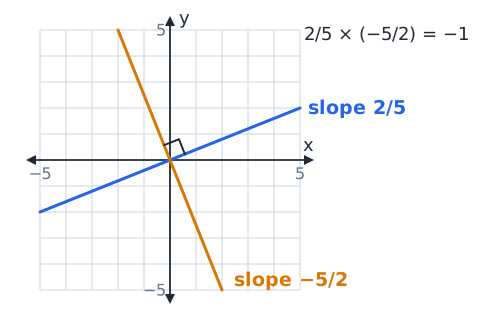
Perpendicular lines meet at a right angle. Their slopes are negative reciprocals, so their product is -1:
A line with slope is perpendicular to any line with slope . The exception is a horizontal line and a vertical line, which are perpendicular even though a vertical slope is undefined.
Intersections as Solutions
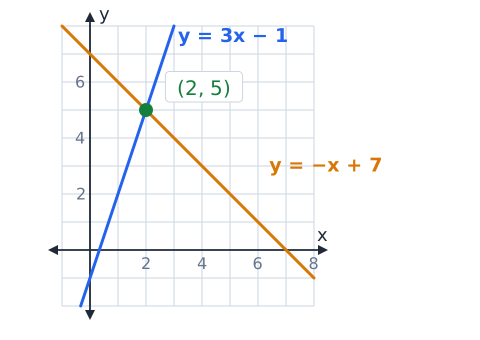
The point where two lines cross makes both equations true at once. For
set the right sides equal:
so x = 2. Then
and the lines meet at (2, 5).
Geometric Meaning of Systems
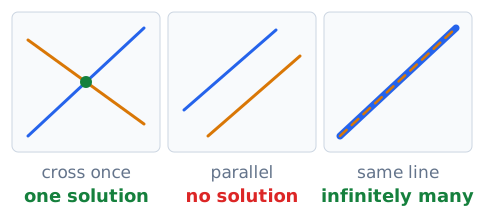
A pair of linear equations can behave in three ways. Lines with different slopes cross once, giving exactly one solution. Lines with the same slope but different intercepts are parallel and never meet, so there is no solution. Two equations that describe the very same line overlap everywhere, giving infinitely many solutions.
Symmetry and Coordinates
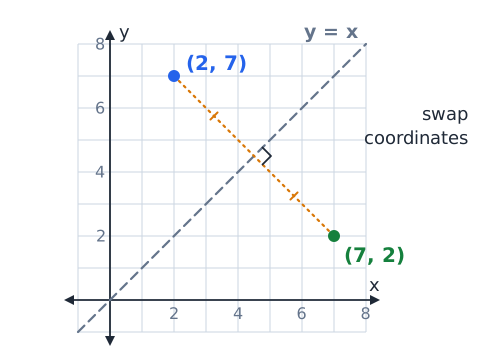
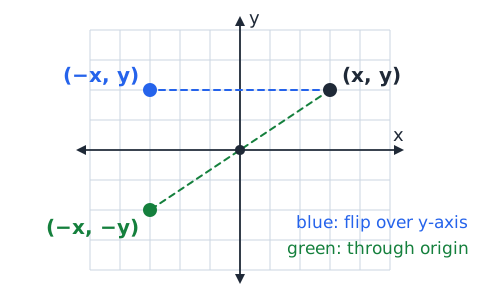
Symmetry describes how a figure matches itself after a flip. A figure symmetric about the y-axis contains (-x, y) whenever it contains (x, y). Symmetry about the origin pairs (x, y) with (-x, -y). Reflecting across the line y = x swaps the coordinates, so (2, 7) becomes (7, 2).
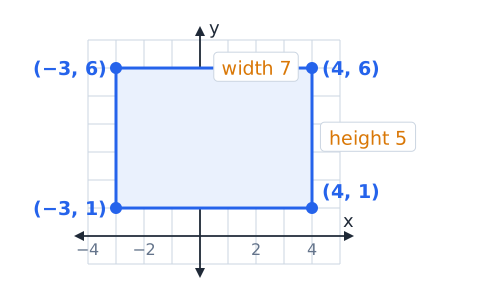
Rectangles on the Coordinate Plane
When a rectangle's sides follow the grid lines, its width is a difference of x-values and its height is a difference of y-values. For corners (-3, 1), (4, 1), (4, 6), and (-3, 6), the width is 7 and the height is 5, so the area is 35 and the perimeter is 24.
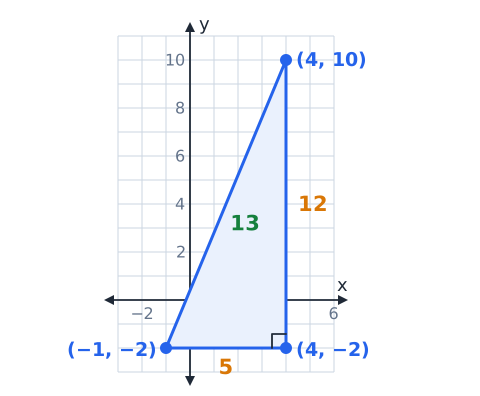
Right Triangles From Coordinates
If two vertices share a y-value and two share an x-value, the triangle has a horizontal leg and a vertical leg. For (-1, -2), (4, -2), and (4, 10), the legs are 5 and 12.
The hypotenuse is
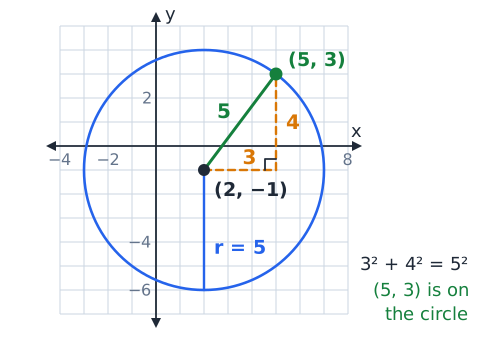
Distance to a Circle Center
Every point on a circle is the same distance, the radius r, from the center (h, k):
For center (2, -1) and radius 5, the point (5, 3) has changes 3 and 4, so its distance is 5 and it lies on the circle.
Reading Nonlinear Graphs Without Assuming a Line
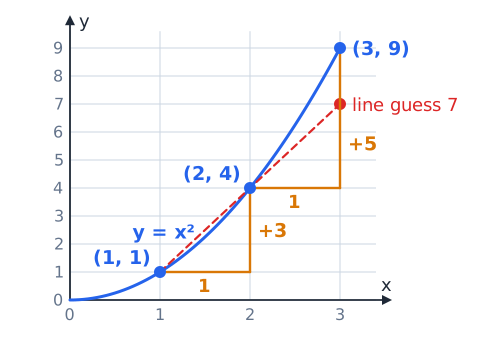
Not every graph is a straight line. On the curve
the points (1, 1), (2, 4), and (3, 9) show y rising by 3 and then by 5 for equal steps in x. Because the rate of change keeps changing, you cannot use one slope for the whole graph. Read values directly from the curve or its equation instead of extending a straight line through two points.
Graphs of Inequalities: Boundary Only
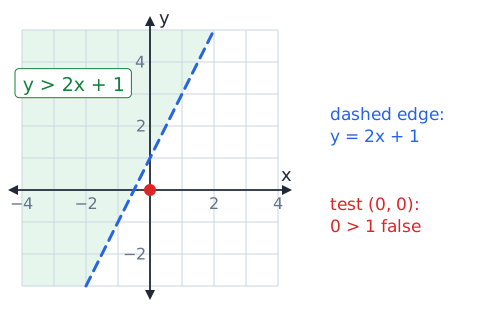
The boundary of an inequality such as
is the line
but the line itself is only the edge, not the answer. Draw it solid for
and dashed for < or >. Then shade the side that works: testing (0, 0) gives 0 > 1, which is false, so shade the side away from the origin.
Sketch Before Doing Algebra
A quick rough sketch takes a few seconds and catches many errors. Plot the given points approximately and ask: Should the slope be positive or negative? Which quadrant should the answer land in? About how long should the segment be? If your computed answer disagrees with the sketch, recheck your signs and subtraction before choosing.
No-Calculator Coordinate Shortcuts
Watch for Pythagorean triples to avoid square roots. For a midpoint, average one coordinate at a time. For slope, simplify the fraction before dividing. To check whether a point is on a line, plug it in rather than rewriting the equation. To find intercepts in standard form, cover one variable, set it to zero, and divide.
Answer-Choice Elimination
Many coordinate questions can be checked by substituting choices. To decide which point lies on
test each one: (2, -2) works because
You can also drop choices with the wrong sign, the wrong quadrant, or a slope pointing the wrong way. Elimination is a check, not a substitute for understanding.
Worked Example 1 — Reflection and Translation
Problem: Reflect the point (3, −2) across the y-axis, then move it 6 units up.
Step 1: Reflecting across the y-axis flips the point left to right. The x-coordinate changes sign; y stays the same.
Step 2: Moving up adds to the y-coordinate. Add 6 to y; x stays the same.
Step 3: Simplify.
Answer: The final point is (−3, 4).
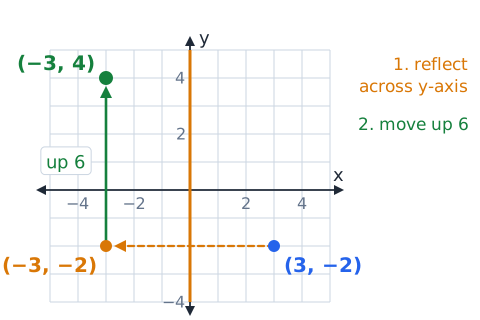
Check: Undo the moves. Go down 6:
Reflect back: (3, −2), the starting point.
Worked Example 2 — Midpoint and Unknown Endpoint
Problem: The midpoint of segment AB is (1, 5), and
Find B.
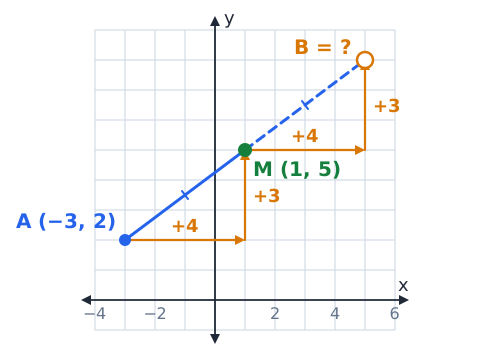
Step 1: The midpoint is the average of the endpoints, so twice the midpoint equals A + B. That means B = 2 × midpoint − A, done one coordinate at a time.
Step 2: Find the x-coordinate of B. Subtracting −3 is the same as adding 3.
Step 3: Find the y-coordinate of B.
Answer: B = (5, 8).
Check: Average A and B. x:
y:
That gives (1, 5), the given midpoint.
Worked Example 3 — Pythagorean Distance
Problem: Find the distance from (−4, 1) to (4, 16).
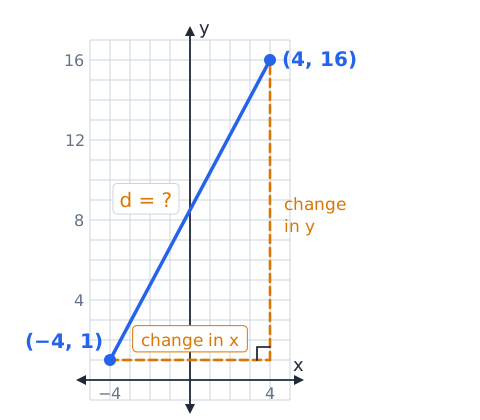
Step 1: Find the horizontal change (x) and the vertical change (y). Subtracting −4 is the same as adding 4.
Step 2: These changes are the legs of a right triangle. The distance is the hypotenuse, so square each leg.
Step 3: Add the squares and take the square root.
Answer: The distance is 17 units.
Check: 8-15-17 is a known right triangle. Also 17 is more than the longer leg, 15, and less than
as it should be.
Worked Example 4 — Slope and Intercept
Problem: A line passes through (0, −3) and (2, 5). Find its equation.
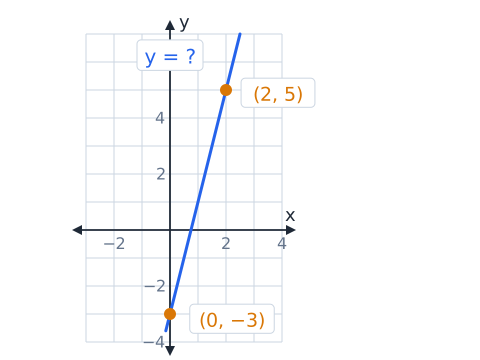
Step 1: Find the slope: change in y divided by change in x. Subtracting −3 is the same as adding 3.
Step 2: Find the y-intercept. The point (0, −3) has x = 0, so it is where the line crosses the y-axis. So
Step 3: Write y = mx + b with m = 4 and
Answer: The line is
Check: Put in the other point, x = 2:
That matches (2, 5).
Worked Example 5 — Standard Form and Two Intercepts
Problem: For the line
find both intercepts and the slope.
Step 1: The x-intercept is where the line crosses the x-axis, so y = 0 there. Set y = 0 and solve.
So the x-intercept is (4, 0).
Step 2: The y-intercept is where x = 0. Set x = 0 and solve.
So the y-intercept is (0, 10).
Step 3: Find the slope from the two intercepts, (0, 10) and (4, 0).
Answer: x-intercept (4, 0), y-intercept (0, 10), slope −5/2.
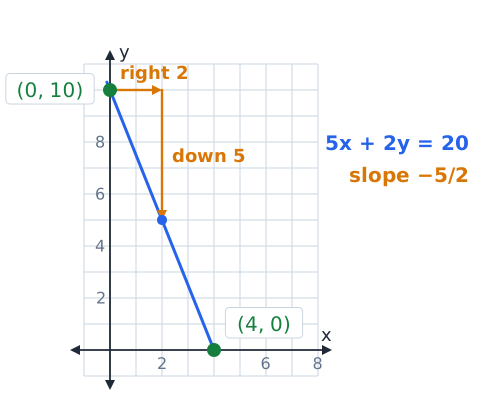
Check: Solve for y:
x + 10. The slope is −5/2 and the y-intercept is 10.
Worked Example 6 — Parallel and Perpendicular
Problem: Find the slopes of lines parallel and perpendicular to
Step 1: Get y alone to read the slope. Subtract 3x from both sides.
Step 2: Multiply both sides by −1 to make y positive.
The number in front of x is the slope, so the slope is 3.
Step 3: Parallel lines have the same slope, so a parallel line has slope 3.
Step 4: Perpendicular lines have the negative reciprocal slope. Flip 3 (which is 3/1) to get 1/3, then change the sign.
Answer: Parallel slope 3; perpendicular slope −1/3.
Check: Perpendicular slopes multiply to −1.
Worked Example 7 — Intersection of Two Lines
Problem: Where do the lines
meet?
Step 1: At the meeting point both lines have the same y, so set the right sides equal.
Step 2: Add x to both sides to gather the x terms on the left.
Step 3: Subtract 1 from both sides, then divide by 3.
Step 4: Put x = 3 into the first equation to find y.
Answer: The lines meet at (3, 7).
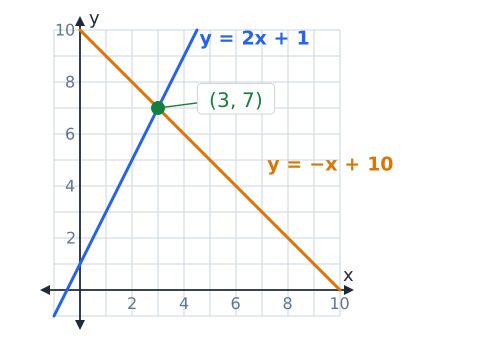
Check: Put x = 3 into the second equation:
Both lines give y = 7.
Worked Example 8 — Rectangle Perimeter and Area
Problem: A rectangle has corners (−2, −3), (6, −3), (6, 2) and (−2, 2). Find its perimeter and area.
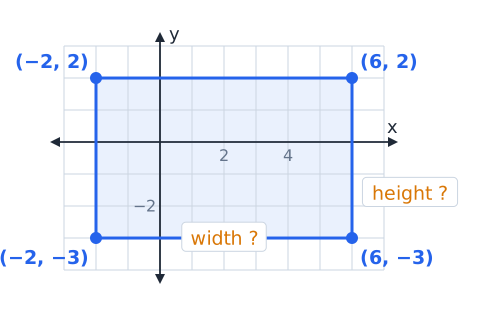
Step 1: Find the width from two corners on the same horizontal side, (−2, −3) and (6, −3). Subtract the x-values; subtracting −2 means adding 2.
Step 2: Find the height from two corners on the same vertical side, (6, −3) and (6, 2). Subtract the y-values.
Step 3: Perimeter is twice the sum of width and height.
Step 4: Area is width × height.
Answer: The perimeter is 26 units and the area is 40 square units.
Check: Add the four sides one by one:
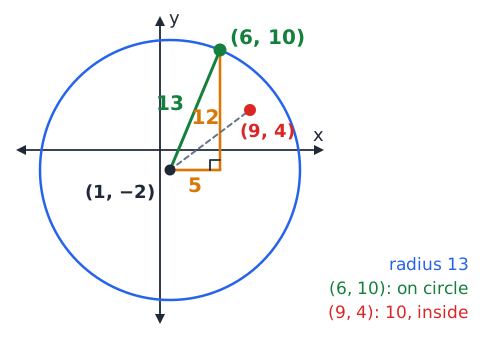
Worked Example 9 — Circle Coordinate Test
Problem: A circle has center (1, −2) and radius 13. Is the point (6, 10) on the circle?
Step 1: Find the horizontal and vertical changes from the center to the point. Subtracting −2 means adding 2.
Step 2: A point is on the circle if its distance from the center equals the radius. Use the Pythagorean theorem: compare the sum of the squared changes with 13².
Step 3: The two results are equal, so the distance is exactly 13.
Answer: Yes, (6, 10) lies on the circle.
Check: By contrast, test (9, 4). The changes are
and 8² + 6² =
so the distance is √100 = 10. Since 10 is less than 13, that point is inside the circle.
Common MK Coordinate Traps
Swapping coordinates: (4, -1) and (-1, 4) are different points. Always list x first.
Reflecting the wrong coordinate: across the x-axis, only y changes sign; across the y-axis, only x changes sign.
Mixing subtraction order in slope: if you start with the second point on top, start with it on the bottom too.
Calling a vertical slope zero: a vertical line has an undefined slope; a horizontal line has slope 0.
Using the coefficient of x in standard form as the slope: in
the slope is -2, not 4.
Forgetting to make a perpendicular slope negative: the perpendicular of 3 is -1/3, not 1/3.
Final Mathematics Knowledge Review
Points are written (x, y): right or left first, then up or down. The quadrant follows from the signs, and a zero coordinate puts a point on an axis. Reflections change one sign; translations add or subtract.
Distance uses subtraction for aligned points and the Pythagorean theorem otherwise. The midpoint averages the coordinates. Slope is change in y over change in x; horizontal lines have slope 0 and vertical lines have undefined slope.
In y = mx + b, m is the slope and b is the y-intercept. Find intercepts by setting the other variable to zero. Parallel lines share a slope; perpendicular slopes multiply to -1. An intersection is a point that satisfies both equations. Sketch first, then compute and check.
 English ▾