 ASVAB Camp
Outcomes and authentic GS scope
By the end of this lesson you should be able to separate distance from displacement and speed from velocity, compute average speed, average velocity and acceleration, and read position and velocity graphs. You will solve steady-acceleration problems such as braking and free fall, apply Newton's three laws with simple force diagrams, and reason about weight, normal force, tension, friction, momentum and motion in a circle.
The General Science test covers physical science at a conceptual level with light arithmetic. Mechanical Comprehension tests related ideas separately. The questions in this course are original practice items, not copies of real test questions.
Describing motion versus explaining motion
Physics treats motion in two layers. The first layer only describes it: where an object is, how fast it goes, which way it heads and how those values change. This descriptive part is called kinematics.
The second layer explains why the motion changes, using forces and mass. That part is called dynamics. A sprinter's split times are kinematics; asking what push from the track made her speed up is dynamics. Most test items quietly belong to one layer, so decide which one first.
Reference points and coordinate directions
Position only means something relative to a chosen reference point, often called the origin. A passenger sitting in a moving train is at rest relative to the train but moving at high speed relative to the platform.
After picking an origin, choose which direction counts as positive. A common choice is east or right as positive and west or left as negative; up is often positive for vertical motion. Any consistent choice works, but you must keep it the same for every quantity in one problem.
Distance is a path length
Distance is the total length of the path an object actually follows, regardless of direction. A dog that runs 20 m to fetch a stick and 20 m back has covered 40 m of distance.
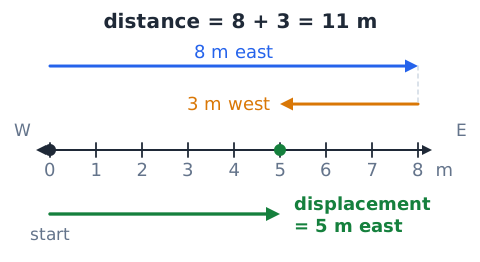
Distance can only grow or stay the same as time passes; it is never negative. It is measured in length units such as meters, kilometers or miles. If a student walks 8 m east and then 3 m west, the distance traveled is 11 m.
Displacement includes direction
Displacement is the straight-line change in position from the starting point to the ending point, together with its direction. The path in between does not matter.
The student who walks 8 m east and then 3 m west ends up 5 m east of the start, so the displacement is 5 m east, even though the distance was 11 m. A runner who completes one full lap of a track returns to the start and has zero displacement. Displacement can be positive, negative or zero.
Scalar versus vector quantities
A scalar has size only: a number with a unit. Distance, speed, mass, time, temperature and energy are scalars.
A vector has size, called magnitude, and a direction. Displacement, velocity, acceleration, force and momentum are vectors. In one dimension the direction is shown by a sign, so means 6 m/s in the negative direction.
A quick test: if saying "north" or "left" adds needed information, the quantity is a vector. Velocity is the classic example of a vector, while speed is its scalar partner.
Average speed = total distance / total time
Average speed tells how fast an object covered its whole path, counting every meter it moved and every second that passed, including stops.
A jogger who covers 1,200 m in 400 s has an average speed of 3 m/s. Average speed is a scalar, so it has no direction and can never be negative.
Average velocity = displacement / total time
Average velocity compares the overall change in position with the elapsed time, and it carries the direction of the displacement.
Suppose a swimmer goes 50 m down a pool and 50 m back in 80 s. The distance is 100 m, so the average speed is 1.25 m/s, but the displacement is zero, so the average velocity is zero.
Instantaneous speed and velocity
Instantaneous speed is how fast something moves at one particular moment. A car's speedometer reading is a good everyday example: it shows the speed right now, not the trip average.
Instantaneous velocity is that speed plus the direction of motion at that moment. On a winding road, a car's speedometer may stay steady while its instantaneous velocity keeps changing, because the direction keeps changing.
Units: meters, seconds, and meters per second
In SI units, length is measured in meters (m) and time in seconds (s). Speed and velocity are therefore in meters per second, m/s.
Acceleration is a change in velocity per second, so its unit is meters per second per second, written . Force is measured in newtons (N), where
Always check that an answer's unit fits the quantity asked for; a speed answer in m/s² is a sign of error.
Conversion: miles or kilometers per hour
Everyday speeds come in kilometers per hour or miles per hour. One hour has 3,600 s, so:
A handy shortcut is to divide km/h by 3.6 to get m/s: 72 km/h equals 20 m/s. One mile per hour is about 0.447 m/s, so 60 mi/h is roughly 27 m/s.
Solving constant-speed travel problems
When speed is constant, distance, speed and time are linked by one relationship that can be rearranged three ways:
A delivery truck moving steadily at 25 m/s for 40 s covers 1,000 m. A boat that travels 150 m in 30 s has a speed of 5 m/s. To find time, divide distance by speed. Keep units matched: meters with seconds, or kilometers with hours.
Acceleration is change in velocity per time
Acceleration is the rate at which velocity changes. It is the change in velocity divided by the time the change took:
A cyclist speeding up from 2 m/s to 8 m/s in 3 s has an acceleration of 2 m/s². Because velocity is a vector, an object also accelerates when it changes direction at steady speed. Acceleration is not the same as speed: a fast jet cruising in a straight line at constant speed has zero acceleration.
Braking, negative acceleration and signs
Acceleration has a direction, shown by its sign. A bus moving in the positive direction slows from +15 m/s to +5 m/s in 5 s:
The negative sign means the acceleration points opposite to the motion, so the bus is slowing. Everyday speech calls this deceleration. Always subtract initial from final velocity, in that order, so the sign comes out right.
Uniform velocity means zero acceleration
Uniform velocity means both the speed and the direction stay the same. If velocity is not changing, then the change in velocity is zero, and so the acceleration is zero.
This surprises many learners: an airliner cruising at 250 m/s in a straight, level line has zero acceleration. High speed does not mean large acceleration. Acceleration only measures how quickly the velocity changes, and a velocity that stays constant has no change at all.
Motion graphs: position versus time
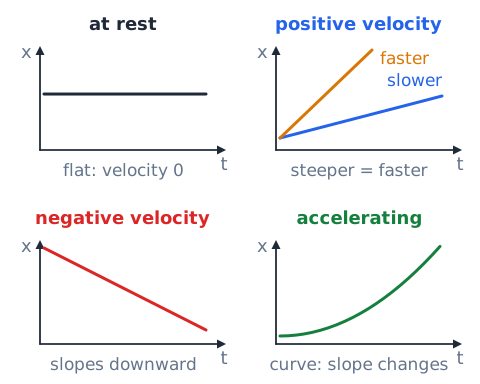
On a position versus time graph, the slope at any point equals the velocity. A straight, rising line means steady positive velocity; a steeper line means a faster object. A flat horizontal line means the position is not changing, so the object is at rest.
A straight line sloping downward means constant velocity in the negative direction. A curved line means the slope, and therefore the velocity, is changing, so the object is accelerating.
Motion graphs: velocity versus time
A velocity versus time graph carries two pieces of information. Its slope is the acceleration, and the signed area between the line and the time axis is the displacement.
A horizontal line at +4 m/s lasting 5 s means zero acceleration, and the rectangle under it has area
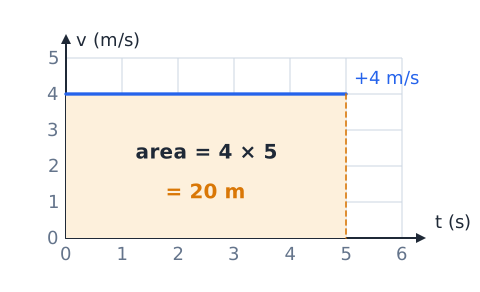
Area below the axis counts as negative displacement. Do not read the height of the line as position.
Motion graphs: acceleration and position
On an acceleration versus time graph, the area under the line gives the change in velocity. A flat line at 3 m/s² lasting 4 s means velocity rises by
When acceleration is constant and nonzero, the velocity graph is a sloped straight line and the position graph becomes a curve, bending upward if the object speeds up in the positive direction.
Constant-acceleration relation: final velocity
When acceleration stays constant, the final velocity equals the starting velocity plus the gain from acceleration:
Here is the initial velocity in m/s, the acceleration in m/s² and the time in s. A scooter moving at 3 m/s that accelerates at 1.5 m/s² for 4 s reaches
If it starts from rest,
Constant-acceleration relation: displacement
For constant acceleration, displacement over a time is
The first term is the distance the starting velocity alone would give; the second is the extra due to acceleration. A cart that starts at rest and accelerates at 2 m/s² for 5 s moves
Notice time is squared, so doubling the time quadruples that part.
Average velocity with constant acceleration
When acceleration is constant, velocity changes evenly, so the average velocity is simply halfway between the start and end values:
Then displacement is average velocity times time. A rider who speeds up steadily from 4 m/s to 10 m/s over 6 s averages 7 m/s and travels 42 m. This shortcut works only for constant acceleration, not for trips with stops or sudden changes.
Stopping distance under steady braking
If a vehicle brakes with steady deceleration of size from speed to rest, the stopping distance is
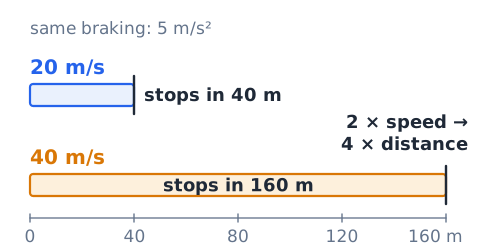
A car at 20 m/s braking at 5 m/s² needs
Because speed is squared, doubling the speed makes the braking distance four times as long, assuming the same braking. Reaction time before the brakes engage adds still more distance, which is why safe following gaps grow quickly at highway speed.
Free fall as a special constant-acceleration case
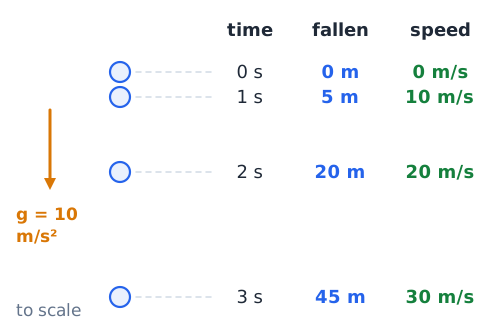
An object in free fall moves only under gravity, with air resistance ignored. Near Earth's surface it accelerates downward at about
which tests often round to 10 m/s².
All the constant-acceleration relations apply with
A stone dropped from rest, using 10 m/s², falls for 3 s and reaches
after falling
A thrown ball still accelerates downward at g at the very top of its flight, even though it is momentarily at rest there.
Horizontal versus vertical components
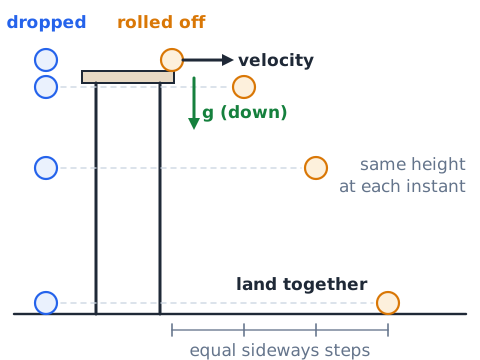
Motion that is partly sideways and partly vertical can be split into two separate pieces that do not affect each other, as long as air resistance is ignored.
Take a ball rolled off a table. Horizontally, nothing pushes it, so its horizontal velocity stays constant. Vertically, gravity pulls it down, so it gains downward speed at g starting from zero. As a result, it hits the floor at the same moment as a ball dropped straight down from the same height. Right after release its velocity points horizontally, and its acceleration is straight down.
Force is a push or pull: net force is the sum
A force is a push or a pull that one object exerts on another, measured in newtons (N). Forces are vectors, so direction matters.
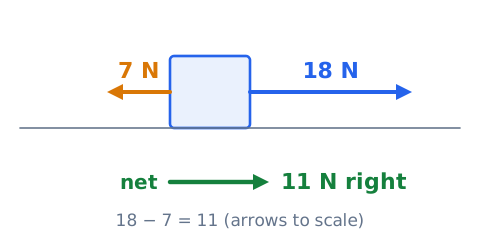
The net force is the vector sum of every force acting on one object. For forces along a line, add those in the same direction and subtract opposing ones. An 18 N push right and a 7 N push left give a net force of 11 N to the right.
Balanced forces and dynamic equilibrium
When the forces on an object add to zero, they are balanced and the object is in equilibrium. Balanced does not mean motionless. An object at rest stays at rest, and a moving object keeps moving at constant velocity.
That second case is called dynamic equilibrium. A crate slid across a floor at steady speed has the push exactly matched by friction. A skydiver falling at terminal speed has air drag equal to weight. In both cases, velocity is constant because the net force is zero.
Unbalanced forces change velocity
When forces do not cancel, a net force remains, and the object accelerates in the direction of that net force. Depending on how the net force lines up with the motion, the object may speed up, slow down or turn.
With a 12 N pull right and a 4 N drag left, the object accelerates right. If it happened to be moving left at that moment, it would first slow down. Acceleration follows the net force, not the current velocity.
Newton’s first law: inertia
Newton's first law says an object keeps its state of motion unless a net external force acts on it. At rest stays at rest; moving stays moving in a straight line at the same speed. This tendency to resist changes in motion is called inertia.
In a car that brakes hard, your body tends to keep moving forward. A seat belt supplies the backward force needed to change your velocity along with the car's. The belt does not remove inertia; it acts on it. Without the belt, you keep going until the dashboard or windshield supplies that force much more abruptly.
Mass measures inertia; it is not force
Mass is the amount of matter in an object and the measure of its inertia. More mass means more force is needed for the same change in velocity. Mass is measured in kilograms and is not a force.
Mass stays the same wherever the object goes. A 70 kg astronaut is still 70 kg on the Moon or floating in orbit; only the gravitational pull on that mass changes. Pushing a loaded shopping cart is harder than pushing an empty one because of mass, not because of height or shape.
Newton’s second law: force and mass
Newton's second law connects net force, mass and acceleration:
Net force is in newtons, mass in kilograms, acceleration in m/s². Rearranged,
more net force gives more acceleration, and more mass gives less. A 5 kg cart pushed with a net 25 N accelerates at 5 m/s².
Use the net force, not just one applied push. The acceleration points in the same direction as the net force.
Solving F = ma without a calculator
Most F = ma test items are built so the numbers divide evenly. Write the relationship, plug in what is known, and solve for the missing one.
A 6 kg box with a net 24 N force:
A 3 kg object accelerating at 7 m/s²:
To find mass, divide force by acceleration: 30 N giving 2 m/s² means 15 kg.
Weight is a gravitational force
Weight is the gravitational force that a planet exerts on an object. Near Earth's surface it is found with
where is mass in kilograms and is about 9.8 m/s², often rounded to 10. A 50 kg student weighs about 490 N, or about 500 N using 10. Weight always points toward the center of Earth, which we call downward.
Gravity and the mass misconception
A popular misconception is that heavier objects fall faster. A heavier object does feel a larger gravitational force, but it also has proportionally more inertia, and the two effects cancel. Every object therefore falls with the same acceleration, g, when air resistance is negligible.
A hammer and a feather dropped together in a vacuum land together. In ordinary air, the feather lags because air resistance is large compared with its tiny weight, not because gravity treats it differently. Shape and surface area, not mass alone, explain the difference.
Normal force supports objects perpendicular to surfaces
The normal force is the support force a surface exerts on an object pressing against it. "Normal" means perpendicular: the force always points straight out from the surface.
For a book resting on a level table, the normal force points upward and, if nothing else pushes vertically, equals the book's weight. On a ramp, the normal force tilts with the surface and is smaller than the weight. If you press down on the book, the table pushes back harder.
Tension in strings and ropes
Tension is the pulling force carried along a rope, string, cable or chain. A rope can only pull; it cannot push. The force acts along the rope, away from the object it is attached to.
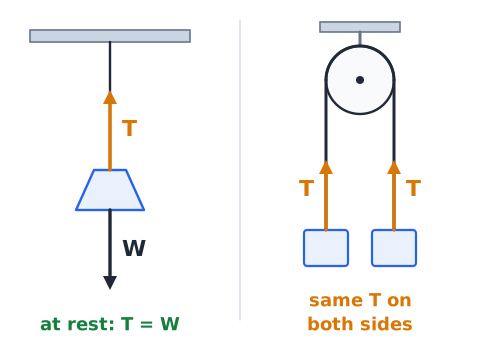
For a lamp hanging still from a single cord, the tension upward equals the lamp's weight. If a crane lifts a load and speeds it up while rising, the cable tension must be greater than the weight. A light rope passing over a frictionless pulley has the same tension on both sides.
Friction acts against relative sliding or its tendency
Friction is the force between touching surfaces that opposes their sliding past each other, or their tendency to start sliding. It acts parallel to the surfaces.
Friction is not always "against motion" in the everyday sense. When you walk, your shoe pushes backward on the ground, and static friction from the ground pushes you forward. Without that friction, as on smooth ice, you cannot get started. Rougher surfaces and stronger pressing generally mean more friction.
Static versus kinetic friction
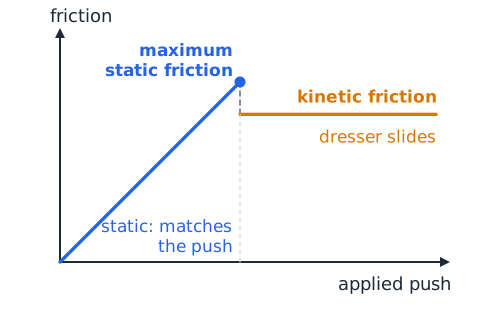
Static friction acts when surfaces are not slipping. It adjusts to match the applied push, up to a maximum value. Push a heavy dresser gently and it stays put because static friction matches your push exactly.
Once the push exceeds that maximum, the dresser breaks loose and kinetic, or sliding, friction takes over. Kinetic friction is usually a bit smaller than the maximum static friction, which is why something often moves more easily once it gets going.
Air resistance and terminal speed
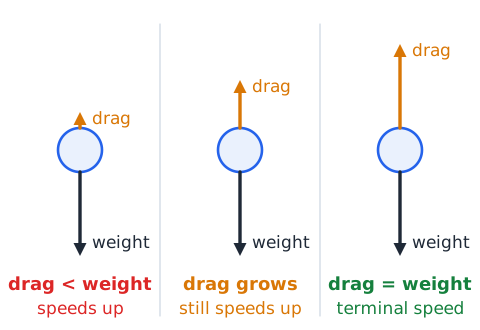
Air resistance, or drag, is a friction-like force from a fluid such as air. It acts opposite to the object's motion through the fluid and grows as speed increases.
When a skydiver jumps, weight is larger than drag at first, so she speeds up. As her speed rises, drag grows until it equals her weight. The net force is then zero, so she stops gaining speed and falls at a steady terminal speed. Opening a parachute increases drag, which lowers the terminal speed.
Newton’s third law: action–reaction pairs
Newton's third law says that when object A pushes or pulls on object B, B pushes or pulls back on A with a force equal in size and opposite in direction. The two forces form an action–reaction pair.
The pair always acts on two different objects and is always the same type of force. A swimmer pushes water backward; the water pushes the swimmer forward, and that second force is what moves the swimmer. A rocket pushes exhaust gas down; the gas pushes the rocket up.
Why third-law pairs do not cancel on one object
Because a third-law pair always acts on two different objects, the two forces never cancel each other. Cancelling only happens among forces acting on the same object.
When a hammer strikes a nail, the nail pushes back on the hammer as hard as the hammer pushes on the nail. The nail moves because of the force on the nail; the hammer slows because of the force on the hammer. To decide what one object does, list only the forces acting on that object.
Momentum and force over time
Momentum is mass times velocity:
It is a vector measured in kg·m/s. A 1,200 kg car at 15 m/s has momentum 18,000 kg·m/s. Changing momentum requires a net force applied over time:
For the same change in momentum, a longer stopping time means a smaller force. Air bags, padded helmets and bending your knees on landing all work this way.
Conservation of momentum, carefully stated
The total momentum of a group of objects stays constant when no net external force acts on the group. Forces between the objects inside the group are third-law pairs, so they shift momentum from one object to another without changing the total.
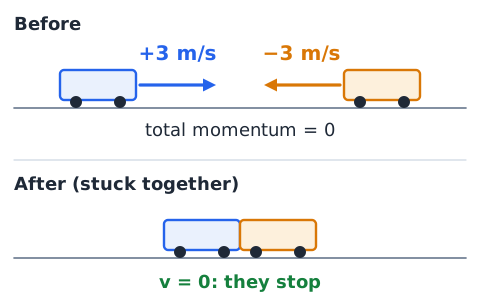
In collisions and explosions on a nearly frictionless surface, add up the momentum before and after, keeping track of signs. Two equal carts approaching at +3 m/s and −3 m/s have total momentum zero, so if they stick together they stop. External forces like heavy friction break this rule.
Circular motion needs inward acceleration
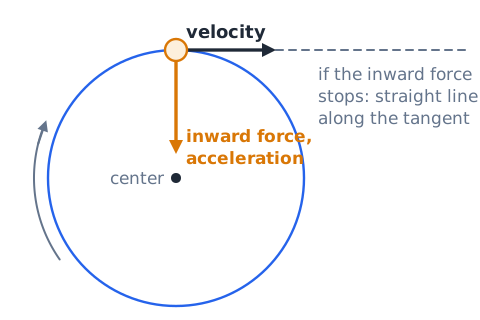
An object moving in a circle at constant speed is still accelerating, because the direction of its velocity changes from moment to moment. That acceleration points toward the center of the circle and is called centripetal acceleration.
A net inward force is required. For a car on a curve, it is friction from the road; for a satellite, gravity; for a ball on a string, tension. If the inward force disappears, the object moves off in a straight line tangent to the circle, not outward along the radius.
Circular acceleration and speed squared
For motion around a circle of radius at speed , the size of the inward acceleration is
with in m/s, in m and in m/s². A cart at 12 m/s on a 48 m radius track has
toward the center. Doubling speed makes it four times larger; a tighter turn (smaller radius) also makes it larger.
Slope and friction on ramps
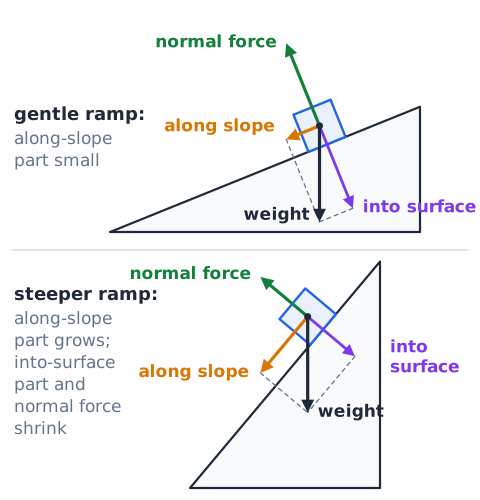
On a ramp, it helps to split an object's weight into two parts: one along the slope and one into the surface. The part along the slope tends to make the object slide down; the part into the surface is balanced by the normal force.
As a ramp gets steeper, the along-slope part grows and the into-surface part shrinks. That means the normal force drops and the maximum friction drops too, which is why objects begin sliding once a slope is steep enough. On a level surface, none of the weight points along the surface.
Terminal-velocity and elevator reasoning
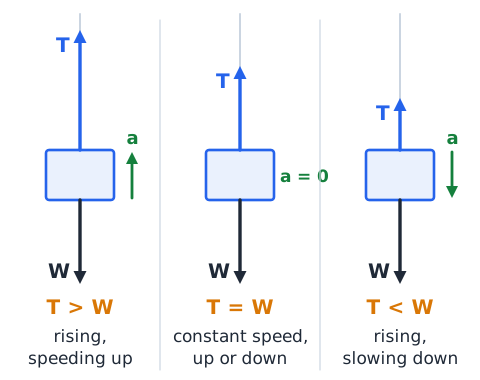
Use net force to reason about vertical motion. In an elevator with only cable tension up and weight down, the acceleration tells you which force is bigger.
Rising and speeding up means upward acceleration, so tension exceeds weight. Moving at constant speed, either way, means tension equals weight. Rising but slowing down means downward acceleration, so tension is less than weight. A falling object at terminal speed is the same idea: drag equals weight because the acceleration is zero.
Reading free-body diagrams
A free-body diagram shows one object, drawn as a box or dot, with an arrow for each force acting on it. Each arrow starts at the object and points in the force's direction, with longer arrows for larger forces.
Include only forces on that object, such as weight, normal force, tension, friction, drag and applied pushes. Leave out forces the object exerts on other things. Then compare arrows: if they balance, acceleration is zero; if not, the object accelerates toward the larger side.
Force along two directions
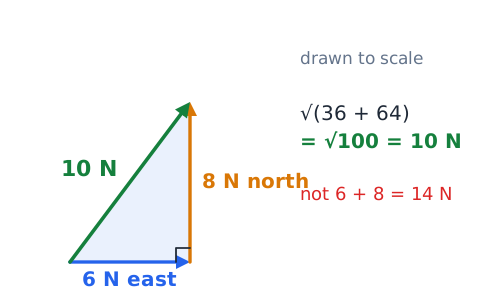
When two forces act at right angles, their combined size comes from the Pythagorean theorem, not simple addition:
A 6 N pull east and an 8 N pull north combine to
pointing somewhere between east and north. Simply adding to 14 N would be wrong.
Thinking in intervals for two-stage motion
Many motion stories have more than one stage, such as speeding up, cruising, then braking. Treat each stage as its own small problem with its own time, starting velocity and acceleration.
The final velocity of one stage becomes the starting velocity of the next. Find each stage's displacement and add them at the end. Never apply one constant-acceleration formula across a whole trip whose acceleration changes partway; that blends different rules together and gives the wrong answer.
Why average of two speeds can mislead
It is tempting to average two speeds by adding and dividing by two, but that works only when equal times are spent at each speed. When equal distances are covered at each speed, more time is spent at the slower speed, so the true average is lower.
Drive 60 km at 40 km/h (1.5 h) and 60 km at 60 km/h (1 h):
/h, not 50 km/h. Always go back to total distance divided by total time.
Estimate before calculating
Before calculating, predict a rough answer. If a car slows down, expect a negative acceleration in a positive-direction frame. If a light object gets a large push, expect a large acceleration.
Example: a 20 kg sled with a net force of 98 N. Rounding gives
so the true answer, 4.9 m/s², should be near 5. If your answer is 0.2 or 1,960, you divided the wrong way or multiplied by mistake.
Common error: nonzero speed is not nonzero net force
Many learners think a moving object must have a forward net force on it. Not so. An object can move at constant velocity with zero net force; force is needed to change velocity, not to keep it.
A hockey puck sliding on very smooth ice keeps going with almost no force. A car cruising steadily on a highway has the engine's driving force balanced by drag and friction. Moving means velocity; net force means acceleration.
Common error: negative acceleration is not always deceleration
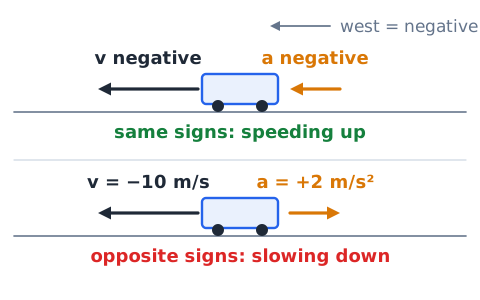
A negative acceleration does not always mean slowing down. Slowing happens when acceleration and velocity point in opposite directions.
A car moving west, with west as negative, has negative velocity. If it speeds up westward, its acceleration is also negative, and it is speeding up. If its velocity is m/s and the acceleration is , it is slowing down. Compare the signs.
Common error: action–reaction does not cancel weight
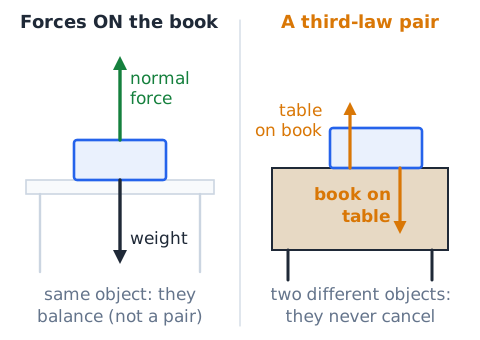
A book on a table feels its weight downward and the table's normal force upward. These two forces are equal and opposite, but they are not a third-law pair.
Both act on the same book, and they are different kinds of force. The real partner of the book's weight is the book's gravitational pull upward on Earth. The partner of the table's push on the book is the book's push down on the table. Weight and normal force balance here because the book is not accelerating.
Common error: one formula cannot solve every motion story
No single equation fits every motion question. The average speed formula ignores direction. The constant-velocity relation d = vt fails when the object accelerates. The constant-acceleration equations fail when the acceleration changes or the object stops partway.
Before choosing a formula, ask: Is acceleration constant? Does direction matter? Are there separate stages? Then pick the relationship whose conditions actually match the story in the question.
ASVAB strategy: select the tested principle
Most motion and force questions test one principle hiding in a story. Read the final sentence first to see what is asked: a speed, a direction, a force or a comparison. Then identify the key clue word.
"Constant velocity" or "at rest" signals zero net force. "Speeds up" or "slows down" signals a net force and acceleration. "Total distance" signals path length; "displacement" signals start-to-end. "Pair" signals the third law. Eliminate choices with the wrong unit or the wrong direction before doing any arithmetic, and check that the remaining answer makes physical sense.
Formula map: choose the right relationship
Choose a formula by matching what you know and what you need.
Path and time to speed:
Start-to-end change and time:
Velocity change and time:
Constant acceleration:
Braking to rest:
Forces:
and for circles
Worked example 1 — Out and back
A hiker walks 600 m north to a lookout and then 600 m south back to the trailhead, taking 20 minutes in all. Find the average speed and average velocity.
Total distance is 1,200 m, and 20 minutes is 1,200 s, so the average speed is 1 m/s. She ended where she began, so the displacement is zero, and the average velocity is 0 m/s.
Worked example 2 — Includes stops
A courier bikes 3 km in 10 min, waits 5 min at a stoplight, then bikes another 3 km in 15 min. Find the average speed.
Total distance is 6 km. Total time, including the wait, is 30 min, or 0.5 h. Average speed is
/h.
Worked example 3 — Unit conversion
A train travels at 90 km/h. What is its speed in m/s?
Each kilometer is 1,000 m and each hour is 3,600 s, so dividing by 3.6 does both swaps at once. Answer: 25 m/s. A quick sense check: 25 m/s is a bit under 100 km/h, which fits.
Worked example 4 — Acceleration sign
A puck moves in the negative direction. Its velocity changes from m/s to m/s in 2 s. Find the acceleration.
The acceleration is positive while the velocity is negative, so the puck is slowing down.
Worked example 5 — Starts from rest
A go-kart starts from rest and accelerates at 4 m/s² for 3 s. Find its final velocity and distance traveled.
Check: average velocity 6 m/s times 3 s gives 18 m.
Worked example 6 — Two stages
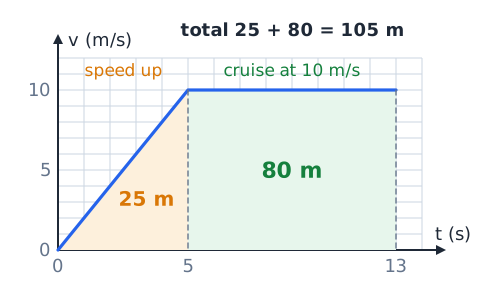
A bus starts from rest, accelerates at 2 m/s² for 5 s, then cruises at its new speed for 8 s. Find the total displacement.
Stage 1:
Stage 2:
Total: 105 m.
Worked example 7 — Braking distance
A car moving at 30 m/s brakes steadily at 5 m/s² until it stops. Find the braking distance and the time.
Time:
Check: average velocity 15 m/s for 6 s also gives 90 m.
Worked example 8 — Net force before acceleration
A worker pulls an 8 kg sled forward with 40 N while friction drags back with 16 N. Find the acceleration.
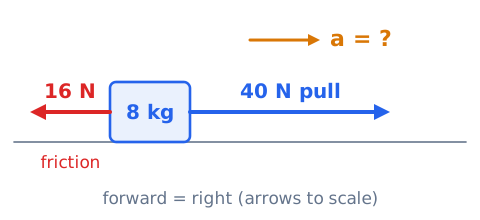
First the net force:
N forward. Then
forward. Using 40 N alone would give 5 m/s², which is wrong.
Worked example 9 — Balanced forces
A mover pushes a crate across a floor at a steady 0.5 m/s with a 60 N horizontal push. How large is the friction force?
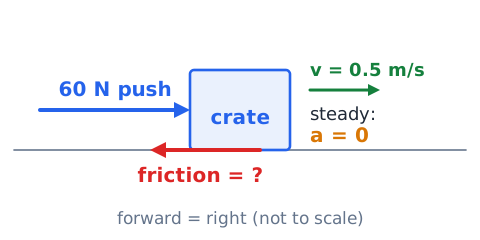
Steady speed in a straight line means zero acceleration, so the net force is zero. Friction must equal the push: 60 N, pointing backward. The speed value does not change this answer.
Worked example 10 — Mass versus weight
A 12 kg toolbox is taken from Earth (g about 9.8 m/s²) to the Moon (g about 1.6 m/s²). Compare its mass and weight.
Mass stays 12 kg in both places. Weight on Earth is
on the Moon it is
Worked example 11 — Velocity graph area
A velocity–time graph rises in a straight line from 0 to 8 m/s over 4 s. Find the acceleration and the displacement.
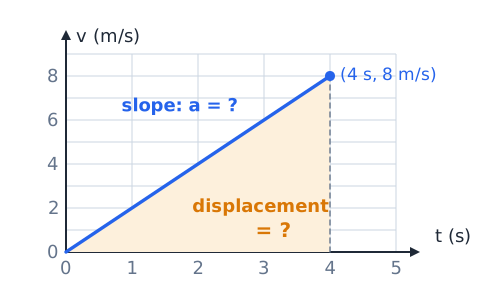
Slope:
Area under the line is a triangle:
The displacement is 16 m.
Worked example 12 — Turning
A 1,000 kg car rounds a curve of radius 75 m at a constant 15 m/s. Find its acceleration and the net force needed.
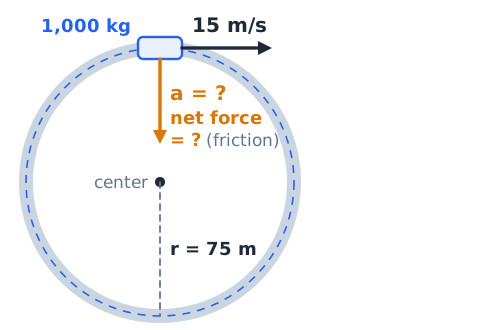
That acceleration points toward the center of the curve. Net force:
N inward, supplied by friction between the tires and the road. Speed is constant, but velocity is not.
Worked example 13 — Momentum and stopping time
A 1,500 kg car moving at 10 m/s is brought to rest. Compare the average force if it stops in 0.5 s versus 0.1 s.
Momentum change:
·m/s.
Stopping in 0.5 s:
Stopping in 0.1 s:
The longer stop needs one fifth of the force, which is why crumple zones help.
Worked example 14 — Average speeds over equal distances
A jogger runs 6 km to a park at 12 km/h and walks back at 4 km/h. What is the average speed for the round trip?
Time out:
h. Time back:
h. Total 12 km in 2 h gives 6 km/h, not the 8 km/h from averaging the two speeds.
Try it 1 — Route versus endpoint
A runner completes exactly one lap of a 400 m track. Distance and displacement? Answer: 400 m distance, zero displacement.
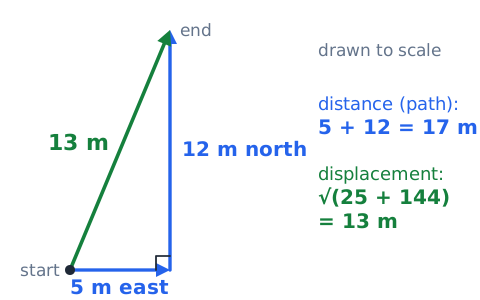
A student walks 5 m east, then 12 m north. Distance and displacement size? Answer: distance 17 m; displacement
pointing mostly north (a little east of north).
A car drives 3 km west. Answer: both values are 3 km, with displacement pointing west.
Try it 2 — Speed conversion
Convert 36 km/h to m/s. Answer:
Convert 15 m/s to km/h. Answer:
/h.
Convert 108 km/h to m/s. Answer: 30 m/s.
Try it 3 — Balanced push
Two movers push a piano from opposite sides, each with 150 N. The piano starts at rest. What happens? Answer: net force is zero, so it stays at rest.
The same piano is already rolling at a steady speed when the equal pushes begin, with negligible friction. Answer: it keeps rolling at that constant velocity.
Try it 4 — Braking acceleration
A truck slows from 20 m/s to 8 m/s in 4 s while moving in the positive direction. Find its acceleration. Answer:
A sled slows from 9 m/s to rest in 3 s. Answer: m/s², the same as the truck.
Try it 5 — Three forces and mass
A 3 kg block feels 20 N right, 5 N left and 6 N left. Find the net force and acceleration. Answer:
N right, so
right.
If the 20 N push is raised to 26 N, what is the new acceleration? Answer: 15 N net, so 5 m/s² right.
Try it 6 — Two motion stages
A walker goes 2 m/s for 30 s, then 4 m/s for 15 s. Find the total distance. Answer:
What is the average speed? Answer:
not 3 m/s, because more time was spent at the slower pace.
Seven exam traps consolidated
Seven traps appear again and again. First, confusing distance with displacement: a round trip has distance but zero displacement. Second, averaging two speeds directly when equal distances, not equal times, were covered. Third, thinking motion needs a net force: constant velocity means zero net force. Fourth, reading a negative acceleration as automatic slowing: compare its sign with the velocity's sign. Fifth, mixing up mass and weight: mass stays fixed; weight depends on gravity. Sixth, cancelling action–reaction forces: they act on different objects. Seventh, using one constant-acceleration formula across a trip with several stages.
Final quick reference
Distance is path length; displacement is the straight start-to-end change with direction. Speed is a scalar; velocity is a vector. Average speed is total distance over total time; average velocity is displacement over time. Acceleration is change in velocity per unit time,
For constant acceleration:
and braking distance . On graphs, position slope is velocity; velocity slope is acceleration and its area is displacement.
Newton's laws: zero net force keeps velocity constant;
interaction forces come in equal, opposite pairs on two objects. Weight is , momentum is , and circular motion needs an inward acceleration of .
 English ▾