 ASVAB Camp
Learning objectives, scope and honest examination expectations
In this lesson you will learn to name the reactants and products in an equation, tell a chemical change from a physical one, and judge which observations really point to a reaction. You will balance equations by counting atoms, use coefficients as ratios, and apply conservation of mass. You will also compare acids and bases with the pH scale and indicators, predict neutralization products, and explain what changes reaction rate and energy.
The General Science test expects recognition and simple reasoning, not lab skills or heavy math. The practice items here were written for this course and do not reproduce official test questions.
Reactants become products; atoms are rearranged
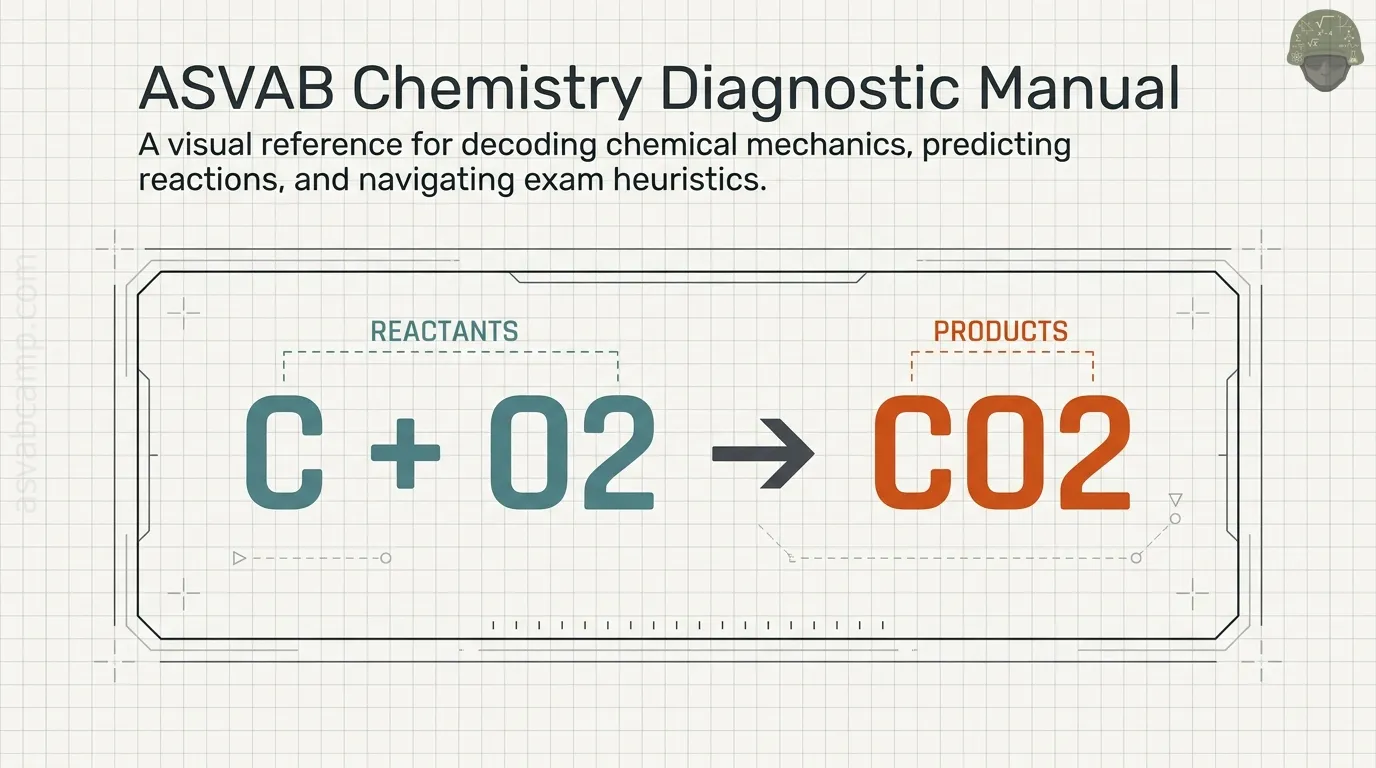
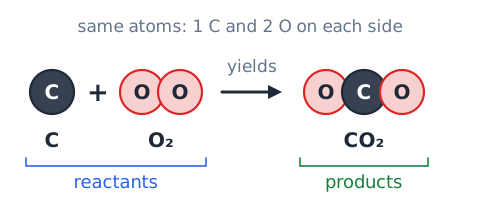
In a chemical reaction, the starting substances are the reactants and the new substances formed are the products. An arrow separates them and is read as yields or forms.
Here carbon and oxygen are the reactants and carbon dioxide is the product. During the reaction, bonds between atoms break and new bonds form, but the atoms themselves are not created or destroyed. They are simply rearranged into new combinations, which is why the products have different properties from the reactants.
Chemical change versus physical change
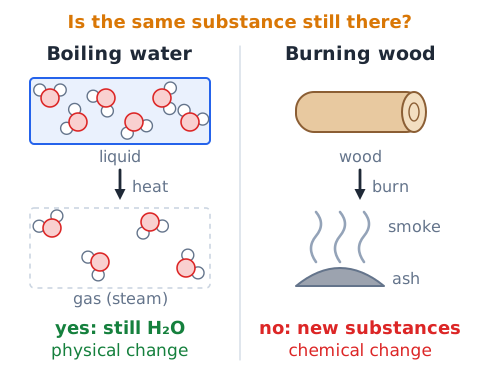
A physical change alters the form or state of a substance without changing what it is made of. Melting ice, boiling water, cutting paper, bending wire and dissolving sugar in tea are physical changes. The substance is still the same compound afterward.
A chemical change produces one or more new substances with different compositions and properties. Burning wood, rusting iron, baking a cake, souring milk and digesting food are chemical changes.
A useful question is: after the change, is the same substance still there? Water vapor is still , so boiling is physical. Ash and smoke are not wood, so burning is chemical.
Observations are clues, not automatic proof
Common signs of a chemical reaction include a color change, gas production, a solid forming from two liquids, light, or an unexpected temperature change. These are good clues, but none of them is proof by itself.
Bubbles appear when water boils, and boiling is physical. Food coloring changes the color of water without any reaction. A hand warmer gets hot by a reaction, but a pan on a stove gets hot without one.
The strongest evidence is identifying a new substance with a different chemical formula or properties. When a test asks which observation is least conclusive, look for one that a simple physical change could also explain.
Chemical symbols, formulas, and state labels
Each element has a symbol of one or two letters, such as H for hydrogen, O for oxygen, Na for sodium and Fe for iron. A chemical formula shows which elements are in a substance and how many atoms of each, using subscripts. has one carbon atom and two oxygen atoms.
State labels in parentheses show the physical state: (s) for solid, (l) for liquid, (g) for gas and (aq) for aqueous, meaning dissolved in water.
Mass conservation requires accounting for all substances
The law of conservation of mass says that in a chemical reaction, the total mass of the products equals the total mass of the reactants. Atoms are only rearranged, so their total mass stays the same.
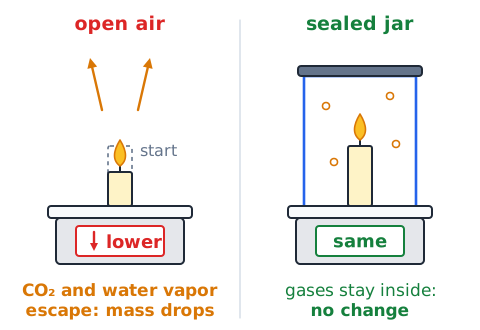
This holds only if you count every substance, including gases. When a candle burns in open air, the candle seems to lose mass because carbon dioxide and water vapor escape. If the candle burned inside a sealed jar, a balance would show no change in total mass.
Likewise, a metal that reacts with air gets heavier because oxygen atoms from the air join it.
Count atoms on both sides before choosing coefficients
To balance an equation, start by making a tally of each element on the reactant side and the product side.
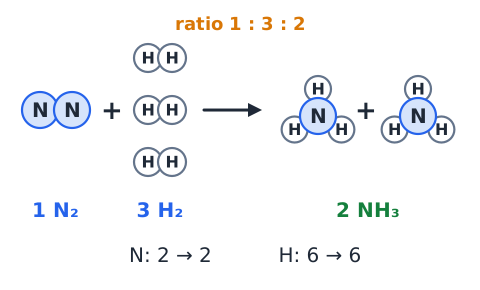
Left side: 2 nitrogen, 2 hydrogen. Right side: 1 nitrogen, 3 hydrogen. Neither element matches. Once you know which atoms are off, you can choose coefficients to fix them, as the next sections show. Always recount after each change.
Never change a subscript while balancing
Subscripts are part of a substance's identity. is water, while is hydrogen peroxide, a different chemical with different properties. Changing a subscript to make atoms add up changes the substance itself, so the equation no longer describes the real reaction.
Balance only by placing coefficients, the whole numbers written in front of formulas. Writing means two water molecules, each still with two hydrogen atoms and one oxygen atom.
Coefficients are ratios of formula units
Coefficients show how many molecules or formula units of each substance react or form. A missing coefficient means 1.
This says 1 nitrogen molecule reacts with 3 hydrogen molecules to form 2 ammonia molecules. The coefficients are a ratio, 1 to 3 to 2, so they also hold for larger counts: 10 nitrogen molecules react with 30 hydrogen molecules to make 20 ammonia molecules. Always use the smallest whole numbers that balance the equation.
Common reaction pattern: synthesis
In a synthesis reaction, also called a combination reaction, two or more simple substances join to form a single, more complex product. The general pattern is A plus B gives AB.
Here sodium metal and chlorine gas combine to form table salt. Other examples include iron joining with sulfur to form iron sulfide, and hydrogen joining with nitrogen to form ammonia. A clue: several reactants but only one product.
Common reaction pattern: decomposition
In a decomposition reaction, one compound breaks down into two or more simpler substances. The pattern is AB gives A plus B, the reverse of synthesis.
Heating limestone (calcium carbonate) breaks it into lime and carbon dioxide. Passing electric current through water splits it into hydrogen and oxygen gas. Decomposition often needs an input of energy, such as heat, light or electricity. A clue: one reactant, several products.
Combustion generally reacts a fuel with oxygen
Combustion is a rapid reaction between a fuel and oxygen that releases heat and usually light. When the fuel is a hydrocarbon, made of carbon and hydrogen, complete combustion forms carbon dioxide and water.
This is propane burning in a gas grill. If oxygen is limited, combustion may be incomplete and can produce carbon monoxide, a toxic gas, and soot.
Single displacement and double displacement
In a single displacement reaction, one element replaces another element in a compound. The pattern is A plus BC gives AC plus B. Dropping zinc into copper sulfate solution causes zinc to replace copper, and reddish copper metal coats the zinc.
In a double displacement reaction, two compounds swap partners: AB plus CD gives AD plus CB. Mixing silver nitrate and sodium chloride solutions forms a white solid, silver chloride. Acid–base neutralization is also a double displacement reaction.
Acid plus carbonate: carbon dioxide gas
Acids react with carbonates and bicarbonates to produce carbon dioxide gas, water and a salt. That is why vinegar fizzes when poured on baking soda, and why a drop of dilute acid bubbles on limestone or marble.
In baking, the acid in buttermilk reacts with baking soda, and the carbon dioxide bubbles make the batter rise. Geologists use a drop of acid to test whether a rock contains carbonate minerals.
Oxidation, reduction and electron transfer
Many reactions involve electrons moving from one substance to another. Oxidation is the loss of electrons, and reduction is the gain of electrons. They always happen together, so these are called redox reactions.
A memory aid is OIL RIG: Oxidation Is Loss, Reduction Is Gain. When magnesium burns, each magnesium atom loses two electrons and is oxidized; oxygen gains those electrons and is reduced.
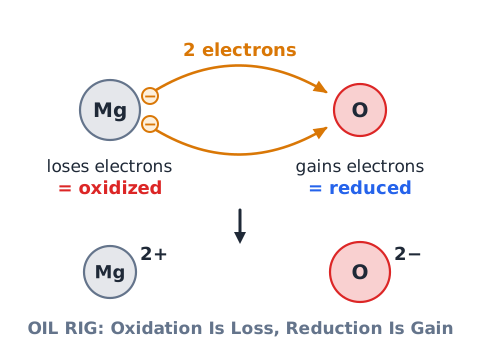
The word oxidation originally meant combining with oxygen, but it now covers any loss of electrons, even with no oxygen involved. Batteries produce electric current from redox reactions.
Rusting and corrosion are chemical transformations
Rust forms when iron reacts with oxygen and water. The iron is oxidized, forming hydrated iron oxide, a reddish-brown, flaky substance with very different properties from shiny metal iron. Because a new compound forms, rusting is a chemical change.
Salt water speeds up rusting, which is why cars rust faster where roads are salted. Paint, oil, galvanizing with zinc and stainless-steel alloys all slow corrosion by protecting the iron from oxygen and water.
Reaction rate measures speed of change
Reaction rate is how quickly reactants are used up or products are formed. It can be measured as the amount of gas produced per second, the drop in mass per minute, or the time until a color change appears.
Rates vary enormously. An explosion is over in a fraction of a second, a match burns in a few seconds, milk sours over days, and iron rusts over months or years.
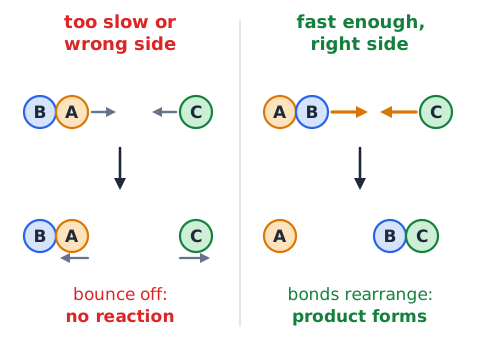
For particles to react, they must collide with enough energy and in the right orientation. Anything that increases the number of effective collisions speeds up the reaction. Raising the temperature is the most common way: particles move faster, collide more often and with more energy.
Surface area, concentration, and stirring
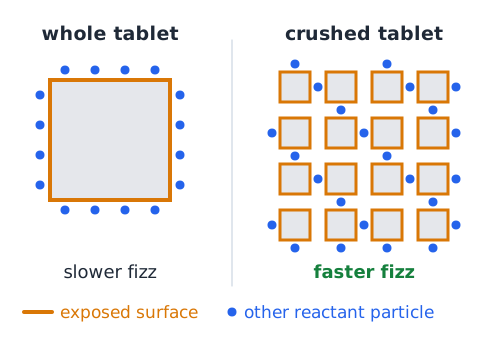
Increasing surface area speeds up a reaction involving a solid, because more particles are exposed to collide with the other reactant. A whole antacid tablet fizzes more slowly than a crushed one, and fine sawdust burns far faster than a solid log.
Increasing concentration puts more reactant particles into each unit of volume, so collisions happen more often. Steel wool burns brightly in pure oxygen but only glows in air.
Stirring or shaking brings fresh reactant into contact with the surface and keeps concentrations even, which also speeds most reactions in solution.
A catalyst accelerates without being consumed overall
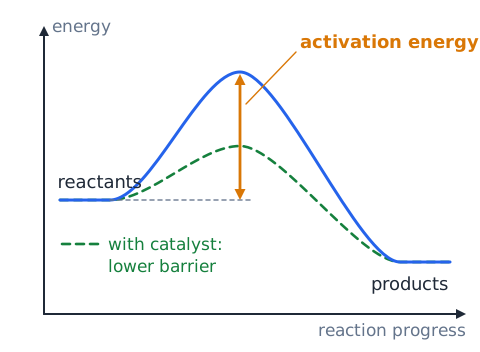
A catalyst is a substance that speeds up a reaction without being used up. It provides a different reaction pathway with a lower activation energy, so more collisions are successful at a given temperature.
The catalyst may take part in intermediate steps, but it is regenerated by the end, so a small amount can be used again and again. A catalytic converter in a car uses metals such as platinum to turn carbon monoxide into carbon dioxide. Enzymes are biological catalysts; for example, amylase in saliva speeds the breakdown of starch.
A catalyst does not change the overall energy released or absorbed, and it does not increase the final amount of product.
Activation energy and the reaction barrier
Activation energy is the minimum energy that colliding particles need for a reaction to start. Think of it as a hill that the reactants must climb before they can roll down to the products.
A match head does not burst into flame on its own, even though burning releases plenty of energy. Striking it on the box supplies enough energy, through friction, to get over the barrier. After that, the heat released keeps the reaction going.
Higher temperature gives more particles enough energy to clear the barrier, and a catalyst lowers the barrier itself.
Exothermic reactions transfer energy to surroundings
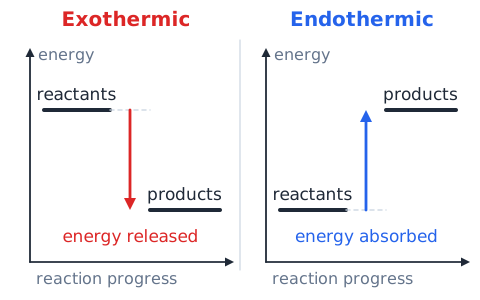
An exothermic reaction releases energy, usually as heat and sometimes as light, to its surroundings. The surroundings get warmer.
Examples include burning gasoline or wood, the reaction inside a disposable hand warmer as iron powder oxidizes, and cellular respiration in your body. Neutralizing a strong acid with a strong base also gives off heat.
In an exothermic reaction, the products have less stored chemical energy than the reactants; the difference is released.
Endothermic reactions take in energy overall
An endothermic reaction absorbs energy from its surroundings. If the reaction happens in a container you are holding, the container feels cold, because heat is flowing into the reaction.
An instant cold pack works this way: when ammonium nitrate dissolves in water, it absorbs heat, and the pack becomes cold enough to soothe a sprain. Photosynthesis is endothermic, using light energy to build sugars. Baking soda and vinegar also feel slightly cool as they react.
In an endothermic reaction, the products store more chemical energy than the reactants, and the extra energy came from the surroundings.
Energy released is not the same as reaction speed
Whether a reaction releases or absorbs energy tells you nothing about how fast it goes. These are separate properties.
Rusting is exothermic, but it is so slow that the heat is hard to notice. Burning a sheet of paper is also exothermic, but fast. A cold pack is endothermic and fast.
Speed depends on activation energy, temperature, concentration, surface area and catalysts. The overall energy change depends on the bonds broken and formed. So a reaction can be strongly exothermic and still very slow.
Acids in aqueous solutions raise hydronium
In water, an acid releases hydrogen ions, . Each hydrogen ion quickly attaches to a water molecule, forming a hydronium ion, . The more hydronium ions in a solution, the more acidic it is.
Acids taste sour, turn blue litmus paper red, react with many metals to release hydrogen gas, and react with carbonates to release carbon dioxide. Lemon juice contains citric acid, vinegar contains acetic acid, and stomach fluid contains hydrochloric acid. Acids have a pH below 7.
Bases in aqueous solutions and hydroxide
A base increases the concentration of hydroxide ions, , in water, or removes hydrogen ions from the solution. Bases that dissolve well in water are called alkalis.
Bases taste bitter and feel slippery, turn red litmus paper blue, and neutralize acids. Sodium hydroxide is used in drain cleaners, ammonia in glass cleaners, and magnesium hydroxide in antacids. Bases have a pH above 7.
Never taste or touch unknown chemicals to test them; these descriptions are for recognizing properties in questions, not for testing at home.
Brønsted–Lowry proton transfer
The Brønsted–Lowry model defines acids and bases by what happens to protons, which are hydrogen ions. An acid is a proton donor, and a base is a proton acceptor.
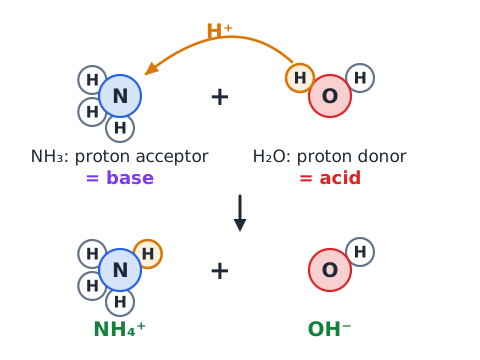
Here water gives a proton to ammonia, so water acts as the acid and ammonia acts as the base. In a reaction with hydrogen chloride, water accepts a proton and acts as a base instead. A substance's role depends on its partner in the reaction.
The pH scale is logarithmic, not linear
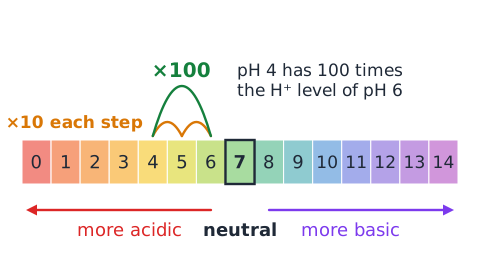
The pH scale usually runs from 0 to 14 for ordinary water solutions near room temperature. A pH of 7 is neutral, below 7 is acidic and above 7 is basic.
Each step of one pH unit is a tenfold change in hydrogen-ion level. So a solution at pH 4 has 10 times the hydrogen-ion level of one at pH 5, and 100 times that of one at pH 6. In general:
Interpreting pH comparisons without a calculator
To compare two pH values, subtract the smaller from the larger, then write 1 followed by that many zeros.
Black coffee at about pH 5 versus tomato juice at about pH 4: difference 1, so tomato juice is about 10 times more acidic.
Seawater near pH 8 versus pure water at pH 7: difference 1, so seawater has one-tenth the hydrogen-ion level.
The lower pH always has the higher hydrogen-ion level.
Acid strength is different from concentration
Strong and concentrated sound alike, but they describe different things.
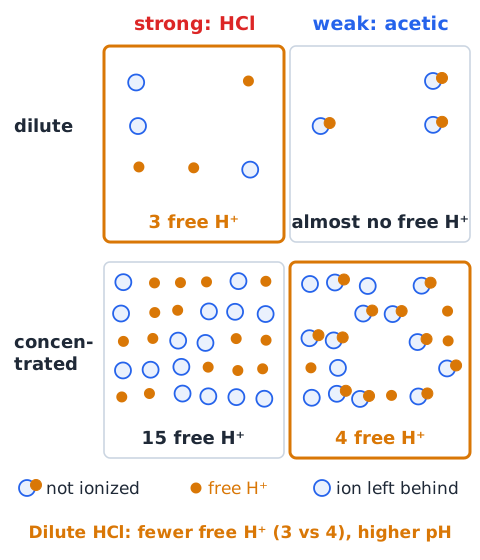
Strength is how completely an acid ionizes in water. A strong acid, such as hydrochloric acid, releases nearly all of its hydrogen ions. A weak acid, such as acetic acid in vinegar, releases only a small fraction.
Concentration is how much acid is dissolved in a given volume of solution. You can have a dilute solution of a strong acid, or a concentrated solution of a weak acid.
So a dilute hydrochloric acid solution can have a higher pH than very concentrated acetic acid, even though hydrochloric acid is the stronger acid.
Indicators reveal acid/base behavior
An indicator is a substance that changes color depending on pH. It is a fast way to tell whether a solution is acidic or basic.
Litmus paper is the classic example. Blue litmus turns red in an acid; red litmus turns blue in a base. Phenolphthalein is colorless in acids and neutral solutions but turns pink in a fairly basic solution. Universal indicator shows a range of colors from red for strong acid through green for neutral to purple for strong base.
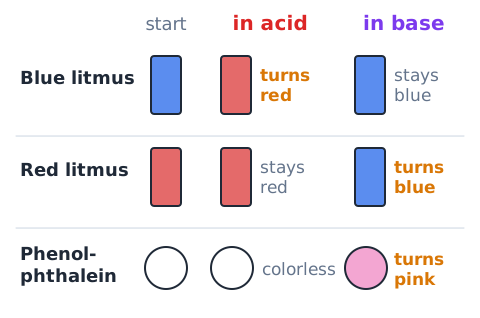
Red cabbage juice works as a natural indicator. Most indicators only give an approximate pH range; a pH meter gives a precise reading.
Neutralization involves chemical consumption of acid/base
In neutralization, an acid and a base react and use each other up. Hydrogen ions from the acid combine with hydroxide ions from the base to form water.
The remaining ions form a salt. Taking an antacid for heartburn neutralizes some stomach acid, and farmers add lime to acidic soil to neutralize it.
Salt is a broad ionic-compound category
In chemistry, a salt is any ionic compound made of a positive ion, other than hydrogen, and a negative ion, other than hydroxide. Salts form when acids react with bases.
Table salt, sodium chloride, is only one example. Potassium nitrate is used in fertilizer, calcium sulfate is the mineral in plaster and drywall, and ammonium chloride is used in batteries. To predict the salt from a neutralization, combine the metal ion from the base with the negative ion from the acid.
A balanced acid–base equation preserves every atom
Neutralization equations must be balanced just like any others.
Count: 1 calcium, 2 chlorine, 4 hydrogen and 2 oxygen on each side. Each acid particle supplies one hydrogen ion, and each calcium hydroxide supplies two hydroxides, so two acid particles are needed.
Acid reacts with reactive metals in specific cases
Many acids react with fairly reactive metals, such as zinc, magnesium and iron, producing a salt and hydrogen gas.
Less reactive metals, such as copper, silver and gold, do not release hydrogen from dilute acids like hydrochloric acid. That is one reason gold jewelry does not corrode.
Gas, precipitate and color-change reactions
Chemists often recognize reactions by a few visible outcomes. A gas-forming reaction produces bubbles of a new gas, such as carbon dioxide from acid and carbonate or hydrogen from acid and zinc.
A precipitate is an insoluble solid that forms when two clear solutions are mixed. For example, mixing lead nitrate and potassium iodide solutions forms a bright yellow solid.
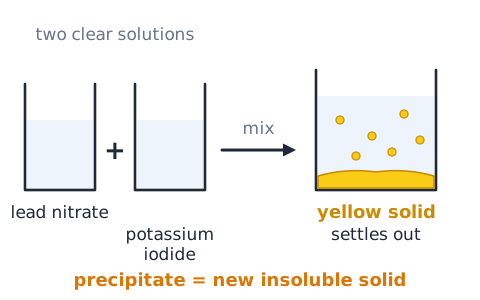
A color change can show a new substance, such as a copper roof turning green over many years. Each clue is strongest when it cannot be explained by a physical change.
Solution, solvent, solute and dissociation
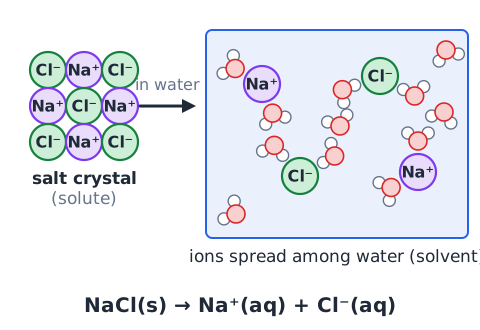
A solution is a uniform mixture of two or more substances. The solvent is the substance present in the larger amount, which does the dissolving. The solute is what dissolves in it. In salt water, water is the solvent and salt is the solute. Water is called the universal solvent because it dissolves so many substances.
When an ionic compound dissolves, it dissociates: its ions separate and spread out among the water molecules. Sodium chloride splits into sodium and chloride ions. Dissolving is usually a physical change, since the salt can be recovered by evaporating the water.
Dilution changes amount per volume, not identity
Dilution means adding more solvent, usually water, to a solution. The amount of solute stays the same, but it is spread through a larger volume, so the concentration drops.
If you dilute an acidic solution with pure water, the hydrogen-ion level falls and the pH rises toward 7, though it does not pass 7. The acid is still the same chemical; there are simply fewer acid particles per liter.
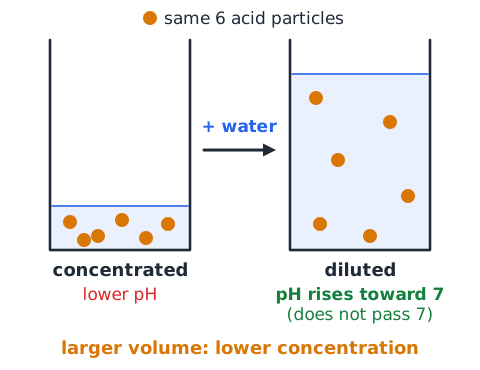
For example, mixing 1 cup of concentrated juice with 3 cups of water does not change what the juice is, only how strong it tastes.
pH and water quality in the real world
Most fish and aquatic life thrive in water with a pH roughly between 6.5 and 8.5. Lakes that become too acidic can lose fish, snails and amphibians.
Acid rain forms when sulfur dioxide and nitrogen oxides from burning fuels react with water in the air. Lakes on limestone can resist the acid, because the carbonate rock neutralizes some of it. Lakes on granite cannot. Water utilities and pool owners adjust pH to protect pipes, prevent irritation and keep disinfectants working well.
Buffers resist changes in pH
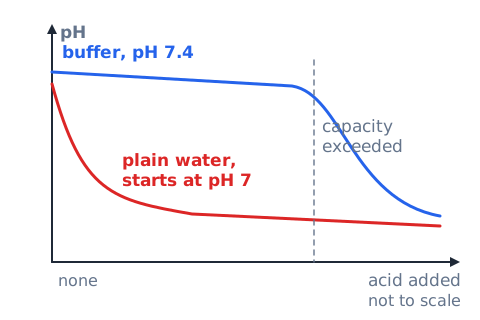
A buffer is a solution that resists change in pH when small amounts of acid or base are added. It usually contains a weak acid together with its matching base, so one part neutralizes added acid and the other neutralizes added base.
Human blood is buffered and stays near pH 7.4. Adding a little acid to plain water can drop its pH sharply, while the same amount added to a buffer changes pH only slightly. Buffers have a limited capacity, though; enough added acid or base will overwhelm them.
Reaction energy and bond changes
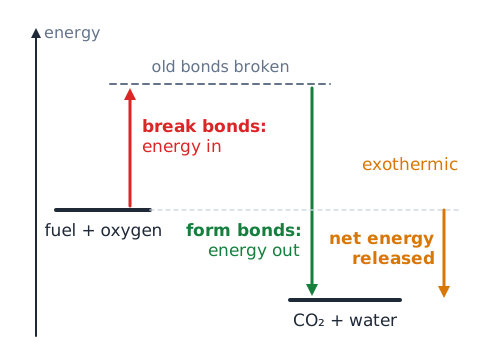
Chemical energy is stored in the bonds between atoms. Breaking a bond always requires energy, and forming a bond always releases energy.
During a reaction, bonds in the reactants break and new bonds form in the products. If forming the new bonds releases more energy than breaking the old ones required, the reaction is exothermic overall. If breaking bonds takes more energy than forming bonds gives back, it is endothermic.
When natural gas burns, the strong bonds formed in carbon dioxide and water release more energy than was needed to break the fuel and oxygen bonds. The extra energy becomes the heat of the flame.
Identify reaction categories using equation shape
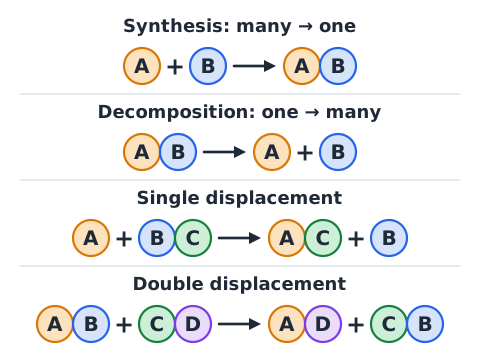
You can often classify a reaction from the shape of its equation.
Many reactants to one product suggests synthesis. One reactant to many products suggests decomposition. A fuel plus oxygen that yields carbon dioxide and water is combustion. An element plus a compound giving a different element and compound is single displacement. Two compounds swapping partners is double displacement; if those compounds are an acid and a base forming salt and water, it is neutralization.
Example:
has one reactant and two products, so it is decomposition.
Balanced mass calculation in a closed container
In a sealed container, nothing enters or leaves, so the total mass before and after a reaction is the same.
Total mass of reactants equals total mass of products.
Example: in a sealed flask, 14 g of substance X reacts completely with 9 g of substance Y. The products must have a total mass of
even if some of them are gases. If one product is 15 g of solid, the rest must be 8 g of other products.
Simple reaction-ratio calculations
A balanced equation gives particle ratios you can scale up.
The ratio is 1 nitrogen to 3 hydrogen to 2 ammonia. With 4 nitrogen molecules, you need 4 times 3, or 12, hydrogen molecules, and you form 4 times 2, or 8, ammonia molecules. Multiply every coefficient by the same factor.
Limiting reactant as the supply constraint
The limiting reactant is the one that runs out first and so sets the maximum amount of product. The other reactant is in excess, and some is left over.
Think of making bicycles: each needs 1 frame and 2 wheels. With 5 frames and 8 wheels, the wheels run out after 4 bicycles. Wheels are limiting.
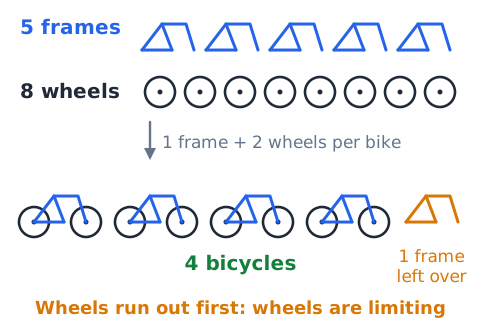
Chemistry works the same way. To find the limiting reactant, divide each reactant's amount by its coefficient; the smallest result is limiting.
Chemical safety and interpretation, not home experimentation
This lesson is about understanding chemistry for the test, not about trying reactions at home. Many common household products are dangerous when mixed. For example, bleach mixed with ammonia or with acidic cleaners can release toxic gases.
General safety habits: read product labels and safety data sheets, use chemicals only as directed, keep them in original labeled containers, store them away from children, and work with good ventilation. In any lab, wear eye protection and follow your instructor. If a chemical gets in your eyes or on your skin, flush with water and get medical help.
Exam technique: match direction and units
Many chemistry questions hinge on direction. Lower pH means more acidic, not less. Adding base raises pH. An arrow points from reactants to products. Exothermic gives heat out; endothermic takes heat in.
Check units too. Masses add in grams; particle counts follow coefficients, not masses. A pH difference becomes a power of ten, not a simple difference.
Before choosing, restate what the question asks: more acidic or less, faster or more product, reactants or products.
Evidence-based conclusions versus overclaiming
Good chemical reasoning matches the strength of a conclusion to the evidence. A single observation, such as bubbles or a color change, suggests a reaction might have happened but does not prove it. Identifying a new substance, for example by testing a gas or analyzing a solid, is much stronger evidence.
Likewise, litmus turning red shows a sample is acidic but does not give its exact pH. A final pH of 3 after mixing an acid and a base shows acid remains in excess, not that no reaction occurred. Pick answers that claim only what the data support.
Worked example 1 — physical or chemical?
Problem: Classify each change as physical or chemical.
Case A: A cook melts butter in a pan. The butter becomes liquid but is still butter, and it hardens again when cooled. Physical.
Case B: The butter is left on high heat and turns brown with a nutty smell. New compounds formed, so this is chemical.
Case C: Salt is stirred into water and seems to disappear. Evaporating the water gets the salt back, so this is physical.
Case D: A silver spoon darkens over months. Silver reacted with sulfur compounds in air to form tarnish, a new substance. Chemical.
Worked example 2 — balance hydrogen combustion
Problem: Balance
Oxygen: 2 on the left, 1 on the right. Put 2 in front of water, giving 2 oxygen and 4 hydrogen on the right.
Hydrogen: now 2 on the left, 4 on the right. Put 2 in front of hydrogen.
Worked example 3 — balance magnesium oxidation
Problem: Balance
Oxygen: 2 on the left, 1 on the right. Place 2 in front of MgO, making 2 magnesium and 2 oxygen on the right.
Magnesium: now 1 on the left and 2 on the right. Place 2 in front of Mg.
Check: 2 magnesium and 2 oxygen on each side.
Worked example 4 — balance a combustion equation
Problem: Balance the burning of propane.
Carbon: 3 on the left, so write . Hydrogen: 8, so . Oxygen on the right is
so use .
Worked example 5 — closed-system mass
Problem: A sealed plastic bag holds 50 g of vinegar and a small cup with 5 g of baking soda. The bag is tipped so they mix; it fizzes and puffs up. What is the total mass afterward?
The bag is sealed, so the carbon dioxide stays inside. Mass is conserved:
the same as before.
Worked example 6 — acid–base litmus
Problem: A student dips blue litmus paper into an unknown liquid, and it stays blue. Red litmus dipped into the same liquid turns blue. What can be concluded?
Blue litmus not turning red means the liquid is not acidic. Red litmus turning blue means it is basic.
Answer: the liquid is basic, with pH above 7. Litmus cannot tell its exact pH.
Worked example 7 — compare pH 3 and pH 5
Problem: How does the hydrogen-ion level of a pH 3 solution compare with a pH 5 solution?
The difference is 5 minus 3, which is 2 units.
Answer: the pH 3 solution has about 100 times the hydrogen-ion level, not 2 times.
Worked example 8 — neutralization products
Problem: Predict the products when nitric acid reacts with potassium hydroxide.
The hydrogen ion from the acid combines with the hydroxide ion from the base to form water. The leftover ions, potassium and nitrate, form a salt.
Answer: potassium nitrate and water. Each side has 1 potassium, 1 nitrogen, 2 hydrogen and 4 oxygen.
Worked example 9 — sulfuric acid coefficients
Problem: Balance sulfuric acid with potassium hydroxide.
Sulfuric acid gives 2 hydrogen ions, so it needs 2 KOH and forms 2 water.
Worked example 10 — identify a limiting reactant
Problem: For
a container holds 10 hydrogen molecules and 7 oxygen molecules. Which runs out?
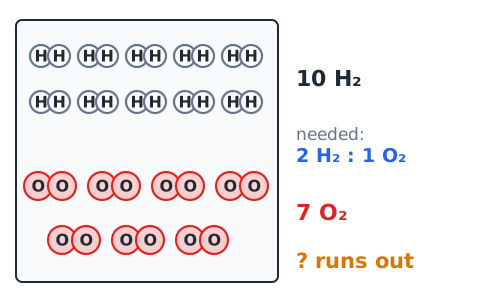
The 10 hydrogen molecules need 5 oxygen molecules, and 7 are available. So hydrogen is limiting.
Answer: 10 water molecules form and 2 oxygen molecules are left over.
Worked example 11 — exothermic versus rate
Problem: An iron railing slowly rusts over several years, while a firework explodes in a split second. Both reactions release heat. Which is exothermic, and which is faster?
Both are exothermic, because both release energy to the surroundings. The firework is much faster.
The difference in speed comes from activation energy, temperature, concentration and surface area, not from whether energy is released. A slow reaction can be just as exothermic as a fast one in total; it simply spreads the heat out over a long time.
Worked example 12 — gas mass escaping
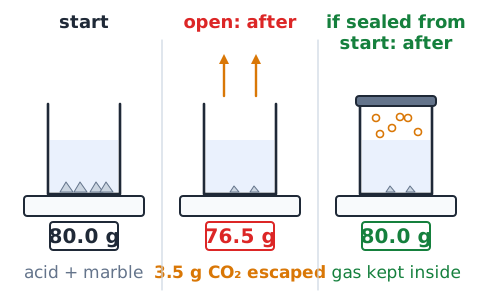
Problem: An open beaker of dilute acid with marble chips has a total mass of 80.0 g. After the fizzing stops, the beaker reads 76.5 g. Explain the loss.
Mass was not destroyed. Carbon dioxide gas formed and escaped into the air because the beaker was open.
Escaped gas = 80.0 minus 76.5 = 3.5 g of carbon dioxide. In a sealed container, the mass would have stayed at 80.0 g.
Worked example 13 — decomposition or phase change
Problem: Table sugar heated in a pan first melts into a clear liquid, then turns brown and finally black, giving off steam. Which stages are physical and which are chemical?
Melting is a phase change; it is physical.
Turning brown and black means the sugar is breaking down into carbon and water vapor. That is decomposition, a chemical change, because new substances form.
Worked example 14 — rate and surface area
Problem: Two equal 2-gram samples of the same antacid tablet are dropped into identical cups of water at the same temperature. One is whole and one is crushed. Which fizzes faster, and do they make different amounts of gas?
The crushed tablet has more surface area exposed, so it reacts faster.
Both have the same mass of reactant, so when each is fully reacted they make the same amount of gas. Surface area changes speed, not final yield.
Trap: changing the chemical formula when balancing
The mistake: balancing
by writing on the right.
Why it is wrong: that changes the product from water to hydrogen peroxide, a different substance, so the equation describes a different reaction.
The fix: change only coefficients. The correct answer is
Trap: interpreting bubbles as definite chemical proof
The mistake: assuming that any bubbles mean a chemical reaction occurred.
Why it is wrong: bubbles also come from boiling, from dissolved air escaping as water warms, or from opening a carbonated drink. These are physical changes.
The fix: ask whether a new substance formed. Bubbles are a clue; identifying a new gas such as carbon dioxide is stronger evidence.
Trap: assuming acid equals concentrated or dangerous
The mistake: thinking every acid is strong, concentrated and harmful.
Why it is wrong: many acids are weak and dilute. Orange juice, vinegar and soda contain acids and are safe to drink. Strength, concentration and hazard are separate ideas.
The fix: read what the question actually says. Strong refers to ionization; concentrated refers to amount per volume.
Trap: treating pH as an ordinary number line
The mistake: saying pH 2 is twice as acidic as pH 4 because 4 divided by 2 is 2.
Why it is wrong: each pH unit is a factor of 10. The gap from 2 to 4 is 2 units, so the hydrogen-ion level differs by 100 times.
The fix: subtract the pH values, then raise 10 to that power.
Trap: assuming all neutralization reaches pH 7
The mistake: assuming any time an acid and base mix, the final solution is exactly neutral.
Why it is wrong: if more acid than base is present, the mixture stays acidic; if more base, it ends basic. Some salts also make a solution slightly acidic or basic.
The fix: compare the amounts. A final pH below 7 means acid is left over, not that no reaction happened.
Trap: confusion between energy and speed
The mistake: assuming an exothermic reaction must be fast, or that a slow reaction must be endothermic.
Why it is wrong: energy change depends on bonds formed and broken; speed depends on activation energy and conditions. Rusting releases heat but takes years.
The fix: answer energy questions with exothermic or endothermic, and rate questions with temperature, surface area, concentration or catalysts.
Trap: missing the gas or added oxygen in mass totals
The mistake: concluding that mass was lost when wood burns, or gained from nowhere when steel wool burns.
Why it is wrong: burning wood releases gases that escape, while burning steel wool takes oxygen from the air into the solid oxide.
The fix: account for every reactant and product, including gases. In a sealed system, total mass does not change.
ASVAB GS decision process and pacing
For each chemistry question, first identify the topic: change type, balancing, mass, pH, acids and bases, energy or rate. Then recall the one key rule for that topic, such as count atoms, mass is conserved, one pH unit equals ten times, or exothermic releases heat.
Apply the rule in one or two steps and pick the choice that matches. If a question needs more than a few steps, you may have misread it; reread the stem.
Do not spend too long on any one item. Mark a best guess and move on. There is no penalty for guessing, so never leave an answer blank.
Four-option elimination for chemistry questions
Use elimination when you are unsure. First cross out answers that break basic laws, such as creating atoms, destroying mass or energy flowing backward.
Next, remove answers with absolute words like always, never or every, unless the rule truly is absolute, as with conservation of mass in a sealed system.
Then check direction: a lower pH is more acidic, and adding base raises pH.
Finally, choose between the remaining options by asking which one is fully supported by the information given.
No-calculator methods for ratios and powers of ten
pH ratios: subtract the pH values and write 1 followed by that many zeros. A difference of 3 means 1,000 times.
Coefficients: multiply each coefficient by the same scale factor. If the equation is 1 to 3 to 2 and you have 5 of the first, you need 15 of the second and make 10 of the third.
Limiting reactant: divide each amount by its coefficient and compare. For a 2-to-1 equation with 8 and 3, compare 4 and 3; the second one runs out first.
Masses: in a sealed system, simply add.
Guided drill 1 — detect formation of new substances
Prompt: Gasoline evaporates from an open can. Chemical or physical? Answer: Physical; gasoline vapor is still gasoline.
Prompt: Gasoline burns in an engine. Chemical or physical? Answer: Chemical; it forms carbon dioxide and water.
Prompt: An egg is fried and turns white and firm. Chemical or physical? Answer: Chemical; the proteins are permanently altered.
Prompt: Two clear solutions are mixed and a cloudy yellow solid forms. Chemical or physical? Answer: Chemical; a precipitate is a new substance.
Guided drill 2 — balance two equations
Prompt: Balance
Answer:
Prompt: Balance
Answer:
Guided drill 3 — count pH differences
Prompt: How many times greater is the hydrogen-ion level at pH 2 than at pH 6? Answer: 10,000 times, since the difference is 4.
Prompt: Which is more basic, pH 8 or pH 11? Answer: pH 11.
Prompt: How do their hydrogen-ion levels compare? Answer: pH 8 has 1,000 times more hydrogen ions than pH 11.
Prompt: Is pH 6.5 acidic or basic? Answer: Slightly acidic.
Guided drill 4 — mass and escaping gases
Prompt: In a sealed jar, 30 g of reactants fully react with 20 g of other reactants. What is the total product mass? Answer: 50 g.
Prompt: The same reaction is run in an open dish and 6 g of gas escapes. What does the dish read? Answer: 44 g.
Prompt: Was mass destroyed? Answer: No; the gas carried it away.
Guided drill 5 — reaction rate controlled comparison
Prompt: You want to test whether temperature affects how fast a tablet fizzes. What should differ between the two cups? Answer: Only the water temperature.
Prompt: What should be kept the same? Answer: The tablet type and mass, whole or crushed form, water volume and cup type.
Prompt: Why not also crush one tablet? Answer: Then two variables would change, and you could not tell which one caused the difference in rate.
Prompt: What result would you predict? Answer: The tablet in warmer water fizzes faster.
Guided drill 6 — integrated neutralization and ratios
Prompt: What forms when hydrochloric acid reacts with calcium hydroxide? Answer: Calcium chloride and water.
Prompt: In
how many calcium hydroxide units neutralize 6 HCl? Answer: 3, using the 2 to 1 ratio.
Prompt: How many water molecules form? Answer: 6.
Prompt: If excess acid is left, is the final pH above or below 7? Answer: Below 7.
Final review: what must be automatic
Reactants appear before the arrow and products after it. A chemical change makes new substances; a physical change only alters form or state. Bubbles, color and heat are clues, not proof.
Balance equations by changing coefficients, never subscripts, and recount atoms on both sides. Coefficients are particle ratios. In a sealed system, total mass is constant. The limiting reactant runs out first.
Acids donate protons and have pH below 7; bases accept protons and have pH above 7; pH 7 is neutral. Each pH unit is a tenfold change. Acid plus base gives salt plus water. Blue litmus turns red in acid, and red litmus turns blue in base. Buffers resist pH change but can be overwhelmed.
Exothermic releases heat; endothermic absorbs it. Rate rises with temperature, concentration, surface area and catalysts. A catalyst lowers activation energy without being used up, and does not change the energy released or the final yield.
 English ▾