 ASVAB Camp
Learning objectives and ASVAB boundaries
In this lesson you will learn to name the main energy stores, such as kinetic, gravitational, elastic, chemical, electrical and thermal, and to calculate kinetic and gravitational potential energy. You will apply conservation of energy, compute work, power and efficiency, and convert between watts, joules and kilowatt-hours.
You will also separate temperature from internal energy, convert among Celsius, Kelvin and Fahrenheit, and classify heat transfer as conduction, convection or radiation. Finally, you will compare mechanical and electromagnetic waves and use frequency, period, wavelength and wave speed to solve echo and light questions.
The General Science test asks for conceptual understanding and simple arithmetic. Practice items here are original and are not official test questions.
Energy means capacity to cause change
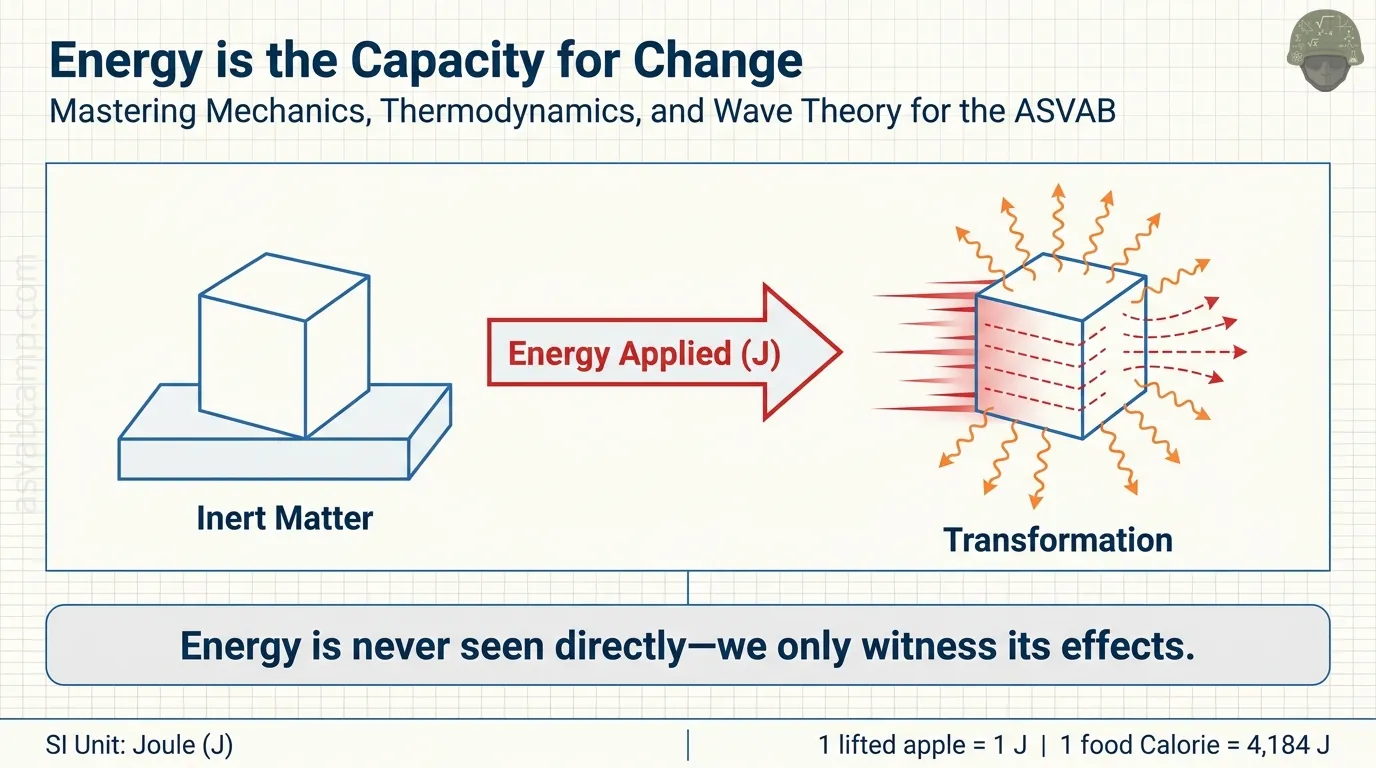
Energy is the capacity to make something change: to move an object, warm it, light it, stretch it or rearrange its chemical bonds. You never see energy directly; you notice what it does.
The SI unit of energy is the joule (J). Lifting a small apple about 1 m takes roughly 1 J. Larger amounts use kilojoules (1 kJ = 1,000 J) and megajoules (1 MJ = 1,000,000 J). Food labels use Calories, where one food Calorie is about 4,184 J.
Energy can move from one object to another and change from one store to another, but the total amount in a closed accounting never changes. That bookkeeping idea is the backbone of this lesson.
Common forms and stores of energy
Physicists sort energy into a few useful categories. Kinetic energy belongs to anything that moves. Gravitational potential energy depends on an object's height in a gravitational field. Elastic potential energy is stored in stretched or squeezed springs, bands and bows.
Chemical energy is stored in the bonds of fuels, food and batteries. Electrical energy is carried by moving charges in circuits. Thermal energy is the random motion of particles inside matter. Nuclear energy is stored in the nuclei of atoms and released in reactors and in the Sun. Light and sound carry energy as waves.
A rolling bowling ball has mainly kinetic energy; a book on a high shelf has gravitational potential energy relative to the floor.
Kinetic energy depends on mass and speed squared
Kinetic energy is the energy of motion:
Mass is in kilograms, speed in m/s, and the result in joules. A 2 kg ball rolling at 5 m/s has
Because speed is squared, doubling speed makes kinetic energy four times larger, and tripling speed makes it nine times larger. Doubling the mass only doubles it.
Gravitational potential energy near Earth
Lifting an object against gravity stores energy that can be released when it comes back down. Near Earth's surface the stored amount is
where is mass in kg, is about 9.8 m/s² (often rounded to 10), and is height in meters above a chosen reference level. A 4 kg box raised 2.5 m gains about
Only changes in height matter, so the reference level is your choice; the floor or the ground is usual. Doubling either the mass or the height doubles the potential energy.
Elastic potential energy
Elastic potential energy is stored when a material is stretched, compressed, bent or twisted and can spring back. A drawn bow, a compressed car spring and a stretched rubber band are examples.
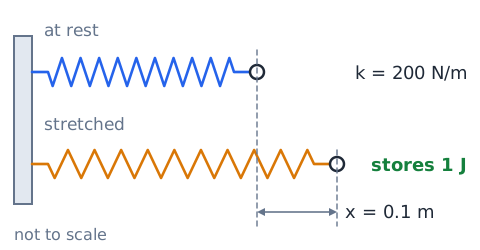
For an ideal spring, the stored energy is
where is the spring constant in N/m and is the stretch or compression in meters. A spring with
N/m stretched 0.1 m stores 1 J. Because is squared, doubling the stretch stores four times the energy.
Chemical and electrical conversions
Many devices are energy converters. A flashlight battery turns chemical energy into electrical energy, and the bulb turns that into light and some heat. A car engine turns the chemical energy of fuel into motion, with much of it ending up as heat in the exhaust and radiator.
Your muscles convert chemical energy from food into motion and body heat. A solar panel turns light into electrical energy, while an electric motor turns electrical energy into motion. A generator does the reverse. In each case, no energy appears from nothing; it is changed from one store to another.
Conservation of energy in an isolated system
The law of conservation of energy says that energy cannot be created or destroyed. In an isolated system, where no energy enters or leaves, the total amount stays the same, even while it shifts between kinetic, potential, thermal and other forms.
When a bicycle coasts to a stop because of friction, its kinetic energy is not lost. It becomes thermal energy in the brakes, tires and air, plus a little sound. Tracking every transfer always accounts for the full starting amount.
Mechanical energy versus total energy
Mechanical energy is the sum of kinetic and potential energy of an object's motion and position. Total energy also includes thermal, chemical, sound and every other store.
When friction and air resistance are negligible, mechanical energy stays nearly constant: whatever potential energy is lost becomes kinetic energy, and vice versa. A pendulum swinging in a vacuum would keep rising to the same height.
In real life, friction steadily turns some mechanical energy into thermal energy, so a playground swing gradually loses height if nobody pushes. The mechanical energy decreases, but total energy is still conserved, because the missing amount warmed the chains, the air and the rider.
Transformation on a descending coaster
Picture a roller coaster car hauled to the top of the first hill. There it has its maximum gravitational potential energy and very little speed. As it descends, height drops and speed grows: potential energy is changing into kinetic energy.
At the bottom of the drop, kinetic energy is at its peak and speed is highest. Climbing the next hill turns kinetic energy back into potential energy, so the car slows.
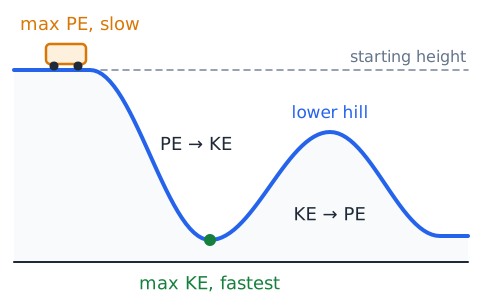
Because some energy turns into heat and sound from friction and air drag, each later hill must be lower than the first. No car can coast over a hill taller than its starting point without a motor adding energy.
Work is force along displacement
In physics, work is done when a force moves an object through a distance in the direction of the force. Work equals the force times the distance moved along that force's direction, and it is measured in joules: 1 J is 1 newton acting over 1 meter.
Pushing a cart with 20 N for 3 m in the direction of the push does 60 J of work. Pushing hard on a wall that does not move does no work on the wall, however tiring it feels. Work is a way of transferring energy into or out of an object.
Positive, negative, and zero work
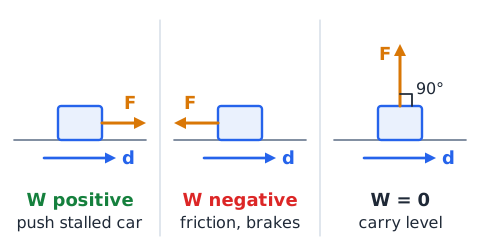
The sign of work depends on how the force lines up with the motion. When force and displacement point the same way, the work is positive and energy is added to the object, as when you push a stalled car forward.
When the force opposes the motion, the work is negative and energy is removed; friction on a sliding crate and brakes on a car do negative work.
When the force is perpendicular to the motion, the work is zero. Carrying a backpack across a level room at steady height does no work on it against gravity, and gravity does no work on a satellite in a circular orbit. The net work on an object equals its change in kinetic energy.
Power compares rate of energy transfer
Power is the rate at which energy is transferred or work is done:
Energy is in joules, time in seconds, and power in watts (W), where 1 W = 1 J/s. A motor that does 1,800 J of work in 30 s delivers 60 W. Two climbers of equal weight who climb the same stairs do equal work, but the faster climber produces more power.
Energy, power, and kilowatt-hours
Watts measure power, the rate of energy use. Energy itself is power multiplied by time. Utility companies bill energy in kilowatt-hours (kWh): one kilowatt of power used for one hour.
One kWh equals 1,000 W times 3,600 s, which is 3,600,000 J. A 1,500 W space heater running for 2 hours uses 3 kWh. A trap answer gives energy in watts or power in kWh; watch the units.
Efficiency and what counts as useful output
Efficiency compares the useful energy output of a device with the total energy put in:
Efficiency = useful output energy divided by total input energy, times 100%.
What counts as useful depends on the job. For a light bulb, light is useful and heat is waste; for a space heater, heat is the useful output. An LED that turns 40 J of every 100 J into visible light is 40% efficient for lighting.
No real machine reaches 100%, because some energy always ends up as unwanted heat, sound or vibration. An efficiency above 100% would mean energy was created, which never happens. The wasted energy is not destroyed; it is just not in a useful form.
Temperature and thermal energy differ
Temperature measures the average kinetic energy of the particles in a substance: how vigorously, on average, they jiggle. A thermometer reads temperature.
Thermal energy, or internal energy, is the total energy of all the particles, so it depends on the amount and type of matter, not only on temperature. A spark from a sparkler can be hotter than 1,000 °C yet hardly burns your hand, because it holds very little total energy. A large lake at 15 °C holds far more internal energy than a cup of hot coffee, because it contains vastly more particles.
Heat is transferred energy, not “hotness”
In physics, heat means energy transferred from one object to another because of a temperature difference. It always flows on its own from the hotter object to the colder one.
Objects do not contain heat; they contain internal energy. Heat is the name for energy in transit. When you hold an ice cube, energy flows from your hand into the ice, which is why your hand feels cold. Cold is not something that flows into you; your hand feels cold because it is losing energy. Heat is measured in joules like any other energy.
Thermal equilibrium and the zeroth law
When two objects at different temperatures touch, energy flows from warmer to cooler until both reach the same temperature. They are then in thermal equilibrium, and the net flow stops.
The zeroth law of thermodynamics adds that if object A is in equilibrium with B, and B is in equilibrium with C, then A and C are also at the same temperature. This is why a thermometer works: it reaches equilibrium with the object it touches, then reports its own temperature.
A metal bench and a wooden bench in the same shade are at the same temperature, even though the metal feels colder because it conducts energy away from your hand faster.
Celsius, Kelvin and Fahrenheit
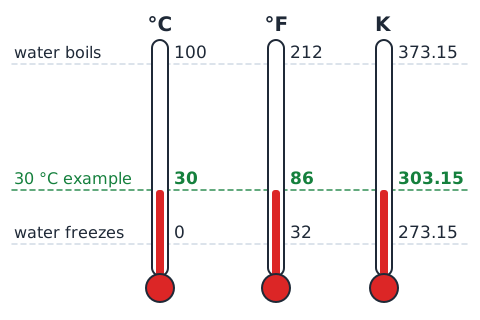
Three temperature scales are common. Celsius sets water's freezing point at 0 °C and boiling point at 100 °C at sea level. Fahrenheit sets those points at 32 °F and 212 °F. Kelvin starts at absolute zero, the lowest possible temperature, and uses Celsius-sized steps with no degree sign.
So 30 °C is 86 °F and 303.15 K. Kelvin values are never negative.
Specific heat capacity and temperature change
Specific heat capacity is the energy needed to raise the temperature of 1 kg of a substance by 1 °C. Its unit is J/(kg·°C).
Energy absorbed equals mass times specific heat times temperature change. Substances with a high specific heat warm and cool slowly. Water's is unusually high, about 4,200 J/(kg·°C), while many metals are only a few hundred. That is why a metal pan heats quickly while the water in it lags, and why coastal climates swing less than inland ones.
Conduction through direct interaction
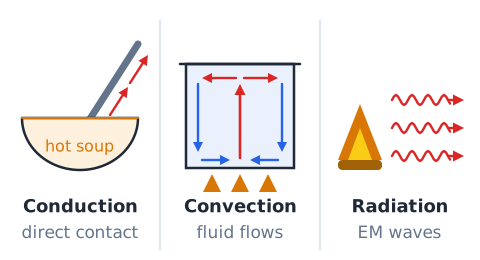
Conduction is energy transfer through direct contact, as faster-moving particles bump into slower neighbors and pass energy along. It happens mostly in solids, and no material moves from place to place.
A metal spoon in hot soup grows warm at its handle by conduction. Metals are good conductors because free electrons carry energy quickly. Wood, plastic, glass, still air and foam are poor conductors, called insulators. A tile floor feels colder than a rug at the same temperature because tile conducts energy away from bare feet faster.
Convection via bulk movement of fluid
Convection is energy transfer by the bulk flow of a liquid or gas. Fluid near a heat source warms, expands and becomes less dense, so cooler, denser fluid sinks and pushes it upward. The cycle forms a convection current.
Warm air rising from a floor vent, water circulating in a heated pot, sea breezes along a coast and the slow churning of Earth's mantle are all convection. It cannot occur in a solid because the particles cannot flow.
Radiation travels as electromagnetic energy
Radiation is energy carried by electromagnetic waves, mostly infrared at everyday temperatures. It needs no medium and can cross empty space, which is how sunlight warms Earth across the vacuum between them.
Every object emits thermal radiation, and hotter objects emit far more. You feel radiation as warmth on your face near a campfire, even when the air between is cool. Dark, dull surfaces absorb and emit radiation well; shiny, light surfaces reflect much of it, which is why emergency blankets are silvered.
Insulation slows transfers rather than creating heat
Insulation does not produce warmth or cold; it slows the flow of energy. A winter coat keeps you warm because it slows the escape of your own body heat. The same coat wrapped around a block of ice would keep the ice frozen longer.
Good insulators trap still air in small pockets, which blocks convection and conducts poorly. A thermos bottle fights all three pathways: a vacuum gap stops conduction and convection, and silvered walls reduce radiation. Double-pane windows and attic fiberglass work on the same principles.
Expansion and phase changes
Most materials expand when heated, because their particles move more and push farther apart. They contract when cooled. Bridges have expansion joints, and power lines sag more on hot days.
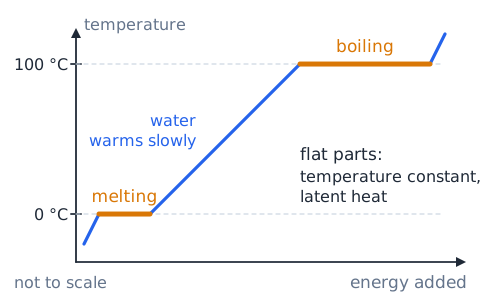
Adding enough energy can also change a substance's state. Melting turns a solid into a liquid; boiling and evaporation turn a liquid into a gas. The reverse processes, condensation and freezing, release energy. During melting or boiling, the temperature holds steady while energy goes into breaking particle attractions rather than raising speed. Water is a notable exception to expansion rules: it expands as it freezes, so ice floats.
Latent heat and evaporation
Latent heat is the energy absorbed or released during a change of state at constant temperature. A pot of boiling water stays near 100 °C at sea level however high the burner is set, because added energy is pulling molecules into the gas phase.
Evaporation also absorbs energy. The fastest-moving molecules escape the liquid surface and take their energy with them, leaving the rest cooler. That is why sweating cools you: as sweat evaporates, it carries energy away from your skin. Humid air slows evaporation, so sweat cools less well. Condensing steam releases the same latent heat, which makes steam burns severe.
Heat engine limits and energy quality
A heat engine, such as a car engine or a power plant turbine, uses heat flowing from a hot source to a cold surrounding to do work. Some energy must always be released to the cold side, so no heat engine can convert all of its input heat into work.
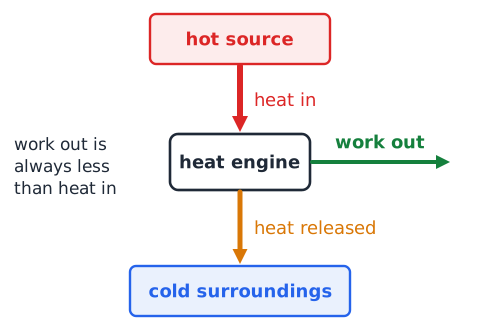
Typical gasoline car engines turn roughly a quarter to a third of fuel energy into motion. The rest leaves as heat. As energy spreads out into warm surroundings it becomes less useful, even though none is lost. Engineers talk about energy quality: concentrated energy is easier to use than the same amount spread thinly.
What a wave transports
A wave is a disturbance that travels from place to place and carries energy without carrying the material along with it. The medium's particles only wiggle around their resting positions.
A cork floating on a pond bobs up and down as ripples pass but does not ride away with them. A stadium wave moves around the arena while each fan stays at their seat. Mechanical waves, such as sound, water waves and earthquake waves, need a medium. Electromagnetic waves, such as light and radio, do not.
Transverse waves and longitudinal waves
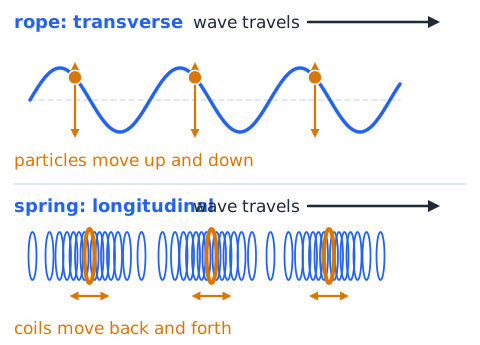
Waves are classified by how the medium moves relative to the direction the wave travels.
In a transverse wave, particles move perpendicular to the wave's travel. Flicking one end of a rope up and down sends a transverse wave along it. Light and other electromagnetic waves are also transverse.
In a longitudinal wave, particles move back and forth parallel to the wave's travel. Pushing and pulling one end of a stretched coil spring sends a longitudinal wave. Sound in air is longitudinal: air molecules crowd together and spread apart along the direction of travel.
Wavelength, crest, trough and compression
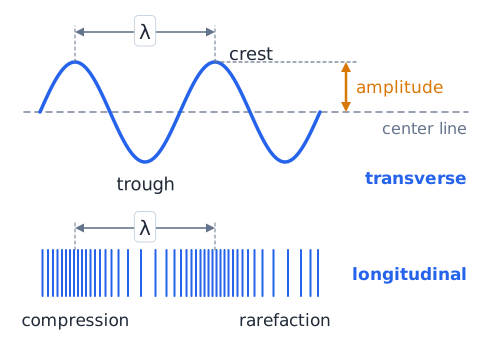
In a transverse wave, the highest points are crests and the lowest points are troughs. Wavelength is the distance from one crest to the next, or between any two matching points, and is written with the Greek letter lambda (λ).
In a longitudinal wave, regions where particles crowd together are compressions, and stretched-out regions are rarefactions. Here, wavelength is the distance from one compression to the next.
Amplitude is the maximum displacement of the medium from its rest position. It is measured from the center line to a crest, not from crest to trough.
Frequency, period and hertz
Frequency is the number of complete cycles that pass a point each second. It is measured in hertz (Hz), where 1 Hz means one cycle per second.
Period is the time for one complete cycle, measured in seconds. Frequency and period are reciprocals: period equals one divided by frequency. A wave at 50 Hz has a period of 0.02 s; a wave with a 0.5 s period has a frequency of 2 Hz. To find frequency, divide the number of cycles by the time they took.
The wave equation v = f λ
Every wave obeys one simple relationship:
Wave speed is in m/s, frequency in hertz, and wavelength in meters. Rearrange it to
A 170 Hz note in air where sound travels 340 m/s has a wavelength of 2 m. For a given speed, raising frequency shortens the wavelength.
Amplitude, intensity, pitch and loudness
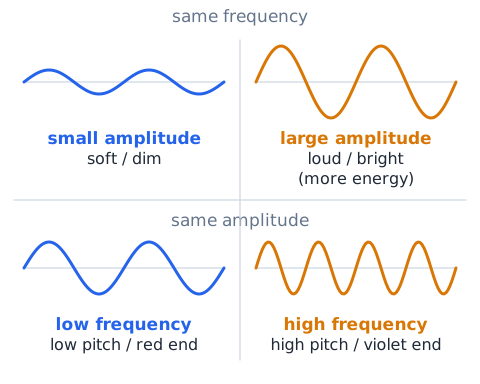
Amplitude and frequency control different things. Amplitude sets how much energy a wave carries; a larger amplitude means a more intense wave. In sound, greater intensity is heard as greater loudness, which is often measured in decibels.
Frequency sets the pitch of a sound: higher frequency means higher pitch. A whistle has a high pitch; a tuba has a low pitch. You can play the same note softly or loudly, which keeps the frequency but changes the amplitude. In light, frequency sets the color and amplitude sets the brightness.
Sound is mechanical and needs a medium
Sound is a mechanical wave, a chain of pressure changes passed from particle to particle. It needs a medium, such as air, water or a solid, and cannot travel through a vacuum.
If an alarm clock rings inside a jar while the air is pumped out, the sound fades even though the clapper keeps moving. Astronauts on a spacewalk use radios because sound cannot cross empty space. Light, by contrast, reaches us through the vacuum from the Sun.
Speed of sound is not a universal constant
The speed of sound depends on the medium and its conditions. In air at about 20 °C, sound travels roughly 343 m/s, and it moves faster in warmer air. In water it is around 1,500 m/s, and in steel it is several thousand meters per second.
Sound is much slower than light, which travels about m/s. That is why you see lightning before you hear thunder. Thunder takes about 3 s to cover each kilometer, so a 6 s delay means the strike was roughly 2 km away.
Echoes, reflection and travel time
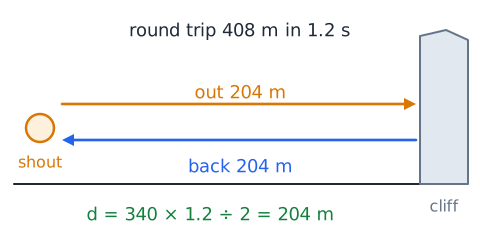
An echo is sound reflected from a surface back to the listener. The measured echo time covers the trip out to the surface and back, so the distance to the surface uses half the total path:
If a shout returns from a cliff after 1.2 s and sound travels at 340 m/s, the round trip is 408 m and the cliff is 204 m away. Bats, ships with sonar and some parking sensors rely on this idea.
Ultrasound and infrasound
Healthy young people hear frequencies from about 20 Hz to 20,000 Hz. Sound above that range is called ultrasound; sound below it is called infrasound.
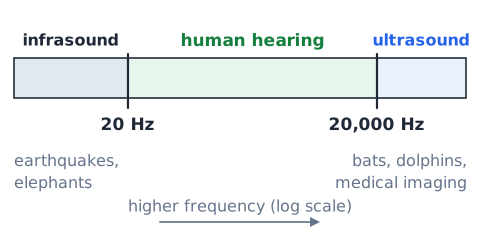
Ultrasound is used in medical imaging, where high-frequency pulses reflect from tissue boundaries to build a picture, and in cleaning and in animal communication, since bats and dolphins use it. Infrasound is produced by earthquakes, volcanoes, heavy machinery and large animals such as elephants, and it can travel long distances. Both are ordinary sound waves; they just lie outside human hearing.
Doppler effect: approaching and receding sources
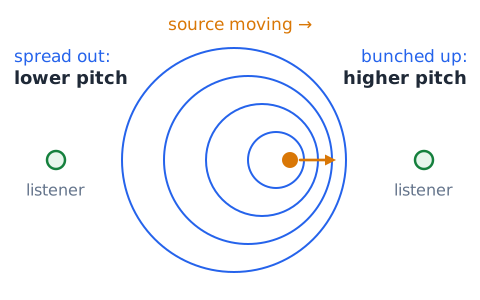
When a wave source moves relative to a listener, the received frequency changes. This is the Doppler effect.
As an ambulance approaches, each wave crest is sent from a slightly closer point, so the crests bunch up. The listener receives a higher frequency and hears a higher pitch. As it moves away, the crests spread out, so the pitch drops. The siren itself never changes its emitted frequency.
The same effect applies to light. Light from galaxies moving away from us is shifted toward longer, redder wavelengths. Police radar and weather radar also use Doppler shifts to measure speed.
Wave behavior at a boundary
When a wave reaches the boundary between two media, some of it reflects back, some passes through, and some may be absorbed. The part that passes into the new medium usually changes speed.
The frequency is set by the source, so it stays the same when the wave crosses the boundary. Since
a change in speed must change the wavelength: slower speed means shorter wavelength, and faster speed means longer wavelength.
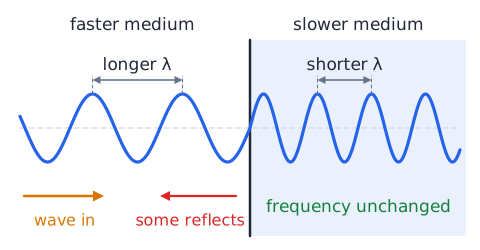
If the wave strikes the boundary at an angle, the change of speed also bends its direction. That bending is called refraction.
Interference and standing waves
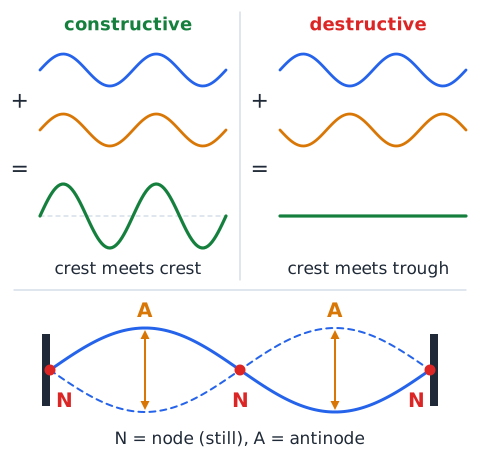
When two waves overlap, their displacements add. Where crest meets crest, the result is a larger wave; this is constructive interference. Where crest meets trough, they partly or fully cancel; this is destructive interference. After passing through each other, both waves continue unchanged.
Noise-canceling headphones produce sound that interferes destructively with outside noise. When waves reflect back and forth in a fixed space, such as a plucked guitar string, interference can create a standing wave, with points that do not move (nodes) and points of maximum motion (antinodes). Only certain frequencies fit, which sets an instrument's notes.
Light is electromagnetic radiation
Light is an electromagnetic wave: linked electric and magnetic fields that sustain each other as they travel. It needs no medium, and in a vacuum every electromagnetic wave travels at the same speed:
Light also obeys
Because is fixed in vacuum, higher frequency always means shorter wavelength. Red light has a wavelength near 700 nm; violet light is near 400 nm. Light slows down inside glass, water and other transparent materials.
Electromagnetic spectrum order
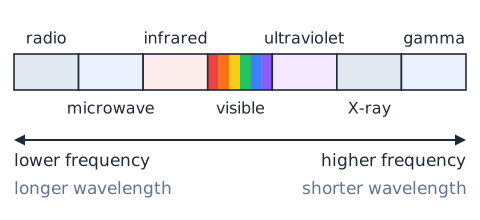
The electromagnetic spectrum, from lowest frequency and longest wavelength to highest frequency and shortest wavelength, runs: radio waves, microwaves, infrared, visible light, ultraviolet, X-rays and gamma rays.
Within visible light, the order is red, orange, yellow, green, blue and violet, with red at the low-frequency end. A memory phrase helps: "Rabbits Mate In Very Unusual eXpensive Gardens" for radio, microwave, infrared, visible, ultraviolet, X-ray, gamma. All of these are the same kind of wave, differing only in frequency and wavelength.
Photon energy rises with frequency
Light is emitted and absorbed in small packets of energy called photons. Each photon's energy is proportional to its frequency: photon energy equals Planck's constant times frequency. Double the frequency and each photon carries twice the energy.
That explains why ultraviolet light can cause sunburn while bright red light cannot: each ultraviolet photon carries enough energy to damage skin cells. X-ray and gamma-ray photons carry even more, which is why exposure to them is limited. Radio photons carry very little energy each.
Reflection and plane mirrors
When light reflects from a smooth surface, the angle of reflection equals the angle of incidence. Both angles are measured from the normal, an imaginary line perpendicular to the surface at the point where the ray strikes. A ray arriving 35° from the normal leaves 35° from the normal on the other side.
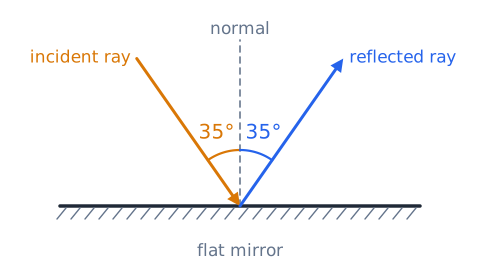
A plane (flat) mirror forms an upright, virtual image that appears as far behind the mirror as the object is in front of it, and is the same size. The image is reversed front to back, which is why text looks backward. Rough surfaces scatter light in many directions instead, called diffuse reflection.
Refraction, lenses and a common illusion
Refraction is the bending of light as it passes at an angle from one material into another where its speed differs. Light slows going from air into water or glass and bends toward the normal; it speeds up and bends away from the normal when leaving.
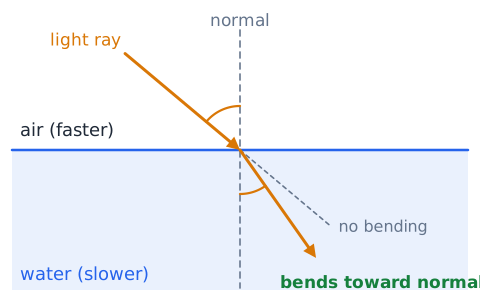
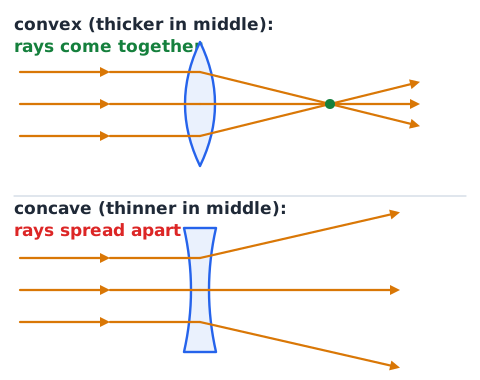
Refraction causes a familiar illusion: a straw in a glass of water looks bent at the surface, and a pool looks shallower than it really is. Lenses use refraction on purpose. A convex lens, thicker in the middle, brings light rays together and can magnify; a concave lens spreads rays apart. Prisms separate white light into colors because each color bends by a slightly different amount.
Absorption, transmission and object color
When light strikes an object, it can be reflected, transmitted (passed through) or absorbed. Absorbed light energy usually becomes thermal energy, which is why dark clothing feels warmer in sunlight.
An opaque object's color is the color of light it reflects. A green leaf absorbs most red and blue light and reflects green. A white shirt reflects all visible colors; a black one absorbs nearly all of them. Transparent colored glass transmits its own color and absorbs the rest. Under red light only, a blue object looks nearly black because there is no blue light for it to reflect.
Shadows, diffraction and scale
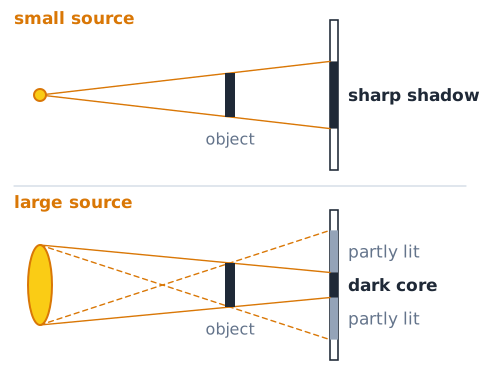
A shadow forms when an opaque object blocks light traveling in straight lines. A small light source makes sharp shadows; a large source makes a dark core with a softer, partly lit edge.
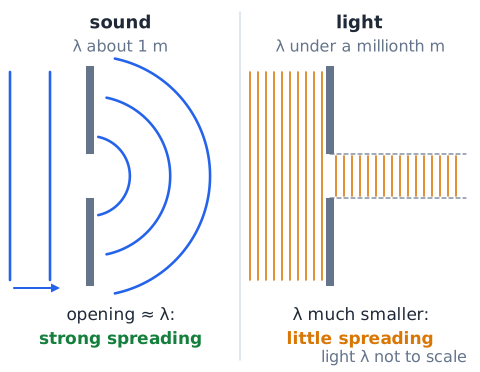
Waves also spread out as they pass through openings or around edges, called diffraction. The effect is strongest when the opening is about the same size as the wavelength. Sound waves, with wavelengths around a meter, bend easily around doorways, so you can hear someone in the next room. Visible light, with wavelengths under a millionth of a meter, diffracts very little around everyday objects, so you cannot see around the corner.
Graphs of waves and energy
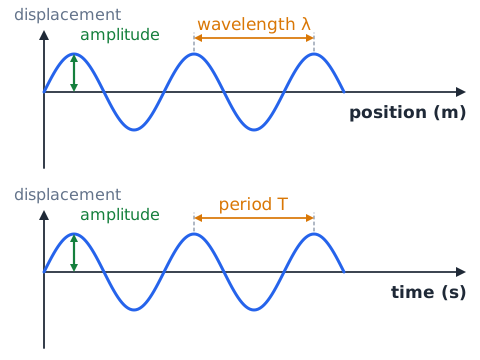
Two wave graphs look alike but mean different things. A displacement versus position graph is a snapshot of the whole wave at one instant; the distance between crests is the wavelength. A displacement versus time graph shows one point in the medium over time; the time between crests is the period, and frequency is one divided by that.
In both, the height from the center line to a crest is the amplitude. Always check the horizontal axis label before reading a spacing.
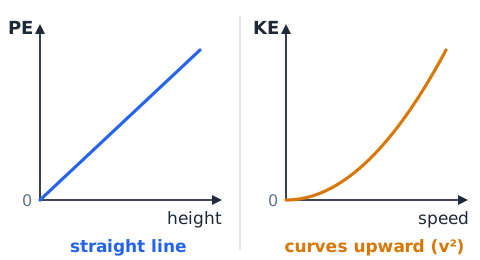
Energy graphs follow the formulas: potential energy rises in a straight line with height, while kinetic energy plotted against speed curves upward, because energy grows with the square of speed.
Energy and waves in everyday technology
Energy and wave ideas show up throughout modern life. Microwave ovens use microwaves absorbed by water in food. Cell phones, Wi-Fi and GPS use radio and microwave signals. Fiber-optic cables carry data as light that reflects along glass strands.
Medical ultrasound and sonar use sound echoes. Thermal cameras detect infrared radiation from warm objects. Hybrid cars recover kinetic energy during braking and store it in batteries. Heat pumps move thermal energy from cooler outdoor air into a warmer house, using electrical energy to run against the natural direction of heat flow. Each example uses a principle from this lesson.
Common misconception: “energy is used up”
People say they "used up" energy, but energy is never destroyed. What actually happens is that energy changes into less useful forms, usually thermal energy spread into the surroundings.
When a phone battery runs down, its chemical energy has become light from the screen, sound, radio signals and warmth. When a car stops, its kinetic energy becomes heat in the brakes. The total is unchanged; it is just spread out where it is hard to use again. Energy conservation and "running out" of useful energy are both true at once.
Common misconception: “heat rises”
"Heat rises" is a common phrase but a misleading one. Heat is energy transfer, and it flows from hotter to colder in every direction: down, sideways and up.
What rises is warm fluid. Warmer air or water is less dense than its cooler surroundings, so it is pushed upward by buoyancy while cooler fluid sinks, which is convection. A hot stove burner warms a pan above it by conduction and warms your hand beside it by radiation, neither of which depends on rising.
Common misconception: waves carry the material away
A wave transports energy, not the medium. As a sound wave crosses a room, air molecules vibrate in place; air from the speaker does not blow across to your ear.
Ocean swells can travel thousands of kilometers, yet the water in each swell mostly moves in small loops and ends up near where it started. Only near shore, where waves break, does water surge forward. The idea to keep: energy goes along, matter stays behind.
Common misconception: amplitude and frequency
Learners often mix up amplitude and frequency. Amplitude is how far the medium moves from rest, and it controls energy, loudness and brightness. Frequency is how many cycles occur per second, and it controls pitch and color.
Turning up a speaker's volume increases amplitude, not frequency; the note's pitch stays the same. Moving a guitar finger up the neck to a higher note changes frequency, not loudness. Also, frequency does not change when a wave enters a new medium; its speed and wavelength do.
Quick strategy for word problems
For energy and wave word problems, first list the given values with their units, then write what is asked for and its unit. Next, pick the matching relationship:
work = force times distance,
efficiency = useful output over input,
and echo distance
Convert minutes to seconds and kilowatts to watts first. Finally, check whether the answer is reasonable: an efficiency over 100% or a negative kelvin temperature signals a mistake.
ASVAB-style scientific reasoning boundaries
ASVAB General Science questions in this area reward clear concepts over heavy math. Expect to identify forms of energy, choose the right heat-transfer process, compare wave properties and do short calculations with friendly numbers.
You will not need calculus, detailed thermodynamics or advanced optics. When a choice says energy is created, destroyed or "used up," or that sound crosses a vacuum, or that efficiency exceeds 100%, eliminate it. Watch units carefully, since joules, watts, hertz and kelvins are frequently swapped in distractors. If a question names a scenario, first identify which single principle it tests, then answer from that principle.
Worked 01 — kinetic energy with a speed change
An 800 kg car speeds up from 10 m/s to 20 m/s. How much does its kinetic energy increase?
The increase is 120,000 J. Doubling the speed made the kinetic energy four times larger, as speed-squared predicts.
Worked 02 — gravitational potential energy change
A 60 kg hiker climbs a trail that rises 150 m. Using
how much gravitational potential energy does the hiker gain?
That is about 88 kJ. Only the vertical rise matters, not the length of the winding trail.
Worked 03 — frictionless energy conversion
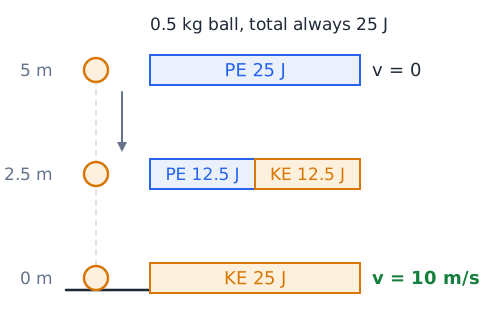
A 0.5 kg ball is dropped from rest 5 m above the ground. Ignoring air resistance and using
find its kinetic energy and speed just before landing.
Starting potential energy:
All of it becomes kinetic energy, so KE = 25 J at the ground.
Halfway down, it has 12.5 J of each kind.
Worked 04 — work and direction
A shopper lifts a 10 kg bag straight up 1.2 m, then carries it 20 m across a level parking lot at the same height. Use
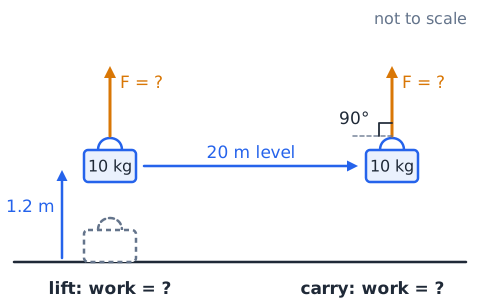
Lifting: the upward force is about 100 N over 1.2 m, so the shopper does 120 J of work on the bag. Carrying it level: the upward holding force is perpendicular to the sideways motion, so it does zero work on the bag.
If the shopper then lowers the bag back down, the hand's upward force opposes the motion and does negative work.
Worked 05 — watts and kilowatt-hours
A 60 W lamp runs 5 hours a day for 30 days. How much energy does it use, and what does it cost at 15 cents per kWh?
Total time: 150 h. Energy:
kWh. Cost:
Worked 06 — simple efficiency
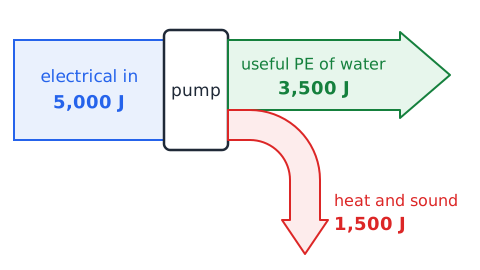
An electric pump uses 5,000 J of electrical energy to lift water, and the water gains 3,500 J of gravitational potential energy. Find the pump's efficiency.
The other 1,500 J becomes heat and sound in the motor and pipes. Total output still equals total input; only 70% of it is useful.
Worked 07 — temperature conversion
Normal body temperature is about 37 °C. Express it in Fahrenheit and Kelvin.
As a bonus fact, −40 is the one temperature where Celsius and Fahrenheit agree.
Worked 08 — specific heat calculation
How much energy is needed to warm 2 kg of water from 20 °C to 30 °C? Take water's specific heat as 4,200 J/(kg·°C).
The temperature change is 10 °C. Energy equals mass times specific heat times temperature change: 2 times 4,200 times 10 equals 84,000 J, or 84 kJ.
The same energy would warm 2 kg of aluminum, with a specific heat near 900, by over 45 °C.
Worked 09 — count frequency and period
A buoy rises and falls 24 complete times in 8 s as waves pass. Find the frequency and period.
Check: 24 cycles times 0.33 s each gives about 8 s.
Worked 10 — wave speed or wavelength
Ripples on a pond have crests 0.4 m apart and pass a post 5 times each second. How fast do they travel?
An FM radio station broadcasts at 100 MHz. Its wavelength in air is about
Worked 11 — echo distance uses half the trip
A ship's sonar sends a pulse straight down and hears the echo from the seafloor 0.8 s later. Sound in seawater travels about 1,500 m/s. How deep is the water?
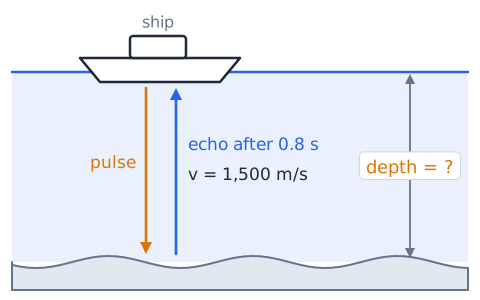
Round-trip distance:
Depth is half of that: 600 m. Forgetting to halve would give an answer twice too large.
Worked 12 — infrared versus ultraviolet
Both infrared and ultraviolet light are invisible to us, but they lie on opposite sides of the visible band. Which has higher frequency, shorter wavelength and more energy per photon?
Infrared lies just beyond red, the low-frequency end of the visible spectrum. Ultraviolet lies beyond violet, the high-frequency end. Therefore ultraviolet has higher frequency and shorter wavelength than infrared.
Because photon energy rises with frequency, each ultraviolet photon carries more energy. That is why ultraviolet can sunburn skin, while infrared from a heat lamp mostly just warms it. Both travel at the same speed in vacuum.
Worked 13 — identify convection
A pot of soup heats on a stove. A pinch of pepper dropped near the bottom rises in the middle, spreads at the top and sinks at the sides. Which heat-transfer process does this show?
The soup near the burner warms, expands and becomes less dense, so it rises; cooler soup at the surface sinks to replace it. The circulating loop is a convection current, carrying energy through the whole pot.
Conduction still passes energy from the burner through the pot's metal base, and the burner glows with some radiation, but the pepper's looping path is the visible sign of convection.
Worked 14 — boundary frequency and wavelength
A 500 Hz sound travels at 340 m/s in air and then enters water, where its speed is 1,500 m/s. Find its wavelength in each medium.
In air:
In water, the frequency remains 500 Hz because the source sets it. So
The faster medium gives a longer wavelength. The pitch a diver hears is unchanged.
Practice 01 — energy scaling
A cart's speed triples. How does its kinetic energy change? Answer: it becomes 9 times larger.
A box is lifted to twice its original height. Answer: its potential energy doubles.
A runner with twice the mass moves at twice the speed of a friend. Answer: kinetic energy is
times larger.
Practice 02 — classify all three heat pathways
Name the main heat-transfer process in each case.
A skillet handle grows hot. Answer: conduction.
A radiator warms a room as air circulates. Answer: convection.
Your cheeks warm in front of a bonfire. Answer: radiation.
The Sun warms a parked car through space. Answer: radiation.
Ice melts in your hand. Answer: conduction.
Practice 03 — spot incorrect units
Find the error in each statement.
"The heater has an energy of 1,500 W." Answer: watts measure power; energy is in joules or kWh.
"The wave's frequency is 6 meters." Answer: frequency is in hertz; meters fit wavelength.
"The room was 295 °K." Answer: kelvins use no degree sign; write 295 K.
"The car's kinetic energy was 50 N." Answer: newtons measure force; energy is in joules.
Practice 04 — distinguish sound and light
Which travels through a vacuum, sound or light? Answer: light only.
Which is longitudinal in air? Answer: sound.
Which is faster in air? Answer: light, by about a million times.
Which is an electromagnetic wave? Answer: light.
Which can be ultrasonic? Answer: sound, above about 20,000 Hz.
Practice 05 — chart interpretation
A displacement versus time graph for one point on a string shows a peak every 0.25 s, reaching 3 cm above the center line. Find the period, frequency and amplitude.
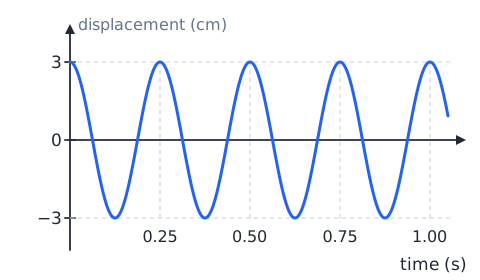
Answer: period 0.25 s; frequency
amplitude 3 cm.
If the wavelength is 1.5 m, what is the wave speed? Answer:
Practice 06 — efficiency and conservation
A blender takes in 400 J and delivers 100 J of useful mechanical work. Find its efficiency and the energy not used usefully. Answer: 25%; the other 300 J becomes heat and sound.
An advertisement claims a motor is 110% efficient. Is that possible? Answer: no; output cannot exceed input, since energy is not created.
Final recall map and targeted review
Energy is measured in joules; power, the rate of energy transfer, in watts, with
Kinetic energy is ; gravitational potential energy is . Work is force times distance along the force. Efficiency is useful output divided by input, always under 100%. Energy is never created or destroyed, only transferred or transformed.
Temperature is average particle energy; internal energy also depends on amount of matter. Heat flows from hot to cold by conduction, convection or radiation.
Waves carry energy, not matter. Sound is mechanical and longitudinal; light is electromagnetic and crosses a vacuum. Use
and echo distance . Higher light frequency means shorter wavelength and more energy per photon. Review any weak area with the worked examples above.
 English ▾