 ASVAB Camp
Learning outcomes and honest ASVAB scope
By the end of this lesson you should be able to sort matter into solids, liquids, gases and plasma, name each phase change, and tell physical changes from chemical ones. You will separate elements, compounds and mixtures, calculate density from mass and volume, and count protons, neutrons and electrons in atoms, isotopes and ions. You will also read simple chemical formulas and use periodic table groups and broad trends to reason through questions.
A note on scope: the General Science subtest covers physical and life science in general terms. Everything here is original practice written for this course. It is not taken from real test items and does not predict how many chemistry questions you will see.
Matter occupies space and has mass
Matter is anything that has mass and takes up space. Air in a tire, water in a canteen, the steel of a wrench and the cells in your body are all matter. You can prove air is matter: a deflated basketball weighs slightly less than the same ball pumped up, and a sealed balloon resists being squeezed because the air inside fills that space.
Some things you experience are not matter. Light, sound, heat and magnetic fields carry energy, but they have no mass of their own to put on a scale and they do not fill a container the way a gas does. On a test, ask two questions: does it have mass, and does it occupy volume?
Mass, weight and volume: different measurements
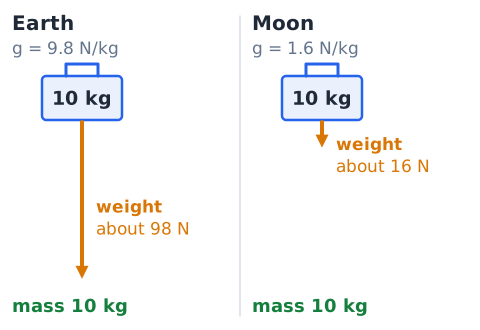
Mass is the amount of matter in an object, measured in grams or kilograms. It stays the same wherever the object goes. Weight is the pull of gravity on that mass, a force measured in newtons or pounds:
Here W is weight, m is mass, and g is the strength of gravity, about 9.8 N/kg on Earth. A 10 kg toolbox weighs about 98 N on Earth but only about 16 N on the Moon, where g is about 1.6 N/kg, yet its mass is still 10 kg. Volume is a third, separate idea: how much space something fills, measured in liters, milliliters or cubic centimeters.
Solid, liquid and gas: particle model
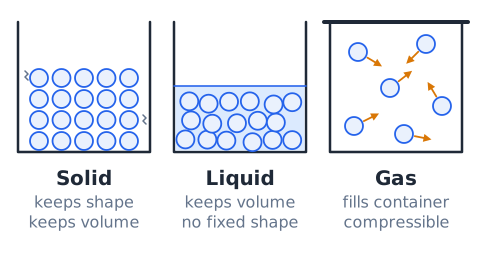
All matter is made of tiny particles (atoms, molecules or ions) that are always moving. The state of a sample depends on how tightly those particles are held together.
In a solid, particles are packed close and locked in place, vibrating but not sliding past one another, so a solid keeps its own shape and volume. In a liquid, particles are still close together but can slide around each other, so a liquid has a fixed volume but takes the shape of its container. In a gas, particles are far apart and move freely, so a gas has neither a fixed shape nor a fixed volume; it spreads out to fill whatever container holds it and can be compressed.
Plasma and the limits of the three-state model
Plasma is often called the fourth state of matter. It forms when a gas gets so much energy, from very high temperature or strong electric fields, that electrons are stripped from atoms. The result is a glowing mix of free electrons and positive ions that conducts electricity. Lightning, the Sun and other stars, and the glowing gas in a neon sign are examples.
The solid, liquid and gas model is a useful simplification, not a complete list. Some materials behave in between: glass is rigid but lacks an orderly crystal pattern, and gels or toothpaste hold a shape until pushed. For exam questions, stick with the four main states unless told otherwise.
Heating and cooling change particle motion
Temperature is a measure of the average kinetic energy of particles, meaning how fast they move. Heating a substance speeds up its particles; cooling slows them down.
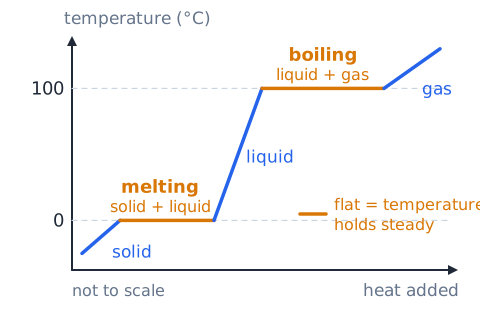
Picture an ice cube in a pan. As heat flows in, the water molecules vibrate harder until they break out of their fixed positions and the ice melts. Keep heating and the liquid molecules move fast enough to escape into the air as steam. Cooling runs the steps in reverse. During the actual change of state, the temperature holds steady even though heat is still flowing, because the energy goes into pulling particles apart or is released as they pull together. Most materials also expand when heated because faster particles push farther apart.
Phase changes: six useful names
Six terms cover the changes among solid, liquid and gas. Melting is solid to liquid, such as butter softening in a hot pan. Freezing is liquid to solid, such as a puddle turning to ice overnight. Vaporization is liquid to gas; when it happens only at the surface it is called evaporation, and when bubbles form throughout the liquid it is boiling. Condensation is gas to liquid, such as droplets forming on a cold soda can. Sublimation is solid straight to gas, as with dry ice. Deposition is gas straight to solid, as when frost forms on a car window. Melting, vaporization and sublimation absorb energy; the other three release it.
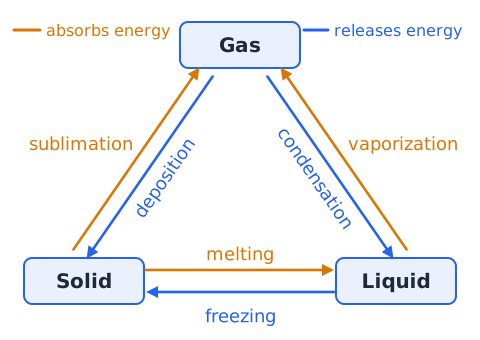
Example 1 — recognize a phase change
Problem: On a cold winter morning, a soldier notices a thin layer of ice crystals on the inside of a tent window, even though no liquid water was ever on the glass. Which phase change produced the crystals?
Step 1: Identify the starting state. The water came from water vapor in the warm, humid air inside the tent, so it started as a gas.
Step 2: Identify the ending state. The crystals are ice, a solid.
Step 3: Name the change. Gas going directly to solid, with no liquid stage, is deposition.
Answer: deposition.
Physical properties and physical changes
A physical property can be observed or measured without turning the substance into something else. Color, odor, hardness, melting point, boiling point, density, and the ability to conduct heat or electricity are all physical properties.
A physical change alters the form or appearance of a substance but leaves its chemical identity the same. Cutting a copper wire, crushing a soda can, dissolving salt in water, and every change of state are physical changes. When water boils, the steam is still made of water molecules, each with two hydrogen atoms and one oxygen atom. Many physical changes are easy to reverse: cool the steam and you have liquid water again. The test is simple: is it still the same substance afterward?
Chemical change means new substances
A chemical change, or chemical reaction, rearranges atoms to form one or more new substances with different properties. Rust forming on an iron fence, wood burning in a campfire, food cooking, and baking soda fizzing in vinegar are chemical changes.
Clues that a reaction may have happened include a new color, a gas produced when two substances are mixed, a solid (precipitate) forming when two liquids are combined, light, or an unexpected temperature change. These clues are hints, not proof; the real test is whether a new substance exists. A chemical property describes how a substance can react, such as flammability or the tendency to corrode. Chemical changes are usually hard to reverse: you cannot un-burn a log.
Elements, compounds and mixtures are different
A pure substance has a fixed composition throughout. There are two kinds. An element contains only one kind of atom and cannot be broken down into simpler substances by chemical means; gold, oxygen and carbon are examples. A compound is two or more elements chemically bonded in a fixed ratio, such as water or table salt (sodium chloride). A compound has its own properties, often very different from its elements: sodium is a reactive metal and chlorine a toxic gas, yet together they make a seasoning.
A mixture is a physical combination of two or more substances that are not bonded together. Each part keeps its own properties, and the proportions can vary, as in trail mix or sweetened tea.
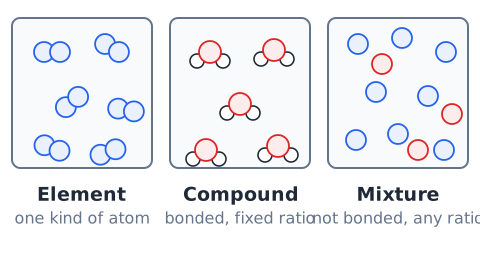
Homogeneous versus heterogeneous mixtures
Mixtures come in two kinds. A homogeneous mixture has the same composition everywhere in the sample, so you cannot see separate parts even under an ordinary microscope. Another name for it is a solution. Salt water, clean air, gasoline and brass (an alloy of copper and zinc) are examples.
A heterogeneous mixture has parts you can see or that differ from one region to another. A garden salad, gravel, oil floating on water, and a bottle of sand and water are heterogeneous. A handy test: if two spoonfuls taken from different spots could have different makeup, it is heterogeneous. Remember that a homogeneous mixture is still a mixture, not a pure substance.
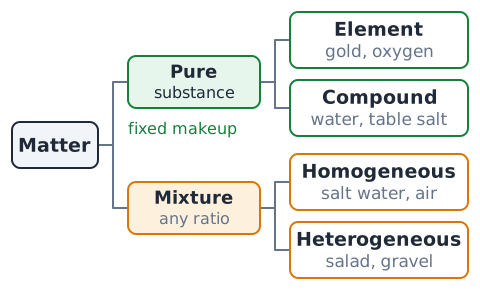
Example 2 — classify three samples
Problem: Classify each sample as an element, a compound, a homogeneous mixture or a heterogeneous mixture: (a) a bar of pure silver, (b) carbon dioxide gas, (c) a bowl of chicken noodle soup.
Step 1: Silver contains only silver atoms and cannot be broken down chemically, so (a) is an element.
Step 2: Carbon dioxide is carbon and oxygen bonded in a fixed 1 to 2 ratio, so (b) is a compound.
Step 3: The soup has visible noodles, chicken and broth, and spoonfuls differ, so (c) is a heterogeneous mixture.
Answer: element, compound, heterogeneous mixture.
Separating mixtures without changing molecules
Because the parts of a mixture are not bonded, they can be separated using differences in physical properties. No new substances form.
Filtration separates a solid from a liquid by particle size, as when a coffee filter holds back grounds. Evaporation removes a liquid and leaves a dissolved solid behind, which is how salt is harvested from seawater in shallow ponds. Distillation boils a liquid and condenses the vapor elsewhere, separating substances with different boiling points; it can produce drinking water from salt water. A magnet can pull iron filings out of sand. Decanting means pouring off a liquid after a solid settles. Chromatography separates dyes in ink by how far each travels along paper. Separating a compound into its elements, in contrast, requires a chemical reaction such as passing electricity through water.
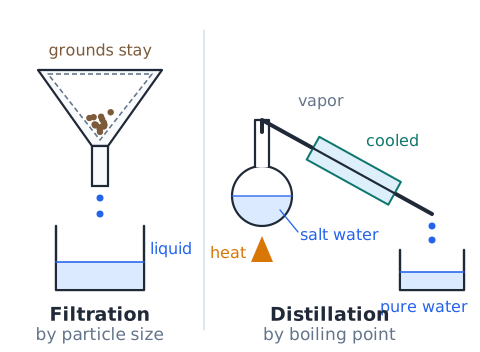
Density relates mass to volume
Density tells how much mass is packed into a given volume:
D is density, m is mass and V is volume. Common units are grams per cubic centimeter (g/cm³) for solids and grams per milliliter (g/mL) for liquids; 1 mL equals 1 cm³. Pure water has a density of about 1.0 g/mL.
Quick use: a block of wood has a mass of 120 g and a volume of 200 cm³, so
Rearranged,
Density is a property of the material, not of the sample size.
Example 3 — displacement and density
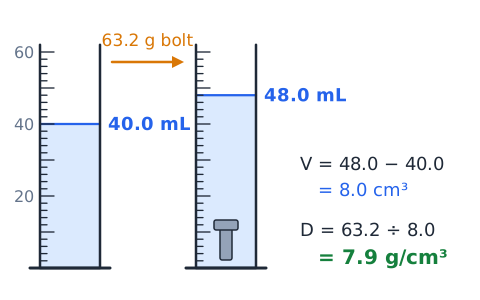
Problem: A graduated cylinder holds 40.0 mL of water. A small metal bolt with a mass of 63.2 g is dropped in, and the water rises to 48.0 mL. Find the density of the bolt.
Step 1: Volume of the bolt equals the water it displaced:
which is 8.0 cm³.
Step 2: Divide mass by volume.
Answer: 7.9 g/cm³, a value typical of iron or steel.
Atoms are building blocks; nuclei occupy tiny regions
An atom is the smallest unit of an element that still has that element's chemical identity. Atoms are extremely small; a single drop of water contains more atoms than there are grains of sand on most beaches.
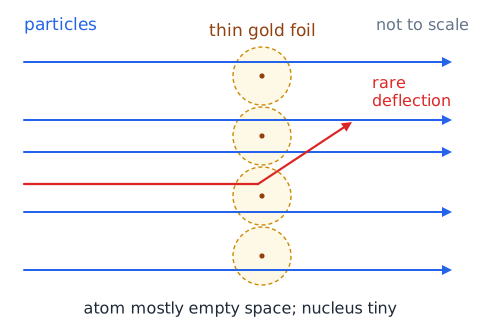
Almost all of an atom's mass is concentrated in its nucleus, a dense core at the center made of protons and neutrons. Electrons move in the much larger space around the nucleus. The nucleus is tiny compared with the whole atom: if an atom were blown up to the size of a football stadium, the nucleus would be about the size of a small marble on the center line. That means an atom is mostly empty space, which is why early experiments found that most particles fired at thin gold foil passed straight through.
Protons, neutrons and electrons
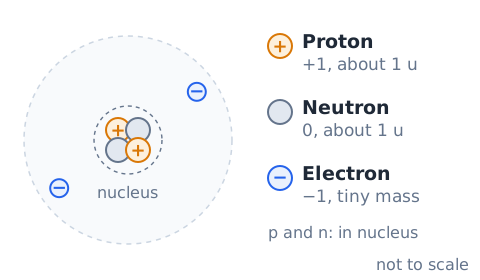
Atoms are built from three main subatomic particles. A proton carries a positive charge (+1) and sits in the nucleus. A neutron has no charge and also sits in the nucleus. Protons and neutrons have nearly the same mass, each about 1 atomic mass unit (u).
An electron carries a negative charge (−1) and moves around the nucleus. An electron's mass is tiny, roughly 1/1800 of a proton's, so electrons barely affect an atom's mass. Remember the charges this way: protons are positive, neutrons are neutral, and the electron is the one with the negative charge.
Atomic number identifies the element
The atomic number, written Z, is the number of protons in the nucleus of an atom. It is the fingerprint of an element: every atom with 6 protons is carbon, every atom with 8 protons is oxygen, and every atom with 26 protons is iron. Change the number of protons and you have a different element.
Neutrons and electrons do not decide identity. An atom can gain or lose electrons, or have extra neutrons, and still be the same element. The periodic table lists elements in order of increasing atomic number, so the whole number in each box tells you the proton count. An atom with 8 protons has atomic number 8.
Mass number is a count of nucleons
Protons and neutrons are both called nucleons because they live in the nucleus. The mass number, written A, is the total count of nucleons in one atom:
mass number = protons + neutrons
The mass number is always a whole number because you cannot have part of a particle. Electrons are not included, since their mass is so small. Rearranging gives the most useful exam relationship: neutrons = mass number − atomic number. For example, an atom with A = 23 and Z = 11 has 12 neutrons.
Example 4 — find neutrons
Problem: An atom of potassium has atomic number 19 and mass number 39. How many neutrons does it have? How many electrons does the neutral atom have?
Step 1: Atomic number gives protons: 19 protons.
Step 2: Neutrons equal mass number minus atomic number:
neutrons.
Step 3: A neutral atom has equal numbers of protons and electrons, so it has 19 electrons.
Answer: 20 neutrons and 19 electrons. Check:
which matches the mass number.
Isotopes differ in neutron number
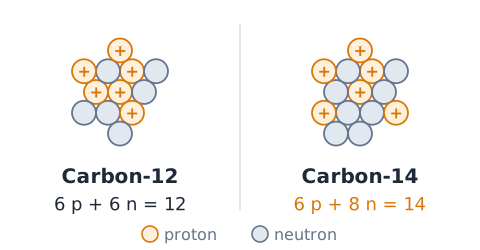
Isotopes are atoms of the same element that have different numbers of neutrons. Because the proton count is the same, they share the same atomic number and the same chemical behavior, but they have different mass numbers.
Carbon is a good example. Carbon-12 has 6 protons and 6 neutrons. Carbon-14 has 6 protons and 8 neutrons. Both are carbon and both form the same kinds of compounds, but carbon-14 is heavier and radioactive, which is why it is used to date ancient wood and bone. Hydrogen also has isotopes: ordinary hydrogen has no neutrons, deuterium has one, and tritium has two. The number after an element's name is always the mass number.
Atomic mass on a periodic table is an average
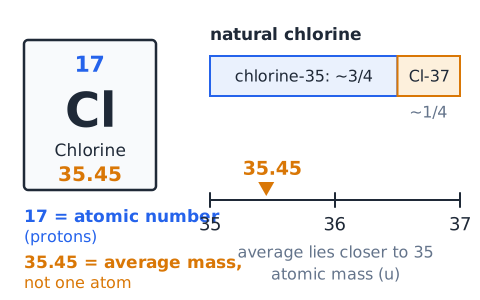
The decimal number in most periodic table boxes is the standard atomic weight, often called average atomic mass. It is not the mass of any single atom. It is a weighted average of the masses of the element's naturally occurring isotopes, taking into account how common each isotope is.
Chlorine shows this well. Its box lists about 35.45, yet no chlorine atom has that mass. Natural chlorine is roughly three-quarters chlorine-35 and one-quarter chlorine-37, and the average falls in between, closer to the more common isotope. If an element had only one natural isotope, its listed atomic mass would be very close to that isotope's mass.
Example 5 — distinguish atomic weight from isotope label
Problem: A periodic table lists copper with atomic number 29 and atomic mass 63.55. A student says a copper-65 atom must have
neutrons. What is wrong, and what is the correct count?
Step 1: Neutron counts must be whole numbers, so 34.55 is impossible. The 63.55 is an average over isotopes, not the mass number of one atom.
Step 2: Use the isotope label. Copper-65 has mass number 65.
Step 3: Neutrons =
Answer: copper-65 has 36 neutrons.
Neutral atoms and the balance of charges
An atom has no overall charge when its number of electrons equals its number of protons. Each proton's +1 is canceled by an electron's −1, so the total is zero.
This gives a quick rule: in a neutral atom, electrons = protons = atomic number. A neutral magnesium atom has 12 protons and therefore 12 electrons. A neutral sulfur atom has 16 of each. Neutrons do not enter the charge calculation at all, because they carry no charge. If a question says "neutral atom" and gives the number of protons, you already know the number of electrons.
Cations and anions: electron transfers
An ion is an atom or group of atoms with a net electric charge. Ions form when atoms gain or lose electrons; the number of protons never changes in ordinary chemistry.
When an atom loses electrons, it has more protons than electrons and becomes a positive ion, called a cation. Sodium easily loses one electron to become Na⁺, and calcium loses two to become Ca²⁺. When an atom gains electrons, it has more electrons than protons and becomes a negative ion, called an anion. Chlorine gains one electron to form Cl⁻, and oxygen gains two to form O²⁻. Use the formula: charge = protons − electrons. A memory aid: a cation is "paws-itive," like a cat.
Example 6 — solve ion electron counts
Problem: Find the number of electrons in (a) Al³⁺, atomic number 13, and (b) S²⁻, atomic number 16.
Step 1: Rearrange charge = protons − electrons into electrons = protons − charge.
Step 2: For Al³⁺:
electrons. Losing electrons gives a positive charge.
Step 3: For S²⁻: the charge is −2, so
electrons. Gaining electrons gives a negative charge.
Answer: Al³⁺ has 10 electrons and S²⁻ has 18 electrons.
Periodic table: columns and rows
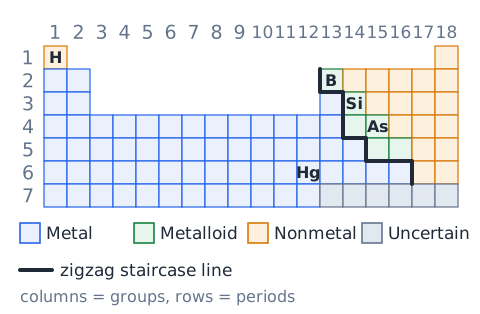
The periodic table arranges elements by increasing atomic number. Vertical columns are called groups or families, numbered 1 through 18. Elements in the same group have the same number of outer (valence) electrons, so they tend to react in similar ways. Lithium, sodium and potassium in group 1 all react strongly with water, for example.
Horizontal rows are called periods, numbered 1 through 7. Moving left to right across a period, each element has one more proton than the one before it, and properties shift gradually from metallic to nonmetallic. Elements in the same period have the same number of occupied electron shells. A simple memory aid: groups go down like a column of soldiers, periods go across like a line of text.
Metals, nonmetals and metalloids
Most elements are metals, found on the left side and center of the table. Metals are usually shiny, conduct heat and electricity well, and are malleable (can be hammered flat) and ductile (can be drawn into wire). All are solid at room temperature except mercury, which is a liquid. Metals tend to lose electrons and form positive ions.
Nonmetals sit in the upper right, plus hydrogen. They are usually dull, brittle as solids, and poor conductors; many are gases, such as oxygen and nitrogen, and bromine is a liquid. Nonmetals tend to gain or share electrons. Metalloids lie along the zigzag staircase line between the two regions. Silicon, boron and arsenic are examples; they have mixed properties, and silicon's moderate conductivity makes it the basis of computer chips.
Group 1: alkali metals and hydrogen exception
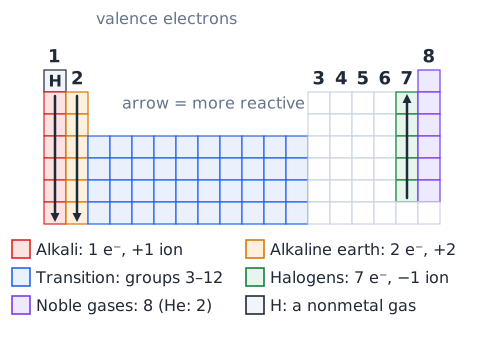
Group 1 below hydrogen contains the alkali metals: lithium, sodium, potassium, rubidium, cesium and francium. Each has one valence electron, which it gives up easily to form a +1 ion. That makes them the most reactive metals. They are soft enough to cut with a knife, and they react with water to form hydrogen gas and a basic solution, often violently. Reactivity increases going down the group, so potassium reacts more strongly than sodium. They are stored under oil.
Hydrogen sits at the top of group 1 because it has one electron, but it is a nonmetal gas, not an alkali metal.
Group 2: alkaline earth metals
Group 2 holds the alkaline earth metals: beryllium, magnesium, calcium, strontium, barium and radium. Each atom has two valence electrons and tends to lose both, forming a +2 ion such as Mg²⁺ or Ca²⁺. They are reactive, though less so than their group 1 neighbors, and they also become more reactive going down the group.
These metals show up in everyday life. Calcium is a major part of bones, teeth, limestone and chalk. Magnesium is a light, strong metal used in alloys for aircraft and wheels, and it burns with a brilliant white flame, which is why it appears in flares and fireworks.
Group 17: the halogens
Group 17 contains the halogens: fluorine, chlorine, bromine, iodine and astatine. Each has seven valence electrons, one short of a full outer shell, so halogens readily gain one electron to form a −1 ion such as F⁻ or Cl⁻. They are very reactive nonmetals, and fluorine is the most reactive of all. Unlike the metals, halogens become less reactive going down the group. They react strongly with alkali metals to form salts such as sodium chloride. Chlorine is used to disinfect water, and fluoride compounds help protect teeth.
Group 18: noble gases and reactivity
Group 18 holds the noble gases: helium, neon, argon, krypton, xenon and radon. Their outer electron shells are full (helium has 2 outer electrons, the others have 8), a very stable arrangement, so they have little tendency to gain, lose or share electrons. That is why they are the least reactive elements. All are colorless gases at room temperature.
Least reactive does not mean impossible to react. Chemists have made a few compounds of xenon and krypton under special conditions. Uses include helium in balloons, argon as a shield gas in welding, and neon in glowing signs.
Transition metals and familiar symbols
Groups 3 through 12, in the middle of the table, are the transition metals. They include iron, copper, nickel, zinc, silver, gold and chromium. Most are hard, strong, shiny and good conductors, and many can form ions with different charges, such as Fe²⁺ and Fe³⁺.
Chemical symbols use one or two letters, and only the first letter is capitalized. Several familiar symbols come from Latin names: Fe for iron (ferrum), Cu for copper (cuprum), Ag for silver (argentum), Au for gold (aurum) and Pb for lead (plumbum). Capitalization matters: Co is the element cobalt, while CO is carbon monoxide, a compound of carbon and oxygen.
Valence electrons drive basic bonding patterns
Valence electrons are the electrons in an atom's outermost shell. They are the ones involved in bonding, so they control much of an element's chemistry. For the main-group elements in groups 1, 2 and 13 through 18, a simple pattern applies: group 1 has 1 valence electron, group 2 has 2, group 13 has 3, and so on up to group 18 with 8 (helium is the exception with 2).
Many atoms react in ways that give them a full outer shell of eight, called the octet rule. Atoms with 1 to 3 valence electrons usually lose them and become cations. Atoms with 5 to 7 usually gain electrons to become anions or share electrons with other nonmetals. Carbon, with 4, usually shares.
Ionic and covalent substances in one picture
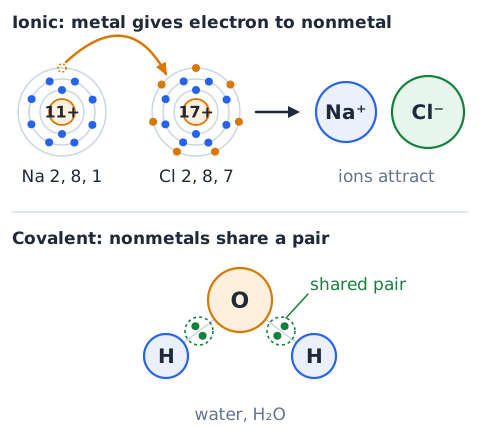
Atoms join in two main ways. In an ionic bond, a metal transfers electrons to a nonmetal. The resulting positive and negative ions attract each other strongly. Sodium chloride is the classic example: each sodium gives one electron to a chlorine. Ionic compounds are usually hard crystalline solids with high melting points, and they conduct electricity when melted or dissolved in water.
In a covalent bond, two nonmetal atoms share a pair of electrons. Water, carbon dioxide and methane are covalent. These substances form molecules, often have lower melting points, and many are liquids or gases at room temperature. Quick rule: metal plus nonmetal suggests ionic; nonmetal plus nonmetal suggests covalent.
Example 7 — group and charge reasoning
Problem: Element J is in group 2 and element Q is in group 17. Predict the charge on each ion and the formula of the compound they form.
Step 1: Group 2 atoms have 2 valence electrons and lose them, so J forms J²⁺.
Step 2: Group 17 atoms have 7 valence electrons and gain 1, so Q forms Q⁻.
Step 3: Balance charges. One J²⁺ (+2) needs two Q⁻ (−1 each) for a total of zero.
Answer: J²⁺, Q⁻, and the formula JQ₂. A real example is calcium chloride, CaCl₂.
Reading simplified period and group questions
Many test questions give a few facts and ask you to place an element or predict its behavior. Translate each clue into a table position. "Same group as sodium" means one valence electron and a +1 ion. "Same period as sodium" means the third row, with three occupied shells, but it says nothing about reactivity pattern. "A shiny solid that conducts electricity" points to a metal on the left or center. "Brittle and does not conduct" points to a nonmetal on the right.
When two answer choices name elements in the same group, expect similar chemical behavior. When they name elements in the same period, expect a gradual change from metal on the left to nonmetal on the right, ending with a noble gas.
Atomic size and ionization: qualitative trends
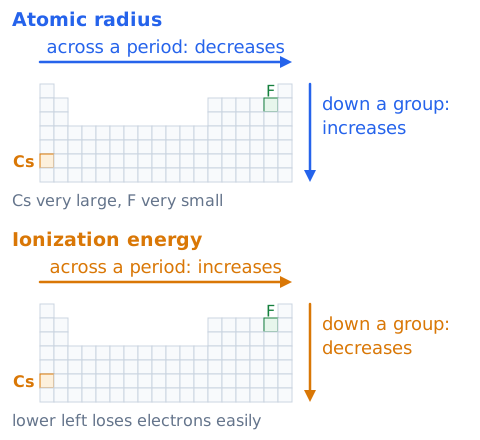
Two broad trends are worth knowing. Atomic radius, the size of an atom, increases going down a group because each row adds another electron shell. It decreases going left to right across a period because more protons pull the electrons in more tightly, even though the shell count stays the same. So cesium is very large and fluorine is very small.
Ionization energy, the energy needed to remove an electron, follows the opposite pattern. It decreases down a group because outer electrons are farther from the nucleus, and it increases across a period. That explains why the large atoms at the lower left lose electrons easily, while noble gases at the far right hold theirs most tightly.
Molecules and chemical formulas
A molecule is two or more atoms held together by covalent bonds and acting as a unit. Some molecules contain only one element, such as oxygen gas, O₂, or nitrogen gas, N₂. Others contain different elements, such as ammonia, NH₃.
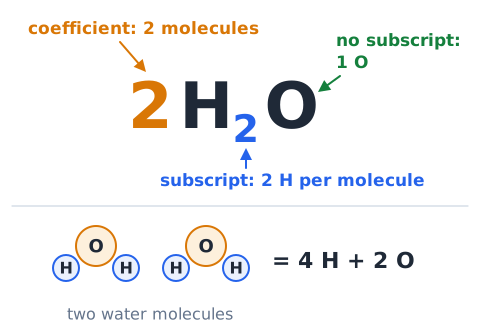
A chemical formula shows which elements are present with their symbols and how many atoms of each with subscripts. A subscript applies only to the symbol directly before it, and a missing subscript means 1. So NH₃ has one nitrogen and three hydrogen atoms. A number written in front of a formula, called a coefficient, counts whole units: 2H₂O means two water molecules, holding four hydrogen and two oxygen atoms in total.
Example 8 — count atoms from a formula
Problem: How many atoms of each element are in one unit of ammonium phosphate, (NH₄)₃PO₄, and how many atoms in total?
Step 1: The subscript 3 outside the parentheses multiplies everything inside. Nitrogen:
Hydrogen:
Step 2: Phosphorus has no subscript, so 1. Oxygen: 4.
Step 3: Add:
Answer: 3 N, 12 H, 1 P and 4 O, for 20 atoms total.
Mixtures versus compounds: proportion and separation
Two features reliably tell a mixture from a compound. First, proportion. A compound always has the same ratio of elements: every sample of pure water has two hydrogen atoms for each oxygen atom, whether it comes from a glacier or a lab. A mixture can have any ratio: lemonade can be sweet or tart, and air can be humid or dry.
Second, separation and properties. A mixture can be pulled apart by physical methods such as filtering, evaporating or using a magnet, and its parts keep their own properties. A mixture of iron filings and sulfur powder can be separated with a magnet. Heat them strongly and they react to form iron sulfide, a compound that is no longer magnetic and cannot be separated that way.
Conservation of matter in ordinary chemical reactions
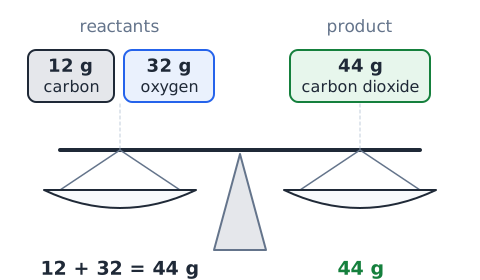
The law of conservation of mass says that in an ordinary chemical reaction, matter is neither created nor destroyed. Atoms are only rearranged into new combinations, so the total mass of the products equals the total mass of the reactants.
Suppose 12 g of carbon burns completely with 32 g of oxygen. Exactly 44 g of carbon dioxide forms. When a log burns, it seems to lose mass because the carbon dioxide and water vapor drift away; if you captured all the gases, the totals would match. This is also why chemical equations must be balanced: the same number of each kind of atom must appear on both sides of the arrow.
Temperature, pressure and boiling
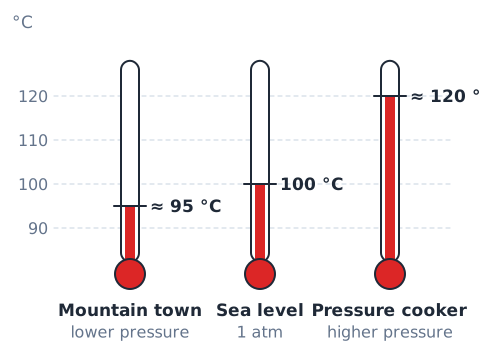
A liquid boils when the pressure of its vapor equals the pressure of the air above it. At sea level, where air pressure is about 1 atmosphere, pure water boils at 100 °C (212 °F) and freezes at 0 °C (32 °F).
Boiling point depends on pressure. At high altitude, air pressure is lower, so water boils at a lower temperature; in a mountain town water may boil near 95 °C, and food takes longer to cook. A pressure cooker does the reverse: it traps steam, raises the pressure, and lets water reach about 120 °C, cooking food faster. Dissolving salt in water also raises its boiling point slightly and lowers its freezing point.
Density and floatation: predict rather than guess
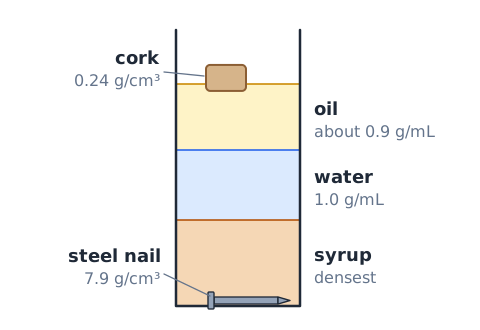
Whether an object floats depends on density, not on weight alone. An object floats in a fluid if its average density is less than the fluid's density, and sinks if it is greater. Water's density is about 1.0 g/mL, so a cork at 0.24 g/cm³ floats and a steel nail at 7.9 g/cm³ sinks.
The key word is average. A steel ship floats because its hull encloses a large volume of air, making the overall density of the ship less than water. Liquids layer by density too: oil (about 0.9 g/mL) floats on water, and water floats on syrup. Seawater is denser than fresh water, so things float a little higher in the ocean.
Example 9 — mass, volume and floatation
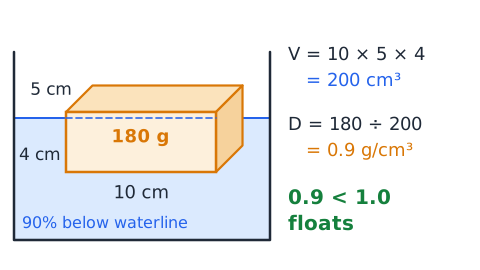
Problem: A plastic storage block measures 10 cm by 5 cm by 4 cm and has a mass of 180 g. Will it float in fresh water?
Step 1: Find volume:
Step 2: Find density.
Step 3: Compare with water, about 1.0 g/cm³. Since 0.9 is less than 1.0, the block floats.
Answer: it floats, riding with about 90 percent of its volume below the waterline.
Elements versus ions in everyday materials
Many everyday labels name an element when the substance is really present as ions. A sports drink lists "sodium" and "potassium," but you are not drinking the soft, reactive metals. You are drinking Na⁺ and K⁺ ions dissolved in water. Calcium in milk is mostly Ca²⁺ ions, and fluoride in toothpaste is the F⁻ ion, not toxic fluorine gas.
The difference matters because ions have different properties from their neutral atoms. Sodium metal reacts violently with water, while sodium ions are a normal part of body fluids. Chlorine gas is poisonous, while chloride ions in salt are harmless in normal amounts. Both are the same element because the proton count is unchanged; only the electron count differs.
Electron shells and the limits of sketches
A common drawing shows electrons in rings, or shells, around the nucleus. In this simple model, the first shell holds up to 2 electrons and the second up to 8. A sodium atom with 11 electrons is drawn as 2, 8, 1, and that single outer electron explains why sodium forms a +1 ion. A chlorine atom with 17 electrons is drawn as 2, 8, 7.
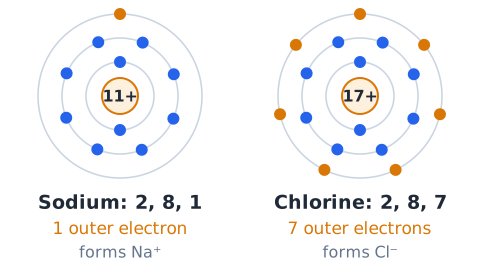
The ring picture is helpful but not literal. Electrons do not travel in neat circular paths like planets. Modern physics describes them as clouds of probability called orbitals, where an electron is likely to be found. For ASVAB-level questions, the shell model is enough to count valence electrons and predict ion charges for light elements.
Example 10 — an electron-count comparison
Problem: Which has more electrons, a fluoride ion F⁻ (atomic number 9) or a magnesium ion Mg²⁺ (atomic number 12)?
Step 1: F⁻ has 9 protons and a −1 charge, so it gained one electron:
electrons.
Step 2: Mg²⁺ has 12 protons and a +2 charge, so it lost two electrons:
electrons.
Step 3: Compare: 10 and 10.
Answer: they have the same number of electrons, 10 each, the same as a neutral neon atom. Particles with equal electron counts like this are called isoelectronic.
Isotope notation and nuclear symbols
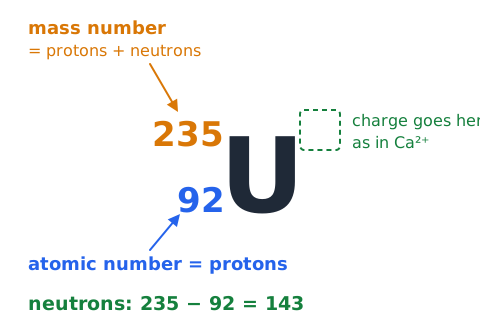
Isotopes can be written in a few ways. The hyphen form puts the mass number after the name or symbol: uranium-235 or U-235. Nuclear notation stacks two numbers to the left of the symbol, with the mass number on top and the atomic number on the bottom:
From this symbol you can read 92 protons and
neutrons. A charge, when present, goes at the upper right, as in Ca²⁺. Since the symbol already tells you the element, the bottom number is sometimes left off.
Two isotope questions without a table
You can often solve isotope questions without looking anything up. First question: an atom has 17 protons and 20 neutrons, and another has 17 protons and 18 neutrons. Are they the same element? Yes, because both have 17 protons; they are isotopes with mass numbers 37 and 35.
Second question: an atom has mass number 40 and 22 neutrons. What is its atomic number? Subtract:
protons, so atomic number 18. If a question also names the element, check consistency: atomic number 18 is argon. Any pair of atoms with different proton counts are different elements, no matter how similar their masses are.
Why average atomic masses are usually decimals
Students sometimes think a decimal atomic mass means an atom holds a fraction of a proton. It does not; particle counts are always whole numbers. Decimals appear for two reasons.
The main reason is that most elements occur in nature as a blend of isotopes, and the listed value is an average weighted by how common each one is. Boron, for example, is about 20 percent boron-10 and 80 percent boron-11, giving an average near 10.8. A smaller reason is that even a single isotope's exact mass is not a perfect whole number, because of the binding energy that holds the nucleus together and the slight mass difference between protons and neutrons.
Example 11 — weighted average of fictional isotopes
Problem: A fictional element Zq occurs as 60 percent Zq-20 and 40 percent Zq-22. Using mass numbers as isotope masses, find the average atomic mass.
Step 1: Convert percentages to decimals: 0.60 and 0.40.
Step 2: Multiply and add:
Total 20.8.
Answer: 20.8 u. Check: the result lies between 20 and 22, closer to 20, the more common isotope.
Periodic patterns help eliminate implausible answers
Even when you do not know an exact fact, table patterns can remove wrong answers. If a question asks which element forms a 2+ ion, cross out halogens and noble gases; look for a group 2 metal. If it asks for the most reactive nonmetal, choose a halogen near the top, such as fluorine. If it asks for the largest atom, favor elements low and on the left.
Watch for choices that break basic rules. An answer claiming a noble gas readily forms ions, a metal gains electrons to become negative, or two isotopes have different proton counts is almost certainly wrong.
Avoid mixing atomic mass with material density
Atomic mass and density sound alike but measure different things. Atomic mass is the mass of one atom, in atomic mass units. Density is the mass of a bulk material per unit volume, in g/cm³, and it depends on both how heavy the atoms are and how tightly they are packed.
The two do not always rise together. Lead atoms (about 207 u) are much heavier than iron atoms (about 56 u), and lead is denser. But osmium (about 190 u) is denser than lead despite lighter atoms, because its atoms pack more tightly. Gases with heavy atoms, like xenon, are still far less dense than liquid water.
A compact table of reference elements
A short list of elements worth knowing by symbol and atomic number: hydrogen H, 1; helium He, 2; carbon C, 6; nitrogen N, 7; oxygen O, 8; neon Ne, 10; sodium Na, 11; magnesium Mg, 12; aluminum Al, 13; chlorine Cl, 17; potassium K, 19; calcium Ca, 20; iron Fe, 26; cobalt Co, 27; copper Cu, 29.
Notice potential confusions: C is carbon, Co is cobalt, Cl is chlorine and Ca is calcium. K stands for potassium and Na for sodium, both from older names. Knowing these lets you count particles quickly.
Classify observations before choosing vocabulary
Many questions describe an event and ask you to name it. Before reading the choices, classify what you see. Ask first: is a new substance formed? If not, it is a physical change, and you then decide whether it is a change of state, a change of shape, or dissolving. If a new substance forms, it is a chemical change.
For a change of state, name the starting and ending phase, then match the term. A puddle shrinking on a sunny day is liquid to gas at the surface, so evaporation. Silver tarnishing turns shiny metal into a dark new compound, so it is chemical. Settling the category first keeps similar-sounding words from pulling you off course.
Example 12 — mixed multi-step atom challenge
Problem: An ion has 20 protons, 22 neutrons and 18 electrons. Identify the element, its mass number, its charge and its periodic group.
Step 1: 20 protons means atomic number 20, which is calcium.
Step 2: Mass number =
Step 3: Charge = protons − electrons = 20 − 18 = +2.
Step 4: Calcium is an alkaline earth metal in group 2, which fits a +2 ion from losing two valence electrons.
Answer: calcium-42 ion, Ca²⁺, group 2.
Short practice with volume and density units
Remember 1 mL = 1 cm³ and 1 L = 1000 mL.
Prompt: A liquid has density 0.8 g/mL. What is the mass of 250 mL? Answer:
Prompt: A 2.0 L jug of water has what mass? Answer: 2.0 L is 2000 mL, and at 1.0 g/mL that is 2000 g, or 2.0 kg.
Prompt: What volume does 54 g of aluminum occupy if its density is 2.7 g/cm³?
Strategy 1 — solve nuclear counts before considering choices
For any question about protons, neutrons or electrons, work out all three counts on scratch paper before looking at the answers. Write protons from the atomic number, neutrons as mass number minus atomic number, and electrons as protons minus charge. Then check that protons plus neutrons equals the mass number.
Answer choices are often built from common slips, such as the mass number listed as the proton count or electrons counted in the wrong direction. Having your own answer ready lets you spot the match instead of being tempted by a decoy.
Strategy 2 — classify the problem before memorizing facts
Most questions in this topic fall into a few types: states and phase changes, physical versus chemical change, elements versus compounds versus mixtures, density math, particle counting, and periodic table families or trends. Spend a second naming the type before you answer.
Once you know the type, a small tool applies. Phase change questions need only start and end states. Particle questions need three subtractions. Density needs one division. Family questions need valence electrons. This approach turns a question that looks unfamiliar into one you have already practiced, and it reduces the amount of pure memorization you need.
Strategy 3 — no-calculator and CAT-safe habits
Calculators are not allowed on the ASVAB, so keep numbers friendly. Round where reasonable and estimate first: if 63 g fills 8 cm³, the density is a bit under 8. Use the estimate to rule out choices that are far off.
On the computer-adaptive version, you cannot skip a question and return later, and you cannot change an answer after moving on, so settle each item before leaving it. Read for traps such as "not," "except" and "always." If unsure, eliminate what breaks basic rules, then choose. The adaptive test also penalizes unanswered questions near the end, so pace yourself steadily rather than stalling on one hard item.
Trap 1 — atomic number versus mass number
The mistake: treating mass number as the number of protons, or treating atomic number as the total of protons and neutrons. For sodium-23, a student might say it has 23 protons.
Why it is wrong: the atomic number (11 for sodium) counts protons only. The mass number (23) counts protons plus neutrons.
The fix: small number, protons; large number, nucleons. Sodium-23 has 11 protons and
neutrons.
Trap 2 — ion versus isotope
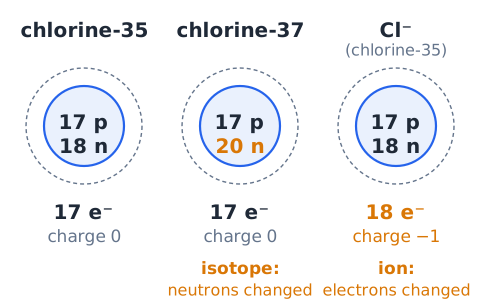
The mistake: confusing ions and isotopes, for example calling Cl⁻ an isotope of chlorine or calling chlorine-37 an ion.
Why it is wrong: isotopes differ in neutrons, which changes mass but not charge. Ions differ in electrons, which changes charge but barely affects mass.
The fix: ask which particle changed. Different neutrons means isotope; different electrons means ion. Protons stay the same in both. A particle can be both at once: chlorine-37 that gains an electron is a Cl⁻ ion of the chlorine-37 isotope.
Trap 3 — molecules and compounds are not synonymous
The mistake: assuming every molecule is a compound, or every compound is made of molecules.
Why it is wrong: a molecule only needs two or more atoms bonded together. O₂ and N₂ are molecules but are elements, not compounds. A compound needs two or more different elements. Ionic compounds like sodium chloride form a repeating lattice of ions, not separate molecules.
The fix: molecule describes the bonded unit; compound describes having more than one element.
Trap 4 — bubbles do not always mean chemical change
The mistake: deciding that any bubbles prove a chemical reaction took place.
Why it is wrong: boiling water forms bubbles of water vapor, which is still water, so it is a physical change. Opening a soda releases carbon dioxide that was already dissolved in it, also physical.
The fix: ask where the gas came from. If the gas is a new substance produced when two materials meet, such as gas forming when an antacid tablet is dropped into water, it is chemical. If the gas was already present or is the same substance in a new state, the change is physical.
Trap 5 — equating heavy atoms with high density
The mistake: assuming a substance with heavier atoms must be denser.
Why it is wrong: density is mass per volume of the bulk material:
It depends on atom mass and on how closely atoms or molecules are packed. Radon atoms are heavy (about 222 u), but radon is a gas with particles far apart, so its density is a tiny fraction of water's.
The fix: compare states first, then packing, then atomic mass. A solid or liquid almost always beats a gas.
Trap 6 — rigid periodic-table rules have exceptions
The mistake: applying the group rules as if they had no exceptions.
Why it is wrong: hydrogen sits in group 1 but is a nonmetal gas. Helium sits in group 18 with only 2 outer electrons, not 8. Mercury is a metal that is liquid at room temperature. Noble gases are very unreactive, yet xenon can form some compounds. Transition metals often form more than one ion charge.
The fix: use trends as strong guides for typical questions, but do not choose an answer that claims "always" or "never" when a well-known exception exists.
Trap 7 — chemical symbols and subscripts matter
The mistake: misreading capital letters or subscripts. Co and CO look alike, and so do CO₂ and 2CO.
Why it is wrong: Co is one element, cobalt, while CO is a compound of carbon and oxygen. CO₂ is one molecule with 3 atoms; 2CO is two molecules with 4 atoms total.
The fix: a capital letter starts a new element symbol. A subscript counts the atom just before it, and a leading coefficient multiplies the whole formula.
Guided drill 1 — three common phase changes
Prompt: Wet laundry dries on a clothesline. What phase change? Answer: evaporation, a form of vaporization, liquid to gas.
Prompt: Mothballs slowly shrink in a closet without becoming liquid. What phase change? Answer: sublimation, solid to gas.
Prompt: A bathroom mirror fogs during a hot shower. What phase change? Answer: condensation, gas to liquid.
Prompt: Which of these three releases energy to its surroundings? Answer: condensation.
Guided drill 2 — classify pure samples and mixtures
Prompt: Helium in a party balloon. Answer: element; only helium atoms.
Prompt: Table sugar. Answer: compound; carbon, hydrogen and oxygen bonded in a fixed ratio.
Prompt: Seawater. Answer: homogeneous mixture; dissolved salts are spread evenly within a sample, though the salt content differs from one sea to another.
Prompt: Concrete. Answer: heterogeneous mixture; you can see gravel and sand.
Prompt: Stainless steel. Answer: homogeneous mixture, an alloy of iron with chromium and other elements.
Guided drill 3 — mass number, isotopes and ions
Prompt: Nitrogen-15, atomic number 7. Neutrons? Answer:
Prompt: An atom has 26 protons and 30 neutrons. Mass number? Answer: 56, and the element is iron.
Prompt: K⁺, atomic number 19. Electrons? Answer: 18.
Prompt: N³⁻, atomic number 7. Electrons? Answer: 10.
Prompt: Hydrogen-1 and hydrogen-2 differ in what? Answer: one neutron.
Guided drill 4 — periodic family discrimination
Prompt: Which family forms −1 ions and includes iodine? Answer: halogens, group 17.
Prompt: Lithium belongs to which family? Answer: alkali metals, group 1.
Prompt: Argon belongs to which family, and why is it unreactive? Answer: noble gases, group 18; full outer shell.
Prompt: Strontium forms which ion charge? Answer: +2, as a group 2 alkaline earth metal.
Prompt: Which is a transition metal: nickel, sulfur or barium? Answer: nickel.
Guided drill 5 — density plus displacement
Prompt: A stone raises water in a cylinder from 30 mL to 42 mL and has mass 30 g. Density? Answer: volume 12 mL, so
Prompt: Does the stone float in water? Answer: no; 2.5 is more than 1.0.
Prompt: A 5.0 cm³ piece of gold has density 19.3 g/cm³. Mass? Answer:
Guided drill 6 — combined exam-style reasoning
Prompt: An atom has 8 protons and 10 electrons. Name and charge? Answer: oxygen, O²⁻.
Prompt: If that ion's mass number is 18, how many neutrons? Answer: 10.
Prompt: A particle has 11 protons and 10 electrons; another has 10 of each. Same element? Answer: no; the first is a sodium ion Na⁺, the second neutral neon.
Prompt: Burning paper or tearing paper: which is chemical? Answer: burning.
Quick review and self-check
Matter has mass and takes up space. Solids keep shape and volume, liquids keep volume only, gases keep neither, and plasma is an ionized gas. The six phase changes are melting, freezing, vaporization, condensation, sublimation and deposition. Physical changes keep the substance; chemical changes make new ones.
Elements contain one kind of atom, compounds bond elements in fixed ratios, and mixtures combine substances physically in any ratio. Density equals mass divided by volume, and objects less dense than a fluid float in it.
Atomic number equals protons and identifies the element. Mass number equals protons plus neutrons. Electrons equal protons minus charge. Isotopes differ in neutrons; ions differ in electrons. Decimal atomic masses are averages of isotopes.
Self-check: neutrons in phosphorus-31 (atomic number 15)? Answer: 16. Ion charge for group 17? Answer: −1.
 English ▾