 ASVAB Camp
Learning outcomes and test relevance
By the end, you should classify solar-system objects and planets, explain rotation versus revolution, identify the causes of seasons, Moon phases and eclipses, describe how gravity maintains orbits, contrast asteroids with comets and meteors, interpret stars and galaxies, and solve simple astronomy distance or time problems. These are original General Science (GS)-style learning exercises, not actual or guaranteed ASVAB questions. The official GS subtest is broadly described as physical and biological science knowledge; no exact astronomy weighting is implied.
Astronomy versus space exploration
Astronomy is the scientific study of celestial objects and phenomena using observations, models and evidence. Space exploration sends probes or people beyond Earth to investigate some of those objects, but a telescope on Earth also collects astronomical data. The key questions are what an object is, what forces affect it, and how measurements support conclusions. For GS questions, reason from a physical principle instead of relying on mission trivia.
Scale: solar system, galaxy and universe
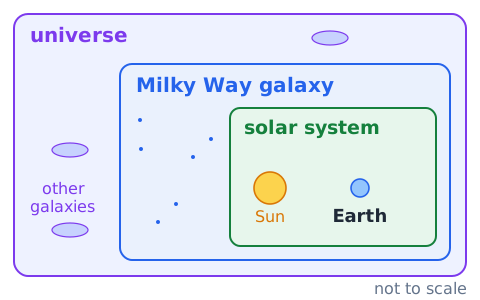
A solar system contains a star and its gravitationally associated planets, minor bodies and other material. A galaxy is a vast gravitationally bound system containing stars, gas, dust and dark matter. The universe includes galaxies and the large-scale space in which they exist. Our Sun is a star within the Milky Way. Earth is not at the center of the solar system, the Milky Way or the universe. Distinguish each scale carefully.
Our solar system in one model
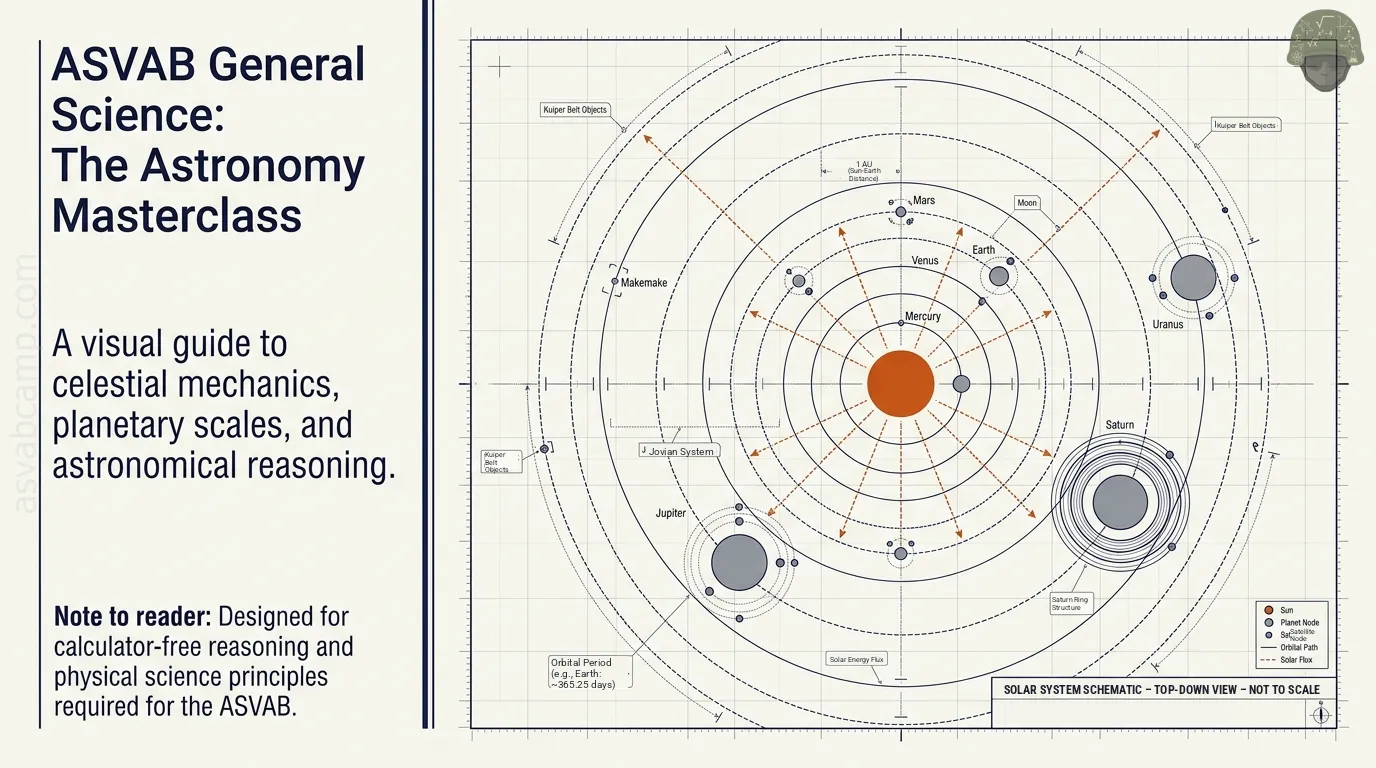
The solar system formed about 4.6 billion years ago from a collapsing cloud of gas and dust. The Sun occupies its center of mass approximately, while the planets and numerous smaller bodies orbit under gravity. The same forming disk helps explain why many planetary orbits are nearly in one plane and in the same broad direction. A schematic drawing with planets equally spaced is not to scale: real distances and planet sizes vary enormously.
The Sun is a star
The Sun is a star, not a planet or a burning lump of ordinary chemical fuel. Hot plasma in its core fuses hydrogen into helium, releasing energy that ultimately reaches space as radiation. Its gravity dominates the solar system. Sunlight heats Earth and provides energy for photosynthesis. Never confuse nuclear fusion in a stellar core with combustion requiring atmospheric oxygen; both release energy but use fundamentally different processes.
Gravity and orbital motion
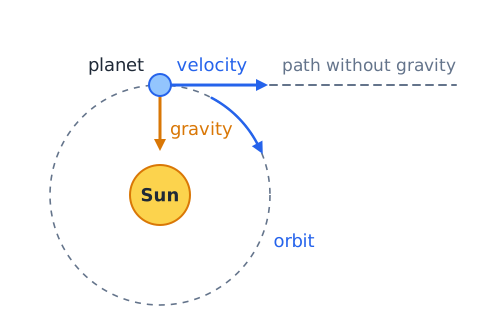
Gravity attracts masses. A planet moving sideways would follow a straighter path without the Sun's gravitational pull. With gravity, its direction continually changes and an orbit forms. An orbiting body is in continuous free fall around its primary; it is not sitting still or supported by a rigid track. Ideal circular motion requires inward acceleration even at constant speed. Real planet orbits are elliptical, and speeds can vary along them.
Rotation versus revolution
Rotation is spinning around an axis, as Earth does roughly once per day relative to the Sun. Revolution is traveling around another body, as Earth does around the Sun in roughly one year. The two motions are independent ideas: one governs the day-night pattern, and the other combines with Earth's axial tilt to produce an annual seasonal cycle. A question about daylight each 24 hours points to rotation, not revolution alone.
Order of the eight planets
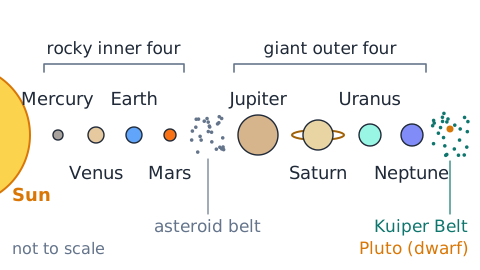
From the Sun outward the eight planets are Mercury, Venus, Earth, Mars, Jupiter, Saturn, Uranus and Neptune. Mercury is nearest and Neptune is farthest among the eight recognized planets. Remember the sequence in two groups of four. Pluto orbits the Sun but is classified as a dwarf planet; it is not an additional ninth major planet under the internationally accepted modern classification.
Rocky inner planets
Mercury, Venus, Earth and Mars are terrestrial planets with solid rocky surfaces. They are relatively small compared with the giant outer planets. Venus has a very thick atmosphere and extreme surface heating; Earth has substantial liquid surface water; Mars has a thin atmosphere and cold conditions; Mercury has little substantial atmosphere. Do not infer surface temperature from distance alone without considering atmospheric greenhouse effects and other conditions.
Outer planets: gas and ice giants
Jupiter and Saturn are gas giants with extensive hydrogen-helium atmospheres, while Uranus and Neptune are called ice giants because their internal composition differs and includes greater proportions of heavier volatile substances. All four are large outer planets, but none has a rocky ground surface directly comparable to Earth's. Jupiter is the largest planet, and Saturn is famous for a conspicuous ring system; the other giant planets also possess rings.
Dwarf planets and Pluto
A dwarf planet orbits the Sun and is approximately round from its own gravity but has not cleared its orbital neighborhood in the same way a planet does. Pluto is a well-known dwarf planet in the Kuiper Belt region. It did not physically shrink or vanish when astronomers refined the classification in 2006. Classification labels describe scientific criteria; they do not change the object's actual size, location or composition.
Asteroids and the main asteroid belt
Asteroids are small rocky or metallic solar-system bodies orbiting the Sun. Many lie between Mars and Jupiter in the main asteroid belt, though some have different orbits. The belt is not a solid wall of rock; widely separated objects occupy an enormous region. A diagram that places the asteroid belt between Earth and Mars or outside Neptune is misleading. Some asteroids cross or approach Earth's orbit, which makes their trajectories important to study.
Comets and their tails
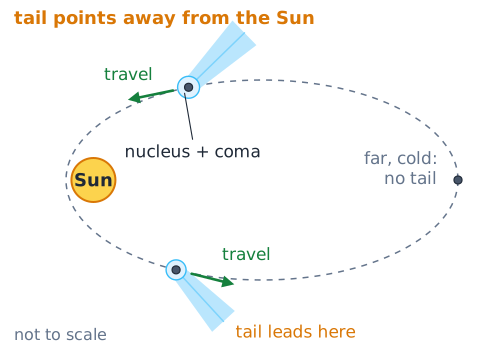
Comets contain substantial icy material mixed with dust and rock. As a comet approaches the Sun, sunlight heats its nucleus and gas and dust escape to form a coma and often tails. The tails generally point away from the Sun because of solar radiation pressure and the solar wind, not necessarily behind the comet's direction of travel. When distant and cold, a comet may have no bright visible tail at all.
Meteoroid, meteor and meteorite
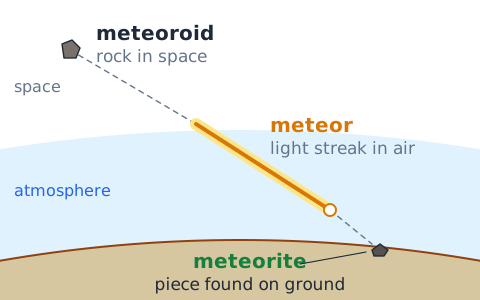
A meteoroid is a small natural solid body in space. The bright streak produced when a meteoroid enters an atmosphere is a meteor. Any surviving fragment recovered on the ground is a meteorite. The names describe different stages or phenomena, not three unrelated materials. Most meteors are not stars falling from the sky; they are atmospheric light phenomena associated with space debris.
Kuiper Belt and Oort Cloud
The Kuiper Belt lies beyond Neptune and contains many icy bodies, including Pluto. The much more distant Oort Cloud is a hypothesized reservoir of icy objects associated with some long-period comets. These two regions are not additional planets. A GS question usually tests the basic distinction: the asteroid belt is mainly between Mars and Jupiter, whereas the Kuiper Belt occupies an outer region beyond Neptune.
Moons and natural satellites
A natural satellite, or moon, orbits a planet, dwarf planet or other larger body. Earth's Moon reflects sunlight; it does not generate its own visible light like the Sun. Some other planets have numerous moons, and several moons are geologically active or possess ice. A moon's shape and environment vary by object. Do not assume all planets have moons: Mercury and Venus have none that are currently known.
Earth rotates: day and night
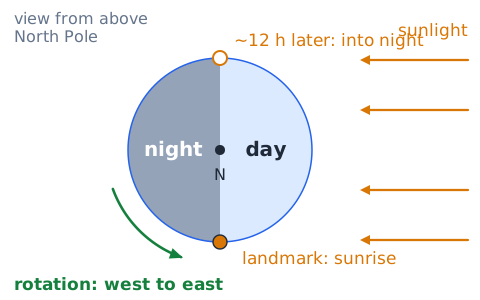
Earth rotates west-to-east relative to the distant stars, so the Sun appears to move from east toward west in the sky. As a location rotates into sunlight, it experiences daytime; as it turns away, night follows. Earth's rotation explains the daily pattern of apparent Sun movement, not the Sun circling Earth once per day. The approximate 24-hour solar day differs slightly from Earth's rotation period relative to distant stars.
Earth revolves: the year
Earth completes an orbit around the Sun in about 365.25 days. A leap-day calendar adjustment helps keep seasons aligned with the calendar because 365 days is not an exact orbital year. Revolution by itself cannot explain different seasons in opposite hemispheres; the axis tilt changes the angle and duration of sunlight each hemisphere receives. Think orbit plus tilt, not orbit distance alone.
Axial tilt is the main cause of seasons
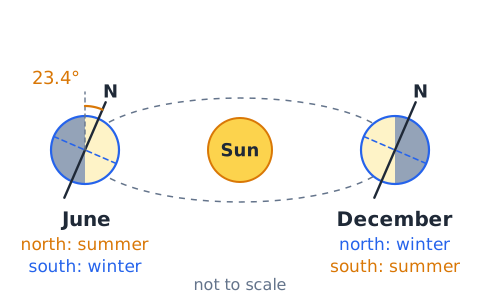
Earth's rotation axis is tilted about 23.4 degrees relative to a perpendicular to its orbital plane. Over a year, each hemisphere alternates leaning toward and away from the Sun. Leaning toward the Sun raises average sunlight angle and lengthens daylight at most mid-to-high latitudes, producing summer there. This is the main cause of ordinary seasons; Earth-Sun distance variations are a comparatively minor explanation and cannot explain simultaneous opposite-hemisphere seasons.
Opposite hemisphere seasons
Around June, the Northern Hemisphere tilts toward the Sun and has summer while much of the Southern Hemisphere experiences winter. Around December, the reverse is true. The equator generally has much less variation in day length and solar angle than polar regions, though local rainfall seasons can be important. If two hemispheres differ in temperature at the same time, the axial-tilt geometry—not the planet being simultaneously both near and far from the Sun—explains the basic pattern.
Solstices and equinoxes
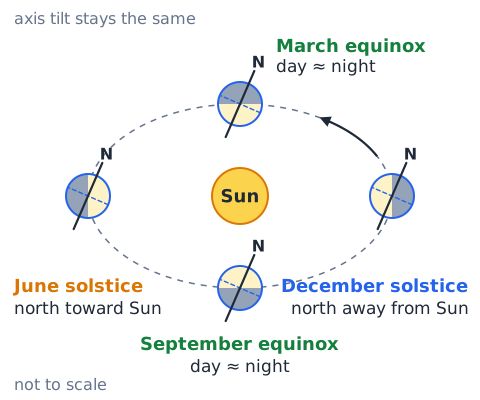
A solstice occurs when one hemisphere has its greatest seasonal tilt toward or away from the Sun; at most northern midlatitudes the June solstice brings the longest daylight and the December solstice the shortest. Near an equinox, day and night are approximately equal at many locations. Approximate equality is not identical sunrise-to-sunset duration everywhere because of atmospheric refraction and the visible solar disk. Questions normally focus on axial orientation and changing daylight.
Why the Moon appears to change shape
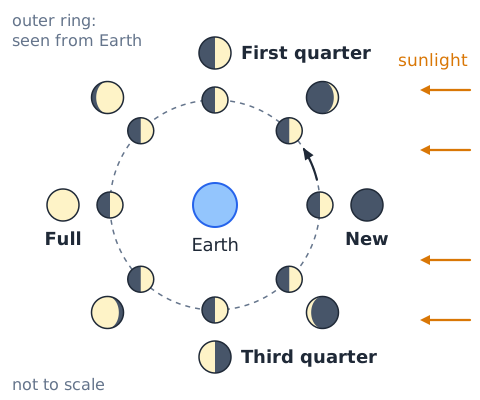
The Moon is illuminated by the Sun. As the Moon orbits Earth, observers see changing proportions of the Moon's sunlit half. These appearances are lunar phases. They are generally not caused by Earth's shadow falling across the Moon; Earth's shadow is relevant specifically during a lunar eclipse. A crescent moon is still a spherical Moon, with much of its sunlit side turned away from our view.
Lunar phase sequence
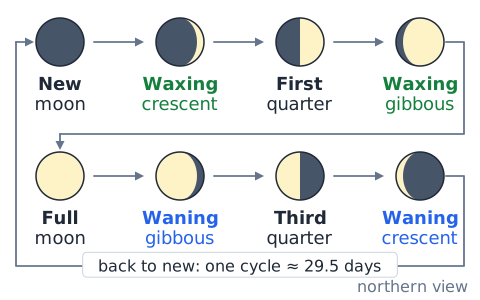
The familiar sequence runs new moon, waxing crescent, first quarter, waxing gibbous, full moon, waning gibbous, third (last) quarter and waning crescent. 'Waxing' means the illuminated fraction visible from Earth is increasing; 'waning' means decreasing. The words first and third quarter refer to progression through the phase cycle, not a Moon physically shaped like a quarter sphere. A phase cycle lasts about 29.5 days.
New versus full moon geometry
At new moon, the Moon is roughly between Earth and the Sun, so the sunlit face is mostly turned away from Earth. At full moon, Earth is roughly between the Sun and Moon, making the Moon's near face appear fully illuminated. Perfect straight-line alignment is unusual because the orbital planes are tilted; otherwise eclipses would happen at every new and full moon. Use 'roughly' for ordinary phases and precise alignment for eclipses.
Solar eclipses: Moon between Earth and Sun
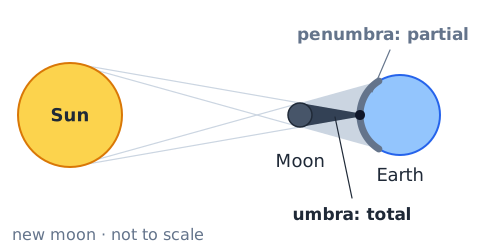
A solar eclipse can occur at new moon when the Moon passes directly between the Sun and a portion of Earth's surface, causing its shadow to fall on Earth. Observers in the darkest central shadow, the umbra, can experience totality when the apparent disk covers the Sun; those in the penumbra may see a partial eclipse. Eye safety matters: looking at the uneclipsed or partly eclipsed Sun without appropriate protection can injure vision.
Lunar eclipses: Earth between Sun and Moon
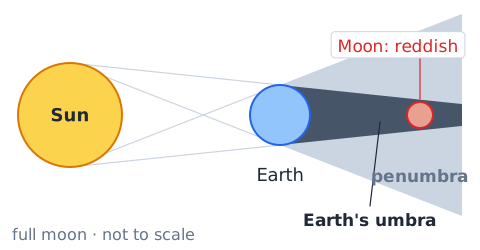
A lunar eclipse can occur around full moon if Earth comes directly between the Sun and Moon so Earth's shadow falls on the Moon. In a total lunar eclipse the Moon may appear reddish because sunlight filtered and bent through Earth's atmosphere reaches it. Unlike solar eclipses, lunar eclipses are observable from much of the nighttime hemisphere and do not require solar viewing protection. Shadow geometry, not a change in lunar material, causes the effect.
Why no eclipse every month?
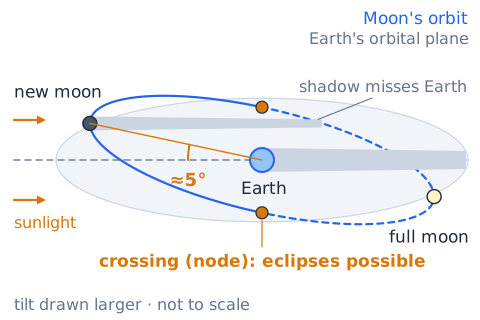
The Moon's orbit is inclined by roughly five degrees to Earth's orbital plane. In most months the Moon passes above or below the exact Sun-Earth line as seen from Earth, so its shadow misses Earth during new moon, and the Moon misses Earth's shadow during full moon. Only near crossings of the orbital planes can the bodies align precisely for eclipses. Eclipses therefore depend on both phase and orbital geometry.
Gravity and ocean tides
The Moon's gravitational effects and the Sun's gravity produce tidal forces that contribute to changing ocean levels. The difference in gravitational pull across Earth matters, rather than simply an ocean on the Moon-facing side being lifted in isolation. The coastline, seafloor and regional ocean dynamics modify actual tide schedules and heights. A simple textbook model predicts two tidal bulges, but local tidal behavior can be more complicated.
Spring tides versus neap tides
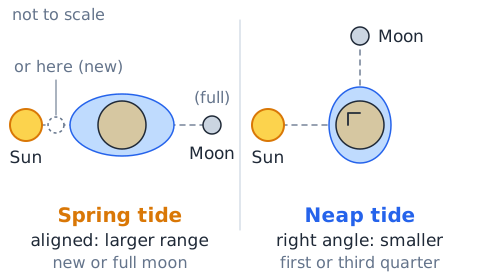
During new and full moon, Sun-Earth-Moon alignment produces spring tides with relatively larger differences between high and low water under otherwise comparable conditions. Around first and third quarter, solar and lunar tide-producing effects partly offset, giving smaller-range neap tides. 'Spring' means a stronger tidal range, not the spring season. Remember alignment leads to larger range; right-angle geometry leads to smaller range.
Orbital speed and distance
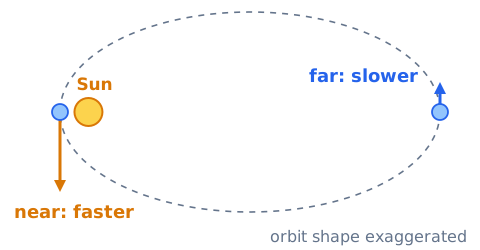
A planet in an elliptical orbit moves faster near the Sun and slower farther away, following orbital mechanics. A more distant solar-system planet generally takes longer to complete an orbit than a closer planet. Do not assume all planets move with the same speed or take one Earth year to orbit. For basic ASVAB reasoning, compare near versus far and the direction of gravity rather than memorizing elaborate orbital equations.
Why astronauts look weightless
Astronauts aboard an orbiting spacecraft may appear weightless because the spacecraft and occupants are in continuous free fall together. Earth's gravity at low Earth orbit is still substantial; it does not suddenly become zero just beyond the atmosphere. Apparent weightlessness is a shared acceleration condition, not proof that gravity has vanished. The same principle explains why orbiting satellites can continuously fall around Earth without hitting its surface.
Stars versus planets in the night sky
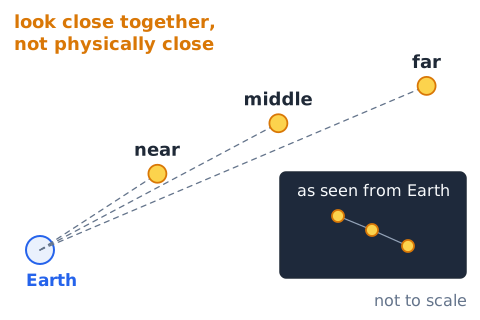
Stars generate light through internal physical processes such as nuclear fusion. Planets are generally seen because they reflect a star's light. Nearby planets may be bright, but brightness by itself does not establish whether an object is a star or planet. The stars in familiar constellations are not necessarily physically close to one another: they appear in patterns because of our viewpoint. Contrast a self-luminous stellar source with reflected planetary light.
Star formation and nebulae
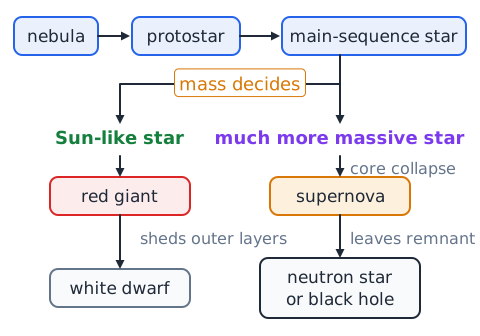
A nebula can be a large cloud of gas and dust. In some regions, gravity compresses parts of the cloud and produces a protostar that heats as it contracts. If its core becomes hot and dense enough for sustained hydrogen fusion, it becomes a main-sequence star. Not every nebula is forming stars; some are remnants of stellar deaths or regions illuminated by existing stars. Context determines the nebula's role.
Main-sequence stars and fusion
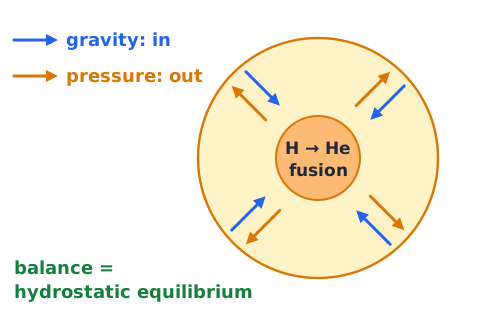
A main-sequence star generates energy primarily by fusing hydrogen into helium in its core. Gravity tends to compress the star, while pressure associated with its internal energy counters that compression. This long-lasting balance is approximately hydrostatic equilibrium. A star can remain on the main sequence for millions to many billions of years depending strongly on mass. A star is not powered mainly by chemical fire, electricity from its orbit, or reflected planetary light.
Star color and temperature
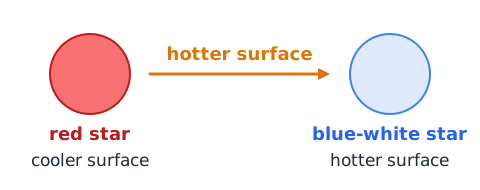
A star's color offers a clue to its surface temperature: generally blue-white stars are hotter than red stars. This reverses an everyday intuition based on red 'hot' warnings and blue 'cold' symbols. A star's apparent brightness also depends on distance and size, so it does not alone reveal temperature. When comparing stars, distinguish intrinsic luminosity from the brightness seen by an observer on Earth.
Brightness versus distance
Apparent brightness is how much light from an object reaches an observer; luminosity is the total power emitted by the object. If two identical light-emitting objects are at different distances, the farther one appears dimmer. In unobstructed space light spreads over larger areas with distance; brightness decreases approximately with the inverse square of distance. Do not conclude a faint star must be physically smaller or cooler than a bright one without other evidence.
Low-mass stars and red giants
A Sun-like star eventually exhausts hydrogen fusion in its core and can swell into a red giant as its internal structure evolves. Later it sheds outer layers and leaves a hot dense white dwarf, which is not sustained by ongoing hydrogen fusion in the same way as a main-sequence star. The Sun is not expected to end in a core-collapse supernova: that pathway requires a much more massive star. Stellar evolution depends on mass and composition.
Massive stars, supernovae and remnants
Massive stars can develop complex nuclear burning stages and eventually undergo core collapse, producing a supernova. The compact remnant can be a neutron star or black hole depending on conditions and remaining mass. These outcomes are not the destiny of every star. Supernova material can enrich interstellar gas with heavy elements that become part of later stars and planets, connecting stellar evolution with the formation of matter around us.
Black holes and gravity
A black hole is a region with an event horizon beyond which light cannot escape to distant observers. It is not a universal vacuum cleaner that pulls every object everywhere toward it. Far enough away, its gravitational influence follows the same general mass-and-distance dependence as other objects. Some black holes are remnants of massive stars; larger black holes can occupy galaxy centers. Avoid treating the horizon as a material solid surface.
Galaxies and the Milky Way
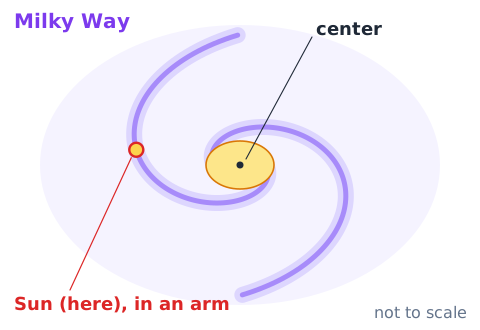
Galaxies are large systems containing many stars, gas, dust and substantial dark matter held together gravitationally. The Milky Way is our galaxy; the Sun lies within one of its spiral regions, not at its center. A galaxy is vastly larger than a planetary system and itself is one of many galaxies. The Andromeda Galaxy is a neighboring large galaxy, not another planet in the solar system or a star orbiting Earth.
The universe is not one galaxy
The observable universe contains an immense population of galaxies. Our Milky Way is a single galaxy, and the solar system is a tiny part of it. Scientists study large-scale patterns with telescopes and spectroscopy. The fact that we observe distant galaxies does not imply that they are inside the Milky Way or that Earth is the geometric center of cosmic expansion. Hierarchy questions should be answered: planet → solar system → galaxy → universe.
Light-years measure distance
A light-year is the distance light travels through vacuum in one year, not an amount of time itself. Light travels approximately 300,000 kilometers each second; one light-year is about 9.46 trillion kilometers. For mental arithmetic, a signal traveling one light-second covers about 300,000 kilometers, while one light-minute covers about 18 million kilometers. In space science, 'light time' and 'light distance' are related but represent different quantities.
Astronomical unit (AU)
One astronomical unit is approximately the mean Earth-Sun orbital distance, about 150 million kilometers. AU is convenient within the solar system; light-years are useful for distances between stars. A star 4 light-years away is much farther than an outer planet a few tens of AU away. Avoid multiplying with AU values unless the problem provides an approximation or expects a simple estimation without a calculator.
Looking back in time with light
Because light takes time to travel, a distant object is observed as it was when its light started the journey. Light from the Sun takes a little more than eight minutes to reach Earth, while light from a star 100 light-years away takes about 100 years to arrive. This is not literal time travel by the observer; it is delayed information. Distinguish when the event happened at the source from when its light becomes visible.
Electromagnetic waves and astronomy
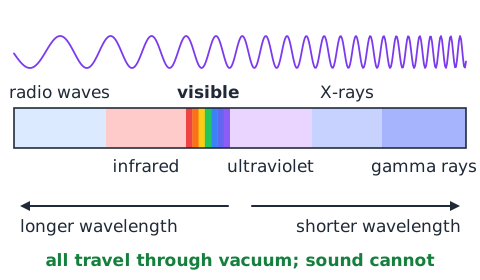
Visible light is one part of the electromagnetic spectrum, which also includes radio waves, infrared, ultraviolet, X-rays and gamma rays. Electromagnetic waves can travel through vacuum; ordinary sound cannot. Astronomers use instruments suited to different wavelengths because objects may reveal different physical processes at each band. An infrared space telescope detects radiation outside human-visible colors, not sound waves traveling through empty space.
Reflecting versus refracting telescopes
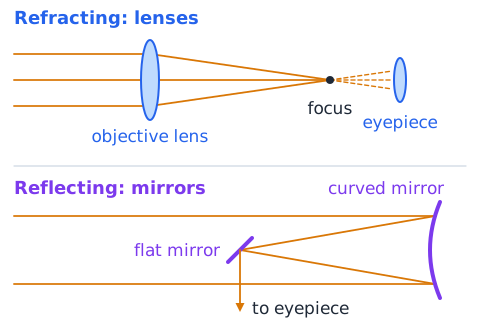
An optical reflecting telescope focuses light with mirrors, while a refracting telescope primarily uses lenses. Both help gather light and resolve detail; they do not create new light inside a distant star. Space telescopes can avoid many effects of Earth's atmosphere, while ground-based instruments may be larger or upgraded. A radio telescope detects radio wavelengths, not necessarily visible light. Match the instrument to the radiation measured rather than memorizing telescope names.
Why exoplanets matter
An exoplanet is a planet orbiting a star outside our solar system. Astronomers can infer some exoplanets from periodic dips in a star's brightness when a planet transits, or from small stellar motions caused by gravitational interactions. Such measurements require care: not every brightness dip proves a planet. Finding exoplanets helps compare planetary systems and estimate how common different types of worlds may be.
Habitable zone is not proof of life
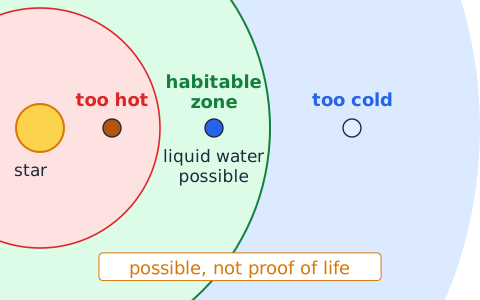
A star's habitable zone describes distances where liquid water could exist at a planetary surface under suitable conditions. It does not guarantee a planet has liquid water, a protective atmosphere or living organisms. A planet too close may be overheated, and one too distant may be too cold, but atmospheric properties can alter conditions. On a test, the cautious conclusion is potentially suitable for surface liquid water, not life definitely exists.
The expanding universe and redshift
Light from many remote galaxies shows cosmological redshift: wavelengths have stretched as space expanded during the light's journey. On large scales this is evidence for cosmic expansion. Redshift is not proof that all nearby galaxies move away at identical speeds, nor that our solar system itself is expanding apart. The Big Bang model describes the early hot dense state and subsequent cosmic evolution; it is not simply an explosion of matter into an otherwise empty preexisting room.
Observations and models
Astronomers rely on recorded light, motion, spectra and timing to test physical models. A hypothesis about a distant object's composition should lead to observations that could support or challenge it. Multiple independent measurements strengthen a conclusion. A photograph alone can be misleading if distances, scales and colors are not explained; scientific images may use selected wavelengths or color mapping, especially outside visible light.
Science calculations without a calculator
Astronomy problems for general-science practice often require only unit reasoning: distance = speed × time, period is time per full cycle, and relative comparisons can avoid large numbers. Write units beside each number before multiplying or dividing. For example, if a signal moves 300,000 km in one second, it moves about 900,000 km in three seconds. Use the approximations stated in the question rather than trying to recall excessive precision.
Read diagrams critically
Most educational solar-system pictures exaggerate planet sizes or compress distances so both fit on one page. Read the legend and determine whether a diagram is to scale. Arrows may depict axis rotation, orbital revolution or a line of sight; they are not interchangeable. For phases and eclipses, locate the Sun first, then identify the illuminated side and the observer. For orbital comparisons, identify which body is attracting which.
Space science versus unsupported claims
Not every astronomical observation yields a definite answer about life, habitability or the ultimate fate of the universe. Separate measured facts (such as a transit brightness dip) from interpretations (such as a possible planet) and stronger conclusions requiring confirmation. Questions with words like 'always', 'every' and 'proves life' often overstate the evidence. Use the narrowest scientifically supported conclusion instead of assuming more than observations show.
Example 1 — Classify nested systems
A student's diagram labels Earth, the Sun, the Milky Way and the universe. Begin with Earth as a planet. Earth belongs to the solar system, which is inside the Milky Way galaxy; that galaxy is in the universe. The correct nesting is Earth → solar system → Milky Way → universe. Reversing galaxy and solar system would incorrectly place billions of stars inside one planetary system.
Example 2 — Put planets in order
A four-choice question asks which world lies between Earth and Jupiter in the outward solar-system order. Use Mercury, Venus, Earth, Mars, Jupiter. Mars is the immediate planet after Earth and before Jupiter. Saturn, although a giant planet, comes after Jupiter; Mercury is closer than Earth. Notice that the question concerns orbital order, not planetary size or mass.
Example 3 — Day length and rotation
An observer reports that a landmark enters morning sunlight and is in darkness about 12 hours later. Earth's rotation carries the landmark from illuminated to unilluminated regions. Revolution takes roughly a year and does not alone cause the daily alternation. The data do not justify assuming every location has exactly 12 hours of daylight every day: latitude and season influence the actual duration.
Example 4 — June hemispheres
A model places Earth's Northern Hemisphere tilted toward the Sun in June. Predict longer daylight and stronger average solar angle at northern midlatitudes; southern midlatitudes generally have shorter days and winter conditions. Do not say Earth must be closer to the Sun in June, because seasonal differences between hemispheres arise mainly from axis orientation and sunlight distribution.
Example 5 — Solar-eclipse alignment
Three labels are given for positions on a line: Sun — Moon — Earth. The Moon can block the Sun and cast a shadow on Earth, describing a solar eclipse when alignment is sufficiently exact and the observer is within the shadow. Reverse the order to Sun — Earth — Moon and Earth's shadow may fall on the Moon, describing a lunar eclipse. First identify the central object, then name whose light is blocked.
Example 6 — Distinguish lunar phases from shadow
An image shows a crescent Moon but no special Sun-Earth-Moon alignment. The correct explanation is that observers see only part of the Moon's sunlit hemisphere. Earth's shadow does not normally create the crescent. A true lunar eclipse requires Earth between Sun and Moon near full moon with unusually exact geometry. Identify the causal mechanism before naming a phase.
Example 7 — Predict tide range
Compare two dates: Date A is near full moon, and Date B is near first-quarter moon. Sun and Moon are roughly aligned on A, favoring a spring tide and a larger tidal range. Their directions are closer to a right angle on B, favoring a neap tide and smaller range. Local ocean geography still affects actual values; this is a pattern prediction, not an exact tide-height forecast.
Example 8 — Classify a falling space rock
A rocky fragment approaches Earth while still in space: it is a meteoroid. A brilliant atmospheric streak appears during entry: that luminous event is a meteor. If a piece survives and lands, the recovered object is a meteorite. One physical fragment can be described using different terms at different stages, avoiding the misconception that 'meteors' are distant stars.
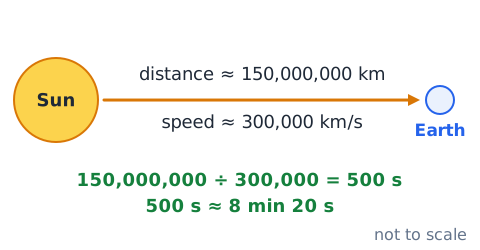
Example 9 — Compute travel time of sunlight
Use rounded numbers supplied by the problem: Earth is about 150 million km from the Sun, and light travels about 300,000 km per second. Divide distance by speed:
Since 60 seconds equal one minute, 500 seconds is about 8 minutes 20 seconds. The answer is travel time, not an orbital period.
Example 10 — Light-year comparison
A hypothetical star is 6 light-years away. The light received today left that star roughly six years earlier. If another similar star is 12 light-years away, its light takes twice as long to arrive. The numbers refer to distance traveled by light; do not interpret the first star as being only six years old or the distance as six kilometers.
Example 11 — Brightness and inverse square
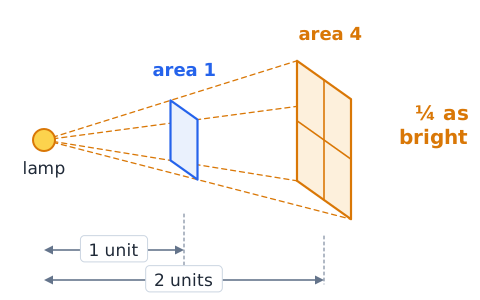
Two identical lamps are observed from one and two units of distance in unobstructed space. The farther lamp spreads its emitted light across about four times the area, so the apparent brightness becomes roughly one quarter. Doubling distance does not double the amount of energy emitted at the source. Apply this approximation only when intrinsic luminosity and measurement conditions are comparable.
Example 12 — Predict a stellar endpoint
A star similar in mass to our Sun spends most of its life on the main sequence, then expands into a red giant and eventually leaves a white dwarf. A much more massive star may end in core collapse and a supernova, possibly leaving a neutron star or black hole. The essential decision variable is mass, not an assumption that every stellar death produces the same explosion.
Example 13 — Transit reasoning
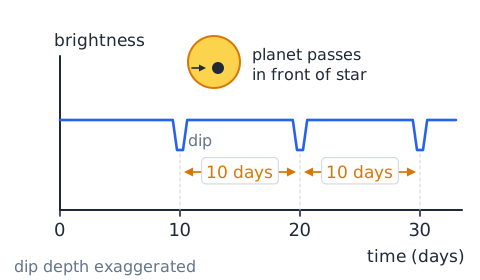
A telescope measures a small brightness dip in a star every 10 days, with similar duration and depth. One plausible explanation is a planet transiting in front of the star once per orbit. The repeated 10-day interval can suggest an orbital period near 10 days, subject to verification and the observing geometry. The brightness pattern alone does not prove liquid water or biological life.
Example 14 — Relative orbital periods
Consider two planets orbiting the same star in roughly circular orbits, one substantially closer than the other. In general, the closer planet has the shorter orbital period, and the farther planet takes longer to go around. You need not calculate exact speeds to decide the likely order. Do not apply this comparison carelessly to planets around different stars, where host-star mass changes the relationship.
Guided drill 1 — Organize celestial scales
Without notes, put 'Milky Way', 'Solar System', 'universe' and 'Earth' from smallest to largest. Then explain why the Sun is not the universe's center. Expected: Earth < solar system < Milky Way < universe. Our solar system is one of many star systems within our galaxy; galaxies are distributed across the universe. Repeat until you can justify every nesting step.
Guided drill 2 — Map the planets
Write the eight planets in order from the Sun, then circle the four terrestrial planets and underline the four giant planets. Place the asteroid belt and Kuiper Belt in their typical locations. Self-check: asteroid belt mainly between Mars and Jupiter; Kuiper Belt beyond Neptune. Pluto is a dwarf planet in the outer belt region; not the ninth major planet.
Guided drill 3 — Sketch seasons
Draw the Sun and Earth in two opposite positions along a circularized orbit while keeping the tilt orientation the same in space. Label which hemisphere receives longer days in June versus December. Explain in one sentence why the near-far Earth-Sun distance idea cannot explain opposite seasons at the same time in the Northern and Southern Hemispheres.
Guided drill 4 — Moon phases and eclipses
For solar eclipse, draw Sun → Moon → Earth; for lunar eclipse, draw Sun → Earth → Moon. Add a tilted lunar orbit that usually prevents perfect monthly alignments. Separately, draw a crescent Moon with half of the sphere illuminated but only part of that half visible from Earth. State why an ordinary phase is not Earth's shadow.
Guided drill 5 — Estimate light travel
Use 300,000 as an approximate speed. A radio signal travels 1,200,000 km through vacuum; calculate
Then estimate the Sun-to-Earth light time for 150,000,000 km, giving 500 seconds or about 8.3 minutes. State the units at every step, and explain how light-seconds refer to a distance if used as a distance unit.
Guided drill 6 — Evaluate evidence
Classify these as observation, inference or unsupported conclusion: 'A star's brightness dipped repeatedly' (observation); 'a planet may be crossing the star' (inference needing checking); 'the planet definitely has animals' (unsupported). Next identify whether a faint blue-white star is automatically cooler than a brighter red star (no). Finish by stating which further data would strengthen each inference.
Eight frequent astronomy traps
(1) A light-year measures distance, not time. (2) The Moon's phases usually do not result from Earth's shadow. (3) Seasons are primarily about tilt, not annual distance changes. (4) Pluto is a dwarf planet, not one of eight major planets. (5) A meteor is a luminous atmospheric event, not a space-borne rock by definition. (6) Outer planets are not all identical gas giants. (7) An object in a star's habitable zone need not harbor life. (8) Space has gravity; orbiting astronauts are in free fall, not outside all gravitational fields.
ASVAB General Science decision strategy
First identify what the stem requests: classification, geometry, physical cause, comparison or simple arithmetic. For eclipses and phases draw the Sun and relative positions. For scales write solar system < galaxy < universe. For numerical items label units and estimate before choosing. Eliminate responses that swap cause and effect or make absolute claims unsupported by the scenario. Practice items in this course are original ASVAB-style questions, not secure test content; any timing estimates are study suggestions only, not official GS operating limits.
Final recall checklist
Recall the planet order; terrestrial versus giant planets; a star generates light while most planets reflect it; rotation gives day-night, and tilted-axis revolution gives seasons; Moon phases come from illumination geometry; a solar eclipse occurs with Moon between Sun and Earth, a lunar eclipse with Earth between; aligned Sun and Moon favor spring tides; a meteor is a visible atmospheric streak; a light-year is a distance; stellar lifetimes depend on mass; and a habitable-zone location does not establish life.
 English ▾