 ASVAB Camp
Learning outcomes and ASVAB scope
This review pulls the whole General Science unit together. When you finish it, you should be able to trace one situation through biology, chemistry, physics and Earth or space science; name the variables in an experiment and spot a confounder; tell correlation from causation; check an answer with units and with conservation of mass and energy; and solve short multi-step numeric problems.
The ASVAB General Science subtest checks knowledge of physical and biological science. The cases here are original practice. They are not official items, an official topic weighting, or a score prediction.
Think in mechanisms, not topic labels
Integrated questions rarely announce which subject they come from. A question about a fish kill in a pond might need chemistry, biology and Earth science together. Instead of asking which chapter a question belongs to, ask what is physically happening: what moves, what changes form and what drives the change. A handful of mechanisms show up everywhere: diffusion down a gradient, conservation of mass and energy, net force producing acceleration, and selection acting on inherited variation. Name the mechanism and you can usually reason to the answer, even in an unfamiliar setting.
Four domains in a shared investigation
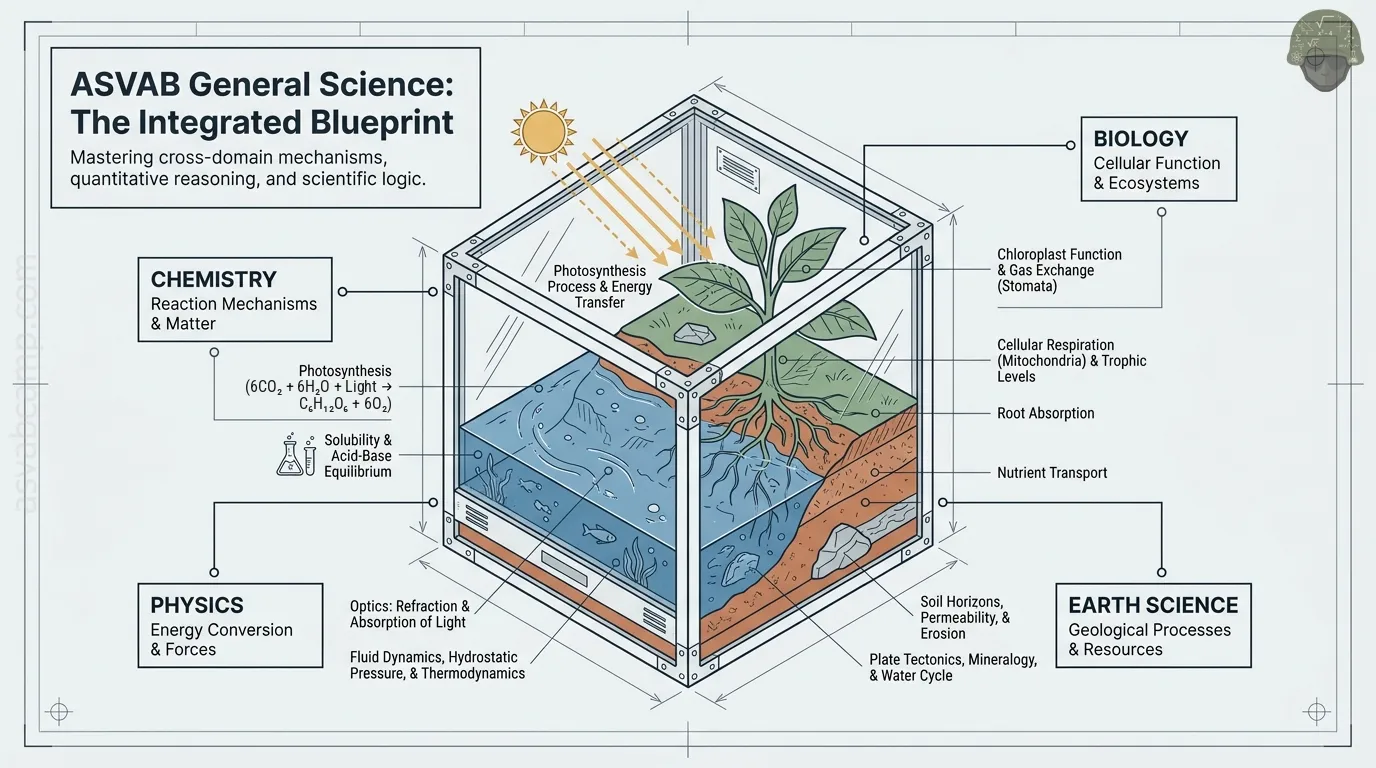
Real situations rarely stay inside one chapter. Picture a farm field after a summer storm. Physics explains how fast the rain falls and how much energy it carries into the soil. Earth science tracks where the water goes: into the ground, into a ditch, or back into the air. Chemistry describes the fertilizer that dissolves and travels with it. Biology follows what happens when those nutrients reach a creek full of algae and fish.
Each domain answers a different part of one question. Strong test takers ask which part a given question is really about.
Evidence, hypothesis and prediction
An observation is something recorded directly, such as "the bread molded faster on the counter than in the refrigerator." A hypothesis is a testable explanation: "warmth speeds mold growth." A prediction follows from the hypothesis and names a result you could check: "if warmth matters, bread kept at 30 degrees Celsius will mold sooner than identical bread at 10 degrees Celsius."
Evidence that matches a prediction supports the hypothesis but does not prove it forever. Evidence that clearly conflicts with a careful prediction is a strong reason to revise the idea.
Independent, dependent and controlled variables
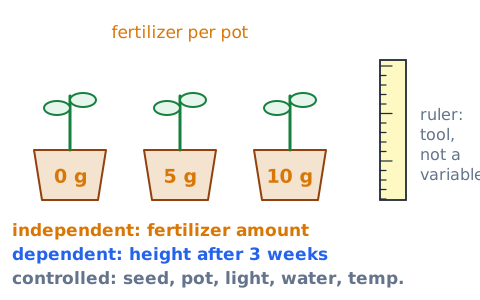
The independent variable is the factor the investigator deliberately changes. The dependent variable is the outcome that is measured to see whether it responds. Controlled variables are everything else that is kept the same so that it cannot explain the result.
Suppose a student gives bean plants 0, 5 or 10 grams of fertilizer and measures plant height after three weeks. Fertilizer amount is independent, height is dependent, and seed type, pot size, light, water and temperature are controlled. The ruler is a measuring tool, not a variable.
Replication, sample size and experimental bias
One plant per group can mislead, because individual plants differ for many reasons. Replication means running each condition on several subjects, or repeating the whole test, so random variation tends to average out. Larger samples usually give more trustworthy averages.
Bias is a systematic tilt in the result. If the healthiest seedlings all go into the treatment group, the treatment looks better than it is. Random assignment to groups, identical handling, and measuring without knowing which group a subject belongs to (blinding) all reduce bias.
Correlation versus causation
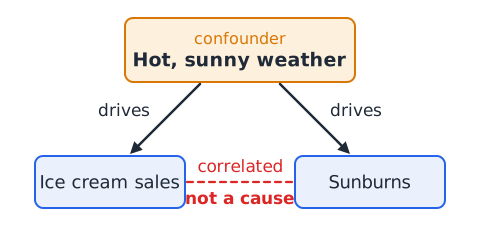
A correlation means two quantities tend to change together. A cause means changing one actually produces a change in the other. The two are easy to confuse.
Towns with more ice cream sales also report more sunburns, but ice cream does not burn skin. Hot, sunny weather drives both. A hidden factor like this is called a confounder. Reverse direction is another trap: the outcome may be driving the supposed cause. To argue for causation, look for a controlled experiment, a believable mechanism, and a result that repeats.
Measurements, SI units and dimensional checks
Science uses SI base units: meter for length, kilogram for mass, second for time, kelvin for temperature. Many other units are combinations. A newton is a kilogram meter per second squared, and a joule is a newton meter.
Units act like algebra. If a cyclist covers 2.5 km in 500 s, first convert to 2,500 m, then divide:
If your units come out as seconds per meter, you divided the wrong way. Checking units catches many errors before you choose an answer.
Reading tables without making up facts
A data table answers only what it measures. If a table lists the dissolved oxygen in a lake each month, you can say which month was lowest and whether values rose or fell. You cannot say from the table alone why oxygen dropped, unless another column gives a cause such as temperature or algae count.
Read the title, column headings and units first. Note the time span and sample size. Then match each answer choice against the numbers. Choices that add a reason, location or trend the table never shows are guesses, not conclusions.
Accuracy, precision and uncertainty
Accuracy is how close a measurement is to the true value. Precision is how close repeated measurements are to one another. A kitchen scale that reads 251 g, 251 g and 252 g for a 200 g weight is precise but not accurate; it probably needs calibration.
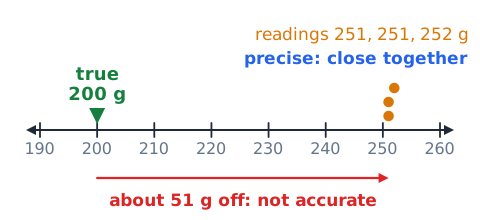
Every measurement carries some uncertainty from the tool and the person using it. Reporting 12.3 cm implies you can read to about a tenth of a centimeter. Averages of repeated trials reduce random scatter, but they cannot fix a consistent offset in the instrument.
Matter is rearranged rather than magically created
In ordinary chemical and physical changes, atoms are neither created nor destroyed. They are regrouped. When wood burns, its carbon and hydrogen combine with oxygen from the air to make carbon dioxide and water vapor. The ash weighs less than the log because most of the mass left as gas, not because matter vanished.
When a total mass seems to shrink or grow, ask what crossed the boundary. Was the container open? Did a gas escape or get absorbed? Counting every input and output keeps the mass balanced.
Elements, compounds and mixtures in practical contexts
An element is made of only one kind of atom, such as copper or oxygen. A compound is two or more elements chemically bonded in a fixed ratio; table salt is always one sodium for each chlorine. A mixture combines substances physically, in proportions that can vary.
Saltwater is a mixture: you can add more or less salt, and boiling off the water and condensing it leaves the salt behind, unchanged. Air, granite and trail mix are other mixtures. Breaking a compound into its elements requires a chemical reaction.
Atomic number, ions and isotopes
The atomic number is the count of protons in the nucleus, and it alone identifies the element. Carbon always has 6 protons. Change the protons and you have a different element.
Electrons can be gained or lost without changing the element. A chlorine atom that gains one electron becomes a chloride ion with a charge of negative one, but its atomic number is still 17. Isotopes are atoms of the same element with different numbers of neutrons, such as carbon-12 and carbon-14. They differ in mass, not in identity.
Conservation and balancing for simple equations
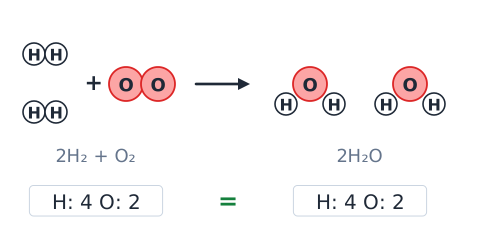
A balanced chemical equation shows the same number of each kind of atom on both sides. Take hydrogen burning in oxygen:
Count the left side: 4 hydrogen atoms and 2 oxygen atoms. Count the right side: two water molecules also hold 4 hydrogen and 2 oxygen. You balance with coefficients in front of formulas, never by changing subscripts, because a new subscript would describe a different substance.
Acids, bases and aqueous conditions
The pH scale describes how acidic or basic a water solution is. Values below 7 are acidic, 7 is neutral at room temperature, and values above 7 are basic. The scale is logarithmic: each step of one pH unit is a tenfold change in hydrogen-ion activity. A drop from pH 7 to pH 5 is a hundredfold increase in acidity, not a small one.
Acids react with many metals and with carbonate rocks such as limestone. Bases neutralize acids. Living things usually tolerate only a narrow pH range, so a modest shift can stress fish or plants.
Reaction speed versus energy balance
How fast a reaction goes and whether it releases or absorbs energy are separate questions. A rusting nail releases energy but does so very slowly. A struck match also releases energy, but only after a small input gets it started.
Rate depends on temperature, concentration, surface area and catalysts. Powdered sugar dissolves faster than a sugar cube because more surface touches the water. A catalyst, such as an enzyme in your body, speeds a reaction without being used up and without changing the overall energy released or absorbed.
Cells transform matter and energy
Every living cell takes in matter and energy, rearranges them and releases products. In photosynthesis, chloroplasts in plants and algae use light energy to build glucose from carbon dioxide and water, releasing oxygen; light energy becomes chemical energy stored in bonds, and much of a plant's new mass is carbon taken from the air. In cellular respiration, mitochondria break glucose down with oxygen, releasing carbon dioxide and water and capturing energy as ATP. Plants do both. Atoms are rearranged, never created, and some energy is lost as heat.
Diffusion, osmosis and concentration gradients
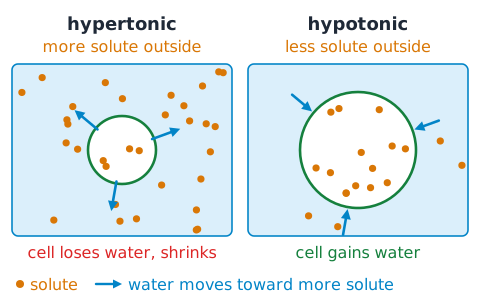
Particles in a fluid move randomly, so on average they spread from regions of higher concentration to regions of lower concentration. This net movement is diffusion, and it requires no energy from the cell. Osmosis is the diffusion of water across a selectively permeable membrane. Water moves toward the side where dissolved solute is more concentrated, which is the side with relatively less free water. A cell in a hypertonic solution, with more solute outside, loses water and shrinks; in a hypotonic solution it gains water. Moving a substance against its gradient takes active transport, powered by ATP.
DNA, alleles and environmental effects
In eukaryotic cells, including human cells, most DNA is kept in the nucleus, packaged into chromosomes. A gene is a stretch of DNA that carries instructions, often for building a protein. Different versions of the same gene are called alleles, and an individual inherits one allele of each gene from each parent. The genotype is the combination of alleles; the phenotype is the observable trait. Phenotype often depends on environment too: a plant with alleles for tall growth may stay short in poor soil, and nutrition affects human height. Genes set a range; environment helps decide where in it an organism lands.
Inheritance probabilities and independent events
Each offspring is an independent event: the result for one child does not change the odds for the next. For one gene with complete dominance, a Punnett square lists every equally likely combination of parental alleles. Crossing Aa with aa gives Aa, Aa, aa and aa, so the chance of aa is 2 out of 4, or 50 percent. Crossing Aa with Aa gives AA, Aa, Aa and aa: 25 percent aa and 75 percent showing the dominant trait. To find the chance that two independent events both happen, multiply: 1/2 times 1/2 equals 1/4.
Natural selection versus individual adjustment
Natural selection acts on inherited variation that already exists in a population. When some variants help organisms survive and reproduce in a given environment, those variants become more common over generations.
Individuals do not evolve by wanting a trait. A moth does not darken its genes because the trees are sooty. Instead, darker moths that happen to be harder for birds to spot leave more offspring. Changes an individual makes during life, like stronger muscles from training, are not passed through DNA. Populations evolve; individuals adjust.
Organ systems work as coupled processes
Organ systems rarely act alone; a change in one sets off responses in others. During exercise, muscle cells speed up cellular respiration, so the respiratory system must take in more oxygen and remove more carbon dioxide, the heart must pump faster to carry those gases, and the skin must shed the extra heat the muscles produce. The kidneys adjust water loss to protect blood volume. Most of these adjustments are negative feedback loops that push a variable back toward its set point. When a question describes one system changing, predict the knock-on effect in the systems linked to it.
Photosynthesis, trophic transfer and decomposers
Photosynthesis uses light energy to turn carbon dioxide and water into sugars and release oxygen. The light energy ends up stored in chemical bonds, and most of a plant's dry mass comes from carbon dioxide pulled from the air. Plants also respire, using some of that sugar for their own needs.
In a food chain, each arrow points from the eaten to the eater, showing energy in food moving up. Only a small share, often about 10 percent, passes to the next level. Decomposers break down dead matter and return nutrients to soil and water for reuse.
Nutrients, eutrophication and dissolved oxygen
Nitrogen and phosphorus from fertilizer or sewage can wash into lakes. These nutrients feed rapid algal growth, called a bloom, and the over-enrichment is called eutrophication.
The oxygen crash usually comes later. When the algae die, bacteria decompose them, and that microbial respiration consumes dissolved oxygen. Warm water makes it worse because it holds less dissolved gas. Fish and other animals may suffocate. The chain links chemistry (nutrients), biology (growth and decay) and physics (gas solubility with temperature).
Energy and the first law in the real world
The first law of thermodynamics says energy is conserved: it changes form or moves between objects but is not created or destroyed. A car engine turns chemical energy in fuel into motion, but most of it becomes thermal energy released through the exhaust and radiator.
So "lost" energy is usually energy that went somewhere less useful, often heat. Efficiency is the useful output divided by the total input. No real device reaches 100 percent, yet the total accounted energy still equals the energy put in.
Thermal energy, temperature and heat
Temperature measures the average kinetic energy of the particles in a substance. Thermal energy is the total internal energy of all those particles, so it depends on the amount of material too. Heat is energy transferred from a warmer object to a cooler one because of a temperature difference.
A bathtub of warm water holds more thermal energy than a cup of hotter tea, even though the tea's temperature is higher. Given the same heat input, an object with more mass of the same material warms less, because the energy is spread over more particles.
Phase changes join chemistry and Earth science
Melting, freezing, evaporation, condensation and sublimation are physical changes. The molecules stay the same substance; only their arrangement and spacing change. Ice, liquid water and water vapor are all H2O.
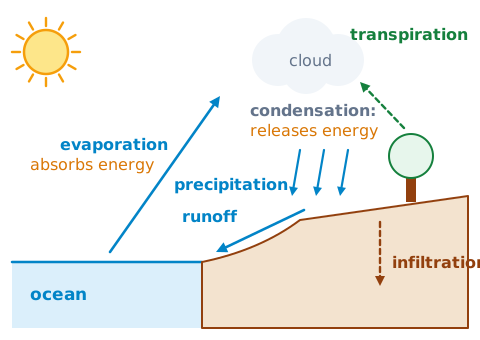
During a phase change at constant pressure, added energy breaks or loosens attractions between molecules instead of raising temperature, so the thermometer holds steady. The same physics shapes weather: evaporation absorbs energy from the ocean surface, and condensation releases that energy in clouds, helping power storms.
Newton’s laws applied across settings
Newton's first law: an object keeps its state of rest or constant straight-line motion unless a net force acts. A puck gliding on ice at steady velocity has zero net force on it.
Second law: net force equals mass times acceleration, so a given push speeds up a light cart more than a heavy truck. Third law: forces come in equal and opposite pairs acting on different objects. A swimmer pushes water backward, and the water pushes the swimmer forward. The same three laws govern a rocket, a falling apple and a person walking.
Force, mass and gravitational weight
Mass is the amount of matter in an object, measured in kilograms, and it does not depend on location. Weight is the gravitational force on that mass, measured in newtons. Near Earth's surface, weight is about mass times 9.8 newtons per kilogram.
An astronaut with a mass of 70 kg has about 686 N of weight on Earth and roughly one sixth of that on the Moon, but still 70 kg of mass. Bathroom scales report kilograms only because they assume Earth's gravity; what they physically sense is a force.
Speed, velocity and direction
Speed tells how fast something moves. Velocity tells how fast and in which direction. Average velocity uses displacement, the straight-line change in position:
A bus that ends up 1,800 m north of its start after 300 s has an average velocity of 6 m/s north. If it drives a loop and returns to the starting stop, its displacement and average velocity are zero, even though its speedometer showed motion the whole time. A change in direction alone is a change in velocity.
Distance-time and velocity-time plots
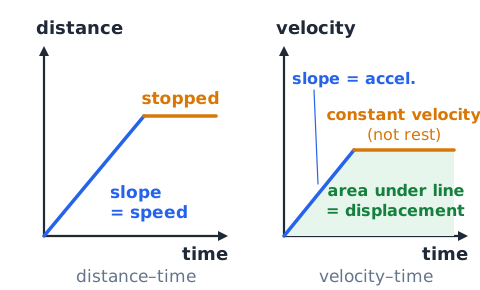
On a distance-time graph, the slope is speed. A straight, rising line means steady speed; a flat line means the object is stopped; a steeper line means faster motion; a curve that bends upward means it is speeding up.
On a velocity-time graph, the slope is acceleration, and the area under the line is displacement. A horizontal line above the axis means constant velocity, not rest. Before answering, always read which quantity is on each axis, because the same line shape means different things on the two kinds of graph.
Density and flotation as cross-domain reasoning
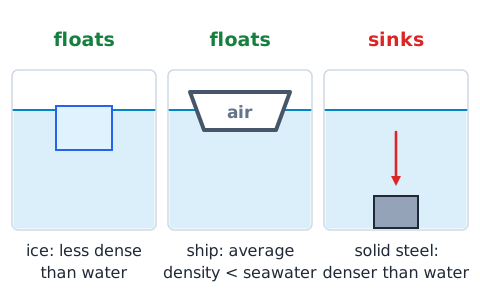
Density is mass per unit volume. An object that is less dense than the fluid around it floats; one that is denser sinks. Ice floats on water because freezing spreads its molecules into an open structure, lowering density.
The idea reaches every domain. Warm air rises over cooler air and drives convection. Oil slicks spread across the ocean surface. Continental crust rides higher than denser oceanic crust. A steel ship floats because its hull encloses air, making its average density lower than that of seawater.
Waves carry energy and information
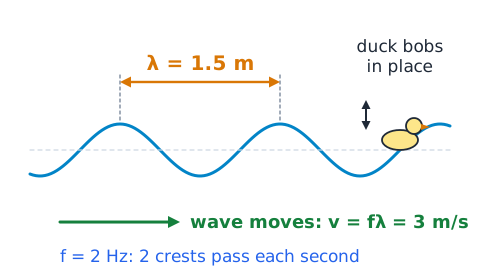
A wave moves energy from place to place without carrying the medium along with it. A floating duck bobs up and down as ripples pass but stays roughly in the same spot. Wave speed, frequency and wavelength are linked:
Here v is speed in meters per second, f is frequency in hertz (cycles per second) and is wavelength in meters. Waves arriving at 2 Hz with crests 1.5 m apart travel at 3 m/s. Radio, light and sound also carry information, which is why phones and satellites depend on wave physics.
Sound, echo and measurement
Sound is a mechanical wave, so it needs a medium; it cannot cross empty space. In air at room temperature it travels roughly 340 m/s, and faster in water and solids.
An echo is a reflected sound. The sound travels out and back, so the one-way distance is half the round trip:
If a shout returns after 1.5 s in 340 m/s air, the wall is 255 m away. Forgetting the factor of two is the classic echo mistake. Bats and ship sonar use the same reasoning.
Water cycle: mass transport and energy
The water cycle moves the same water among oceans, air, land and living things. Sunlight drives evaporation and plants release vapor through transpiration. Rising air cools, and vapor condenses onto tiny particles to form cloud droplets. Droplets grow and fall as precipitation, then soak into soil (infiltration) or flow over land as runoff toward streams.
Energy rides along with the water. Evaporation absorbs energy, and condensation releases it into the atmosphere. Runoff also carries sediment and dissolved substances, linking the cycle to soil loss and water quality.
Weather versus climate and seasonality
Weather is the short-term state of the atmosphere: today's temperature, wind, humidity and rain. Climate is the long-term pattern of weather in a region, usually averaged over about 30 years. One cold week does not disprove a warming climate.
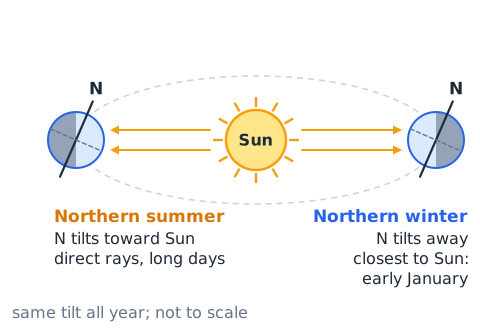
Seasons come from Earth's tilted axis, not from changing distance to the Sun. As Earth revolves, each hemisphere takes turns leaning toward the Sun, receiving more direct rays and longer days in its summer. Earth is actually closest to the Sun in early January, during the Northern Hemisphere's winter.
Rocks, weathering and the cycle of material
Weathering breaks down or chemically alters rock where it sits. Frost wedging and plant roots crack rock physically; acidic rain dissolves limestone chemically. Erosion is the movement of that loosened material by water, wind, ice or gravity. Deposition drops it somewhere new.
Over time, buried sediment can harden into sedimentary rock. Heat and pressure can change any rock into metamorphic rock, and melting followed by cooling makes igneous rock. The rock cycle recycles Earth's crust, with no fixed starting point or required order.
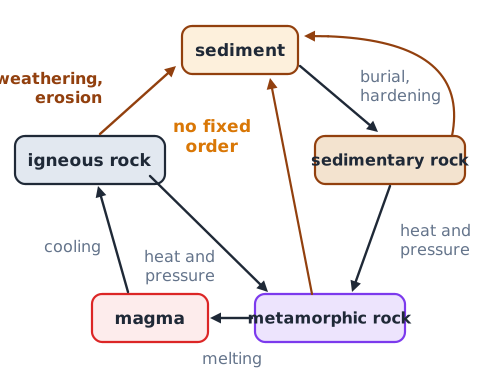
Plate boundaries and hazard reasoning
Earth's outer shell is broken into plates that move a few centimeters a year. At divergent boundaries plates pull apart, and magma rises to form new crust, as along mid-ocean ridges. At convergent boundaries plates collide; an oceanic plate may sink beneath another, building volcanoes and deep trenches. At transform boundaries plates slide past each other, storing strain that is released in earthquakes.
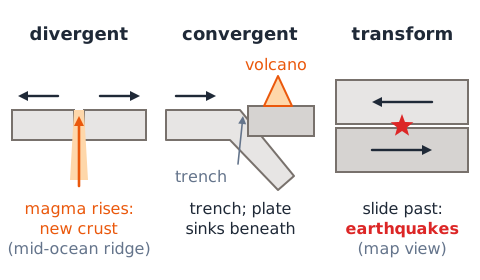
Knowing the boundary type helps predict the hazard. A coast above a subduction zone faces earthquakes, volcanoes and possible tsunamis.
Atmosphere, greenhouse gases and radiation
Sunlight reaches Earth mostly as visible and near-infrared radiation, and much of it is absorbed by land and water. The warmed surface gives off longer-wavelength infrared radiation. Greenhouse gases such as carbon dioxide, water vapor and methane absorb part of that outgoing infrared and re-emit it, some back toward the surface.
This greenhouse effect keeps Earth far warmer than it would be otherwise. Adding more of these gases strengthens the effect. The ozone layer is a separate topic: it absorbs incoming ultraviolet radiation.
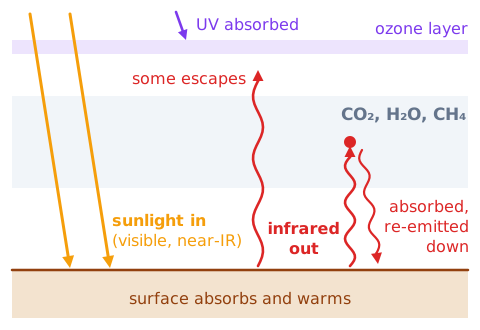
Astronomy: rotation, revolution and phases
Rotation is a spin on an axis. Earth rotates about once every 24 hours, which causes day and night. Revolution is travel around another body. Earth revolves around the Sun about once a year, and with its tilted axis, that produces the seasons.
The Moon's phases come from viewing geometry. Half the Moon is always lit by the Sun, but as it orbits Earth over about a month we see different portions of that lit half. Earth's shadow is not the cause; that happens only during a lunar eclipse.
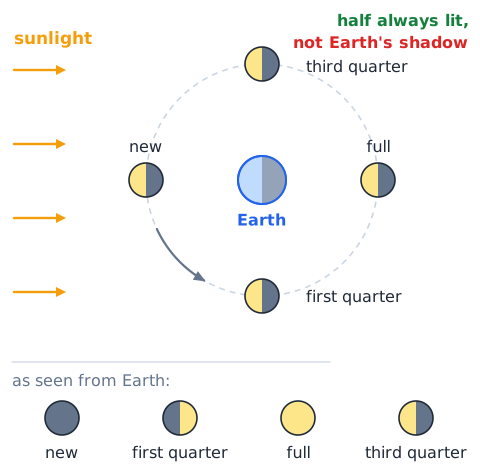
Gravity connects falling objects and orbits
Gravity is an attraction between any two masses. It gets stronger as the masses increase and weaker as the distance between them grows. Near Earth's surface it gives a falling object an acceleration of about 9.8 m/s squared when air resistance is negligible. A satellite is falling toward Earth too, but it moves sideways so fast that the surface curves away beneath it, so it keeps circling. Even at constant speed its direction keeps changing, so it is accelerating toward Earth's center. The same pull holds the Moon in orbit and helps raise tides.
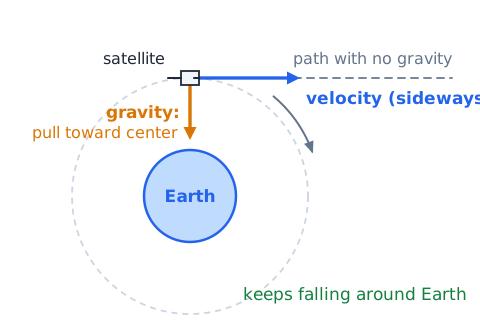
Scale and model limitations
Models simplify reality so we can think about it. A classroom globe, a ball-and-stick molecule or a food-chain diagram each leaves things out. Most diagrams of the solar system cannot show true distances; at real scale, the planets would be invisible dots far apart.
Use a model for what it was built to show, and be cautious about extending it. A food chain shows energy flow but hides the web of other feeding links. A computer climate model is useful, but it carries assumptions and stated uncertainty that a careful reader should notice.
Track input, process and output in coupled systems
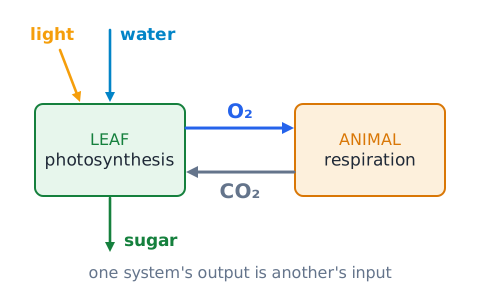
A useful habit is to list what goes into a system, what happens inside it, and what comes out. For a leaf: inputs are light, carbon dioxide and water; the process is photosynthesis; outputs are sugar and oxygen.
Systems are coupled when one system's output becomes another's input. The oxygen from leaves feeds animal respiration, and the carbon dioxide animals exhale feeds leaves. Tracing these links helps you predict how a change in one place, such as fewer trees, ripples through others.
Scientific claims need an appropriate denominator
A raw count can mislead unless you know what it is divided by. Saying one town had 50 cases of an illness and another had 200 means little if the first town has 1,000 residents and the second has 100,000; the rates are 5 percent and 0.2 percent. Likewise, a river carrying more total pollutant may simply be carrying more water. Always ask: per what? Per person, per liter, per second, per kilogram? Concentration is amount per volume, and a flow rate is amount per time. When groups differ in size, compare rates, not totals.
Multi-step quantitative questions
Some questions need two calculations before the final answer. Write the given values with units, find the intermediate quantity, then use it.
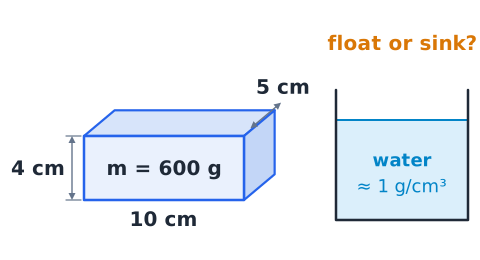
A block has mass 600 g and measures 10 cm by 5 cm by 4 cm. Will it float in water? First the volume:
Then the density:
Water is about 1 g/cm³, so the block sinks.
When answers are conditional
Many science statements hold only under stated conditions. Water boils at 100 degrees Celsius at sea-level pressure but at a lower temperature high on a mountain. A feather and a hammer fall at the same rate only when air resistance can be ignored. Mass is always conserved in a reaction, but a measured total matches only if every product is counted, including any gas that escapes from an open container. The 10 percent rule for energy passed between trophic levels is an approximation, not a law. Phrases such as ignoring friction, in a sealed container or under comparable conditions tell you which model to use. Pick the answer that fits the stated conditions, not just everyday experience.
Distinguish necessary from sufficient evidence
A necessary condition must be present for an outcome to happen, but it may not be enough by itself. A sufficient condition guarantees the outcome. Oxygen is necessary for a wood fire, but it is not sufficient: fuel and enough heat are also needed. In science, showing that a factor is present whenever an effect appears does not prove the factor causes the effect. A controlled comparison, in which only that factor changes while other variables are held constant and the trial is replicated, is much stronger evidence. Be wary of answer choices that turn one necessary factor into the only cause with words like proves or always.
Cause chains can cross time and scale
Some causes act through a series of steps that unfold at different speeds and sizes. Clearing a hillside of trees removes roots that held soil. Months later, heavy rains wash that soil into a river. The muddy water blocks sunlight, so underwater plants grow poorly. Over years, fish that spawn in those plant beds decline.
When a question links a distant cause to an effect, check each link. Is every step physically possible? Could another path explain the effect? A chain is only as strong as its weakest link.
Review a multi-domain watershed case
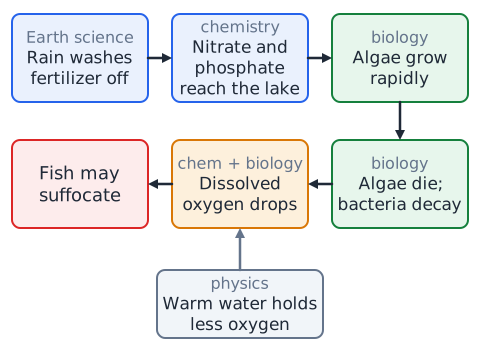
Picture a farm field upstream from a small lake. Heavy rain washes fertilizer containing nitrate and phosphate into a stream that feeds the lake, an Earth science process called runoff. In the lake, the extra nutrients fuel rapid algae growth, a biology process. When the algae die, bacteria decompose them and consume dissolved oxygen in respiration, so oxygen levels drop, linking chemistry and biology. Warm water holds less dissolved oxygen than cold water, adding a physical factor. Fish may then suffocate. Following each step, rain to nutrients to algae to decay to low oxygen, ties four domains into one chain.
Review a multi-domain exercise case
A recruit runs a timed mile. Physics: her leg muscles exert forces that accelerate her body and lift it with each stride, doing work. Chemistry: muscle cells oxidize glucose and fats in cellular respiration, producing carbon dioxide, water and ATP, and most of the released energy ends up as heat. Biology: rising carbon dioxide speeds up breathing, the heart pumps more blood per minute, and skin vessels widen to shed heat. Earth science: on a hot, humid day, sweat evaporates slowly, so cooling is less effective. Each answer choice in such a case can be checked against one of these steps.
Review a multi-domain greenhouse case
A gardener closes a glass greenhouse on a sunny morning. Visible light passes through the glass and is absorbed by soil and plants, which warm up. The warm surfaces give off infrared radiation, and the closed glass also traps the warmed air so it cannot rise away by convection. The inside temperature climbs well above outside air.
Biology joins in: the plants photosynthesize faster in light and warmth, drawing down carbon dioxide unless vents are opened. If it gets too hot, leaves lose water quickly and may wilt. Opening vents lets warm air escape and fresh air enter.
Review a satellite-and-signal case
A weather satellite circles Earth at nearly constant speed. Its velocity is still changing because its direction keeps turning, so it is accelerating toward Earth. Gravity supplies that inward pull. The satellite is falling around the planet, not floating free of gravity.
It sends data to the ground by radio waves, which are electromagnetic waves that travel at the speed of light and need no medium. Its instruments read infrared radiation from clouds and land to estimate temperatures. One case links motion, gravity, waves and atmospheric science.
Review an acid-rain-and-rock case
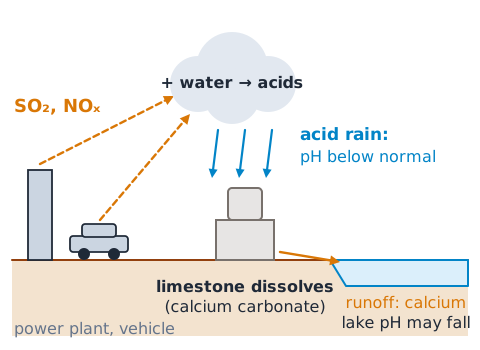
Burning coal can release sulfur dioxide, and vehicles and power plants release nitrogen oxides. In the air these gases react with water to form acids that fall as acid rain, with a pH lower than normal rain.
When that rain lands on limestone or marble, the acid reacts with calcium carbonate. The stone slowly dissolves, which is chemical weathering. Carvings on old monuments lose detail. Runoff then carries dissolved calcium and other ions into streams. If a lake sits on rock that cannot neutralize acid, its pH may fall enough to harm fish eggs and insects.
Review an antibiotic-selection case
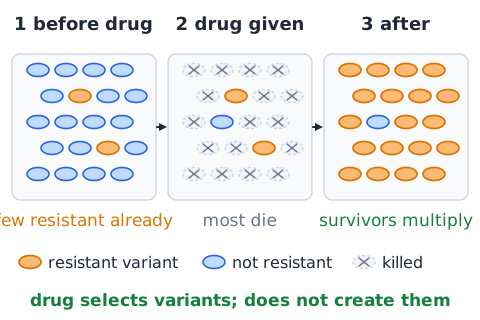
A patient takes an antibiotic for a bacterial infection. Most bacteria die, but a few carry a gene variant that lets them survive the drug. That variant was already present by chance before treatment. The drug did not create it on purpose.
The survivors divide and pass the variant to their offspring, so the next population is richer in resistant cells. If treatment stops early, more survivors remain. Bacteria can also share resistance genes with one another. This is natural selection in fast motion: the environment, here the drug, favors variants that already exist.
Exam reasoning: prioritize the tested relationship
Integrated questions often include details from several areas, but usually only one relationship decides the answer. A stem about a fish kill may mention rain, fertilizer, algae and warm weather, yet ask only why oxygen fell. The key link is decomposition using up oxygen.
Before reading the choices, put the actual question in your own words and name the relationship it depends on, such as density, Newton's second law or selection. Then eliminate choices that are true in general but do not answer that particular question.
Two-pass integrated problem-solving workflow
On the first pass, read the stem for its final question, underline the given quantities with units, and decide which domain and relationship are involved. Answer at once if it is a recall item.
On the second pass, work the calculation or the cause chain step by step. Check the units of your answer and its size: a person walking at 300 m/s or a pond with negative oxygen signals an error. Eliminate choices that break conservation, reverse a relationship or rely on an outside assumption. If two remain, pick the one that answers exactly what was asked.
Ten pitfalls that cause cross-topic errors
Watch for these traps. Calling the measuring tool a variable. Treating correlation as proof of cause. Ignoring a gas that escaped and deciding mass was lost. Confusing heat with temperature. Mixing up mass and weight. Using distance where displacement is required. Forgetting to halve the round-trip time in echo problems. Treating pH as a linear scale. Thinking individual organisms evolve because they need a trait. Blaming Earth's distance from the Sun, or Earth's shadow, for seasons or Moon phases.
Each one is fixed by asking what the quantity or process really means.
Solved case 1 — Experimental variables
A student wants to know whether water temperature affects how quickly brine shrimp eggs hatch. She sets up five jars at 18, 22, 26, 30 and 34 degrees Celsius, each with 200 eggs in the same volume of identically salted water and the same light, then counts hatched shrimp after 48 hours.
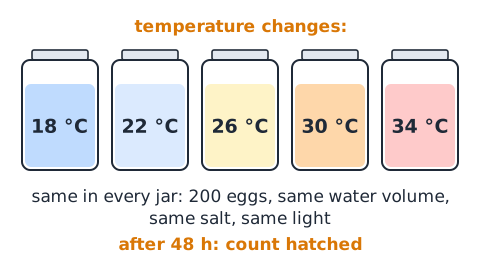
Step one: the factor she deliberately changes is temperature, so it is the independent variable. Step two: the outcome measured is the number hatched after 48 hours, the dependent variable. Step three: egg count, salt level, water volume, light and timing are held constant, so they are controlled variables. To strengthen the test, she should run several jars at each temperature.
Solved case 2 — Density plus measurement units
A metal sample has a mass of 1.35 kg and a volume of 500 cm³. Find its density in g/cm³ and in kg/m³.
Convert mass to grams: 1.35 kg is 1,350 g. Then divide:
Since 1 g/cm³ equals 1,000 kg/m³, the density is 2,700 kg/m³, a value typical of aluminum. Because it is greater than water's 1 g/cm³, a solid piece sinks.
Solved case 3 — Force and motion
A 1,200-kg car is pushed by a 3,600 N forward force from its engine while friction and air resistance together supply 600 N backward. What is its acceleration?
First find the net force:
Then apply Newton's second law:
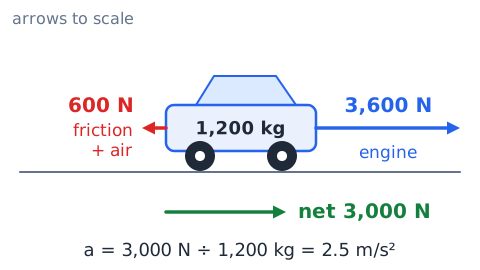
Using the full 3,600 N would overstate the answer.
Solved case 4 — Average speed and displacement
A hiker walks 120 m north, then 50 m south, taking 100 s in total. Find average speed and average velocity.
Total distance is
so average speed is 170 m divided by 100 s, which is 1.7 m/s.
Displacement is 120 m north minus 50 m south, leaving 70 m north:
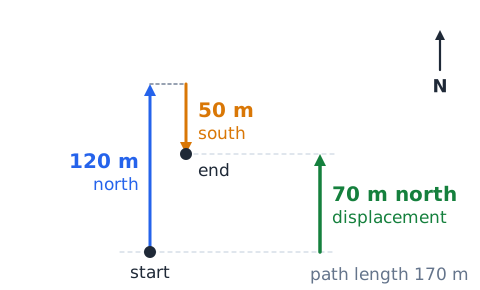
Speed uses path length; velocity uses net change in position plus direction.
Solved case 5 — Energy transfer and food webs
In a lake model, phytoplankton capture 80,000 J of energy. Zooplankton eat the phytoplankton, small fish eat the zooplankton, and a heron eats the small fish. Assume about 10 percent passes up each step.
Step one, zooplankton: 10 percent of 80,000 J is 8,000 J. Step two, small fish: 10 percent of 8,000 J is 800 J. Step three, heron: 10 percent of 800 J is 80 J.
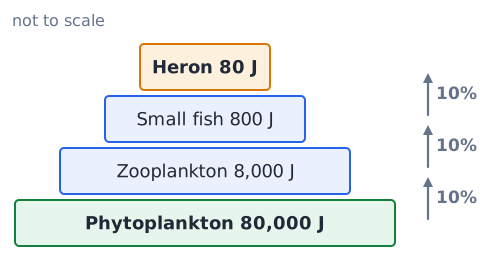
The other energy is not destroyed. Most is used for life processes and released as heat, and some stays in waste and dead matter that decomposers use. This steep loss is why top predators are few.
Solved case 6 — pH comparison
A student measures a soft drink at pH 3 and a sample of tap water at pH 6. How much greater is the hydrogen-ion activity in the drink?
Each one-unit drop in pH means about ten times more hydrogen-ion activity. The difference here is 6 minus 3, which is 3 units. Multiply ten by itself three times: 10 times 10 times 10 equals 1,000.
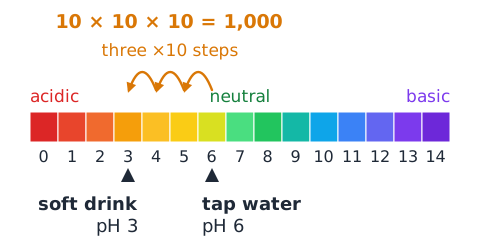
The soft drink is about 1,000 times more acidic by this measure, not twice as acidic. A common wrong answer comes from simply dividing 6 by 3 as if the scale were linear.
Solved case 7 — Simple inheritance
In a plant, purple flowers (P) are completely dominant over white (p). Two heterozygous plants, Pp and Pp, are crossed. Find the chance an offspring has white flowers, and the chance two offspring in a row are both white.
A Punnett square gives PP, Pp, Pp and pp, each equally likely. Only pp shows white, so the probability is 1 in 4. Three of the four combinations show purple.
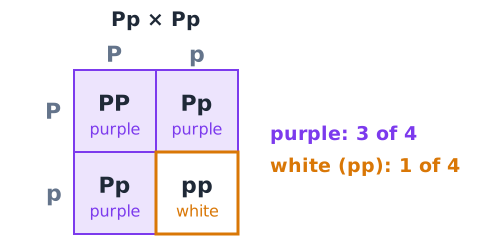
Each offspring is an independent event, so multiply:
Solved case 8 — Osmosis and soil salinity
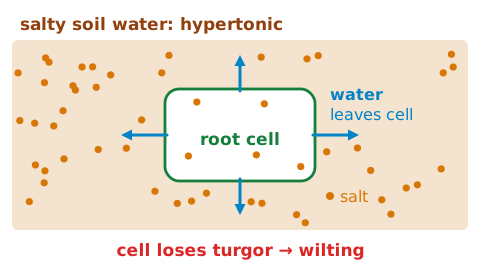
Scenario: Road salt washes into the soil beside a highway, and the grass along the edge wilts even though the soil is moist. Explain. Step 1: Identify the gradient. The soil water now holds more dissolved salt than the fluid inside the root cells. Step 2: Apply osmosis. Water moves across membranes toward the side with the higher solute concentration, so water tends to leave the root cells, or at least stops entering them. Step 3: Predict the effect. The cells lose turgor pressure and the plant wilts, even though water is present. Answer: the salty soil solution is hypertonic to the root cells, so the plant cannot take up enough water.
Solved case 9 — Wavelength and speed
A tuning fork vibrates at 680 Hz in air where sound travels at 340 m/s. What is the wavelength of the sound?
Start with the wave equation and solve for wavelength:
Units check: hertz means per second, so meters per second divided by per second leaves meters. A higher frequency at the same speed gives a shorter wavelength.
Solved case 10 — Echo distance
A ship's sonar sends a sound pulse downward. The echo from the seafloor returns after 4.0 s, and sound travels about 1,500 m/s in seawater. How deep is the water?
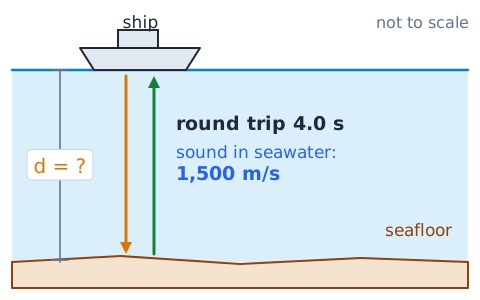
The pulse makes a round trip, so divide the total path by two:
Without halving, you would report 6,000 m, double the true depth.
Solved case 11 — Fertilizer, rain and fish
After a heavy storm, a farm pond receives runoff from freshly fertilized fields. A week later the water turns green. Two weeks after that, during a hot, still spell, dead fish appear at dawn. Explain the chain.
Step one: rain carries dissolved nitrogen and phosphorus into the pond. Step two: those nutrients fuel an algal bloom. Step three: as algae die, bacteria decompose them and consume dissolved oxygen through respiration. Step four: warm water holds less oxygen, and at night no photosynthesis replaces it, so oxygen is lowest near dawn. The fish suffocate. The best single explanation for the oxygen decline is microbial decomposition.
Solved case 12 — Heating and phase change
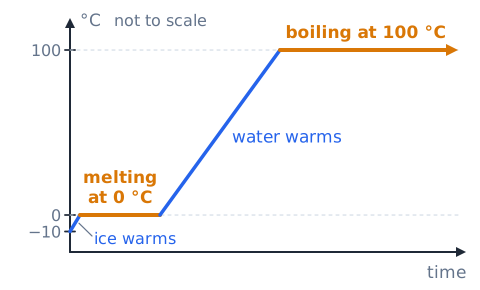
A beaker holds 50 g of crushed ice at negative 10 degrees Celsius on a steady burner. A student records temperature every minute. Describe and explain the graph.
First the temperature rises as the ice warms to 0 degrees. Then it stays flat while the ice melts, because incoming energy goes into loosening the solid's structure. At roughly 334 J per gram, melting all 50 g takes about 16,700 J. Once all the ice is liquid, the temperature rises again until near 100 degrees, where it levels off a second time during boiling. Throughout, the substance remains water; only its phase changes.
Solved case 13 — Rock weathering and groundwater
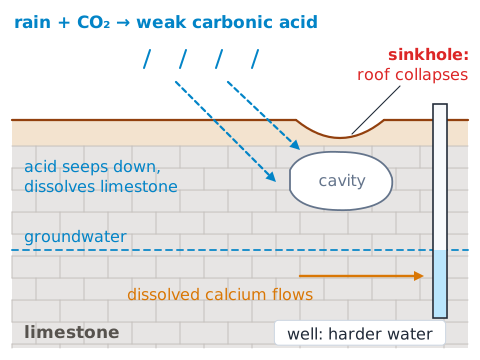
A town in limestone country notices that its well water has become harder, with more dissolved calcium, and a small sinkhole opens in a field. Explain the link.
Step one: rainwater absorbs carbon dioxide from air and soil, forming weak carbonic acid. Step two: as it seeps down, this acid chemically weathers limestone, dissolving calcium carbonate. Step three: the dissolved calcium travels with groundwater into wells, which explains the harder water. Step four: over time, dissolving rock leaves underground cavities. When a cavity roof weakens, the surface can collapse, forming a sinkhole.
Solved case 14 — Moon phases and seasons
A student claims that both the seasons and the Moon's phases are caused by changing distances. Evaluate each part.
Seasons: Earth's distance to the Sun changes only slightly through the year, and Earth is nearest in January, the Northern Hemisphere's winter. The real cause is Earth's tilted axis as it revolves, which changes the angle of sunlight and the length of day.
Phases: the Moon's distance also varies slightly, but phases come from geometry. As the Moon orbits, we see changing portions of its sunlit half. Both parts of the claim are wrong.
Guided drill 1 — Identify a fair comparison
Prompt: To test whether a new feed makes chickens lay more eggs, one farm uses the feed in summer and another farm uses old feed in winter. Fair? Answer: No. Season and farm differ along with the feed.
Prompt: Hens from one flock are randomly split into two equal groups, kept in identical coops, and given new or old feed. Fair? Answer: Yes. Only the feed differs.
Prompt: What improves the fair design further? Answer: Use more hens per group and repeat the trial.
Guided drill 2 — Dimensional-analysis check
Prompt: What do kilograms times meters per second squared equal? Answer: newtons, the unit of force.
Prompt: Meters per second divided by seconds gives what? Answer: meters per second squared, the unit of acceleration.
Prompt: Joules divided by seconds gives what? Answer: watts, the unit of power.
Prompt: Grams divided by milliliters gives what? Answer: a density.
Guided drill 3 — Connect runoff and oxygen
Practice: After a storm, a stream carries fertilizer into a pond, and an algal bloom follows. 1. What happens to dissolved oxygen as the bloom dies off? 2. Which organisms cause that change, and how? 3. Would warmer water make the problem better or worse? Answers: 1. It falls. 2. Decomposing bacteria, which use oxygen in respiration as they break down dead algae. 3. Worse, because warm water holds less dissolved oxygen. Bonus: name the overall process. Eutrophication.
Guided drill 4 — Genetics versus environment
Practice: Classify each difference as mainly genetic, mainly environmental, or both. 1. Two cuttings from the same plant differ in height after one is grown in shade. 2. A child has the same blood type as one parent. 3. Identical twins raised apart differ in adult weight. 4. Bacteria survive an antibiotic because they carry a resistance allele. Answers: 1. environmental, since the genes are identical. 2. genetic. 3. environmental acting on the same genes. 4. genetic, revealed by selection.
Guided drill 5 — Energy, temperature and waves
Prompt: Two pans of the same metal get equal heat; one has twice the mass. Which warms more? Answer: the lighter one, by about twice as much.
Prompt: A wave has frequency 5 Hz and wavelength 4 m. What is its speed? Answer:
Prompt: Can sound travel through outer space? Answer: No; it needs a medium.
Prompt: Energy is added to boiling water but its temperature stays steady. Why? Answer: The energy is driving the phase change.
Guided drill 6 — Interpret causal evidence
Prompt: Cities with more streetlights have more traffic accidents. Do streetlights cause crashes? Answer: Not shown. Bigger cities have both more lights and more traffic.
Prompt: Patients who took a vitamin felt better, but there was no comparison group. Is the claim proven? Answer: No. They might have recovered anyway.
Prompt: What evidence would be stronger? Answer: A randomized, controlled trial with a placebo group, repeated with similar results, plus a plausible mechanism.
Rapid integrated checklist
Before you choose an answer, run this quick check. Did I identify what the question asks and which relationship applies? Did I name the independent, dependent and controlled variables correctly? Is the claim based on correlation, or on a controlled test without confounders?
Do my units work out, and is the size reasonable? Did I count every input and output so mass and energy are conserved? Did I separate heat from temperature, mass from weight, speed from velocity and distance from displacement? For living systems, am I describing populations changing over generations rather than individuals wishing for traits? For Earth and sky, did I use tilt, rotation and viewing geometry correctly?
 English ▾