ASVAB Camp Get the appGoogle Play
Test guide · lesson 7 of 8 · 16 min

ASVAB Timing, Guessing and Question Navigation

Knowing the material is only half of test day; using your time well is the other half. This lesson opens with the first timing rule, protecting the whole subtest, then breaks down the CAT-ASVAB time structure and practical pacing so you do not run short on the questions you could have answered.

Video lesson: Timing, Guessing and Question Navigation

Video transcript

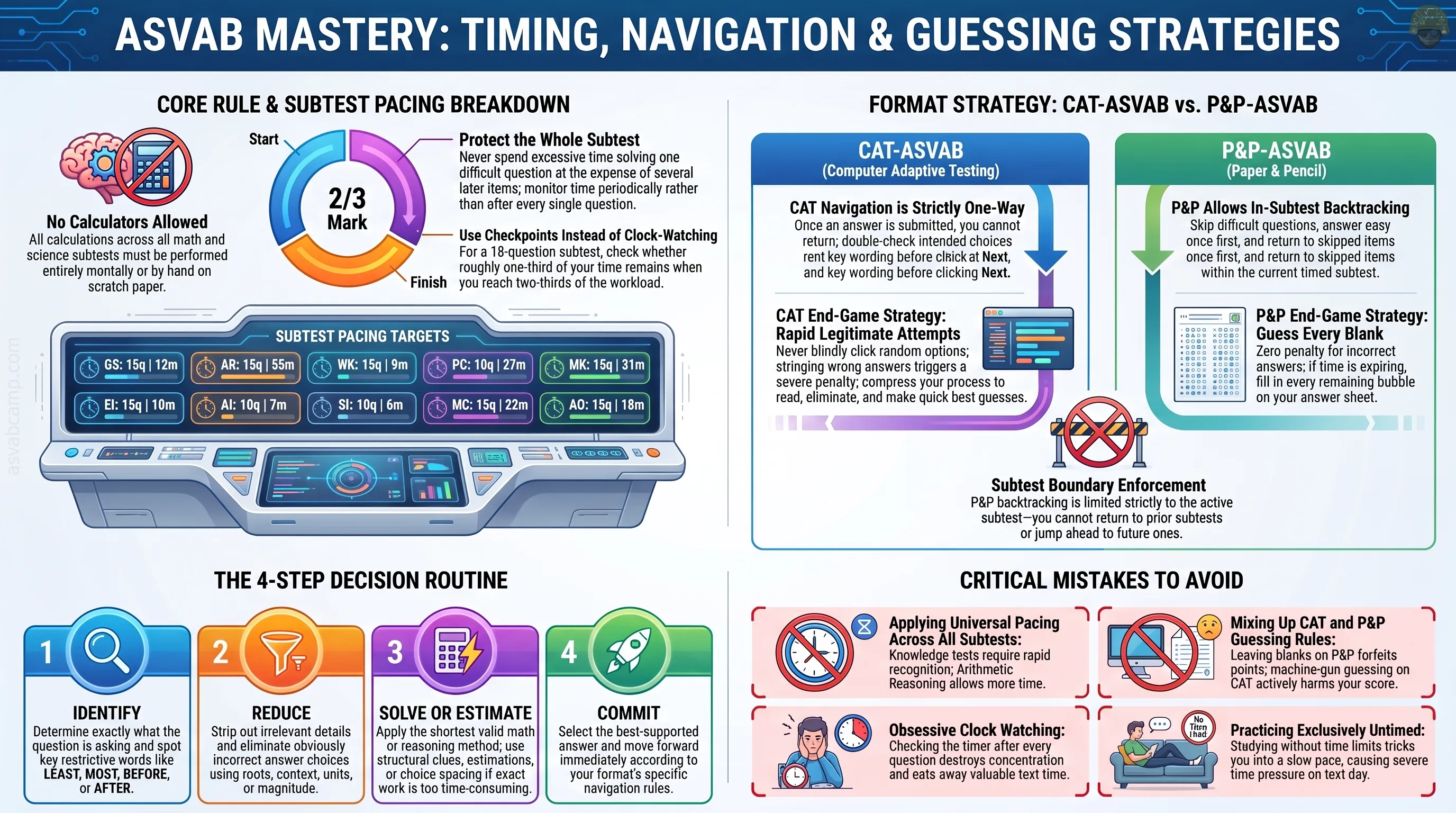
0:00 Alright, let's dive right into this explainer. If you're a high school grad getting ready to conquer the ASVAB, and well, maybe math isn't exactly your favorite subject, you are absolutely in the right place. Today, we are going to master ASVAB pacing, educated guessing, and question navigation strategies. And honestly, the best part, we're doing all of this without needing a calculator. Remember, on the ASVAB, calculators simply aren't allowed, so we are relying entirely on a smart step-by-step strategy to maximize your score and keep your confidence high. Here's a quick look at our roadmap. We're hitting six key areas, protecting the subtests, cat versus paper navigation, the art of guessing, timing decision scenarios, routine and common mistakes, and a final check yourself section. We'll start with the ground rules and move straight into practical scenarios. Let's get to it. Protecting the whole subtest. Okay, so here is your golden rule. You need to protect the remaining questions while still making a legitimate attempt on the current one. See, every ASVAB subtest has its own specific time limit. The goal here is not to perfectly solve one incredibly difficult math problem, if it means you run out of time and sacrifice several really easy points later on.

1:09 It's like winning the battle but losing the war. You have to protect the whole subtest. So monitor your time, and if a question is just burning up minutes, simplify it. Cross out the obvious wrong choices, make your best defensible guess, and keep going. CAT versus paper navigation. Now this is a huge deal. Your strategy actually has to change completely depending on the test format you're taking. The computer-based test, the cat, uses strictly one-way navigation. That means you must commit before you click next because there is no going back. You have to make a deliberate choice and then just mentally reset. On the flip side, the paper and pencil test, or P&P, is way more flexible. It allows you to skip hard questions, return to them later, and review your answers, as long as you stay within that current timed subtest. Trust me, if you treat the computer test like the paper test, you are going to get tripped up. All right, section three, the art of guessing. This brings us to why you absolutely cannot copy your strategies between formats. Doing that is actually dangerous for your final score. On the cat format, random guessing at the end of the test creates a relatively large penalty if you rack up a bunch of incorrect answers right at the buzzer.

2:19 You've got to make short, legitimate attempts instead of just blind-clicking. But look at the paper and pencil side. There is absolutely zero penalty for guessing. On paper, if time is expiring, you should guess and fill in every single remaining item. Those are free points, guys. Now, when you do have to guess, you don't just close your eyes and point. You use evidence. In math, compare the signs, the units, or the divisibility. Think about it. If you know an answer has to be a positive number, and two of the choices are negative, well, you've just eliminated half the trap answers without doing a lick of complex math. If it's a vocabulary question, look at the root of the word, the context, or the part of speech. Using these tools to cross out even one impossible option drastically improves your odds. Let's put this into practice, section four, timing decision scenarios. Okay, imagine scenario A. You're taking the CAT arithmetic reasoning subtest. You've spent way too much time on this one word problem, and you just cannot complete the math. You do. Step one, estimate the answer range.

3:22 Step two, eliminate the impossible choices based on your estimate. Step three, choose the strongest remaining option and move on, and step four, do not plan to return. Remember the cat won't let you. You confidently lock it in and protect the rest of your test. Scenario B, CAT word knowledge. You're staring at a word, and two of the choices clearly do not match the words part of speech. Step one, remove them immediately. Boom. You just doubled your chances. Step two, use context or root knowledge to pick between the final two. Step three, submit and continue. No hesitation, just a smart, educated decision. Now, let's switch over to the paper format. Scenario C, P and P, mathematics knowledge. You hit a geometry problem that looks incredibly confusing and time-consuming. Step one, skip it temporarily. Step two, answer the straightforward questions that come right after it to secure those easy points first. Step three, return to that ugly geometry problem while the section is still active. This is classic triage, and it works flawlessly on paper. Scenario D, you are in the final seconds of a P&P subtest, and three bubbles remain blank.

4:28 Look at these steps. Step one, fill them right now. Step two, remember that P&P has absolutely no guessing penalty. It's a super simple rule, but vital. Never, ever leave free points blank on the paper test. Finally, scenario E. This is a big warning for the final minutes of the cat test when you still have several questions left. Step one, do not machine gun random options. As we discussed, that causes a penalty. Step two, instead, compress your process. Step three, read quickly, eliminate the impossible, answer and continue. Rapid, legitimate attempts are your best shield against that cat-guessing penalty. Up next, section five, routine and common mistakes. To pull all this off smoothly, you want to memorize this four-step routine for every question. One, identify exactly what is being asked. Two, reduce irrelevant info and cross out the wrong choices. Three, solve or estimate using the shortest valid method. Because you don't have a calculator, estimation is literally your best friend here. Four, commit to the best answer and move on.

5:32 This compact little routine stops you from making careless, impulsive choices, and it also stops you from overthinking. Let's talk about the trap doors you need to avoid. Mistake one, using the same pacing style for every single subtest. The time per question differs wildly, so you have to adapt. Mistake two, watching the clock after every single question, and totally losing your focus. Mistake three, spending several minutes trying to force absolute certainty on one stubborn problem. And Mistake four, forgetting that cat answers cannot be revisited once submitted. Steer clear of these. And here are Mistakes five through eight. Mistake five, blindly guessing a block of cat questions at the end. Just don't do it. Mistake six, leaving P and P items blank when time runs out. Again, guessing is free on paper. Mistake seven, forgetting that P and P backtracking is subtest only. You can't jump back to an earlier section. And Mistake eight, practicing untimed for weeks only to discover on test day that your recognition speed is way too slow. Always practice with the timer.

6:35 All right, let's bring it all home with section six. Check yourself. Let's challenge you with two final questions pulled straight from the source material. Listen closely to question two. After submitting an answer on CAT-ASVAB, what should you expect? A, you cannot return to the item. B, you can change it once. C, you can return to it if time remains. D, the proctor must approve the answer. Take a quick mental pause here and lock in your choice. Okay, did you get it? The answer is A, the CAT-ASVAB strictly enforces one-way navigation. Once you submit that answer, it absolutely cannot be revisited. You have to commit before you click. Let's do one more. Question four, time is about to expire on a P and P subtest. That's paper and pencil. And four items are blank. What should you do? A, leave them blank because guessing reduces your score. B, ask for additional time. C, move backward to the previous subtest. D, fill in answers because P and P has no guessing penalty. Take a second to decide.

7:41 And the correct answer is D. Official P and P guidance says to answer every single question because there is absolutely no penalty for guessing on the paper test. This just proves that when you understand these rules, you'll never let easily preventable mistakes stand between you and your best possible score. So leaving you with this thought, now that you know the exact rules of engagement for pacing and guessing, which of your old, unhelpful test-taking habits are you going to drop before test day?

Visual lesson

Lesson slides

14 slides
Timing, Guessing and Question Navigation – slide 1 of 14

Lesson Goal

By the end of this lesson, the learner should be able to manage time intelligently on both CAT-ASVAB and P&P-ASVAB, distinguish educated guessing from random guessing, understand when backtracking is permitted, use answer-choice elimination efficiently, and avoid the timing behaviors most likely to damage performance.

The First Timing Rule: Protect the Whole Subtest

Every ASVAB subtest has its own time limit. The goal is not to solve one difficult question perfectly at the expense of several later questions. Before testing, know the approximate pace required for the version you will take. During the test, monitor time periodically rather than after every item. If a question is consuming disproportionate time, simplify the problem, eliminate choices, make the best defensible answer, and continue. Effective pacing means protecting the remaining questions while still making a legitimate attempt on the current one.

CAT-ASVAB Time Structure

The current CAT-ASVAB contains 135 scored questions across ten subtests. Official scored-question/time limits without tryout items are: GS 15 in 12 minutes; AR 15 in 55; WK 15 in 9; PC 10 in 27; MK 15 in 31; EI 15 in 10; AI 10 in 7; SI 10 in 6; MC 15 in 22; AO 15 in 18. Tryout questions may be included and official time limits expand when they are present. Because some subtests are intentionally generous while others are much faster, learners should practice each section under its own timing conditions rather than use one universal seconds-per-question target.
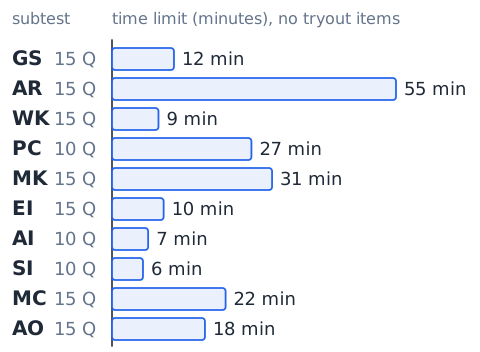
CAT-ASVAB time limits without tryout items: GS 15 Q/12 min, AR 15/55, WK 15/9, PC 10/27, MK 15/31, EI 15/10, AI 10/7, SI 10/6, MC 15/22, AO 15/18.

Practical CAT Pacing

A practical CAT pacing habit is to use checkpoints instead of obsessively watching the clock. For a 15-question subtest, notice whether roughly one-third of the time remains when about two-thirds of the scored workload has been attempted. On faster knowledge sections such as WK, EI, AI, and SI, recognition and elimination must be quick. On AR, PC, MK, MC, and AO, more reasoning time is available, but no single item deserves unlimited attention. These are practice heuristics—not official scoring rules—and should be adjusted based on the user's timed practice results.
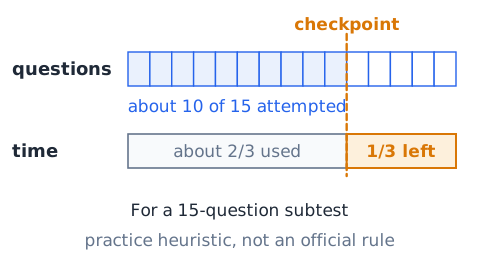
Pacing checkpoint for a 15-question subtest: a question bar with about 10 of 15 attempted lines up with a time bar that has about one-third of the time left; labelled as a practice heuristic, not an official rule.

CAT Navigation: Commit Before You Click

CAT-ASVAB is one-way. Once an answer is submitted, the examinee cannot return to that item. Therefore, before clicking Next or submitting, confirm two things: first, that the selected option is the intended one; second, that the question was read correctly, especially words such as NOT, EXCEPT, LEAST, MOST, INCREASE, DECREASE, BEFORE, or AFTER. This brief confirmation should take seconds, not turn into repeated re-solving. The correct CAT habit is deliberate commitment followed by a mental reset.

Educated Guessing

When an answer is uncertain, official guidance recommends eliminating as many incorrect choices as possible and then making an educated guess. Educated guessing uses evidence. In math, compare signs, units, magnitude, divisibility, reasonableness, and answer-choice spacing. In vocabulary, use roots, context, part of speech, and connotation. In reading, return mentally to passage evidence rather than outside knowledge. In technical questions, identify the governing mechanical, electrical, automotive, or shop principle. Removing even one impossible option improves the quality of the decision.

CAT: Why Random End-of-Test Guessing Is Dangerous

CAT-ASVAB applies a penalty procedure when an examinee fails to complete a subtest. Official technical guidance describes unfinished items as being scored through a penalty equivalent to random responses. Official applicant preparation guidance also warns that filling a string of random guesses at the end of a CAT subtest can produce a relatively large penalty when several incorrect answers occur near the end. Therefore, the correct late-stage strategy is not blind clicking. Continue making short, legitimate attempts: read the task, remove impossible choices, choose the best answer, and move on.

P&P Navigation: Skip, Return, Review

P&P-ASVAB uses a different strategy. Within the current timed subtest, an examinee may skip a difficult question, answer easier questions first, return to skipped items, and review answers if time remains. However, the examinee cannot go backward to an earlier completed subtest or move forward to the next subtest until instructed. This makes triage more useful on P&P than on CAT: mark a difficult item, protect easy points, then return before the current section closes.
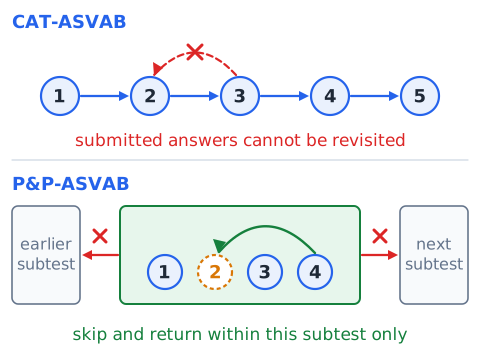
CAT is one-way with no return to submitted items; P&P allows skipping and returning within the current subtest but not moving to an earlier or the next subtest.

P&P: Guess Every Remaining Item

Official guidance states that there is no penalty for guessing on the P&P-ASVAB. If time is expiring and unanswered items remain, it is advantageous to fill them rather than leave them blank. This is deliberately different from the CAT strategy. A learner must know in advance which version is being taken; copying the CAT end-of-section strategy onto P&P, or the P&P random-fill strategy onto CAT, is a preventable mistake.

Timing Decision Scenarios

Scenario A — CAT Arithmetic Reasoning: You have spent much longer than usual on one word problem and still cannot complete the algebra. Estimate the answer range, eliminate impossible choices, choose the strongest remaining option, and move on. Do not plan to return later because CAT does not permit it. Scenario B — CAT Word Knowledge: Two choices clearly do not match the word's part of speech. Remove them immediately, use context/root knowledge to choose between the remaining two, submit, and continue. Scenario C — P&P Mathematics Knowledge: A geometry problem looks time-consuming. Skip it temporarily, answer the straightforward questions that follow, then return while the MK subtest is still open. Scenario D — P&P Final Seconds: Three bubbles remain blank. Fill them. P&P has no guessing penalty. Scenario E — CAT Final Minutes: Several questions remain. Do not machine-gun random options. Compress the process—read, eliminate, answer, continue.

A Four-Step Decision Routine

Use the same compact routine across content areas: 1. IDENTIFY — What exactly is the question asking? 2. REDUCE — Remove irrelevant information and obviously wrong answer choices. 3. SOLVE OR ESTIMATE — Apply the shortest valid method; if exact work is expensive, use estimation or structural clues where appropriate. 4. COMMIT — Select the best-supported answer and move on according to the navigation rules of your test version. This routine prevents two opposite failures: careless impulsive answers and excessive perfectionism.

Common Timing and Navigation Mistakes

Mistake 1: Using the same pacing style for every subtest even though time-per-question differs greatly. Mistake 2: Watching the clock after every question and losing concentration. Mistake 3: Spending several minutes trying to force certainty on one problem. Mistake 4: Forgetting that CAT answers cannot be revisited after submission. Mistake 5: Blindly guessing a block of CAT questions at the end instead of making legitimate rapid attempts. Mistake 6: Leaving P&P items blank when time expires even though there is no guessing penalty. Mistake 7: Forgetting that P&P backtracking is only within the current subtest. Mistake 8: Practicing untimed for weeks and discovering on test day that recognition speed is too slow.

Quick Review

Remember: • Every ASVAB subtest has its own time limit. • Protect the whole subtest; do not sacrifice many later items for one difficult question. • CAT-ASVAB is one-way: submitted answers cannot be changed. • On CAT, use educated guesses and continue making legitimate attempts even when time is short. • Do not infer that blindly filling a CAT end block is harmless. • P&P allows skipping and returning within the current timed subtest. • P&P has no penalty for guessing, so unanswered items should be filled if time is expiring. • P&P does not allow returning to an earlier completed subtest. • Use elimination, estimation, units, context, and answer-choice structure to make faster decisions. • Practice under section-specific time limits before test day.

What next?

← Previous: Standard Scores and Percentiles

About this lesson

You will learn to commit before you click on the computerized version, how educated guessing narrows choices, and why random end-of-test guessing on CAT can hurt. The paper-and-pencil rules are different: there you can skip, return and review, and you should guess on every remaining item before time is called. Timing decision scenarios and a four-step decision routine turn these rules into habits you can use under pressure.

The lesson takes about 16 minutes and pays off on every subtest, from Arithmetic Reasoning to Assembling Objects. After the common mistakes and Quick Review, take the 12-question lesson test, then continue with no-calculator skills and retesting rules.

Take it with you: the free app

The same 124 lessons, 6,516 questions and 82 timed practice tests on your phone, plus flashcards with spaced review and progress tracking. Free to download, and it works offline.

  • Works offline
  • Spaced-review flashcards
  • Progress for every subtest
  • Menus in 59 languages
ASVAB Camp appGoogle Play