ASVAB Camp Get the appGoogle Play
Test guide · lesson 8 of 8 · 18 min

No-Calculator Skills, Retesting and Score Validity

Two practical questions come up for almost every test taker: can I use a calculator, and what happens if I need to retake the ASVAB? This lesson answers both. It begins with the current no-calculator rule and what no-calculator preparation should actually train, then teaches high-value mental-math patterns, estimation and answer-choice control, with an example set to practice on.

Video lesson: No-Calculator Skills, Retesting and Score Validity

Video transcript

0:00 All right, welcome to this explainer. Today, we are completely demystifying two of the absolute biggest hurdles on the ASVAB. We're going to build up your no calculator math toolkit, and then we're going to translate those super strict administrative testing policies into plain English. Listen, if you're gearing up to test and feeling, you know, a little anxious about having to do math purely by hand, don't sweat it. You are in exactly the right place. So here is our game plan for today. First, the no calculator rule. Second, mental math and estimation. Third, step by step math examples. Fourth, retesting rules. Fifth, avoiding mistakes. And finally, number six, a quick check yourself section. Okay, let's jump right into section one, the no calculator rule. Standardization and fairness. Now, instead of just mechanically memorizing random math facts, this is exactly where you should be focusing your energy. Since the ASVAB is entirely standardized without calculators, every single question is literally designed to be solved with just paper, a pencil, and your brain.

1:00 You really need efficiency in those core operations, things like fractions, decimals, percentages, and estimation. Mental math and estimation. Your no calculator toolkit. I can't stress this enough. Memorizing these high value mental math patterns will dramatically reduce your workload. If you just instinctively know that one fifth is 0.2, which is 20%, you get to skip the long division entirely. You could also use this for place value scaling. Like, once you realize that 15% is really just 10% plus 5%, figuring that out in your head becomes an absolute breeze. The crucial trick here is breaking multiplication down into distributive pieces. So let's look at 38 times 7. Doing that in your head sounds kind of terrible, right? But what if we break 38 into 40 minus 2? Now just multiply both of those parts by 7. 40 times 7 is 280. 2 times 7 is 14. Subtract that 14 from 280 and you get 266. And hey, always estimate first.

2:00 38 is super close to 40. So your answer has to be a bit less than 280. Doing that instantly helps you eliminate impossible multiple choice options. Alright, section 3. Step-by-step math examples. Let's start actually applying this toolkit. Let's try finding 17.5% of 240 using that scaling trick we talked about. First, find 10% simply by moving the decimal over one spot. Boom, that's 24. Next, well, 5% is just half of 10%, so half of 24 is 12. Then 2.5% is half of 5%, so half of 12 is 6. Finally, just add up those easy chunks. 24 plus 12 plus 6 equals 42. See? Breaking it down makes the arithmetic totally painless. Now this right here is exactly why you must simplify before you multiply. Look at this. 18 over 35 times 14 over 27. If you multiply straight across, you're going to end up with giant messy numbers that are a nightmare to divide later.

3:03 Instead, let's cross cancel. 18 and 27 are both divisible by 9, so they shrink down to 2 and 3. 14 and 35 are both divisible by 7, becoming 2 and 5. Now, you just multiply the new tiny fractions. 2 thirds by 2 fifths, which gives you 4 fifteenths. So much easier, right? This next example perfectly reinforces that distributive pattern again. For 49 times 36, do not write out a long column. Let's rewrite 49 as 50 minus 1, so you do 50 times 36 and then just subtract one group of 36. 50 times 36 is 1800. 1800 minus 36 is 1764. Just rounding up to 50 makes mental multiplication feel like a breeze. Okay, let's talk about estimating roots. Let's say you need to estimate the square root of 85. You really don't need a calculator for this. You just need to use nearby benchmarks. We already know the square root of 81 is 9 and the square root of 100 is 10. Since 85 is just a little bit larger than 81, we can confidently say that an answer near 9.2 is highly reasonable.

4:10 Then you just scan your multiple choice options for the one that fits. Let's tackle ratios next. If three parts correspond to 45 units, what do seven parts equal? The secret is to establish the value of a single part first. Divide 45 by 3 and that tells us we have 15 units per part. Now just multiply that 15 by the seven parts we're looking for to get 105 units. Honestly, this method is significantly faster than setting up some long, complicated proportion that forces you to cross multiply. Retesting and score validity. Let's cover the rules of the game. So here's how the standard retest waiting periods actually map out. After your initial test, you have to wait one calendar month before you can take your first retest. Then it's another calendar month for your second retest. But, and this is a big but, after that second retest, any additional attempt requires a full six calendar month wait. Oh, and keep this in mind too. If you get a critical AFQT score gain of 20 or more points within six months, that triggers an immediate confirmation test to verify the score. So don't assume a massive score jump is automatically finalized.

5:15 It's a safeguard to ensure testing validity. It's also super important to understand the difference between the two types of invalidated tests. Let's say your test is invalidated because the building's fire alarm went off. That's an administrative disruption. It doesn't count against you at all and you can reschedule quickly. On the flip side, an invalidation for cheating forces an immediate six-month penalty. Test integrity absolutely matters here. Two, that's a very important number to remember. How long is your score actually good for? Well, your ASVAB scores are officially usable for enlistment decisions for up to two years from your test date. If your score gets older than that, it's considered stale. And you'll have to confirm the current requirements with a recruiter. Avoiding common ASVAB mistakes, let's troubleshoot your prep. If you find yourself in a waiting period before a retest, this sequence shows exactly how you should strategically use that time. Please don't just repeatedly take practice tests until you've accidentally memorized the answers. Use week one to diagnose where you actually lost points. The middle weeks should be for targeted lessons, like practicing those fraction cross-cancelations we did earlier.

6:20 And the final days, those are all about sleep, timing, and execution. Take a really close look at these eight common mistakes, because you want to avoid them entirely. A massive trap is practicing with your phone's calculator and subconsciously expecting to have that same support on test day. Just don't do it. Another big one is doing long, drawn out arithmetic instead of simplifying your numbers first. And definitely watch out for the waiting period trap. Do not assume the wait resets to one month forever. Remember, after that second retest, you are literally waiting half a year. All right, we made it to section six. Check yourself. This is a quick live knowledge check. I'll read question three straight from the source text. It asks, which is the fastest no calculator way to find 15% of 240? Is it A, find 10% and 5% then add, B, multiply by 15, C, divide by 15, or D, estimate it as 50%. I'll give you a second. Go ahead and hit pause to think about your answer. Okay, the answer is A.

7:22 Breaking percentages into easy benchmark percentages is the absolute most efficient no calculator technique. 10% is 24, 5% is 12, and together they add up to 36. You're leveraging those benchmark patterns we learned to make the math simple, rather than doing some huge block multiplication problem. Let's do one more. This is a policy check with question four regarding testing rules. After an applicant's initial ASVAB, how long is the standard wait before the first retest? Is it A, 24 hours, B, six months, C, one calendar month, or D, three months? I'll pause again for you to lock in your final answer. The correct answer is C, one calendar month, which leaves us with this final thought as we close out today's explainer. Look, memorizing practice tests might build a little passing familiarity, but truly mastering these underlying skills without relying on a calculator, that's what actually builds a solid foundation for your career. You've got the tools now, so ask yourself today, are you just training to scrape by and pass a test, or are you training to be genuinely ready?

Visual lesson

Lesson slides

12 slides
No-Calculator Skills, Retesting and Score Validity – slide 1 of 12

Lesson Goal

By the end of this lesson, the learner should be able to prepare for the ASVAB without a calculator, use efficient paper-and-pencil and mental-math methods, explain the standard ASVAB retest waiting periods, recognize special retest situations such as large AFQT gains or invalidated tests, and understand how long ASVAB scores remain usable for enlistment.

The Current No-Calculator Rule

Calculators are not allowed on the ASVAB under the current standardized testing policy. This applies to the mathematics demands of applicant testing and is not merely a suggestion for practice. The reason is psychometric as well as practical: ASVAB items and score interpretations were developed and standardized under no-calculator conditions. Allowing calculators without re-standardizing the assessment could change what the scores mean and threaten comparability and fairness. Therefore, preparation should build calculation fluency rather than dependence on a calculator.

What No-Calculator Preparation Should Actually Train

No-calculator preparation does not mean memorizing every arithmetic fact mechanically. It means becoming efficient at the operations most likely to support ASVAB reasoning: whole-number arithmetic, fractions, decimals, percentages, ratios, signed numbers, exponents and roots, algebraic manipulation, common geometry formulas, estimation, and unit conversion. The learner should be able to write organized scratch work, simplify before multiplying or dividing, recognize common number relationships, and decide when an exact answer is necessary versus when estimation can eliminate choices.

High-Value Mental-Math Patterns

Several patterns dramatically reduce work. Know common fraction-decimal-percent equivalents such as = 0.5 = 50%, = 0.25 = 25%, = 0.75 = 75%, = 0.2 = 20%, = 0.1 = 10%, and useful eighths such as = 12.5%. Use place-value scaling: 15% of 240 can be found as 10% (24) + 5% (12) = 36. Break multiplication into distributive pieces:

38×7 = (40×7)−(2×7)

Use nearby benchmarks for squares and roots, and cancel common factors before multiplying fractions. These methods reduce both time and arithmetic error.

Estimation and Answer-Choice Control

Multiple-choice structure is a tool. Before calculating exactly, estimate the sign, approximate size, and unit of the answer. If a product is roughly 30×20, an answer near 600 is plausible while 60 or 6,000 may not be. If a 20% discount is applied to a price, the result must be lower than the original price. If converting a smaller unit to a larger unit, the numerical value often decreases. Estimation should not replace exact work when choices are close, but it can eliminate impossible options and catch arithmetic slips.

No-Calculator Example Set

Example 1 — Percentage: Find 17.5% of 240. Use 10% = 24, 5% = 12, and 2.5% = 6. Total = 42. Example 2 — Fraction Simplification: () × (). Cancel before multiplying: = and = , so the product is . Example 3 — Multiplication:

49×36 = (50×36)−36 = 1,800−36 = 1,764

Example 4 — Root Estimate: lies between = 9 and = 10, so an answer near 9.2 is reasonable. Example 5 — Ratio: If 3 parts correspond to 45 units, one part is 15; 7 parts are 105. This can be faster than setting up a long proportion.
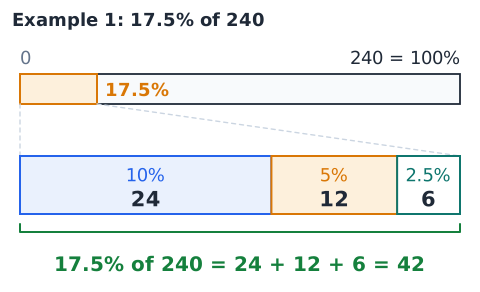
Example 1: 17.5% of 240 split as 10% = 24, 5% = 12 and 2.5% = 6, total 42.

The Standard Retest Timeline

After the initial ASVAB, the standard policy requires one calendar month before the first retest. After that first retest, another one-calendar-month wait is required before a second retest. After the second retest—meaning after three total administrations—every additional standard retest requires a six-calendar-month waiting period. The same basic retest timing applies whether the initial administration was a student test or an enlistment test. Applicants should plan study cycles around these waiting periods rather than repeatedly testing without meaningful preparation.
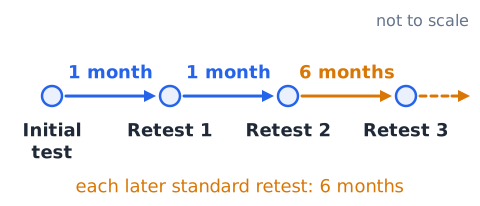
Retest timeline: initial test, 1 month, retest 1, 1 month, retest 2, 6 months, retest 3; each later standard retest needs 6 months.

Large AFQT Gains and Confirmation Testing

Retesting has an additional safeguard for unusually large AFQT increases. Official retest policy identifies a Critical AFQT Gain as a gain of 20 or more AFQT points within a six-month period. In that situation, a Confirmation Test (C-Test) is required to verify the gain. The applicant may take the C-Test immediately rather than waiting the normal one month. After a C-Test, another standard retest normally requires a six-month wait from the C-Test date. This policy exists to protect score validity, so treat it as a testing rule rather than assuming a dramatic score jump is automatically final.
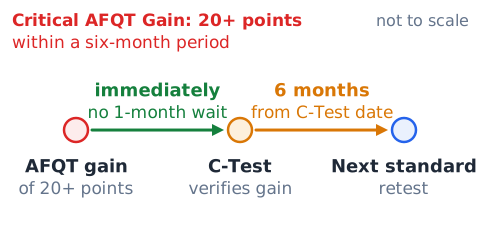
Not to scale: a Critical AFQT Gain of 20 or more points within six months leads immediately to a C-Test with no 1-month wait; the next standard retest comes 6 months from the C-Test date.

Invalidated Tests: Administrative Problems vs. Cheating

Not every invalidated administration is treated the same way. If an initial test is invalidated for an administrative reason such as a disruption, official policy says that invalid initial test does not count as the first test and a new initial test can be scheduled according to MEPS availability. Administrative invalidation of a first or second retest likewise does not count as a valid retest, although timing rules still depend on the prior valid administration. By contrast, if an initial test or early retest is invalidated for cheating, the applicant must wait six months before retesting. This distinction reinforces why controlled testing materials and test integrity matter.

How Long ASVAB Scores Are Valid for Enlistment

Official ASVAB guidance states that scores may be used for enlistment for up to two years from the date of testing. The two-year period is tied to score-validity evidence and Department of Defense policy. A score that is older than two years should not be treated as automatically usable for a new enlistment decision. Applicants with older scores should confirm current requirements with a recruiter. For in-service reclassification decisions, current DoD guidance advises caution with ASVAB scores of record that are more than two years old and notes the Armed Forces Classification Test (AFCT) as the appropriate assessment for in-service classification decisions when needed.

How to Use a Retest Waiting Period

A waiting period is valuable only if it changes preparation. Use the first week to diagnose why points were lost: content gaps, slow arithmetic, vocabulary weakness, reading errors, or technical knowledge. Use the middle weeks for targeted lessons and spaced practice. Then move into timed subtests and mixed review. In the final days, reduce new content and focus on accuracy, timing, sleep, and test-day execution. Do not simply repeat the same practice questions until they are memorized; that creates familiarity without improving transferable ability.

Common Mistakes

Mistake 1: Practicing all mathematics with a phone calculator and expecting the same support on test day. Mistake 2: Believing no-calculator math means every problem requires long arithmetic. Simplification, estimation, and answer-choice reasoning are often faster. Mistake 3: Retesting as soon as permitted without fixing the underlying weak areas. Mistake 4: Assuming the waiting period resets to one month forever. After the second retest, later standard retests require six months. Mistake 5: Ignoring the Critical AFQT Gain confirmation rule after a very large score increase. Mistake 6: Treating an administratively invalidated test and a cheating invalidation as the same situation. Mistake 7: Assuming an ASVAB score remains valid indefinitely for enlistment. Current policy limits enlistment use to two years. Mistake 8: Using or sharing controlled actual test questions. Official ASVAB materials prohibit disclosure of specific test content and warn against deceptive services claiming access to real questions.

Quick Review

Remember: • Calculators are currently not allowed on the ASVAB. • Train arithmetic fluency, simplification, estimation, fractions, percentages, ratios, algebra, formulas, and unit reasoning without a calculator. • Use answer choices to check magnitude, sign, unit, and plausibility. • Initial test → wait 1 calendar month → first retest. • First retest → wait another 1 calendar month → second retest. • After the second retest, additional standard retests require 6 calendar months. • A Critical AFQT Gain of 20+ points within six months triggers a Confirmation Test. • Administrative invalidations and cheating invalidations follow different retest rules; cheating can require a six-month wait. • ASVAB scores may be used for enlistment for up to two years from the test date. • Older in-service classification decisions may call for the AFCT rather than relying on stale ASVAB scores. • Use retest waiting time to improve transferable skills, not to memorize repeated practice items.

What next?

← Previous: Timing, Guessing and Question Navigation

About this lesson

The second half covers the rules around retesting. You will learn the standard retest timeline, why large AFQT gains can trigger confirmation testing, how invalidated tests differ when the cause is an administrative problem versus cheating, and the two-year window during which ASVAB scores remain valid for enlistment. A section on using a retest waiting period shows how to turn the wait into productive study.

The lesson takes about 18 minutes and closes out the foundations unit. After the common mistakes and Quick Review, take the 12-question lesson test, then begin the Arithmetic Reasoning lessons, where your mental-math work gets immediate use.

Take it with you: the free app

The same 124 lessons, 6,516 questions and 82 timed practice tests on your phone, plus flashcards with spaced review and progress tracking. Free to download, and it works offline.

  • Works offline
  • Spaced-review flashcards
  • Progress for every subtest
  • Menus in 59 languages
ASVAB Camp appGoogle Play