 ASVAB Camp
Lesson Goal
By the end of this lesson, the learner should be able to distinguish raw performance, ability estimates, ASVAB Standard Scores, and AFQT percentiles; interpret the ASVAB Standard Score scale correctly; explain what scores such as 40, 50, 60, and 70 mean relative to the norm group; and avoid false practice-score conversions.
Four Different Score Ideas
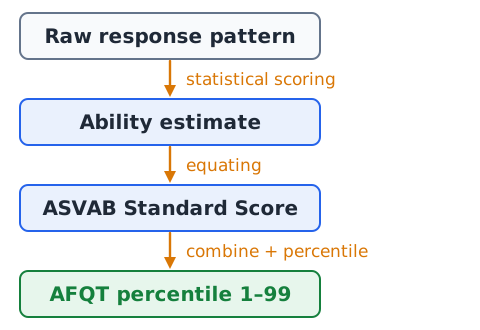
ASVAB score reporting makes more sense when four ideas are kept separate. First, a raw response pattern is simply which items were answered correctly or incorrectly; it is not the final reported ASVAB score. Second, CAT-ASVAB and paper forms use statistical scoring to estimate an examinee's underlying ability. Third, those ability estimates are converted through equating to ASVAB Standard Scores so scores retain comparable meaning across item pools and forms. Fourth, the AFQT combines selected standardized ASVAB information and reports the result as a percentile from 1 to 99. Never collapse these four ideas into one number.
What an ASVAB Standard Score Is
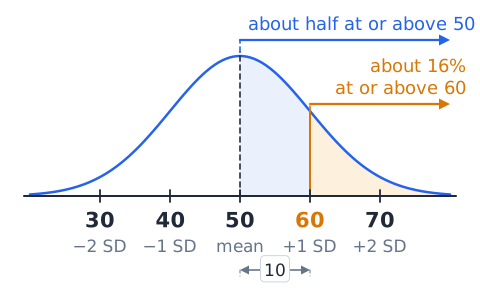
Scores on individual ASVAB subtests are reported as Standard Scores. A Standard Score expresses performance relative to the national norm group using a scale with a fixed mean and standard deviation. For ASVAB subtests, the mean is 50 and the standard deviation is 10. This means 50 represents the center of the normed score distribution, while each 10-point change represents one standard deviation of distance from that mean. Standard Scores are not percentages and should not be read as 'questions correct out of 100.'
Reading the 50-and-10 Scale
The ASVAB Standard Score scale can be interpreted in standard-deviation units. A Standard Score of 50 is at the mean. A score of 60 is one standard deviation above the mean. A score of 40 is one standard deviation below the mean. A score of 70 is two standard deviations above the mean. A score of 30 is two standard deviations below the mean. Official applicant guidance also gives useful population intuition: about half the reference population scores at or above 50, while about 16% scores at or above 60. The key idea is relative standing, not percent correct.
Why Equating Matters
Different CAT item pools and different paper test forms cannot be assumed to have exactly the same raw difficulty. Official ASVAB scoring therefore uses equating. After an ability estimate is produced, statistical transformations link that estimate to the common ASVAB score scale. Equating studies are conducted for CAT item pools and paper forms so that a Standard Score is intended to carry the same meaning regardless of which approved item pool or test form an examinee receives. This is one reason a simple practice-test raw score cannot be converted honestly into an official ASVAB Standard Score without a validated psychometric model.
Standard Score vs. Percentile
A Standard Score and a percentile answer different questions. A Standard Score tells how far a performance lies above or below the norm-group mean on a standardized scale. A percentile tells what percentage of the reference group scored at or below a given level. On the ASVAB, individual subtests are reported primarily as Standard Scores, while AFQT is reported as a percentile from 1 to 99. Therefore, a subtest Standard Score of 60 is not the same thing as the 60th percentile, and an AFQT percentile of 60 is not an ASVAB subtest Standard Score of 60.
How to Interpret AFQT Percentiles
AFQT percentiles compare the examinee with the national AFQT reference group. Current official ASVAB guidance states that the reference group is a nationally representative sample of 18- to 23-year-old youth who took the ASVAB as part of the 1997 norming study. An AFQT of 90 means the examinee scored as well as or better than approximately 90% of that reference group. An AFQT of 50 means performance as well as or better than approximately half of the reference group. Percentile is therefore a rank-like comparison, not a statement that the examinee answered that percentage of questions correctly.
Standard Score Interpretation Examples
Example 1 — Standard Score 60: Because the ASVAB subtest mean is 50 and the standard deviation is 10, 60 is one standard deviation above the mean. It does not mean 60% correct. Example 2 — Standard Score 40: This is one standard deviation below the mean. It does not mean the examinee failed 60% of the test. Example 3 — Standard Score 70: This is two standard deviations above the mean. Example 4 — AFQT 70: Unlike a subtest Standard Score of 70, AFQT 70 is a percentile. It indicates performance as well as or better than about 70% of the AFQT reference group. These two scores share the number 70 but represent different scales.
Why Raw Practice Accuracy Cannot Become an Official ASVAB Score
Suppose an app presents 20 Mathematics Knowledge questions and a learner answers 16 correctly. The app can accurately report or 80% practice accuracy. It cannot responsibly claim that this equals an MK Standard Score of 80, an MK Standard Score of 60, or AFQT 80. Official ASVAB scoring depends on calibrated items, statistical ability estimation, equating, standardized score transformations, and—for AFQT—additional composite and percentile conversion. Unless a practice product has been formally validated against the official psychometric scale, it should report practice performance separately.
How Practice Results Should Be Reported
Practice results should carry transparent labels such as 'practice accuracy,' 'timed-set accuracy,' 'topic accuracy,' or 'mock-test result.' A practice report may identify strengths and weaknesses by content area, but it should not present an invented official ASVAB or AFQT score.
Common Score-Reading Mistakes
Mistake 1: Reading Standard Score 60 as 60% correct. Standard Scores are standardized relative scores, not percentages. Mistake 2: Assuming Standard Score 60 equals the 60th percentile. These are different score systems. Mistake 3: Treating AFQT 70 as though it were an individual ASVAB subtest Standard Score of 70. Mistake 4: Converting a practice raw score directly to an official Standard Score using a homemade table. Mistake 5: Comparing two test forms only by raw number correct and assuming equal difficulty. Official scoring uses equating to maintain comparable meaning. Mistake 6: Assuming the mean Standard Score of 50 means 'barely passing.' It represents the center of the normed distribution, not a universal pass/fail threshold.
Quick Review
Remember: • Individual ASVAB subtests are reported as Standard Scores. • ASVAB Standard Scores use mean 50 and standard deviation 10. • 60 = one standard deviation above the mean; 40 = one below; 70 = two above. • Standard Scores are not percentages. • Official scoring uses statistical ability estimation and equating so scores retain meaning across forms and CAT item pools. • AFQT is reported as a percentile from 1–99. • AFQT percentile describes standing relative to a national reference group, not percent correct. • Standard Score 60 and AFQT percentile 60 are not the same type of score. • Practice accuracy should remain practice accuracy unless a prediction system has real validation. • Never advertise a homemade raw-score table as an official ASVAB or AFQT conversion.
 English ▾