ASVAB Camp Get the appGoogle Play
Test guide · lesson 2 of 8 · 14 min

The 10 ASVAB Subtests and the Four Aptitude Domains

The ASVAB is not one test but ten subtests, and knowing how they fit together tells you where to spend your study hours. This lesson groups every subtest into the four aptitude domains: General Science; Arithmetic Reasoning and Mathematics Knowledge; Word Knowledge and Paragraph Comprehension; the technical group of Electronics, Auto, Shop and Mechanical; and Assembling Objects, the spatial subtest.

Video lesson: The 10 Subtests and Four Domains

Video transcript

0:00 Welcome to the explainer. Today, we are breaking down the structure of the ASVAB test in a really friendly, stress-free way to help you build a winning strategy. You know, if you're a high school graduate gearing up for this test and just feeling completely overwhelmed by all the acronyms or maybe math just isn't your strongest subject, you are in exactly the right place. We're going to clear up all that confusion right now and give you a super-focused step-by-step game plan. Okay, here's our quick roadmap for it today. We'll start by looking at the four aptitude domains, then zero in on the core tests that actually get you enlisted. After that, we'll check out the technical subtests, untangle a tricky scoring rule, and build a study strategy. And finally, we'll wrap up with a couple of practice questions. All right, section one, the four aptitude domains, sorting the 10 subtests. Let's make sense of this alphabet soup right out of the gate. So the ASVAB is made up of 10 different subtests, but they aren't just a random jumble of letters. They actually organize perfectly into four neat little boxes. First, you've got the verbal domain, which is word knowledge and paragraph comprehension.

1:05 Second is the math domain, arithmetic reasoning and mathematics knowledge. Third is the biggest one, science and technical, covering everything from general science to auto information. And finally, the spatial domain, which is literally just one test called assembling objects. Now, listen closely, because here is our first major trap. When you look at all 10 of those subtests, do not make the mistake of thinking they are all equally important for your main enlistment score. The reality is, out of those 10, only four of them actually feed into that core score. The AFQT core tests. This is your ticket to enlistment. If you take away just one thing today, it's this. The Armed Forces Qualification Test, or AFQT, is what actually gets you through the door, and it's computed entirely from those four core tests. The two math tests, AR and MK, and the two verbal tests, WK and PC. If you're just starting to study and want to guarantee your basic eligibility, these four are the absolute VIPs. You have to focus on them first. Okay, let's talk math.

2:08 If that word alone gives you anxiety, take a deep breath. Arithmetic reasoning is really just solving real world word problems. Mathematics knowledge is basic high school algebra and geometry. But here is the absolute most important thing to remember. Actually, burn this into your brain right now. There are absolutely no calculators allowed on the ASVAB. None. You have to practice solving these step-by-step, entirely by hand, or in your head. It's a totally different muscle than just punching numbers into your phone, right? So you have to train for it. Here's another trap people fall into, especially when looking at the verbal side. You might hear recruiters talk about your VE score, the verbal composite. A huge mistake is panicking and thinking VE is some secret 11th test you forgot to study for. It's not. VE is simply your word knowledge and paragraph comprehension scores mashed together. Science, technical, and spatial. Finding your military job. So your core AFQT gets you in. But these five science and technical subtests, they decide what you'll actually be doing every day. They don't help your AFQT score at all, but they are incredibly important if you want a hands-on career in engineering, maintenance, mechanics, or electronics.

3:17 Then, there's the spatial domain, which is just the assembling objects test or AO. This one is pretty cool, because unlike the science stuff, it isn't about memorizing facts from a textbook. It's basically a visual puzzle. It tests your ability to mentally rotate shapes and figure out how separate pieces connect together in your head. Assuming that just because these technical and spatial tests don't impact your AFQT, they don't matter. The reality, they matter a lot for your job classification. If you totally neglect them, you could severely limit what jobs are actually available to you once you're in. Okay, section four, the AI/SI/AS rule. Let's quickly untangle auto and shop. There's a weird little scoring quirk here depending on how you take the test. If you take it on a computer, auto information and shop information are given to you as two totally separate sections. But later, they merge them into a single score labeled AS. If you take the old-school paper version, auto and shop are just blended into one test from the very start. So the pitfall to avoid here is looking at a chart, seeing AI, SI, and AS, and freaking out because you think there are three completely different tests.

4:28 They aren't. AI and SI are just the ingredients that bake into that final AS score. Let's get practical. Section five, study strategy and profiles. How do you actually prepare for this efficiently? A smart strategy comes down to three basic steps. Step one, secure that AFQT core first. Lock down your reading and math so you know for sure you can enlist. Step two, once the core is solid, start studying the specific technical stuff for the job you actually want. Step three, always talk to a recruiter to confirm the exact score you need for that dream job. To put this into perspective, let's look at three typical learners. Profile one. This is for those of you feeling that math anxiety we talked about. If math is a weak spot, you absolutely must prioritize AR and MK because they literally make up half of your critical AFQT score. Profile two, you've got a great core score but want to work in electronics. Great, go heavy on studying electronics information. Profile three, you're terrible at assembling objects but you want a job that doesn't even use that score? Well then don't stress over it. Drop it to the bottom of your priority list.

5:32 Oh, and our final trap? Do not just memorize a scoring formula you saw online and assume it's set in stone. The military changes these formulas based on current policies. What got you a specific mechanic role last year might be slightly different today. Always verify with an official source. Alright, section six, check yourself. Let's see how much you picked up today. Which pair contains only verbal domain ASVAB subtests? Is it A, general science and electronics information, B, arithmetic reasoning and math knowledge, C, word knowledge and paragraph comprehension, or D, mechanical comprehension and assembling objects? I'll give you a second to think. Okay, the answer is C. Word knowledge and paragraph comprehension are the two tests that make up the entire verbal domain. Let's try question two. This is the absolute most important concept from today. Which four subtests are used to compute the AFQT? Take a good look at options A, B, C and D. The answer is B. Your AFQT is always computed from arithmetic reasoning, mathematics knowledge, word knowledge and paragraph comprehension. It perfectly highlights why those foundational math and verbal skills are so critical.

6:44 So now that you know exactly how this test is structured and you know a calculator won't be there to save you, how are you going to start practicing those math problems tonight?

Visual lesson

Lesson slides

11 slides
The 10 Subtests and Four Domains – slide 1 of 11

Lesson Goal

By the end of this lesson, the learner should be able to name all ten CAT-ASVAB subtests, place each in the correct aptitude domain, identify the four AFQT subtests, explain the special AI/SI reporting rule, and understand why the non-AFQT subtests still matter for military job classification.

The Four Aptitude Domains

The ASVAB organizes its subtests into four broad aptitude domains: Verbal, Math, Science/Technical, and Spatial. Verbal covers Word Knowledge (WK) and Paragraph Comprehension (PC). Math covers Arithmetic Reasoning (AR) and Mathematics Knowledge (MK). Science/Technical covers General Science (GS), Electronics Information (EI), Auto Information (AI), Shop Information (SI), and Mechanical Comprehension (MC). Spatial contains Assembling Objects (AO). These domains help learners understand what type of ability each subtest is designed to measure; they are not separate exams and should not be confused with military Service composite scores.
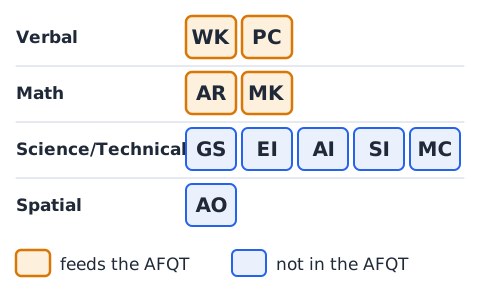
The four aptitude domains and their subtests: Verbal (WK, PC), Math (AR, MK), Science/Technical (GS, EI, AI, SI, MC) and Spatial (AO); the four AFQT subtests WK, PC, AR and MK are highlighted.

General Science (GS)

General Science measures knowledge of physical and biological sciences. Preparation should cover foundational biology, chemistry, physics, earth science, and space science at the level needed to recognize principles, terminology, relationships, and simple applications. GS is not one of the four AFQT subtests, but it can contribute to Service-specific composite scores used for job classification, particularly in technical career areas.

Arithmetic Reasoning (AR) and Mathematics Knowledge (MK)

Arithmetic Reasoning measures the ability to solve arithmetic word problems. It tests whether the learner can translate a real-world situation into mathematical relationships and solve it accurately. Mathematics Knowledge measures knowledge of high-school mathematics principles, including algebra and geometry foundations. Both AR and MK are Math-domain subtests and both feed the AFQT. They can also appear in Service composite formulas, so strong math performance can influence both enlistment aptitude eligibility and occupational options.

Word Knowledge (WK) and Paragraph Comprehension (PC)

Word Knowledge measures the ability to identify correct word meanings in context and the best synonym for a given word. Paragraph Comprehension measures the ability to obtain information from written passages. Both are Verbal-domain subtests and both feed the AFQT. In military score systems, verbal performance is also important because some Service composite formulas use a verbal composite commonly referred to as VE, which is derived from WK and PC standard-score information rather than being a separate test a learner sits for.

Electronics, Auto, Shop and Mechanical

Electronics Information (EI) measures knowledge of electricity and electronics. Auto Information (AI) measures knowledge of automobile technology. Shop Information (SI) measures knowledge of tools, shop terminology, and shop practices. Mechanical Comprehension (MC) measures knowledge of mechanical and physical principles. All four belong to the Science/Technical domain. They do not contribute directly to the AFQT, but they can be highly important when a learner is targeting technical, mechanical, maintenance, engineering, electronics, or similar military occupations.

Assembling Objects (AO): The Spatial Subtest

Assembling Objects is the ASVAB's Spatial-domain subtest. It measures the ability to determine how an object will look when separate parts are put together. AO is a visual reasoning task rather than a factual-knowledge test. It rewards mental rotation, matching connection points, tracking orientation, and quickly eliminating impossible assemblies. AO does not contribute directly to the AFQT, but it may appear in Service-specific composite formulas for certain occupations.

The AI + SI = AS Reporting Rule

On the computer-administered ASVAB, Auto Information and Shop Information are administered as separate subtests. For score reporting, however, their results contribute to a combined Auto & Shop score labeled AS. In the paper-and-pencil administration, Auto and Shop are combined into a single AS subtest. This distinction matters when interpreting official tables: AI and SI may appear separately as test sections in computer administration while AS appears as the reported combined score used in some classification formulas.
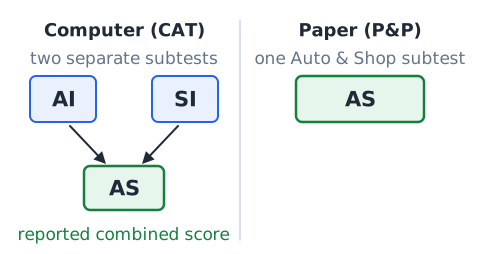
On the computer ASVAB, AI and SI are two separate subtests whose results combine into a reported AS score; on the paper ASVAB, Auto & Shop is one AS subtest.

AFQT Core vs. Full-ASVAB Strategy

The four AFQT subtests are AR, MK, WK, and PC. A learner whose immediate risk is enlistment aptitude eligibility should make these four the first priority. That does not mean the other subtests are optional in a full preparation plan. Military Services build their own job-classification composites from different combinations of subtests, so technical and spatial scores can affect access to particular occupations. A practical study order is: first secure the AFQT core, then strengthen the specific technical/spatial areas connected to the careers the learner wants, while confirming current branch requirements with official recruiting sources.

How to Read a Subtest Profile

Example 1: A learner is strong in WK and PC but weak in AR and MK. Their verbal foundation is useful, but because all four contribute to the AFQT, weak math can still limit the AFQT result. The study plan should prioritize AR and MK without abandoning verbal practice. Example 2: A learner already has a strong AFQT foundation but wants an electronics-oriented military occupation. Concentrating only on AR/MK/WK/PC would be incomplete; EI, and depending on the Service formula, other technical subtests may matter. Example 3: A learner performs poorly on AO but is not targeting an occupation whose current Service composite uses AO. The weakness still deserves attention for a complete ASVAB, but its priority may be lower than AFQT-core weaknesses or subtests directly tied to the learner's target occupation. The key is to study according to both enlistment eligibility and job goals.

Common Mistakes When Thinking About the Subtests

Mistake 1: Treating all ten subtests as equally important for the AFQT. Only AR, MK, WK, and PC feed AFQT. Mistake 2: Assuming non-AFQT subtests do not matter. They can matter substantially for job classification. Mistake 3: Treating VE as an eleventh ASVAB test. VE is a verbal composite derived from WK and PC score information, not a separate subtest. Mistake 4: Treating AI, SI, and AS as three unrelated tests. AI and SI are separate computer subtests whose results contribute to the combined AS score; paper administration combines Auto & Shop. Mistake 5: Memorizing a single branch job-score formula forever. Service composite formulas and occupational requirements are policy-sensitive and must be checked against current official sources.

Quick Review

Four domains: Verbal, Math, Science/Technical, Spatial. Ten CAT-ASVAB subtests: GS, AR, WK, PC, MK, EI, AI, SI, MC, AO. AFQT core: AR + MK + WK + PC. Science/Technical: GS, EI, AI, SI, MC. Spatial: AO. Computer testing gives AI and SI separately but reports a combined AS score; paper testing combines Auto & Shop. The AFQT helps with enlistment aptitude eligibility, while additional subtests can affect Service-specific job classification. Study the AFQT core first when eligibility is the main risk, then target technical/spatial subtests according to current career goals.

What next?

← Previous: Exam Purpose and Who Takes It

About this lesson

You will also learn the AI + SI = AS reporting rule, which explains why Auto Information and Shop Information appear as a single Auto and Shop score, and you will see the difference between AFQT-core subtests and those used mainly for job classification. A section on reading a subtest profile shows how to spot strengths and gaps, and a list of common mistakes helps you avoid misjudging which areas matter for your goals.

Plan on about 14 minutes. Once you can name all ten subtests and their roles, take the 10-question lesson test, then move on to how CAT-ASVAB delivers those subtests on a computer.

Take it with you: the free app

The same 124 lessons, 6,516 questions and 82 timed practice tests on your phone, plus flashcards with spaced review and progress tracking. Free to download, and it works offline.

  • Works offline
  • Spaced-review flashcards
  • Progress for every subtest
  • Menus in 59 languages
ASVAB Camp appGoogle Play