 ASVAB Camp
Lesson Goal
By the end of this lesson, the learner should be able to explain what the ASVAB is, what it measures, who takes it, and the three approved purposes of ASVAB scores: military selection, military job classification, and career exploration. The learner should also understand that the ASVAB is not the same thing as the AFQT and that taking the ASVAB does not by itself guarantee enlistment or a specific military job.
What the ASVAB Is
ASVAB stands for Armed Services Vocational Aptitude Battery. It is a multiple-aptitude battery used by the U.S. Department of Defense. Rather than measuring one subject, it measures developed abilities across verbal, mathematics, science/technical, and spatial domains. The current Enlistment Testing Program includes ten subtests. ASVAB results are used to support decisions about whether an applicant meets aptitude requirements for enlistment and which military occupations may be suitable based on Service-specific composite scores. The ASVAB is therefore both an entrance-related assessment and a job-classification tool; it is not simply a single pass/fail school exam.
The Three Approved Uses of ASVAB Scores
Official DoD guidance identifies three validated uses of ASVAB scores. First, Selection: the Armed Forces Qualification Test (AFQT), which is derived from four ASVAB subtests, is used as part of determining whether an applicant meets aptitude requirements for enlistment. Second, Classification: the military Services combine selected ASVAB subtest scores into Service-specific composites used to help assign qualified applicants to occupations and training programs. Third, Career Exploration: high-school and post-secondary students can take the ASVAB through the Career Exploration Program (CEP) and use their results with career-planning tools to explore civilian and military occupations. These uses are related but not interchangeable.
Who Takes the ASVAB?
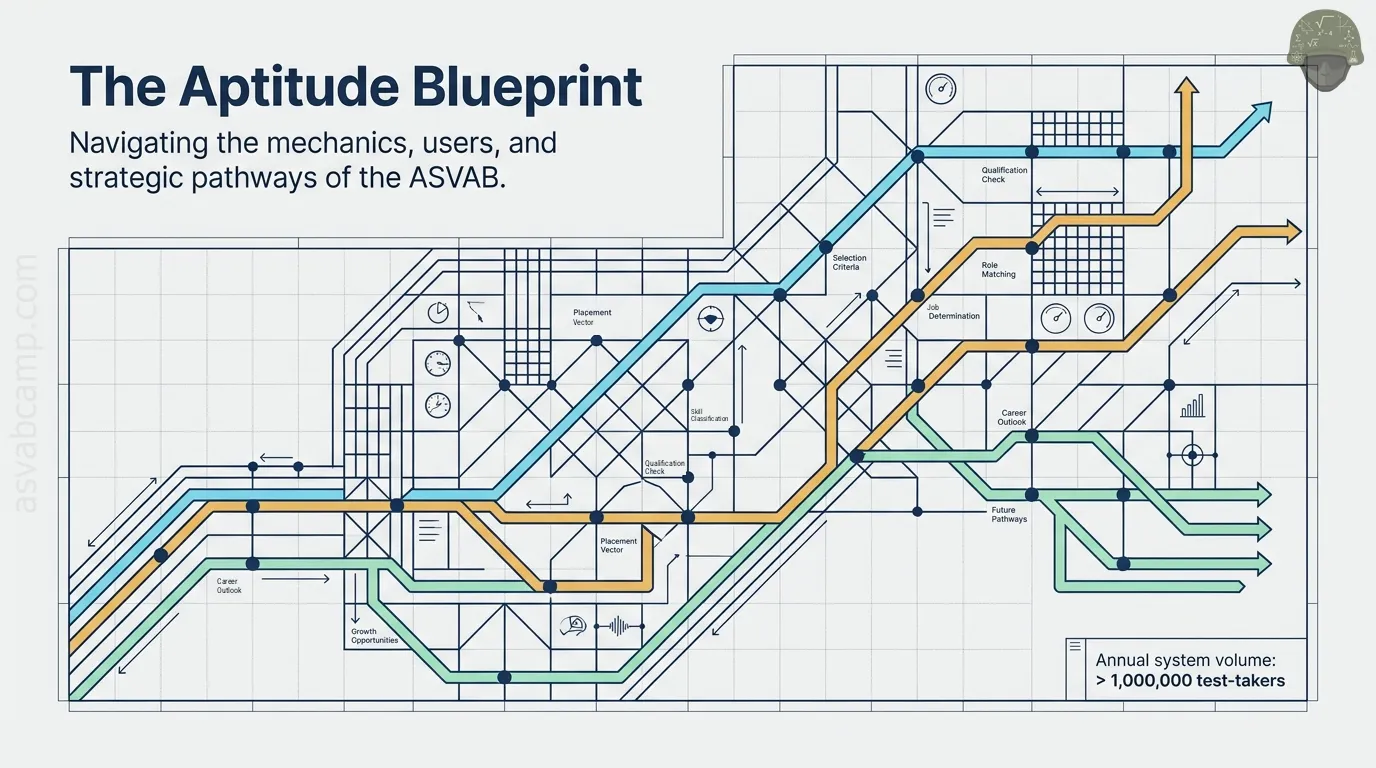
There are three major groups. (1) Military applicants: people pursuing enlistment normally work with a recruiter and are scheduled for testing at a Military Entrance Processing Station (MEPS) or an affiliated Military Entrance Test (MET) site. (2) High-school and post-secondary students: schools may offer the ASVAB as part of the free Career Exploration Program. These students may be exploring civilian careers, military careers, or both. Eligible CEP scores may sometimes be used later in the enlistment process, subject to current requirements; School Staff Testing scores require a Verification Test before enlistment use. (3) In-service personnel: people already serving may take an ASVAB-related retest for reclassification or access to training opportunities, according to Service procedures. More than one million military applicants, high-school students, and post-secondary students take the ASVAB each year, but these groups do not all take it for the same reason.
Three Realistic ASVAB Paths
Scenario A — Enlistment: Jordan wants to join a military Service. A recruiter confirms that Jordan can continue processing and schedules the ASVAB. Jordan's AFQT result is used for enlistment aptitude eligibility, while other ASVAB subtest combinations may affect the military occupations for which Jordan can qualify. Scenario B — Career Exploration: Maya takes the ASVAB at her high school through the Career Exploration Program. Her purpose is to identify strengths and explore career areas. Taking the school ASVAB does not obligate her to enlist. If she later wants to use an eligible school score for enlistment, current verification and recruiting requirements apply. Scenario C — In-Service: Alex is already serving and is interested in reclassification into a different occupational field. Alex contacts the base education office to learn whether retesting is appropriate and what current Service rules apply.
ASVAB Is Not the AFQT
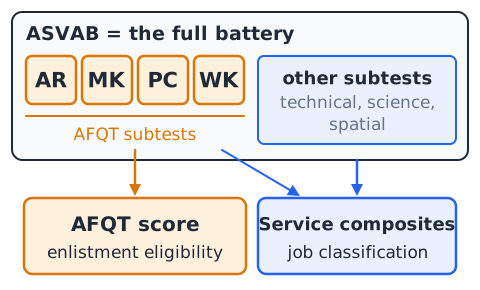
A common misunderstanding is that the ASVAB and AFQT are two separate entrance exams. They are not. The ASVAB is the full aptitude battery. The AFQT is a score computed from four ASVAB subtests: Arithmetic Reasoning (AR), Mathematics Knowledge (MK), Paragraph Comprehension (PC), and Word Knowledge (WK). AFQT is important for enlistment eligibility, but the remaining ASVAB subtests also matter because the Services use combinations of subtest scores for job classification. A learner who studies only enough to raise the AFQT may improve enlistment eligibility yet still limit access to occupations that depend heavily on technical, mechanical, electronics, auto/shop, science, or spatial scores.
Common Misunderstandings
Misunderstanding 1: The ASVAB is only a pass/fail test. In reality, it produces multiple scores used for different purposes. Misunderstanding 2: AFQT and ASVAB are different exams. AFQT is a derived score from four ASVAB subtests. Misunderstanding 3: A high AFQT automatically qualifies me for any military job. Job qualification also depends on Service-specific composite scores and other current eligibility requirements. Misunderstanding 4: Taking the ASVAB at school means I have joined the military. The Career Exploration Program is also designed for civilian and military career exploration and does not itself create an enlistment obligation. Misunderstanding 5: Every person who takes the ASVAB takes exactly the same program. Applicant testing, school Career Exploration testing, and in-service testing have different administrative purposes and score reporting contexts.
Quick Review
Remember these points: • ASVAB = Armed Services Vocational Aptitude Battery. • It measures multiple aptitude areas rather than one school subject. • Officially approved score uses include Selection, Classification, and Career Exploration. • Military applicants normally enter the testing process through a recruiter and test at MEPS or an affiliated MET site. • High-school and post-secondary students may take the ASVAB through the Career Exploration Program. • Scores from School Staff Testing (SST) require a Verification Test (Vtest) before enlistment use; consult an authorized recruiter. • In-service personnel may also test for reclassification/training purposes under Service procedures. • The ASVAB is the full battery; AFQT is a score derived from AR, MK, PC, and WK. • AFQT helps determine enlistment aptitude eligibility; Service composites help with job classification. • A strong preparation plan should target both AFQT performance and the subtests relevant to desired military occupations.
 English ▾