ASVAB Camp Get the appGoogle Play
Test guide · lesson 3 of 8 · 13 min

How CAT-ASVAB Adaptive Testing Works

Most people take the ASVAB on a computer, and the computerized version, CAT-ASVAB, behaves very differently from a paper test. This lesson explains what computer-adaptive testing means, why question difficulty shifts based on your answers, and why one-way navigation means you cannot return to an earlier item.

Video lesson: CAT-ASVAB: Adaptive Testing

Video transcript

0:00 Hey everyone, and welcome to this explainer. Look, if you're prepping for the ASVAB right now, let's just get the elephant in the room out of the way. Test anxiety is completely 100% normal. It's a high stakes exam, and honestly, the computer format can feel incredibly intimidating at first. But here is the really good news. The CAT-ASVAB isn't out to trick you. Not at all. It actually operates on a very specific logical set of rules, and once you understand the mechanics behind those rules, that anxiety really starts to melt away. So think of this explainer as your clear, friendly guide to mastering the Cat ASVAB without the panic. We're going to break down exactly how this test thinks, so you can walk in there and perform at your absolute best. Okay, here's our roadmap for today. Sections 1 through 6. We're going to cover what is computer adaptive testing, one-way navigation and pacing, guessing and time strategies, the three decision scenarios, avoiding common Cat mistakes, and finally, a check yourself section with some practice questions. All right, let's jump right into section 1. What is computer adaptive testing?

1:04 So what does Cat actually mean? It stands for computerized adaptive testing. Now, think about those old-school paper tests we've all taken, where everybody in the room gets the exact same fixed sequence of questions. The Cat ASVAB is completely different. The computer is constantly evaluating you in real time. It actively selects questions that are appropriate for your estimated ability level, based on your previous answers. And because it adapts to you so efficiently, it literally takes fewer questions to figure out your score than a traditional paper test would. It's like a highly structured statistical model, completely logical, not random at all. And this brings us to a totally counterintuitive truth about the test. Generally speaking, a correct response pushes the system to give you a more difficult item, while an incorrect response leads toward an easier item. So getting a harder question is actually a fantastic sign. It means you're doing well, and the system is targeting that higher ability range. Because of this, you absolutely cannot try to reverse engineer your score while you're testing. Don't sit there thinking, oh no, this question is easy. I must have messed up the last one.

2:05 That's a trap. A harder question doesn't mean you're failing, and an easier one doesn't prove you got the last one wrong. Just focus on the problem right in front of you. One-way navigation and pacing. This right here is absolutely crucial. One-way navigation. What this means is that once you click submit on the CAT-ASVAB, that answer is locked in. You cannot go back to review it. You cannot change it. It is gone. This is a massive strategic difference from a paper test where you can flip back and forth. So before you click submit, you definitely want to confirm you've actually selected the option you meant to, and double check that you haven't missed a tricky word, like NOT, EXCEPT, LEAST or MOST. But, and this is a big but, please don't let this turn into perfectionism. If you spend five minutes agonizing over a single question just to be safe, you're going to create some huge time pressure for yourself later on. To put the whole test into perspective, across the 10 different subtests, things like general science, arithmetic reasoning, word knowledge, there are exactly 135 total scored questions.

3:09 Now, they might throw in a few unscored tryout questions here and there, but don't worry, they give you extra time to account for those. And time-wise, the average proctored cat Asvab takes about two hours in total. Official materials point out that most people actually finish before the clock runs out. The really important takeaway here is that each subtest has its own fixed time limit. You aren't managing one giant two-hour timer. You need to pace yourself within each individual subtest. So what happens when time gets tight? Let's talk about it in section three, guessing and time strategies. No matter how prepared you are, there's a chance you'll look up and realize you're running out of time. When that happens, you might wonder, should I just leave them blank or guess? Well, leaving a bunch of questions blank triggers a penalty for unfinished items. It treats them as if you answered them at random. But if you just sit there and blindly mash buttons to fill in random guesses at the very end, that also carries a pretty significant penalty. So the absolute best strategy when the clock is shrinking is to keep reading. Eliminate the obviously wrong options as fast as you can and make legitimate educated guesses so you can keep moving forward.

4:16 To avoid that late test panic altogether, you've got to adopt what we call a local mindset. Don't chase the difficulty level and don't psych yourself out over the big picture. Here is your four-step mantra. Step one, solve the question in front of you. Step two, submit your best informed response. Step three, reset mentally. Seriously, entirely forget the question you just answered. And step four, continue. Solve, submit, reset, continue. If you stick to that rhythm, you'll be golden. Let's put these strategies to the test in section four, the three decision scenarios. These are three real world situations you will almost certainly face. Scenario one, a wildly harder question appears. Maybe you just crushed an algebra problem and the next one looks like absolute nonsense. Your best action? Do not slow down. Just read it normally and solve what you can. Remember, harder questions are a reward. It's just adaptive targeting doing its thing. Scenario two, you are unsure. Let's say you're staring at a word-knowledge question and you've got it down to two choices. Staring at the screen for another full minute is not going to magically beam the definition into your brain.

5:24 Just pick the better supported option and move on. Scenario three, you have three minutes left in the subtest and several items are still blank. Do not panic and start random clicking. Instead, shorten your process. Read the prompt, cross out the obvious distractors, make your best defensible choice, and continue. Every legitimate attempt counts. Alright, section five, avoiding common cat mistakes. My goal here is to keep you out of the most common psychological and mechanical traps. Let's knock out the first three. First, believing that harder questions mean you're doing terribly. As we've established, strong test takers see harder items. It's a compliment from the computer. Second, trying to deduce if your last answer was right based on the next question. Actually, it's way more complex than that. The algorithm is incredibly sophisticated. You literally cannot read its mind, so don't waste brain power trying. Third, clicking through quickly thinking you can just flag it and come back later. Nope, one way navigation is strictly enforced. Once you click, it is history. And here are the final three big mistakes.

6:27 Mistake four, spending so much time agonizing over a single question that you have to rush the rest of the subtest. Mistake five, random clicking the final block of questions when you're low on time. Remember those penalties we talked about? And mistake six, which is huge for your prep right now. Practicing only in an untimed environment where you can easily backtrack. Your prep absolutely must include timed one way practice sessions. You want that locked in one and done feeling to be completely second nature by test day. Okay, we have covered a lot of ground today. Let's wrap things up with section six. Check yourself. I'm going to throw a couple of practice questions your way. An examinee answers several questions correctly and then begins seeing more difficult items. What is the best interpretation? Go ahead and hit pause on this explainer. Think about your answer. Lock it in and unpause when you're ready. And the correct answer is B. Why? Because on the Cat Asvab, a strong performance naturally leads to harder items. The system is actively targeting your evolving ability level to get a precise measurement. It is absolutely not punishing you.

7:32 Let's try one more. Question two, why is it risky to spend an excessive amount of time on one Cat Asvab question? Once again, pause the explainer, pick your answer, and resume when you're ready. The answer here is A. Over investing your time on a single item just creates totally avoidable pressure on the rest of your subtest. And remember, you don't get to use calculators on the Asvab. So your mental stamina is incredibly precious. Don't burn all your mental energy on one stubborn problem while the clock is ticking down. The correct mindset is local. Solve the question in front of you. Submit the best answer, and mentally reset before the next item. If you can internalize that rhythm, you are going to master this test. So the only question left is, are you ready to tackle your next practice test with this confident one question at a time mindset? I absolutely think you are. Thanks so much for joining me on this explainer and best of luck on your Asvab prep. You've got this.

Visual lesson

Lesson slides

14 slides
CAT-ASVAB: Adaptive Testing – slide 1 of 14

Lesson Goal

By the end of this lesson, the learner should understand how computer-adaptive testing works on the CAT-ASVAB, why question difficulty changes during a subtest, why submitted answers cannot be revisited, how time limits and incomplete-item penalties affect strategy, and how to respond intelligently when a question feels unusually easy or unusually difficult.

What Computer-Adaptive Testing Means

CAT stands for Computerized Adaptive Testing. On the CAT-ASVAB, the computer does not simply present every applicant with the same fixed sequence of questions. Instead, the testing system selects items that are appropriate for the examinee's estimated ability level. A correct response generally leads the system toward a more difficult item; an incorrect response generally leads toward an easier item. This repeated adjustment allows the test to estimate ability efficiently while using fewer questions than a traditional fixed-form paper test.
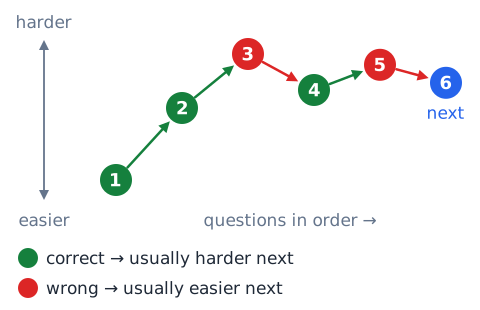
Adaptive path through questions 1 to 5 with question 6 marked next: after a correct answer the next question is usually harder, after a wrong answer it is usually easier.

Why Question Difficulty Changes

A harder question does not mean the examinee is doing badly. In fact, an examinee who is performing above average may receive questions that feel harder because the adaptive system is targeting that higher ability range. Likewise, an easier question after a difficult one does not prove that the previous answer was wrong. Item selection is based on a statistical model and the examinee's evolving ability estimate, not a simple visible one-question-up/one-question-down scoreboard. The practical rule is simple: do not try to reverse-engineer your score from how difficult the next question feels.

One-Way Navigation: You Cannot Go Back

Once an answer is submitted on CAT-ASVAB, the examinee cannot return to that question to review or change it. This is a major strategic difference from the paper-and-pencil version. Before submitting, confirm that the intended option is selected and that no important word such as NOT, EXCEPT, LEAST, MOST, INCREASE, or DECREASE was overlooked. However, do not turn this into perfectionism: spending too long rechecking one item can create time pressure later in the subtest.
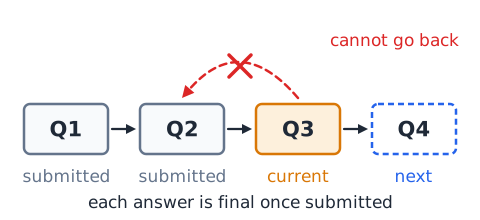
Questions Q1 to Q4 in one direction: Q1 and Q2 are submitted, Q3 is current, and a crossed-out arrow shows you cannot go back to Q2.

Time Limits and Pacing

Each CAT-ASVAB subtest has a fixed number of scored questions and a time limit. Current scored counts are: GS 15, AR 15, WK 15, PC 10, MK 15, EI 15, AI 10, SI 10, MC 15, and AO 15, for 135 scored questions total. Official materials note that most examinees finish before the limits expire and that the proctored CAT-ASVAB takes about 2 hours on average. Some administrations can include unscored tryout questions, which increase the allowed time. The learner should therefore pace within each subtest instead of treating the entire battery as one single timer.

What Happens If Time Runs Out

CAT-ASVAB applies a penalty procedure when a subtest is not completed before time expires. Official guidance explains that unfinished items are handled as though they had been answered at random. This means leaving a large block unanswered is undesirable. At the same time, the official preparation guidance warns against blindly filling in a string of random guesses near the end of a CAT subtest, because several incorrect answers at the end can carry a relatively large penalty. The best response to shrinking time is to continue reading, eliminate obviously wrong options, and make legitimate educated guesses quickly enough to keep moving.

CAT-ASVAB Guessing Strategy

There is no benefit in staring at a question indefinitely. If the answer is uncertain, first identify what the problem is asking, remove choices that are clearly impossible, and then choose the best remaining option. On quantitative items, use estimation, sign, unit, size, and answer-choice structure to eliminate distractors. On verbal items, use context, roots, tone, and passage evidence. On technical or spatial items, identify the governing principle or geometric constraint. The goal is an informed response, not a perfect certainty level before every click.

Do Not Chase the Difficulty Level

Adaptive tests can create psychological traps. A run of difficult questions may make a strong examinee feel as if the test is going badly, while a run of easier-looking questions may cause panic about earlier mistakes. Neither reaction helps. The examinee cannot reliably infer the current score from perceived difficulty, and the same question may feel easy to one person and difficult to another. The correct mindset is local: solve the question in front of you, submit the best answer, and mentally reset before the next item.

Three CAT Decision Scenarios

Scenario 1 — Harder Question Appears: You answer an algebra question correctly and the next mathematics item looks much harder. Do not slow down merely because it appears difficult. Read it normally and solve what you can. Harder questions can be a natural result of adaptive targeting. Scenario 2 — You Are Unsure: You have narrowed a Word Knowledge question from four choices to two. Spending another full minute is unlikely to create new information. Choose the better-supported option and move on. Scenario 3 — Three Minutes Remain: Several items remain in the subtest. Do not click random answers instantly. Shorten your process: read the actual task, eliminate obvious distractors, estimate where appropriate, make the best defensible choice, and continue.

Common CAT-ASVAB Mistakes

Mistake 1: Believing harder questions mean a bad performance. Adaptive targeting can make strong examinees see harder items. Mistake 2: Trying to deduce whether the previous answer was correct from the next item's difficulty. The adaptive algorithm is more complex than a visible one-step pattern. Mistake 3: Clicking quickly and expecting to return later. CAT-ASVAB does not allow review after an answer is submitted. Mistake 4: Spending so long on one question that later items become rushed or unfinished. Mistake 5: Random-clicking the final block of questions when time is low. Official guidance recommends legitimate attempts and educated guessing instead. Mistake 6: Practicing only in an untimed, backtracking-friendly environment. Preparation should include one-way timed practice so the actual CAT behavior feels normal.

Quick Review

Remember: • CAT-ASVAB adapts item selection to the examinee's estimated ability. • Correct answers generally lead toward harder items; incorrect answers generally lead toward easier ones. • Perceived difficulty is not a reliable live score indicator. • Once an answer is submitted, you cannot return to it. • Each subtest has its own time limit. • Most examinees finish within the available time; the average total CAT-ASVAB testing time is about 2 hours. • Running out of time triggers a penalty procedure for unfinished items. • When uncertain, eliminate wrong options and make an educated guess. • When time is short, keep making legitimate attempts rather than blindly random-guessing the remaining block. • The best adaptive-test mindset is: solve, submit, reset, continue.

What next?

← Previous: The 10 Subtests and Four Domains

About this lesson

From there it moves to the practical side: time limits and pacing, what happens if time runs out with questions unanswered, and a sensible guessing strategy for CAT-ASVAB. You will see why chasing the difficulty level is a distraction, then work through three CAT decision scenarios that show how to act when you are stuck on a question or short on time. A list of common CAT-ASVAB mistakes and a Quick Review round it out.

The lesson takes roughly 13 minutes. Knowing these rules ahead of time keeps test-day surprises from costing you points on any subtest. Next, take the 10-question lesson test, then compare this format with the paper version and PiCAT in the following lesson.

Take it with you: the free app

The same 124 lessons, 6,516 questions and 82 timed practice tests on your phone, plus flashcards with spaced review and progress tracking. Free to download, and it works offline.

  • Works offline
  • Spaced-review flashcards
  • Progress for every subtest
  • Menus in 59 languages
ASVAB Camp appGoogle Play