 ASVAB Camp
Lesson Goal
By the end of this lesson, the learner should be able to explain what the Armed Forces Qualification Test (AFQT) score represents, identify the four ASVAB subtests that feed it, understand the role of the Verbal Expression (VE) composite, interpret an AFQT percentile correctly, recognize AFQT categories, and distinguish enlistment eligibility from military-job qualification.
What the AFQT Actually Is
The AFQT is not a separate exam. It is a composite score derived from four ASVAB subtests and used by all U.S. military Services as an important part of determining aptitude eligibility for enlistment. The full ASVAB measures ten subtest areas, but the AFQT focuses on verbal and mathematics performance. This makes AFQT one of the most important numbers an applicant receives, but it is not the only score that matters in the enlistment process.
The Four AFQT Subtests
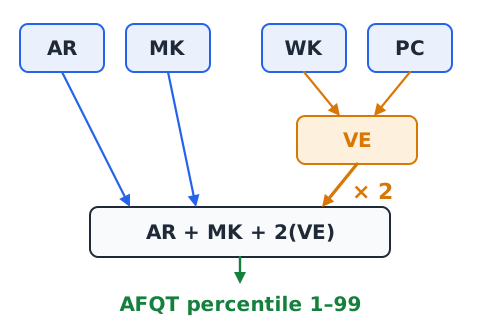
Four ASVAB subtests contribute to AFQT: Arithmetic Reasoning (AR), Mathematics Knowledge (MK), Word Knowledge (WK), and Paragraph Comprehension (PC). AR measures the ability to solve arithmetic word problems. MK measures knowledge of high-school mathematics principles. WK measures vocabulary and word meaning. PC measures the ability to obtain information from written passages. Together, these four subtests represent the mathematics and verbal abilities used in the AFQT.
VE: The Verbal Expression Composite
Word Knowledge and Paragraph Comprehension do not simply enter the AFQT as two independent raw percentages. Official ASVAB technical documentation forms a Verbal Expression (VE) composite from WK and PC standard-score information. VE is then double-weighted in the AFQT computation. At a conceptual level, the long-standing AFQT relationship is AFQT = AR + MK + 2(VE), followed by conversion of the resulting standardized composite to the official AFQT percentile scale. This is why both verbal subtests deserve serious attention even when an applicant thinks of ASVAB mainly as a mathematics test.
AFQT Is a Percentile, Not Percent Correct
An AFQT score from 1 to 99 is a percentile score, not the percentage of questions answered correctly. A score of 70 does not mean '70% correct.' It means the examinee performed as well as or better than approximately 70% of the nationally representative reference group used for current AFQT norms. Official ASVAB materials state that the current reference group is a national sample of 18- to 23-year-old youth from the 1997 norming study. Because AFQT is norm-referenced, a simple practice-test accuracy such as 80% correct does not equal an official AFQT percentile of 80.
AFQT Categories
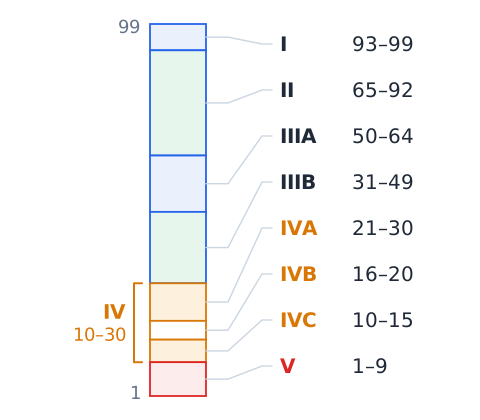
Official ASVAB reporting divides AFQT percentiles into categories. Category I covers 93–99; Category II covers 65–92; Category IIIA covers 50–64; Category IIIB covers 31–49; Category IVA covers 21–30; Category IVB covers 16–20; Category IVC covers 10–15; and Category V covers 1–9. Some applicant-facing official pages simplify Category IV as 10–30, but the more detailed official scoring tables subdivide it into IVA, IVB, and IVC. These categories help the Department of Defense and the Services interpret aptitude ranges for accession policy and reporting.
What Counts for Enlistment
All military Services use AFQT in determining whether an applicant meets aptitude requirements for enlistment, but the minimum AFQT score is not one universal number for every branch and every applicant. Official ASVAB guidance states that minimum qualifying scores vary by Service. Requirements can also interact with education status, recruiting programs, waivers, current manpower needs, and other policies. Therefore, learn the AFQT scale and work on the four underlying subtests, and check current official Service recruiting sources or a recruiter for the actual minimum that applies to you.
Current Policy Context: Categories IIIA, IV and V
The AFQT category scale identifies Category IIIA as 50–64, Category IV as 10–30, and Category V as 1–9. AFQT Category IIIA or higher can be relevant to certain Service enlistment incentives, but an individual must meet current program requirements. In addition, 10 U.S.C. § 520 sets a default four-percent annual cap on original active-duty accessions (other than active duty for training) with AFQT scores at or above the tenth and below the thirty-first percentile; the Secretary of Defense may authorize an increase up to twenty percent on request. This is a statutory limit on the share of such accessions, not a universal personal minimum qualifying score. Category V lies below that statute's Category-IV band. Always check current Service recruiting rules and any special training pathway separately; do not infer a personal legal eligibility decision from the category label alone.
AFQT Eligibility vs. Military Job Qualification
Passing a branch's AFQT requirement does not mean the applicant qualifies for every military occupation. AFQT answers a broad question: does the applicant meet the Service's aptitude requirement for enlistment? Job classification answers a different question: which occupations and training programs does the applicant qualify for? The Services use additional ASVAB subtest combinations—often called line, composite, or aptitude-area scores—to classify applicants. Someone may have a strong AFQT yet miss a desired technical occupation because Electronics Information, Mechanical Comprehension, General Science, Auto/Shop, or another relevant subtest is too low.
How to Prioritize AFQT Study
Because VE is double-weighted in the AFQT relationship, and AR and MK also enter directly, all four AFQT subtests deserve deliberate preparation. The best study priority is not automatically 'spend equal time on all four.' Begin with a diagnostic. If mathematics is weak, build Arithmetic Reasoning and Mathematics Knowledge foundations while practicing no-calculator speed. If verbal performance is weak, develop Word Knowledge and Paragraph Comprehension together because both feed VE. Once AFQT performance is safely above the current target for the desired Service, shift more study time toward the technical or spatial subtests that matter for the desired occupation.
Three Score-Interpretation Scenarios
Scenario A — AFQT 72: An applicant receives an AFQT percentile of 72. This does not mean 72% of ASVAB questions were correct. It means the applicant performed as well as or better than about 72% of the reference group. That score falls in Category II. Scenario B — AFQT 52 With a Technical Goal: An applicant earns AFQT 52, which is Category IIIA, but wants an electronics-heavy occupation. The applicant still needs to examine the Service-specific job composite requirements; AFQT 52 alone does not guarantee the job. Scenario C — Practice App Says 80% Correct: A practice test shows 80% accuracy. It should be reported as 80% practice accuracy, not converted directly to 'AFQT 80.' Official AFQT is based on standardized ASVAB scoring and percentile conversion, not a simple percent-correct rule.
Common AFQT Misunderstandings
Mistake 1: Treating AFQT as a separate exam. It is derived from ASVAB subtests. Mistake 2: Believing AFQT 65 means 65% of questions were correct. It is a percentile. Mistake 3: Adding raw practice-test correct answers to calculate an official AFQT score. Official scoring uses standardized scores and norm-referenced conversion. Mistake 4: Ignoring Word Knowledge and Paragraph Comprehension. They combine into VE, which is double-weighted in the AFQT relationship. Mistake 5: Assuming there is one permanent minimum AFQT score for every military branch. Minimums and programs can differ and change. Mistake 6: Believing a qualifying AFQT guarantees any desired military occupation. Job qualification uses separate Service-specific composite scores and other eligibility criteria.
Quick Review
Remember:
• AFQT is a derived score from the ASVAB, not a separate exam.
• AFQT combines AR, MK, WK and PC; WK and PC form the VE composite.
• A widely reported computation is AR + MK + 2(VE), followed by official percentile conversion.
• AFQT 1–99 is a national-reference percentile, never simply percent correct.
• AFQT categories are I 93–99; II 65–92; IIIA 50–64; IIIB 31–49; IVA 21–30; IVB 16–20; IVC 10–15; and V 1–9.
• The 10 U.S.C. § 520 Category-IV accession cap is not one universal Service-specific minimum.
• Category V is the lowest reported AFQT category; do not substitute category ranges for a complete enlistment-eligibility assessment.
• Occupational qualification depends on additional Service-specific composites and other criteria.
• Do not turn app practice percentages into claimed official AFQT scores.
 English ▾