ASVAB Camp Get the appGoogle Play
Test guide · lesson 4 of 8 · 15 min

Paper-and-Pencil ASVAB and PiCAT Explained

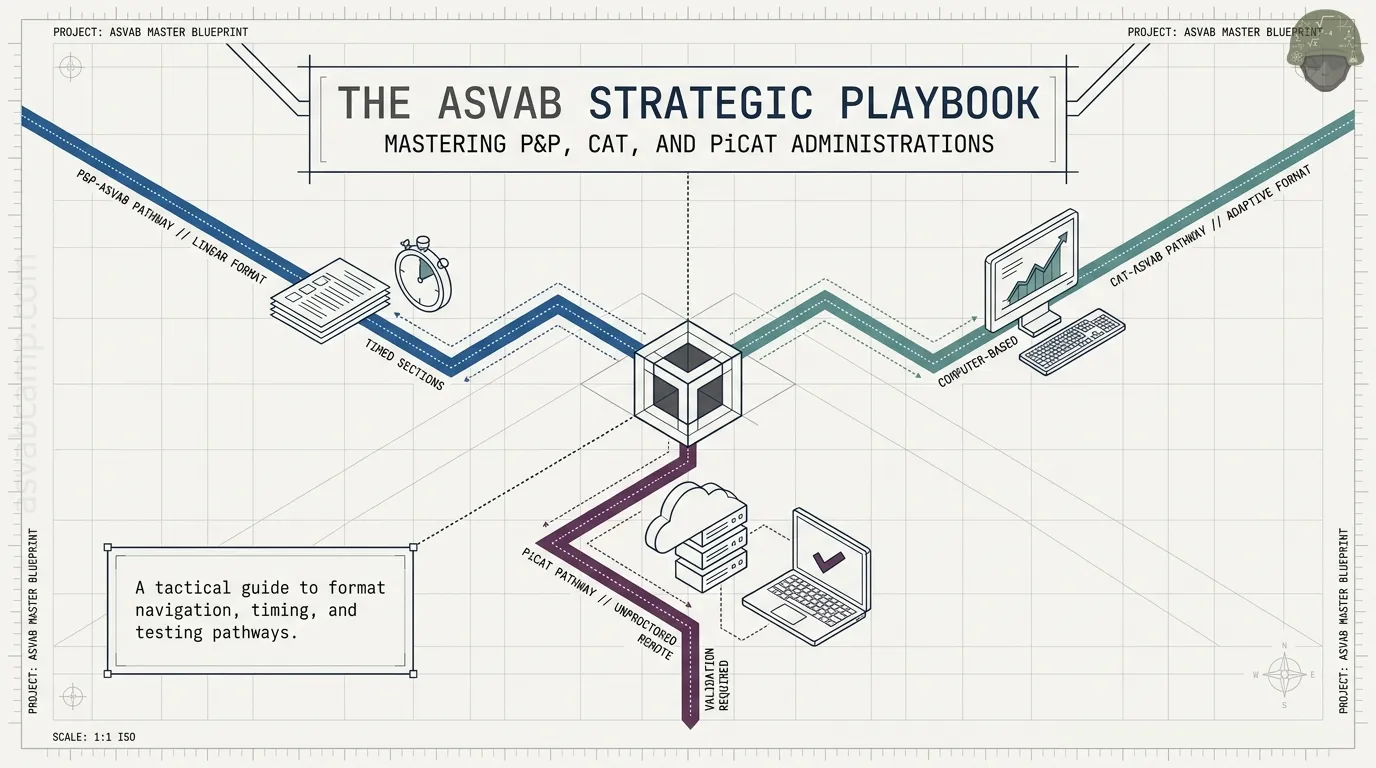
Not every ASVAB looks the same on test day. This lesson compares the fixed-form paper-and-pencil ASVAB with CAT-ASVAB and PiCAT, the version some applicants begin at home before a verification step. It covers where P&P-ASVAB is used, why its strategy differs from the computerized version, and what makes PiCAT its own path.

Video lesson: P&P ASVAB and PiCAT

Video transcript

0:00 Hey, everyone. Welcome to this explainer. Look, if you're gearing up for the ASVAB, you probably already know your score is basically the key to unlocking your future career paths. But here's a massive secret that trips up so many test takers. How you take the test completely changes the strategy you need to use. Today, we're going to break down the three totally different formats of the ASVAB so you know exactly what rules apply to you on test day. And right off the bat, I want to emphasize one universal rule that causes a ton of anxiety, but is absolutely crucial to know. There is a strict no calculator policy across the board. No calculators allowed at all. But don't worry, we'll talk about exactly how to navigate that too. To make sure you're perfectly prepared, we're going to follow the exact sequence of your official study guide. We'll quickly cover ASVAB formats explained, paper and pencil rules, understanding the PiCAT, real test scenarios, common mistakes to avoid, and finally a quick check yourself section. All right, section one, ASVAB formats explained. So it's incredibly important to start by clarifying that while there are different ways to take this exam, every single one measures the exact same core abilities. They're all testing your verbal, math, and science skills. You basically have three potential pathways.

1:11 First, the P&P ASVAB, which is your traditional fixed form paper and pencil test. Second, the cat ASVAB, which is the computer adaptive test, you typically take at a military processing station. And third, the PiCAT, an unproctored remote test. But here is the major takeaway for all three of these. Calculators are completely banned. You've got to do all the math by hand on scratch paper or just mentally in your head. So practicing those manual math skills before test day, absolutely mandatory. Paper and pencil rules. Let's focus specifically on the paper and pencil or P&P ASVAB. If you happen to live pretty far from a main computer testing center, your recruiter might schedule you at a MET site, and they often use this paper version. It's got very specific timing and structural rules you really need to be aware of. Honestly, the official P&P test structure is a bit of a marathon. It includes exactly 225 questions spread over 149 minutes of subtest time. Now, if you've been practicing for the computer version, you might notice some structural differences here. On the paper test, auto information and shop information are combined into a single auto and shop test.

2:14 It also explicitly includes a 25 question assembling object section that you have 15 minutes to knock out. It's all the same core knowledge, just bundled a little differently. Now, here's the absolute crucial point, how you actually navigate the test. The biggest advantage of the paper format is freedom of movement. On the P&P ASVAB, if you hit a math problem that is totally stumping you and without a calculator that definitely happens, you can just skip it. You can return to it later as long as you're still within that specific subtest time limit. Contrast that with the computer adaptive cat ASVAB, which is strictly one way. On the computer, once you submit an answer, it's locked in forever. There is absolutely no going back. And you know, this builds directly into your guessing strategy. Because the paper test is a fixed form, there is literally zero penalty for guessing. If you've got one minute left on the clock and five blank bubbles, official guidance says you should just fill them all in. You might get a couple right. But on the cat ASVAB, the computer is actively analyzing your behavior.

3:14 If you suddenly start rapidly, randomly guessing at the end of the test, the algorithm flags it and triggers a really substantial penalty to your score. Don't do it. Okay, section three, understanding the PiCAT. Let's explore the PiCAT. This is a relatively newer option, and it offers incredible flexibility, especially if you live way out of town. PiCAT actually stands for Pending Internet Computerized Adaptive Test. You can think of it as the unproctored, take it home version of the computer test. But I need to be super clear here. This is absolutely not just some casual practice test. The score you get on the PiCAT can literally become your official permanent score record. Because it can become your official score, the PiCAT timeline is incredibly rigid. You can't just boot it up whenever you feel like it. Step one, your recruiter has to issue you a specific access code, and that code expires in exactly 30 days. Step two, once you sit down and actually start the test, a 48-hour countdown begins. You have to finish the entire thing within that window. And step three, to make that score official, you have to go in person and pass a proctored verification test, or V-test, within 45 days.

4:27 This V-test is way shorter, usually just 25-30 minutes, and its whole purpose is to prove that the person taking the test at home was actually you. And speaking of taking it at home, personal integrity is everything here. You're only allowed to use basic scratch paper and a pencil. No calculators, no googling answers, and definitely no having a buddy stand over your shoulder helping you out with the math. If you cheat, your home score is going to be drastically higher than your proctored verification test score. The system will catch that inconsistency right away, your score will be completely invalidated, and you won't be able to use it. Seriously, just stick to your scratch paper. Let's jump to section four, real test scenarios. To ground all these theoretical rules, let's look at three practical scenarios you might actually find yourself in. If you're scheduled at MEPS, like Taylor here, you're taking the Cat Asvab. Your strategy must be one-way navigation. Take your time on each question because you can't go back. If you're testing at home, like Jordan, you're taking the PiCAT. Your strategy relies on zero outside help, and being completely ready for that in-person V test later. And if you're at a satellite MET site like Morgan, you might get the paper and pencil Asvab.

5:33 In that case, your strategy is to knock out the easy questions first, skip the hard ones, and return to them before the time is up. Basically, your prep strategy has to perfectly match your testing location. Common mistakes to avoid. Now that we know the three different paths, let's explicitly list out the absolute most common traps applicants fall into, so you can easily bypass them. Mistake number one is studying for the paper test, but actually taking the computer test, and then expecting to be able to go back and change your answers. You can't. Mistake two is treating the PiCAT like a joke or a quick practice run. It is the real deal. Mistake four is a huge one, the temptation to use a calculator at home on the PiCAT. Please don't do it, because you definitely won't have one on the verification test. And finally, Mistake seven, thinking one test format is inherently easier than another. They literally all measure the exact same abilities. Avoid these major pitfalls, and you're already way ahead of the pack. Finally, section six, check yourself. Let's wrap up our explainer today with a quick little self-assessment. Here's your first question. What is a key navigation advantage on the P&P ASVAB compared to the Cat ASVAB?

6:40 Is it A, change answers after the ASVAB ends, B, no time limits, C, calculator use, or D, skip an item and return within the current subtest. Take a second to think about it. Did you get it? The correct answer is D. Official guidance totally allows you to answer the questions you know first, and then return to the skipped ones on the paper version. You just have to make sure you do it before the proctor calls time on that specific section. Alright, here is your second question to check your memory. What does the acronym PiCAT actually stand for? A, preliminary individual career aptitude test, B, Proctored internet classification aptitude test, C, pending internet computerized adaptive test, or D, personnel integrated computer assessment tool. The correct answer is C, it's the pending internet computerized adaptive test. Pending is really the key word there, because it's the unproctored version that remains, well, pending, until you go in and complete your required in-person verification test. So I want to leave you with this final, highly important question to think about.

7:45 Which test format strategy will you need to master based on your scheduled testing location? Knowing the strict differences between these formats basically changes everything about how you study. So as soon as you finish this explainer, go ask your recruiter which specific version you're taking. That way you can practice the exact navigation rules and definitely practice your scratch paper math, so you are perfectly prepared for your specific test day. Thanks for hanging out and learning with me today, and hey, good luck out there.

Visual lesson

Lesson slides

14 slides
P&P ASVAB and PiCAT – slide 1 of 14

Lesson Goal

By the end of this lesson, the learner should be able to distinguish the paper-and-pencil ASVAB (P&P-ASVAB), CAT-ASVAB, and PiCAT; explain where each is typically administered; describe the major navigation and timing differences; understand the PiCAT access and verification process; and choose preparation strategies that match the version they are likely to take.

P&P-ASVAB: The Fixed-Form Version

The paper-and-pencil ASVAB is a fixed-form version of the exam. Everyone taking the same form receives the same items in the same order, regardless of ability level. Unlike CAT-ASVAB, the questions do not adapt after each response. Current official materials show the P&P-ASVAB as a 225-question battery with 149 minutes of test time. General Science, Arithmetic Reasoning, Word Knowledge, Paragraph Comprehension, Mathematics Knowledge, Electronics Information, Auto & Shop Information, Mechanical Comprehension, and Assembling Objects are administered as timed subtests. Auto Information and Shop Information are combined into a single Auto & Shop (AS) test on the P&P-ASVAB.

Where P&P-ASVAB Is Used

Most applicant testing is conducted at Military Entrance Processing Stations (MEPS), where the ASVAB is administered by computer. Applicants who do not live near a MEPS may be scheduled by their recruiter at an affiliated Military Entrance Test (MET) site. Official ASVAB pages differ in how frequently they describe paper-and-pencil versus computer administration at MET sites. Do not assume the format from the testing-center type alone: ask the recruiter or test administrator which administration method is scheduled. This determines whether the one-way CAT strategy or within-subtest paper review rules apply.

P&P Strategy Is Different from CAT

P&P-ASVAB allows a test-taking behavior that CAT-ASVAB does not: within a timed subtest, an examinee can skip a difficult item and return to it later before the subtest ends. Official preparation guidance recommends answering the questions you know, returning to skipped questions, answering every item, and reviewing answers if time remains. If time is about to expire on P&P, there is no penalty for guessing, so filling remaining unanswered items is advantageous. This differs sharply from CAT-ASVAB, where submitted answers cannot be revisited and random-answer behavior near the end can trigger a substantial penalty.
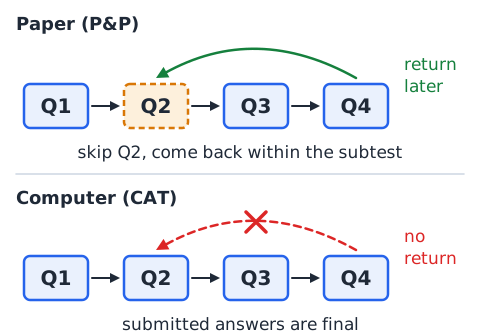
Two navigation strips: on paper (P&P) you can skip Q2 and return to it later within the subtest; on computer (CAT) the back arrow is crossed out because submitted answers are final.

What PiCAT Is

PiCAT stands for Pending Internet Computerized Adaptive Test. It is the unproctored version of CAT-ASVAB and can be taken anywhere with a suitable internet connection. It is not simply a casual practice test: it can become the applicant's official ASVAB score of record after successful verification. PiCAT does not require the applicant to travel to a MEPS or MET site to complete the initial test, making it especially convenient for applicants who live far from a testing location.

PiCAT Access, Eligibility and Completion Window

PiCAT is not an open public exam that anyone can launch independently. An applicant must work with a military recruiter, who issues an access code. Official guidance states that the access code expires 30 days after issuance. Once the applicant starts PiCAT, the full test must be completed within 48 hours. PiCAT may be taken only once and is available only to applicants who have never previously taken the ASVAB. Individual PiCAT subtests do not have time limits, although official guidance says the overall test typically takes about two to three hours.

PiCAT Verification Test (Vtest)

A PiCAT result is not automatically finalized for enlistment use. Applicants whose PiCAT performance indicates potential military eligibility are required to complete a proctored Verification Test at a MEPS or MET site. The purpose is not to produce a new score but to confirm that the unproctored PiCAT performance is legitimate and consistent. Official guidance states that the Vtest must be taken within 45 days of the PiCAT and generally takes about 25 to 30 minutes. The applicant does not receive a separate Vtest score. If verification is successful, the PiCAT scores become the official ASVAB scores of record and can be used in the enlistment process.
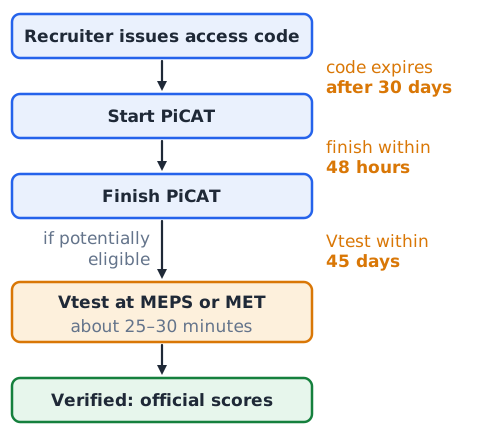
PiCAT flow: recruiter issues access code (expires after 30 days), start PiCAT, finish within 48 hours, then, if potentially eligible, Vtest at MEPS or MET within 45 days (about 25–30 minutes), then verified official scores.

How to Take PiCAT Correctly

Because PiCAT is unproctored, integrity is critical. Official guidance says to take it in a quiet environment with stable internet, preferably complete it without unnecessary interruptions, and use only basic scratch paper and a writing instrument. The applicant should not ask another person for help, search for answers online, use outside reference material, or use a calculator. Using assistance can make the PiCAT result inconsistent with the later proctored Verification Test and may prevent the score from being verified.

Which Version Am I Looking At?

Scenario A — MEPS Appointment: Taylor's recruiter schedules testing at a MEPS. The likely administration is CAT-ASVAB. Taylor should practice one-way navigation and timed adaptive-test decision making. Scenario B — Remote Applicant: Jordan lives far from a MEPS and is offered an access code to test from home. This is PiCAT. Jordan must complete it personally, without calculator or outside help, and later complete a proctored verification process if required. Scenario C — MET Site Paper Test: Morgan tests at a satellite MET site using answer sheets and a booklet. This is P&P-ASVAB. Morgan can skip a difficult item within the current subtest, answer easier items first, return before time expires, and fill any remaining unanswered items if time is running out.

Same Abilities, Different Administration

Computer and paper ASVAB administrations both provide scores for enlistment aptitude, but their subtest structures are not literally identical. CAT-ASVAB administers Auto Information (AI) and Shop Information (SI) as separate timed subtests. In paper-and-pencil enlistment testing, they are combined as Auto & Shop (AS). The current official paper-and-pencil table also includes Assembling Objects (AO): 25 questions with a 15-minute subtest limit. Both formats include AO, but the full subtest arrangements and question counts are different. Both versions assess core verbal, mathematics, and science/technical skills; the candidate's AFQT information can support enlistment assessment from either format. Navigation also differs: CAT uses adaptive item selection and does not allow revisiting committed answers, whereas P&P uses fixed paper forms and may permit returning to skipped items inside the current timed subtest. PiCAT is a separate unproctored pathway that requires verification before its scores can become official. Neither format should be treated as automatically easier or fully interchangeable in every subtest detail.

Common P&P and PiCAT Mistakes

Mistake 1: Preparing for CAT navigation and then assuming the same no-backtracking rule applies on P&P. P&P permits returning to skipped items within the current subtest. Mistake 2: Assuming PiCAT is an unofficial practice test. It can become the official score of record after verification. Mistake 3: Thinking PiCAT has to be taken at MEPS. The initial PiCAT is unproctored and can be taken anywhere with appropriate internet access. Mistake 4: Using a calculator or outside assistance on PiCAT because it is taken remotely. Official guidance prohibits such assistance. Mistake 5: Waiting too long after receiving the PiCAT access code or after beginning the test. The code and completion windows are limited. Mistake 6: Assuming a successful PiCAT automatically eliminates all in-person testing. A proctored Verification Test is part of the process when the score is to be used for enlistment. Mistake 7: Believing P&P is inherently easier or harder than CAT. The versions measure the same abilities; administration strategy is what changes.

Quick Review

Remember:

• P&P-ASVAB is fixed-form; CAT-ASVAB is adaptive.

• The published P&P test structure includes 225 questions and 149 minutes of subtest time.

• On P&P, AI and SI are combined into Auto & Shop (AS), and Assembling Objects (AO) is also included (25 questions / 15 minutes).

• MEPS typically administers the computer ASVAB; an applicant scheduled at a MET site should confirm whether the appointment is CAT or paper, because official pages differ about MET format frequency.

• P&P permits revisiting items within the active timed subtest; CAT does not allow returning to a submitted item.

• In P&P, answer every remaining item when time is running out because ordinary guessing has no penalty.

• PiCAT is an unproctored computer-adaptive administration, not an unofficial practice test.

• A military recruiter issues its access code. The code expires after 30 days; after starting, the applicant must complete PiCAT within 48 hours.

• PiCAT is available only once to an applicant who has never taken the ASVAB and has no individual subtest time limits.

• A supervised Verification Test generally takes 25–30 minutes and must be completed within 45 days.

• No calculator, searching for answers online, outside assistance, or outside reference materials are permitted while taking PiCAT.

What next?

← Previous: CAT-ASVAB: Adaptive Testing

About this lesson

You will learn how PiCAT access, eligibility and the completion window work, what the PiCAT Verification Test (Vtest) is for, and how to take PiCAT correctly so the result holds up. A section called Which Version Am I Looking At? helps you identify your format, and Same Abilities, Different Administration makes clear that the skills you study carry over to every version. Common P&P and PiCAT mistakes and a Quick Review close the lesson.

Set aside about 15 minutes. If a recruiter has mentioned a specific format, this is where you learn its rules. Afterward, take the 10-question lesson test, then continue to the lesson on the AFQT.

Take it with you: the free app

The same 124 lessons, 6,516 questions and 82 timed practice tests on your phone, plus flashcards with spaced review and progress tracking. Free to download, and it works offline.

  • Works offline
  • Spaced-review flashcards
  • Progress for every subtest
  • Menus in 59 languages
ASVAB Camp appGoogle Play