 ASVAB Camp
Learning outcomes and model assumptions
After this lesson you should be able to tell alternating current from direct current, and tell steady DC from pulsating DC, by looking at a graph of current or voltage against time. You should be able to count cycles, find frequency and period, convert between peak, peak-to-peak and RMS values for a sine wave, and compute average power in a simple resistor.
You will also identify what a rectifier, an inverter and a transformer do. The models here are idealized: sources are perfect, resistors are pure and keep a fixed value, and waveforms are clean. Capacitors, coils, phase shift and power factor are left for later study.
What the EI section actually examines
The Electronics Information subtest checks practical understanding more than heavy math. For AC and DC topics, expect questions such as which source gives DC, what unit measures frequency, what a rectifier or inverter does, or what household voltage and frequency are in the United States.
You may also see a short calculation: converting a frequency to a period, finding a peak voltage from an RMS value, or finding the power in a resistor. The numbers are usually easy, so success depends on knowing the definitions and relationships precisely rather than on long arithmetic.
Electric current has both size and direction
Current is the rate at which charge flows past a point. Its size is measured in amperes, where one ampere is one coulomb of charge per second:
Current also has a direction around the circuit. On a graph, we pick one direction as positive; current flowing the other way is plotted as negative. For example, 6 coulombs passing in 3 seconds is 2 A. If the same flow went the other way, the graph would show −2 A. Telling AC from DC is all about whether that sign ever changes.
Direct current is one-direction current
Direct current (DC) flows in only one direction around the circuit. Its value on a signed graph stays on one side of zero, all positive or all negative, and never crosses to the other side.
DC can be perfectly steady, like a fresh battery driving a fixed resistor, or it can vary in size while keeping its direction. A flashlight battery, a car's 12 V system and the output of a phone charger all deliver DC. The key word is direction, not constancy.
Alternating current reverses periodically
Alternating current (AC) repeatedly reverses its direction. On a graph, its value rises above zero, falls back through zero, goes below zero, and returns, over and over in a regular pattern.
The repeating, reversing pattern is what defines AC. The charges in the wire do not travel around the circuit; they shift back and forth around their positions, yet energy still flows to the load. The electricity delivered to U.S. homes and businesses through wall outlets is AC.
AC does not have to be a sine wave
Utility power is shaped like a smooth sine wave, but AC can take other shapes. A square wave jumps between a positive level and an equal negative level. A triangle wave ramps steadily up and down through zero. Some inexpensive inverters produce a stepped wave that only roughly resembles a sine.
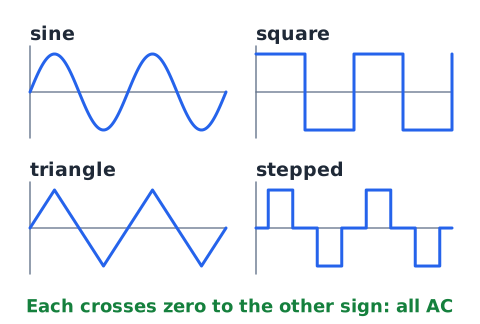
All of these are AC because their direction reverses on a regular schedule. The shape matters for some calculations, such as RMS, but not for the basic classification. Ask whether the value crosses zero to the other sign, not whether it looks smooth.
Steady DC compared with pulsating DC
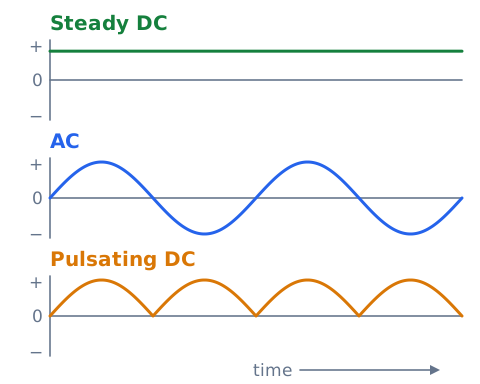
The figure shows three signed current graphs. The first is a flat horizontal line above zero: steady DC, with constant size and constant direction.
The second is a sine wave swinging above and below zero: AC. The third is a series of humps that rise from zero and fall back to zero but never dip below it. That is pulsating DC, the kind of output a rectifier produces from AC. It changes size constantly, yet its direction never reverses, so it is still DC.
A sign convention for graph questions
Questions with graphs depend on reading the vertical axis carefully. Values above the horizontal axis mean current or voltage in the chosen positive direction; values below it mean the opposite direction.
So the test is simple. If a graph has points above zero and points below zero, the direction reverses, and the waveform is AC. If every point stays on the same side of zero, including touching zero, the waveform is DC. Check whether the axis is labeled signed current or only magnitude before deciding.
A cycle is one complete repeat
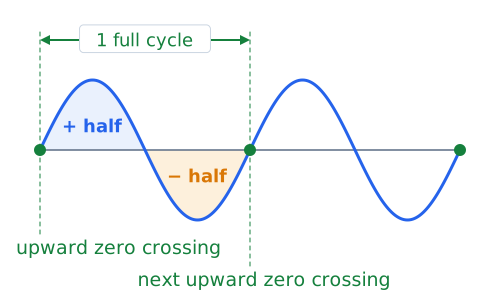
A cycle is one complete run of a repeating pattern, from any starting point until the wave returns to that same point and is moving the same way. For a sine wave, a common choice is from one upward zero crossing to the next.
One full AC cycle includes a positive half and a negative half. If a graph shows the pattern repeating 3 complete times, that is 3 cycles. Be careful: a single hump above the axis is only half a cycle. Count , the number of full cycles, before finding frequency.
Frequency counts cycles per second
Frequency is the number of complete cycles that occur in one second. Its SI unit is the hertz (Hz), and one hertz equals one cycle per second:
Here is the number of full cycles and is the time in seconds. For example, 30 cycles in 0.25 s gives
Larger units are common: 1 kilohertz (kHz) is 1,000 Hz and 1 megahertz (MHz) is 1,000,000 Hz. Steady DC has no repeating cycle, so its frequency is effectively zero.
Period is the time for one cycle
The period is the time needed for one complete cycle, measured in seconds or a smaller unit like milliseconds:
If 8 cycles take 0.4 s, each one takes
or 50 ms. On a graph, the period is the horizontal distance from one peak to the next.
Frequency and period are reciprocals
Frequency and period describe the same thing from opposite directions, so each is the reciprocal of the other:
A 200 Hz signal has
or 5 ms. Doubling the frequency halves the period, and halving the frequency doubles it.
Why the time axis matters
Graph questions often label time in milliseconds (ms) or microseconds (µs), not seconds. One millisecond is 0.001 s and one microsecond is 0.000001 s.
Convert to seconds before using
For example, a period of 4 ms is 0.004 s, so
A common wrong answer is 0.25 Hz, which comes from forgetting the unit conversion. Read every tick mark and label before counting cycles.
The U.S. household example
Standard household power in the United States is AC at 60 Hz with a nominal voltage of 120 V for ordinary outlets. Larger appliances like dryers and ranges use 240 V circuits. Many other countries use 50 Hz and about 230 V.
At 60 Hz, one cycle lasts
The 120 V figure is an RMS value, so the voltage actually peaks at about 170 V. Know 120 V, 60 Hz as the standard U.S. pair.
Batteries provide DC at their terminals
A battery creates a voltage through chemical reactions that push charge in one direction. One terminal is always positive and the other always negative, so current through a connected load flows in a single direction: DC.
As the battery discharges, its voltage gradually falls, but the polarity never flips. That is why batteries power flashlights, phones, cars and portable tools directly, and why an inverter is needed to run ordinary AC household devices from a battery bank.
Generators and mains AC
A generator produces voltage by rotating coils and magnets relative to each other. As a coil turns through the magnetic field, the induced voltage rises, falls and reverses each rotation, which naturally makes AC. A device built to deliver this output directly is called an alternator.
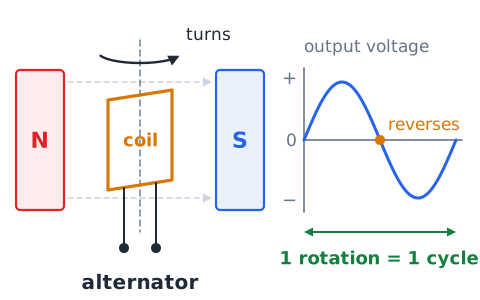
Power plants use huge generators spinning at tightly controlled speeds to hold the grid frequency at 60 Hz in North America. Some generators include a commutator or electronic rectifier to deliver DC instead, but the basic rotating-coil action is alternating.
What an inverter does
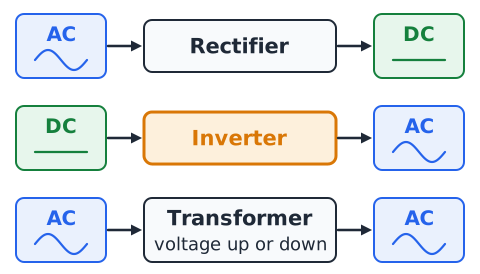
An inverter converts DC into AC. The figure shows it on the side of the conversion chain that turns a DC input into an alternating output.
Inside, electronic switches rapidly reverse the connection of the DC source, creating a waveform that changes direction many times per second; filtering can smooth it toward a sine. Common uses include running household devices from a car battery, connecting solar panels to the grid and backing up computers.
What a rectifier does
A rectifier converts AC into DC. Its key part is the diode, which lets current pass in only one direction. A simple half-wave rectifier blocks one half of every cycle. A full-wave or bridge rectifier flips the negative halves to positive, so every half-cycle becomes a positive hump.
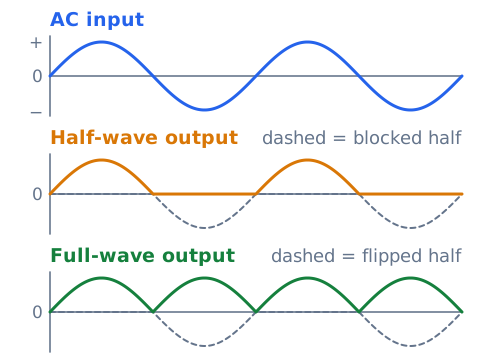
The raw output is pulsating DC. Filter capacitors and regulators then smooth it into nearly steady DC for electronics. Remember: rectifier, AC in, DC out.
Transformer action requires changing flux
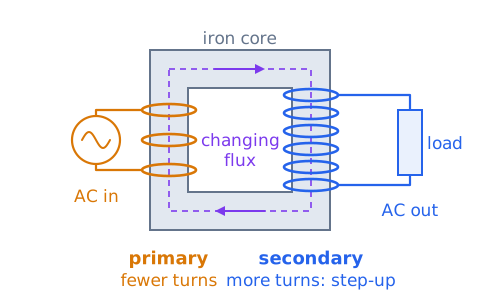
A transformer has two coils wound on a shared iron core. Alternating current in the primary coil creates a magnetic field that keeps changing in strength and direction. That changing field passes through the secondary coil and induces an alternating voltage there.
The ratio of turns sets the voltage change: more turns on the secondary steps the voltage up, fewer steps it down. Steady DC creates an unchanging field, which induces no ongoing voltage. So a plain transformer works with AC, does not convert AC to DC, and is useless on steady DC.
Voltage conversion and distribution efficiency
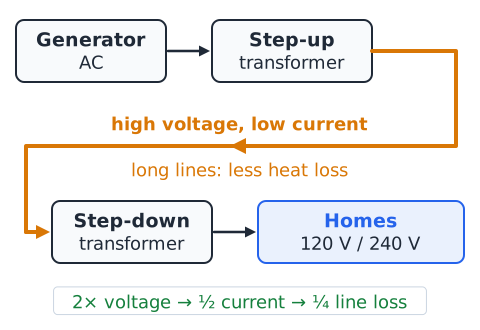
Power lines lose energy as heat, and that loss grows with the square of the current. For the same delivered power, raising the voltage lowers the current. Doubling the voltage cuts the current in half and reduces the line loss to one quarter.
Transformers make it easy to step voltage up to very high values for long-distance transmission and then step it back down near homes. This simple, efficient voltage changing is the main historical reason AC became the standard for power grids.
Peak voltage is the greatest magnitude
The peak value of a waveform is its largest magnitude measured from zero. For a symmetric AC wave that swings between and , the peak is .
For example, a wave swinging between +40 V and −40 V has a peak of 40 V. On a graph, find the highest point and read its height above the zero line. The peak is a single instant; most of the time the voltage is lower in size.
RMS is not the ordinary average
The ordinary average of a symmetric AC wave over a full cycle is zero, because the positive half cancels the negative half. That number says nothing about how much heating the wave can do.
RMS, short for root mean square, solves this. You square the value at every instant, which makes all values positive, average those squares, and take the square root. The result is the steady DC value that would heat a resistor the same amount. That is why AC voltages and currents are normally rated in RMS.
The sine-wave RMS relationship
For a sine wave with no DC offset, the RMS value is the peak divided by the square root of 2:
Going the other way:
Both voltages are in volts; the same rule works for current in amperes. For example, a 20 V peak sine wave has an RMS of about
RMS is always smaller than the peak for a sine.
Understand 120 V RMS properly
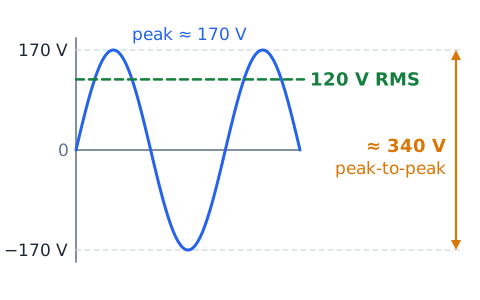
When we say an outlet supplies 120 V, we mean 120 V RMS. The actual voltage keeps swinging, reaching a peak of
in each direction, for a peak-to-peak swing of about 340 V. The 120 V rating is useful because a heater on 120 V RMS AC produces the same average heat as it would on steady 120 V DC.
A pure resistor responds to instantaneous voltage
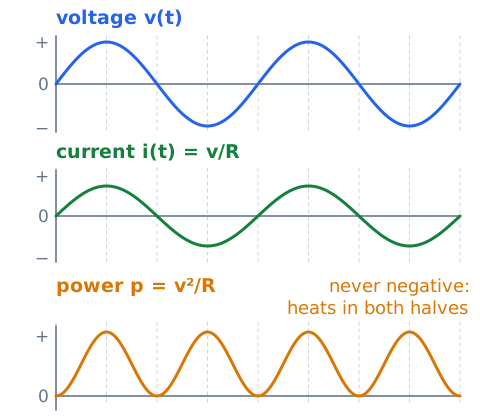
A pure resistor has no delay or storage. At every instant, its current follows Ohm's law using the voltage at that moment:
When the voltage is at its peak, the current is at its peak; when the voltage is zero, so is the current; and when the voltage reverses, the current reverses. The instantaneous power,
is never negative, because squaring removes the sign. So the resistor heats during both halves of each cycle.
Average power for a purely resistive load
Because RMS values are defined to match DC heating, the familiar power formulas work with AC as long as you use RMS values and the load is purely resistive:
P is average power in watts, V in volts, I in amperes and R in ohms. Example: 30 V RMS across a 10 Ω heater gives
Do not use peak values in these formulas, or you will overstate the power.
Power factor is a scope boundary
In real AC circuits, motors, coils and capacitors cause the current to lead or lag the voltage. Then multiplying RMS voltage by RMS current overstates the real power, and a correction called the power factor is needed.
This lesson stays inside the purely resistive case, such as a heater element, a toaster coil or a plain resistor, where current and voltage rise and fall together and the power factor is 1. If a question involves motors or reactance, the simple formulas give apparent power, not necessarily real power.
When a changing DC signal is still DC
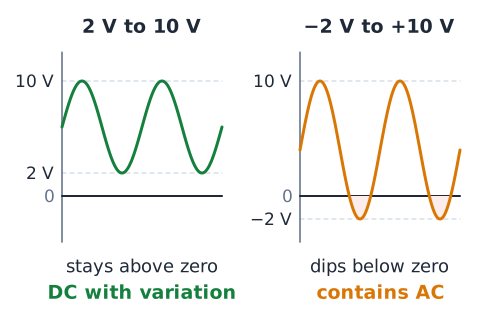
A signal can change in size and still be DC, as long as its direction stays the same. Examples include a battery slowly running down, a dimmer that varies a DC lamp's brightness, an audio signal riding on a positive supply, and the bumpy output of a rectifier.
To classify, look for a change of sign, not a change of size. A waveform that sweeps between 2 V and 10 V is DC with variation. A waveform that sweeps between −2 V and +10 V reverses, so it contains an AC part.
A square-wave alternating source
An ideal square wave jumps instantly between and and stays at each level for half the period. Because the magnitude is always , the square of the voltage never changes, and
A ±5 V square wave therefore has an RMS of 5 V and heats a resistor just like 5 V DC. A ±5 V sine wave has only about 3.54 V RMS.
Why a voltage waveform differs from a source label
A label on a device tells you the nominal rating, not the shape of the wave. A wall outlet labeled 120 V is not fixed at 120 V; it swings through about ±170 V each cycle. A power supply labeled 12 V DC may show a small ripple on an oscilloscope.
Questions sometimes give you a label and expect you to know what lies behind it. Others show a graph and expect you to name the rating. Keep the two ideas separate: ratings are usually RMS for AC and average or nominal for DC, while graphs show instantaneous values.
Distinguishing AC direction from electron flow
In a metal wire, current is carried by electrons. In DC, they drift slowly but steadily in one direction around the circuit. In AC, they move a tiny distance one way, then back, again and again, without making real progress around the loop.
Energy is still delivered, because the electric field that pushes the charges travels along the wiring almost instantly. Whether we use electron flow or the conventional current direction, AC is defined by the reversal of the flow, and the classification is the same either way.
The clock analogy for frequency
Think of a clock's second hand. It makes one full turn every 60 s, so its period is 60 s and its frequency is
A 60 Hz power waveform is the reverse: 60 full turns every second. Each turn of the hand is one complete cycle; a half turn is only a half cycle.
Crossing zero versus changing direction
Touching zero is not the same as reversing. A full-wave rectified signal dips down to zero between humps, but the next hump rises on the same positive side again. The current momentarily stops, then continues in the same direction, so it is pulsating DC.
A true AC waveform passes through zero and continues to the opposite sign. When reading a graph, follow the line through each zero point and see where it goes next. If it returns to the same side, there is no reversal.
Half-cycle timing and reversals
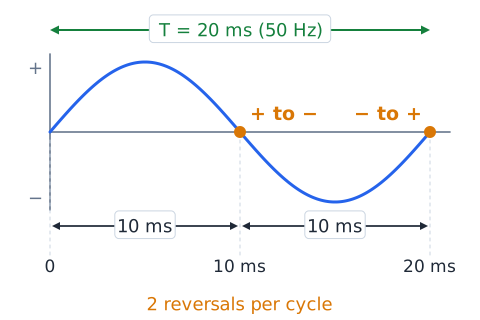
Each full cycle of AC contains two reversals of direction: once going from positive to negative and once going from negative to positive. So the number of reversals per second is twice the frequency, and the time for one half-cycle is half the period:
For 50 Hz, the period is 20 ms, each half cycle lasts 10 ms, and the current reverses 100 times per second. Zero crossings in the same direction are a full period apart.
Frequency affects time, not DC polarity
Frequency only tells how quickly a pattern repeats along the time axis. It has nothing to do with whether a signal is positive or negative, or how large it is.
Changing the frequency of a sine wave stretches or compresses it horizontally; the peaks stay the same height. Pulsating DC can also have a frequency, the rate of its humps, and it still stays DC no matter how fast those pulses come.
Voltage polarity can reverse even when magnitude is positive
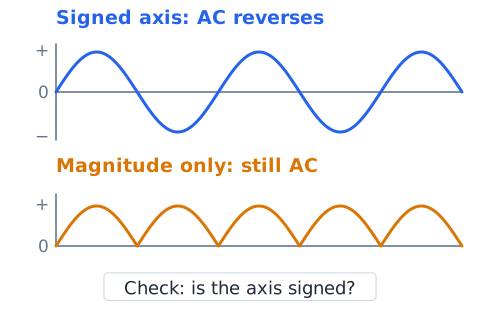
A meter on the AC setting reads a single positive number, such as 120 V. That does not mean the voltage is always positive. It is reporting a magnitude, the RMS value, while the polarity of the outlet terminals reverses 120 times every second.
Likewise, some graphs plot only magnitude, which makes AC look like a train of positive humps. Before you classify a waveform, check whether the axis is signed. Only a signed plot shows whether the direction really reverses.
AC adapters combine multiple stages
A typical wall adapter for electronics takes 120 V AC in and delivers a low DC voltage out. To do so it goes through several stages: it reduces the voltage, rectifies it with diodes, smooths it with capacitors, and regulates it to a steady level.
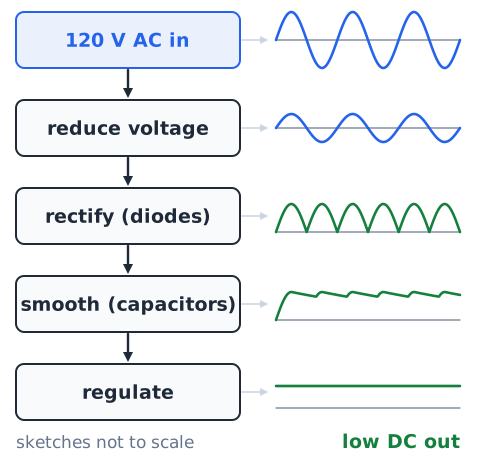
Older adapters used a heavy transformer first. Modern switching adapters rectify first, then chop the DC at high frequency through a small transformer and rectify again. Either way, the device's label lists AC input and DC output.
Solar modules and electronic conversion
Solar panels generate DC: light knocks charges loose in the cells, and they are driven in one direction, so each panel has a fixed positive and negative lead.
To run household appliances or feed the utility grid, an inverter converts that DC into AC at the correct voltage and frequency. A home with batteries may also use a charge controller to manage DC charging. On a test, panels and batteries are DC sources and the inverter is what turns their output into AC.
Why rectified DC can have ripple
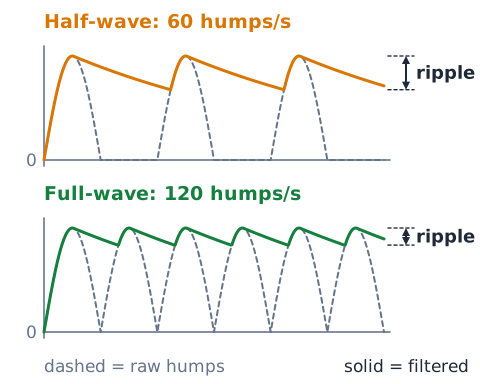
A rectifier only redirects the current; it does not fill in the gaps between humps. The raw result rises and falls each half-cycle, which is pulsating DC.
A filter capacitor charges near each peak and releases charge in between, holding the voltage up. What remains is a small leftover variation called ripple. A full-wave rectifier on 60 Hz power produces 120 humps per second, which is easier to smooth than the 60 humps per second from a half-wave rectifier. Voltage regulators reduce ripple further.
Where Hz and RPM differ
Revolutions per minute (rpm) counts rotations per minute, while hertz counts cycles per second. To convert rotation speed to rotations per second, divide rpm by 60. For example, 1,800 rpm is 30 rotations per second.
The electrical frequency of a generator also depends on its number of magnetic poles, not only on speed. A simple two-pole generator spinning at 3,600 rpm produces 60 Hz, while a four-pole machine produces the same 60 Hz at 1,800 rpm. So a rotation speed alone is not automatically the electrical frequency.
Voltage in an AC waveform: peak and peak-to-peak
Peak-to-peak voltage is the total vertical distance from the most negative point to the most positive point. For a symmetric wave centered on zero, it is twice the peak:
A wave between +25 V and −25 V has a 25 V peak and a 50 V peak-to-peak value. Read the question closely, because peak, peak-to-peak and RMS are different numbers for the same wave.
Root-mean-square does not remove danger
An RMS rating is an average-heating measure. It does not describe the highest voltage present. A 120 V RMS outlet repeatedly reaches about 170 V, and insulation, switches and the human body must withstand that peak.
A lower-sounding RMS figure should never be read as safer than it is. Current through the body, not the number printed on the label, causes injury, and household AC can drive a dangerous current through skin, especially wet skin. Treat every energized circuit as hazardous.
Simple resistance and a constant DC source
With steady DC and a fixed resistor, voltage, current and power all stay constant. Ohm's law and the power formula apply directly:
For example, a 24 V DC source across a 6 Ω resistor gives
A and
Since nothing changes over time, there is no difference between instantaneous, average and RMS values.
A changing AC resistor calculation
With AC, Ohm's law still applies at each instant. Suppose a sine wave with a 100 V peak is applied to a 50 Ω resistor. At the instant of peak voltage, the current is
When the voltage passes through zero, the current is zero. The RMS current is about
and the average power is
half the 200 W peak power.
What a handheld meter reports
A digital multimeter has separate settings for DC and AC. On DC, it reports the average value with its sign, so reversed leads show a negative reading. On AC, it reports an RMS value with no sign.
Many low-cost meters calculate RMS using a shortcut that is accurate only for clean sine waves. A true-RMS meter measures correctly for square waves and distorted waveforms too. A typical meter does not show peak or peak-to-peak voltage; an oscilloscope does that by drawing the waveform itself.
The familiar transformer symbol
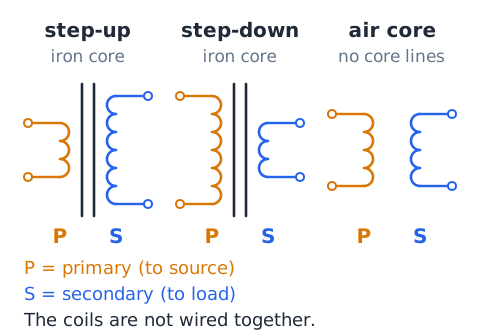
On a schematic, a transformer is drawn as two coil symbols, a series of bumps or loops, placed side by side. Two straight parallel lines between the coils mean an iron core; no lines usually means an air core.
The coil wired to the source is the primary, and the coil wired to the load is the secondary. If the secondary is drawn with more loops, the transformer steps voltage up; with fewer, it steps voltage down. The two coils are not wired together; energy crosses between them through the changing magnetic field.
Electrical supply examples by endpoint
Classify a supply by what comes out of the terminals you are using. A battery, a solar panel and a phone charger's output plug all give DC. A wall outlet, a utility generator and an inverter's output all give AC.
Some devices contain both. A car alternator creates AC internally but has a built-in rectifier, so its output terminal supplies DC to charge the battery. A computer power supply takes AC in and delivers DC to the circuit boards.
Time scales can be inconvenient
Audio and radio signals have periods far too short to measure in whole seconds, so prefixes help. Use
s and
s for time;
for frequency.
Kilohertz pairs with milliseconds and megahertz with microseconds. A 1 kHz tone has a period of 1 ms, and a 1 MHz signal has a period of 1 µs. A 5 kHz signal therefore has
or 200 µs.
Check physical plausibility
Before choosing an answer, ask whether it makes sense. Household mains has a period near 17 ms, not 17 s. The peak of a sine wave must be larger than its RMS value, never smaller. The average power in a resistor can never be negative or zero when voltage is applied.
If you calculate that a 60 Hz wave has 3,600 cycles in one second, you multiplied instead of dividing. If a 120 V RMS outlet comes out with an 85 V peak, you divided by 1.414 when you should have multiplied.
Reading charts without false assumptions
Do not assume a graph starts at zero time, that every curve is a sine, or that the axis is in seconds. Find the zero line on the vertical axis; it may not be at the bottom of the chart. Note the scale per grid square on both axes.
Then measure from the picture, not from appearances. A wave that looks large may be small if the vertical scale is fine, and a wave crowded with cycles may still have a low frequency if the time window is long. Count full cycles, not peaks or halves.
Real-world safety is not a bench experiment
Calculations on paper are safe; real household circuits are not. Mains power can cause severe shocks, burns and fires. Never open outlets, panels or appliance housings while energized, and never defeat fuses, breakers or ground-fault protection.
Use outlets with ground-fault circuit interrupters near water, keep cords in good condition, and turn off the breaker before any work. Qualified electricians use rated tools, verify a circuit is dead with a tested meter, and follow lockout procedures. Inverters and charged capacitors in power supplies can also hold dangerous voltage.
What to memorize for quick recall
AC reverses direction periodically; DC flows in one direction, steady or pulsating. Frequency is in hertz. The two timing rules are
For a sine wave,
For a resistor,
U.S. outlets are 120 V RMS at 60 Hz, peaking near 170 V. A rectifier turns AC into DC, an inverter turns DC into AC, and a transformer changes AC voltage up or down.
The trap of assuming AC is always dangerous and DC safe
Some people believe DC is harmless and only AC can hurt. That is false. A high-voltage DC source, such as an electric vehicle battery, a solar array or a charged capacitor, can deliver a lethal shock or start a fire. A short across a car battery can melt tools and cause burns from the huge current.
Danger depends on the voltage, the current that can flow, the path through the body and the duration, not on the type label alone. Low-voltage sources, AC or DC, are generally lower risk, but respect any circuit you have not verified.
The trap of counting half-waves
When counting cycles on a graph, a frequent error is counting every hump as one cycle. A full AC cycle has one positive hump and one negative hump. If a graph shows 8 humps total, 4 up and 4 down, that is 4 cycles, not 8.
Pick a clear starting feature, such as an upward zero crossing, and count how many times that exact feature repeats. Doubling the count by mistake doubles the frequency and halves the period, so both answers would be wrong.
The trap of applying RMS to arbitrary waves
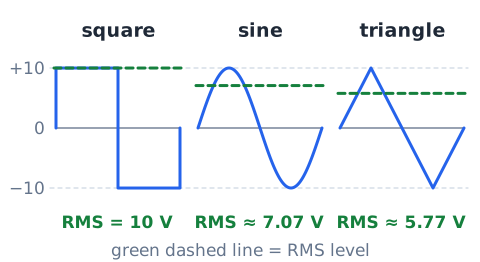
The 0.707 factor belongs only to sine waves without offset. Other shapes have different relationships between peak and RMS. For an ideal square wave, the RMS equals the peak. For a symmetric triangle wave, the RMS is
So a ±10 V square wave is 10 V RMS, a ±10 V sine is about 7.07 V RMS, and a ±10 V triangle is about 5.77 V RMS. Identify the shape before applying any conversion factor.
The trap of mixing a changing source with changing current
Current can change for reasons that have nothing to do with AC. Closing a switch on a DC circuit makes the current jump from zero to a value; adjusting a variable resistor raises or lowers it; a motor drawing more under load changes it.
All of those are changes in size, and the current still flows one way, so the circuit is DC throughout. The source type is AC only when the source itself reverses polarity periodically. Ask what the source does, not whether a reading moved.
The trap of ignoring meter modes
A meter set to DC volts on an AC outlet may show nearly zero, because the average of a symmetric AC wave is zero. A meter set to AC on a steady battery may show zero or a meaningless value. Neither means the voltage is absent.
Always select the mode that matches the source, and select a range high enough for the expected value. Measuring current requires different jacks and inserting the meter in series. Using the current setting across a voltage source can blow the meter's fuse.
A compact problem-solving workflow
First, classify the waveform: does the signed value change sign? If so, it is AC; if not, it is DC. Second, read the axes and units, and convert to seconds and volts. Third, count full cycles and use
Fourth, decide which voltage the question gives or wants: peak, peak-to-peak or RMS. Convert with
and, for sines only,
Fifth, for resistors, compute power with RMS values. Finally, check that the answer is physically sensible.
Classify a constant battery output
Problem: a current graph for a 9 V battery driving an 18 Ω resistor shows a flat line at +0.5 A for 2 s. Classify it and find the power.
The line never changes sign or size, so it is steady DC with no repeating cycle. The current checks with Ohm's law:
The power is
Answer: steady DC, 0.5 A and 4.5 W.
Count full cycles from the graph
Problem: a graph spanning 0 to 50 ms shows a sine wave that completes exactly 4 full cycles. Find the frequency and the period.
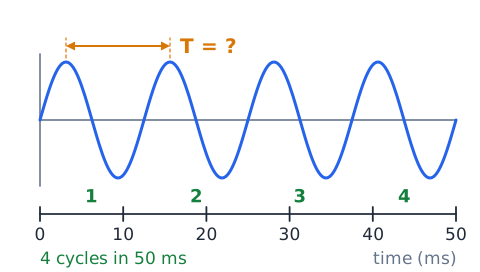
Convert time: 50 ms is 0.05 s. Frequency:
Period:
or 12.5 ms. Check:
Answer: 80 Hz and 12.5 ms.
Convert 60 Hz to a period
Problem: find the period of the standard 60 Hz U.S. power supply.
Multiply by 1,000 to get milliseconds: about 16.7 ms. Each half-cycle therefore lasts about 8.3 ms. Answer: approximately 16.7 ms per cycle.
A 25 millisecond period
Problem: a waveform repeats every 25 ms. What is its frequency?
Convert: 25 ms is 0.025 s. Then
Check by reversing:
which is 25 ms. Answer: 40 Hz, meaning 40 complete cycles each second. A common slip is answering 0.04 Hz, which comes from leaving the period in milliseconds.
Peak and peak-to-peak
Problem: an AC voltage graph swings between +15 V and −15 V. Find the peak and the peak-to-peak values.
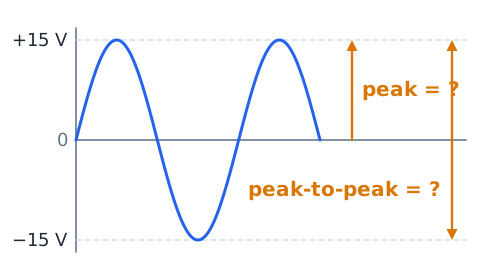
The peak is the largest distance from zero: 15 V. The peak-to-peak value is the full swing:
Answer: 15 V peak and 30 V peak-to-peak.
Peak to RMS with an easy approximation
Problem: a sine wave has a 50 V peak. Estimate its RMS value.
For a quick mental estimate, use 0.7:
Answer: about 35 V RMS, below the 50 V peak as expected.
RMS to peak for a simple sine
Problem: a transformer secondary supplies 24 V RMS as a sine wave. What are its peak and peak-to-peak values?
The peak-to-peak value is twice that, about 67.9 V. Answer: about 34 V peak and about 68 V peak-to-peak. Insulation and diodes must handle the peak, not just the 24 V rating.
DC power in a resistor
Problem: a steady 24 V DC source is connected to a 6 Ω heating element. Find the current and the power.
Check:
Answer: 4 A and 96 W.
RMS current from voltage and resistance
Problem: a 30 Ω heater runs on a 120 V RMS outlet. Find its RMS current and average power.
The average power is
Check:
Answer: 4 A RMS and 480 W.
AC versus rectified DC
Problem: a 60 Hz sine wave swings between +10 V and −10 V. After a full-wave rectifier, the output rises from 0 V to +10 V and back, repeatedly. Classify each and give the output pulse rate.
The input changes sign, so it is AC. The output never goes below zero, so it is pulsating DC. Each input cycle has two halves, and both become positive humps:
Sinusoidal and square-wave RMS
Problem: a ±10 V sine wave and a ±10 V square wave each drive a 10 Ω resistor. Compare their average powers.
Sine:
Square:
Answer: with equal peaks, the square wave delivers twice the heating, because it stays at full magnitude all the time.
Inverter and rectifier chain
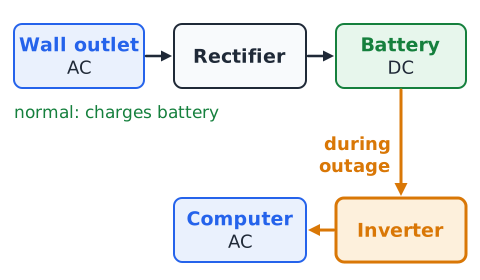
Problem: a computer backup unit plugs into a wall outlet, charges an internal battery, and keeps the computer running during an outage. Name the conversions.
AC from the outlet goes through a rectifier, becoming DC that charges the battery. When the outlet fails, the battery's DC goes through an inverter to become AC for the computer. Answer: rectifier, then inverter.
Kilohertz and microseconds
Problem: an audio tone has a frequency of 4 kHz. Find its period in microseconds.
Convert: 4 kHz is 4,000 Hz.
Multiply by 1,000,000 to get microseconds: 250 µs. A shortcut is that kilohertz and milliseconds are reciprocal partners: ms is 0.25 ms, which is the same 250 µs. Answer: 250 µs.
Reversals per second on a sine
Problem: a 50 Hz sine wave supplies a resistor. How many times per second does the current change direction?
Each cycle has two direction changes: positive to negative, then negative to positive.
Answer: 100 reversals per second, one every 10 ms.
Identify waveform direction
Prompt: a current graph sits at a constant −3 A. AC or DC? Answer: DC, steady in the negative direction.
Prompt: a voltage rises from 0 V to +8 V and back to 0 V repeatedly. Answer: pulsating DC.
Prompt: a triangle wave ramps between +4 V and −4 V. Answer: AC.
Prompt: a voltage varies between +1 V and +6 V. Answer: DC.
Time axis warmup
Prompt: 12 cycles in 0.2 s. Frequency? Answer: 60 Hz.
Prompt: period of 100 Hz? Answer: 10 ms.
Prompt: a period of 2 ms. Frequency? Answer: 500 Hz.
Prompt: if frequency triples, what happens to the period? Answer: it becomes one third as long.
Read the peaks
Prompt: a sine wave reaches +30 V and −30 V. Peak? Answer: 30 V.
Prompt: peak-to-peak? Answer: 60 V.
Prompt: approximate RMS? Answer: about 21.2 V.
Prompt: a 12 V peak square wave. RMS? Answer: 12 V.
Source conversion sort
Prompt: AC from a wall outlet must charge a phone battery. Which converter is required? Answer: a rectifier, usually with a voltage reducer.
Prompt: a camping battery must run a 120 V AC fan. Answer: an inverter.
Prompt: 7,200 V AC must become 240 V AC. Answer: a step-down transformer.
Prompt: what does a flashlight battery supply? Answer: DC.
Resistive heating comparison
Prompt: a 20 Ω heater on 20 V DC. Power? Answer: 20 W.
Prompt: the same heater on 20 V RMS AC. Power? Answer: also 20 W.
Prompt: the same heater on a sine wave with a 20 V peak. Power? Answer: about 10 W.
Prompt: why does AC still heat it? Answer: power depends on voltage squared.
Safety and assumptions
Prompt: is a 120 V RMS outlet's peak higher or lower than 120 V? Answer: higher, about 170 V.
Prompt: is DC automatically safe? Answer: no; high-voltage DC can be deadly.
Prompt: can the simple P equals V times I formula be used for motors? Answer: not directly; V times I gives apparent power, and real power also depends on the power factor.
Prompt: should you test a live outlet with an ohmmeter? Answer: never.
Fast EI item strategy
Read the stem for its key word: reverses, one direction, frequency, period, peak, RMS, rectifier, inverter or transformer. Many AC and DC questions are pure definitions that you can answer in seconds without calculating.
For graph items, first decide AC or DC by checking for a sign change, then count full cycles over the stated time. For voltage items, decide which voltage measure is given and which is asked. Use 1.4 and 0.7 as quick sine conversions, and pick the answer choice nearest your estimate. Eliminate choices with the wrong unit, such as a frequency given in volts, and any choice that confuses rectifier with inverter. Save longer items for after the quick ones.
Common errors and how to correct them
Calling any changing current AC is wrong; only a sign reversal makes AC, so a bumpy positive wave is pulsating DC. Counting humps as cycles doubles the frequency; count full positive-and-negative pairs. Forgetting to convert milliseconds to seconds gives frequencies off by a factor of 1,000.
Mixing up RMS and peak is another trap: peak is larger for a sine, so multiply by 1.414 to go from RMS to peak. Applying 0.707 to square waves is wrong; their RMS equals their peak. Finally, rectifier means AC to DC and inverter means DC to AC, not the reverse.
Final formula and concept review
AC periodically reverses direction; DC flows one way and may be steady or pulsating. Frequency is measured in hertz, and the timing relationships are
There are two reversals per cycle. For a symmetric wave,
For a sine only:
A square wave's RMS equals its peak. For pure resistors,
and equal RMS and DC voltages produce equal heating. U.S. outlets supply 120 V RMS at 60 Hz with a peak near 170 V. Batteries and solar panels supply DC; rectifiers convert AC to DC, inverters convert DC to AC, and transformers change AC voltage levels.
 English ▾