 ASVAB Camp
Lesson objective and Auto Information relevance
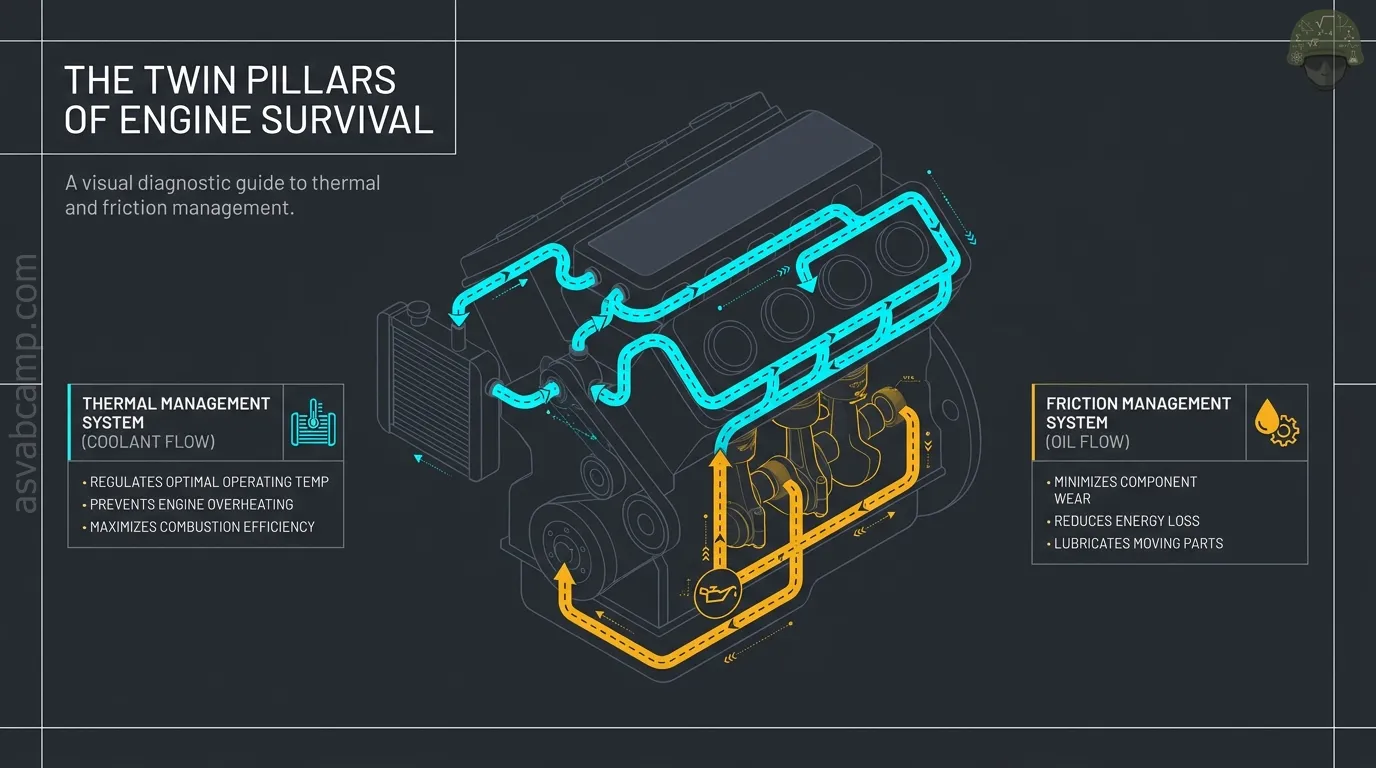
By the end of this lesson you should be able to name the main parts of an engine's cooling system and its lubrication system, and keep the two flow paths separate in your head: coolant moves through the block, head, hoses, and radiator, while oil moves from the sump through a pump, filter, and galleries back to the sump.
You will also learn to read warning lights and gauges sensibly, to accept that service details depend on the specific vehicle, and to work simple heat problems using given mass, specific heat, temperature change, and time. These skills show up in ASVAB Auto Information items that test parts, symptoms, and basic cause-and-effect.
Why engines need thermal management
Burning fuel inside a cylinder releases far more heat than the engine can turn into motion. A large share of that energy simply warms the pistons, cylinder walls, valves, and head. If nothing carried it away, metal parts would expand too much, oil would thin out and break down, and parts could warp or seize.
The cooling system's job is not to make the engine as cold as possible. It holds the engine near a designed operating temperature, warm enough for clean, efficient combustion and good oil flow, but cool enough to protect parts. That balance is called thermal management.
Lubrication is a separate vital system
The lubrication system is its own circuit with its own fluid, pump, and filter. Engine oil coats moving surfaces so they ride on a thin film instead of grinding against each other. Oil also carries away some heat, helps seal piston rings, cushions shock loads, and holds tiny particles in suspension until the filter catches them.
Coolant and oil should never mix. They travel in separate passages, and a gasket or wall keeps them apart. When a test question asks which system protects crankshaft bearings from metal-to-metal contact, the answer is lubrication, not cooling.
Follow heat from metal to ambient air
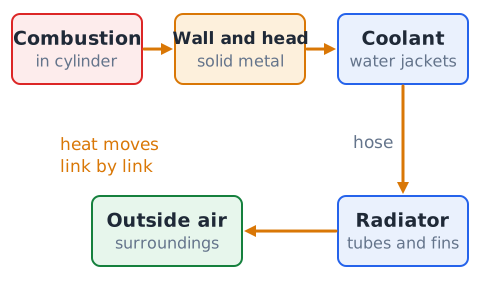
It helps to picture heat taking a relay trip. First, combustion heats the cylinder wall and head. Second, that heat soaks through the solid metal to the coolant passages, called water jackets. Third, flowing coolant picks up the heat and carries it out through a hose to the radiator. Fourth, the coolant warms the radiator tubes and fins. Finally, air passing through the fins carries the heat away into the surroundings.
If any link in this chain is weak, such as low coolant, a stopped pump, or blocked fins, heat piles up in the engine and temperature climbs.
Radiator construction and purpose
The radiator is a heat exchanger mounted at the front of the vehicle where it can meet outside air. Hot coolant enters a tank on one side, spreads through many narrow tubes, and leaves through a tank on the other side somewhat cooler. Thin metal fins are bonded between the tubes to give the air much more surface to touch.
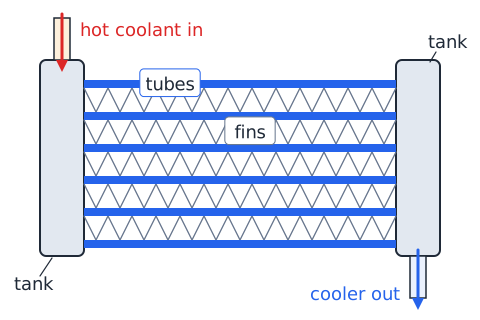
Its purpose is simple: move heat from the liquid into the air. Bent fins, bugs and debris on the face, or internal deposits inside the tubes all cut the radiator's ability to shed heat.
Coolant pump and circulation
The coolant pump, often called the water pump, keeps coolant moving. On many engines a belt or the timing drive turns it; some newer designs use an electric pump. Inside, a spinning impeller flings coolant outward, pushing it through the engine's water jackets, out to the radiator, and back again.
Without the pump, coolant would sit still in the hot engine and boil locally while the radiator stayed cool. A worn pump may leak from a small weep hole, make a grinding noise from a failing bearing, or lose flow if the impeller is damaged or corroded.
Thermostat is a temperature-controlled valve
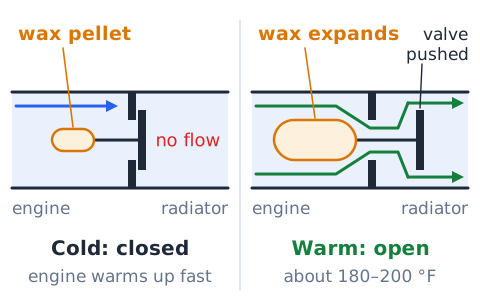
The thermostat sits in the coolant path, usually where coolant leaves the engine toward the radiator or where it returns. It contains a wax pellet that expands as it warms. When the coolant reaches the thermostat's rated temperature, often somewhere around 180 to 200 degrees Fahrenheit, the expanding wax pushes the valve open and lets coolant flow to the radiator.
When the engine is cool, the valve stays closed so the engine warms up quickly. The thermostat does not create heat or pump fluid. It only controls how much coolant is sent through the radiator.
Cold-engine bypass circulation
While the thermostat is closed, coolant still needs to move inside the engine, or hot spots could form near the combustion chambers. A bypass passage lets the pump circulate coolant through the block and head, and often through the heater core, without sending it to the radiator.
This short loop spreads heat evenly and helps the thermostat sense the true engine temperature. Once the engine is warm and the thermostat opens, most of the flow shifts to the full path through the radiator.
Electric cooling fan and airflow
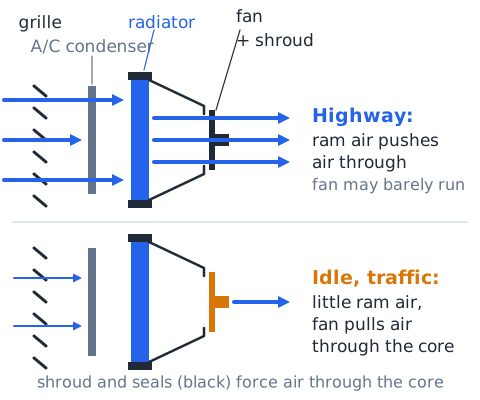
At low speed there is little natural air moving through the radiator, so a fan pulls or pushes air across it. Most modern cars use an electric fan controlled by the engine computer or a temperature switch. It switches on when coolant temperature rises past a set point and often runs when the air conditioning is on, because the A/C condenser sits in front of the radiator.
Older rear-drive engines often used a belt-driven fan with a viscous clutch that slips when cool and locks up more when hot. Either way, the fan exists to keep air moving when the car itself is not.
Air flow and vehicle speed
When a vehicle drives at highway speed, air is forced through the grille and radiator by the car's own motion. This ram air usually removes plenty of heat, so the fan may barely run. In slow traffic, at idle, or when climbing a long hill slowly while towing, ram air is weak and the fan carries the load.
That is why some cooling faults show up only in stop-and-go driving. A shroud around the fan and seals around the radiator help make sure air goes through the core instead of around it.
Coolant mixture and protection
Engine coolant is a mixture of water and antifreeze, commonly ethylene glycol or propylene glycol, plus corrosion inhibitors. Water is excellent at carrying heat, but alone it freezes at 32 degrees Fahrenheit, boils too easily, and lets metal rust. Adding glycol lowers the freezing point and raises the boiling point.
Many manufacturers call for roughly half water and half antifreeze, but the right type and ratio come from the owner's manual. Too much antifreeze can actually reduce heat transfer and freeze protection. Inhibitors wear out with time, so coolant is replaced on a schedule even if it still looks clean.
Pressure cap and boiling behavior
The radiator or reservoir cap is a spring-loaded pressure valve. As coolant warms and expands, pressure builds in the sealed system. Raising the pressure raises the boiling point, so the coolant can run hotter than its normal boiling temperature without turning to steam. A common rule of thumb is about 3 degrees Fahrenheit higher boiling point for each pound per square inch of pressure.
That same pressure makes the system dangerous to open while hot. Removing the cap can drop the pressure suddenly and let scalding coolant flash to steam and spray out.
Expansion reservoir and recovery tank
Coolant expands when hot and shrinks when cold. A plastic overflow or recovery tank gives that extra volume somewhere to go. As the engine heats up, the cap lets excess coolant pass into the tank; as it cools, a vacuum valve in the cap draws coolant back into the radiator, keeping the system full.
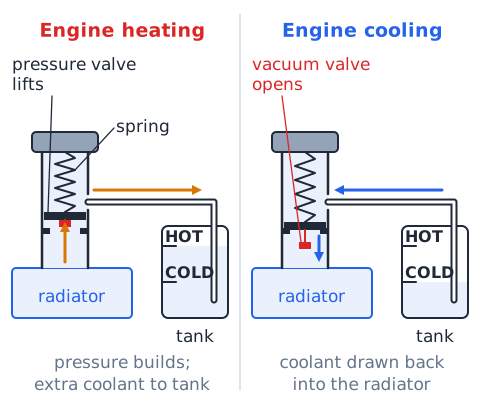
Some vehicles use a pressurized expansion tank that is part of the sealed system and carries the pressure cap itself. Level marks on the tank, often labeled for cold and hot conditions, tell you where the coolant should be. Check them with the engine cool unless the manual says otherwise.
Hoses, clamps, and leak evidence
Rubber hoses connect the engine, radiator, and heater core. Over time they harden, crack, swell, or turn soft and spongy, especially near hot connections. Clamps can loosen as the rubber shrinks with age. The lower radiator hose may also collapse under suction if it is weak.
Leak evidence includes wet spots, dried crusty residue around fittings, a sweet smell, drips under the front of the car, and steam from the engine bay. Even a small seep matters because it lets coolant and pressure escape a little at a time.
Heater core transfers cabin heat
The heater core is a small radiator tucked behind the dashboard. Hot engine coolant flows through it, and the cabin blower pushes air across its fins to warm the interior. A valve or blend door controls how much heat reaches the passengers.
Because it uses engine heat, cabin heat depends on the engine being warm and coolant actually reaching the core. Turning the heater to full hot with the fan on high can even help pull a little extra heat from an overheating engine, though it is a temporary measure, not a repair.
Temperature sensor and warning information
A coolant temperature sensor, usually a thermistor whose resistance changes with temperature, reports engine temperature to the computer and the dashboard. The computer uses that signal to adjust fuel mixture, idle speed, and fan operation. The gauge or warning light gives the driver a simplified view.
Many gauges are buffered so the needle sits steady across a normal range, then rises sharply when temperature is truly high. A red temperature light or a needle near the top means stop and investigate. A gauge reading cold all the time may point to a stuck-open thermostat or a faulty sensor.
Overheating requires a safety-first decision
If the temperature warning comes on or steam appears, the safe response is to reduce load, pull over where it is safe, and shut the engine off as the owner's manual directs. Continuing to drive can warp the cylinder head, damage the head gasket, or seize the engine.
Do not open a hot radiator cap or pressurized reservoir. Wait for the engine to cool before checking coolant levels, and keep hands and face away from fans, which may start on their own. Calling for help is often wiser than adding fluid to a hot, damaged system.
Overheating is a symptom, not one diagnosis
High engine temperature tells you heat is not leaving fast enough, but it does not tell you why. Possible causes include low coolant from a leak, a thermostat stuck closed, a weak pump, a clogged or blocked radiator, a fan that does not run, a slipping belt, trapped air, or even a head gasket leak forcing combustion gas into the coolant.
Good technicians collect evidence first: when it overheats, at what speed, what the coolant level is, whether the fan runs, and whether hoses feel hot. Jumping to one part wastes money and can miss the real fault.
Thermostat stuck closed versus stuck open
A thermostat that sticks closed blocks the main path to the radiator. Coolant keeps circulating in the engine but cannot unload heat, so temperature rises steadily, sometimes within minutes, and the upper radiator hose stays relatively cool.
A thermostat stuck open sends coolant to the radiator all the time. The engine warms slowly, the gauge may read low, cabin heat is weak in cold weather, and fuel economy can suffer. The first fault risks overheating; the second causes an engine that runs too cold.
Low coolant and trapped air
When coolant is low, there is less liquid to carry heat, and the pump may draw in air. Air pockets often collect near high points such as the thermostat housing, cylinder head, or heater core. Air carries heat poorly, so a pocket next to the temperature sensor can cause odd readings, and a pocket in the heater core can leave the cabin cold.
After a coolant service, many systems need careful filling or a bleeding procedure from the manufacturer to purge air. Topping off and then rechecking the level after the engine cools is a common part of that routine.
Cooling performance at idle versus highway
Comparing when overheating happens gives strong clues. If temperature climbs while idling or crawling in traffic but drops once you reach highway speed, the problem is often airflow at low speed, such as a fan that does not turn on.
If temperature rises at highway speed or under heavy load but is fine at idle, look more toward limited heat-rejection capacity, such as a partly clogged radiator, low coolant, or weak pump flow. Ram air already covers low-speed airflow at highway speed, so a fan fault is less likely there.
Engine oil begins in the sump
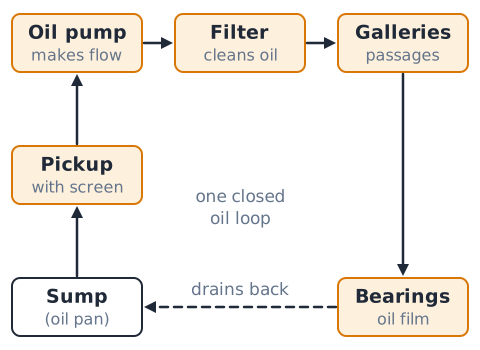
In a conventional wet-sump engine, oil rests in the oil pan, also called the sump, bolted to the bottom of the engine. When the engine is off, nearly all the oil drains back down and collects there. The pan has a drain plug for oil changes and sometimes baffles that stop oil from sloshing away from the pickup during hard turns or braking.
Some racing and high-performance engines use a dry-sump design with a separate tank, but the wet sump is the standard layout for most cars and trucks.
Oil pickup screen and oil pump
A tube called the pickup reaches down into the sump. Its open end is covered by a mesh screen that keeps large debris from entering the pump. The oil pump, driven by the crankshaft or camshaft, draws oil up the pickup and pushes it into the engine.
If sludge or debris badly blocks the screen, the pump cannot get enough oil. Delivery to the bearings drops, pressure falls, and parts may be starved even though the pan still holds oil. Clean oil and on-time changes help prevent sludge.
Oil galleries deliver pressurized lubricant
After the pump and filter, oil enters a network of drilled passages called galleries. A main gallery runs along the block, and branch passages lead to each main bearing of the crankshaft. Holes drilled through the crankshaft then carry oil on to the connecting-rod bearings.
Other passages feed the cylinder head, camshaft bearings, valve lifters, and in many engines the timing chain tensioner or variable valve timing parts. After doing its job, oil drips or drains back down through return holes to the sump to begin the trip again.
Bearings and the protective oil film
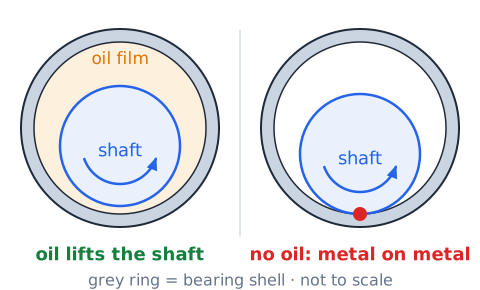
Crankshaft and connecting-rod bearings are smooth, replaceable shells, not ball bearings. The shaft does not actually touch them when the engine is running. Instead, pressurized oil forms a thin wedge-shaped film that lifts the shaft and holds it centered, a condition called hydrodynamic lubrication.
If oil pressure or supply fails, that film collapses and metal rubs metal. The soft bearing surface wears or melts quickly, producing knocking noises and possibly a seized engine. This is why lubrication failure can ruin an engine in a short time.
Oil filter and bypass features
The oil filter captures dirt, metal particles, and combustion byproducts carried in circulating oil. It cleans the oil; it does not create flow or pressure. That job belongs to the pump.
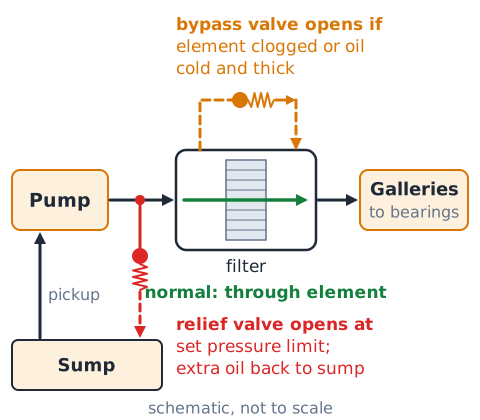
Many filters or filter mounts include a bypass valve. If the filter element becomes clogged, or if cold, thick oil cannot pass through it easily, the bypass opens so unfiltered oil still reaches the engine. Dirty oil is far less harmful than no oil at all. Some filters also have an anti-drainback valve that keeps oil in the filter after shutdown so pressure builds faster at startup.
Pressure relief valve prevents excessive oil pressure
A positive-displacement oil pump moves more oil as engine speed rises. At high rpm, or when oil is cold and thick, pressure could climb high enough to burst a filter, blow out seals, or overwork the pump drive.
A spring-loaded pressure relief valve, usually built into the pump or nearby, opens when pressure reaches a set limit and routes excess oil back to the pump inlet or the sump. This keeps pressure within a safe range. A valve stuck open can cause low pressure, while one stuck closed can cause excessive pressure.
Oil viscosity means resistance to flow
Viscosity is a fluid's resistance to flow. Honey has high viscosity; water has low viscosity. Engine oil must be thick enough to keep a strong film between moving parts, but thin enough to flow quickly to every bearing, especially at a cold start.
Temperature changes viscosity greatly. Cold oil thickens and moves slowly, while hot oil thins. The ideal oil balances these needs across the engine's whole temperature range, which is why multi-grade oils with additives called viscosity index improvers are common today.
Interpret multi-grade oil labels correctly
A label such as SAE 5W-30 describes viscosity test results, not mileage or engine design. The number before the W, with W standing for winter, rates how the oil behaves in cold-temperature tests; a lower number means it flows better when cold. The number after the dash rates viscosity at normal hot operating temperature.
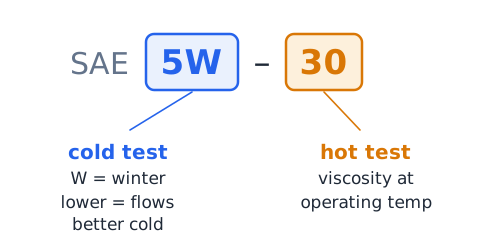
So 5W-30 flows like a light oil on a cold morning but protects like a 30-grade oil when hot. It says nothing about change intervals, maximum engine temperature, or cylinder count. Use the grade the manufacturer specifies.
Hot oil and friction losses
Oil reduces friction, but pushing oil around and shearing it between parts still costs a little energy. Thicker oil causes more drag, which is one reason manufacturers often specify thinner grades to improve fuel economy.
Oil also absorbs heat from bearings, pistons, and the turbocharger if equipped. If oil gets too hot, it thins beyond its design range, the film weakens, and the oil oxidizes faster, forming varnish and sludge. Keeping oil at a proper temperature protects both the oil and the parts it serves, which is why heavy-duty engines may add an oil cooler.
Oil pressure and oil level are not interchangeable
Oil level tells how much oil is in the sump. Oil pressure tells how hard the pump is pushing oil through the passages at a monitored point. They are related but not the same thing.
An engine can be full of oil and still have low pressure, for example from a clogged pickup, a worn pump, or worn bearings that let oil escape too easily. An engine can also show normal pressure while the level is slowly dropping. Check level with the dipstick or the vehicle's electronic method, and treat a pressure warning as its own serious signal.
Dipstick and level checks are model-specific
Most engines have a dipstick with marks showing the acceptable range, such as add and full. The reading is valid only when taken under the conditions the manual describes, often on level ground with the engine off for a few minutes so oil can drain back.
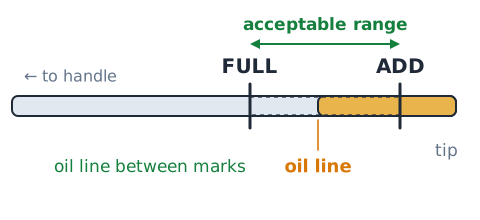
Some newer vehicles have no dipstick and report oil level through the dashboard instead, sometimes only after a specific wait or drive cycle. Because methods differ by model, always follow the owner's manual rather than assuming one routine fits every vehicle.
Oil changes and additive packages
Motor oil is a base oil blended with additives. Detergents and dispersants keep deposits from forming and hold fine particles in suspension. Anti-wear compounds protect surfaces under heavy pressure. Antioxidants slow breakdown, and corrosion inhibitors protect metal from acids.
With use, these additives get used up, and the oil collects fuel, moisture, soot, and wear debris. Changing oil and filter on the manufacturer's schedule removes the dirty oil and restores the additive protection. Severe service, such as towing or many short trips, often calls for shorter intervals.
Oil contamination: coolant mixing
Coolant should never be in the oil. If it gets there, often through a failed head gasket, a cracked head or block, or a leaking oil cooler, the oil may look milky or like a light brown milkshake on the dipstick or under the oil fill cap.
Glycol-contaminated oil loses its ability to protect bearings and can form sludge. Other signs may include unexplained coolant loss, white exhaust smoke with a sweet smell, or overheating. A small amount of light condensation under the cap after short cold trips is different and should be judged with other evidence.
Oil contamination: fuel, water, and particles
Fuel can dilute oil when an engine runs rich, has a leaking injector, or makes many short trips before warming up. Diluted oil may smell of gasoline and become thinner than intended. Water from condensation collects when the engine never gets fully warm, and it can form sludge with combustion byproducts.
Dust that slips past a torn air filter and metal particles from wear are abrasive and speed up wear. Regular oil and filter changes, a sound air filter, and occasional longer drives that fully warm the engine help control all of these.
Engine oil cooler
Some engines, especially turbocharged, heavy-duty, and towing-rated ones, use an engine oil cooler to remove heat from lubricating oil. One common type is a small heat exchanger near the filter that passes oil next to engine coolant; another is a small air-cooled radiator for oil mounted in the airflow.
In a coolant-type cooler, the oil and coolant passages are separated by thin walls. If those walls fail, oil and coolant can mix, so a leaking cooler is one possible cause of oil in the coolant or coolant in the oil.
Piston cooling with oil spray
Pistons absorb intense heat from combustion and cannot touch coolant directly. In many modern engines, small nozzles called piston cooling jets spray oil upward at the underside of each piston. The oil absorbs heat and drains back to the sump.
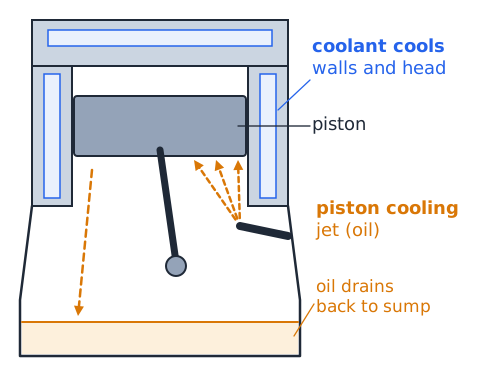
This shows that oil does some cooling as well as lubricating. It also means that low oil pressure or a blocked jet can let pistons run hotter than designed. The coolant system, meanwhile, mainly cools the cylinder walls and head, so the two systems share the cooling job without sharing fluid.
Oil pressure switch versus sensor
An oil pressure switch is a simple on-off device. When pressure drops below a set threshold, its contacts change state and turn on the oil warning light. It tells you only that pressure at that point is below the limit.
An oil pressure sensor, also called a sender, produces a changing signal in proportion to pressure, so it can drive a gauge or send a value to the computer. Both concern pressure in the lubrication circuit at the spot where they are mounted. Neither one measures how much oil is in the pan or the condition of the coolant.
Temperature versus pressure diagnosis
Engine temperature and oil pressure answer different questions. The coolant temperature gauge reports how well heat is being removed. The oil pressure warning reports whether oil is being pushed through the bearings.
An engine can have a normal temperature reading while losing oil pressure, and bearings can be destroyed within minutes. It can also overheat while oil pressure looks fine, because a blocked radiator or a stuck thermostat has nothing to do with the oil pump. Read each warning on its own terms and do not let a normal gauge cancel out a serious warning.
Heat transfer: conduction
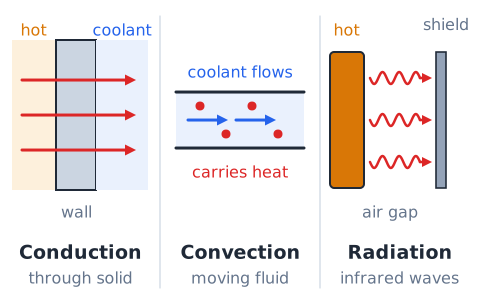
Conduction is heat moving through a material, or between touching materials, without the material itself flowing. Fast-vibrating particles on the hot side pass energy to their neighbors. In an engine, heat from combustion conducts through the solid cylinder wall and head to the coolant on the other side.
The rate of conduction through a wall grows with the area, the temperature difference, and the material's thermal conductivity k, and shrinks with thickness d:
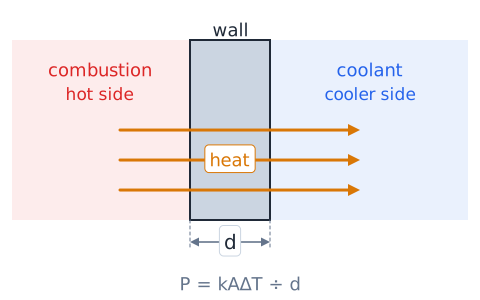
Aluminum conducts heat well, which is one reason it is common for cylinder heads and radiators.
Heat transfer: convection
Convection is heat carried by a moving fluid, either a liquid or a gas. As coolant flows through the water jackets, it picks up heat from the hot metal and then physically carries it to the radiator. There, air flowing over the fins picks up the heat and carries it away.
When a pump or fan drives the fluid, it is called forced convection. When warm fluid rises on its own because it is less dense, it is natural convection. Engines rely mostly on forced convection, which is why both the coolant pump and airflow are essential.
Heat transfer: radiation
Radiation is heat transfer by electromagnetic waves, mainly infrared, and it needs no material in between. You feel it when standing near a campfire or next to a hot exhaust manifold.
Despite its name, a car radiator does most of its work through convection to passing air, not through radiation. Radiation plays a smaller role in engine cooling, though it matters for very hot parts such as exhaust components, which is why heat shields are placed near fuel lines, wiring, and the floor of the vehicle.
Understand the heat equation
To find how much heat energy a substance gains or loses when its temperature changes, use:
Q is heat energy, usually in joules or kilojoules. m is mass in kilograms. c is specific heat, the energy needed to warm 1 kg by 1 degree, in kJ/(kg·°C). is the temperature change in °C.
Example: 2 kg of fluid with c = 4 kJ/(kg·°C) warms by 10°C. Then
Keep units matched so they cancel properly.
Heat-transfer rate versus total heat
Total heat Q is an amount of energy. Heat-transfer rate, or thermal power P, is how fast that energy moves:
With Q in kilojoules and t in seconds, P comes out in kilowatts, because 1 kJ/s equals 1 kW, or 1,000 W.
Example: a test radiator sheds 90 kJ in 45 s.
/s, or 2 kW. The same amount of heat removed in less time means a higher rate.
A closed liquid circuit still needs a pump
A cooling system is a closed loop, so some people assume the liquid will simply move around on its own. It will not move fast enough. Natural convection inside a car engine is far too slow to carry away the heat produced, especially under load.
The coolant pump supplies the steady forced flow that makes the loop work. The closed design keeps the coolant from escaping and allows pressure to build, but the pump is what keeps it moving. Similarly, the oil loop is closed, yet it still needs the oil pump.
Two pumps that should never be confused
An engine has a coolant pump and an oil pump, and test questions often check whether you can keep them apart. The coolant pump, or water pump, moves water and antifreeze through the water jackets and radiator. It is usually on the front of the engine and driven by a belt, the timing drive, or an electric motor.
The oil pump moves engine oil from the sump through the filter and galleries to the bearings. It is usually inside the engine near the crankshaft or under it in the pan. Different fluids, different paths, different jobs.
Common symptom: slow cabin heat
If the cabin takes a very long time to warm up, or blows only lukewarm air, think about whether hot coolant is reaching the heater core. Likely causes include a thermostat stuck open that keeps the engine too cool, low coolant, air trapped in the heater core, a clogged core, or a blend door that does not move.
Checking the temperature gauge, coolant level, and feel of the heater hoses once the engine is warm helps narrow the list.
Common symptom: cooling fan never engages
If the engine runs hot at idle or in traffic but the cooling fan never starts, possible causes include a blown fuse, a failed fan relay, a bad fan motor, a damaged connector, or a faulty temperature input to the controller. On older belt-driven fans, a worn viscous clutch may slip too much.
A quick clue is whether the fan runs when the air conditioning is switched on, since many systems command the fan with A/C. Keep hands clear: an electric fan can start without warning even with the key off.
Common symptom: serious low-oil-pressure warning
A low-oil-pressure warning while driving is one of the most serious signals a car can give. It means oil may not be reaching the bearings. The right response is to get safely off the road as soon as practical and shut the engine down according to the owner's guidance.
Do not keep driving or rev the engine to see if the light goes away, and do not assume all is well because the temperature gauge looks normal. After stopping, check the oil level once it is safe, and have the cause diagnosed before running the engine again.
Common symptom: coolant loss without visible puddle
Sometimes coolant level drops but nothing drips on the ground. The coolant may be leaking internally, such as through a head gasket into a cylinder where it burns and leaves as white exhaust vapor, or into the oil. It may also leak into the cabin from the heater core, causing a damp floor, fogged windows, or a sweet smell.
Small leaks can also evaporate off hot engine parts before they reach the ground. A pressure test of the cooling system helps reveal where coolant is escaping.
Identify coolant and oil without relying on color
Coolant comes in many colors, including green, orange, pink, blue, and yellow, and the color does not reliably tell you the chemistry. Mixing types can reduce corrosion protection. Instead, read the container label and match the specification in the owner's manual.
To tell fluids apart under the hood, use location and labels. Coolant goes in the reservoir or radiator marked with a coolant symbol. Oil goes in the engine oil fill, often marked with an oil can symbol. Engine oil feels slick and is usually amber to dark brown, while coolant is thin and watery.
Maintenance is specific to the manufacturer
Oil grade, oil capacity, coolant type, change intervals, and fill procedures all vary between engines. One pickup may need a different coolant and a different oil than another pickup from the same maker. Using the wrong fluid can shorten engine life or void a warranty.
The owner's manual and the manufacturer's service information are the authority. General rules in this lesson explain how systems work, but actual service should always follow the specific vehicle's instructions.
Compare quick recall routes
Two short routes are worth memorizing so you never mix them up.
Cooling route: water pump, engine water jackets, thermostat, upper hose, radiator, lower hose, and back to the pump. When the engine is cold, the bypass sends coolant back to the pump without the radiator trip.
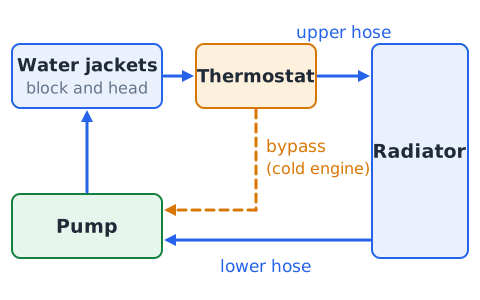
Oil route: sump, pickup screen, oil pump, filter, main gallery, bearings and other moving parts, then drainback to the sump.
Notice that each route has its own pump and each returns to its starting point. No part of one route belongs in the other.
ASVAB study boundaries and question language
The ASVAB Auto Information test asks about how systems work, common parts, symptoms, and safe practices. It does not expect a technician's level of detail, such as exact pressures for a particular model. Focus on purposes and cause and effect.
Watch for key words. Primarily, most directly, and best tell you to pick the strongest answer, not every answer that is partly true. Words like always, never, and guarantees often signal a false choice. Questions that supply numbers expect you to use those numbers, not a value you remember from elsewhere.
Worked 01 — identify the radiator
Problem: A part at the front of the car has many thin tubes with fins between them, plus a tank on each side. Hot coolant enters one tank and leaves the other. What is it?
Step 1: It handles coolant, so it belongs to the cooling system. Step 2: Tubes and fins give lots of surface for air contact, which is the design of a heat exchanger. Step 3: Its front location places it in the outside airflow.
Answer: the radiator, which moves heat from coolant into the air.
Worked 02 — trace circulation
Problem: A warm engine has its thermostat open. Starting at the coolant pump, trace the coolant's path.
Step 1: The pump pushes coolant into the block's water jackets. Step 2: Coolant rises through the head, gathering heat. Step 3: It passes the open thermostat and flows through the upper hose to the radiator. Step 4: Air cools it in the radiator. Step 5: It returns through the lower hose to the pump.
Answer: pump, block, head, thermostat, upper hose, radiator, lower hose, pump.
Worked 03 — thermostat stuck closed
Problem: Ten minutes after a cold start, the temperature gauge is climbing toward red. The coolant level is full, the fan is running, and the upper radiator hose feels only slightly warm while the engine is very hot.
Step 1: A full level and running fan make low coolant and fan failure less likely. Step 2: A cool upper hose means hot coolant is not reaching the radiator. Step 3: The part that controls that flow is the thermostat.
Answer: the evidence points to a thermostat stuck closed. Stop driving and confirm before replacing parts.
Worked 04 — thermostat stuck open
Problem: On a winter commute, the temperature gauge stays near the bottom even after 25 minutes of driving, and the heater blows only mildly warm air. There are no leaks.
Step 1: The engine is not reaching operating temperature. Step 2: Something is sending too much heat to the radiator. Step 3: A thermostat that stays open does exactly that.
Answer: a thermostat stuck open is the most likely cause; it brings slow warm-up, weak heat, and poorer fuel economy.
Worked 05 — identify low-speed airflow
Problem: A delivery van runs at normal temperature on the interstate but overheats in a long drive-through line on a hot day.
Step 1: At highway speed, ram air flows through the radiator. Step 2: In the slow line, little air moves unless the fan supplies it. Step 3: Overheating only at low speed points to weak airflow.
Answer: check the cooling fan and its controls first, along with anything blocking the radiator face.
Worked 06 — oil path reconstruction
Problem: A student's diagram lists these oil system parts out of order: galleries, sump, filter, bearings, pump, pickup. Arrange them into the loop.
Step 1: Oil rests in the sump. Step 2: It enters the pickup and screen. Step 3: The pump pressurizes it. Step 4: The filter cleans it. Step 5: Galleries deliver it. Step 6: It lubricates the bearings. Step 7: It drains back to the sump.
Answer: sump, pickup, pump, filter, galleries, bearings, and back to the sump.
Worked 07 — warning light priorities
Problem: While driving, two lights come on at once: a reminder that a scheduled service is due, and a red oil pressure warning. Which needs action first?
Step 1: A service reminder is informational; it can wait for an appointment. Step 2: Red oil pressure means bearings may be losing their oil film. Step 3: Damage can happen within minutes.
Answer: the oil pressure warning comes first. Pull over safely, shut the engine off as the manual directs, and check the oil level once stopped.
Worked 08 — coolant heat energy
Problem: In an idealized test, 6 kg of coolant with specific heat c = 3.6 kJ/(kg·°C) warms by 15°C. How much heat did it absorb?
Step 1: Use
Step 2: 6 times 3.6 is 21.6, and 21.6 times 15 is 324.
Answer: the coolant absorbed 324 kJ.
Worked 09 — average heat-removal power
Problem: 4 kg of fluid with c = 4 kJ/(kg·°C) cools by 6°C in 24 s. What is the average rate of heat removal?
Step 1:
Step 2:
/s.
Answer: 4 kW, or 4,000 W.
Worked 10 — coolant temperature difference
Problem: A simplified radiator model must remove 84 kJ from 8 kg of coolant with c = 3.5 kJ/(kg·°C). By how much does the coolant temperature drop?
Step 1: Rearrange the heat equation to solve for temperature change.
Step 2:
/°C.
Step 3:
Answer: the coolant cools by 3°C.
Worked 11 — oil volume consistency
Problem: A service sheet lists an engine's oil capacity as 5.7 L. After draining, measured at the same specified condition, 4.9 L is found in the system. What is the shortfall?
Step 1: Make sure both values use the same unit and condition. They do: liters, measured the same way.
Step 2:
Answer: the system is 0.8 L short. If one number were in quarts, you would convert before subtracting.
Worked 12 — fan operation inference
Problem: With the engine warm and idling, the gauge rises slowly. A technician turns on the air conditioning and the electric fan starts at once; within a few minutes the temperature drops back to normal.
Step 1: The fan motor works, since it runs on the A/C command. Step 2: It did not run on its own when coolant was hot. Step 3: So the temperature-based command path is suspect.
Answer: suspect the temperature input or the fan control logic, not the fan motor itself.
Worked 13 — distinguish both pumps
Problem: A part on the front of the engine has a pulley turned by the accessory belt, a hose connected to the lower radiator hose, and a small weep hole that shows a green crusty trail. Is it the coolant pump or the oil pump?
Step 1: The hose links it to the radiator, so it handles coolant. Step 2: The coolant residue at the weep hole confirms a coolant leak. Step 3: The oil pump sits inside the engine and connects to the pickup and galleries, not to radiator hoses.
Answer: it is the coolant pump.
Worked 14 — compare loss and flow
Problem: Engine A has a full coolant level but a seized coolant pump. Engine B has a working pump but is a gallon low on coolant. Explain why both overheat.
Step 1: Engine A has fluid but no flow, so heat cannot travel from the engine to the radiator. Step 2: Engine B has flow but too little fluid, and air pockets form where coolant should be. Step 3: Either way, the heat-carrying chain is broken.
Answer: cooling needs both enough coolant and steady circulation.
Guided drill 01 — classify components
Sort each part into cooling or lubrication.
Thermostat? Answer: cooling.
Oil pickup screen? Answer: lubrication.
Radiator cap? Answer: cooling.
Pressure relief valve in the oil pump? Answer: lubrication.
Heater core? Answer: cooling, because it uses hot coolant.
Piston cooling jets? Answer: lubrication; they spray oil even though their job is to cool.
Recovery tank? Answer: cooling.
Guided drill 02 — explain two thermostat failures
Prompt: What happens when a thermostat sticks closed? Answer: coolant cannot reach the radiator, so the engine overheats quickly.
Prompt: What happens when it sticks open? Answer: coolant always flows to the radiator, so the engine warms slowly and runs cool, with weak cabin heat.
Guided drill 03 — handle warnings safely
Prompt: Steam is rising from under the hood. Should you open the radiator cap to look? Answer: no; stop safely, shut down, and let it cool first.
Prompt: The oil pressure light comes on but the temperature is normal. Keep driving? Answer: no; stop safely and shut the engine off as directed.
Prompt: Can an electric fan start with the key off? Answer: yes, so keep clear.
Guided drill 04 — heat and unit reasoning
Prompt: 2 kg of coolant with c = 4.2 kJ/(kg·°C) warms 5°C. Find Q. Answer:
Prompt: That heat moves in 14 s. Find P. Answer:
Prompt: Is 1 kJ/s the same as 1 kW? Answer: yes.
Guided drill 05 — oil supply chain
Prompt: Where does oil start? Answer: the sump.
Prompt: What keeps large debris out of the pump? Answer: the pickup screen.
Prompt: What creates the flow? Answer: the oil pump.
Prompt: What cleans the oil? Answer: the filter.
Prompt: What follows the pickup in the loop? Answer: the pump.
Guided drill 06 — evidence is not certainty
Prompt: The engine overheats, so the radiator must be clogged. True? Answer: not necessarily; low coolant, a stuck thermostat, or a dead fan also fit.
Prompt: Milky oil proves a head gasket failure. True? Answer: no; it strongly suggests coolant in the oil, but a cracked head or leaking oil cooler can cause it too.
Prompt: What should you do with one clue? Answer: gather more evidence before replacing parts.
ASVAB Auto Information elimination strategy
Start by asking which system the question is really about. If it mentions bearings, galleries, sump, or viscosity, think lubrication; if it mentions radiator, thermostat, antifreeze, or fan, think cooling. Cross out choices that belong to unrelated systems, such as ignition, fuel injection, or exhaust.
Next, match the function to the part. A filter cleans, a pump moves fluid, a thermostat controls flow by temperature, a cap holds pressure. Eliminate answers that give a part a job it cannot do.
For warning questions, choose the response that protects people and the engine, usually stopping safely. Distrust choices built on always, proves, or guarantees.
For calculations, write the formula, plug in the given numbers, and check units before choosing.
Common traps and misleading shortcuts
Trap: thinking the thermostat cools the engine. It only opens and closes a path; the radiator and airflow do the cooling.
Trap: calling the oil filter a pump. The filter catches particles; the pump makes the flow.
Trap: treating a normal temperature gauge as proof that oil pressure is fine. The two signals measure different things.
Trap: reading 5W-30 as a mileage or temperature limit. It is a viscosity rating from cold and hot tests.
Trap: judging coolant type by color. Read the label and the manual.
Trap: opening a hot pressure cap to check level. Wait until it is cool.
Trap: confusing heat Q with heat rate P. Q is energy in kJ; P is energy per second in kW.
Trap: assuming one maintenance schedule fits every vehicle. Follow the manufacturer.
Cooling and lubrication quick review
The cooling system moves heat from the engine to the air. The pump circulates coolant through the water jackets, the thermostat decides when coolant goes to the radiator, a bypass keeps coolant moving in a cold engine, and the fan supplies airflow at low speed. A pressure cap raises the boiling point, and a recovery tank handles expansion.
The lubrication system stores oil in the sump, draws it through a screened pickup into the oil pump, cleans it with a filter that has a bypass for blockage, and sends it through galleries to the bearings, where an oil film prevents metal contact. A relief valve caps pressure.
Treat warnings seriously and separately. For heat problems, use
 English ▾