 ASVAB Camp
Lesson objectives and ASVAB relevance
By the end of this lesson you should be able to follow braking force from the driver's foot to the tire, name the main parts of disc and drum brakes, and explain what the booster, master cylinder, lines and ABS each contribute. You will also read warning lamps correctly, recognize common failure symptoms, and solve simple pressure, area, energy and stopping-distance problems. The Auto Information test rewards knowing what each part does and why.
Braking is controlled removal of motion
A moving car carries kinetic energy, and stopping it means getting rid of that energy in a controlled way. Ordinary friction brakes do this by rubbing a stationary friction material against a part that turns with the wheel, converting motion into heat. Think of a 1,500 kg car at highway speed: all of its energy must leave as heat in the pads, rotors, shoes and drums, so brakes are really heat-making devices.
Trace the driver-to-wheel force path
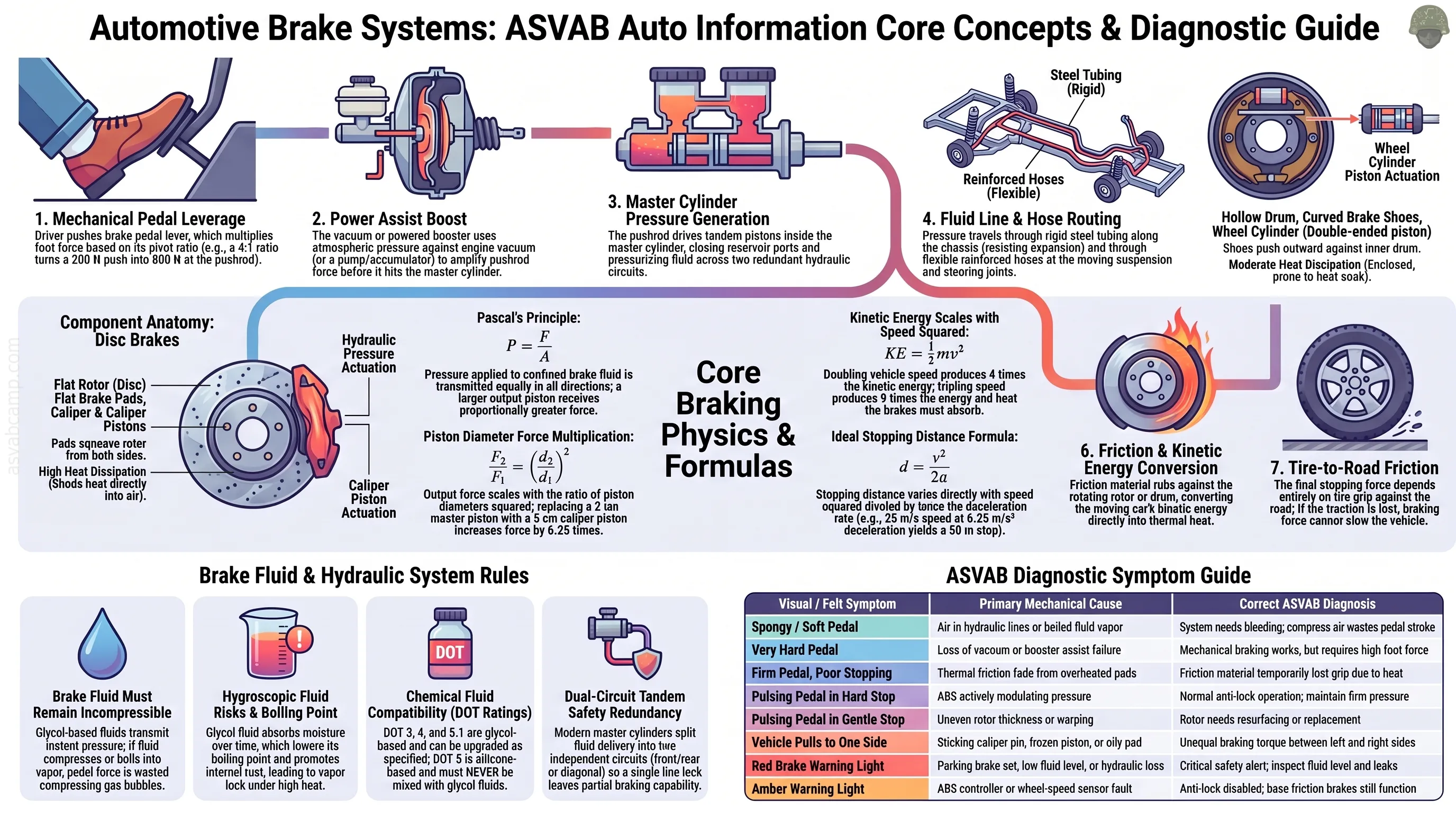
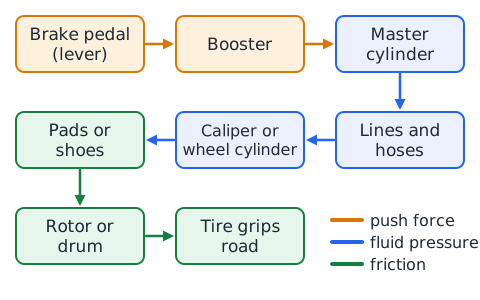
The chain runs in a fixed order. The driver pushes the pedal, a lever that multiplies the foot force. A booster adds more push. The pushrod moves pistons in the master cylinder, creating hydraulic pressure. Steel lines and flexible hoses carry that pressure to each wheel, where caliper pistons or wheel-cylinder pistons push friction material against a rotor or drum. Finally the tire must grip the road to actually slow the car.
Pedal lever and mechanical advantage
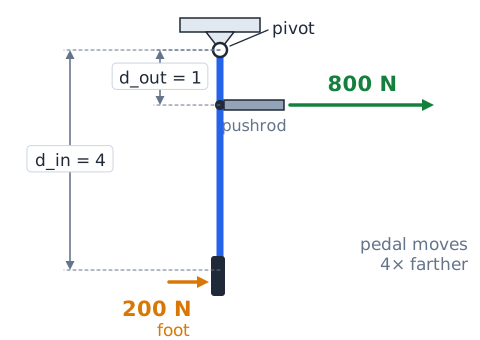
The brake pedal pivots near its top. The foot pushes far from the pivot, while the pushrod attaches close to it, so the pedal works as a force-multiplying lever.
Here d is each force's distance from the pivot. With a 4:1 ratio, a 200 N push gives an ideal 800 N at the pushrod, but the pedal moves four times farther than the pushrod.
What a vacuum or powered booster does
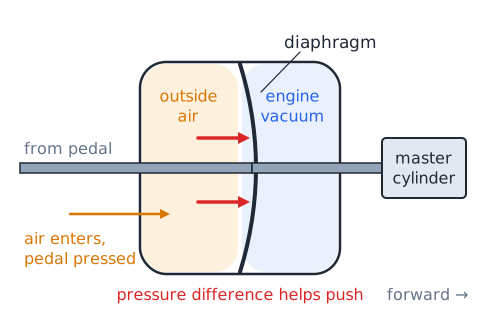
The booster sits between the pedal and the master cylinder and multiplies the driver's effort. A vacuum booster has a large diaphragm; when the pedal is pressed, outside air enters one side while the other side holds engine vacuum, and the pressure difference pushes the diaphragm forward to help the pushrod. Vehicles without steady vacuum, such as many diesels and hybrids, use a vacuum pump, a hydraulic accumulator or an electric unit instead. The booster lowers foot effort; it does not create braking by itself.
Master cylinder: pressure source
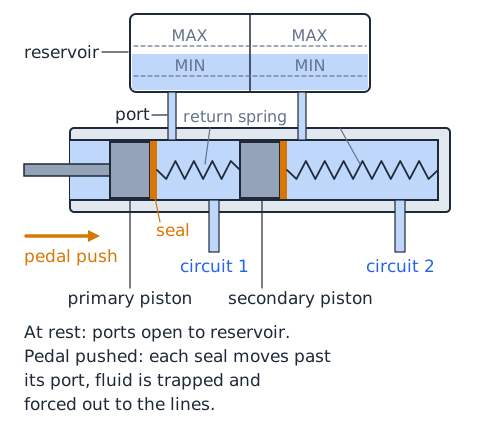
The master cylinder is where hydraulic pressure is first created. The pushrod drives a piston, and usually a second piston behind it, along a bore filled with brake fluid. As the pistons move, seals close off the reservoir ports and the trapped fluid is forced into the brake lines. A reservoir on top stores spare fluid. When the pedal is released, return springs push the pistons back and fluid can refill from the reservoir.
Pascal’s principle is the braking foundation
Pascal's principle says pressure applied to a confined fluid is transmitted equally to every part of that fluid. Pressure is force spread over area.
P is pressure, F is force and A is piston area. In N and cm squared, P comes out in N/cm². Because every piston in one circuit sees the same P, a piston with more area receives more force.
Hydraulic force example: two piston areas
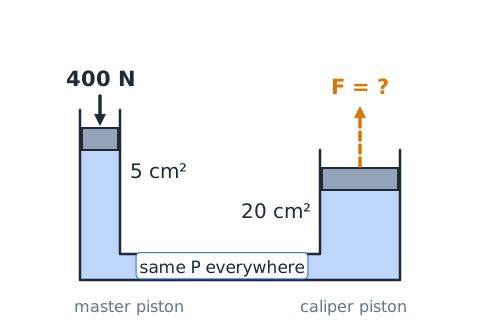
A master-cylinder piston of 5 cm² is pushed with 400 N. Find the force on a 20 cm² caliper piston, ignoring losses.
Pressure:
N/cm².
Output force:
The answer is 1,600 N, four times the input, because the caliper piston has four times the area.
Hydraulic force versus brake torque
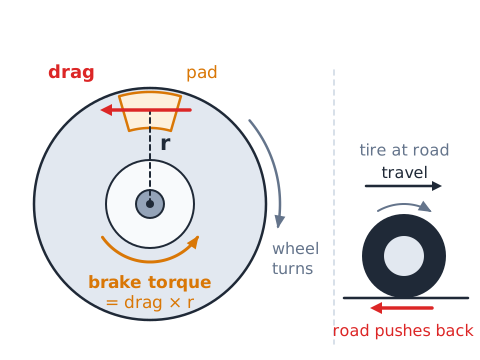
Piston force alone does not stop the wheel. The pads squeeze the rotor, and friction between them creates a drag force at the rotor's rubbing surface. That drag acts at some distance from the axle, producing brake torque that resists rotation. A larger rotor diameter or a pad material with higher friction gives more torque for the same clamping force. The tire then converts that torque into a friction force at the road, and the road pushes backward on the tire to slow the car.
What brake fluid must do
Brake fluid has several jobs. It must stay nearly incompressible so pedal motion becomes pressure, not squish. It needs a high boiling point because brakes get very hot. It must flow well in deep cold, protect metal parts from corrosion, and stay compatible with the rubber seals and hoses. Most automotive fluids are glycol-based DOT 3, DOT 4 or DOT 5.1; DOT 5 is silicone-based and is a different chemistry altogether.
Why water contamination matters
Glycol-based brake fluid is hygroscopic, meaning it slowly absorbs moisture from the air through seals, hoses and the reservoir vent. Water lowers the boiling point of the fluid, so after a few years a hot brake can boil the fluid and form vapor bubbles. Vapor compresses, which turns into a soft or sinking pedal. Moisture also promotes internal rust. This is why many makers specify fluid replacement at set intervals.
Reservoir level is not a pressure reading
The reservoir shows how much spare fluid is stored, not how much pressure the system makes. Pressure is produced only when the pistons move. A level that drops slowly can be normal pad wear, because the caliper pistons sit farther out as pads thin. A sudden drop, or a level below the MIN mark, points to a leak or another fault and needs prompt inspection.
Rigid lines and flexible brake hoses
Most of the hydraulic path is rigid steel tubing clipped to the body, because metal does not swell under pressure. Near each wheel the path changes to a flexible reinforced hose, since the wheel moves up and down with the suspension and the front wheels also steer. A hose that is cracked, bulging or rubbing on a tire is a hazard. A rusted or kinked steel line is also a serious fault.
Disc brake anatomy
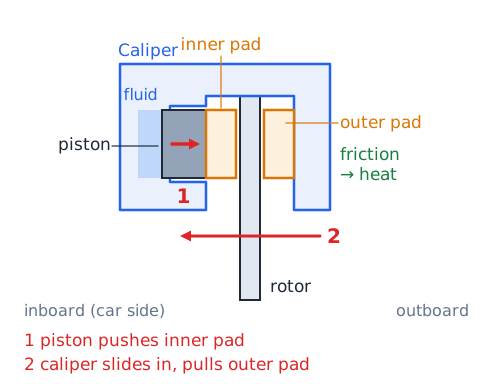
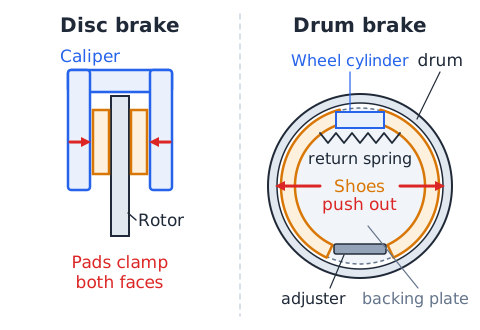
A disc brake has a flat rotor, also called a disc, that bolts to the hub and turns with the wheel. A caliper straddles the rotor and holds one or more hydraulic pistons. Two brake pads with friction lining sit on either side of the rotor. Many calipers float on slide pins so one piston can clamp both pads. Ventilated rotors have internal vanes between two faces to shed heat faster.
Disc brake sequence from pedal to heat
Press the pedal and fluid pressure reaches the caliper. The piston moves out and presses the inner pad onto the rotor; in a floating caliper the body then slides and pulls the outer pad in too. Friction between pads and rotor resists rotation and turns the car's motion into heat in the pads and rotor. That heat moves into the air. On release, piston seals pull the piston back very slightly.
Drum brake anatomy
A drum brake uses a hollow drum that turns with the wheel. Inside, mounted on a fixed backing plate, are two curved shoes lined with friction material. A wheel cylinder with a piston at each end pushes the shoes outward against the inside of the drum. Return springs pull the shoes back when pressure drops, and an adjuster keeps the shoes close to the drum as the lining wears.
Disc versus drum: identify the distinctive parts
Match parts to their brake type. Disc brake: rotor, caliper, caliper pistons, pads, slide pins. Drum brake: drum, curved shoes, wheel cylinder, backing plate, return springs, self-adjuster. In a disc brake the pads squeeze a disc from both sides. In a drum brake the shoes push outward on the inner surface of the drum. A caliper never appears in a plain drum brake.
Parking brake and holding a vehicle
The parking brake holds a stopped vehicle in place, usually through the rear wheels. In older designs a lever or pedal pulls a cable that mechanically applies the rear shoes or a caliper. Electric parking brakes use small motors at the calipers, worked by a switch, so no hand cable is needed. Some rear discs hide a small drum inside the rotor hat just for parking. It is not the main way to slow a moving car.
Red brake warning versus amber ABS warning
The red brake warning usually means the parking brake is applied, the fluid level is low, or the system has detected a hydraulic or base-brake problem. Red signals a potentially serious condition. The amber ABS lamp means the anti-lock system has found a fault and may be switched off; normal braking typically remains but without anti-lock help. Both lamps light briefly at startup as a bulb check. A lamp that stays on after that check should be looked into.
ABS purpose: preserve steering in a near-lock event
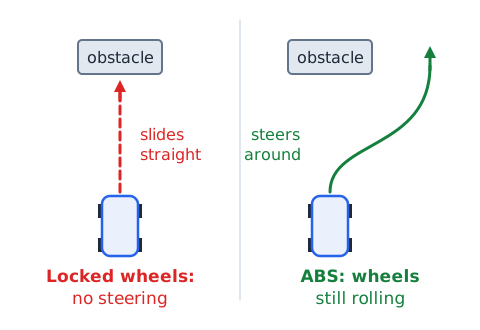
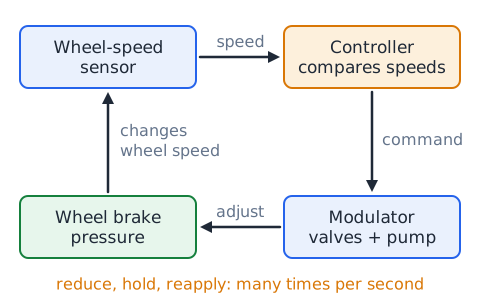
When a wheel locks and skids, its tire can no longer produce useful side force, so the driver loses steering control. An anti-lock braking system watches for a wheel slowing far faster than the car and briefly reduces, holds and reapplies pressure at that wheel, many times per second. The tire stays near peak grip while still rolling, so the driver can steer around an obstacle during hard braking.
ABS sensors, controller and hydraulic modulator
A wheel-speed sensor at each wheel, or at the axle on some older trucks, reads a toothed or magnetic ring and reports how fast that wheel turns. An electronic controller compares wheel speeds. If one wheel is about to lock, the controller commands the hydraulic modulator, a block of valves and a pump, to adjust brake pressure in that wheel's circuit. The driver may feel this as pedal pulsing.
How to brake with four-wheel ABS
In an emergency stop with four-wheel ABS, press the pedal firmly and keep it pressed. Do not pump it; the system pulses the brakes for you, much faster than a person can. Expect buzzing, a vibrating pedal and some noise, which are normal. Look and steer toward a safe path. Pumping the pedal interrupts ABS and can lengthen the stop.
Traction control, stability control and ABS are not the same
ABS manages wheel lock while braking. Traction control manages wheel spin while accelerating, by braking the spinning wheel or cutting engine power. Electronic stability control watches steering angle, yaw rate and sideways acceleration and brakes individual wheels to keep the car pointed where the driver is steering. All three share the wheel-speed sensors and modulator, but they solve different problems.
Wet roads, ice and stopping distance
Brakes can only slow a car as much as the tires can grip. Rain, ice, snow, gravel and wet leaves all lower the friction between tire and road, so the maximum deceleration drops and stopping distance grows. On ice it can be several times longer than on dry pavement. Powerful brakes or ABS do not change this limit. Slower speeds and larger following gaps are the real defense.
Weight transfer when braking
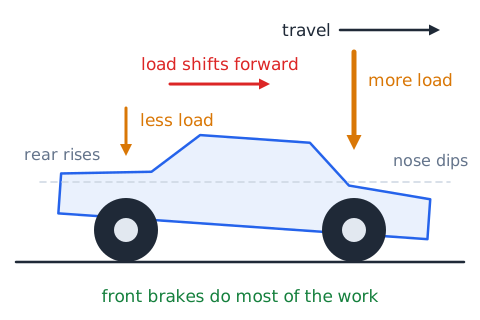
When a car decelerates, load shifts toward the front axle; the nose dips and the rear rises. The front tires gain grip because they carry more weight, while the rear tires lose some. That is why front brakes are larger and do most of the work, often well over half. Many systems use a proportioning valve or electronic brake-force distribution to limit rear pressure so the rear wheels do not lock first.
Brake fade: heat reduces effectiveness
Brake fade is a loss of stopping power after repeated or prolonged hard use. Pads and rotors heat up faster than they can cool, and very hot friction material grips less well. The driver presses just as hard yet the car slows less. A classic example is riding the brakes down a long mountain grade. Letting brakes cool and using a lower gear help prevent it.
Distinguish friction fade from fluid vapor
Two heat problems feel different. With friction fade, the pedal stays firm but the car simply slows less, because hot pads grip poorly. With fluid boiling, vapor bubbles form in the caliper and the pedal becomes soft, sinks farther and may need pumping. Both mean overheated brakes and both call for a cooldown and inspection.
Air in hydraulic lines: compressibility
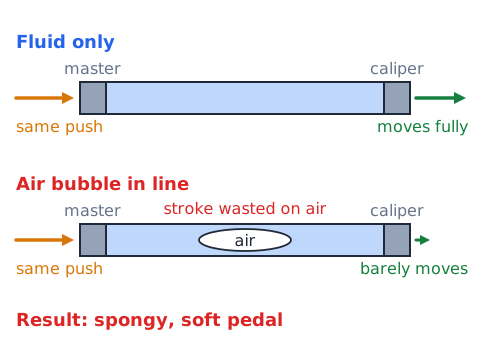
Liquid brake fluid barely compresses, so pedal motion turns directly into pressure. Air is very compressible. If air gets into the system, perhaps after a part is replaced or the reservoir ran low, part of the pedal stroke is wasted squeezing the bubble. The result is a spongy, soft pedal that travels farther than normal. Air must be removed by a proper bleeding procedure performed by a qualified technician.
A hard pedal may signal failed assistance
If the pedal suddenly feels very hard and the car needs much more leg force to slow, the booster may have lost its help. Causes include a leaking vacuum hose, a failed check valve, a torn diaphragm or no engine vacuum. The brakes still work mechanically, but the driver must push much harder. This is unlike a soft pedal, which points to air, vapor or a leak.
Brake pull and unequal braking
If the car pulls to one side when braking, the two wheels on one axle are not doing equal work. Common causes include a sticking caliper piston or slide, contaminated friction material on one side, a collapsed hose that traps pressure, or mismatched pads. Pull can also come from tires or alignment, so the pull should be checked both while braking and while coasting.
Brake squeal, grinding and wear indicators
Many pads include a small metal tab, a wear indicator, that touches the rotor and squeals when the lining is thin. That high-pitched sound is a warning to schedule service. Grinding is more serious: it often means the lining is gone and metal is rubbing metal, which damages the rotor quickly and cuts braking power. Some vehicles use electrical wear sensors that light a dash lamp.
Rotor vibration and pulsation
A pulsing pedal or a shaking steering wheel during ordinary, gentle braking often means the rotor surface varies in thickness or has uneven pad deposits, commonly called a warped rotor. The pads ride over high and low spots and pressure rises and falls. Rear drums that are out of round can cause a similar throb. This differs from ABS pulsing, which happens only in hard stops near wheel lock.
Rotors, drums and heat capacity
Rotors and drums act as heat sinks. Their mass absorbs heat during a stop and then sheds it to the air. A thicker, heavier rotor can soak up more energy before getting too hot, and vanes in a ventilated rotor pull air through to cool it. Machining or wear makes the part thinner, which reduces this capacity. That is why makers list a minimum thickness or maximum drum diameter.
Brake inspection is more than checking pads
A proper brake inspection covers the whole system: fluid level and condition, lines and hoses for leaks, rust or cracks, caliper slides and pistons, rotor and drum condition, parking brake operation, pedal feel and travel, warning lamps, and the ABS wheel sensors and wiring. Measurements are compared to the maker's specifications. Thick pads alone do not prove the brakes are healthy.
Dual-circuit hydraulic redundancy
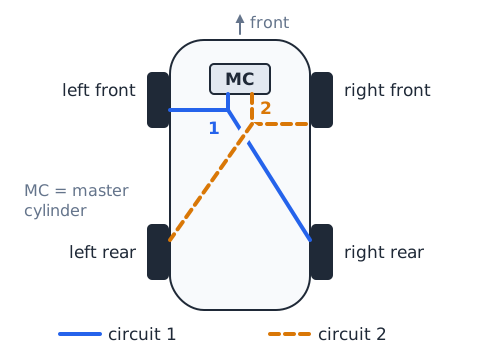
Modern master cylinders are tandem units with two pistons feeding two separate hydraulic circuits. Some cars split front and rear; many front-drive cars split diagonally, one front wheel with the opposite rear. If one circuit leaks, the other still provides partial braking. The pedal travels farther and stopping distance increases, but the car is not left with nothing.
Service brakes versus engine braking
Service brakes are the foot-operated friction brakes at the wheels. Engine braking is the slowing effect produced when the driver lifts off the throttle in gear; the engine's internal resistance holds the wheels back through the drivetrain. Selecting a lower gear on a long downhill increases engine braking, so the service brakes are used less and stay cooler. Engine braking adds to, but does not replace, the service brakes.
Regenerative braking and blended systems
Hybrids and electric vehicles can slow down by running the traction motor as a generator. The wheels turn the motor, it makes electricity to recharge the battery, and that drag slows the car. A controller blends this regenerative braking with normal friction braking. Friction brakes are still needed for hard stops, low speeds, a full battery and any fault, so the vehicle always keeps a hydraulic friction system.
Brake lights and the stop-lamp switch
The brake lights warn drivers behind you that you are slowing. A switch near the brake pedal arm, or a pressure sensor in some systems, closes the circuit when the pedal moves. On many modern cars the same signal also tells the engine computer, cruise control and shift interlock that the brake is applied. A failed switch can leave lights dark or stuck on.
What a caliper slide or piston fault can do
A caliper must apply and then release. If a slide pin corrodes or a piston sticks, pads may stay in contact with the rotor after the pedal is released. That drag creates constant heat at one wheel, a burning smell, faster pad wear, a pull to one side and poorer fuel economy. If a piston sticks retracted, that wheel brakes weakly and the car may pull the other way.
Rear drum adjusters and pedal travel
As drum-brake lining wears, the gap between shoes and drum grows. The wheel cylinder then has to push the shoes farther before they touch, which takes more fluid and more pedal travel. A self-adjuster, often a starwheel screw, takes up that gap automatically. If the adjuster seizes, the pedal gets low and the parking brake lever may travel farther than normal.
Work versus energy in stopping
To stop, the brakes must do work equal to the car's kinetic energy.
m is mass in kg and v is speed in m/s, giving joules. Braking work is force times distance,
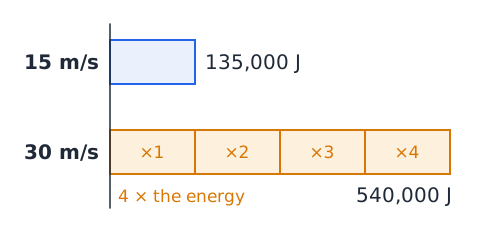
Because KE grows with the square of v, doubling speed means four times the energy to remove.
Worked example: comparing two braking energies
A 1,200 kg car at 15 m/s versus the same car at 30 m/s.
Twice the speed, four times the energy.
Ideal stopping distance with constant deceleration
If braking produces a steady deceleration, the distance to stop from speed v is
d is in meters, v in m/s and a in m/s². Reaction time is not included. Because v is squared, tripling the speed makes braking distance nine times longer, while doubling a halves it.
Worked example: elementary braking distance
A car traveling 25 m/s brakes at a steady 6.25 m/s². How far does it slide before stopping?
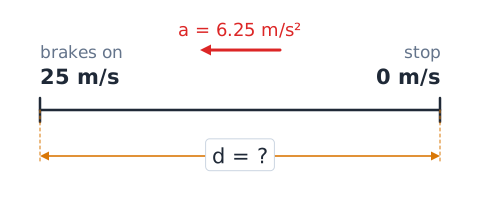
The braking distance is 50 m, not counting reaction distance.
Deceleration and force are related
Newton's second law links the slowing force to mass and deceleration.
F in newtons, m in kg, a in m/s². A 1,800 kg vehicle slowing at 5 m/s² needs a net force of
supplied by tire grip on the road.
Pressure units and careful unit conversions
Brake problems use several pressure units. The SI unit is the pascal, 1 N per square meter. Since 1 square meter is 10,000 square centimeters, 1 N/cm² equals 10 kPa. One bar is 100 kPa, and 1 psi is about 6.9 kPa. So 80 N/cm² is 800 kPa, or 8 bar. Always convert area units before dividing force by area.
Worked example: area ratio without π
Piston area scales with diameter squared, so the force ratio is
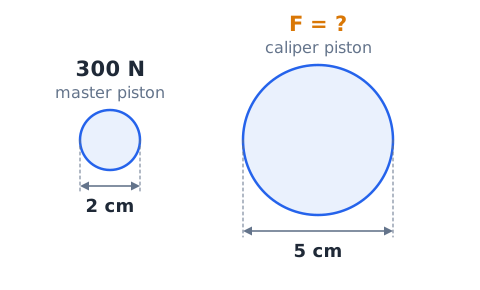
Master piston 2 cm, caliper piston 5 cm:
A 300 N input gives
The cancels.
Brake fluid pressure is not pedal effort
Pedal effort is the force from the driver's foot, measured in newtons or pounds. Line pressure is force per area inside the fluid, measured in kPa or psi. The pedal lever and booster multiply the foot force, and the master piston area converts that force into pressure. A smaller master piston creates more pressure for the same push but needs more pedal travel. Keep the two ideas separate.
ASVAB recognition strategy: follow the causal chain
When a question asks which part does something, place it on the chain: pedal, booster, master cylinder, lines and hoses, caliper or wheel cylinder, pads or shoes, rotor or drum, tire. The part that makes pressure comes before the lines; the part that touches the rotor comes after. Eliminate choices from other systems, like radiators or spark plugs, at once.
ASVAB recognition strategy: compare symptoms carefully
Match the feel to the cause. Soft or spongy pedal: air, vapor or a leak. Hard pedal with weak assist: booster problem. Firm pedal but weak stopping after heavy use: friction fade. Pulsing only in hard stops: ABS working. Pulsing in light stops: rotor issue. Pull to one side: uneven braking. Pick the answer that fits all the stated clues.
ASVAB numerical strategy: write units before calculating
Before doing arithmetic, write each value with its unit. Confirm that force is in newtons, area in a consistent unit, speed in m/s and mass in kg. If a problem mixes cm² and m², convert first. Check whether the answer should be bigger or smaller than the input; a larger output piston should give more force, not less. Units that cancel correctly are a quick sanity check.
Trap: ABS guarantees shorter stops
A common wrong answer claims ABS always stops a car in less distance. ABS mainly keeps the wheels rolling so the driver can steer. On dry or wet pavement it often matches or slightly beats a locked-wheel stop, but on loose gravel or deep snow a locked tire can build a wedge of material and stop shorter. Choose answers about steering control, not guaranteed distance.
Trap: drum shoes press on a rotor
Some answer choices mix the vocabulary of the two brake types. Shoes belong to drum brakes and push outward against the inside surface of the drum. Pads belong to disc brakes and clamp the faces of a rotor. A wheel cylinder applies shoes; a caliper applies pads. If a choice pairs shoes with a rotor or a caliper with a drum, treat it as suspect.
Trap: hydraulic fluid compresses like air
Brake fluid is treated as nearly incompressible; that property is what lets it transmit pressure instantly from the master cylinder to every wheel. Air or vapor bubbles are the compressible part, and they are a fault. Any answer calling healthy brake fluid compressible or gas-like is wrong.
Trap: all DOT numbered fluids are interchangeable
DOT ratings are not freely interchangeable. DOT 3, 4 and 5.1 are glycol-based with different boiling points, while DOT 5 is silicone-based and should not be mixed with them. Seals and ABS units are designed for a specific type. Always use the fluid named on the reservoir cap or in the owner's manual.
Trap: fourfold speed produces fourfold braking energy
Energy is not proportional to speed; it grows with speed squared. Doubling speed gives four times the energy. Four times the speed gives sixteen times the energy, and sixteen times the heat the brakes must absorb. Watch for answer choices that scale energy or braking distance in a straight line with speed.
Guided drill 1: identify the component
Name the part. It holds pistons and straddles a spinning disc. Answer: caliper.
It stores spare fluid above the master cylinder. Answer: reservoir.
It pulls drum shoes back after release. Answer: return springs.
It carries fluid to a wheel that steers. Answer: flexible brake hose.
Guided drill 2: caliper versus wheel cylinder
Which applies pads to a rotor? Answer: the caliper piston.
Which pushes two shoes apart inside a drum? Answer: the wheel cylinder, with a piston at each end.
Which brake type typically uses a backing plate? Answer: drum.
Which can float on slide pins? Answer: the caliper.
Guided drill 3: soft pedal after a leak
A wet stain appears inside one wheel and the pedal sinks lower than usual. Likely cause? Answer: a leak in that wheel's hose, caliper or wheel cylinder.
Why does the car still stop somewhat? Answer: the other hydraulic circuit still works.
Right response? Answer: stop driving it and have it inspected.
Guided drill 4: ABS pulse while braking
During a panic stop on a wet road the pedal buzzes and pushes back. Normal? Answer: yes, that is ABS modulating pressure.
What should the driver do? Answer: hold firm pressure and steer.
The same pulse appears in every gentle stop at low speed. Normal? Answer: no, check rotors and drums.
Guided drill 5: energy ratio
Speed rises from 12 to 24 m/s. Energy ratio? Answer:
times.
From 10 to 30 m/s? Answer:
times.
Speed is cut in half. Energy? Answer: one quarter.
Mass doubles at the same speed? Answer: twice the energy.
Guided drill 6: piston-force ratio
Areas 3 cm² and 12 cm², equal pressure. Force ratio? Answer: 4 to 1.
Diameters 1.2 cm and 3.6 cm? Answer:
to 1.
Input 150 N, area ratio 4? Answer: 600 N.
Which piston moves farther? Answer: the smaller one.
Guided drill 7: compare a warning and a sensor
The red brake lamp stays on with the parking brake released. First check? Answer: fluid level, and have the hydraulics inspected.
The amber ABS lamp stays on. Meaning? Answer: an ABS fault was detected; base brakes usually remain.
A wheel-speed sensor wire is cut. Which lamp is likely? Answer: the amber ABS lamp.
Guided drill 8: brake fade on a long hill
A driver brakes steadily down a long grade and the car slows less although the pedal is firm. Cause? Answer: friction fade from hot pads and rotors.
Better technique? Answer: shift to a lower gear and brake firmly in short periods.
The pedal later turns soft. New concern? Answer: boiling fluid.
Case study: firm pedal but a longer stopping distance
A delivery van carries a heavy load in summer heat. After a series of hard stops in city traffic, the driver notices the pedal feels normal and firm, yet the van needs noticeably more room to stop.
Analysis: a firm pedal means the hydraulics are still building pressure, so air, vapor and leaks are less likely. The heavy load added kinetic energy, and repeated stops left little time to cool. Overheated pads lose friction, which is fade. Glazed pads or worn friction material are also possible. The van should be allowed to cool and then have its brakes inspected before carrying the load again.
Case study: soft pedal immediately after service
A car leaves the shop after a caliper replacement. On the first drive the pedal goes almost to the floor before the brakes grab, then feels spongy.
Analysis: opening a hydraulic line during service can let air into the system. If the bleeding procedure did not remove all of it, the bubbles compress and waste pedal stroke. A loose fitting at the new caliper could also leak fluid. Both explanations fit the timing. The driver should not keep driving the car; it should go back to the shop so a technician can check for leaks and correct the air problem.
Case study: one wheel smells hot
After a short drive a driver notices a sharp burning smell near the right front wheel. That wheel radiates far more heat than the others, and the car drifts slightly right when coasting.
Analysis: one wheel running hot while the others stay cool suggests that brake is not releasing. A seized caliper slide pin or a sticking piston could hold the pad on the rotor. The constant drag explains the heat and the drift toward that side. Continued driving risks fade at that wheel, boiled fluid and damaged parts, so the car should be inspected promptly. Do not touch hot brake parts.
Case study: red lamp with released parking brake
A pickup's red brake warning lamp stays on after the parking brake is fully released. The pedal still feels normal for now.
Analysis: once the parking brake is ruled out, the red lamp commonly means low fluid or a hydraulic problem. A level well below the MIN mark points to a leak or very worn linings. Topping up only hides the cause. A faulty switch is possible, but the safe assumption is a real hydraulic issue until proven otherwise. The truck should be inspected before normal use, since a leak can get worse without warning.
Case study: comparing wet-road and dry-road ABS
The same sedan makes two emergency stops from equal speed: one on dry asphalt and one in heavy rain. ABS activates in both, yet the wet stop is much longer.
Analysis: ABS keeps each tire near its best grip, but it cannot raise that grip. Water lowers the tire-to-road friction, so the highest possible deceleration is smaller and, by
distance grows. The driver kept steering control in both stops, which is the system's main purpose. The real lesson is to slow down and leave more space when roads are wet.
Case study: warning about changing brake fluid
A car owner finds an old bottle of silicone DOT 5 fluid in the garage. The reservoir cap on his car calls for DOT 3. He wonders if any brake fluid will do.
Analysis: DOT 5 is silicone-based and does not mix with glycol fluids such as DOT 3. Mixing can create separation and cause poor performance and seal problems. Using the wrong fluid may also harm the ABS unit. The correct choice is the fluid named on the cap or in the owner's manual, from a sealed container, since glycol fluid absorbs moisture once opened.
Case study: split circuits after a leak
A front-drive hatchback with a diagonally split system develops a leak at the left rear line. The pedal sinks farther, but the car still slows.
Analysis: the leak empties one circuit, which serves the left rear and right front wheels. The other circuit, right rear and left front, keeps working, so partial braking remains. Stopping distance is longer and the car may pull slightly. The red warning lamp will likely light as the fluid level drops. Redundancy buys time to stop safely; the car should be towed or driven no farther than needed to reach help.
Case study: downhill braking and gear choice
A driver towing a small camper descends a long mountain grade. In high gear she rides the brakes continuously, and near the bottom the brakes feel weak.
Analysis: the camper adds mass, so more energy must be removed, and continuous light braking never lets the parts cool. Heat builds until fade sets in, and the fluid may approach boiling. A better plan is to select a lower gear before the descent so engine braking holds speed, then use firm, brief brake applications when needed. Pulling over to let the brakes cool is also sensible.
Case study: dual-use rear axle hardware
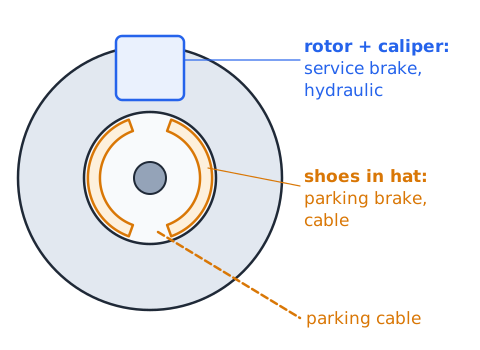
A technician explains a rear disc brake that also has a small drum inside the rotor's center hat. The customer is confused about why one wheel needs two brakes.
Analysis: the outer rotor and caliper are the service brake, applied hydraulically. The inner drum and small shoes are only the parking brake, applied mechanically by cable. This keeps a strong holding brake without complicating the caliper. Questions may test whether the learner knows which part serves which function.
Case study: brake force and tire force are not identical
A sports car with large calipers and high-grip pads is driven on a cold, packed-snow road. The driver brakes hard and the wheels approach lockup almost at once.
Analysis: the calipers can create far more torque than the tires can pass to the road. Stopping force actually comes from friction between tire and road surface. On snow that limit is low, so extra brake torque only drives the wheels toward lock, where ABS steps in. Bigger brakes help with heat on dry roads, but on slick surfaces tire grip is the limit, and winter tires or lower speed are what help.
Case study: speed, reaction and braking distance
A driver traveling 24 m/s sees a hazard and needs 1.2 s to start braking. The car then decelerates steadily at 8 m/s².
Reaction distance:
covered at full speed.
Braking distance:
Total:
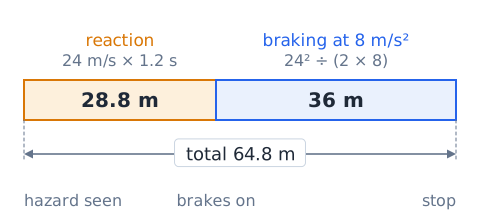
Analysis: almost half the total distance passes before the brakes are even applied. Distraction lengthens the first part; speed lengthens both parts.
Case study: mechanical versus hydraulic brake questions
An ideal system has a 5:1 pedal ratio, a 3 cm² master piston and 15 cm² caliper pistons, with no booster. The driver pushes with 150 N.
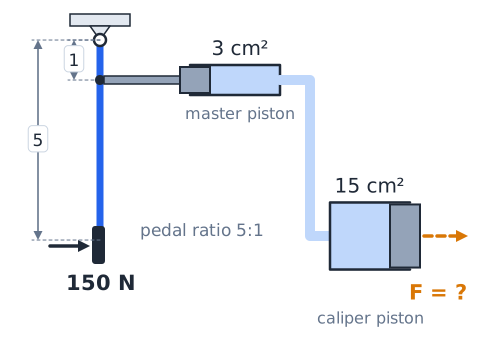
Lever:
N at the pushrod.
Pressure:
N/cm².
Caliper force:
Analysis: the lever multiplies force mechanically, and the area ratio multiplies it hydraulically. Real systems lose some to friction and add booster help, so these are idealized values.
Case study: regen and friction do not cancel each other
An electric vehicle owner believes that because the car regenerates energy, its friction brakes are never used and can be ignored.
Analysis: regeneration handles much of the light, routine slowing, but the controller blends in friction braking whenever more stopping is needed, when the battery is full or cold, at very low speeds, or if a fault occurs. Lightly used friction brakes can actually corrode from sitting idle, so they still need inspection and fluid service. Regenerative and friction braking work together; neither cancels or replaces the other.
Case study: no-code assumptions in brake diagnosis
A scan tool shows no stored trouble codes, but a customer reports a pulsing pedal in light stops and a slight pull to the left.
Analysis: most base-brake faults, such as uneven rotors, worn pads, sticking slides or a soft hose, never set an electronic code. Codes mainly cover ABS sensors, valves and related circuits. A clean scan does not prove the brakes are healthy. The technician must still inspect, measure and road-test. Codes help diagnosis but never replace a physical check.
Case study: unexpected partial-braking behavior
On an older car, a driver says one rear wheel locks early in moderate stops, especially with an empty trunk, and the car feels unsettled.
Analysis: with little load over the rear, those tires have less grip, so the rear brakes should receive limited pressure. A failed proportioning valve or load-sensing valve, a contaminated shoe, or a grabby drum could let that wheel lock before the others. Rear lockup can make a car spin, so this is a safety concern that warrants prompt professional inspection.
Final ASVAB brake-systems reference
Force path: pedal lever, booster, master cylinder, lines and hoses, caliper or wheel cylinder, pads or shoes, rotor or drum, tire grip. Disc: caliper, pads, rotor. Drum: wheel cylinder, shoes, return springs. Air gives a spongy pedal; lost assist gives a hard pedal; heat gives fade. ABS keeps steering, and the driver holds firm pressure.
 English ▾