ASVAB Camp Get the appGoogle Play
AR · lesson 2 of 12 · 26 min

Whole-Number Math and Order of Operations

Because the ASVAB does not allow a calculator, quick and accurate whole-number arithmetic still matters, even on questions that look like reasoning problems. This lesson explains why that fluency matters on the Arithmetic Reasoning subtest and then works through addition and subtraction with structure, multiplication without a calculator, and division with quotients and remainders.

Video lesson: Whole-Number Operations and Order of Operations

Video transcript

0:00 All right, welcome to this explainer. Look, if you're gearing up for the ASVAB, there's one specific rule that probably makes your stomach completely drop. No calculators allowed. If the thought of doing all that math by hand makes you, you know, a little anxious, just take a deep breath. You are absolutely not alone here. It's a totally normal feeling. But today, we're going to completely flip that anxiety on its head. Our goal for this explainer is to empower you with solid whole number fluency. By the time we wrap up, you'll be tackling these problems mentally and on paper with total confidence. So here's our game plan for today. We'll start with the no calculator rule itself. Then move into mastering the four operations. After that, we'll hit divisibility and the order of operations. Look at some estimation and fast patterns. Tackle real ASVAB examples and traps. And finally, we'll finish up with a practice section to check your skills. OK, let's dive into part one, the no calculator rule. Why whole number fluency is your secret weapon? Here's the reality of the ASVAB arithmetic reasoning and mathematics knowledge sections.

1:02 Almost every single question, whether it's fractions, percentages, ratios, or even algebra, eventually boils down to just a few basic whole number steps. And if those steps are slow or kind of shaky for you, well, you lose time. And you really risk making careless errors on problems you actually know how to solve. Imagine you're in the middle of a super stressful test. And you need to multiply 25 by 36. Now, a prepared test taker knows that four times 25 is 100, right? So they just mentally divide 36 by 4 to get 9. And then multiply that 9 by 100 to instantly snap to 900. Seeing this answer mentally, without scribbling out long multiplication, that saves you precious minutes. It literally gives you the extra time you need for the harder questions. And it keeps your brain fresh. Moving on to part two, mastering the four operations. Adding, subtracting, multiplying, and dividing by hand. Let's kick this off with a subtraction problem that trips up a lot of people. 2004 minus 1868. If you set this up the old school traditional way, working right to left, you're immediately forced to borrow across multiple zeros.

2:08 Guys, this is a massive trap. Borrowing across zeros is exactly where rushing produces careless errors. It's so common to get confused, forget to drop a 9, and just end up with a completely wrong answer. But there is a much better, way safer method. It's what we call the counting up method. Instead of borrowing, we just count up from the smaller number to the larger one in nice, easy chunks. Watch how this works. Starting at 1,868, let's just count up to the next friendly hundred, which is 1,900. Well, that's a difference of 32. Next, we count up from that 1,900 right to our target, 2,004. That's a difference of 104. Finally, you just add those two friendly chunks together. 32 plus 104 equals 136. We completely bypassed that nasty zero borrowing trap, and the math was practically stress-free. OK, next up is multiplication. Here we've got 36 multiplied by 24. Doing that entire thing at once in your head, pretty tough. But we can make it so much easier by breaking one of those factors down into tens and ones.

3:14 Let's take that 24 and break it down. We simply split the 24 into 20 and 4. First, we do 36 times 20, which is 720, then we do 36 times 4, which is 144. Just add those two partial products together. 720 plus 144 equals 864. Now, I do want to give a quick warning here. If you are doing this as long multiplication on scratch paper, you absolutely must watch out for the dreaded misalignment trap. When you multiply by the tens digit, you have to remember to shift your partial product one place to the left. If you forget to shift it, your addition at the very end is going to be completely off. Division. More specifically, the huge trap of ignoring the remainder. Let's say we divide 347 by 8. Well, 8 goes into 347 43 times, with 3 left over. So strictly mathematically speaking, it's 43 remainder 3. But on the ASVAB, context is everything. What if this is a word problem about 347 trainees riding in vans that seat 8? Well, this exact same division gives you three completely different answers depending on how the question is asked.

4:21 If they ask for completely full vans, the answer is 43. If they ask how many trainees are left over, it's three. But if they ask how many vans are needed, so nobody gets left behind, the answer is 44. Because those three left over trainees still need a ride, right? Always, always read the question carefully. All right, part three, divisibility and order of operations, working smarter, not harder. Here's a super handy overview of divisibility rules. These are basically cheat codes for simplifying numbers without having to grind through long division. Let's just run through them real quick. A number divides by two if it ends in an even digit. It divides by five if it ends in a zero or a five. And by 10 if it ends in zero. Pretty simple, right? Now for the fun ones. It divides by three if its digits add up to a multiple of three. Same exact logic for nine. It divides by nine if its digits add up to a multiple of nine. For four, you just look at the last two digits. If they form a multiple of four, the whole big number does, too. And for six, it just has to pass both the two and the three tests. Seriously, memorize this.

5:23 It's a massive time saver on test day. Now, let's talk about the strict order of operations. When a math expression has several operations going on, you have to follow this exact sequence. Step one, grouping symbols like parentheses or brackets, and you work from the inside out. Step two, exponents. Step three, multiplication and division. And finally, step four, addition and subtraction. Now, notice how I placed a major emphasis on the left to right rule for steps three and four. Multiplication and division are on the exact same level. You just do them from left to right as they appear. And the exact same thing goes for addition and subtraction. Let me show you exactly why that left to right rule is absolutely critical. We call this the deadly PEMDAS trap. Look at this problem. Evaluate 18 divided by three times two. So many test takers mistakenly think the M in PEMDAS means multiplication always comes before division. But if you fall for that trap, you might multiply three by two first to get six, and then 18 divided by six is three. That is completely wrong.

6:26 No way. The correct way is to read it left to right. 18 divided by three is six. Then six times two is 12. 12 is the actual correct answer. Don't let that trap catch you. Moving into part four. Estimation and fast patterns. Mental shortcuts for quick calculations. Check out this crazy fast no calculator pattern for multiplying by 99. Let's say you need to solve 37 times 99. Please don't write out long multiplication for this. Since 99 is just one less than 100, all you do is multiply the number by 100 instead and then subtract the original number once. So 37 times 100 is 3700. Then just subtract 37. 3700 minus 37 is 3663. You can literally do that in your head in about five seconds. Here's another brilliant trick. This time for multiplying any two digit number by 11. To instantly multiply by 11, you just add the two digits together and pop that sum right in the middle. So for 43 times 11, four plus three is seven. Put the seven in the middle and you get 473.

7:30 Super easy. Now if the sum is 10 or more, you just carry the one. So for 78 times 11, seven plus eight is 15. Put the five in the middle and carry the one over to the seven, making it an eight. So 858. These patterns are absolute gold for saving time. Part five, ASVAB examples and traps, putting it all together. All right, here is a classic packaging problem right out of our source material. A range has 380 rounds to pack and they fit 32 rounds per box. Now the test might ask how many boxes are completely filled? How many boxes are needed in total? Or how many rounds go in the partial box? The basic setup here is just straightforward division. 380 divided by 32. So let's solve it step by step. Let's do a quick estimation first. 32 times 10 is 320, right? So 11 seems like a really solid guess. 32 times 11 is 352. Now we just subtract that from our total. 380 minus 352 equals 28. So our mathematical answer is 11 remainder 28. But returning to that remainder trap we talked about earlier, what does this actually mean in the real world?

8:38 Well, it means we have 11 completely full boxes. The 28 left over rounds mean we have a partial box, which means we actually need 12 boxes total to hold everything. See how absolutely crucial that context is? Okay, part six, check yourself. Practice questions from the source. It's time to test out these skills. Here's the first one. Question two, what is 3,005 minus 1,748? Is it A, 4,753, B, 2,743, C, 1,257, or D, 1,267? I actually want you to pause this explainer right now, grab a pencil and try solving this by hand using the methods we just discussed. All right, welcome back. So the correct answer is C, 1,257. If you got that, excellent job. If you didn't quite get there, no worries at all. Let's quickly recap that counting up method to show how it completely avoids those messy borrowing mistakes across all those zeros in 3,005. We just count up from 1,748 to the nearest friendly number, which is 1,800.

9:45 That gives us a jump of 52. Then we count from 1,800 all the way up to 3,005, which is a jump of 1,205. Add those two chunks together, 52 plus 1,205 equals 1,257. No carrying, no borrowing, and absolutely zero careless errors. All right, one last challenge for you. Question four. 150 recruits ride to the range in buses that seat 40. How many buses are needed so everyone has a seat? Is it A, three, B, 3.75, C, 30, or D, four? Go ahead and pause the explainer one last time and solve for the exact number of buses. Let's see how you did on this one. The correct answer is D, four buses. Here's why. When you divide 150 by 40, you get three, because three times 40 is 120. That leaves a remainder of 30. So mathematically, it's three remainder 30. But remember, context is literally everything on these tests. The question specifically asks how many buses are needed so everyone has a seat.

10:49 You obviously can't just leave 30 recruits standing on the curb. Those 30 left over recruits absolutely require a fourth bus. And just like that, you've tackled ASVAB math without a calculator. You've successfully bypassed major traps and you've used mental patterns to speed up your work. You are honestly so much more capable than you probably realize. So as we wrap up today, I wanna leave you with this thought. Now that you've conquered your fear of the no calculator rule, what other math fears are you ready to absolutely crush next? Keep practicing, you've got this, and I'll see you in the next explainer.

Visual lesson

Lesson slides

15 slides
Whole-Number Operations and Order of Operations – slide 1 of 15

Lesson Goal

In this lesson you will add, subtract, multiply, and divide whole numbers quickly and accurately by hand, evaluate expressions using the order of operations, decide what a remainder means in a word problem, and use estimation and inverse operations to check your answers.

Why Whole-Number Fluency Still Matters on ASVAB

The ASVAB does not let you use a calculator, so every Arithmetic Reasoning and Mathematics Knowledge item ends with hand computation. Fractions, percentages, ratios, and even algebra problems almost always reduce to a few whole-number steps.

If those steps are slow or shaky, you lose time and make careless errors on problems you actually understand. A test taker who knows that

without writing anything has more time left for the harder questions. Fluency here pays off across the whole test.

Addition and Subtraction With Structure

Line numbers up by place value and work from the ones column left, carrying or borrowing as needed. Mental shortcuts help too.
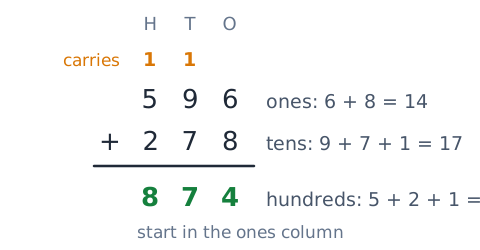
Column addition of 596 + 278 lined up by hundreds, tens and ones, with carried 1s above the tens and hundreds columns and one note per column (ones: 6 + 8 = 14, tens: 9 + 7 + 1 = 17, hundreds: 5 + 2 + 1 = 8), giving 874.

Compensation: to find , add 600 instead, then take back the extra 4:

Counting up: to find , count from 1,868 to 1,900 (32), then from 1,900 to 2,004 (104). The difference is

This avoids borrowing across zeros, where many errors happen.
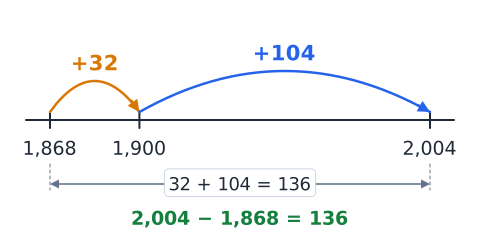
Counting up on a number line drawn to scale: a jump of +32 from 1,868 to 1,900 and a jump of +104 from 1,900 to 2,004, so 2,004 − 1,868 = 32 + 104 = 136.

Multiplication Without a Calculator

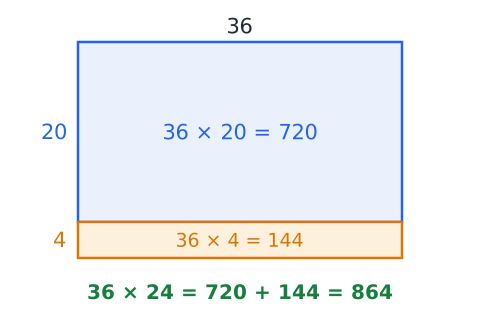
Break one factor into tens and ones, multiply each piece, and add the partial products. For :

and

so the product is

Area model for 36 × 24: a 36-wide rectangle split into a 20 row (36 × 20 = 720) and a 4 row (36 × 4 = 144); 720 + 144 = 864.

Look for friendly factors as well. Since

you can find as

then

In long multiplication, remember to shift each partial product one place left.
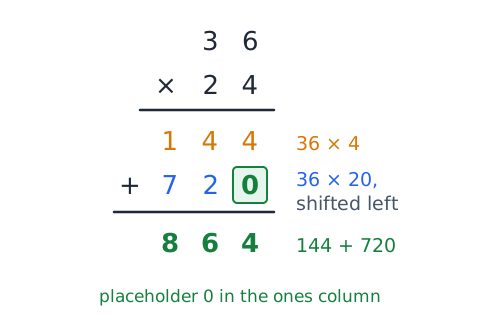
Long multiplication of 36 × 24: first partial product 144 (36 × 4), second partial product 720 (36 × 20) shifted one place left with a placeholder 0 in the ones column, sum 864.

Division, Quotients and Remainders

Division gives a quotient and sometimes a remainder. For , eight goes into 347 a total of 43 times, because

with

left over. Write this as 43 remainder 3.
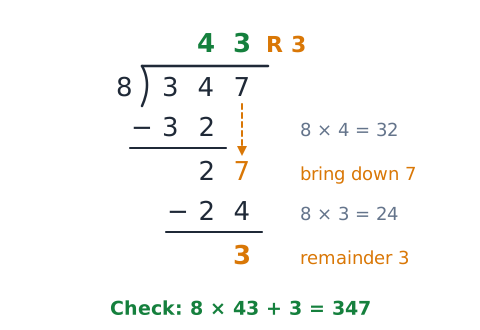
Long division of 347 by 8: 8 × 4 = 32 under 34 leaves 2, bring down 7 to make 27, 8 × 3 = 24 leaves remainder 3, so the quotient is 43 R 3; check 8 × 43 + 3 = 347.

In a word problem, the context tells you what to report. If 347 trainees ride in vans that seat 8, then 43 vans are completely full, 3 trainees are left over, and 44 vans are needed so nobody is left behind. Read the question carefully: "full," "needed," and "left over" lead to three different answers from the same division.
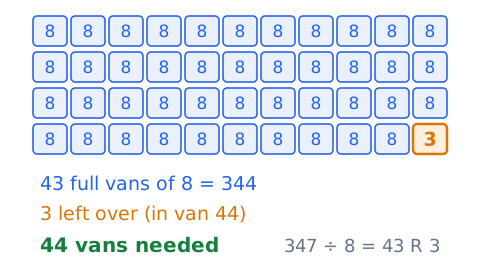
44 van boxes: 43 full vans of 8 seat 344 trainees and a 44th van holds the 3 left over, so 347 ÷ 8 = 43 R 3 and 44 vans are needed.

Divisibility and Factor Awareness

Divisibility rules let you simplify and check work without long division. A number is divisible by 2 if it ends in an even digit, by 5 if it ends in 0 or 5, and by 10 if it ends in 0.

It is divisible by 3 if its digits add to a multiple of 3, and by 9 if its digits add to a multiple of 9. It is divisible by 4 if its last two digits form a multiple of 4, and by 6 if it passes both the 2 and 3 tests.

Example: 7,236 has digit sum 18, so it divides evenly by 9 (giving 804). Its last two digits, 36, make it divisible by 4 as well.

Order of Operations

When an expression has several operations, follow this order: grouping symbols first, then exponents, then multiplication and division, then addition and subtraction.

Multiplication and division are on the same level, so do them from left to right in the order they appear. The same is true for addition and subtraction. The memory aid PEMDAS can mislead you here, because it seems to say multiplication always comes before division.
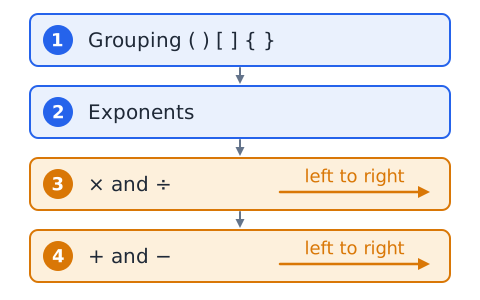
Order of operations as four steps from top to bottom: 1 grouping symbols, 2 exponents, 3 multiplication and division left to right, 4 addition and subtraction left to right.

Example: . Working left to right,

then

Multiplying first would give 3, which is wrong.

Order-of-Operations Examples

Rule: work parentheses first, then exponents, then multiplication and division from left to right, then addition and subtraction from left to right.

Example 1: Evaluate .

Step 1: There are no parentheses or exponents, so do division and multiplication first.

Step 2: Put those results back in, then add and subtract from left to right.

Answer: 52. Check: doing 3 + 15 first (and getting

40 − 18 = 22

) breaks the left-to-right rule. Subtract first, then add.

Example 2: Evaluate .

Step 1: Exponent first. means 3 times 3:

Step 2: Multiply next, then add.

Answer: 38. Check: adding 2 + 9 before multiplying would give 44, which is the wrong order.

Example 3: Evaluate .

Step 1: Parentheses first, then the exponent, then divide.

Answer: 2. Check:

and 16 is 4 squared.

Parentheses and Nested Grouping

When grouping symbols sit inside one another, work from the innermost pair outward. Brackets and braces act just like parentheses.

Evaluate . Innermost:

Inside the brackets:

Finally,
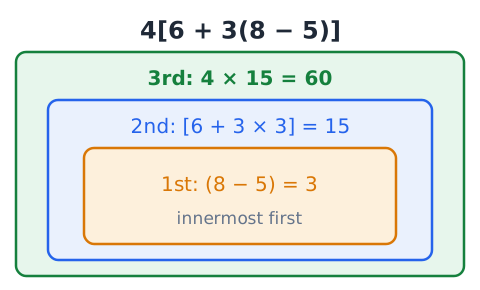
Nested boxes for 4[6 + 3(8 − 5)], worked from the inside out: first (8 − 5) = 3, then [6 + 3 × 3] = 15, then 4 × 15 = 60.

Evaluate . Innermost gives 6, the brackets give 9, then

and

A number written right next to a grouping symbol means multiply.

Estimation and Reasonableness

Rounding to one or two friendly digits gives you a fast picture of the answer's size. For , think

The exact answer is 17,748, so a choice such as 1,775 or 177,480 can be eliminated immediately.
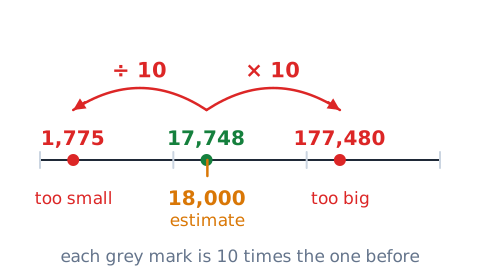
Powers-of-ten scale: the exact 17,748 sits right next to the estimate 18,000 (600 × 30), while 1,775 is ÷ 10 too small and 177,480 is × 10 too big.

After you calculate, ask whether the result makes sense: a total should be larger than its parts, and a quotient of a large number by a small one should still be fairly large.

Inverse Operations as a Check

Every operation has an inverse you can use to check it. Subtraction is checked with addition: if

then must return 912.

Division is checked with multiplication: if

then must equal 1,008. For a remainder, multiply the quotient by the divisor and add the remainder.

This check takes seconds and catches most borrowing and carrying slips.

Fast No-Calculator Patterns

To multiply by 5, multiply by 10 and halve:

To multiply by 25, multiply by 100 and divide by 4:

To multiply by 99, multiply by 100 and subtract the number once:

To multiply a two-digit number by 11, put the sum of its digits between them, carrying 1 into the left digit if the sum is 10 or more:

and

Halving one factor and doubling the other keeps the product the same:

ASVAB-Style Example 1 — Packaging

Problem: a range has 380 rounds to pack, 32 rounds per box. How many boxes are completely filled, how many boxes are needed for all rounds, and how many rounds go in the partial box?

Step 1: Divide 380 by 32. Start with an easy estimate: 10 boxes hold

Step 2: See what is left after 10 boxes.

Since 60 is more than 32, one more box can be filled:

Step 3: Find the remainder. Only 28 rounds are left, which is less than 32, so no more full boxes.

So is 11 remainder 28.

Step 4: Read each question carefully. Full boxes: 11. Boxes needed for all rounds: the 28 leftover rounds still need a box, so

11 + 1 = 12

Rounds in the partial box: 28.

Answer: 11 full boxes, 12 boxes needed in total, and 28 rounds in the last partial box.

Check:

so every round is counted.
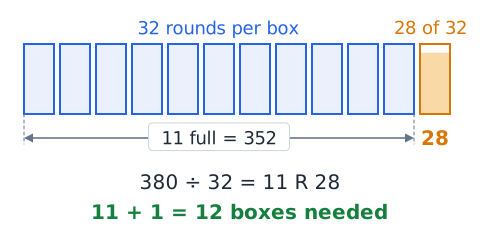
380 rounds packed 32 per box: 11 full boxes hold 352 and a 12th box holds the remaining 28 of 32, so 380 ÷ 32 = 11 R 28 and 12 boxes are needed.

ASVAB-Style Example 2 — Multi-Step Inventory

Problem: a supply room has 1,920 meal packs. It issues 14 cases of 12 packs, then receives 300 packs. How many packs are on hand?
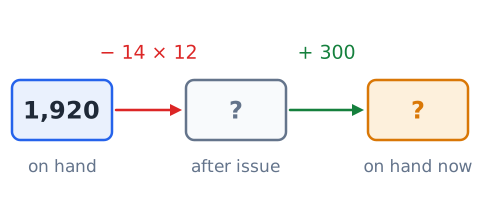
Inventory flow: 1,920 packs on hand, minus 14 × 12 issued gives an unknown amount, plus 300 received gives the unknown number on hand now.

Step 1: Find how many packs were issued. 14 cases of 12 means multiply. Break 14 into 10 + 4:

Step 2: Subtract the packs that went out. Take away 100 first, then 68:

Step 3: Add the packs that came in.

Answer: 2,052 meal packs.

Check: the net change is 300 in and 168 out, so

more packs.

Same answer.

ASVAB-Style Example 3 — Expression Translation

Problem: write and evaluate "subtract 6 from the product of 7 and 9, then divide the result by 3."

Step 1: Find the product. "Product" means multiply:

Step 2: Subtract 6 from it. "Subtract 6 from" the product means the product comes first:

Step 3: Divide that result by 3. Because the whole difference is divided, it needs parentheses:

By hand:

5 ÷ 3 = 1

remainder 2, then

27 ÷ 3 = 9
so
57 ÷ 3 = 19

Answer: the expression is , and its value is 19.

Check: work backward.

and

Watch out: without parentheses,

a different value.

When to Use Exact Arithmetic vs. Estimation

Estimate when the answer choices are far apart. If the choices are 180, 1,800, 18,000, and 180,000, a rounded calculation is enough to pick the right one.

Calculate exactly when choices are close together, such as 4,212 and 4,221, or when the problem involves a remainder or an exact count. A good routine is to estimate first anyway, then do exact work only if the estimate cannot separate the choices.

Common Whole-Number and Order-of-Operations Traps

Working strictly left to right: in , adding first gives 27. Multiplication comes before addition, so the value is 17.

Multiplying before dividing: in , the operations share a level, so go left to right to get 12, not 3.

Ignoring the remainder's meaning: 50 people in cars seating 4 need 13 cars, not 12. Ask whether the question wants full groups or enough groups.

Borrowing across zeros: in , rushing produces errors such as 2,467. Count up or check by adding: the answer is 1,533.
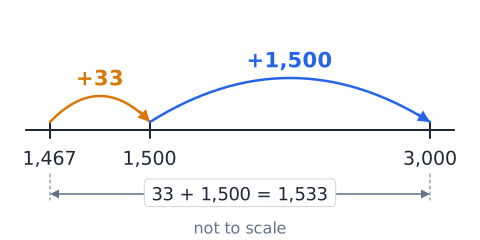
Counting up on a number line (not to scale): +33 from 1,467 to 1,500, then +1,500 from 1,500 to 3,000, so 3,000 − 1,467 = 33 + 1,500 = 1,533.

Misaligned partial products: forgetting to shift the tens-row product one place left makes come out wrong. Shift, then check with an estimate near

the exact value is 322.

Quick Review

Whole-number skill is the base for nearly every ASVAB math item, and none of it involves a calculator.

Add and subtract by place value, and use compensation or counting up to avoid errors. Multiply with partial products and shortcuts for 5, 25, 99, and 11. For division, report the quotient, the remainder, or the rounded-up count depending on the question.

Divisibility rules for 2, 3, 4, 5, 6, 9, and 10 speed up simplifying and checking. Order of operations is grouping, exponents, multiplication and division from left to right, then addition and subtraction from left to right. With nested grouping, work from the inside out.

Estimate first, then use the inverse operation to confirm your exact answer.

Quick review

What is the order of operations?
Grouping symbols, then exponents, then multiplication and division from left to right, then addition and subtraction from left to right.
Evaluate .
12. Multiplication and division share one level, so go left to right: , then . Multiplying first (giving 3) is the PEMDAS trap.
How do you evaluate nested grouping such as ?
Work from the innermost group outward: , then , then . A number written next to a bracket means multiply.
347 trainees ride vans seating 8. Full vans, vans needed, people left over?
remainder 3: 43 full vans, 44 vans needed so nobody is left behind, and 3 trainees left over. The question decides which number to report.
What are the divisibility tests for 3, 9, 4 and 6?
3: the digit sum is a multiple of 3. 9: the digit sum is a multiple of 9. 4: the last two digits form a multiple of 4. 6: the number passes both the 2 test and the 3 test.
Mental shortcuts for multiplying by 5, 25 and 99?
By 5: times 10, then halve (). By 25: times 100, then divide by 4 (). By 99: times 100, minus the number ().
How do you multiply a two-digit number by 11 in your head?
Place the sum of its digits between the digits, carrying 1 into the left digit when the sum is 10 or more: and .
How do you check a division answer that has a remainder?
Multiply the quotient by the divisor and add the remainder; you should get the dividend back. For R 28: .

What next?

← Previous: Turning Words into Math

About this lesson

You will also review divisibility and factor awareness, order of operations with examples, and parentheses and nested grouping, the spots where small slips create wrong answers that happen to appear among the choices. Sections on estimation and reasonableness, inverse operations as a check, and fast no-calculator patterns help you confirm results in seconds. Three ASVAB-style examples (packaging, a multi-step inventory and expression translation) show the skills in context, and a section on when to use exact arithmetic versus estimation helps you choose the faster route.

Plan on about 26 minutes, including the common traps and Quick Review. Next, take the 15-question lesson test to see how well your arithmetic holds up without a calculator.

Take it with you: the free app

The same 124 lessons, 6,516 questions and 82 timed practice tests on your phone, plus flashcards with spaced review and progress tracking. Free to download, and it works offline.

  • Works offline
  • Spaced-review flashcards
  • Progress for every subtest
  • Menus in 59 languages
ASVAB Camp appGoogle Play