ASVAB Camp Get the appGoogle Play
AR · lesson 1 of 12 · 28 min

Turning Word Problems into Math

Most missed Arithmetic Reasoning questions go wrong before any calculation starts, at the moment a sentence is turned into math. This core lesson treats AR as translation before calculation. You will learn to identify the unknown first, translate relationships instead of isolated keywords, and recognize addition, subtraction, multiplication and division structures inside everyday wording.

Video lesson: Turning Words into Math

Video transcript

0:00 Hey, everyone. Welcome to this explainer. Look, if you're gearing up for the ASVAB, you probably already know that arithmetic reasoning is a massive part of your score. But here's the thing. A lot of people feel super intimidated by the math, especially because, well, you're not allowed to use a calculator. But today, we're going to completely change how you look at these problems. Our goal is to learn how to easily translate ASVAB word problems into simple math, making that calculator totally unnecessary. By the end of this, you're going to be tackling these questions with absolute confidence. To get you there, here is our simple roadmap. We'll start with translation basics, look at operations, ratios, and units, and then work through five real examples together. Finally, we'll build a defense against common traps and test your skills. Let's take it one step at a time. All right, let's dive right into section one, translation before calculation. This is all about the foundational mindset you need for the ASVAB. I want you to shift your mindset right this second. Literally stop thinking of this as doing math. You know, when test takers miss an arithmetic reasoning item, the cause is almost always the setup, not the actual arithmetic.

1:08 So treat every problem as a short story that you just have to restate in the language of math. Once you get that translation right, the calculation is actually the easy part. You aren't really doing math yet. You're just acting as a language translator. So the absolutely crucial point here is knowing exactly what you're translating. Before you jot down a single number, find the question sentence, which by the way is usually the very last one, and state exactly what it wants, including the unit. Give this unknown a name, like X. For example, if a recruiter drives 35 miles to one office and then to a second office for 82 miles in all, naming your unknown as the distance of that second leg keeps you laser focused. Finding the target prevents you from stopping at some in between number that might just sneakily show up in the answer choices to trick you. Okay, section two, operations and equations. Now that we know how to find our target, let's figure out how to choose the right mathematical operations to get there. Stop hunting for isolated keywords. Seriously, keywords can actually completely mislead you. For instance, the word left often makes people think of subtraction, but sometimes the story asks for a starting count where you actually need to add.

2:17 Instead of keyword hunting, ask yourself, what's the overarching action in this story? If you're combining parts or increasing, well, you add. Removing, comparing or finding a missing part, that means you subtract. If you see equal groups repeated amounts or you're scaling up, that's multiplication. And if the story is all about equal sharing, splitting a total or finding a rate, you divide. Focus on the action, not the words. Let's actually build an equation from scratch. If you've got a pencil handy, write this down with me. Seven more than twice a number is 31. We're going to build it piece by piece. Twice a number translates perfectly to two x. Seven more means we just add seven to it. The word is literally translates to the equal sign, followed by 31. So the whole shebang is two x plus seven equals 31. From there, subtract seven from both sides to get two x equals 24. Divide by two. And boom, x equals 12. Advanced ratios and units. Let's step it up and look at some of the specific grammar rules of our math language.

3:19 Units basically tell you if your setup actually makes sense. Now, watch out for this classic ASVAB trap. Time. One hour and 15 minutes is absolutely not 1.15 hours. Minutes are sixtieths of an hour, right? So you must translate that 15 minutes by dividing 15 by 60, which gives you 0.25. Therefore, the correct translation is 1.25 hours. If a vehicle is moving at 52 miles per hour, you'd multiply 52 by 1.25 to get 65 miles. Always, always convert to a common unit before you start calculating. Ignore the noise. Some problems throw in numbers you simply do not need. If a problem asks how many flashlights are in a cargo van, and then casually mentions the van weighs 5,200 pounds, ignore the weight, focus strictly on the crates and the flashlights. Also, always do a really quick mental estimate first. If 49 workers earn 21 dollars each, round it to 50 times 20 in your head.

4:20 That's a thousand bucks. When you know the rough size and direction, you can instantly eliminate completely bogus answer choices. Step by step worked examples. We've got the rules down, so let's practice this translation together with five real scenarios you might actually see on the test. Example 1. Think about the physical action here. After a flood crew used 38 sandbags, 154 remained. How many did they start with? Well, the unknown is the starting amount, right? That's our X. The action in the story is start minus the used bags equals the remaining bags. So X minus 38 equals 154. To solve it, we just add 38 to both sides, which gives us 192 sandbags. Now, if you had subtracted 38 from 154, you'll be running the story backward. That's exactly why naming the unknown first is so incredibly important. Example 2 is a multi-step cost problem. A unit orders six helmets at $45 each, and six pairs of gloves at $12 each. Shipping adds a flat $15.

5:24 What's the total cost? Write each link on its very own line. Helmets six times 45 is 270. Gloves six times 12 is 72. Finally, just add the totals plus that flat shipping fee. 270 plus 72 plus 15 equals $357. If you break it down line by line like this, you won't get overwhelmed. Example 3. Ratios. Picture this. At a motor pool, the ratio of trucks to jeeps is 3 to 5. There are 27 trucks. How many jeeps are there? Set this up as a simple proportion, and keep matching units in matching positions. Put the trucks on top. 3 over 5 equals 27 over X. Since 27 is 3 times 9, the ratio just scales up by multiplying by 9. So we multiply the bottom by 9 as well. 5 times 9 equals 45 jeeps. Simple as that. Example 4 is a classic percentage trap. A stock count dropped by 40% and is now 270. What was the original count? The trap here is just adding 40% back onto the 270. Don't do it.

6:30 Think about the story. A 40% drop means 60% is left, so 60% of our unknown original equals 270. Write that as 0.60X equals 270. Divide 270 by 0.60 to get the original count, which is 450. And example 5. Throwing some geometry into the story. A rectangular storage pad is 30 feet long and 16 feet wide. One gallon of sealant covers 80 square feet. How many gallons are needed? Well, sealant covers a surface, so the action is finding the area. Area equals length times width. 30 times 16 is 480 square feet. Now we divide that total 480 by the 80 square feet each gallon covers. 480 divided by 80 equals 6 gallons. All right, section 5. Translation traps and routine. Let's see how all this builds into a bulletproof defense against the most common mistakes out there. You absolutely need to use the exact same routine on every single problem, so the setup becomes completely automatic.

7:32 You want to keep your cognitive load low. Here are your six steps. Step 1. Read the question sentence and note the unit. Step 2. Name the unknown your X. Step 3. Pick out only the linked facts and toss the rest. Step 4. Translate the relationships into an equation, converting any units like time first. Step 5. Make a quick mental estimate. And step 6. Calculate. Then check that your result actually answers the specific question asked. Reverse order. It is incredibly common to read the phrase five less than a number and write it down exactly in that order. Five minus X. Scratch that. It's a huge trap. The phrase actually means you start with the unknown number and you take five away from it, so you must put X first. The correct translation is X minus five. Always think about the real action happening in the story. Check yourself practice. You've got the mindset, the rules, and the routine. Now it's time to challenge yourself and really test these new translation skills. Okay, here is your first practice question. Nine less than a number is 23.

8:37 What is the number? I want you to go ahead and pause this explainer right now, grab a pencil, and try to write the equation and solve it without a calculator. Go ahead, pause it now. Okay, let's see how you did. Remember that trap we just talked about? Nine less than a number means you start with your X and you take nine away. So your equation should look exactly like this. X minus nine equals 23. To solve it, you simply add nine to both sides, which leaves you with X equals 32. If you got that, fantastic work. Let's do one final question to test your knowledge of parentheses. Which equation matches the sentence? Twice the sum of a number and nine is 50. Once again, pause the explainer, write down your translation, and hit play when you're ready. Let's break it down together. The sum of a number and nine tells us we need to combine those first, which means we write X plus nine. Twice that sum means we're doubling that entire group, so we absolutely must use parentheses. That gives us two times open parentheses, X plus nine, closed parentheses equals 50. Look, if you can master translating sentences just like this, the math on the ASVAB becomes simple arithmetic.

9:50 You now speak the language of math. So the only question left is, are you ready to ditch the calculator and turn your next math test into a simple translation exercise? I think you are.

Visual lesson

Lesson slides

15 slides
Turning Words into Math – slide 1 of 15

Lesson Goal

In this lesson you will learn to turn an Arithmetic Reasoning word problem into a correct expression or equation before you calculate anything.

You will practice naming the unknown, recognizing how the quantities in a story relate to each other, and building setups for multi-step totals, rates, ratios, percentages, time and measurement units, and simple area or perimeter situations. The goal is a reliable habit: understand the story, write the math, then compute.

Arithmetic Reasoning Is Translation Before Calculation

When test takers miss an Arithmetic Reasoning item, the cause is usually the setup, not the arithmetic. They add when the story describes equal groups, or they answer a number the question never asked for.

Treat every problem as a short story that you must restate in the language of math. For example, "A crew loads 14 pallets an hour for 6 hours" describes the same amount repeated, so the math is

pallets. Once the translation is right, the calculation is usually the easy part.

Identify the Unknown First

Before you write any numbers down, find the question sentence, which is usually the last one, and state exactly what it wants, including the unit. "How many gallons were used?" and "How many gallons are left?" lead to different answers from the same facts.

Give the unknown a name, such as x. Example: a recruiter drives 35 miles to one office, then on to a second office, for 82 miles in all. The unknown is the second leg, so

and
miles

Naming the target keeps you from stopping at an in-between number that also shows up among the answer choices.
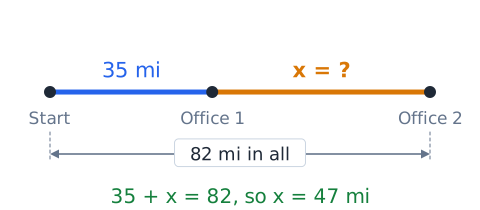
A drive drawn to scale: 35 miles from Start to Office 1, then an unknown leg x to Office 2, 82 miles in all, so 35 + x = 82 and x = 47 miles.

Translate Relationships, Not Isolated Keywords

Keyword lists are a helpful start, but they can mislead you. The word "left" often suggests subtraction, yet "after 12 radios were handed out, 30 were left" asks for the starting count, which is
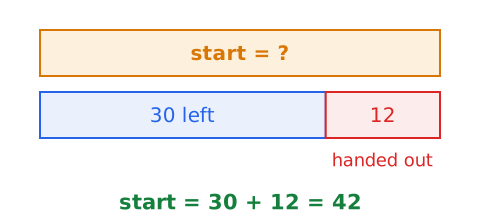
Bar model to scale: the start = ? bar is as long as 30 left plus 12 handed out, so start = 30 + 12 = 42.

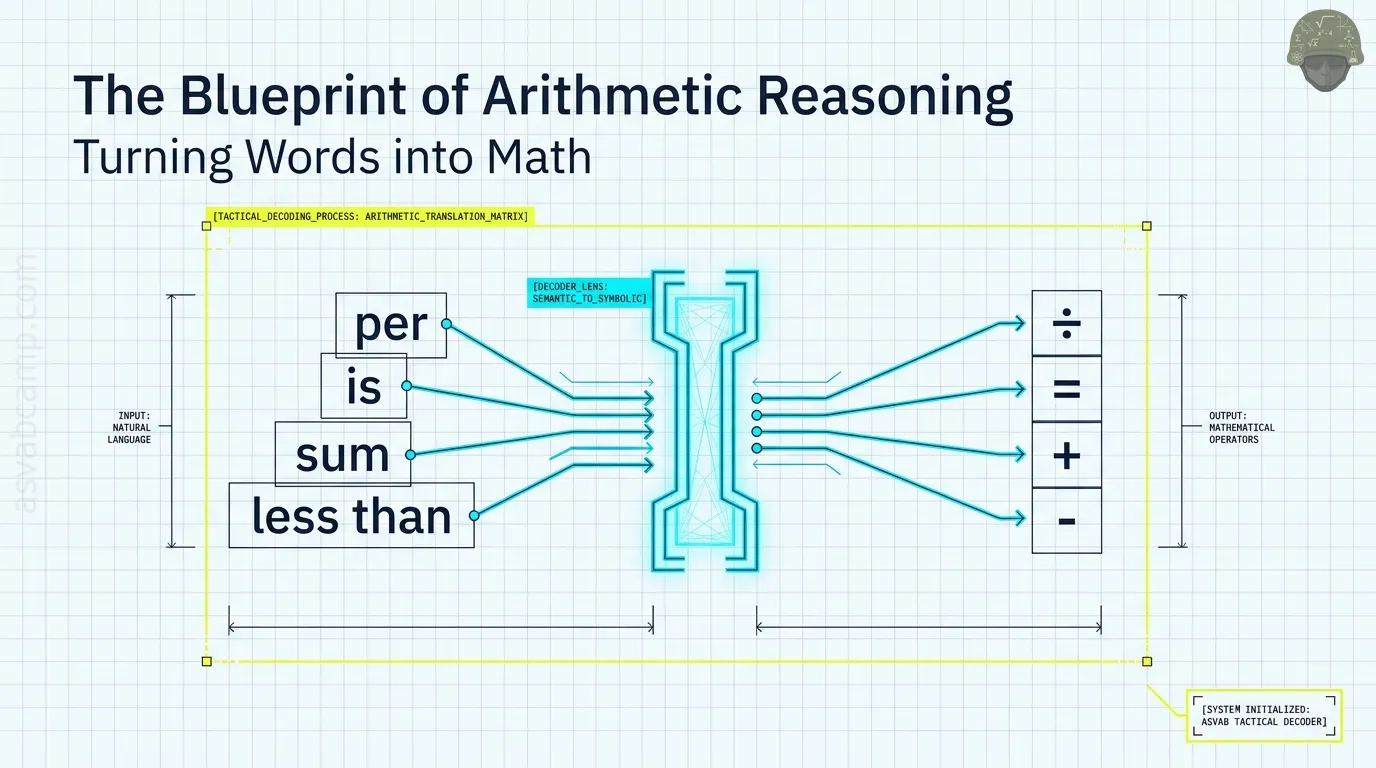
Order matters too. "8 less than a number" means , not . "Three times as many" means multiply by 3, and "per" or "each" can call for multiplication when you build a total or division when you split one.

Instead of hunting for single words, ask what the story is doing to the quantities: combining them, comparing them, repeating an amount, or sharing a total. That action tells you the operation.

Addition and Subtraction Structures

Addition fits stories that combine parts into a total or increase a starting amount. Subtraction fits stories that remove an amount, compare two amounts, or find a missing part when the total is known.

Example: a depot holds 215 tires, receives 90 more, and then issues 128. The story is start plus received minus issued:

tires.

A comparison question such as "How many more vehicles does Unit A have?" asks for a difference. If Unit A has 64 vehicles and Unit B has 47, the answer is
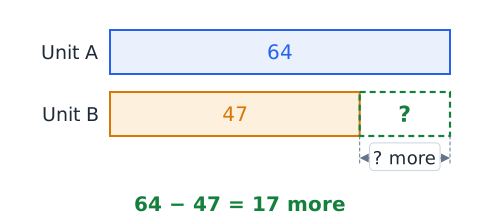
Comparison bars to scale: Unit A has 64 and Unit B has 47; the extra piece of A is how many more, 64 − 47 = 17.

Multiplication and Division Structures

Multiplication fits equal groups, repeated amounts, rate times time, and scaling up. Division fits splitting a total into equal shares, finding how many groups fit, and finding a rate.

Example: 9 boxes holding 16 cartridges each contain

cartridges. If those 144 cartridges are shared equally among 12 squads, each squad gets
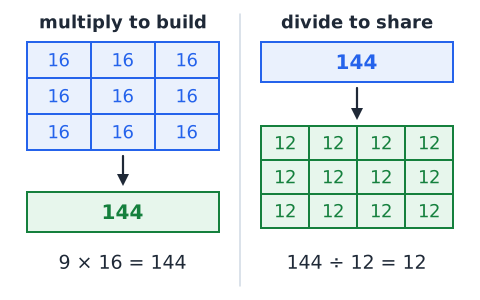
Two panels: multiply to build, 9 boxes of 16 combine into 144 (9 × 16 = 144); divide to share, 144 split into 12 shares of 12 (144 ÷ 12 = 12).

The numbers are related, but the structure is opposite: multiply to build a total from groups, divide to break a total apart. A truck that covers 255 miles in 5 hours averages

miles

per hour.

Turning Sentences into Equations

Translate a sentence piece by piece. "Is" or "equals" becomes the equal sign, "a number" becomes a variable, and "of" often means multiply.

"Seven more than twice a number is 31" becomes

Build "twice a number" first, then add 7 to it. Solving gives

so

Compare "twice the sum of a number and 7," which is . Use parentheses when the words say to combine first.
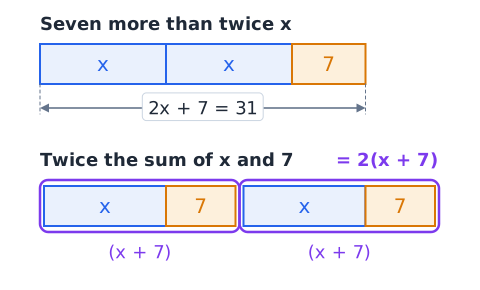
Bar models: x, x and 7 together make 2x + 7 = 31; two groups of (x + 7), each x and 7, make 2(x + 7).

Multi-Step Relationships

Many problems chain two or three relationships together. Write each link on its own line instead of trying to do everything at once.

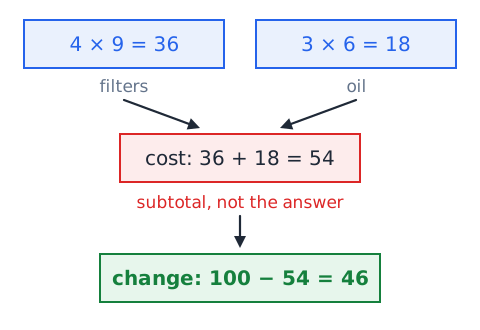
Example: a mechanic buys 4 filters at 9 dollars each and 3 quarts of oil at 6 dollars each, then pays with a 100 dollar bill. How much change does he get?

First find the cost:

dollars

Then find the change:

dollars
Chain: 4 × 9 = 36 for filters and 3 × 6 = 18 for oil give cost 36 + 18 = 54, a subtotal, not the answer; then change 100 − 54 = 46.

Before choosing an answer, confirm that your final number matches the last step the question asked for, not an earlier total such as 54.

Rates, Ratios, Percentages and Proportions as Relationships

A rate compares two different kinds of units, such as miles per hour or dollars per pound. Multiply a rate by time or amount to get a total, and divide a total by time or amount to get a rate.

A ratio compares quantities of the same kind, such as 3 officers to 8 enlisted members. A percentage is a ratio out of 100: 40 percent of 250 is

To find what percent one number is of another, divide part by whole: 45 filled seats out of 60 is

or 75 percent.

A proportion says two ratios are equal. If 5 gallons of paint cover 2 rooms, then

gives 15 gallons for 6 rooms. Keep matching units in matching positions.
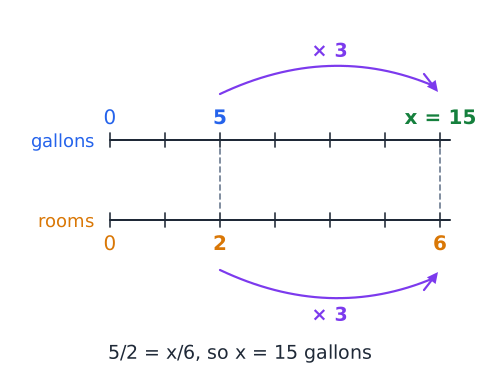
Double number line: 5 gallons match 2 rooms, and multiplying both by 3 gives x = 15 gallons for 6 rooms, so 5/2 = x/6.

Units Are Part of the Mathematics

Units are not decoration; they tell you whether the setup makes sense. Convert to a common unit before you combine numbers.

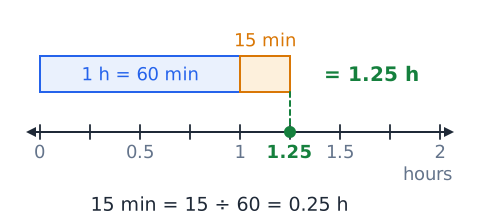
Time is the classic trap. One hour 15 minutes is not 1.15 hours. Because 15 minutes is

hour

the time is 1.25 hours. A vehicle moving at 52 miles per hour for that long covers
miles
Time bar on a number line in hours: 1 hour (60 minutes) plus 15 minutes ends at 1.25 hours, because 15 minutes = 15 ÷ 60 = 0.25 hour.

Lengths work the same way: 3 feet 6 inches is 3.5 feet or 42 inches. Carry the unit labels through the work. Miles per hour times hours leaves miles, which confirms the setup.
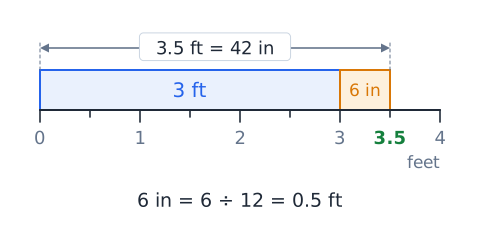
Ruler in feet: a 3 ft bar plus 6 in (half a foot) ends at 3.5 ft, which is 42 in; 6 in = 6 ÷ 12 = 0.5 ft.

Relevant vs. Irrelevant Information

Some problems include numbers you do not need. A cargo van weighs 5,200 pounds and carries 14 crates, each holding 30 flashlights. How many flashlights are in the van?

Only the crates and flashlights matter:

The van's weight is a distractor, and any answer built from 5,200 is wrong.

Decide what the question asks, then use only the facts that connect to it. Also watch for numbers written as words, such as "a dozen" for 12 or "a week" for 7 days, because they may be needed even though no digits appear.

Estimate Before Exact Calculation

A quick estimate before the exact work tells you roughly what the answer should look like. Round to friendly numbers and calculate in your head.

Example: 49 workers each earn 21 dollars for a task. Estimate

dollars

The exact value is

close to the estimate, so any choice near 100 or 10,000 can be crossed out.

Estimates also check direction. If you are finding an original amount before a decrease, the answer must be larger than the amount you were given.

Worked Example 1 — Reverse Relationship

Problem: after a flood crew used 38 sandbags, 154 sandbags remained. How many sandbags did the crew have at the start?

Step 1: Name the unknown. Let x stand for the number of sandbags at the start, because that is what the question asks for.

Step 2: Turn the story into an equation. The crew started with x, used 38, and had 154 left. Start minus used equals remaining:
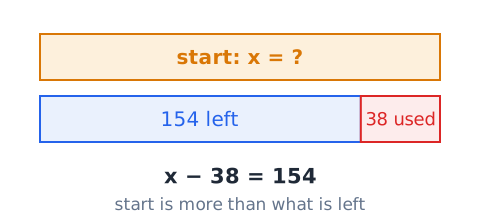
Bar model: the starting amount x = ? is as long as 154 left plus 38 used together, so x − 38 = 154; the start is more than what is left.

Step 3: Get x by itself. The 38 is being subtracted, so undo it by adding 38 to both sides:

Step 4: Add by hand. Ones:

4 + 8 = 12

write 2 and carry 1. Tens:

5 + 3 + 1 = 9

Hundreds: 1.

Answer: 192 sandbags.

Check: put 192 back into the story.

which matches the 154 left over. Watch out: subtracting 38 from 154 to get 116 runs the story backward. The crew must have had more at the start than at the end.

Worked Example 2 — Multi-Step Cost

Problem: a unit orders 6 helmets at 45 dollars each and 6 pairs of gloves at 12 dollars each. Shipping adds a flat 15 dollars. What is the total cost?

Step 1: Find the cost of the helmets. Six helmets at 45 dollars each means multiply. Break 45 into 40 + 5 to do it in your head:

Step 2: Find the cost of the gloves the same way, with

12 = 10 + 2

Step 3: Add everything, including the flat shipping charge. Shipping is added once, not for each item.

Answer: 357 dollars.

Check: each helmet-and-glove set costs

dollars

Six sets:

plus 15 shipping is 357 dollars. Same answer.
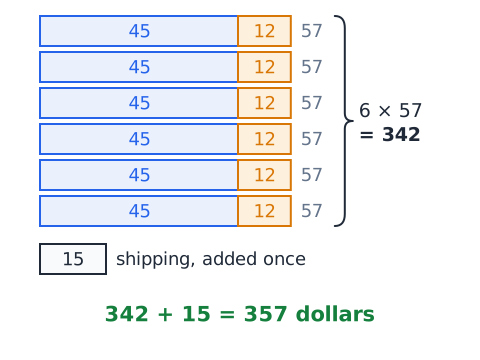
Six identical sets of a 45-dollar helmet and 12-dollar gloves, each 57, bracketed as 6 × 57 = 342, plus one 15-dollar shipping block added once: 342 + 15 = 357 dollars.

Worked Example 3 — Ratio Translation

Problem: at a motor pool, the ratio of trucks to jeeps is 3:5. There are 27 trucks. How many jeeps are there?

Step 1: Set up a proportion. Keep trucks on top in both fractions, and let x be the number of jeeps:

Step 2: Find how much one ratio part is worth. The 3 truck parts became 27 trucks, so divide:

So every part of the ratio stands for 9 vehicles.
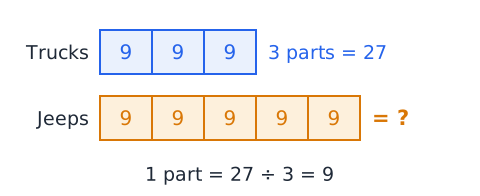
Ratio tape: trucks are 3 equal parts and jeeps are 5 equal parts; 3 parts = 27 trucks, so 1 part = 27 ÷ 3 = 9, and the jeeps total is ?.

Step 3: Jeeps are 5 parts, so multiply 5 by 9:

Answer: 45 jeeps (72 vehicles in all, since

27 + 45 = 72

).

Check: divide both counts by 9.

and

so the ratio is 3:5. Watch out: flipping the ratio to 5:3 gives 16.2 jeeps, and you cannot have part of a jeep.

Worked Example 4 — Percentage Reversal

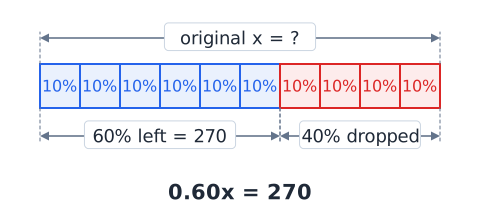
Problem: a stock count dropped by 40 percent and is now 270. What was the original count?

Step 1: Find what percent is left. A 40 percent drop leaves

100 − 40 = 60 percent

of the original.

Percent bar for the original count x = ?, split into ten 10% pieces: six pieces (60%) left equal 270 and four pieces (40%) were dropped, so 0.60x = 270.

Step 2: Write an equation. Let x be the original count. 60 percent of x is 270, and 60 percent is 0.60:

Step 3: Divide both sides by 0.60. To clear the decimal, move the point one place right in both numbers:

Step 4: Divide by hand.

27 ÷ 6 = 4

remainder 3. Bring down 0:

30 ÷ 6 = 5

Bring down the last 0:

0 ÷ 6 = 0

Answer: the original count was 450.

Check: 10 percent of 450 is 45, so 40 percent is

then

It works. Watch out: adding 40 percent of 270 to 270 (giving 378) is a common wrong move, because the 40 percent was taken from the original, not from 270.
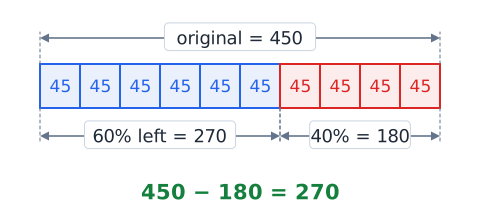
Check bar: the original 450 split into ten 10% pieces of 45; six pieces (60%) left are 270 and four pieces (40%) are 180, so 450 − 180 = 270.

Worked Example 5 — Geometry Inside a Word Problem

Problem: a rectangular storage pad is 30 feet long and 16 feet wide. One gallon of sealant covers 80 square feet. How many gallons are needed?
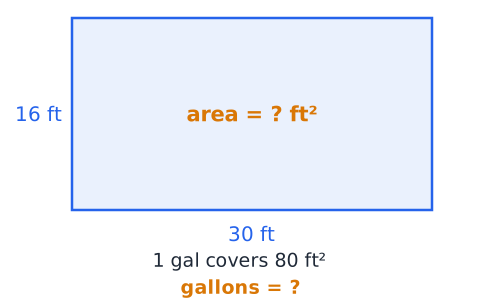
Rectangular storage pad 30 ft by 16 ft drawn to scale with area = ? square feet; 1 gallon covers 80 square feet; gallons = ?.

Step 1: Decide what to measure. Sealant covers a flat surface, so you need area (not perimeter).

Step 2: Find the area. Area of a rectangle is length times width. Break 16 into 10 + 6:

Step 3: Find the gallons. Each gallon covers 80 square feet, so divide the area by 80. Drop a zero from both numbers to make it easier:

Answer: 6 gallons.

Check:

square feet

exactly the area of the pad. Note: if the question asked for fencing around the pad, you would need perimeter instead:

feet

Decide area or perimeter before using the numbers.
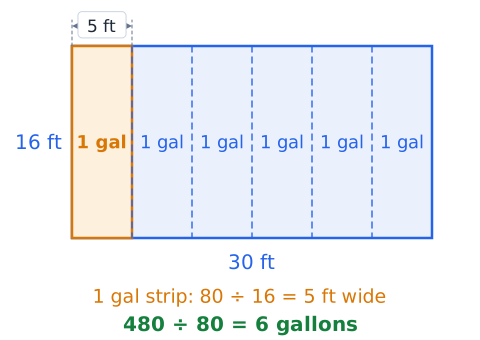
The 30 ft by 16 ft pad split into 6 strips; each 1-gallon strip is 80 ÷ 16 = 5 ft wide (5 × 16 = 80 square feet), so 480 ÷ 80 = 6 gallons.

A Six-Step AR Translation Routine

Use the same routine on every problem so the setup becomes automatic.

First, read the question sentence and note exactly what is asked and in what unit. Second, name the unknown. Third, pick out the facts that connect to the unknown and set aside anything extra. Fourth, translate the relationships into an expression or equation, converting units first if needed.

Fifth, make a quick estimate of the size and direction of the answer. Sixth, calculate, then check that the result answers the question asked, fits your estimate, and matches one of the choices.

Common Translation Traps

Reversed order: writing "5 less than a number" as . The phrase means start with the number and take 5 away, so write .

Minutes as decimals: treating 2 hours 30 minutes as 2.30 hours. Minutes are sixtieths of an hour, so the correct value is 2.5 hours.

Stopping early: choosing a subtotal that appears in the answer list. Reread the question before you bubble an answer.

Whole-number percents: multiplying by 65 instead of 0.65. Convert the percent to a decimal or fraction first.

Flipped ratios: putting the second item on top in one ratio but not the other. Label both ratios with the same order.

Reverse percents: adding the percent of the new amount. Divide by the remaining percent instead.

Quick Review

Arithmetic Reasoning rewards careful translation. Read the question sentence first, name the unknown with its unit, and decide what the story does to the quantities.

Combining or increasing points to addition; removing, comparing, or finding a missing part points to subtraction. Equal groups, rate times time, and scaling point to multiplication; equal sharing, counting groups, and finding a rate point to division.

Translate sentences in order, using parentheses when the words say to combine first. In multi-step problems, write each link separately and make sure the final number is the one requested.

A rate times time gives a total, a ratio keeps the same order on both sides of a proportion, and a percent becomes a decimal before you multiply. Convert minutes to fractions of an hour and mixed lengths to one unit.

Ignore extra facts, catch numbers written as words, estimate first, and check the answer against the story.

Quick review

How do you translate '8 less than a number' into math?
: start with the number and take 8 away. Writing reverses the order and is a classic trap.
Write and solve: 'Seven more than twice a number is 31.'
, so and . 'Is' becomes the equals sign; build 'twice a number' first, then add 7.
When do you need parentheses when translating words into math?
When the words say to combine first. 'Twice the sum of a number and 7' is , not .
Instead of hunting keywords, how do you pick the operation?
Ask what the story does to the quantities: combining or increasing means add; removing, comparing or finding a missing part means subtract; equal groups or rate times time means multiply; equal sharing or finding a rate means divide.
How many hours is 1 hour 15 minutes?
1.25 hours, not 1.15. Minutes are sixtieths of an hour, so hour.
A count fell 40 percent to 270. How do you find the original count?
What is left is 60 percent of the original: , so . Adding 40 percent of 270 (giving 378) is the trap.
What are the six steps of the AR translation routine?
Note what is asked and its unit; name the unknown; keep only the facts linked to it; translate into an equation, converting units first; estimate the size and direction; calculate and check against the question and choices.
Why reread the question sentence before picking an answer?
Intermediate subtotals often appear among the choices. Make sure your number is the final quantity asked for, such as the change from 100 dollars rather than the 54 dollar cost.

What next?

About this lesson

From there the lesson builds to turning sentences into equations, handling multi-step relationships, and treating rates, ratios, percentages and proportions as relationships rather than formulas to memorize. It also shows why units are part of the mathematics, how to separate relevant from irrelevant information, and why estimating before exact calculation saves time. Five worked examples cover a reverse relationship, a multi-step cost, ratio translation, percentage reversal and geometry inside a word problem, followed by a six-step AR translation routine and the most common translation traps.

Arithmetic Reasoning is one of the four AFQT subtests, so this skill pays off directly. Allow about 28 minutes, then take the 15-question lesson test.

Take it with you: the free app

The same 124 lessons, 6,516 questions and 82 timed practice tests on your phone, plus flashcards with spaced review and progress tracking. Free to download, and it works offline.

  • Works offline
  • Spaced-review flashcards
  • Progress for every subtest
  • Menus in 59 languages
ASVAB Camp appGoogle Play