ASVAB Camp Get the appGoogle Play
AR · lesson 3 of 12 · 30 min

Fractions and Mixed Numbers

This 30-minute core lesson rebuilds fraction skills from the ground up. You start with what a fraction represents, then move through equivalent fractions and simplest form, comparing fractions, and converting between improper fractions and mixed numbers. Separate sections cover adding, subtracting, multiplying and dividing fractions, followed by fractions of quantities, fractions in measurement and units, and the link between fractions, ratios and rates.

Video lesson: Fractions and Mixed Numbers

Video transcript

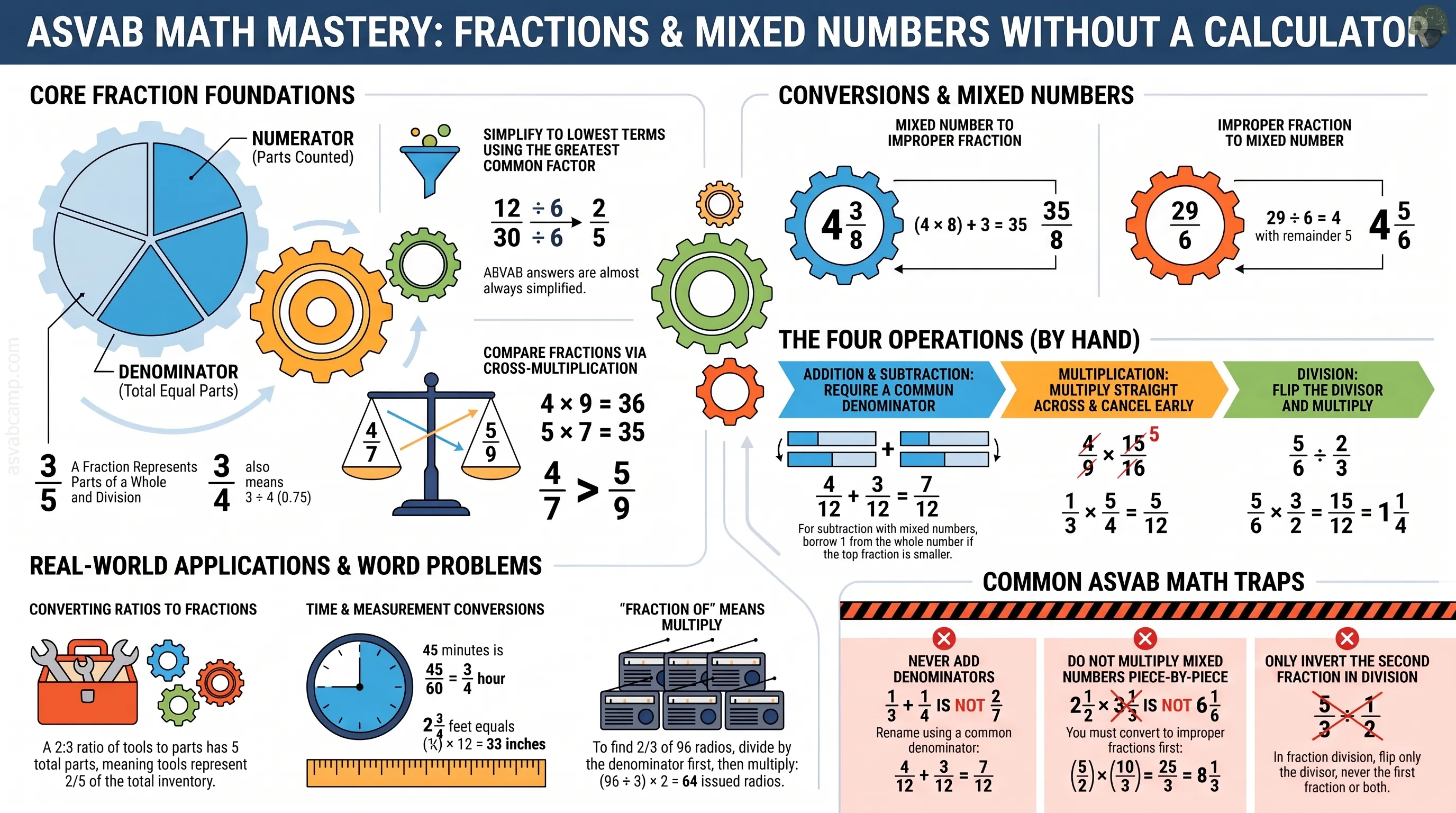
0:00 Welcome to this explainer. Okay, we're jumping right into a topic today that makes a lot of people break into a cold sweat, mastering ASVAB fractions. Now, if you're gearing up for the ASVAB, you already know the deal. Calculators are strictly banned. You've got to do the math by hand or in your head. But seriously, don't worry. We are going to take a very patient step-by-step approach to building up your confidence. By the time we wrap up, you'll be able to tackle these fraction problems completely without a calculator, relying entirely on the foolproof strategies we're about to build together. Here is our game plan for today. We'll start with fraction basics, move on to core math operations, and then dive into our no calculator strategy. After that, we'll walk through some step-by-step worked examples, look at how to avoid common fraction traps, and finally, we'll do a check yourself practice so you can test your skills. All right, let's kick things off with section one. Fraction basics and really understanding the parts. Before we even think about calculating anything, we need to understand the actual anatomy of a fraction. The bottom number is your denominator.

1:02 Think of it as setting the rules. It tells you exactly how many equal parts make up one whole. The top number is your numerator, which simply tells you how many of those parts you're actually counting. So say a tank is three-fifths full. Mentally, the whole tank is divided into five equal bands, and three of them are filled. Makes sense, right? Now, a super crucial skill on the ASVAB is simplifying. Mostly because the answer choices are almost always going to be in their simplest form. To get there, you just divide both the top and the bottom by their greatest common factor. Look at 12 over 30. The absolute largest number that divides evenly into both 12 and 30 is six. Divide them both by six, and you get two fifths. They represent the exact same value just with smaller, way friendlier numbers. Core fraction math operations. We're talking add, subtract, multiply, and divide. Now that we've got our basic definitions down, let's look at addition. The biggest thing to remember is that fractions can only be added together when they count the exact same size parts. That means you absolutely have to find a common denominator first.

2:08 Take two-thirds plus one-sixth. We can't just mash those together. We have to convert two-thirds into four-sixth. Now that both fractions share a denominator of six, it's a breeze. We simply add the numerators straight across. Four plus one is five. Giving us our final answer of five-sixth. Subtraction? Well, it works the exact same way. You need that common denominator before you can do anything else. Here we have five-sixths minus three-eighths. The smallest number that both six and eight can divide into is twenty-four, so we convert five-sixths to twenty over twenty-four and three-eighths to nine over twenty-four. Subtract the numerators, twenty-minus-nine, and we get eleven-twenty-fourths. Honestly, multiplication is actually easier. For multiplication, you don't need a common denominator at all. You literally just multiply straight across. But here is the secret sauce for doing this without a calculator. Cancel out shared factors first to keep the numbers small. Take four-ninths times fifteen-sixteenths. Before multiplying, notice that the four on top and the sixteen on the bottom share a factor of four.

3:14 Cross them out, leaving a one and a four. Now look at fifteen and nine. They share a factor of three. Cross those out, leaving a five and a three. Suddenly, instead of big, messy numbers, we're just multiplying one-third by five-fourths, which smoothly gives us five-twelfths. Okay, now for division. The rule here is incredibly simple. It's just keep, change, flip. Keep the first fraction exactly as it is. Change the division sign to multiplication and turn only the second fraction upside down. So five-sixths divided by two-thirds becomes five-sixths times three-halves. Multiply straight across to get fifteen-twelfths. When we simplify that improper fraction, we get one and three-twelfths. And hey, that reduces perfectly down to one and one-fourth. Let's move to section three. Applications and our no-calculator strategy. This is where we build mental math mastery. Word problems on the ASVAB is really going to test you. But if you memorize these four simple rules, it makes the math totally manageable. First, simplify early and often.

4:18 Always cancel common factors before you multiply. Second, whenever a word problem asks for a fraction of something, 'of' is your trigger word to multiply. Third, always use the smallest common denominator you can find to save yourself from nasty, complex arithmetic. And fourth, estimate using benchmarks, like one-half or one, just to quickly check if your final answer even makes logical sense. All right, section four. Step by step worked examples. Let's put these strategies to work. Let's look at our first real example. Imagine two boards laid end to end. One is three and five eighths feet long. And the other is two and three quarters feet long. What's the total length? The phrases 'end to end' and 'total' Tell us right away this is an addition problem involving mixed numbers. So let's solve it together. We need a common denominator for the fractional parts. And eight works perfectly. We change two and three quarters into two and six eighths. Now add the whole numbers. Three plus two is five. Add the fractions. Five eighths plus six eighths is eleven eighths. But watch out.

5:21 Eleven eighths is an improper fraction. It's actually hiding another whole number inside it. So five and eleven eighths becomes six and three eighths feet. Let's look at another one. Say a cook has five cups of rice. Each serving uses two-thirds of a cup. How many full servings can be made? We're trying to figure out how many smaller pieces fit into a total, which means we need to set up a division problem. We set up five divided by two-thirds. Remember our keep-change-flip rule? So it becomes five times three halves. Five times three is fifteen, so we get fifteen halves. When we divide fifteen by two, we get seven with a remainder of one. So seven and a half. But look really closely at the original question. It asked for full servings. You can't hand someone a half serving and call it full. So the final correct answer here is exactly seven full servings. Avoiding common fraction traps. You definitely want to steer clear of these mistakes. Adding denominators. The test makers love setting this trap. Look at the left side. One-third plus one-fourth does not equal two-sevenths.

6:25 You can never ever just add denominators together. Because the parts are completely different sizes. You have to follow the right side. Rename them with a common denominator of twelve. Four-twelfths plus three-twelfths equals seven-twelfths. Do not fall for the trap on the left. Multiplying mixed numbers piece by piece. Look at the left. Two and a half times three and a third. You might be super tempted to just multiply the whole numbers to get six and the fractions to get one-sixth. Wrong. That completely leaves out parts of the math. Look at the right side. You must always convert them to improper fractions first. You get five halves times ten-thirds. Multiply straight across for fifty sixths. Simplify that down to twenty-five-thirds. And that ultimately gets you to eight and one-third. See? A totally different answer. All right. We've made it to section six. Check yourself practice. Time for a little independent practice to see how you're feeling. A repair crew has finished 24 of its 40 assigned work orders. What fraction is finished in simplest form? I want you to go ahead and pause this explainer right now. Grab a pencil and actually try solving this by hand before you hit play again.

7:31 Okay, we're back. The correct answer is three-fifths. Really great job if you realize that the initial fraction is twenty-four over forty. And then remembered our rule to find the greatest common factor. Both numbers divide evenly by eight. Twenty-four divided by eight is three, and forty divided by eight is five. Let's try one final question. A storeroom holds 64 batteries. If three-eighths of them are issued to a patrol, how many batteries are issued? Again, hit pause? Think really carefully about what the word 'of' triggers in a word problem and calculate your answer without using a calculator. All right, let's see how you did. The correct answer is 24 batteries. Since of means multiply, we needed to find three-eighths of 64. Our no calculator strategy tells us to divide by the denominator first to keep the numbers nice and small. 64 divided by eight is eight. Then just multiply that by the numerator. Eight times three equals 24 perfectly. Look at that. You just conquered ASVAB fractions entirely by hand, which kind of makes me wonder, with this step-by-step approach under your belt, what other math fears are you ready to conquer next?

Visual lesson

Lesson slides

16 slides
Fractions and Mixed Numbers – slide 1 of 16

Lesson Goal

In this lesson you will learn what a fraction means, how to simplify and compare fractions, and how to switch between improper fractions and mixed numbers.

You will add, subtract, multiply, and divide fractions by hand, find a fraction of a quantity, and use fractions in measurement, ratio, and rate word problems of the kind that appear on the ASVAB.

What a Fraction Represents

A fraction names equal parts of a whole. In , the bottom number, the denominator, says the whole is cut into 5 equal parts, and the top number, the numerator, says 3 of those parts are counted. If a fuel can is full, picture it divided into five equal bands with three filled.
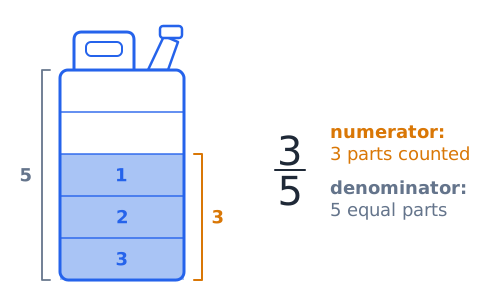
A jerrycan-shaped fuel can divided into 5 equal bands with the bottom 3 filled, next to the fraction 3/5: the numerator 3 is the parts counted and the denominator 5 is the equal parts.

A fraction is also a division: means , which is 0.75. This link to division is what makes fractions useful in rate and ratio problems.

Equivalent Fractions and Simplest Form

Multiplying or dividing the top and bottom of a fraction by the same nonzero number produces an equivalent fraction, one with the same value. For example,
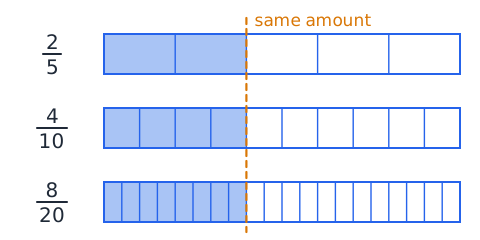
Three equal bars cut into fifths, tenths and twentieths with 2/5, 4/10 and 8/20 shaded; all three shaded lengths end at the same line, so the fractions are equal.

To reach simplest form, divide both parts by their greatest common factor. For , the greatest common factor is 6:

ASVAB answer choices are almost always in simplest form.

Comparing Fractions

With equal denominators, the larger numerator is the larger fraction. Otherwise, rewrite with a common denominator or cross-multiply.

To compare and , compute

and

Since 36 is greater, is larger.

Benchmarks help too: a fraction whose numerator is more than half its denominator is greater than .
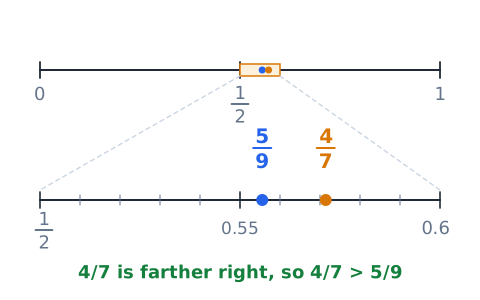
A 0-to-1 number line with the stretch from 1/2 to 0.6 enlarged: 5/9 and 4/7 both lie just above 1/2, with 4/7 farther right, so 4/7 > 5/9.

Improper Fractions and Mixed Numbers

An improper fraction has a numerator at least as large as its denominator, such as . A mixed number combines a whole number and a proper fraction, such as .

To change a mixed number to an improper fraction, multiply the whole number by the denominator and add the numerator:
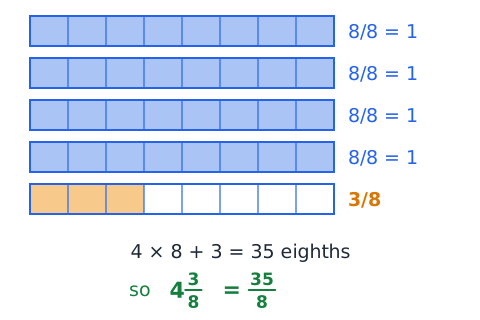
so
Four bars of 8 eighths each fully shaded (8/8 = 1) and a fifth bar with 3 eighths shaded: 4 × 8 + 3 = 35 eighths, so 4 3/8 = 35/8.

To go the other way, divide: is 4 remainder 5, so

Adding Fractions

Fractions can be added only when they count the same size of part, so first find a common denominator, then add the numerators and keep the denominator.
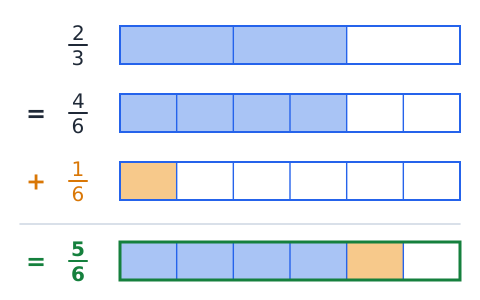
Fraction bars: 2/3 re-cut into sixths is 4/6; adding 1/6 gives 5/6 shaded.

For mixed numbers, add wholes and fractions separately:

Subtracting Fractions

Subtract the same way: common denominator first, then subtract numerators.

With mixed numbers, borrow 1 from the whole part when the top fraction is too small: becomes
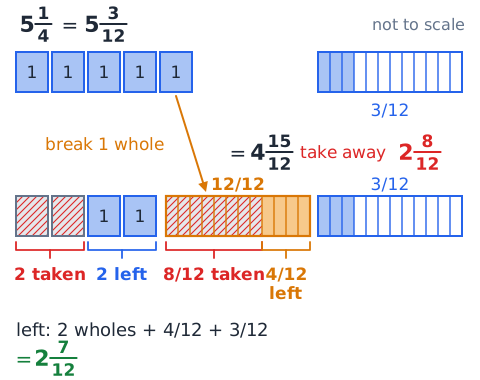
Borrowing bars (not to scale): 5 1/4 = 5 3/12 is five wholes and 3/12; one whole is broken into 12/12 to make 4 15/12; taking away 2 wholes and 8/12 (hatched grey) leaves 2 wholes, 4/12 and 3/12 = 2 7/12.

Multiplying Fractions

To multiply fractions, multiply the numerators together and the denominators together. No common denominator is needed.

Cancel common factors first to keep numbers small. In , 4 and 16 share a factor of 4, and 15 and 9 share a factor of 3:
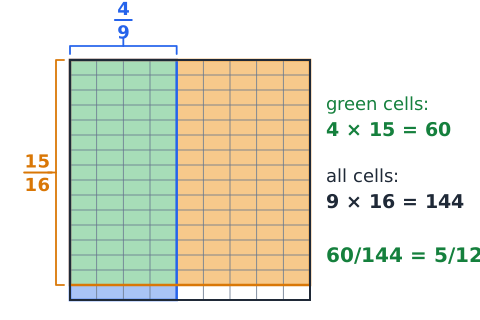
Area model for 4/9 × 15/16: a unit square cut into 9 columns and 16 rows (9 × 16 = 144 cells); 4 columns shaded blue and 15 rows shaded orange overlap in 4 × 15 = 60 green cells, and 60/144 = 5/12.

Change mixed numbers to improper fractions before multiplying.

Dividing Fractions

To divide by a fraction, multiply by its reciprocal, the fraction turned upside down. Keep the first fraction, change division to multiplication, and flip the second fraction.
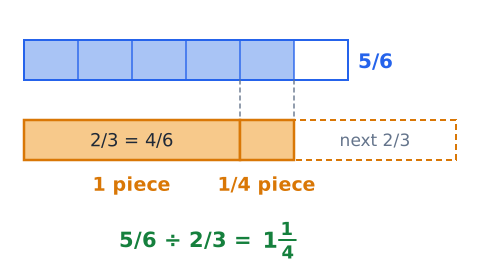
A bar in sixths with 5/6 shaded; one 2/3 piece (4/6) fits, and the remaining 1/6 is 1/4 of a second 2/3 piece, so 5/6 ÷ 2/3 = 1 1/4.

Only the divisor is flipped. Convert mixed numbers first.

Fractions of Quantities

"A fraction of" a quantity means multiply. To find of 144, divide by the denominator and multiply by the numerator:

Dividing first keeps the numbers small. The result should be less than the quantity whenever the fraction is less than 1.

Fractions in Measurement and Units

Measurements often come as fractions. Use the conversion factor as a multiplier: feet is

inches

Time works the same way. Since an hour has 60 minutes, 45 minutes is

hour

and 20 minutes is hour.

Rulers marked in sixteenths and recipes in cups also use fractions, so simplify answers like inch to inch.
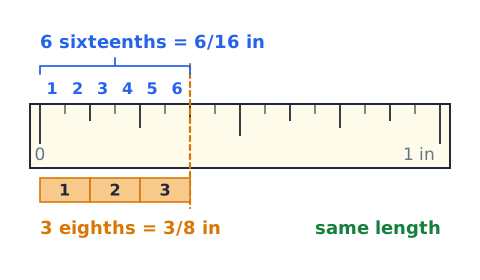
A 1-inch ruler marked in sixteenths: 6 sixteenths reach the same mark as 3 eighths, so 6/16 in = 3/8 in.

Fractions, Ratios and Rates

A ratio can be turned into fractions of the total. If tools and spare parts are in the ratio 2:3, there are 5 parts in all, so tools make up of the total.
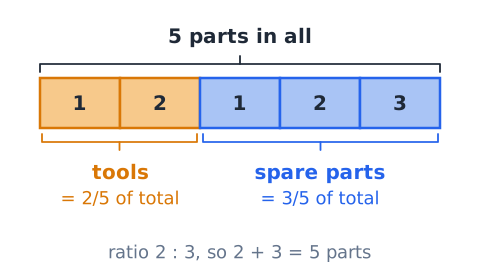
A tape of 5 equal parts for the ratio 2 : 3: 2 parts are tools (2/5 of total) and 3 parts are spare parts (3/5 of total).

A rate can involve fractions too. A patrol that walks mile in hour moves at

No-Calculator Fraction Strategy

Simplify early and often. Cancel common factors before multiplying, and reduce answers so they match the choices.

Pick the operation from the story first. "Of" means multiply, "how many pieces fit" means divide, and combining or removing amounts means add or subtract with a common denominator.

Use the smallest common denominator you can find; the product of the denominators always works but makes the numbers larger. Convert mixed numbers to improper fractions before multiplying or dividing.

Finally, estimate with benchmarks such as and 1 to check whether your answer is a reasonable size.

Worked Example 1 — Mixed Measurement

Problem: two boards, ft and ft, are laid end to end. What is the total length?

Step 1: Get a common denominator. Eighths and fourths do not match, so change fourths to eighths by multiplying top and bottom by 2:

Step 2: Add the whole numbers and the fractions separately.

So the sum is .

Step 3: Fix the improper fraction. 11/8 is more than 1 whole: 8 eighths make 1, with 3 eighths left over.

Answer: ft.
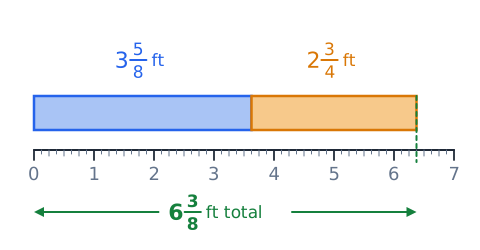
Two boards laid end to end on a ruler in feet: 3 5/8 ft and 2 3/4 ft together reach 6 3/8 ft total.

Check: estimate. The boards are a little more than 3.5 ft and 2.75 ft, about 6.4 ft total. ft is 6.375 ft, which is close.

Worked Example 2 — Fraction of Inventory

Problem: a section has 96 radios and issues of them. How many remain?

Step 1: Find one third of the radios. The bottom number 3 tells you to split into 3 equal groups:

Step 2: Find two thirds. The top number 2 means take 2 of those groups:

So 64 radios are issued.

Step 3: Subtract to find what remains.

Answer: 32 radios remain.
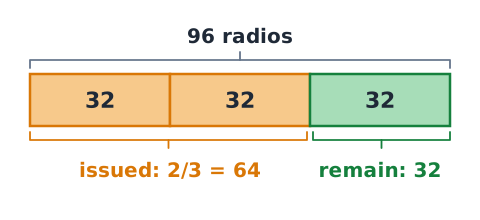
A bar of 96 radios split into 3 equal groups of 32; two groups (2/3 = 64) are issued and one group of 32 remains.

Check: if 2/3 are issued, then

remain, and one third of 96 is 32. It matches.

Worked Example 3 — Combined Fractions

Problem: a crew paints of a fence Monday and Tuesday. What fraction is left?

Step 1: Find a common denominator. The smallest number that both 3 and 5 divide into is 15.

Step 2: Add to find how much is done. Add the tops, keep the bottom:

Step 3: Subtract from the whole fence. The whole fence is 1, which is 15/15:

Answer: of the fence is left.
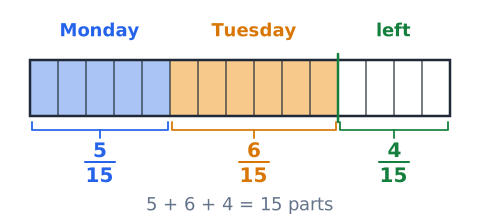
A fence divided into 15 equal parts: 5/15 painted Monday, 6/15 painted Tuesday and 4/15 left; 5 + 6 + 4 = 15 parts.

Check: Monday 5 parts, Tuesday 6 parts, left 4 parts:

parts, the whole fence.

Worked Example 4 — Division by a Fraction

Problem: a cook has 5 cups of rice. Each serving uses cup. How many full servings can be made?

Step 1: Decide the operation. "How many servings fit in 5 cups" means divide 5 by 2/3.

Step 2: To divide by a fraction, flip it and multiply. The flip of 2/3 is 3/2:

Step 3: Turn 15/2 into a mixed number. 2 goes into 15 seven times (14), with 1 left over:

Step 4: Only whole servings count, so drop the half serving.

Answer: 7 full servings.
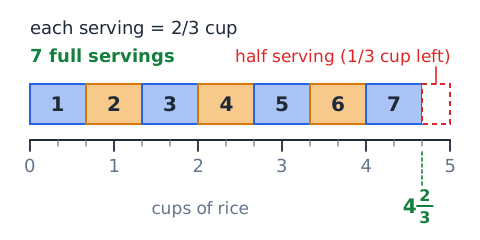
A scale from 0 to 5 cups marked in thirds, with 7 full servings of 2/3 cup each ending at 4 2/3 cups and a half serving (1/3 cup) left over between 4 2/3 and 5 cups.

Check: 7 servings use

cups

which fits in 5 cups. An 8th serving would need

cups

which is too much.

Worked Example 5 — Multi-Step Fraction Problem

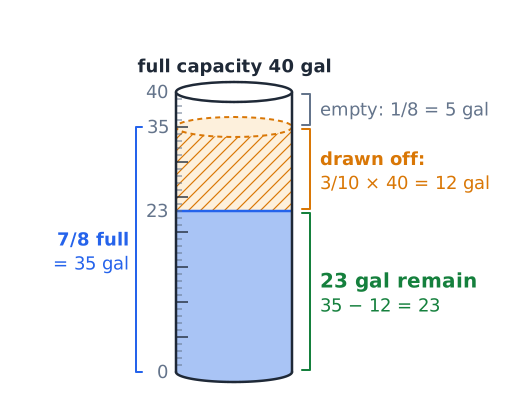
Problem: a 40-gallon drum is full. A crew draws off an amount equal to of the drum's full capacity. How many gallons remain?

Step 1: Find the fraction left. Subtract, using a common denominator. The smallest number both 8 and 10 divide into is 40:

Step 2: Turn the fraction into gallons. The drum holds 40 gallons, so multiply 23/40 by 40. The 40s cancel:

Answer: 23 gallons remain.

Check: work in gallons instead. The drum holds

gallons

The crew draws off

gallons
gallons

Same answer.

A 40-gallon drum with a gallon scale: filled 7/8 = 35 gal; the part from 35 down to 23 gal is drawn off (3/10 × 40 = 12 gal), 23 gal remain, and the top 5 gal (1/8) is empty.

Common Fraction Traps

Adding denominators: is not . The parts are different sizes, so rename them as twelfths:
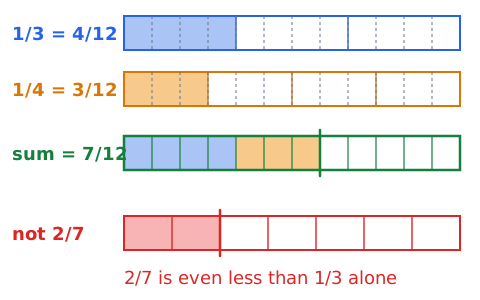
Bars of equal length: 1/3 = 4/12 and 1/4 = 3/12 re-cut into twelfths add to 7/12, while 2/7 (2 of 7 parts) is even less than 1/3 alone, so 1/3 + 1/4 is not 2/7.

Flipping the wrong fraction: in a division, only the second fraction, the divisor, is inverted.

Multiplying mixed numbers piece by piece: is not . Convert first:

Skipping the borrow: when the fraction being subtracted is larger, borrow 1 whole from the mixed number first.

Expecting multiplication to enlarge: multiplying a positive number by a proper fraction makes it smaller, and dividing by one makes it larger.

Quick Review

A fraction counts equal parts: the denominator tells how many parts make the whole, and the numerator tells how many are taken. It also stands for division.

Equivalent fractions come from multiplying or dividing the top and bottom by the same number; simplest form uses the greatest common factor. Compare fractions with a common denominator, cross-multiplication, or benchmarks.

Change a mixed number to an improper fraction by multiplying the whole by the denominator and adding the numerator; reverse by dividing.

Add and subtract only with a common denominator, borrowing when needed. Multiply straight across after canceling. Divide by multiplying by the reciprocal of the divisor.

"Of" means multiply, and fractions show up in measurements, time, ratios, and rates. Simplify, then check the size of the answer.

Quick review

In a fraction, what do the numerator and denominator tell you?
The denominator (bottom) is how many equal parts make the whole; the numerator (top) is how many parts are counted. A fraction is also a division: .
How do you put a fraction in simplest form?
Divide the top and bottom by their greatest common factor: .
How can you tell which is larger, or ?
Cross-multiply: and . The larger product goes with , so is larger.
How do you change a mixed number to an improper fraction?
Multiply the whole number by the denominator, add the numerator, and keep the denominator: .
Why is not ?
Denominators are never added. Rename both with a common denominator, then add numerators: .
How do you multiply fractions?
Multiply numerators together and denominators together; no common denominator is needed. Cancel shared factors first: .
How do you divide by a fraction?
Keep the first fraction, change division to multiplication, and flip only the divisor: .
Can you multiply mixed numbers whole part by whole part?
No. Convert to improper fractions first: , not .

What next?

← Previous: Whole-Number Operations and Order of Operations

About this lesson

Arithmetic Reasoning is one of the four subtests that make up the AFQT, and calculators are not allowed on the ASVAB, so clean fraction work by hand matters. Five worked examples walk through mixed measurements, a fraction of inventory, combined fractions, division by a fraction and a multi-step problem. A no-calculator fraction strategy and a list of common fraction traps help you avoid the slips that cost points on word problems.

Finish with the Quick Review, then take the Fractions and Mixed Numbers lesson test to check what stuck before moving on to decimals.

Take it with you: the free app

The same 124 lessons, 6,516 questions and 82 timed practice tests on your phone, plus flashcards with spaced review and progress tracking. Free to download, and it works offline.

  • Works offline
  • Spaced-review flashcards
  • Progress for every subtest
  • Menus in 59 languages
ASVAB Camp appGoogle Play