ASVAB Camp Get the appGoogle Play
AR · lesson 6 of 12 · 34 min

Ratios and Proportions

Ratio and proportion problems reward a clear setup more than heavy arithmetic. In this 34-minute core lesson you learn what a ratio means, the difference between part-to-part and part-to-whole, how to simplify ratios and recognize equivalent ones, and what makes a proportion. A section on cross-multiplication correctly shows how to avoid placing numbers in the wrong spots.

Video lesson: Ratios and Proportions

Video transcript

0:00 Hey everyone, welcome to this explainer. Today we're tackling an absolutely crucial skill for your exam prep, and we're doing it with one very specific goal in mind, mastering ratios and proportions completely without a calculator. Look, if you're not super confident in math right now, seriously, don't sweat it. By the end of this, you're going to have the exact tools you need to look at these problems and just solve them confidently, either by hand or literally right in your head. Let's get into it. Here's our roadmap for today. We'll hit ratios and their basics, solving proportions effectively, applications and real world scaling, step-by-step worked examples, traps and common mistakes, and finally, some check yourself questions. All right, starting right off with section one, ratios and their basics. So, we're starting right at the foundation. What actually is a ratio? Well, it's a direct comparison of two quantities using division, and here is the kicker. The order absolutely matters. If a question asks for the ratio of A to B, you must write it as A to B, never B to A. This brilliantly illustrates the crucial difference between comparing two distinct groups to each other versus comparing one group to the sum total of all the parts.

1:04 Look at the left side here. We're comparing eight sedans to 12 trucks. That's a part-to-part ratio of eight to 12, which simplifies to two to three. But on the right side, we're comparing those eight sedans to all the vehicles on the lot. Because eight plus 12 equals 20 total vehicles, the part-to-whole ratio is eight to 20, simplifying down to two to five. So, pro tip, always, always read the question carefully to see if it's asking for a part or a whole. Simplifying ratios naturally brings us to this next concept. If you multiply or divide both terms by the exact same number, you get equivalent ratios. It's a pattern that's clearly visible in this ratio table. Notice how three to seven magically becomes six to 14 when we multiply both sides by two, or multiply by three and we get nine to 21. This underlying pattern, it is literally the secret engine behind everything we're about to do today. Solving proportions effectively. Now, what's really interesting is how we actually connect equal ratios together. A proportion simply tells us that two ratios match perfectly, meaning their cross-products will mathematically equalize.

2:15 Basically, if A over B equals C over D, then multiplying diagonally means A times D will always equal B times C. This right here is the golden rule of proportions. But wait, before you ever jump straight to cross multiplication, you should always check for a whole number scale factor first to save yourself some serious time. Take this equation. Seven over 12 equals X over 60. Sure, we could cross multiply, but that requires doing seven times 60 in our heads. Let's work smarter, not harder. Just look at the bottom numbers. Because 12 times 5 is exactly 60, we just multiply the top 7 by 5 to mentally solve for 35 without breaking a sweat. This scaling trick is incredibly powerful, especially when you don't have a calculator handy. Always look for that easy multiplier first. However, sometimes the numbers just don't scale perfectly in your head, or maybe you just prefer the concrete algebraic way of doing things. In those cases, we do need to cross multiply diagonally to find our missing variable. For example, here we have 5 over 12 equals X over 36.

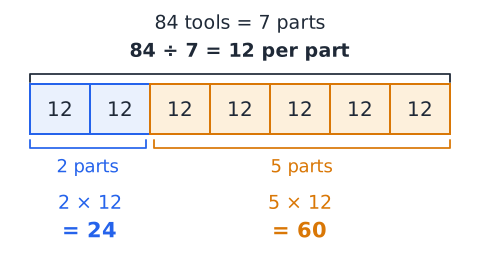
3:17 We simply multiply diagonally, 12 times X and 5 times 36, which is 180. So 12X equals 180. Dividing both sides by 12 gives us a final answer of 15. The biggest thing to remember here, multiply diagonally, never ever straight across the top or the bottom. Okay, section three, applications and real world scaling. Let's see how this builds into real world applications when you need to split a total using a ratio, because this is a really common scenario on exams. Let's say you need to divide 84 tools between two shops in a 2 to 5 ratio. By following three logical steps, we can confidently split that total of 84 tools into the correct 24 and 60 amounts. First up, add the ratio terms together. 2 plus 5 gives us 7 total parts. Second, divide your total by those parts. 84 divided by 7 means one single part equals 12 tools. Finally, multiply that 12 back into your original 2 and 5 ratio.

4:21 2 times 12 is 24, and 5 times 12 is 60. Boom, done. Step by step worked examples. Let's tackle a full multi-step word problem just like the ones you're actually going to face, taking it one line at a time. The problem states, rifles and pistols are in the ratio 7 to 3, and there are 28 more rifles than pistols. How many weapons in all? Now, do not let word problems intimidate you. Let's break it down. We have the ratio, we're given the difference in the amounts, and our end goal is finding the total. Notice they don't give us the total up front. They just tell us there are 28 more rifles than pistols, so how do we unlock this? We use the ratio's parts. Since the ratio difference is four parts, because 7 minus 3 is 4, we know that those four parts represent the 28 extra weapons, so we divide 28 by 4 to find that one single part equals 7 weapons. See that? We've just found our magic multiplier. So the absolutely crucial point here is multiplying our single part value, which is 7 by the original ratio numbers, to confidently arrive at 70 total weapons.

5:29 7 times 7 means 49 rifles. 3 times 7 means 21 pistols. Add them together, 49 plus 21, and we get our grand total of 70. Traps and common mistakes. Look, preventative teaching is vital, because exam writers absolutely love to test if you're paying attention to the details. Keep a mental checklist of these common pitfalls. Specifically, ensure you never multiply straight across, and that you always, always match your unit labels first. If you're comparing feet to inches, make sure you convert everything to inches before you even write the ratio. Also, be super careful with workers and time. More workers means less time to finish a job. Not more. That's an inverse relationship, so simple direct proportions will completely fail you there. All right, final section, section 6, check yourself questions. Now it's your turn to jump in the driver's seat and prove to yourself that you've got this. I'm going to read this question, and then I want you to literally hit pause and solve it mentally before I reveal the answer.

6:30 Okay, here we go. A training platoon has 14 sergeants and 35 privates. What is the ratio of privates to sergeants in simplest form? Is it A, 5 to 7, B, 5 to 2, C, 2 to 7, or D, 2 to 5? Go ahead and hit pause now. Okay, welcome back. The correct answer is B. Why? Because we must write terms in the exact order named. The prompt asked for privates to sergeants. Since there are 35 privates and 14 sergeants, it's 35 to 14. Dividing 35 and 14 by their greatest common factor, which is 7, simplifies it perfectly to 5 to 2. By the way, if you picked D, 2 to 5, you fell right into the reversed order trap. All right, here is your final test. Solve for x in the proportion, x over 8 equals 15 over 24. What is the value of x? Is it A, 3, B, 45, C, negative 1, or D, 5? Go ahead and hit pause now to calculate. And we're back. The correct answer is simply 5.

7:35 Did you get it right? You could have cross multiplied, doing 15 times 8 to get 120, and then dividing by 24 to get 5. Or you could have used our mental math scaling trick, proving you're now fully ready to dominate these questions without a calculator. Let's think about that scaling trick real quick. Looking at the denominators, 24 divided by 3 is 8, so just divide the top, 15 by 3 to get 5. Much faster than doing 15 times 8 in your head, right? You literally have all the tools you need now to scale, solve, and decode these problems. So my final question for you. Next time you see a ratio on a high stakes exam, are you going to try to calculate it the hard way, or will you look for the scale factor first? Keep practicing. You've totally got this. Thanks for hanging out and watching.

Visual lesson

Lesson slides

15 slides
Ratios and Proportions – slide 1 of 15

Lesson Goal

In this lesson you will write and simplify ratios, tell part-to-part ratios from part-to-whole ratios, and solve proportions by scaling or cross-multiplication.

You will also find unit rates, split totals by a ratio, and apply scale factors, map scales, and mixture recipes to ASVAB-style word problems.

What a Ratio Means

A ratio compares two quantities by division. The ratio of 4 to 9 can be written 4:9, "4 to 9," or .

Order matters. If a hangar has 12 pilots and 30 mechanics, the ratio of pilots to mechanics is 12:30, which simplifies to 2:5. The ratio of mechanics to pilots is 5:2, a different statement. Always write the quantities in the order the question names them.

Part-to-Part vs. Part-to-Whole

A part-to-part ratio compares one group with another group. A part-to-whole ratio compares one group with the total.

Example: a lot has 8 sedans and 12 trucks. Sedans to trucks is 8:12, or 2:3. Sedans to all vehicles is 8:20, or 2:5, because the whole is
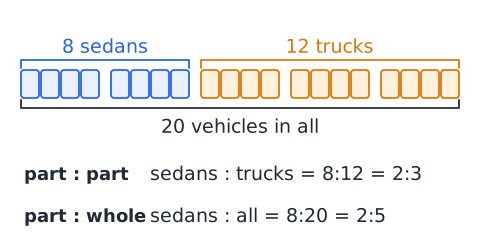
A row of 20 tiles in groups of 4: 8 sedans and 12 trucks; sedans to trucks is 8:12 = 2:3 (part to part) and sedans to all 20 vehicles is 8:20 = 2:5 (part to whole).

Read the question carefully: "to the total," "out of," and "of all" signal part-to-whole, and the whole is the sum of the parts.

Simplifying Ratios

Simplify a ratio the way you simplify a fraction: divide both terms by their greatest common factor. For 45:60, the greatest common factor is 15, so the ratio is 3:4.

If the quantities use different units, convert first. To compare 2 feet with 8 inches, write 24 inches to 8 inches, which is 24:8, or 3:1.

Equivalent Ratios

Equivalent ratios express the same comparison. Multiply or divide both terms by the same number: 3:7, 6:14, and 15:35 are all equivalent.

To test whether two ratios match, simplify both. For example, 9:21 reduces to 3:7, so it is equivalent to 3:7. A ratio table, listing multiples side by side, is a handy way to see the pattern.
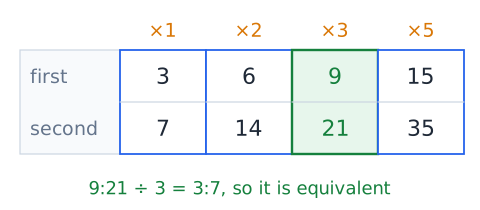
Ratio table with columns 3:7, 6:14, 9:21 and 15:35 (×1, ×2, ×3, ×5); 9:21 divided by 3 is 3:7, so it is equivalent.

What a Proportion Is

A proportion is an equation stating that two ratios are equal:

In a true proportion the cross products are equal, so

For example,

because

and

Cross-Multiplication Correctly

To solve a proportion with one unknown, multiply diagonally, set the products equal, and divide.

Cross products:
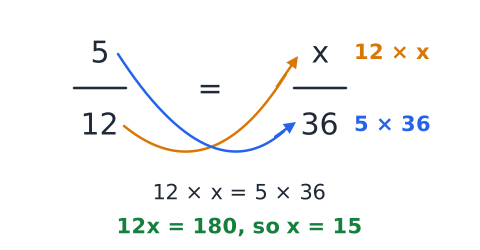
so
Proportion 5/12 = x/36 with two diagonal arrows crossing below the equals sign: orange from 12 to x (12 × x), blue from 5 to 36 (5 × 36); 12 × x = 5 × 36, so 12x = 180 and x = 15.

Another example:

gives
so

Multiply across the diagonal, never straight across the top or bottom.

Unit Rates

A unit rate tells how much for one unit of the second quantity. Divide the first quantity by the second:

Unit rates make comparisons easy. Six cans for 4.20 dollars is 0.70 dollar each, while 10 cans for 6.50 dollars is 0.65 dollar each, so the larger pack is the better buy.

Direct Proportion

Two quantities are in direct proportion when their ratio stays constant: if one doubles, the other doubles; if one is cut in half, so is the other.

Example: a printer outputs 36 pages in 4 minutes. Its rate is 9 pages per minute, so in 11 minutes it prints

pages.
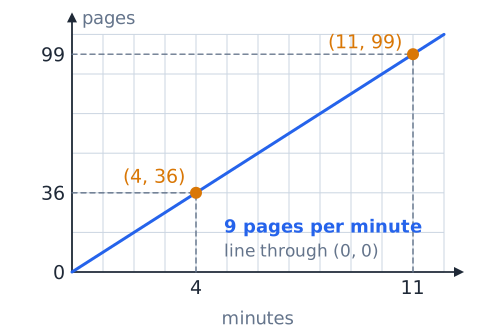
Graph of pages against minutes: a straight line through (0, 0) with points (4, 36) and (11, 99) marked; slope 9 pages per minute.

Before setting up a proportion, ask whether the situation is really direct. Cost and quantity at a fixed price are direct; workers and time to finish a job are not.

Ratio Totals Using Parts

When a ratio describes how a total is split, add the ratio terms to find the number of equal parts.

Example: 84 tools are divided between two shops in the ratio 2:5. There are

parts, so each part is

The shops get

and

tools.

A tape of 84 tools split into 7 equal parts; 84 ÷ 7 = 12 per part, so 2 parts give 2 × 12 = 24 and 5 parts give 5 × 12 = 60.

Finding the Missing Group From a Ratio

If you know one group's actual size, find the value of one ratio part from it, then build everything else.

Example: officers and enlisted members are in the ratio 2:9, and there are 18 officers. One part is

people, so enlisted members number
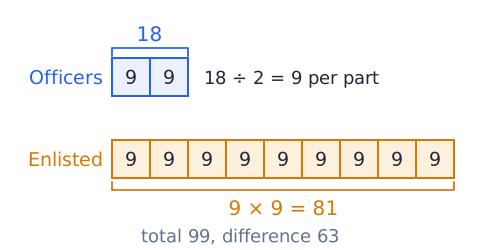
Bar model: Officers 2 parts totalling 18, so 18 ÷ 2 = 9 per part; Enlisted 9 parts of 9, so 9 × 9 = 81; total 99, difference 63.

From the same part value you can find the total,

or the difference,

Scale Factor

A scale factor is the number you multiply by to get from an original figure to a copy:

A triangle with sides 4, 6, and 8 that is enlarged to sides 10, 15, and 20 has

since every side was multiplied by 2.5. A factor greater than 1 enlarges, and one between 0 and 1 shrinks. Areas change by , here 6.25.
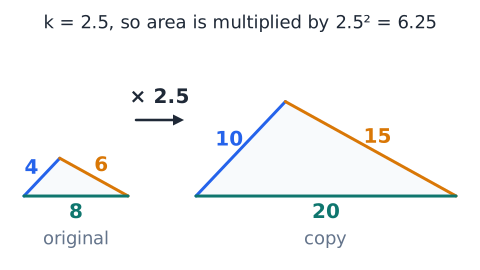
Two similar triangles drawn to scale: the original has sides 4, 6 and 8 and the copy has sides 10, 15 and 20, matching sides in the same colour; arrow labelled × 2.5, and k = 2.5, so area is multiplied by 2.5² = 6.25.

Maps and Scale Drawings

A map or drawing scale is a ratio between drawing length and real length. If 1 cm stands for 25 km, then a 6.4 cm measurement represents

km

To go the other way, divide: a real distance of 75 km is

cm

on the map. Keep drawing units and real units in their own positions.

Mixtures and Recipes

Mixtures and recipes keep ingredients in a fixed ratio. A concrete mix of cement, sand, and gravel in the ratio 1:2:4 has 7 parts. For 21 bags in all, each part is 3 bags, giving 3 cement, 6 sand, and 12 gravel.
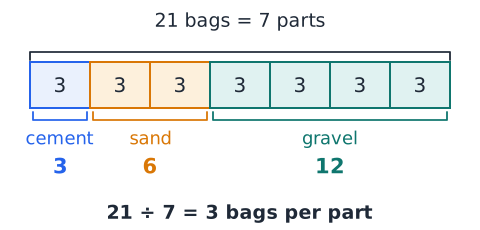
Tape of 21 bags in 7 equal parts of 3: cement 1 part (3 bags), sand 2 parts (6 bags), gravel 4 parts (12 bags); 21 ÷ 7 = 3 bags per part.

To scale a recipe, use a proportion. If 3 cups of flour make 12 biscuits, then for 30 biscuits:

Rates as Ratios

A rate is a ratio of two different units, such as gallons per minute. A pump that moves 18 gallons in 3 minutes has a rate of

A convoy covering 150 miles in 2.5 hours averages 60 miles per hour. Rates can be scaled like any ratio.

Choose Scaling Before Cross-Multiplication

Before cross-multiplying, look for a whole-number scale factor between matching terms. In

60 is 5 times 12, so

This is faster and has fewer chances for error.
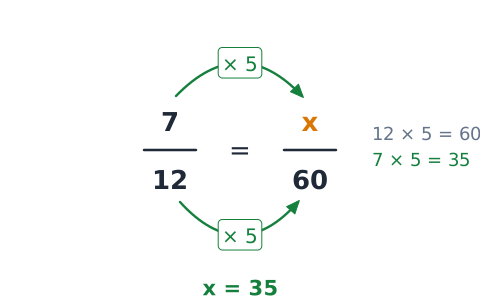
The proportion 7/12 = x/60 with a × 5 arrow from 12 to 60 along the bottom and a matching × 5 arrow from 7 to x along the top, so x = 7 × 5 = 35.

When no clean factor exists, as in

cross-multiply:

giving

Use Units to Build the Proportion

Write unit labels on every number before you build a proportion. If the left ratio is miles over hours, the right ratio must also be miles over hours.

Example: 96 miles in 2 hours, how far in 5 hours? Miles over hours on both sides gives 48 miles per hour, so 240 miles. Matching labels prevents an upside-down setup.

Worked Example 1 — Part-to-Whole Ratio

Problem: in a class of 36, the ratio of men to women is 4:5. How many women are in the class?
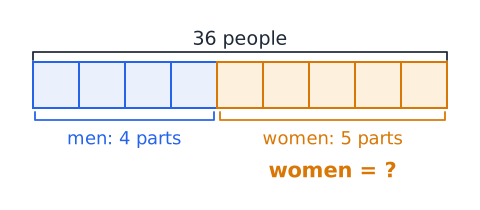
Bar of 9 equal parts for a class of 36 people: men 4 parts, women 5 parts; women = ?.

Step 1: Count the total parts in the ratio. Men are 4 parts and women are 5 parts:

Step 2: Find how many people one part stands for. Split the 36 people into 9 equal parts:

Step 3: Women are 5 parts, so multiply. (This is the same as taking 5/9 of the class.)

Answer: 20 women (and

men).

Check:

the whole class. Divide both counts by 4 to get 4:5, the given ratio.

Worked Example 2 — Constant Rate

Problem: a machine fills 72 bottles in 8 minutes. At that rate, how many does it fill in 25 minutes?
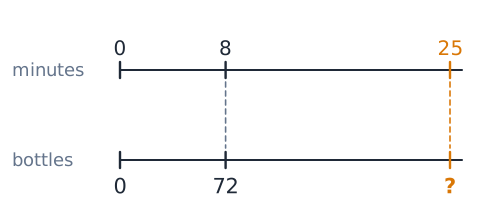
Double number line: 0, 8 and 25 minutes match 0, 72 and ? bottles.

Step 1: Find the rate for one minute. Divide the bottles by the minutes:

Step 2: Multiply the one-minute rate by 25 minutes. Break 25 into 20 + 5:

Answer: 225 bottles.

Check: 24 minutes is 3 times 8 minutes, so it fills

bottles. One more minute adds 9:

Same answer.

Worked Example 3 — Map Scale

Problem: a map scale is 1 inch = 40 miles. Two bases are 2.75 inches apart on the map. What is the real distance?

Step 1: Decide the operation. Every inch on the map stands for 40 real miles, so multiply the map inches by 40.
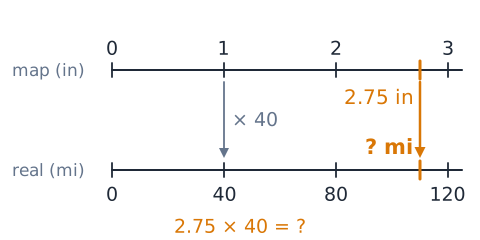
Double number line for the map scale 1 inch = 40 miles: 0, 1, 2, 3 inches match 0, 40, 80, 120 miles; an arrow from 2.75 inches points to ? miles (2.75 × 40 = ?).

Step 2: Split 2.75 into 2 + 0.75 to multiply in your head. 0.75 is three quarters, and a quarter of 40 is 10:

Answer: 110 miles.

Check: reverse it.

inches

Estimate: about 3 inches would be 120 miles, so 110 miles makes sense.

Worked Example 4 — Mixture

Problem: a paint is mixed with tint and base in the ratio 2:13. How much of each is needed for 45 liters?
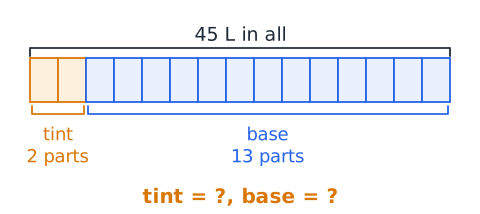
Bar of 15 equal parts for 45 L of paint: tint 2 parts and base 13 parts; tint ? and base ?.

Step 1: Count the total parts. Tint is 2 parts and base is 13 parts:

Step 2: Find the size of one part. Split the 45 liters into 15 equal parts:

Step 3: Multiply each part count by 3 liters.

Answer: 6 liters of tint and 39 liters of base.

Check:

liters

in all. Divide both amounts by 3 to get 2:13, the given ratio.

Worked Example 5 — Multi-Step Ratio

Problem: Crates A and Crates B are in the ratio 7:3, and there are 28 more Crates A than Crates B. How many crates are there in all?

Step 1: Think of the ratio as parts. Crates A get 7 parts and Crates B get 3 parts. Find how many more parts Crates A have.

Step 2: Those 4 extra parts are the 28 extra Crates A. Divide to find the size of one part.
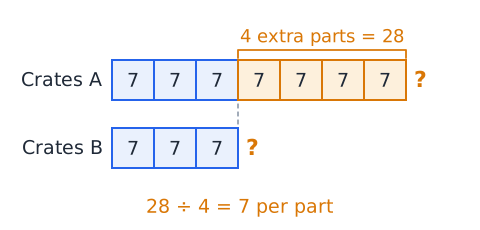
Bar model: Crates A have 7 parts and Crates B have 3 parts; the 4 extra parts equal 28, so 28 ÷ 4 = 7 per part; the totals of each row are marked ?.

So one part is 7 crates.

Step 3: Multiply each side of the ratio by 7.

Step 4: Add to get the total.

Answer: There are 70 crates in all.

Check:

49 − 21 = 28

so there really are 28 more Crates A. Also 49 : 21 divides by 7 to give 7 : 3. Both facts match.

Common Ratio and Proportion Traps

Reversed order: writing the ratio of B to A when the question asks for A to B. Write the terms in the order named.

Part versus whole: using one group as the denominator when the question asks for a fraction of the total. Add the parts to get the whole.

Straight-across multiplying: in

multiplying 3 by 4 is meaningless. Multiply diagonally:

so

Mismatched units: comparing feet with inches or minutes with hours without converting first.

Treating a ratio term as a count: in a 2:5 ratio, there are not necessarily 2 of anything. Find the value of one part first.

Assuming direct proportion: more workers usually means less time, not more, so a simple proportion does not apply.

Quick Review

A ratio compares two quantities in a fixed order. Part-to-part ratios compare groups; part-to-whole ratios compare a group with the total, which is the sum of the parts.

Simplify ratios with the greatest common factor, after converting to the same units. Equivalent ratios come from multiplying or dividing both terms by the same number.

A proportion sets two ratios equal; solve it by finding a scale factor or by cross-multiplying. A unit rate is the amount per one unit and makes comparisons easy.

To split a total, add the ratio terms, find one part, and multiply. Scale factors, map scales, mixtures, and recipes all use the same reasoning. Label units on every number.

Quick review

What is the difference between part-to-part and part-to-whole ratios?
Part-to-part compares one group with another (8 sedans to 12 trucks is 2:3). Part-to-whole compares a group with the total, which is the sum of the parts (8 to 20 is 2:5).
How do you simplify the ratio of 2 feet to 8 inches?
Convert to the same unit first, then divide by the greatest common factor: 24 inches to 8 inches is 24:8, which is 3:1.
In a proportion , what must be true?
The cross products are equal: . For , , so . Multiply diagonally, never straight across.
How do you split 84 tools between two shops in the ratio 2:5?
Add the terms to get 7 parts, find one part (), then multiply: and tools.
Rifles to pistols is 7:3, with 28 more rifles than pistols. Total?
The difference is parts, so one part is . Rifles: 49, pistols: 21, total: 70. Ratio terms are not counts until you find one part.
What is a scale factor, and how does it change area?
; enlarges and shrinks. Areas change by : with , the area becomes 6.25 times as large.
When does a simple direct proportion NOT apply?
When the quantities do not rise together at a constant ratio, such as workers and time to finish a job: more workers means less time. Cost and quantity at a fixed price are direct.
Solve without cross-multiplying.
60 is 5 times 12, so scale the numerator by 5 as well: . Look for a whole-number scale factor before cross-multiplying.

What next?

← Previous: Percentages

About this lesson

Next come unit rates, direct proportion, ratio totals using parts, and finding a missing group from a ratio. Applications include scale factor, maps and scale drawings, mixtures and recipes, and rates as ratios. Two strategy sections, choosing scaling before cross-multiplication and using units to build the proportion, help you solve faster on an AFQT subtest where time is tight.

Worked examples cover a part-to-whole ratio, a constant rate, a map scale, a mixture and a multi-step ratio. After the common traps and Quick Review, take the Ratios and Proportions lesson test to see where you stand.

Take it with you: the free app

The same 124 lessons, 6,516 questions and 82 timed practice tests on your phone, plus flashcards with spaced review and progress tracking. Free to download, and it works offline.

  • Works offline
  • Spaced-review flashcards
  • Progress for every subtest
  • Menus in 59 languages
ASVAB Camp appGoogle Play