ASVAB Camp Get the appGoogle Play
AR · lesson 7 of 12 · 32 min

Averages and Weighted Thinking

Average questions on the ASVAB rarely ask you to just add and divide. This 32-minute core lesson starts with what an average represents and finding a simple mean, then introduces the key tool for harder items: average times count equals total. You use it to find a missing value and to handle combined averages from two groups.

Video lesson: Averages and Weighted Thinking

Video transcript

0:00 Welcome to this explainer. I'm absolutely thrilled you're here. Look, if you're gearing up for the arithmetic reasoning section of the ASVAB, or honestly, just brushing up on some essential math skills, and the mere thought of tackling word problems without a calculator makes your stomach tie up in knots, take a deep breath. You are in exactly the right place. Today, we're going to completely master averages, average speed, missing values, and even mixture concentrations. And we're going to do it all by hand. No stress, no calculators. I promise, by the end of this explainer, you're going to look at these exact types of problems and know exactly what to do. So, let's dive right in. Here's our game plan for today. We'll start with one, foundations of the mean, then move to two, combined and weighted averages, three, average speed and mixtures, four, estimation and worked examples, five, avoiding common average traps, and we'll wrap up with six, check yourself, just to make sure it all stuck. Alright, let's kick things off with section one, foundations of the mean. So, in plain English, what is a mean? Well, the mean, which is really just a fancy word for average, is simply the value each item would have if the total amount were shared out perfectly equally.

1:11 I like to think of it as the balance point for your data. Some numbers are going to sit above this mean, and some will sit below it. But overall, those higher and lower amounts perfectly balance each other out. It really is that simple. Okay, so how do we actually find a simple mean without relying on a calculator? Let's say we're looking at a squad's push-up counts, 12, 15, 9, 20 and 14. Step one, we add all those values together. Watch how easy this is. 12 plus 15 is 27, add 9, you get 36, plus 20 is 56, and finally, adding 14 gives us a total of 70. Step two, we just count the values. We have five push-up counts in total. Step three, divide the total sum by the count. 70 divided by five equals 14. Boom, that's our mean. Oh, and here's a really quick pro tip. Your mean will always, always land somewhere between your smallest value, which here was nine, and your largest value, which was 20. Combined and weighted averages. Okay, listen up because if you only remember one single thing from this entire explainer, make it this equation.

2:18 Average times count equals total. This right here, this is your secret weapon. Almost every complex average problem on the test becomes dramatically easier if you just switch your brain to finding the totals first. Think about it, even if you never see the individual numbers, if you know you have six deliveries that average 45 minutes each, you instantly know the total time is six times 45, which is 270 minutes. And this brilliantly illustrates why that secret weapon is so absolutely crucial. When you combine two groups of different sizes, you cannot, and I mean cannot just average the averages. That is a huge classic trap. Instead, we rely on our totals rule. Let's say 15 recruits average a score of 60, and another 25 recruits average 68. First things first, find total one. 15 times 60 gives us 900. Next, find total two. 25 times 68 is 1,700. Step three, add those two totals together. 900 plus 1,700 gives us a grand total of 2,600. Finally, divide by the total number of people which is our 15 plus 25, giving us 40 recruits.

3:29 2,600 divided by 40 is 65. See, if you had just lazily averaged 60 and 68, you'd get 64, which is totally wrong. Totals first, always. Average speed and mixtures. Now, let's talk about average speed. What's really fascinating here is the difference between equal time and equal distance. If you spend equal amounts of time at each speed, let's say exactly one hour at 40 miles per hour and exactly one hour at 60, you actually can just take a simple average. 100 divided by 2 is 50 miles per hour. But if equal distances are covered, beware, that is a trap. Because you naturally spend more of your time driving at the slower speed, the true average is actually going to be lower than the simple average. When in doubt, always, always use total distance divided by total time. And guess what? The exact same totals logic applies to mixtures, too. Let's ground ourselves with a quick definition. Mixture concentration is simply the percent of a solution that is the pure ingredient.

4:33 To find that pure amount, you just multiply the concentration by the volume. So if you have 12 liters of a 25% antifreeze solution, you just multiply 0.25 times 12. That gives you three liters of pure antifreeze. Seriously, just think of the volume as your count and the concentration as your average. It's literally the exact same math. All right, section four, estimation and worked examples. Time to put this into practice. First, I want to show you a fantastic calculator free trick that is going to save you so much valuable time. If you need to average a cluster of numbers like 88, 92, 95, 89, and 91, do not add them all up. Instead, pick a friendly baseline near the middle. Let's go with 90. Now, just find the differences from that 90. 88 is minus 2. 92 is plus 2. 95 is plus 5. 89 is minus 1. And 91 is plus 1. Sum up those tiny differences. Look how easy this is. The minus 2 and plus 2 cancel out. Minus 1 and plus 1 cancel out. You are literally just left with plus 5. Divide that plus 5 by your 5 values, which gives you a clean plus 1.

5:40 Add that back to your 90 baseline. And boom, your mean is 91. I mean, how incredibly fast was that? OK, let's look at worked example one, the missing score. Three quiz scores average 76. What fourth score raises the average to an 80? Time to bust out our secret weapon. Step one, find the needed total. Four scores averaging 80 means we need four times 80, which is 320 points. Step two, find our current total. Three scores averaging 76 is 3 times 76, which is 228 points. Step three, subtract. 320 minus 228 is 92. Simple as that. The fourth score must be 92. Combined groups. A morning shift of nine workers averages 42 units. And an evening shift of six workers averages 52 units. What's the total average? Say it with me now, totals first. Shift one. Nine times 42 is 378. Shift two, six times 52 is 312. Add our totals together.

6:43 378 plus 312 is 690 total units. Finally, divide by the total number of workers, which is nine plus six or 15. 690 divided by 15 is 46 units. So the combined average is 46. Worked example three is all about weighted grades. Here, some values count more than others. Homework is 20%, the midterm is 30%, and the final is 50%. The student scores are 85, 70, and 90. Now, because those percents beautifully add up to exactly 100, we just multiply and add. Homework, 0.20 times 85 is 17. Midterm, 0.30 times 70 is 21. Final, 0.50 times 90 is 45. Add them all up, 17 plus 21 plus 45 equals 83. That's the final weighted grade, calculated completely effortlessly. Let's check out worked example four, average speed. A driver goes 150 miles at 50 miles per hour and returns the exact same 150 miles at 75 miles per hour. What's the average speed?

7:46 Remember the trap here? Don't you dare just average 50 and 75. We need total distance over total time. Time one, 150 miles divided by 50 miles per hour is three hours. Time two, 150 miles divided by 75 miles per hour is two hours. Total distance both ways is 300 miles. Total time is five hours. 300 divided by five is 60 miles per hour. It is definitively not 62.5. And our final example, mixtures. Eight liters of a 15% solution is mixed with two liters of a 40% solution. What's the new concentration? You guessed it, find the pure amounts first. 0.15 times eight liters is 1.2 liters. 0.40 times two liters is 0.8 liters. Add those pure amounts together. 1.2 plus 0.8 equals 2.0 liters of pure ingredient. Now just divide by the total volume, which is 8 plus 2, giving us 10 liters. 2.0 divided by 10 is 20%. Look at that.

8:49 You just solved a chemical mixture problem entirely by hand using simple totals logic. OK, moving into section five, avoiding common average traps. You really need to keep an eye out for these landmines. First up, averaging averages. Never ever combine group means without weighting them by group size first. Second, averaging speeds over equal distances. Remember, our mantra: always use total distance over total time. Third, averaging mixture concentrations. Mixing a 10% solution and a 50% solution does not just magically equal 30%. Always find those pure amounts first. Fourth, the wrong count. If you add a new item to a group, don't forget to actually increase the total count by one when you divide. And lastly, if your weights are things like arbitrary points or counts instead of clean percents that add up to 100, make sure you divide by the sum of those weights at the very end. And finally, section six, check yourself. Let's see what you've learned. Here's question three, straight from our source material. Five packages must average 14 pounds.

9:52 Four of them weigh 12, 17, 10, and 16 pounds. How much must the fifth package weigh? Is it A, 14, B, 15, C, 13.75 or D, 1? Use your secret weapon right here. Find the total you need first. Then subtract what you already have. I'll give you a couple of seconds to work it out. Okay, the answer is B, 15 pounds. Let's trace the exact steps. The required total for five packages, averaging 14 pounds, is five times 14, which gives us 70 pounds. The known total of our four existing packages, 12 plus 17 plus 10 plus 16 equals 55 pounds. Just subtract 55 from 70 and our missing package must be 15 pounds. Really great job if you work that out by hand. Let's do just one more. Question five. A technician has 15 liters of a 20% antifreeze solution. How many liters of pure antifreeze does it contain? Is it A, 3, B, 0.75, C, 30, or D, 12? Think back to the definition of concentration.

11:00 You just need to multiply to find the pure amount. Take a brief moment to calculate it in your head. And the answer is A, 3 liters. The pure amount simply equals concentration times volume. So 0.20 times 15. Here's a neat mental math trick for that. 2 times 15 is 30. Just slide that decimal over one spot and you get 3 liters. Honestly, take a second to look at what you've accomplished today. You are now totally equipped to handle averages, missing values, speeds, and tricky mixtures entirely by hand. Just remember, average times count equals total. You've just conquered some of the test's toughest math traps without a single keystroke on a calculator. So as you head into your exam, how will this new mental agility change the way you tackle those intimidating word problems?

Visual lesson

Lesson slides

14 slides
Averages and Weighted Thinking – slide 1 of 14

Lesson Goal

In this lesson you will find simple and weighted averages, use the link between average, count, and total to find a missing value, and combine averages from groups of different sizes.

You will also calculate true average speed and the concentration of a mixture made from two solutions.

What an Average Represents

The average, or mean, is the value each item would have if the total were shared out equally. It is a balance point for the data.

Example: three trucks haul 10, 14, and 18 tons. If the 42 tons were spread evenly, each truck would carry 14 tons, so 14 is the mean. Some values sit above the mean and some below, but the amounts above and below balance out.
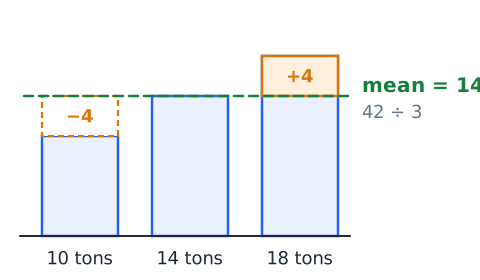
Loads of 10, 14 and 18 tons balance around the mean of 14.

Finding a Simple Mean

To find a simple mean, add all the values and divide by how many there are.

Example: a squad's push-up counts are 12, 15, 9, 20, and 14. The sum is 70, and there are 5 values, so the mean is

The mean always lies between the smallest and largest values.

Using Average × Count = Total

The definition of the mean can be turned around: average times count equals total. This form is the key to most ASVAB average problems.

Example: six deliveries average 45 minutes each. The total delivery time is

minutes

even though you never saw the individual times.

Finding a Missing Value

To find a missing value, first get the total the average requires, then subtract the values you know.

Example: four test scores must average 85, so they must total

Three scores are 82, 90, and 79, which add to 251. The fourth must be
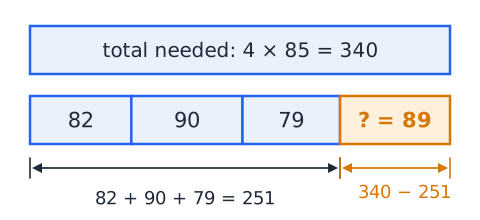
Tape diagram: total needed 4 × 85 = 340 above four scores 82, 90, 79 and ? = 89, with arrows showing 82 + 90 + 79 = 251 and 340 − 251 for the missing score.

Combined Averages

When two groups of different sizes are combined, you cannot just average the two averages. Find each group's total, add the totals, and divide by the total count:

Example: 15 recruits average 60 and 25 recruits average 68. The totals are 900 and 1,700, so the combined mean is
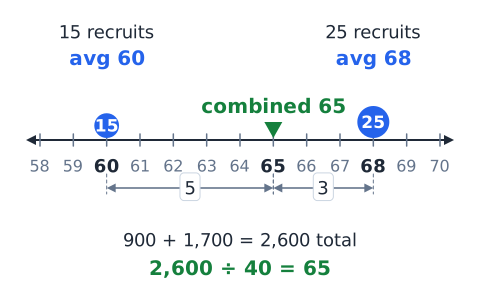
15 recruits averaging 60 and 25 averaging 68 combine to a mean of 65, closer to the larger group.

Weighted Averages

In a weighted average, some values count more than others. Multiply each value by its weight, then add. When the weights are percents that total 100, no further division is needed.

Example: labs count 30 percent and the exam counts 70 percent. With a lab score of 95 and an exam score of 75, the weighted average is
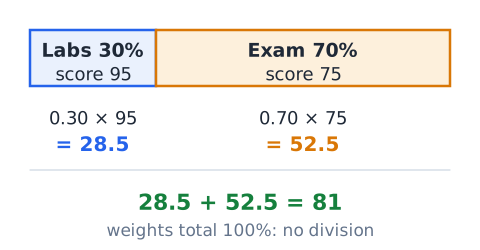
Labs 30% of 95 is 28.5 and exam 70% of 75 is 52.5, for a weighted average of 81.

Repeated Values as Weights

When a value repeats, its count acts as a weight. Multiply each value by how often it occurs, add, and divide by the total count.

Example: a crew works 8 hours on 4 days and 11 hours on 2 days. The average day is
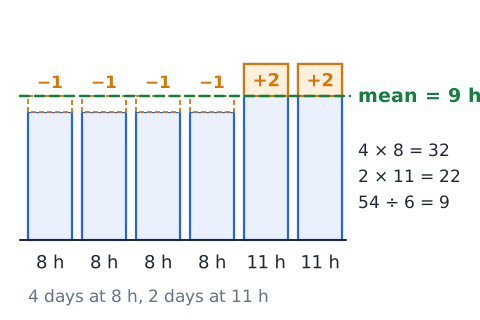
hours
Four 8-hour days and two 11-hour days balance at a mean of 9 hours.

Average Speed: A Special Case

Average speed is total distance divided by total time, not the average of the speeds.

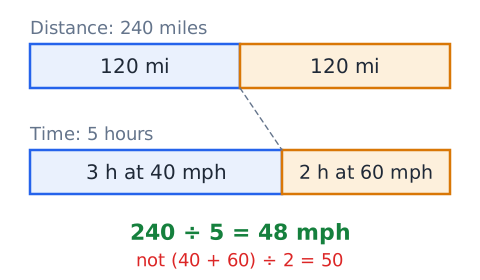
Example: a truck drives 120 miles at 40 miles per hour, taking 3 hours, then 120 miles at 60 miles per hour, taking 2 hours. Average speed is

miles

per hour.

Equal 120-mile legs take 3 hours at 40 mph and 2 hours at 60 mph; 240 ÷ 5 = 48 mph, not 50.

Averaging 40 and 60 to get 50 is wrong because the truck spent more time at the slower speed.

Equal-Time vs Equal-Distance Speed Averages

If equal amounts of time are spent at each speed, the simple average of the speeds is correct: 1 hour at 40 and 1 hour at 60 gives

miles

per hour.

If equal distances are covered, more time goes to the slower speed, so the true average is below the simple average. When in doubt, use total distance over total time.
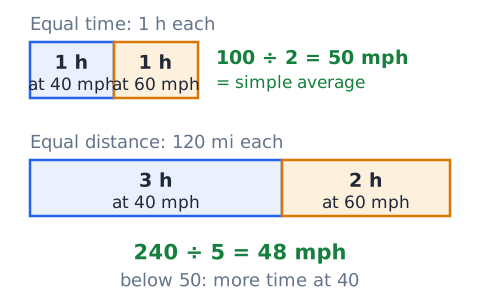
Equal time gives 50 mph; equal distances give 3 h at 40 and 2 h at 60, so 48 mph.

Mixture Concentration Basics

The concentration of a solution is the percent of it that is the pure ingredient. The amount of pure ingredient equals concentration times volume.

Example: 12 liters of a 25 percent antifreeze solution contain

liters

of antifreeze. Concentration is just a weighted average, with volume as the weight.

Combining Two Mixtures

To combine two mixtures, find the pure amount in each, add the pure amounts, and divide by the total volume.

Example: 6 L of a 10 percent solution plus 4 L of a 35 percent solution. Pure amounts: 0.6 L and 1.4 L, for 2.0 L in 10 L. Concentration: 20 percent.
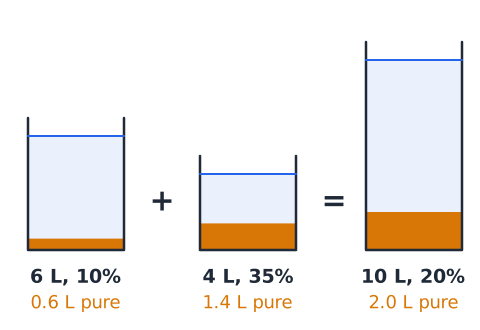
6 L of 10% plus 4 L of 35% make 10 L of 20%, with 0.6 + 1.4 = 2.0 L pure.

Weighted Average Price

To find the average price of a blend, divide total cost by total quantity.

Example: 3 pounds of coffee at 4 dollars per pound and 5 pounds at 6 dollars per pound cost

dollars

for 8 pounds, or 5.25 dollars per pound.
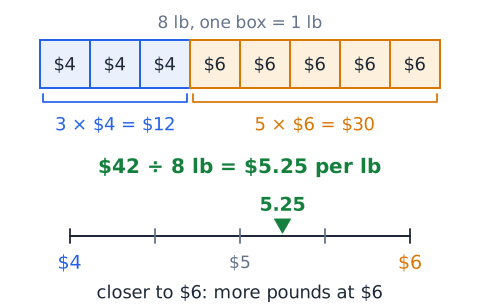
Eight 1-lb boxes: 3 at $4 (3 × $4 = $12) and 5 at $6 (5 × $6 = $30); $42 ÷ 8 lb = $5.25 per lb, marked on a number line from $4 to $6, closer to $6 because more pounds cost $6.

Choose Totals Before Averages

Almost every average problem becomes easier if you switch to totals first. Turn each given average into a total by multiplying by its count, do the adding or subtracting with totals, and divide only at the end.

This one habit handles missing values, combined groups, weighted grades, average speed, and mixtures.

Estimate the Mean

To estimate a mean quickly, choose a convenient baseline near the middle and average the differences from it.

Example: 88, 92, 95, 89, and 91. Using 90 as a baseline, the differences are −2, +2, +5, −1, and +1, which sum to +5. Divided by 5, that is +1, so the mean is 91.
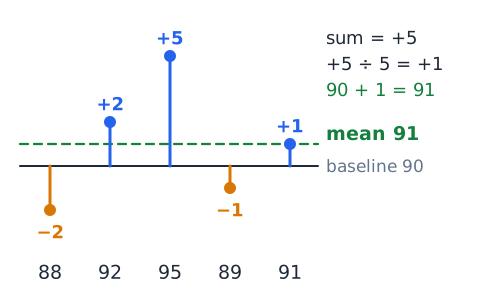
Offsets from 90 are −2, +2, +5, −1, +1; their average +1 gives a mean of 91.

Also remember that the mean must fall between the smallest and largest values, and a combined average lies closer to the larger group's average.

Worked Example 1 — Missing Score

Problem: Three quiz scores average 76. What fourth score raises the average to 80?
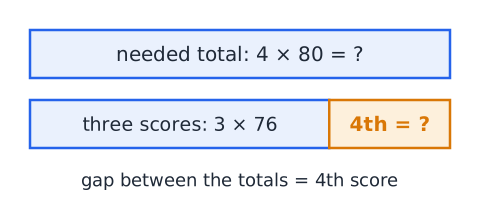
Tape diagram with givens only: needed total 4 × 80 = ? above a bar split into three scores (3 × 76) and the 4th score = ?.

Step 1: An average times the number of scores gives the total. Find the total the four scores must reach for an average of 80.

Step 2: Find the total of the three scores you already have.

(Work it as

3 × 70 = 210
and
3 × 6 = 18
then
210 + 18 = 228

)

Step 3: The fourth score must fill the gap between the two totals.

Answer: The fourth score must be 92.

Check:

228 + 92 = 320
and
320 ÷ 4 = 80

The new average is 80, as required.

Worked Example 2 — Combined Groups

Problem: A morning shift of 9 workers averages 42 units each, and an evening shift of 6 workers averages 52 units each. What is the average for all workers?
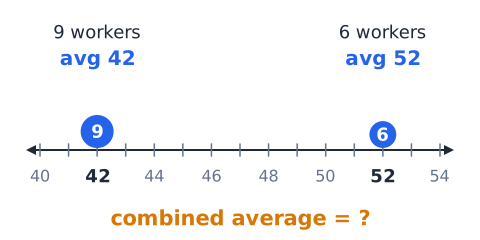
9 workers averaging 42 and 6 workers averaging 52; combined average unknown.

Step 1: You cannot just average 42 and 52, because the groups are different sizes. Instead, find each group's total. Morning shift:

Step 2: Evening shift total:

Step 3: Add the totals and add the number of workers.

Step 4: Divide the total units by the total workers.

(

15 × 40 = 600

and the 90 left over is 15 × 6, so the answer is

40 + 6 = 46

)

Answer: The average for all workers is 46 units.

Check: 46 is between 42 and 52 but closer to 42. That makes sense, because the morning group (9 workers) is larger than the evening group (6 workers).

Worked Example 3 — Weighted Grade

Problem: Homework counts 20 percent, the midterm 30 percent, and the final 50 percent. The scores are 85, 70, and 90. What is the weighted average?
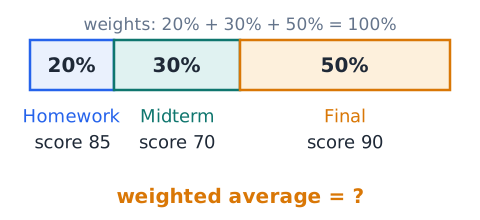
Bar split in proportion 20% / 30% / 50% for Homework (score 85), Midterm (score 70) and Final (score 90); weighted average = ?.

Step 1: Change each percent to a decimal: 20% = 0.20, 30% = 0.30, 50% = 0.50.

Step 2: Multiply each score by its weight. Homework:

(Take 10% of 85, which is 8.5, then double it to get 17.)

Midterm:

Final:

(Half of 90 is 45.)

Step 3: Add the weighted parts.

Answer: The weighted average is 83.

Check: The weights add to

20 + 30 + 50 = 100 percent

so nothing was left out. The answer 83 sits between the lowest score (70) and the highest (90), and leans toward 90 because the final counts the most.

Worked Example 4 — Average Speed

Problem: A driver goes 150 miles at 50 miles per hour and returns the same 150 miles at 75 miles per hour. What is the average speed for the whole trip?
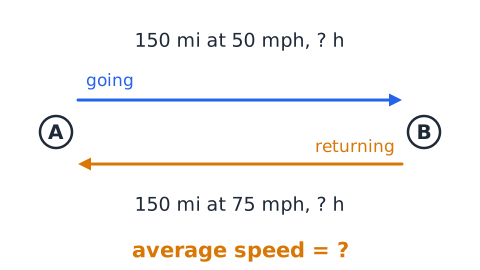
Going 150 mi at 50 mph, returning 150 mi at 75 mph; average speed unknown.

Step 1: Average speed is total distance divided by total time, so first find the time for each leg. Going:

Step 2: Returning:

Step 3: Add the distances and add the times.

Step 4: Divide total distance by total time.

Answer: The average speed is 60 miles per hour, not 62.5. Averaging 50 and 75 gives the wrong answer because the driver spends more time at the slower speed.

Check: 60 mph for 5 hours is

60 × 5 = 300 miles

which matches the total distance.

Worked Example 5 — Mixture Concentration

Problem: 8 L of a 15 percent solution is mixed with 2 L of a 40 percent solution. What is the new concentration?
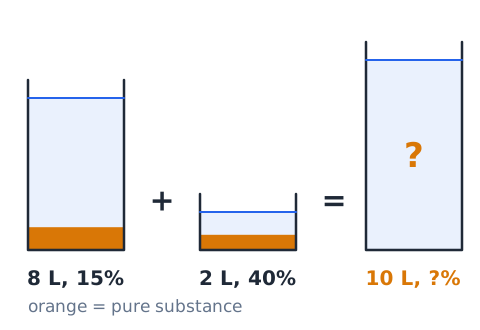
8 L of 15% plus 2 L of 40% make 10 L of unknown concentration.

Step 1: Find how much pure substance is in the first solution. 15% = 0.15.

Step 2: Find the pure substance in the second solution. 40% = 0.40.

Step 3: Add the pure amounts and add the total volumes.

Step 4: Concentration is pure amount divided by total amount.

Answer: The new concentration is 20 percent.

Check: 20% is between 15% and 40%, and closer to 15% because there is much more of the 15% solution (8 L versus 2 L).

Common Average and Mixture Traps

Averaging averages: combining group means without weighting by group size. Multiply each mean by its count first.

Averaging speeds: taking the mean of two speeds over equal distances. Use total distance divided by total time.

Averaging concentrations: mixing 1 L of 10 percent with 9 L of 50 percent does not give 30 percent. Find the pure amounts:

0.1 + 4.5 = 4.6

L in 10 L, or 46 percent.

Wrong count: forgetting to include the new value in the count when an item is added to a group.

Weights that do not total 100 percent: if weights are counts or points, divide by the sum of the weights.

Quick Review

The mean is the total divided by the count, and average times count gives the total. Use the total to find a missing value.

To combine groups, add the group totals and divide by the combined count; never average the averages unless the groups are the same size. A weighted average multiplies each value by its weight.

Average speed is total distance over total time. For mixtures, multiply concentration by volume to get the pure amount, add, and divide by total volume.

Work with totals first, and check that each average falls between the smallest and largest values.

Quick review

How do you find a simple mean?
Add the values and divide by how many there are: 12, 15, 9, 20 and 14 total 70, and . The mean always lies between the smallest and largest values.
What relationship links average, count and total?
. Six deliveries averaging 45 minutes take minutes in all.
Four scores must average 85; three are 82, 90 and 79. What is the fourth?
Needed total: . Known sum: 251. Fourth score: .
How do you combine the means of two groups of different sizes?
, where n is each group's size and x its mean. 15 averaging 60 and 25 averaging 68 give . Never just average the averages.
How do you compute a weighted average with percent weights?
Multiply each value by its weight and add; weights totaling 100 percent need no division: . If weights are counts or points, divide by their sum.
120 miles at 40 mph, then 120 miles at 60 mph. Average speed?
48 mph: total distance over total time, . Averaging the speeds to get 50 is wrong because more time was spent at the slower speed.
When is the plain average of two speeds the true average speed?
Only when equal time is spent at each speed. When equal distances are covered, the true average is below the plain average because the slower leg takes longer.
How do you find the concentration of a mix of two solutions?
Pure amount = concentration times volume. Add the pure amounts and divide by total volume: 6 L at 10 percent (0.6 L) plus 4 L at 35 percent (1.4 L) is 2 L in 10 L, or 20 percent.

What next?

← Previous: Ratios and Proportions

About this lesson

The middle of the lesson moves into weighted averages, treating repeated values as weights, and average speed as a special case, including why equal-time and equal-distance speed averages differ. Mixture concentration basics, combining two mixtures and weighted average price extend the same weighted thinking. Habits such as choosing totals before averages and estimating the mean speed up your work on Arithmetic Reasoning, an AFQT subtest.

Five worked examples cover a missing score, combined groups, a weighted grade, average speed and mixture concentration. Read the common average and mixture traps and the Quick Review, then take the Averages and Weighted Thinking lesson test.

Take it with you: the free app

The same 124 lessons, 6,516 questions and 82 timed practice tests on your phone, plus flashcards with spaced review and progress tracking. Free to download, and it works offline.

  • Works offline
  • Spaced-review flashcards
  • Progress for every subtest
  • Menus in 59 languages
ASVAB Camp appGoogle Play