ASVAB Camp Get the appGoogle Play
AR · lesson 5 of 12 · 32 min

Percentages

Percent questions are a staple of ASVAB Arithmetic Reasoning, and this 32-minute core lesson treats them as one connected idea rather than a pile of formulas. It opens with percent meaning per hundred and the three core percent relationships, then covers finding a percent of a number, finding what percent one number is of another, and finding the original whole.

Video lesson: Percentages

Video transcript

0:00 Hey, everyone, and welcome to this explainer. Look, if you're gearing up for the ASVAB and maybe feeling just a little bit uneasy about the math sections, you are in exactly the right place. Today, we're going to build up your math confidence from the absolute ground up, and we're doing it completely calculator free. We're tackling percentages, which is a massive part of the arithmetic reasoning subtest. I know, I know, math can feel totally intimidating, but I promise you by breaking these concepts down step-by-step, you're going to see just how manageable this really is. Let's get to it. OK, let's take a quick look at our roadmap. We're kicking things off with core-percent relationships. Then we'll look at changes and reverse-percent. After that, we dive into real-world applications, unlock some pretty amazing mental math and estimation tricks, point out the common traps to avoid, and finally, check yourself with some real practice questions. We're just taking this one totally manageable step at a time. All right, part one, core-percent relationships. We're starting with the absolute foundation here. What a percent actually is, and how its parts connect. Trust me, getting this right makes everything else a total breeze.

1:05 So what is a percent? Well, the word literally means per hundred, so 42%, that's just 42 out of every 100. To change a percent to a decimal, it's super simple. You just move the decimal point two places to the left. Boom, 42% becomes 0.42. If you had 7% that becomes 0.07, and to go the other way, from a decimal back to a percent, you guessed it, just move that decimal two places to the right. Now, this conversion flow is absolutely crucial when you're starting with a fraction. You really don't want to jump straight from a fraction to a percent. It's a trap. Always, always turn the fraction into a decimal first. For instance, 3 divided by 5 gives you 0.6. Then just slide that decimal two places to the right, and there you go. You've got 60%. Okay, check this out. These three core relationships right here rule absolutely every basic percent problem you'll ever face. Every single problem links three things. The part, the percent written as a decimal, and the whole. And here is a massive game-changing hint for the ASVAB.

2:10 The word of usually sits right before the whole. Once you figure out which of those three pieces is missing, you just grab the matching formula and you're good to go. So the really crucial point here is just applying that rule step by step. If a question asks for 30% of 420, you just convert the percent to a decimal, which is 0.30, and multiply it by the whole, which is 420. And 0.30 times 420 equals 126. See? It's really that straightforward. Changes and reverse percents. Let's see how this all builds when values go up or down, which, by the way, is incredibly common in ASVAB word problems. So when you need to find a percent increase or decrease, you're essentially comparing the amount of growth or shrinkage to the starting value. You take the new number, subtract the old number to find the difference, and then, and I literally cannot emphasize this strongly enough, you always divide by the original old value, never ever the new one. Multiply that by 100, and bam, you have your percent change. Now, what about reverse percent problems?

3:14 This is where you know the amount after a change, and you have to work backward to find the original. Let's say, after a 30% increase, a budget is $182,000. You write the new amount as a percent of the original. So an original 100%, plus a 30% increase means the new amount is 130%, or 1.30 as a decimal. Then you just divide the new amount, 182 by 1.30. That gives us an original of $140,000. Please don't make the mistake of just taking 30% off 182. Remember, the increase was based on the smaller original number. All right, let's look at section 3, real-world percent applications. Time to apply these formulas to the everyday situations you'll absolutely see on the test. Stuff like sales tax, discounts, and tips. What happens when you combine a discount and a tax? It sounds tricky, right? Well, let's take a $120 radio, that's 20% off, but has a 7% sales tax. First things first, find the sale price. A 20% discount means you're paying 80% of the original price.

4:19 So 120 times 0.80 equals $96. Second, apply the tax. A 7% tax means you multiply by 1.07. But, and this is key, you apply that tax to the new discounted price, not the original. So 96 times 1.07 is 102.72. The exact same logic applies to repeated changes. If a 500-unit inventory rises by 10%, and then falls by 10%, you don't magically end up back at 500, you have to multiply each factor in sequence. First, 500 times 1.10 gives you 550. Then that new larger base of 550 falls 10%, so you multiply 550 by 0.90, which equals 495. It's a really common trap, so watch out for that. Okay, section 4, mental math, and estimation. Because you don't have a calculator on the ASVAB, these right here are your absolute secret weapons for conquering these problems quickly and accurately. Let's dive right into this incredibly useful trick.

5:23 Did you know you can find 10% of literally any number just by moving the decimal one place to the left? And once you have 10%, you can build almost anything. Need 5%, just cut your 10% in half. Need 15%, just add your 10% and your 5% together. Need 1%? Move the original decimal two places to the left. Honestly, it's just like playing with mental building blocks. Now for an unbelievable swapping trick. Did you know percentages are completely reversible? Yeah, seriously. If the test asks you for 8% of 50, that might look a bit tough to do in your head at first glance. But if you just swap the numbers, it's exactly the same as 50% of 8. And 50% of 8 is obviously just half of 8, which is 4. This trick is a total game changer and makes seemingly hard percentage questions incredibly easy to do in your head. Alright, section 5, traps to avoid. Before we get into our practice, we need to deliberately pause and identify the common pitfalls that tend to trip people up when they're under test pressure. Definitely watch out for these traps.

6:27 First, never use the new value as your base for a percent change. Always, always divide by the original. Second, don't try to solve reverse percent problems by just subtracting the percent from the final number. You have to divide. Third, never just add successive percents together, like a 10% raise and a 10% cut. Fourth, watch those decimal slips. A 5% decimal is 0.05, not 0.5. That's a big one. Fifth, ensure you only tax the discounted amount, not the original sticker price. And finally, always remember the whole usually follows the word of. Keep these in mind and you'll be golden. Check yourself. It's time for a safe, guided practice session using real questions straight from our ASVAB study material. Let's see what you've learned. Alright, here's your first question. A savings account pays interest at a rate of 8.5%, which decimal is equal to 8.5%. Is it A, 0.0085, B, 0.85, C, 0.085, or D, 85? Take a moment, think about it, and feel free to pause the explainer to lock in your answer.

7:38 And the correct answer is c, 0.085. Remember our very first rule? Percent literally means per hundred. So to convert a percent to a decimal, you divide by 100 by simply sliding that decimal point two places to the left. Easy, right? Let's try one more. A restaurant bill comes to 36.40. How much is a 15% tip on this bill? Your choices are a, $1.82, b, $41.86, c, $5.46, or d, $3.64. Think back to that mental math building block trick we just learned. Go ahead and pause the explainer if you need to calculate. Okay, the correct answer is c, $5.46. Let's walk through that mental math step by step. First, find 10% by just moving the decimal one place to the left, which gives you $3.64. Next, find 5% by simply taking half of that $3.64, which is $1.82. Finally, just add your 10% and your 5% together, $3.64 plus $1.82 perfectly equals $5.46. See, no way do you need a calculator to ace this.

8:46 Mastering these basic mental frameworks unlocks complete confidence for the test. So here's my challenge for you. As you go about your day, look at price tags, look at tips, and ask yourself, what hidden building blocks can I use to instantly decode the numbers around me? Thanks for learning with me today, and keep putting these tricks to the test.

Visual lesson

Lesson slides

15 slides
Percentages – slide 1 of 15

Lesson Goal

In this lesson you will convert among percents, decimals, and fractions; solve the three basic percent problems (finding the part, the percent, or the whole); and calculate percent increase and decrease.

You will also work backward from a changed amount to the original and apply percents to discounts, sales tax, tips, markups, commission, and repeated changes.

Percent Means Per Hundred

Percent means "per hundred," so 42 percent is 42 out of every 100:
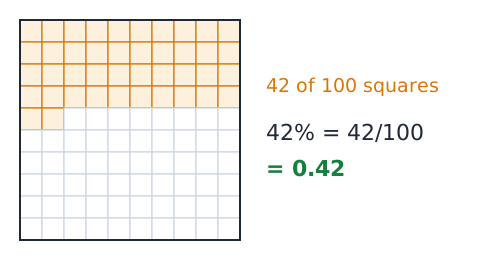
A 10 by 10 grid of 100 squares with 42 shaded: 42% = 42/100 = 0.42.

To change a percent to a decimal, move the decimal point two places left: 7 percent is 0.07, 125 percent is 1.25, and 0.6 percent is 0.006. To go from a decimal to a percent, move it two places right.

A fraction becomes a percent by first becoming a decimal:

Percents over 100 describe more than the whole.

The Three Core Percent Relationships

Every basic percent problem links three numbers: the part, the percent (as a decimal), and the whole.

Part equals percent times whole. Percent equals part divided by whole. Whole equals part divided by percent.
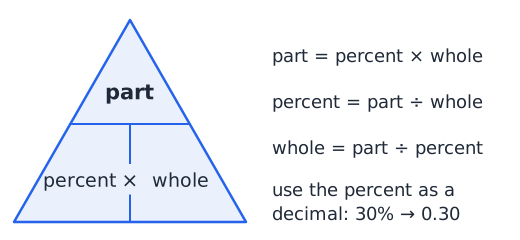
A triangle split into part on top and percent × whole below, with the three forms: part = percent × whole, percent = part ÷ whole, whole = part ÷ percent; use the percent as a decimal (30% → 0.30).

Decide which of the three is missing, then use the matching form. The word "of" usually sits right before the whole.

Finding a Percent of a Number

Convert the percent to a decimal and multiply by the whole.

As a check, 10 percent of 420 is 42, and three times that is 126.
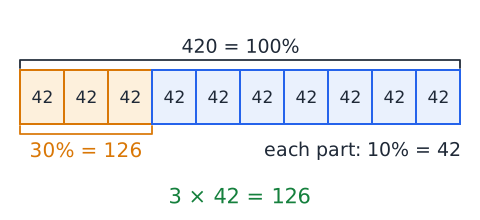
A bar for 420 (100%) split into ten parts of 42 (10% each); three parts are shaded to show 30% of 420 = 3 × 42 = 126.

Finding What Percent One Number Is of Another

Divide the part by the whole, then change the decimal to a percent.

Example: 27 of 36 vehicles are fueled. What percent is that?

which is 75 percent. The whole is the total group, the number after "of."
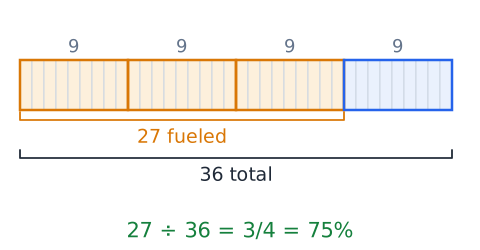
A bar of 36 vehicles in 4 groups of 9; 3 groups (27) are shaded as fueled, and a bracket across the whole bar marks 36 total; 27 ÷ 36 = 3/4 = 75%.

Finding the Original Whole

When you know a part and its percent, divide the part by the percent written as a decimal.

Example: 54 is 45 percent of what number?

Check:

The whole must be larger than the part when the percent is under 100.
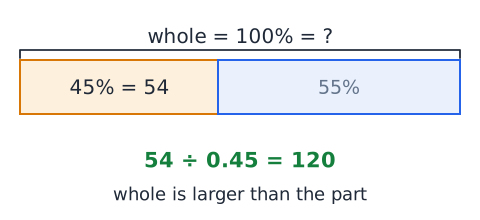
A bar for the whole, 100% = ?, with a shaded 45% piece equal to 54; 54 ÷ 0.45 = 120, so the whole is larger than the part.

Percent Increase

Percent increase compares the amount of growth to the starting value:

percent increase = (new − old) ÷ old × 100

Example: a crew grows from 50 to 65 members. The increase is 15, and

so the crew grew 30 percent. Always divide by the original value, not the new one.
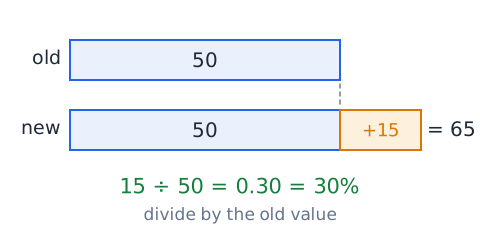
Bars drawn to scale: old value 50, and new value 65 made of 50 plus an increase of 15; 15 ÷ 50 = 0.30 = 30%, dividing by the old value.

Percent Decrease

Percent decrease uses the same idea: (old − new) ÷ old × 100.

Example: a fuel reserve drops from 80 gallons to 68 gallons. The decrease is 12, and

a 15 percent decrease.
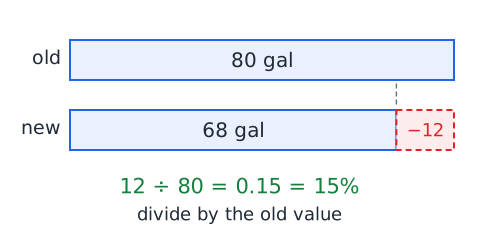
Bars drawn to scale: old 80 gallons, new 68 gallons with the missing 12 dashed; 12 ÷ 80 = 0.15 = 15%, dividing by the old value.

Reverse Percent Problems

In a reverse problem you know the amount after a change and must find the original. Write the new amount as a percent of the original, then divide.

Example: after a 30 percent increase, a budget is 182 thousand dollars. The new amount is 130 percent of the original, so the original is

thousand dollars.
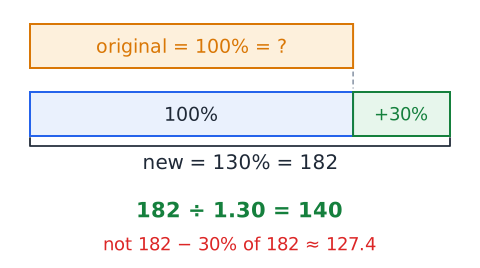
Bars drawn to scale: the original is 100% = ?; the new budget is 100% plus 30%, so 130% = 182 and 182 ÷ 1.30 = 140, not 182 − 30% of 182 ≈ 127.4.

A common mistake is to take 30 percent off 182, which gives about 127.4, not 140. The 30 percent was figured on the original, so you must divide.

Discounts, Sales Tax, Tips, and Markups

A discount lowers a price: a 64 dollar jacket at 15 percent off costs

dollars

Sales tax raises it: 6 percent tax on 35 dollars makes

dollars

A 20 percent tip on a 42.50 dollar bill is

dollars

A 40 percent markup on a 25 dollar cost gives a price of

dollars

Commission and Earnings

Commission is a percent of sales paid as earnings. Multiply the sales total by the rate, then add any base pay.

Example: a salesperson earns a 400 dollar base plus 5 percent of sales. On 12,600 dollars in sales, commission is

so total pay is 1,030 dollars.

Repeated Percentage Changes

When one percent change follows another, the second change applies to the new amount, not the original. Multiply by each change factor in turn.

Example: 500 rises 10 percent, then falls 10 percent.

and

The result is not 500, because the 10 percent decrease was taken from a larger base. Never just add or cancel the percents.
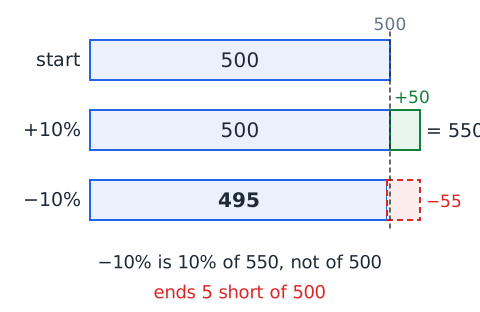
Bars drawn to scale: 500; then 550 (500 + 50 after +10%); then 495 (550 − 55 after −10%), with a dashed line at 500 showing the result ends 5 short because the −10% is 10% of 550.

Fast No-Calculator Percent Methods

Find 10 percent by moving the decimal point one place left, then build other percents from it. Five percent is half of 10 percent, 15 percent is 10 percent plus 5 percent, and 1 percent moves the point two places.

Use fraction equivalents: 25 percent is one fourth and 50 percent is one half.

You can also swap: 8 percent of 50 equals 50 percent of 8, which is 4.

Estimate Before Calculating

Round the percent and the whole to friendly values first. For 19 percent of 412, think 20 percent of 400, which is 80. The exact answer, 78.28, is close.

Also check direction: an increase must give a larger result, a discount a smaller one, and a part must be smaller than its whole when the percent is under 100.

Worked Example 1 — Percent of a Quantity

Problem: a battalion of 640 soldiers has 15 percent on leave. How many are on leave?

Step 1: Change the percent to a decimal. Percent means per hundred, so 15 percent is

15 ÷ 100 = 0.15

Step 2: Multiply the decimal by the whole. "Of" means multiply:

Step 3: Make it easy by splitting 15 percent into 10 percent plus 5 percent. 10 percent: move the decimal one place left. 5 percent: half of 10 percent.
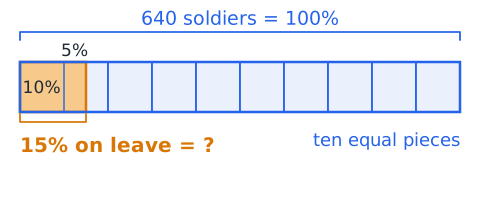
A bar for 640 soldiers = 100% cut into ten equal pieces of 10%; one 10% piece and a half piece (5%) are shaded, labelled 15% on leave = ?.

Answer: 96 soldiers are on leave.

Check:

and dividing by 100 gives 96. Same answer.

Worked Example 2 — What Percent?

Problem: 18 of 24 trucks pass inspection. What percent pass?

Step 1: Write part over whole. The part is the trucks that pass (18) and the whole is all the trucks (24):

Step 2: Simplify. Both 18 and 24 divide by 6:

Step 3: Change to a decimal, then to a percent.

3 ÷ 4 = 0.75

To turn a decimal into a percent, multiply by 100 (move the point two places right).

Answer: 75 percent pass.

Check: 75 percent of 24 is

trucks. It matches.

Worked Example 3 — Percent Increase

Problem: fuel rises from 3.20 to 3.60 dollars per gallon. What is the percent increase?
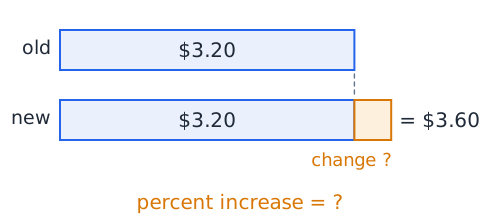
Bars drawn to scale: old $3.20; new bar is $3.20 plus an extra piece marked change ?, totalling $3.60; percent increase = ?.

Step 1: Find the amount of change. Subtract old from new:

Step 2: Divide the change by the original (old) price, because percent change is always measured from where you started:

Step 3: Clear the decimals by multiplying top and bottom by 100, then simplify. Both 40 and 320 divide by 40:

Step 4: Change to a percent.

1 ÷ 8 = 0.125

and moving the point two places right gives 12.5 percent.

Answer: a 12.5 percent increase.

Check: 10 percent of 3.20 is 0.32 and 2.5 percent is 0.08, so 12.5 percent is

dollars

Adding 0.40 to 3.20 gives 3.60. It matches.

Worked Example 4 — Reverse Discount

Problem: after 35 percent off, boots cost 52 dollars. What was the original price?

Step 1: Find what percent you actually pay. With 35 percent off, you pay

100 − 35 = 65 percent

of the original price.

Step 2: Write an equation. Let x be the original price. 65 percent is 0.65:
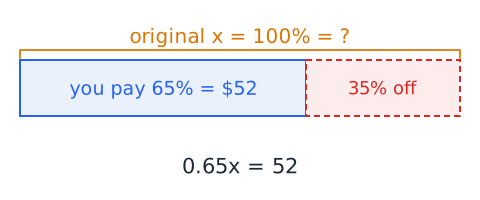
A bar for the original price x = 100% = ? split into the 65% you pay, $52, and the 35% off; equation 0.65x = 52.

Step 3: Divide both sides by 0.65. Move the decimal point two places right in both numbers to get whole numbers:

Step 4: Divide by hand.

65 × 8 = 520
so
65 × 80 = 5,200

Answer: the original price was 80 dollars.

Check: 35 percent of 80 is

dollars

off, and

80 − 28 = 52 dollars

It matches. Watch out: adding 35 percent of 52 to 52 gives about 70.20 dollars, which is wrong, because the discount was taken from the original price.

Worked Example 5 — Tax and Discount Together

Problem: a 120 dollar radio is marked 20 percent off, and then 7 percent sales tax is charged on the sale price. What is the final cost?
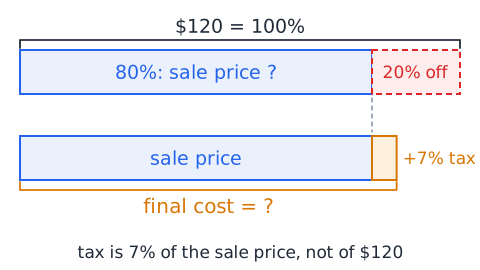
A $120 = 100% bar split into 20% off and 80% sale price (?), then a sale-price bar with a +7% tax piece and final cost = ?; the tax is 7% of the sale price, not of $120.

Step 1: Find the discount. 10 percent of 120 is 12, so 20 percent is twice that:

Step 2: Find the sale price by subtracting the discount. (This is the same as paying 80 percent:

120 × 0.80 = 96

)

Step 3: Find the tax on the sale price, not the original price. 7 percent is 0.07:

By hand:

7 × 96 = 672

then move the decimal two places left to get 6.72.

Step 4: Add the tax to the sale price.

Answer: the final cost is 102.72 dollars.

Check:

the same. Estimate: about

96 + 7 = 103 dollars

which is close.

Worked Example 6 — Repeated Change

Problem: an inventory of 2,000 items falls 25 percent, then rises 20 percent. What is the final count, and what is the overall change?

Step 1: Apply the drop. 25 percent is one quarter:

Step 2: Apply the rise to the new count, 1,500, not the original. 10 percent of 1,500 is 150, so 20 percent is 300:

Step 3: Find the overall change from the starting count.

Answer: the final count is 1,800 items, a drop of 200 items, which is a 10 percent decrease.

Check: using multipliers,

Watch out: simply combining the percents (

−25 + 20 = −5 percent

) is wrong, because the 20 percent rise is taken from a smaller number.
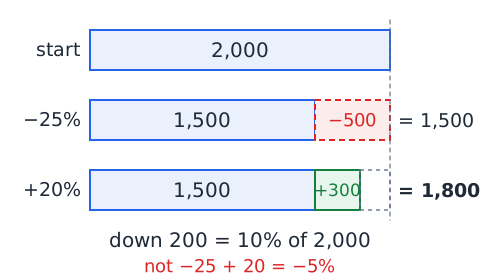
Bars drawn to scale: start 2,000; after a 25% drop 1,500 (500 removed); after a 20% rise 1,800 (300 added), down 200 = 10% of 2,000, not −25 + 20 = −5%.

Common Percentage Traps

Wrong base for change: dividing the change by the new value instead of the original. Percent change always uses the starting value.

Reverse percent by subtraction: adding 20 percent back to a discounted price does not recover the original. Divide by the remaining percent, such as 0.80.

Adding successive percents: a 10 percent raise followed by a 10 percent cut is not zero change. Multiply the factors.

Decimal slips: 5 percent is 0.05, not 0.5. Move the point two places.

Taxing the wrong amount: when a discount and a tax both apply, find the sale price first, then apply tax to it.

Mixing up part and whole: in "what percent of 60 is 15," 60 is the whole and goes in the denominator.

Quick Review

Percent means per hundred. Move the decimal point two places to switch between percents and decimals.

Part equals percent times whole; percent equals part over whole; whole equals part over percent.

Percent change is the change divided by the original value. To undo a change, divide the new amount by its percent of the original, such as 0.80 after a 20 percent decrease or 1.25 after a 25 percent increase.

Discounts multiply by 1 minus the rate, and taxes and markups by 1 plus the rate. Commission is the rate times sales. For repeated changes, multiply the factors in order. Use 10 percent and simple fractions to estimate.

Quick review

What are the three core percent relationships?
Part = percent times whole; percent = part divided by whole; whole = part divided by percent, with the percent written as a decimal. The whole usually comes right after 'of'.
How do you convert between a percent and a decimal?
Percent to decimal: move the point two places left (7 percent is 0.07, 125 percent is 1.25, 0.6 percent is 0.006). Decimal to percent: move it two places right.
What is the formula for percent change?
. Always divide by the original value: 50 rising to 65 is , a 30 percent increase.
After a 30 percent increase a budget is 182 thousand. What was the original?
Divide by the multiplier: thousand. Taking 30 percent off 182 (about 127.4) is wrong because the increase was figured on the original.
What single multiplier handles a discount, a sales tax or a markup?
Discount: multiply by 1 minus the rate (15 percent off means times 0.85). Tax or markup: multiply by 1 plus the rate (6 percent tax means times 1.06).
500 rises 10 percent and then falls 10 percent. What is the result?
495, not 500. Multiply the factors in order: . The second change is taken from the new, larger amount.
A 120 dollar radio is 20 percent off, then taxed 7 percent. Final cost?
Discount first, then tax the sale price: and , so 102.72 dollars.
How can you find percents mentally without a calculator?
Get 10 percent by moving the point one place left; 5 percent is half of that and 15 percent is their sum; 1 percent moves the point two places. Swapping helps too: 8 percent of 50 equals 50 percent of 8, which is 4.

What next?

← Previous: Decimals and Place Value

About this lesson

From there you tackle percent increase, percent decrease and reverse percent problems, followed by real-world applications: discounts, sales tax, tips, markups, commission and earnings. A section on repeated percentage changes explains why two changes in a row do not simply add. Fast no-calculator percent methods and an estimate-before-calculating habit keep you moving on a timed subtest that feeds into the AFQT.

Six worked examples, ranging from a percent of a quantity to tax and discount together, show the methods in action. Review the common percentage traps and the Quick Review, then take the Percentages lesson test.

Take it with you: the free app

The same 124 lessons, 6,516 questions and 82 timed practice tests on your phone, plus flashcards with spaced review and progress tracking. Free to download, and it works offline.

  • Works offline
  • Spaced-review flashcards
  • Progress for every subtest
  • Menus in 59 languages
ASVAB Camp appGoogle Play