 ASVAB Camp
Lesson Goal
By the end of this lesson you will be able to read a rate as a comparison of two different units, reduce it to a unit rate, and use it to find distance, speed or time. You will also compare package prices, scale up production, combine workers or pipes, and handle objects that move apart or toward each other.
What a Rate Means
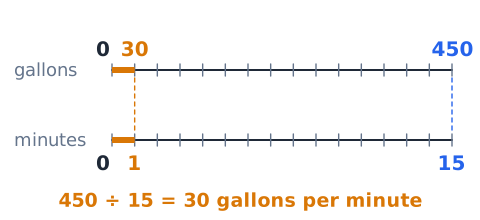
A rate compares two quantities measured in different units, such as miles and hours, dollars and pounds, or gallons and minutes. The word "per" is the signal. If a pump moves 450 gallons in 15 minutes, its rate is 450 gallons per 15 minutes. A rate lets you predict how much will happen over a different amount of time, as long as the pace stays steady.
Unit Rates
A unit rate tells how much of the first quantity goes with exactly one unit of the second. Divide the first quantity by the second. The pump that moves 450 gallons in 15 minutes has a unit rate of
per minute. Multiply that unit rate by any number of minutes to predict the total.
Distance, Rate, and Time
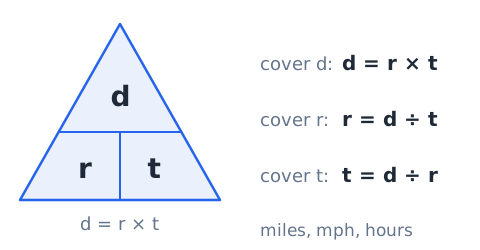
Motion problems rest on one relationship: distance equals rate times time,
Rearranged, it gives
Write the formula, fill in the two known values, and solve for the third. Keep units matched: miles, miles per hour and hours.
Converting Time Units
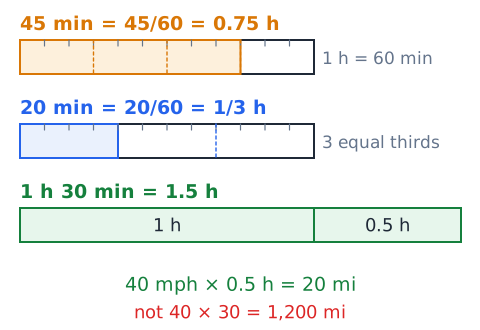
Speeds are usually stated per hour, but problems often give time in minutes. Divide minutes by 60 to get hours: 45 minutes is 0.75 hour and 20 minutes is one-third of an hour. A mixed time such as 1 hour 30 minutes becomes 1.5 hours. Converting first avoids errors like multiplying 40 mph by 30 minutes and getting 1,200 miles instead of the correct 20 miles.
Finding Distance
When rate and time are known, multiply them. A cyclist riding at 14 mph for 3.5 hours covers
The hours cancel and miles remain. A quick estimate, 14 times 3 is 42, confirms the answer is in the right range.
Finding Rate
To find a rate, divide the distance by the time. A delivery van covers 186 miles in 3 hours, so its average rate is
If the time is not a whole number, write it as a decimal first: 99 miles in 1 hour 30 minutes gives
Finding Time
To find time, divide distance by rate.
A boat crossing 36 miles of lake at 24 mph needs
or 1 hour 30 minutes. Multiply any decimal part of an hour by 60 to express it in minutes.
Comparing Unit Prices
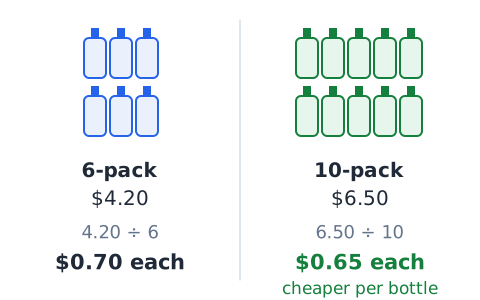
To find the better buy, compute the price of one unit in each package and compare. A 6-pack of juice for 4.20 dollars costs 0.70 dollar per bottle. A 10-pack for 6.50 dollars costs 0.65 dollar per bottle. The 10-pack is cheaper per bottle even though its total price is higher. Compare cost per unit, never the sticker price alone.
Production and Consumption Rates
Machines produce, and engines consume, at steady rates. A bottling line fills 1,200 bottles in 8 minutes, which is 150 bottles per minute, so in 20 minutes it fills 3,000. A generator that burns 2.5 gallons of fuel per hour uses 15 gallons in 6 hours. Find the unit rate first, then scale it.
Rate × Time in Real Contexts
The rate times time idea fits many settings. A clerk who processes 18 forms per hour completes 144 forms in an 8-hour shift. A faucet dripping 0.2 liter per hour wastes 4.8 liters in a day. A printer running 25 pages per minute needs 12 minutes for 300 pages. Identify the rate, the time, and what is being counted.
Combined Rates
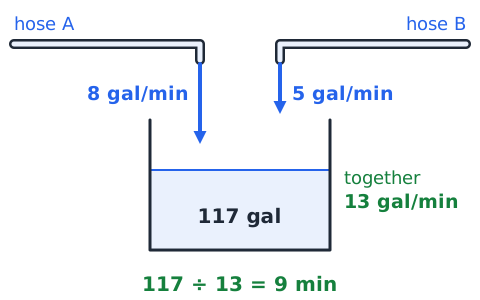
When two sources work on the same task at the same time, add their rates. Two hoses delivering 8 and 5 gallons per minute together supply 13 gallons per minute, so 117 gallons takes
If one source works against the other, subtract instead of adding.
Combined Work With Whole-Job Rates
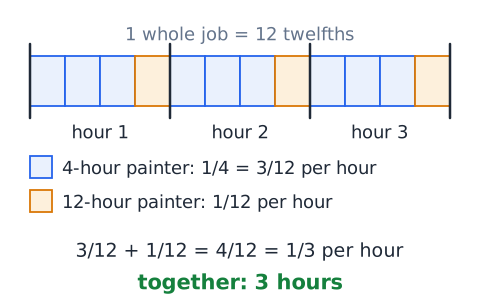
If a worker finishes a job in h hours, the rate is job per hour. Painters who need 4 hours and 12 hours alone have a combined rate of
so together they finish in 3 hours.
Closing and Filling Problems
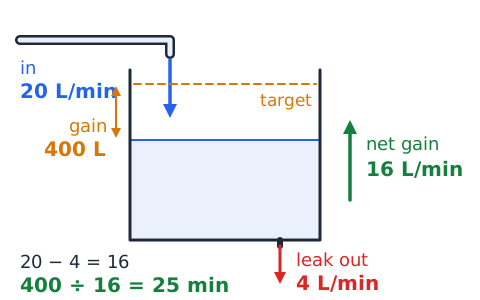
In fill-and-drain problems, inflow adds and outflow subtracts. An inlet pours in 20 liters per minute while a leak loses 4 liters per minute, so the tank gains a net 16 liters per minute. Gaining 400 liters therefore takes
Always divide by the net rate, not the inflow alone.
Relative Motion Basics
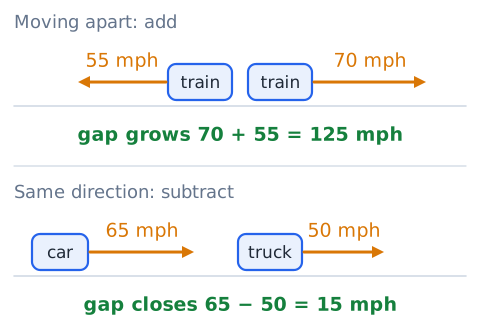
When two objects move, focus on how fast the gap between them changes. If they move in opposite directions or toward each other, add their speeds: trains at 70 mph and 55 mph heading apart separate at 125 mph. If they move in the same direction, subtract: a car at 65 mph gains on a truck at 50 mph at 15 mph. Divide the gap by that combined speed to get the time.
Use Units as an Error Check
Attach units to every number and let them cancel like factors. Miles per hour times hours leaves miles, so that product is a distance. Miles divided by miles per hour leaves hours, a time. If your setup produces miles times hours, or hours per mile when you wanted speed, you multiplied where you should have divided. This quick check removes many wrong choices before you commit.
No-Calculator Rate Shortcuts
Simplify before you divide. For 252 miles in 4.5 hours, double both numbers to clear the decimal:
Learn easy fractions of an hour: 15 minutes is one-quarter, 20 minutes one-third, 40 minutes two-thirds. At 60 mph, minutes and miles are equal. Estimate first so you can discard choices that are far off.
Worked Example 1 — Distance
Problem: A tour bus travels at 58 mph for 3 hours 30 minutes. How far does it go?
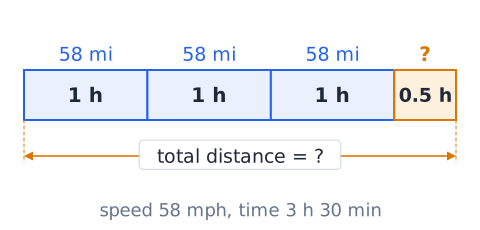
Step 1: The speed is in miles per hour, so write the time in hours. 30 minutes is half an hour.
Step 2: Use distance = rate × time.
Step 3: Break it into easy pieces: 3 hours plus half an hour.
Answer: The bus travels 203 miles.
Check: Estimate with 60 mph:
The real speed is a little less, so 203 miles is reasonable.
Worked Example 2 — Rate
Problem: A runner covers 13.5 kilometers in 1.5 hours. What is her average speed?
Step 1: Speed (rate) is distance divided by time.
Step 2: Get rid of the decimals by multiplying both numbers by 10. This does not change the answer.
Step 3: Divide.
Answer: Her average speed is 9 km per hour.
Check: Multiply back: 9 km per hour × 1.5 hours =
That matches the distance.
Worked Example 3 — Best Buy
Problem: Brand X sells 24 ounces for 3.36 dollars and Brand Y sells 32 ounces for 4.16 dollars. Which is the better buy?
Step 1: Find each brand's unit price: cost divided by ounces. Brand X:
(
and the 0.96 left over is 24 × 0.04, so
)
Step 2: Brand Y:
(
and the 0.96 left over is 32 × 0.03, so
)
Step 3: Compare. Brand X costs 14 cents per ounce and Brand Y costs 13 cents per ounce. Lower is better.
Answer: Brand Y is the better buy.
Check: Multiply back:
Both match the prices.
Worked Example 4 — Production
Problem: A press stamps 135 brackets in 9 minutes. How many brackets does it stamp in 40 minutes?
Step 1: Find the unit rate, the number of brackets in one minute.
(
) So the press stamps 15 brackets per minute.
Step 2: Multiply the unit rate by the new time.
(
then add a zero.)
Answer: The press stamps 600 brackets in 40 minutes.
Check: 40 minutes is a bit more than 4 times 9 minutes (36), so the answer should be a bit more than
600 fits.
Worked Example 5 — Combined Work
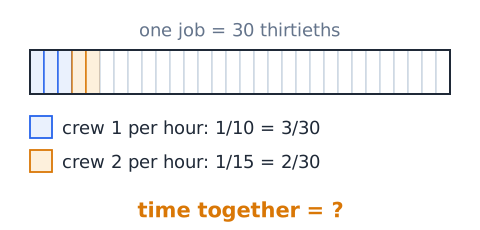
Problem: One crew can clear a lot in 10 hours and a second crew in 15 hours. How long does it take if they work together?
Step 1: Write each crew's rate as the fraction of the job done in one hour. The first crew does of the job per hour; the second does .
Step 2: Add the rates. Use the common denominator 30, since 10 and 15 both divide into 30.
Step 3: Simplify by dividing top and bottom by 5.
Step 4: Together they finish one-sixth of the job each hour, so the whole job takes 6 hours.
Answer: Working together, the crews take 6 hours.
Check: In 6 hours the first crew does 6/10 and the second does
Together
one whole job. Also, 6 hours is faster than the quicker crew alone (10 hours), as it should be.
Worked Example 6 — Opposing Rates
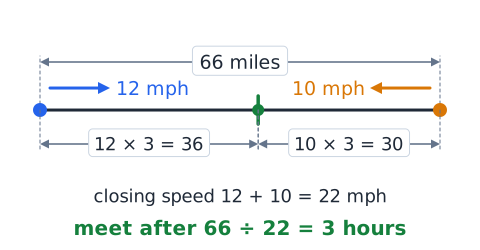
Problem: Two cyclists start 66 miles apart and ride toward each other at 12 mph and 10 mph. When do they meet?
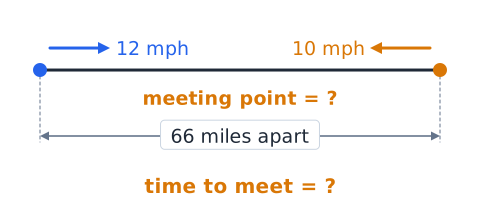
Step 1: Riding toward each other, both close the gap at once, so add the speeds.
Step 2: Time = distance ÷ rate. Divide the gap by the closing speed.
Answer: They meet after 3 hours.
Check: In 3 hours, the first rides
and the second rides
Together they cover the full 66 miles.
Common Rate Problems
Mixed units: multiplying a speed in miles per hour by a time in minutes makes the answer 60 times too large. Convert minutes to hours first.
Averaging times in combined work: workers needing 6 and 3 hours do not need 4.5 hours together. Add their rates instead; a team is always faster than its fastest member.
Comparing total prices: a bigger package can cost more yet be cheaper per unit. Divide to get unit prices.
Wrong relative speed: subtract speeds for same-direction travel, add them for opposite or approaching travel.
Ignoring a drain: use the net rate, inflow minus outflow.
Quick Review
A rate compares two different units; a unit rate gives the amount for one unit and comes from division. For motion,
with time in hours when speed is per hour. Compare deals by price per unit. Scale production by multiplying the unit rate by time. For workers on one job, add rates of and invert the sum. For fill and drain, use the net rate. Add speeds when the gap opens or closes from both sides, subtract when one object chases another, and check units at the end.
 English ▾