ASVAB Camp Get the appGoogle Play
AR · lesson 4 of 12 · 30 min

Decimals and Place Value

Decimals show up constantly in ASVAB word problems about money, measurements and rates. This 30-minute core lesson begins with decimal place value, reading and comparing decimals, and rounding. It then works through adding, subtracting, multiplying and dividing decimals, plus the quick shift that comes from multiplying and dividing by powers of ten.

Video lesson: Decimals and Place Value

Video transcript

0:00 Hey everyone, and welcome to this explainer. Look, I know that prepping for the ASVAB can feel a little intimidating, especially when you realize you won't have a calculator for the math sections. But honestly, I promise you, you've totally got this. Today, we're going to build your confidence step-by-step with a completely no-calculator masterclass on decimals. Decimals are a core foundational skill for the arithmetic reasoning subtest, and by the end of our time together, you're going to see that doing all of this by hand is absolutely manageable. So, let's jump in. Here's our roadmap for today. We're going to hit place value and rounding, math with decimals, conversions and real-world math, step-by-step worked examples, common traps to avoid, and finally, a quick check yourself section to test your skills. All right, starting off with section one, place value and rounding. So, I want you to think of the decimal point as your absolute anchor. It's your grounding point. Each place to the right of the decimal point is worth exactly one-tenth of the place to its left. Take a look at the number 36.582. To the right of our decimal anchor, that first place is the tenths.

1:05 So, that's the five. The second place is the hundredths, that's the eight, and the third place is the thousandths, which is the two. Put it all together, and this is 36 and 582 thousandths. Now, you know a huge part of the ASVAB is literally just figuring out which number is bigger. If you get a question asking you to order 0.6, 0.58, and 0.605, it can look a little tricky at first glance. So, here is the secret. Line up your decimal anchors and pad the shorter numbers with zeros, so they all have the exact same number of places. We just turn 0.6 into 0.600 and 0.58 into 0.580. Now, you're just comparing 680 and 605. It becomes completely obvious that 0.605 is the largest, right? Rounding is another absolutely essential skill, and the rule is super simple. Find your target place and look at the digit right next door to its right. If it's five or more, round up. If it's four or less, just leave it alone. Let's look at 7.364. To round this to the nearest tenth, we look at the digit right after the three, which is a six.

2:10 Since six is five or more, we round up to 7.4. But if we're rounding to the nearest hundredth, we look after the six, which is a four, so we leave it as 7.36. Oh, and watch out for carrying. If you need to round 2.995 to the nearest hundredth, that five makes the nine round up, which carries over to the next nine, which carries over to the two, giving you a clean 3.00. Math with decimals. This right here brilliantly illustrates why that decimal anchor is so crucial. For addition and subtraction, you just line up those decimal points. Fill any empty spaces with zeros and calculate exactly like you're working with regular whole numbers. Check out the addition problem. 9.4 plus 2.75 plus 0.068 simply becomes 9.400 plus 2.750 plus 0.068, which drops straight down to equal 12.218. The decimal just stays right in its column. Same goes for a subtraction. 15 minus 6.38 becomes 15.00 minus 6.38, which easily gives us 8.62.

3:17 Pretty straightforward, right? All right, let's tackle multiplication. Now, here is a golden rule you need to remember. You do not need to line up the decimal points when multiplying. Actually, scratch that, you definitely shouldn't worry about lining them up. Look at 3.2 times 0.45. Step one, just multiply them as if they were whole numbers. 32 times 45 equals 1,040. Step two, count up the total number of decimal places in your original numbers. We've got one place in 3.2 and two places in 0.45, so that's 3 places total. Step three, place the point three spots in from the right. We get 1.440, which is just 1.44. Now, division requires a little shuffle, sure, but it really is straightforward. To divide by a decimal, like 8.64 divided by 0.4, you want your divisor, that's the number you're dividing by, to be a whole number. So just move the point in 0.4, one place to the right to make it a solid four. But remember, whatever you do to the outside, you absolutely have to do to the inside.

4:21 Move the point in 8.64, one place to the right as well, making it 86.4. Now, you just divide normally. 86.4 divided by 4 equals 21.6. By shifting both decimals the exact same amount, your quotient stays perfectly accurate. Okay, section three, conversions and real-world math. Honestly, knowing how to slide your decimal point left or right is like having a superpower for conversions. Multiplying by 10, 100, or 1000 simply moves the decimal point to the right, one, two, or three places. Look at the top line there. 3.07 times 1000 moves the point to the right three times. We just add a zero as a placeholder, and boom, we get 3,070. Dividing, on the other hand, moves it to the left. 52.6 divided by 100 shifts it left two places, becoming 0.526. 0.9 divided by 10 shifts left one place, becoming 0.09. This little trick makes metric conversions an absolute breeze. You're also definitely going to need to switch back and forth between fractions and decimals.

5:25 But remember, a fraction is literally just a division problem waiting to happen. 7 over 8 is simply 7 divided by 8, which equals 0.875. And to go the other way from a decimal to a fraction, just read the decimal out loud. 0.36 is read as 36 hundredths. So, write 36 over 100. And then you just simplify it by dividing both by 4 to get 9 over 25. Before diving into complex math, always estimate first. So you have a gut check on whether your final answer makes real world sense. I mean, 6.92 times 3.1 looks awful, but 7 times 3 is just 21. If your actual calculation gives you something wild like 2.14 or 214, you'll know instantly that your decimal is in the wrong spot. And for rates, say a generator burns 1.6 gallons per hour. Well, in 7.5 hours, it uses 1.6 times 7.5, giving you exactly 12 gallons. Keep your units attached to the numbers, and they'll naturally guide your math. All right, moving into section 4, step by step, worked examples.

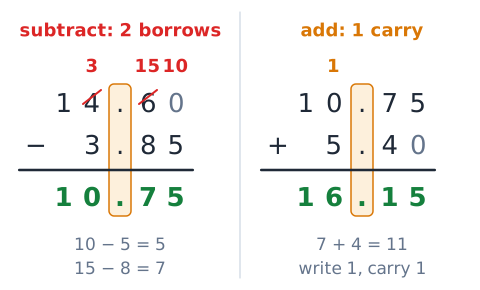
6:29 Let's see some real ASVAB scenarios. Let's look at example 1, which is all about tracking inventory. A bin holds 14.6 kilograms of bolts. Crews use 3.85 kilograms, and then 5.4 kilograms are added back in. So how much is left? First, track what's used. We pad the numbers with zeros. 14.60 minus 3.85 equals 10.75. Then they add more, so we just pad it again. 10.75 plus 5.40 equals 16.15 kilograms. Do you see how just padding with zeros makes this whole process super smooth? Now, example 2 is asking for a unit price. If 8 batteries cost $27.60, what's the price for just 1? We divide the total dollars by the number of items. $27.60 divided by 8 gives us exactly $3.45. Example 3 is finding a rate. A drone flies 37.8 kilometers in 0.6 hours. What's its speed? We just divide the total distance by the time. 37.8 divided by 0.6. But remember our division shuffle rule.

7:33 Shift the decimal one spot to the right for both numbers to make it 378 divided by 6, which gets you a clean 63 kilometers per hour. Okay, let's knock out these last two examples. Example 4 is a multi-step purchase. Let's say you buy four manuals at $6.25 each and three pens at $1.80 each, and you pay with a $40 bill. First, figure out the manuals. Four times 6.25 is $25 even. Then the pens. Three times 1.80 is $5.40. Add those up for a total of $30.40. To find your change, subtract that from the $40 bill. $40 minus $30.40 leaves you with $9.60. And example 5, which is larger? 0.45 or 7/16. First, turn that fraction into a decimal by dividing. Seven divided by 16 is 0.4375. Then, pad 0.45 out to four places. So it's 0.4500. Comparing them side by side, it's pretty obvious that 0.4500 is greater. Common traps to avoid.

8:35 These are the mistakes you definitely want to steer clear of. Listen, the absolute biggest trap people fall into when rushing is misaligned decimal points. Take a look at the left side there. If you try to add 3.5 and 1.25 by just lazily lining up the digits on the far right, you end up adding the five to the five and getting 1.60. That is completely wrong. Look at the right side. You must line up the decimal points like an anchor and pad that 3.5 with a zero. 3.50 plus 1.25 equals 4.75. Your decimal anchor is what keeps you safe. And here's another massive trap. Judging size just by how long a number looks. On the left, it is so tempting to say 0.5 is less than 0.45 simply because five looks smaller than 45. But once again, look at the right side. If you pad 0.5 with a zero, it becomes 0.50. And now it's crystal clear. 50 is obviously greater than 45. Padding with zeros reveals the true value every single time. Seriously, don't let your eyes trick you on test day.

9:40 Finally, section six, check yourself. Let's see what you've learned. All right, here's your first practice question. A shop has four drill bits with diameters of 0.375 inch, 0.4 inch, 0.38 inch, and 0.3125 inch. Which bit has the largest diameter? I strongly encourage you to pause the explainer right now. Grab some paper, work it out, and then hit play to see if you nailed it. Okay, we're back. Did you get 0.4 inch? Because that is the correct answer. Why? Well, if you pad every single option out to four decimal places, the answer basically jumps out at you. You get 0.3750, 0.4000, 0.3800, and 0.3125. If you compare the tenths digits first, only 0.4000 has a four right there. It is the clear winner. Awesome job. Let's tackle one more. Here's your final question. A plumber cuts three pieces of pipe, measuring 3.6 meters, 2.45 meters, and 0.8 meter. What is the total length of the three pieces?

10:45 Take a deep breath, line up those decimal anchor points, pause the explainer, and solve it. All right, let's see how you did. The correct answer is 6.85 meters. You just line up your decimal points, pad any gaps with zeros, and add 3.60 plus 2.45 plus 0.80. That straight vertical addition drops the decimal point right into place perfectly at 6.85. If you got that right, you are well on your way to totally mastering ASVAB decimals. So as you sit down for that real test, ask yourself, have I anchored my decimals correctly and did I actually estimate my answer to make sure it makes real world sense? Keep those two golden rules in your back pocket and you won't even miss the calculator. Thanks so much for learning with me today and keep practicing.

Visual lesson

Lesson slides

15 slides
Decimals and Place Value – slide 1 of 15

Lesson Goal

In this lesson you will read decimals by place value, compare and round them, and add, subtract, multiply, and divide them by hand.

You will also convert between decimals and fractions and apply decimals to money, measurement, rate, and multi-step word problems, using estimation to confirm that each answer is the right size.

Decimal Place Value

Each place to the right of the decimal point is worth one tenth of the place to its left. The first place is tenths, the second is hundredths, and the third is thousandths.

In 36.582, the 3 means 3 tens, the 6 means 6 ones, the 5 means 5 tenths, the 8 means 8 hundredths, and the 2 means 2 thousandths. So 36.582 equals .
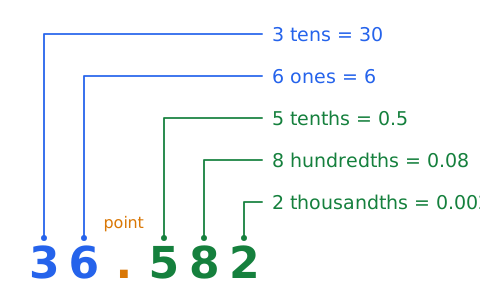
The number 36.582 with each digit linked to its place value: 3 tens = 30, 6 ones = 6, 5 tenths = 0.5, 8 hundredths = 0.08 and 2 thousandths = 0.002.

The decimal point separates whole units from parts of a unit; it is the anchor for every operation in this lesson.

Reading and Comparing Decimals

Read the whole number, say "and" for the decimal point, then read the decimal part using the name of its last place. So 4.07 is "four and seven hundredths."

To compare decimals, line them up and pad with zeros so they have the same number of places. To order 0.6, 0.58, and 0.605, write 0.600, 0.580, and 0.605. Now it is clear that 0.605 is the largest. A longer decimal is not automatically a bigger one.
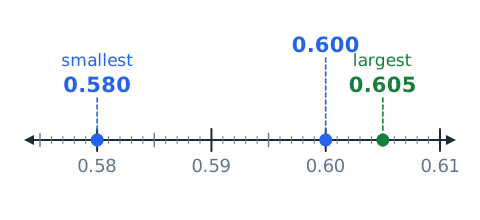
Number line from 0.575 to 0.61 with tall ticks at each hundredth, medium ticks at each half-hundredth, showing 0.580, 0.600 and 0.605: 0.580 is the smallest and 0.605 is the largest.

Rounding Decimals

To round, find the target place and look at the digit just to its right. If that digit is 5 or more, raise the target digit by one; if it is 4 or less, leave the target digit alone. Then drop everything after the target place.

Rounding 7.364 to the nearest tenth: the digit after the tenths place is 6, so the result is 7.4. To the nearest hundredth: the next digit is 4, so the result is 7.36.
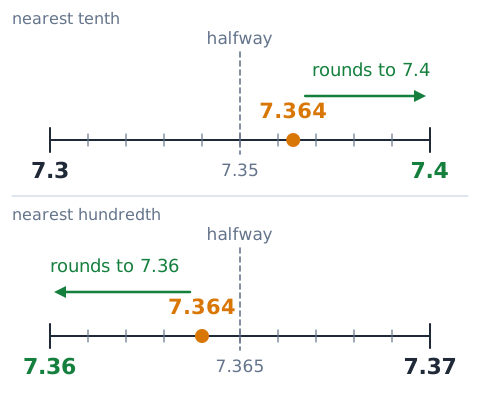
Two number lines: 7.364 lies past the halfway mark 7.35 between 7.3 and 7.4, so it rounds to 7.4; and before the halfway mark 7.365 between 7.36 and 7.37, so it rounds to 7.36.

Watch for carrying: 2.995 rounded to the nearest hundredth becomes 3.00.
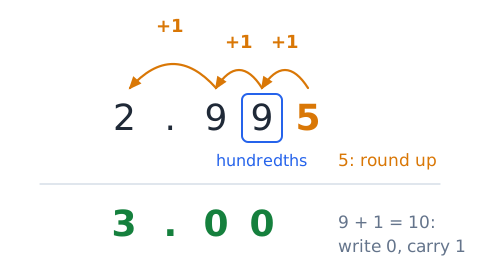
Rounding 2.995 to the nearest hundredth: the 5 rounds the hundredths 9 up to 10, and the +1 carries through the tenths and into the ones, giving 3.00.

Adding and Subtracting Decimals

Line up the decimal points, fill empty places with zeros, and add or subtract as with whole numbers. The decimal point in the answer stays in the same column.

Example: becomes
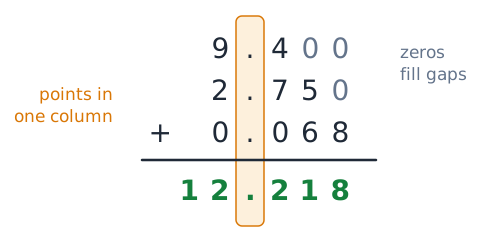
9.400 + 2.750 + 0.068 = 12.218
Column addition with decimal points in one column: 9.400 + 2.750 + 0.068 = 12.218, with the added zeros in grey.

For , write 15 as 15.00, then subtract to get 8.62.

Multiplying Decimals

Multiply as though there were no decimal points, then count the total number of decimal places in both factors and place that many in the product.

For :

The factors have one and two decimal places, three in all, so the product is 1.440, or 1.44.
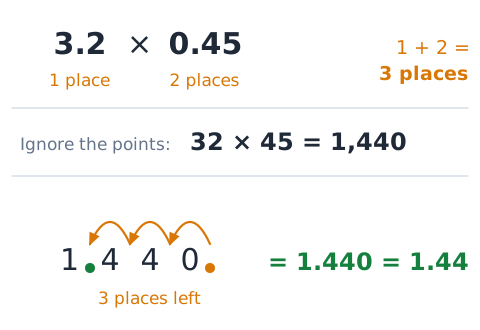
3.2 × 0.45: 1 place plus 2 places makes 3 places; 32 × 45 = 1,440, and moving the point 3 places left gives 1.440 = 1.44.

Check with an estimate:

which is close. You do not need to line up decimal points when multiplying.

Dividing Decimals

To divide by a decimal, make the divisor a whole number by moving its decimal point to the right, and move the dividend's decimal point the same number of places. This multiplies both by the same power of ten, so the quotient does not change.

For , move both points one place:

Then divide normally, placing the decimal point in the quotient directly above the one in the dividend.
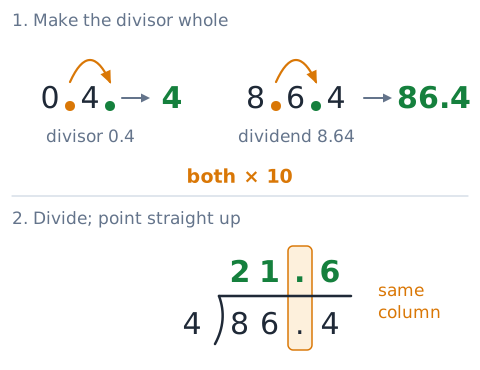
8.64 ÷ 0.4: both decimal points move one place right (both × 10) to give 86.4 ÷ 4; in the long division the quotient 21.6 has its point straight above the point in 86.4.

Multiplying and Dividing by Powers of Ten

Multiplying by 10, 100, or 1,000 moves the decimal point right one, two, or three places. Dividing by them moves it left the same number of places. Add zeros as placeholders when you run out of digits.

Examples:
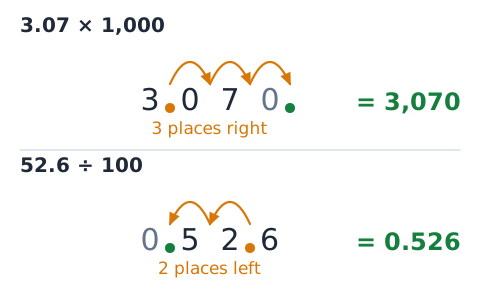
and
Decimal point hops: 3.07 × 1,000 moves the point 3 places right to give 3,070; 52.6 ÷ 100 moves it 2 places left to give 0.526.

This is the basis of metric conversions. Because a kilometer is 1,000 meters, 2.35 km equals 2,350 m. Multiplying should make a number larger and dividing should make it smaller, which gives you a quick check on direction.

Fraction-to-Decimal Conversions

A fraction is a division, so divide the numerator by the denominator:

Some fractions repeat:

often rounded to 0.67. Memorize common ones:

and

Decimal-to-Fraction Conversions

Write the digits over the place value of the last digit, then simplify.
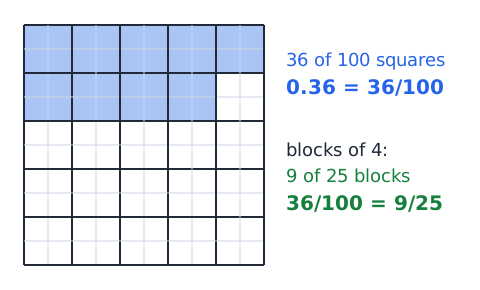
A 10 × 10 hundredths grid with 36 squares shaded (0.36 = 36/100); thick lines group it into 25 blocks of 4, and 9 of the 25 blocks are shaded, so 36/100 = 9/25.

Similarly,

and

Decimals in Money Problems

Money uses two decimal places: dollars to the left of the point, cents to the right. Always write answers to the cent.

Example: three shirts at 14.85 dollars each cost

dollars

Change from a 50 dollar bill is

dollars

When a unit price ends in a fraction of a cent, round to the nearest cent.

Decimals in Measurement and Rates

Measurements and rates often come in decimals. Multiply a rate by time to get a total, and divide a total by time to get a rate.

Example: a generator burns 1.6 gallons per hour. In 7.5 hours it uses

gallons

A hiker who covers 9.6 km in 1.5 hours averages

km

per hour. Keep the units attached to each number.

Estimation With Decimals

Round each decimal to a nearby whole number or friendly value before calculating. For , think

the exact product is 21.452.

For , think

An estimate like this instantly rules out answer choices with the decimal point in the wrong place.

Worked Example 1 — Decimal Inventory

Problem: a bin holds 14.6 kg of bolts. Crews use 3.85 kg, then 5.4 kg are added. How much is in the bin?

Step 1: Line up the decimal points. 14.6 has one decimal place and 3.85 has two, so write 14.6 as 14.60. Adding a zero at the end does not change the value.

Step 2: Subtract what was used. Hundredths: 0 − 5 needs a borrow, so

10 − 5 = 5

Tenths: 5 − 8 needs a borrow, so

15 − 8 = 7

Ones:

3 − 3 = 0

Tens: 1.

Step 3: Add what came in. Write 5.4 as 5.40 and line up the points. Hundredths:

5 + 0 = 5

Tenths:

7 + 4 = 11

write 1 and carry 1. Ones:

0 + 5 + 1 = 6

Tens: 1.

Two column calculations with the decimal points in one column: 14.60 − 3.85 = 10.75 with borrow marks (4 becomes 3, 6 becomes 15, 0 becomes 10; 10 − 5 = 5, 15 − 8 = 7), and 10.75 + 5.40 = 16.15 with a carried 1 over the ones (7 + 4 = 11); padded zeros in grey.

Answer: 16.15 kg.

Check: estimate with whole numbers: about

15 − 4 + 5 = 16 kg

The answer 16.15 is close.

Worked Example 2 — Unit Price

Problem: eight batteries cost 27.60 dollars. What is the price per battery?

Step 1: Decide the operation. Price per battery means split the total cost into 8 equal shares, so divide 27.60 by 8.

Step 2: Long division, keeping the decimal point straight above. 8 into 27 goes 3 times (24), remainder 3. Bring down 6: 8 into 36 goes 4 times (32), remainder 4. Bring down 0: 8 into 40 goes 5 times, remainder 0.
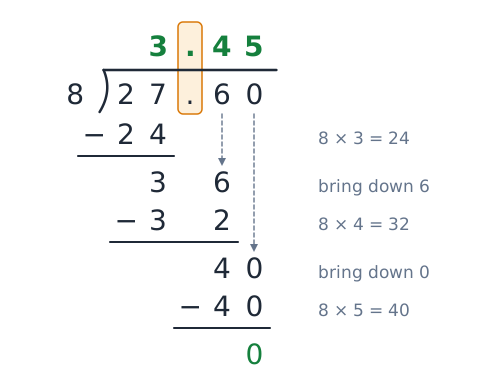
Long division 27.60 ÷ 8 = 3.45 with the quotient point above the dividend point: subtract 24, bring down 6 to make 36, subtract 32, bring down 0 to make 40, subtract 40, remainder 0.

Answer: 3.45 dollars per battery.

Check: multiply back.

and
so
dollars

It matches.

Worked Example 3 — Rate and Time

Problem: a drone flies 37.8 km in 0.6 hour. What is its average speed?

Step 1: Decide the operation. Speed is distance divided by time:

Step 2: Make the divisor a whole number. Move the decimal point one place right in both numbers (this multiplies both by 10, so the answer does not change):

Step 3: Divide by hand. 6 into 37 goes 6 times (36), remainder 1. Bring down 8: 6 into 18 goes 3 times.

Answer: 63 km per hour.

Check: in 0.6 hour at 63 km per hour the drone goes

km

because

It matches.

Worked Example 4 — Multi-Step Purchase

Problem: a clerk buys 4 manuals at 6.25 dollars and 3 pens at 1.80 dollars, paying with 40 dollars. How much change does the clerk get?

Step 1: Find the cost of the manuals. Think of 6.25 as 6 + 0.25:

Step 2: Find the cost of the pens. Think of 1.80 as 1 + 0.80:

Step 3: Add to get the total bill.

Step 4: Subtract the bill from the 40 dollars paid. Write 40 as 40.00 and line up the points.

Answer: 9.60 dollars in change.

Check: count up from the bill:

dollars

It matches.

Worked Example 5 — Decimal and Fraction Connection

Problem: which is larger, 0.45 or ?

Step 1: Change the fraction to a decimal. A fraction means top divided by bottom, so divide 7 by 16. Write 7 as 7.0000 and do long division:

70 ÷ 16 = 4

remainder 6.

60 ÷ 16 = 3

remainder 12.

120 ÷ 16 = 7

remainder 8.

80 ÷ 16 = 5

remainder 0.

Step 2: Give both decimals the same number of places. Pad 0.45 with zeros to get 0.4500.

Step 3: Compare digit by digit from the left. Tenths: 4 and 4 are equal. Hundredths: 5 is greater than 3. So 0.4500 is greater than 0.4375.
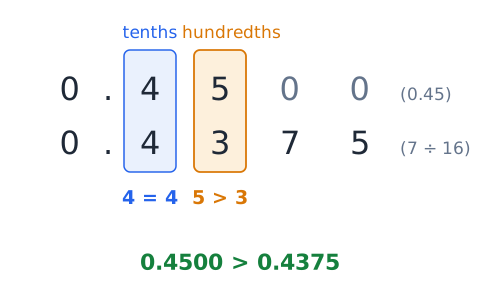
0.4500 (0.45) stacked over 0.4375 (7 ÷ 16) with points aligned: tenths 4 = 4, hundredths 5 > 3, so 0.4500 > 0.4375.

Answer: 0.45 is larger.

Check: compare as fractions instead.

With a common denominator of 80:

and

36 is more than 35, so 0.45 is larger.

No-Calculator Decimal Routine

Start each decimal problem with an estimate so you know the rough size of the answer.

For addition and subtraction, line up decimal points and pad with zeros. For multiplication, ignore the points, multiply, then count total decimal places. For division, shift the divisor's point to make it whole and shift the dividend's the same amount.

Convert fractions to decimals, or the reverse, when the problem mixes the two forms. Finish by comparing your exact answer to the estimate and checking that money answers have two decimal places.

Common Decimal Traps

Misaligned points: writing 3.5 + 1.25 as if the digits lined up on the right gives 1.60. Line up the decimal points to get 4.75.
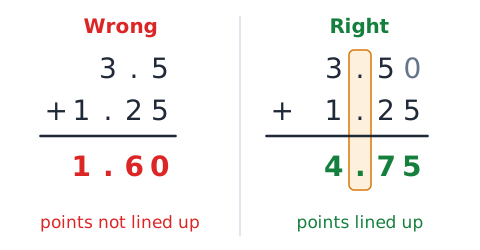
Two panels: wrong, 3.5 and 1.25 lined up on the right give 1.60; right, 3.50 and 1.25 with points lined up give 4.75.

Judging size by length: 0.5 is greater than 0.45 even though it has fewer digits. Pad with zeros before comparing.

Miscounting places in a product: is not 0.6. Two decimal places in all means
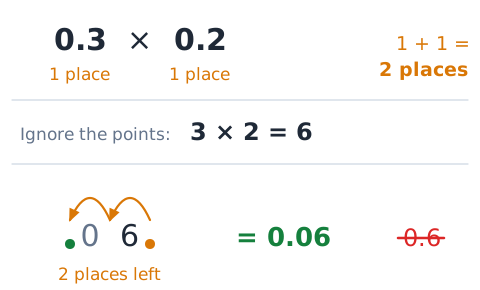
0.3 × 0.2: each factor has 1 decimal place, 1 + 1 = 2 places; 3 × 2 = 6, and moving the point 2 places left gives 0.06, not 0.6 (crossed out).

Shifting only one number in division: moving the divisor's point without moving the dividend's changes the answer. Shift both the same amount.

Rounding too early: rounding each step in a multi-step problem can push the final answer off by a cent or more. Round once, at the end.

Quick Review

Decimal places are tenths, hundredths, and thousandths, each one tenth of the place to its left.

Compare decimals by lining them up and padding with zeros. Round by checking the digit just right of the target place.

Add and subtract with points aligned. Multiply as whole numbers, then place the decimal by counting total places. Divide by first making the divisor a whole number. Multiplying or dividing by 10, 100, or 1,000 just shifts the point.

Convert a fraction to a decimal by dividing; convert a decimal to a fraction by writing it over its place value and simplifying.

Money answers use two places, rates connect totals and time, and a quick estimate catches misplaced decimal points.

Quick review

What are the first three decimal places to the right of the point?
Tenths, hundredths and thousandths; each place is worth one tenth of the place to its left. In 36.582, the 8 stands for 8 hundredths, or 0.08.
Which is larger, 0.5 or 0.45?
0.5. Pad with zeros to the same length (0.50 versus 0.45) before comparing; a decimal with more digits is not automatically bigger.
How do you round a decimal to a given place?
Check the digit just right of the target place: 5 or more raises the target digit by one, 4 or less leaves it. 7.364 becomes 7.4 to the tenth and 7.36 to the hundredth; 2.995 becomes 3.00.
Where does the decimal point go in a product of decimals?
Multiply as whole numbers, then give the product as many decimal places as both factors have in total: , so , and .
How do you divide by a decimal, as in ?
Move the divisor's point right until it is a whole number and move the dividend's point the same number of places: . Shifting only one of them changes the answer.
What happens when you multiply or divide by 10, 100 or 1,000?
The decimal point shifts one place per zero, right when multiplying and left when dividing: and .
Decimal forms of 1/8, 1/5, 3/4 and 7/8?
, , , . Any fraction converts by dividing the numerator by the denominator.
How do you write 0.36 as a fraction?
Put the digits over the place value of the last digit, then simplify: .

What next?

← Previous: Fractions and Mixed Numbers

About this lesson

Two sections handle conversions in both directions, fraction to decimal and decimal to fraction, so you can switch forms whenever one is easier. You then apply decimals to money problems, measurement and rates, and learn estimation with decimals to sanity-check answer choices. Five worked examples cover a decimal inventory, a unit price, rate and time, a multi-step purchase and a decimal and fraction connection.

Because Arithmetic Reasoning counts toward the AFQT and you work without a calculator, the lesson closes with a no-calculator decimal routine, common decimal traps and a Quick Review. When you are done, take the Decimals and Place Value lesson test.

Take it with you: the free app

The same 124 lessons, 6,516 questions and 82 timed practice tests on your phone, plus flashcards with spaced review and progress tracking. Free to download, and it works offline.

  • Works offline
  • Spaced-review flashcards
  • Progress for every subtest
  • Menus in 59 languages
ASVAB Camp appGoogle Play