ASVAB Camp Get the appGoogle Play
AR · lesson 12 of 12 · 40 min

Mixed Multi-Step Word Problems

This advanced 40-minute lesson brings the whole Arithmetic Reasoning unit together. It begins with why multi-step problems feel hard and then teaches a single routine, TARGET, DATA, UNITS, MODEL, SOLVE, CHECK, that you can use on any word problem. Supporting sections cover separating intermediate and final quantities, identifying irrelevant information, converting before combining, order of operations in context and breaking complex problems into blocks.

Video lesson: Mixed Multi-Step Word Problems

Video transcript

0:00 Welcome to this explainer, okay, so we're diving into something today that I know causes a lot of well unnecessary stress mixed multi-step word problems listen if you've been dreading the math section of your test prep Take a deep breath our mission today is actually really simple. We're gonna work together as a team to master these problems entirely by hand. Yep, absolutely no calculator required. You've totally got this Just to make sure there are zero surprises. We've broken this entire lesson down into six bite-sized sections We'll start with the multi-step word problem, then the problem solving routine go through core skills and worked examples tackle advanced scenarios Look at avoiding common math traps and then wrap up with some check yourself practice questions All right, let's jump into section one the multi-step word problem So why do these problems feel so hard? Well, it's because test writers love a good distraction They'll present a huge divide between the essential data, you know things like distance mileage and price and Entirely irrelevant distractions. I'm talking about the driver's name the day of the week maybe even the truck's color Honestly, the math itself is rarely difficult.

1:03 The trick is to just ignore the noise Always match your numbers to the actual target of the question before you do any calculating the problem solving routine To cut through those distractions and bring that test anxiety way down We're gonna rely on a really steady repeatable six step plan. I highly recommend memorizing this step one Target what exactly is the question asking step two data pull only the numbers that actually matter Step three units make sure everything matches up step four model the math by writing it out Step five solve it step by step and finally step six check your work to ensure it actually makes sense think of this as your safety net Core skills and worked examples. Let's look at this in action Let's apply this routine to our first scenario an inventory chain Imagine starting with 960 rounds of inventory range a gets one fourth now one fourth of 960 is 240 which leaves 720 here's the key range B gets three eighths of the rest see what we did there We broke this long word problem into small patient blocks Figuring out exactly what's left over after range a takes its share Next we carefully model the math.

2:17 We need to multiply three eighths by that remaining 720 now to do this without a calculator You just break it into chunks 720 divided by eight is 90 then just multiply that 90 by three which gives us 270 rounds meant for range B Finally, we subtract that 270 from the 720 we had left that leaves us with 450 rounds remaining as our final labeled answer see when you take it one simple block at a time the math stays completely manageable Next up, let's look at motion with a stop Let's say you drive 150 miles at 60 miles per hour stop for 30 minutes and then drive a hundred miles at 50 miles per hour Notice how we need to find the time for each individual leg and convert everything into consistent units in this case hours So 150 miles at 60 MPH takes 2.5 hours a 30-minute stop That's half an hour or point five hours and a hundred miles at 50 MPH takes two hours Add all those up and our totals become 250 miles and five hours For our final step since our total distance is 250 miles and our total time is five hours We simply divide 250 by five that gives us our overall average speed of 50 miles per hour It's really as easy as that.

3:36 No complex formulas literally just total distance divided by total time Okay, let's move to section four advanced scenarios and examples Now we're going to tackle what's known as a reverse problem This is where you're given the final result and asked to find the starting value Let's say that after a 25% discount a pair of boots costs 54 dollars What was the original price now careful here instead of just subtracting We have to recognize that the final $54 price actually represents 75% of the original price We model our math by setting up a simple equation to show this relationship the original price multiplied by 0.75 equals 54 dollars To undo that step in reverse again, absolutely no calculator needed. We divide 54 by 0.75 Here's a pro tip for you 0.75 is just the fraction three-fourths and dividing by a fraction just means multiplying by its flip so 54 divided by three is 18 and 18 times four Confidently reveals the original price of $72.

4:40 You're just working backwards Avoiding common math traps Testwriters absolutely love laying out traps using intermediate numbers But we can easily learn to step right over them make sure you don't fall for these classic mistakes For instance never stop one step early on an intermediate value. That is a stepping stone not the finish line Also apply percentages only to their specific base group never mix units without converting them first And when working backwards, please don't try to reverse percentages by just adding or subtracting the same amount What else? Oh don't just average speeds together always use total distance and total time and finally Watch out for charging a per item fee only once when it should apply to every single item Here is your absolute best defense against all of those traps before you pick an answer choice Take a deep breath and spend exactly 20 seconds running a final safety check reread the final sentence to confirm your target check that the unit is correct Ask yourself does the size of my answer actually make sense in the real world?

5:46 Did I accidentally stop on an intermediate value? This simple check will protect all your hard work All right section six check yourself practice questions It's time to put your new routine to the test. Here's your first question A maintenance task takes 2.25 hours and a follow-up inspection takes 50 minutes How many minutes did the two jobs take in all? Okay, please pause the explainer right here grab some scratch paper and patiently figure this one out without a calculator before I reveal the answer Welcome back. So the correct answer is 185 minutes Why? Because you avoided the trap of mixing units you successfully converted hours into minutes First 2.25 hours times 60 equals 135 minutes then you just combine the times 135 plus 50 gives you 185 minutes. Great job Let's try one more An office orders seven chairs each costs 35 dollars and the seller charges four dollars delivery for each chair What is the total cost of the order once again pause the explainer work it out step-by-step using your routine and press play when you're ready And we're back the answer here is 273 dollars you totally nailed this if you apply the delivery fee to each chair first before multiplying by seven 35 dollars plus four dollars delivery means each chair costs 39 dollars delivered Then you multiply 39 by the seven chairs to get 273 you didn't fall for the trap of only charging delivery once I want to leave you with this final thought Multi-step problems are rarely hard because of the arithmetic remember the arithmetic itself isn't what makes math intimidating It's just the sequence So what other complex challenges in your test prep could you conquer right now just by breaking them down into patient simple steps Keep practicing trust your routine and I'll catch you in the next explainer

Visual lesson

Lesson slides

15 slides
Mixed Multi-Step Word Problems – slide 1 of 15

Lesson Goal

This capstone lesson pulls together fractions, decimals, percents, ratios, rates, motion, work and money. You will practice reading a long word problem, deciding what it really asks, splitting it into small steps, keeping units consistent, estimating before calculating, and checking that the final number answers the question that was asked.

Why Multi-Step Problems Feel Hard

Multi-step problems are rarely hard because of the arithmetic. The difficulty is that one result feeds the next, so an early slip carries through, and the wording may include extra facts or ask for something other than the obvious number. Test writers also put intermediate results among the answer choices. A steady routine and careful labeling remove most of these risks.

The TARGET → DATA → UNITS → MODEL → SOLVE → CHECK Routine

TARGET: state exactly what the question wants, such as "dollars left" or "minutes after B starts." DATA: list the numbers that matter. UNITS: note each unit and convert to a common one. MODEL: write the operations or equation before computing. SOLVE: work step by step, labeling each result. CHECK: confirm the answer is reasonable and matches the target.

Separate Intermediate and Final Quantities

Label each result so you know whether it is a stepping stone or the answer. A depot has 600 crates. It ships 40% on Monday (240), then half of what is left on Tuesday (180). The 360 crates left after Monday is only an intermediate value; the final answer is 180 crates remaining.
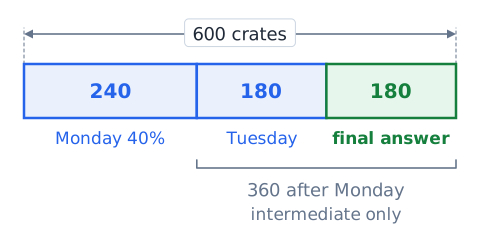
600 crates: 240 Monday, 180 Tuesday, 180 left is the final answer; 360 is intermediate.

Identify Irrelevant Information

Word problems often include facts you do not need, such as the driver's name, the color of the truck, or the day of the week. Before computing, match each number to the target. If a question asks for fuel cost, you need distance, mileage and price per gallon; the number of passengers is a distraction.

Convert Before Combining

You can only add or compare quantities in the same unit. A cable of 2 yards plus a 4-foot piece is

6 + 4 = 10 feet

not 6 of anything. A task lasting 1.5 hours followed by one of 40 minutes takes

90 + 40 = 130 minutes

Choose one unit, convert everything to it, then combine.

Order of Operations in Context

The story decides the order of operations. If each of 5 boxes costs 8 dollars plus 2 dollars shipping, the total is

5 × (8 + 2) = 50 dollars

Writing

5 × 8 + 2 = 42

charges shipping only once. Ask whether each charge applies per item or once per order.
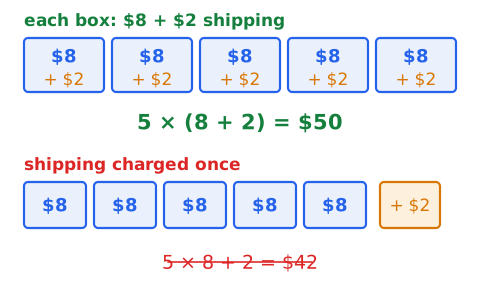
5 × ($8 + $2) = $50, not 5 × 8 + 2 = $42.

Break Complex Problems Into Blocks

Split a long problem into blocks that each answer one small question, such as "How many were made?", "How many were good?", "What did they cost?" Finish one block, write its labeled result, and feed it into the next. Short blocks are easy to check.

Fractions Plus Percentages

Apply each fraction or percent to the correct group. Of 720 recruits, pass a first test:

If 80% of those 450 pass a second test, 360 recruits pass both. The 80% applies to 450, not to 720.
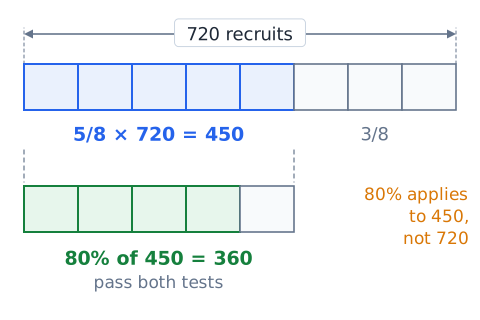
720 in 8 parts, 5 shaded = 450; then 80% of 450 = 360 pass both tests.

Ratios Plus Totals

For a ratio and a total, add the ratio parts to find how many equal shares the total is split into. With a ratio of 3:5 and a total of 64, there are 8 parts:

Each part is 8, so the groups are
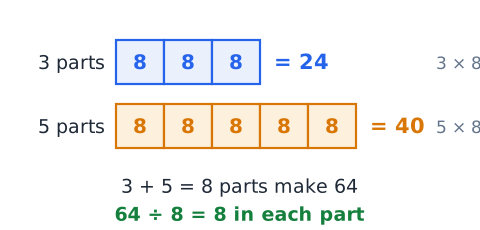
3 × 8 = 24
and
5 × 8 = 40
Ratio 3:5, total 64: 3 boxes of 8 = 24 and 5 boxes of 8 = 40.

Rates Plus Percentages

First use the rate to get a total, then apply the percent. A line makes 150 units per hour for 8 hours, or 1,200 units. If 4% are defective, that is 48 units, leaving 1,152 good units.
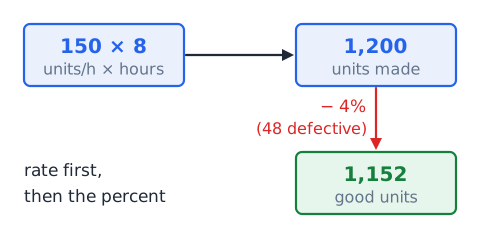
150 × 8 = 1,200 units; − 4% (48 defective) = 1,152 good.

Motion Plus Stops

Find the time for each driving leg, then add any stops. A convoy drives 180 miles at 60 mph (3 hours), takes a 45-minute break, then drives 100 miles at 50 mph (2 hours). Total time: 5.75 hours, or 5 hours 45 minutes. Leaving at 7:00 a.m., it arrives at 12:45 p.m.
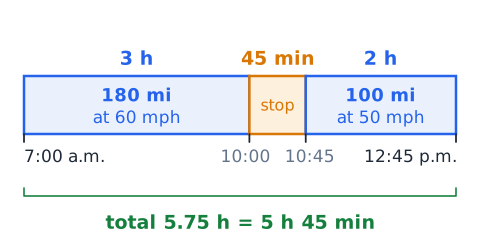
7:00 a.m. start, 3 h driving, 45-minute stop, 2 h driving, arrive 12:45 p.m.

Work Rate Plus Partial Completion

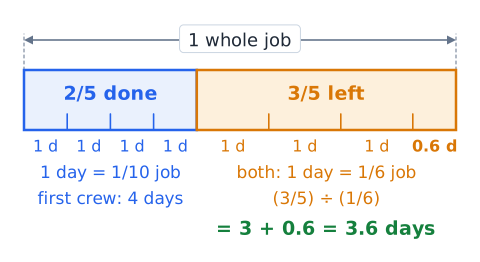
A crew that needs 10 days alone works 4 days, finishing 2/5 and leaving 3/5. A second crew that needs 15 days then joins. Together they do

1/10 + 1/15 = 1/6

per day, so the rest takes

(3/5) ÷ (1/6) = 3.6

more days.

Job bar: 2/5 done in 4 days, 3/5 left at 1/6 per day = 3 + 0.6 = 3.6 more days.

Money Plus Quantity

Multiply the unit price by the quantity, then add any flat charges. Fencing costs 7.25 dollars per meter, and a homeowner needs 18 meters:

18 × 7.25 = 130.50 dollars

Adding a one-time 45-dollar installation fee gives 175.50 dollars. A flat fee is added once, not per meter.

Reverse Problems

Some problems give the result and ask for the starting value. Undo each step in reverse order. After a 15% raise, a wage is 23 dollars per hour. The new wage is 1.15 times the old, so the old wage was

23 ÷ 1.15 = 20 dollars

Subtracting 15% of 23 would be wrong.
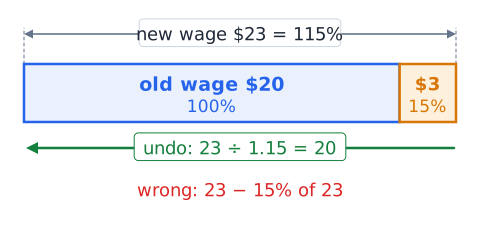
$23 = 115% = $20 old wage + $3 raise; undo with 23 ÷ 1.15 = 20.

Estimate Before Exact Work

Round the numbers and get a rough answer before calculating. If 6 items at about 12 dollars cost roughly 72 dollars, a choice of 7.20 or 720 dollars is clearly wrong. An estimate also tells you whether a result should be larger or smaller than a given value.

Use Answer Choices Strategically

Answer choices can guide you. Eliminate any that fail a quick estimate or have the wrong unit or size. Notice which choices are intermediate values, since one is often the result after only some of the steps. In reverse problems, you can test a choice by running it forward. Do not choose until your result answers the exact target.

Worked Example 1 — Inventory Chain

Problem: An armory holds 960 rounds. One-fourth go to Range A. Then of the rest go to Range B. How many rounds remain?

Step 1: Find one-fourth of 960 for Range A. To take one-fourth, divide by 4.

Step 2: Subtract to find what is left after Range A. This is "the rest" that the next step talks about.

Step 3: Find of 720 for Range B. Divide by 8 to get one-eighth, then multiply by 3.

Step 4: Subtract Range B's share from the 720 that were left.

Answer: 450 rounds remain.

Check: Add all three groups. They should make the full 960.
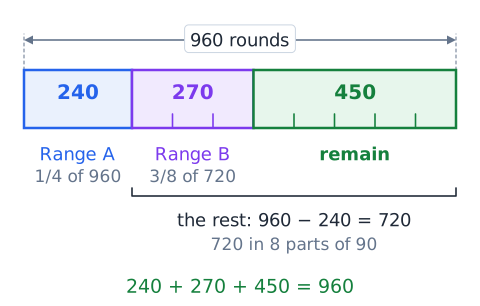
960 rounds: 240 to Range A, 720 in 8 parts of 90, 270 to Range B, 450 remain.

Worked Example 2 — Rate and Defects

Problem: A plant runs two shifts of 7.5 hours each, making 120 units per hour. Three percent are defective. Good units are packed 24 per box. How many full boxes are filled?

Step 1: Find the total hours worked. There are 2 shifts of 7.5 hours.

Step 2: Find the total units made. Multiply hours by units per hour. Split 120 into 100 + 20 to make it easy.

Step 3: Find 3% of 1,800 to get the defective units. 1% means divide by 100, then multiply by 3.

Step 4: Subtract the defective units to get the good units.

Step 5: Divide the good units by 24 to count boxes. Take out 70 boxes first, then see what is left.

So

1,746 ÷ 24 = 72

with a remainder of 18. The 18 extra units are not enough for another full box.

Answer: 72 full boxes.
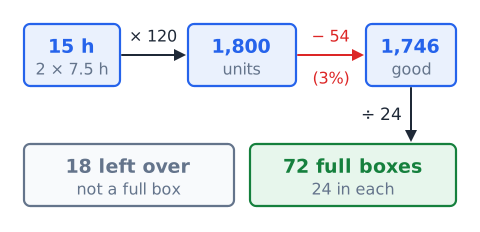
15 h → 1,800 units → 1,746 good → 72 full boxes, 18 left over.

Check: 72 boxes of 24 plus the 18 extras should give back 1,746.

Worked Example 3 — Discount, Quantity and Tax

Problem: Six filters cost 12.50 dollars each. A 20% discount applies, then 7% tax. What is the final cost?

Step 1: Find the subtotal. Multiply the price by 6. Think of 12.50 as 12 + 0.50.

The subtotal is 75 dollars.

Step 2: Take off the 20% discount. 10% of 75 is 7.50, so 20% is twice that.

After the discount, the price is 60 dollars. (This is the same as 0.80 × 75.)

Step 3: Add 7% tax on the discounted price. 1% of 60 is 0.60, so 7% is 7 times that.

This is the same as 60 × 1.07.

Answer: The final cost is 64.20 dollars.
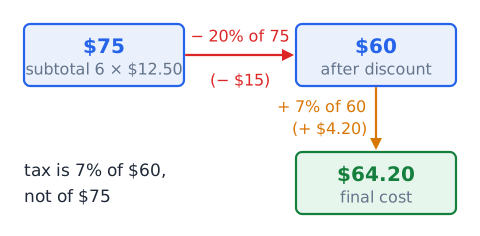
$75 − 20% ($15) = $60, + 7% of 60 ($4.20) = $64.20.

Check: The discount took off a fifth (about 15 dollars), and the tax added back a small amount (about 4 dollars). 75 − 15 + 4 is about 64, which matches.

Worked Example 4 — Motion With Stop

Problem: A driver travels 150 miles at 60 mph, stops 30 minutes, then travels 100 miles at 50 mph. What is the overall average speed, including the stop?
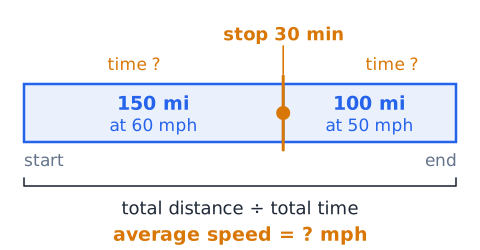
150 mi at 60 mph, stop 30 min, 100 mi at 50 mph; average speed = ? mph.

Step 1: Find the time for the first leg. Time = distance ÷ speed.

Step 2: Change the stop into hours. 30 minutes is half of 60 minutes.

Step 3: Find the time for the second leg.

Step 4: Add all the times. The stop counts, because the question says "including the stop."

Step 5: Add the distances.

Step 6: Average speed = total distance ÷ total time.

Answer: 50 mph.

Check: Driving 50 mph for 5 hours covers

50 × 5 = 250 miles

the full trip. Do not just average 60 and 50; that ignores the stop and the different times.

Worked Example 5 — Ratio Plus Fraction

Problem: A unit of 132 people has officers and enlisted members in a 2:9 ratio. Two-thirds of the enlisted are on duty. How many enlisted are on duty?

Step 1: Add the ratio parts to find how many equal parts make the whole unit.

Step 2: Find the size of one part. Divide the total people by the number of parts.

Step 3: Enlisted members are 9 parts.

Step 4: Find of 108. Divide by 3, then multiply by 2.

Answer: 72 enlisted members are on duty.
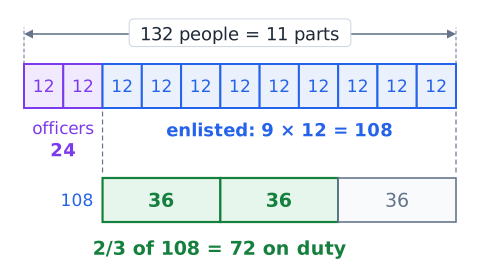
132 in 11 parts of 12: officers 24, enlisted 108; 2/3 of 108 = 72 on duty.

Check: Officers are

2 × 12 = 24
and
24 + 108 = 132

the whole unit. Also 72 is less than 108, as it should be.

Worked Example 6 — Partial Work

Problem: A mechanic can finish a job in 6 hours and works alone for 2 hours. A coworker who can do the whole job in 3 hours then helps. How much longer will it take?

Step 1: Find the mechanic's rate. The whole job takes 6 hours, so each hour does of the job.

Step 2: Find how much is done in 2 hours, and how much remains.

Step 3: Find the team rate. The coworker does of the job per hour. Add the rates using sixths.

Step 4: Time = work left ÷ rate. Dividing by is the same as multiplying by 2.

Step 5: Change hours to hours and minutes. It is 1 hour plus hour, and of 60 minutes is 20 minutes.

Answer: hours, or 1 hour 20 minutes.
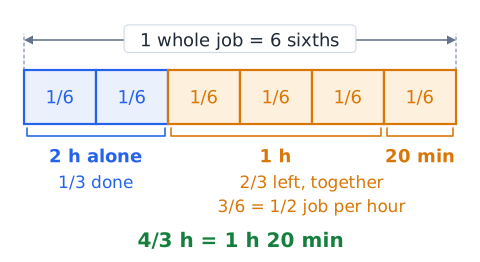
Sixths: 2/6 alone in 2 h; 4/6 left together at 3/6 per hour = 1 h 20 min.

Check: Working together at job per hour for hours does

exactly the work that was left.

Worked Example 7 — Reverse Percentage

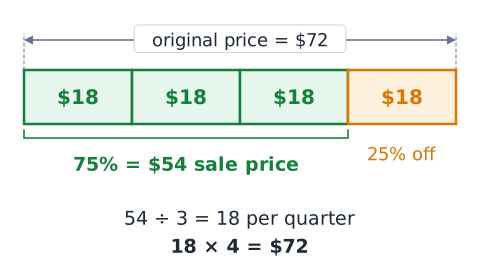
Problem: After a 25% discount, a pair of boots costs 54 dollars. What was the original price?

Step 1: Figure out what percent of the original is left. Taking off 25% leaves 75% of the original.

Step 2: Write an equation. 75% of the original price is 54 dollars.

Step 3: Divide 54 by 0.75. Since 0.75 = , dividing by it is the same as multiplying by : divide by 3, then multiply by 4.

Answer: The original price was 72 dollars.

Check: 25% of 72 is one-fourth of 72, which is 18. Then

72 − 18 = 54

the sale price.

$72 in four quarters of $18; three quarters, $54, is the sale price.

Watch out: Adding 25% to 54 (giving 67.50) is wrong, because the discount was 25% of the original price, not of the sale price.

Common Multi-Step Traps

Stopping one step early: choosing the amount used instead of the amount remaining, or the discount instead of the sale price. Recheck the target.

Applying a percent to the wrong group: a percent of "those assigned" means the assigned count, not the whole.

Mixing units: adding minutes to hours or feet to yards without converting.

Reversing percents by adding or subtracting: undo a change by dividing by the multiplier.

Averaging speeds instead of using total distance over total time.

Charging a flat fee per item, or a per-item fee only once.

Final 20-Second Check

Before choosing, take twenty seconds. Reread the last sentence of the question and confirm your number matches what it asks. Check that the unit is right. Ask whether the size makes sense: a remainder smaller than the start, a team faster than one worker, a sale price below the original. Make sure you did not stop on an intermediate value, then select the answer.

C02 Arithmetic Reasoning Review

Arithmetic Reasoning combines a few core tools. Fractions and percents scale a quantity, and each applies to a specific base. Ratios split a total into equal parts. Unit rates come from division and scale by multiplication. Motion uses

with relative speed for two travelers and total distance over total time for averages. Work rates add as fractions of one job. Money problems use discounts, tax, wages, commission and simple interest. Apply them in labeled steps, convert units, estimate, and check the target.

Quick review

What does the TARGET, DATA, UNITS, MODEL, SOLVE, CHECK routine involve?
Pin down exactly what is asked; list the numbers that matter; convert to common units; write the operations before computing; solve in labeled steps; check that the answer is reasonable and matches the target.
600 crates: 40 percent ship Monday, half the rest Tuesday. How many remain?
180. The 360 left after Monday is only an intermediate value; Tuesday ships 180 of them. Label each result so you do not stop on a stepping stone.
720 recruits: 5/8 pass test 1, and 80 percent of those pass test 2. Pass both?
, then . Apply each percent to the group it describes, not the original total.
5 boxes at 8 dollars each, plus 2 dollars shipping per box. Total cost?
dollars. Writing charges shipping only once; decide whether each charge is per item or per order.
How do you combine 2 yards of cable and a 4-foot piece?
Convert to one unit before combining: 2 yards is 6 feet, so the total is 6 + 4 = 10 feet. Quantities can be added only when their units match.
After a 15 percent raise, a wage is 23 dollars per hour. What was it before?
Undo the change by dividing by the multiplier: dollars. Subtracting 15 percent of 23 is wrong because the raise was based on the old wage.
How can the answer choices help on a multi-step problem?
Cross out choices that fail your estimate or have the wrong unit or size, watch for intermediate values planted as choices, and in reverse problems test a choice by running it forward.
1,746 good units are packed 24 per box. How many full boxes?
remainder 18, so 72 full boxes. The 18 leftover units do not fill another box, so do not round up.

What next?

← Previous: Money, Interest and Everyday Quantities

About this lesson

You then practice combinations the ASVAB likes to mix: fractions plus percentages, ratios plus totals, rates plus percentages, motion plus stops, work rate plus partial completion, and money plus quantity, along with reverse problems. Estimating before exact work and using answer choices strategically help on a timed AFQT subtest. Seven worked examples run from an inventory chain to a reverse percentage.

The lesson ends with common multi-step traps, a final 20-second check and a full C02 Arithmetic Reasoning Review. Afterward, take the Mixed Multi-Step Word Problems lesson test.

Take it with you: the free app

The same 124 lessons, 6,516 questions and 82 timed practice tests on your phone, plus flashcards with spaced review and progress tracking. Free to download, and it works offline.

  • Works offline
  • Spaced-review flashcards
  • Progress for every subtest
  • Menus in 59 languages
ASVAB Camp appGoogle Play