 ASVAB Camp
Lesson objectives
Explain why a hand tool must match both the fastener and the operation. Identify open-end, box-end, combination, adjustable, socket, and torque wrenches; several kinds of pliers, hammers, screwdrivers, clamps, punches, and cutting tools. Solve elementary torque and unit problems and recognize unsafe tool conditions. The ASVAB Shop Information subtest measures tool and shop terminology, not certification to perform repair work.
Start with the action, not the appearance
Translate a task into the action required: grip, turn, cut, strike, hold, measure, scrape, or pry. A similar-looking tool may be designed for another action. The correct sequence is identify the workpiece, identify its material and fastener, choose a properly sized tool, inspect it, and use the recommended procedure.
Tool fit is a safety issue
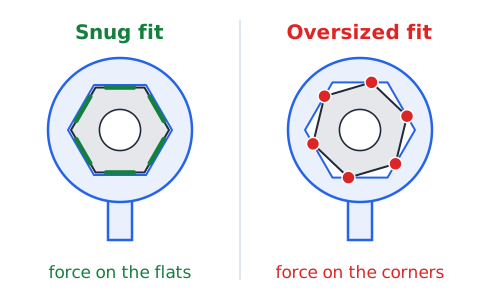
A damaged or poorly sized jaw concentrates force on fastener corners and may slip. Before turning, inspect jaw faces, wrench engagement, socket seating, and work stability. If a tool cannot fit fully, stop instead of applying more force. Improvised extensions and excess leverage can turn a small mismatch into a serious injury.
Hand versus power tools
This lesson emphasizes non-powered hand tools. A ratchet with a socket is hand powered, whereas an impact wrench is power operated. Both may drive a socket, but their sockets are not automatically interchangeable: impact-rated sockets are specifically built for repeated impact loads. Never infer that all chrome sockets are impact rated.
Open-end wrench
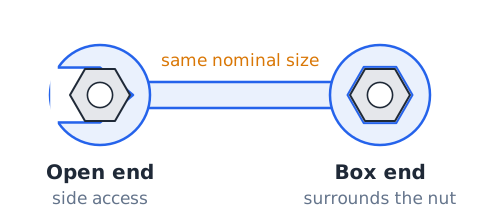
An open-end wrench has a U-shaped jaw that reaches a nut from the side when there is insufficient room to slide a closed ring over it. Use a close-fitting size and position the jaws fully on the nut flats. Because it grips fewer faces than a box-end wrench, it is less desirable for breaking loose a stubborn fastener.
Box-end wrench
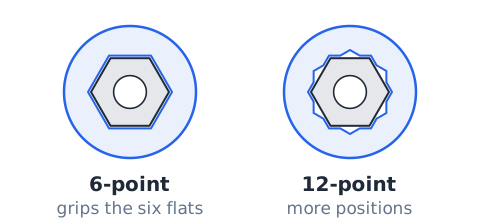
A box-end wrench surrounds a nut or bolt head with a closed ring. A six-point box end engages broad areas of a hex fastener and is usually preferred on tight or damaged fasteners. A twelve-point box end allows more handle positions in cramped spaces but may provide less corner protection under heavy load.
Combination wrench
A combination wrench commonly has an open end and a box end of the same nominal size. Use the box end when greater surrounding contact is needed and the open end for side access. The two ends are not usually different metric sizes; the design offers two engagement styles.
Adjustable wrench
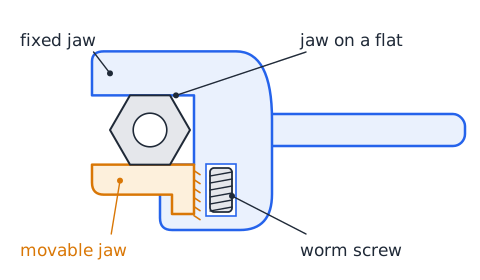
An adjustable wrench has one fixed jaw and one movable jaw operated by a worm screw. Tighten it to fit snugly around parallel flats, keep the load on the properly supported jaw according to tool guidance, and verify no jaw play before applying force. It is convenient across sizes but is not always the best tool for high torque.
Pipe wrench
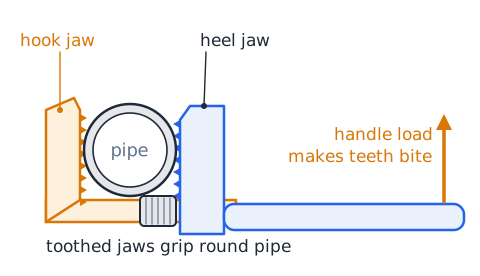
A pipe wrench uses toothed jaws that bite into round pipe or similar material as the handle is loaded. Its teeth can scar finished surfaces and crush thin-wall tubing. Do not select it for ordinary polished hex nuts when a correctly sized wrench or socket is available.
Hex keys and internal hex fasteners
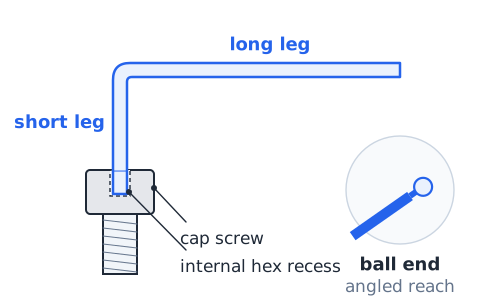
A hex key (Allen key) drives a six-sided internal recess. A wrong-size key may round the recess; imperial and metric sizes that almost fit are not interchangeable. Seat the short or long leg fully, as appropriate, and use manufacturer-recommended torque. Ball-end keys help reach angled positions but generally should not be used to apply peak breakaway torque.
Torx drivers
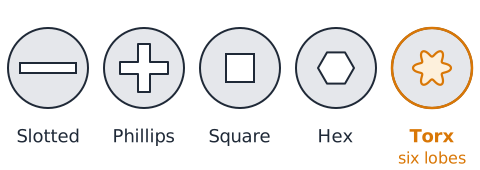
A Torx profile has a six-lobed star shape, distinct from a hexagon or Phillips cross. Match the correct Torx size and form rather than forcing a similar-looking bit. The aim is broad contact between the designed driver surfaces, reducing cam-out when properly used.
Socket set components
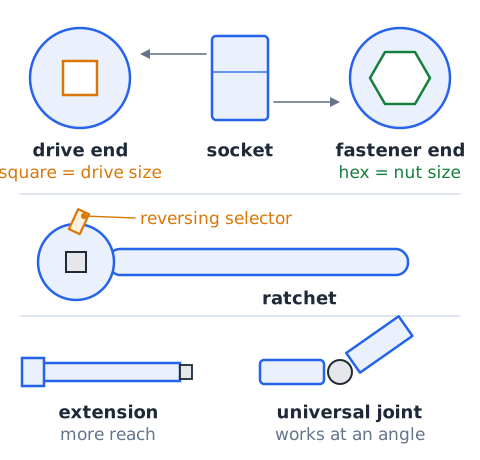
A socket surrounds a nut or bolt head and connects to a ratchet, breaker bar, or torque wrench through a square drive. Common drive sizes include 1/4, 3/8, and 1/2 inch; drive size denotes the square connector, not the size of the hex fastener. Choose both the correct fastener opening and the correct drive accessory.
Six-point and twelve-point sockets
A six-point socket contacts the six flats of a hex fastener and is often favored under high loads. A twelve-point socket offers more indexing positions and may fit some twelve-point fasteners. Compatibility should be judged by the actual fastener geometry and condition, not by a claim that one type is always best.
Shallow and deep sockets
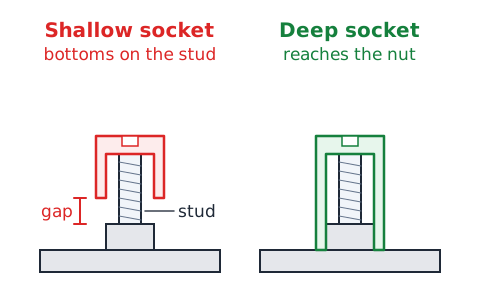
A shallow socket works where vertical clearance is limited; a deep socket reaches a nut on a long exposed stud. Deep sockets are not automatically stronger. A socket that bottoms on a stud before engaging the nut is unsuitable, regardless of how close the nominal size appears.
Ratchet mechanism
A hand ratchet transmits torque in one direction and freewheels in the reverse swing, so the operator need not lift the socket after every short stroke. The reversing selector changes driving direction. Avoid exceeding the ratchet rating; for stubborn bolts, a suitable breaker bar may be the safer choice.
Breaker bar
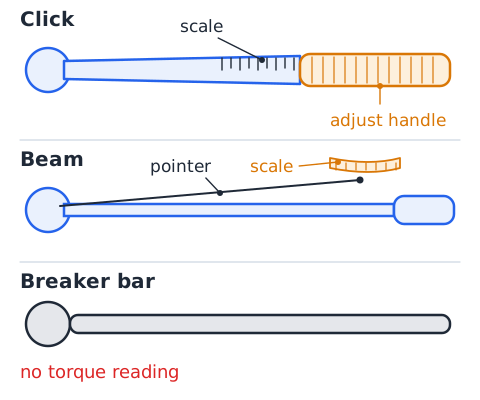
A breaker bar is a long, non-ratcheting handle intended to loosen stubborn fasteners with controlled leverage. It is not a calibrated torque measuring device. Maintain socket alignment and stable footing. Do not use added pipes unless the manufacturer explicitly authorizes that technique.
Extensions and universal joints
A socket extension changes reach; a universal joint allows operation at an angle. Angle attachments and offsets may affect effective torque or load on the drive. Use straight engagement where possible and consult tool directions for torque adjustments. Do not treat an extension as the same thing as a cheater bar.
Torque wrench purpose
A torque wrench indicates or limits the applied turning moment. Common types include click, beam, and digital designs. Use one in its specified range following calibration and handling directions. A click indicates a threshold, not permission to continue pulling; fastener torque must come from the correct service specification.
Torque is force times perpendicular arm
For a force perpendicular to a wrench handle, torque equals force times lever-arm length:
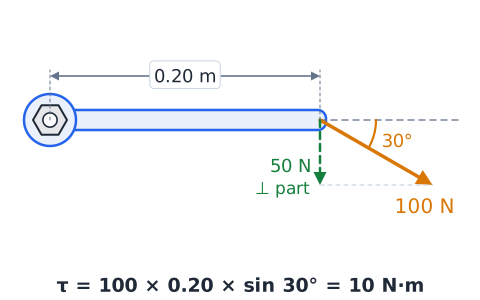
Here torque is in newton-meters if force is newtons and length is meters. If the applied force is angled, only its perpendicular component contributes:
Worked torque example: 30 N at 0.2 m
A mechanic applies 30 N perpendicular to a handle 0.20 m from the pivot.
This arithmetic illustrates a physics relationship; it is not a torque specification for any real bolt.
Angle matters
A 100 N force applied to a 0.20 m handle at 30 degrees to the handle gives
The same force perpendicular to the handle would produce 20 N·m. Keep the reference angle consistent: it is measured between the lever arm and the applied force.
Leverage and handle length
With equal perpendicular force, doubling the handle length doubles torque. This can help explain why a longer breaker bar turns a stubborn fastener. It also explains why adding an improvised pipe may overload a tool or fastener. More leverage is not inherently better.
Metric and US customary wrench sizes
Metric wrench openings are labeled in millimeters, whereas customary sizes are commonly given as fractions of an inch. An exact inch-to-millimeter conversion uses 1 inch = 25.4 mm. Near-looking sizes can still differ enough to round a fastener; match the actual bolt head and wrench design.
Fractional inch example
A 1/2-inch wrench opening corresponds to
This is not the same as a 13 mm wrench opening; a specific fastener may call for one or the other. The correct tool is determined by a full fit check, not just arithmetic proximity.
Slip-joint pliers
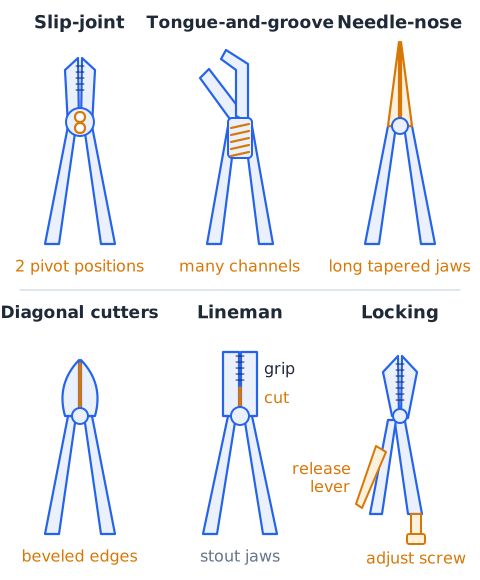
Slip-joint pliers have adjustable pivot positions to grip a range of workpiece sizes. They can hold small parts or bend wire in non-precision contexts but their serrated jaws can mark surfaces. They are poor substitutes for a wrench on high-torque hex fasteners.
Tongue-and-groove pliers
Tongue-and-groove pliers provide multiple jaw openings while preserving useful handle geometry. They are useful for securely gripping irregular or comparatively large objects. Choose positions that keep the jaws properly engaged. Do not over-squeeze brittle or thin components.
Needle-nose pliers
Long, narrow jaws reach confined areas, grasp small objects, and form light wire bends. A long nose offers access, not greater grip strength. Avoid side-loading tips or using them as pry bars. Select insulated-rated designs only where appropriate and follow electrical safety requirements.
Diagonal cutting pliers
Diagonal cutters are designed to sever wire or small soft material within their rated capacity. Their beveled edges are not intended for twisting bolts or cutting hardened stock beyond the rating. Wear suitable eye protection and control cut-off pieces; they can become projectiles.
Lineman pliers
Lineman pliers combine heavy gripping jaws and cutting edges, commonly for bending and cutting suitable wire. Their shape differs from needle-nose pliers: stout jaws favor grip and cut force; tapered jaws favor reach. Never assume an ordinary handle covering is certified electrical insulation.
Locking pliers
Locking pliers use an adjustment screw and over-center mechanism to clamp an object. They can temporarily hold work during setup, but teeth may damage surfaces and they are not substitutes for a rated vise or hoist clamp. Release carefully because stored force may cause movement.
Flat-blade screwdriver
A slotted screwdriver has a flat blade matched to a straight fastener slot. Correct tip width and thickness matter. An undersized tip concentrates pressure and can deform the slot. Screwdrivers are for turning fasteners, not for chiseling, prying, punching, or electrical probing.
Phillips screwdriver
A Phillips head has a cross-shaped recess. Use the proper bit size to obtain full engagement and reduce slipping. The profile may cam out under excess torque; repeated cam-out can damage the recess. A superficially similar Pozidriv recess uses different flank geometry and requires the right bit.
Robertson square drive
A square-drive or Robertson screw accepts a square-profile tip. It can offer good engagement when sized correctly. It is not a Torx, hex, or cross-head recess; choosing a similar-sized but different profile invites damage. The square bit should reach the base of the recess and match its width. A driver that rocks or leaves visible gaps is likely the wrong size or profile; stop before the recess is damaged.
Bit holders and interchangeable bits
A bit driver uses interchangeable tips; quick-change holders may be magnetic or mechanically retained. Check that the chosen tip is seated securely and matches the fastener. Magnetism helps retention of some steel screws but does not increase rated torque or guarantee that the bit will stay attached under load.
Ball-peen hammer
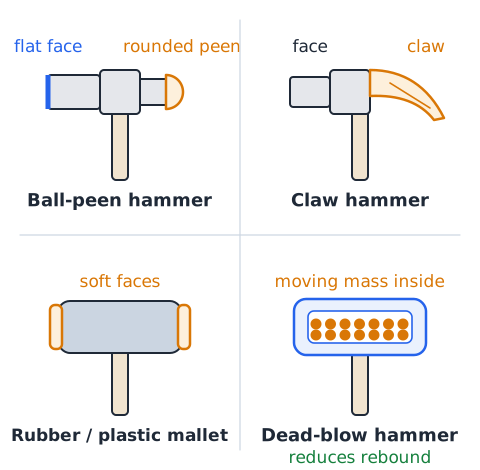
A ball-peen hammer commonly has one flat face and one rounded peen for appropriate metalworking tasks. The rounded side can shape or peen material; the flat face can strike compatible punches or other approved tools. It is not interchangeable with every woodworking or soft-face mallet.
Claw hammer
A claw hammer is associated with driving and extracting nails in wood. The curved or straight claw provides nail-pulling leverage. Do not use it to strike hardened steel tools unless that use is specifically approved; hammer faces can chip.
Rubber and plastic mallets
A soft-face mallet can seat or position delicate parts with less marring than a steel hammer. The material and hardness should be selected for the application; a soft mallet does not eliminate pinch-point or eye hazards. Keep its head secure on the handle.
Dead-blow hammer
A dead-blow hammer uses internal moving mass to reduce rebound on impact. This is useful for positioning parts when rebound control matters. It does not mean impacts can be directed against unapproved brittle surfaces or that the tool cannot injure the operator.
Punches and their distinct jobs
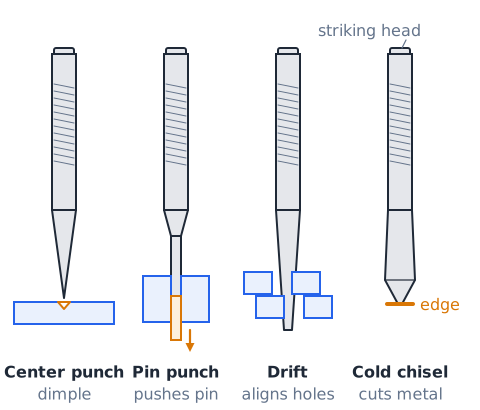
A center punch makes a small dimple that helps locate a drill point. A pin punch pushes out a compatible pin; a drift can align holes or move parts depending on design. Do not substitute a pointed center punch for a pin punch if the point would spread or deform the pin.
Cold chisel
A cold chisel cuts or chips comparatively cold metal when used within its rating and with an appropriate striking tool. Keep the cutting edge suitable for the task and control flying chips. OSHA requires impact-tool heads such as chisels to be kept free of mushrooming. Remove damaged chisels from service.
Files and rasps
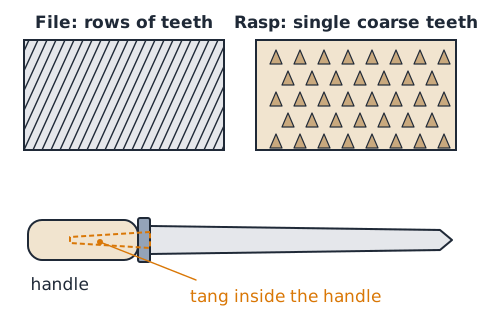
A metalworking file has rows of cutting teeth for shaping and smoothing metal; a rasp uses coarser individual teeth for shaping softer material such as wood. Many tang-type files require a proper handle to prevent puncture injuries. Teeth cut in a preferred stroke direction, so avoid unnecessary pressure on the return stroke.
Hacksaw
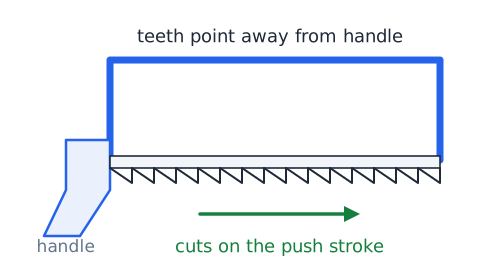
A hacksaw holds a fine-toothed blade in a frame and is often used to cut metal stock or pipe. Select a suitable blade tooth pitch for the workpiece, tension the blade as directed, and secure the work before cutting. Install the blade with its teeth pointing away from the handle, so the saw cuts on the push (forward) stroke.
Handsaw: rip versus crosscut
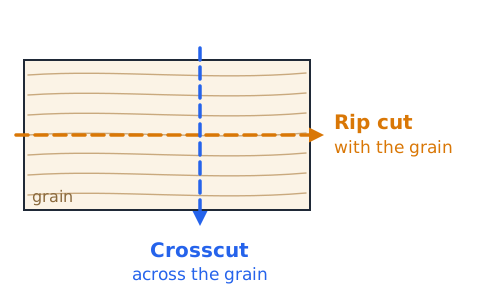
A ripsaw is designed to cut wood with the grain; a crosscut saw is designed to cut across it. Match blade type and work support to the intended cut. On the ASVAB, the grain direction in the question is often the decisive clue.
Coping saw
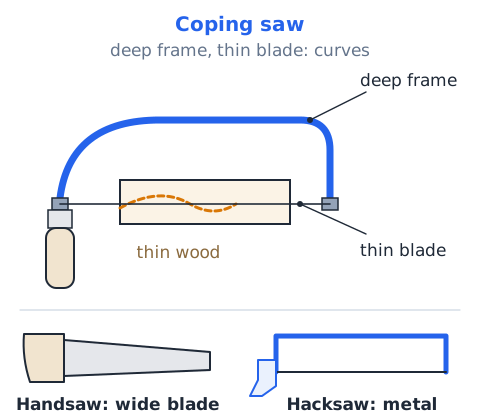
A coping saw has a narrow blade held in a deep frame, suitable for curves and intricate cuts in thin wood and some other appropriate material. It is not the preferred saw for rapidly ripping a thick board along the grain. Secure the work and protect fingers from the blade path.
Utility knife
A utility knife uses a replaceable sharp blade for scoring and cutting suitable sheet or packaging material. Retract or guard the blade when it is not in use. Cut away from your body and hand, use a stable surface, and replace damaged blades following disposal rules.
C-clamp
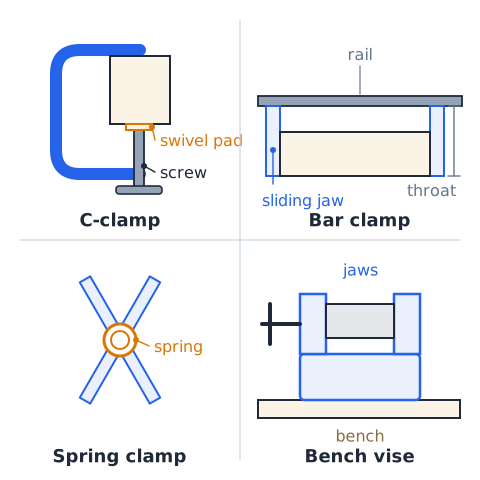
A C-clamp uses a screw to compress work against a supporting surface. Place protective pads where surface marking would matter and tighten only within the clamp rating. It is not designed as a lifting device. Plan clearance so a saw or drill cannot strike the clamp.
Bar clamp
A bar clamp uses a long rail with a moving jaw to hold wider assemblies, commonly in woodworking. Capacity is defined by opening, throat depth, and clamping force, not just the visible bar length. Spread pressure evenly to avoid bending or marking delicate components.
Spring clamp
A spring clamp applies force via its spring-loaded jaws and is useful for quick light-duty holding. It offers less precise force control than screw clamps and is not for structural lifting or heavy loads. Choose jaw pads that suit the material.
Bench vise
A bench vise mounted to a suitable workbench secures a workpiece during filing, sawing, or fitting. A vise is a holding device, not a clamp for moving loads. Keep hands clear of jaws and use non-marring pads where needed.
Awl
An awl creates small pilot locations or marks in suitable softer material, especially for layout on wood or leather. It is not a substitute for a rated screwdriver or punch. Keep its sharp point guarded when stored.
Tape measure and rule
A tape measure handles longer lengths; a rigid steel rule helps with short precise linear measurements and layout. Read from the true reference mark, not a damaged tape hook. Accuracy requires checking whether the units are inches, fractional inches, or millimeters.
Combination square
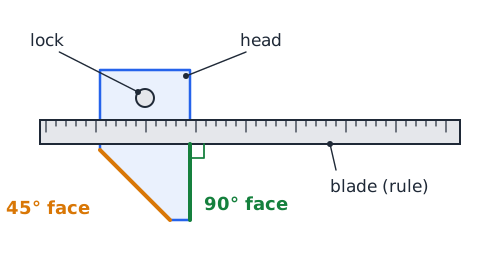
A combination square can check 90-degree and 45-degree relationships, mark lines, and help measure depth depending on design. Its name refers to multiple layout functions, not a combination wrench. Verify the head and blade are locked and clean before trusting an alignment.
Caliper versus micrometer
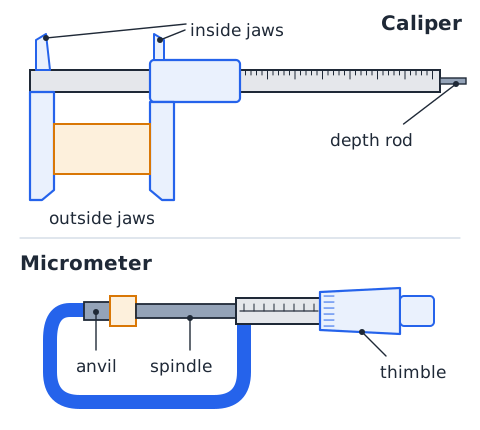
Calipers measure dimensions such as outside width, inside width, or depth with the right jaws/rod. A micrometer commonly offers fine measurement over a narrower range. Neither measures twisting torque; that requires an appropriate torque tool. Do not clamp so tightly that the part deforms.
Feelers and gap measurement
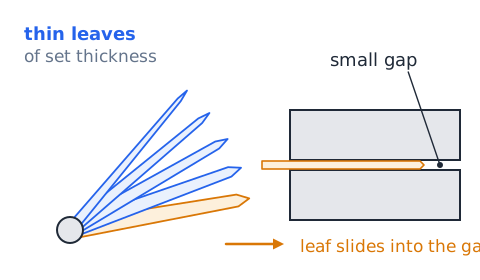
Feeler gauges are thin leaves of specified thickness used to estimate small clearances when the procedure allows. Combine leaves only as specified and account for dirt and burrs. A tight fit alone does not establish a correct gap without a reference specification.
Spare blades and tool maintenance
Inspect saw teeth, files, edges, handles, pivots, and striking faces before use. Clean tools, protect cutting edges, lubricate moving joints where directed, and store them so sharp parts cannot injure another person. Dispose of irreparably unsafe tools rather than leaving them in shared circulation.
PPE and eye hazards
Hammering, chiseling, and cutting can send fragments toward the face. Use appropriate safety glasses or face protection based on the specific hazard assessment; a face shield may be additional protection rather than a substitute for eye protection. Loose clothing and unsecured work also create hazards.
Stop when the tool slips
A wrench that repeatedly slips may be wrong size, worn, poorly seated, or used against a damaged fastener. Do not respond simply by pulling harder. OSHA 29 CFR 1926.301 prohibits use of wrenches with sprung jaws when slippage occurs.
Mushroomed striking heads
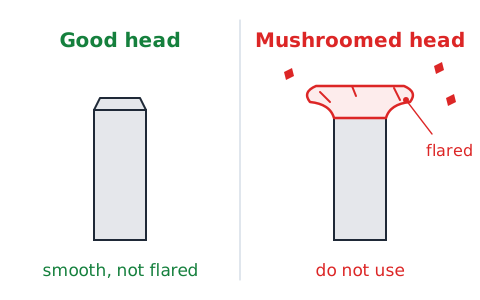
Repeated hammer blows can flare the struck end of a chisel or punch into a mushroom shape. Loose fragments may break away. OSHA 1926.301 specifically requires impact tools such as chisels, wedges, and drift pins to be free from mushroomed heads; damaged tools must not be used.
Loose hammer handle
Cracked or splintered wooden handles and loose hammer heads can release under impact. Inspect the handle-to-head joint. OSHA calls for wooden tool handles to be free of cracks and splinters and tight in the head. A loose head is not fixed by holding the hammer more tightly.
Safe use of screwdrivers
Match the recess and the tip, support the work and keep hands out of the tip travel path. Turning a fastener with a screwdriver is not the same as prying apart two surfaces. Tool misuse creates unpredictable bending forces and can break or slip the tip.
Tool selection in crowded spaces
When a ring wrench cannot descend over a nut on a long stud, an open-end wrench may allow side access; a deep socket may also work when there is enough axial clearance. Neither is universally superior. The critical question is which tool properly engages the specific fastener given the geometry.
Case study: rounded nut
A student tries a loose adjustable wrench on a rusted hex nut and rounds the corners. The error is not lack of force; it is insufficient controlled jaw engagement and inappropriate tool choice. A close-fitting six-point tool would generally provide broader contact, if the fastener condition and access allow.
Case study: small electronics screws
An undersized cross-head bit slips repeatedly in a recessed small screw. The correct response is to stop and identify the recess type and proper driver size, not strike the driver with a hammer or push with ever-increasing force.
Case study: delicate surfaces
A polished metal panel requires gentle repositioning. A hardened steel claw hammer may mar the surface; a rated soft-face mallet and suitable work support offer a better fit. Impact still requires controlled force and safe finger position.
Case study: drilling layout
A technician wants to start a drill at a marked spot on metal. A center punch can mark the location to discourage bit wandering; a pin punch is designed primarily to drive pins. Match the punch tip to the action and the material.
Case study: rip cut
An exam question asks which hand saw cuts a thick board lengthwise along the wood grain. Choose a rip saw. Crosscut refers to cutting across grain and a coping saw favors curves; knowing the grain direction is more useful than memorizing brand names.
Worked example: wrench torque
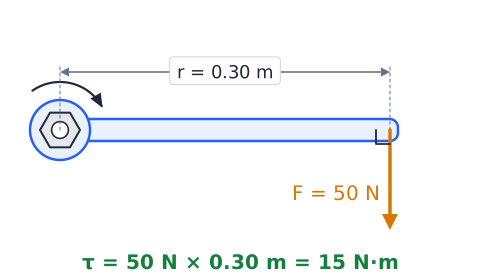
A 0.30 m wrench handle receives 50 N perpendicular force. Its torque is
This is a classroom force calculation, not an instruction to tighten a particular fastener to 15 N·m. Because the direction is perpendicular, there is no angle-reduction factor. This is an idealized force model; actual work also depends on tool seating, friction, material and manufacturer limitations.
Worked example: unit conversion
An indicated length of 3/4 inch is
A 19 mm wrench is close in number but not mathematically identical. Never choose a fastener tool on rounding alone without checking the actual fit. A conversion describes length only: it does not prove that differently labeled tools will fit safely. Metric and inch series should be identified from actual fastener requirements.
Worked example: comparative torque
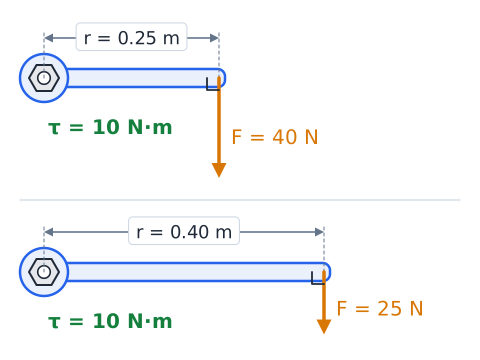
Compare two perpendicular forces: 40 N at 0.25 m makes ; 25 N at 0.40 m also makes . Force alone does not determine turning effect—the lever arm must be included. Both combinations have the same moment about the pivot. This illustrates how changing lever arm length can trade off against required force without changing total torque.
How to read an illustrated question
First identify the contact surfaces: open ring versus closed ring, toothed round-pipe jaw versus parallel smooth jaw, square-drive socket versus screwdriver bit. Next identify the task and material. Only then compare answer labels; this reduces confusion among tools that share a handle-like silhouette.
ASVAB elimination strategy
Reject tools that perform a different fundamental action. A chisel cuts or chips; a punch positions or drives; a file removes small material amounts; a wrench turns nuts; a screwdriver turns screws. When two choices seem plausible, prefer the one designed for the task and access constraints.
Avoid tool-name traps
A combination square is a measuring/layout tool, whereas a combination wrench turns a fastener. A socket drive size is not the nut size. A torque wrench measures torque; an ordinary ratchet does not. A pipe wrench bites round material and is not a universal wrench.
Safety scenario: deciding to stop
If a chisel head is mushroomed or a wooden hammer handle cracked, remove the tool from service. Do not keep striking and assume gloves alone eliminate the hazard. Recognizing when not to use a tool is part of Shop Information competence.
Guided drill: choose the engagement
Match these tasks: fully enclose a stubborn hex nut—six-point box end or socket; reach a nut only from the side—open end; turn a bolt to specified torque—a calibrated torque wrench; drive a six-lobed screw—Torx driver. Justify each match by contact geometry or measured function.
Guided drill: distinguish gripping tools
Identify these jobs: grasp tiny object in recess—needle-nose pliers; sever a suitable wire—diagonal cutter; grip round pipe with biting jaws—pipe wrench; hold a workpiece temporarily with locking force—locking pliers. Check for surface damage and rating constraints.
Guided drill: compare impact tools
Identify a flat-faced and rounded-peen metalworking hammer—ball-peen; a woodworking nail hammer—claw hammer; a reduced-rebound positioning hammer—dead-blow; a softer-faced positioning tool—rubber/plastic mallet. No hammer is automatically acceptable against every target. The intended contact surface, the material being struck, and the impact energy all matter. A damaged striking face or cracked handle must be removed from service before choosing any hammer.
Quick review and readiness check
Before moving on, explain an open-end wrench versus box-end wrench, ratchet versus torque wrench, needle-nose versus diagonal cutter, rip versus crosscut saw, center versus pin punch, and three unsafe-tool symptoms. Verify that torque equals perpendicular force times arm length and that correct tool fit matters more than raw leverage.
 English ▾