 ASVAB Camp
Lesson outcome: identify the controlling idea
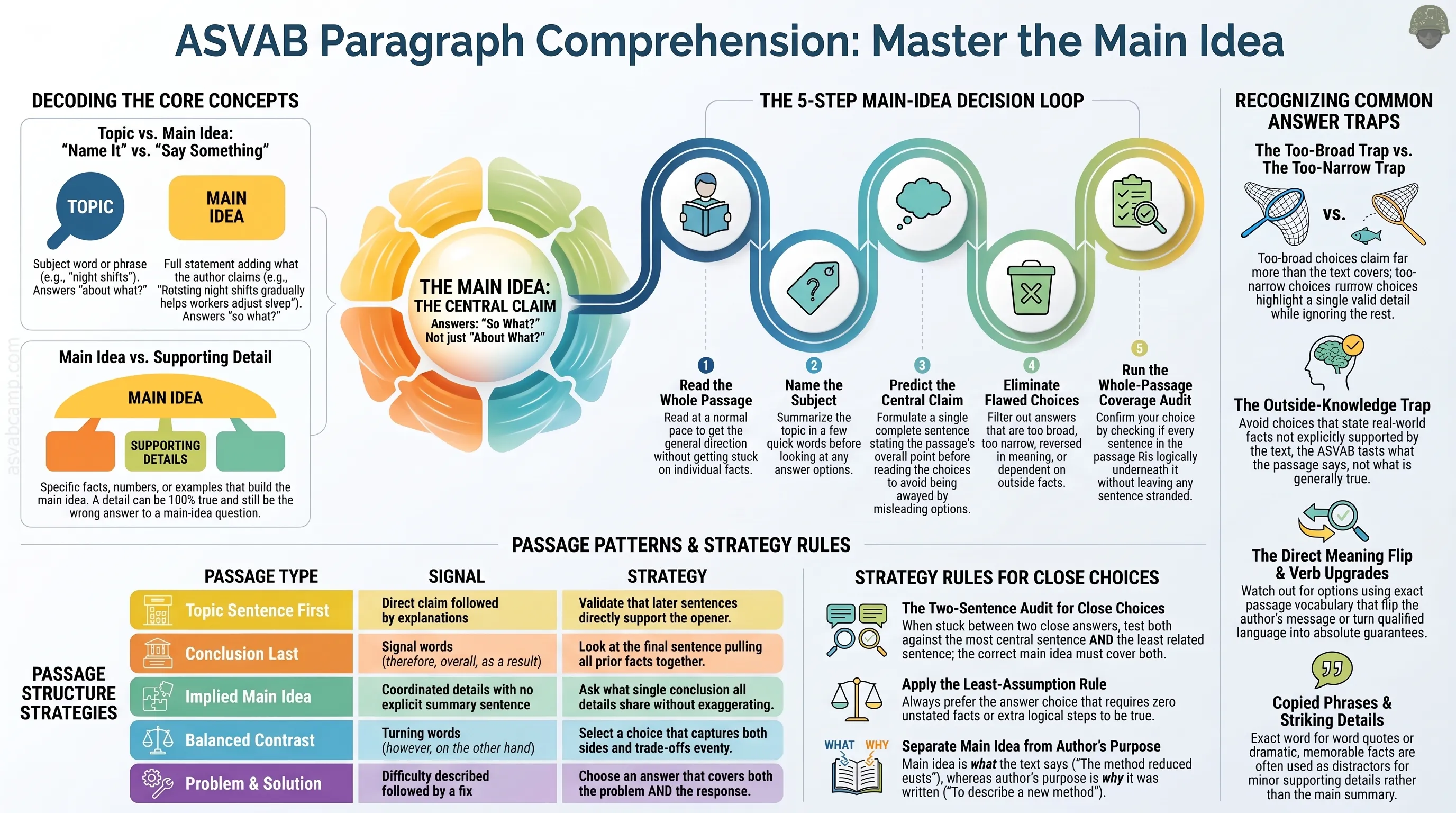
After this lesson you should be able to read a short passage and state, in one sentence, the point that ties all of its sentences together. You will also learn to reject answer choices that claim too much, cover too little, reverse the author's meaning, or depend on facts the passage never gives.
The PC construct and the scope of this lesson
The Paragraph Comprehension (PC) subtest checks how well you take in information from short written passages. Some questions ask for a stated fact, some ask for a reasonable conclusion, and some ask for the central message. This lesson focuses on that last skill, which also makes the other question types easier.
What the main idea actually means
The main idea is the single point the whole passage is built to make. Every sentence in a well-built paragraph either states that point or helps support it. It is not simply the first sentence, the most interesting fact, or the subject word. It is the claim the author wants you to come away believing or understanding.
Topic versus main idea: name it, then say something
The topic is the subject, usually a word or short phrase such as "night shifts." The main idea adds what the passage says about that subject: "Rotating night shifts gradually can help workers adjust their sleep." A good test is whether your answer is a full statement. A topic alone answers "about what?" but not "so what?"
Main idea versus supporting detail
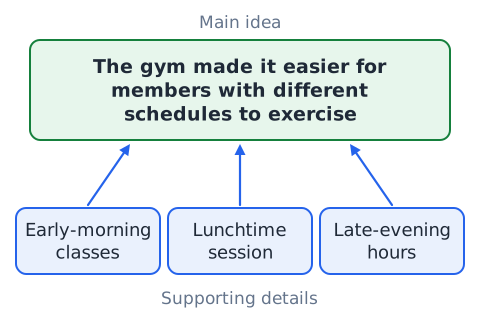
Supporting details are the facts, examples, reasons, and numbers that back up the main idea. If a passage says a gym added early-morning classes, a lunchtime session, and late-evening hours, each of those is a detail. The main idea is what they add up to, such as the gym making it easier for members with different schedules to exercise. A detail can be true and still be the wrong answer to a main-idea question.
The whole-passage coverage test
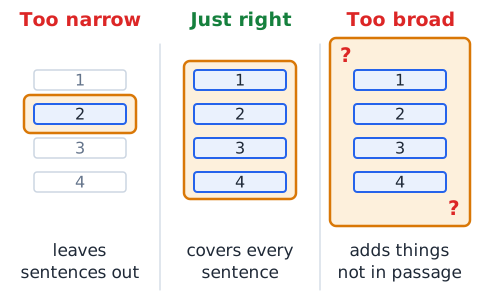
Hold each answer choice up against every sentence. Ask whether the first sentence, the middle sentences, and the last sentence all fit under it. If one sentence would be left out or would seem out of place, the choice is probably too narrow. If the choice drags in things no sentence mentions, it is probably too broad.
Avoid the too-broad option
A too-broad choice describes a larger subject than the passage actually covers. Suppose a paragraph explains how one county trained volunteers to check smoke alarms in older homes. A choice saying "Fire safety is important everywhere" sounds reasonable, but the passage never discusses fire safety in general. The right answer stays the same size as the passage.
Avoid the too-narrow option
A too-narrow choice repeats one detail, often accurately, but ignores the rest. If a passage describes three ways a warehouse cut energy use, a choice mentioning only its new LED lighting misses the other two. Ask whether the choice could serve as a title for the entire passage. If it would fit only one sentence, it is a detail.
Avoid the opposite-meaning option
Some choices use the passage's own vocabulary but reverse its message. If a paragraph argues that short breaks improve accuracy on long inspection tasks, a choice claiming that breaks interrupt focus and reduce accuracy borrows the topic while flipping the point. Check the direction of the claim: helps or hurts, increases or decreases, supports or rejects.
Avoid the outside-knowledge trap
A choice may state something you know is true in real life but the passage never says. The test asks what this passage supports, not what is generally correct. If a paragraph about a coastal town's sea wall says nothing about climate, a choice about rising global temperatures is unsupported here, however accurate it may be elsewhere.
Use a complete main-idea sentence
After reading, try to say the point in a single complete sentence with a subject and a claim. For example: "The shop's new labeling system reduced shipping mistakes." Writing or thinking a full sentence forces you to decide what the passage says, not just what it is about. Then look for the choice that matches your sentence in meaning, even if the wording differs.
Look for repeated concepts, not repeated vocabulary
Authors often repeat an idea using different words. A paragraph might say "lowers costs," then "saves money," then "reduces spending." The repeated concept is savings, even though no single word repeats. Track the idea that keeps returning; that recurring thread usually points straight to the main idea.
Find the main idea when the topic sentence comes first
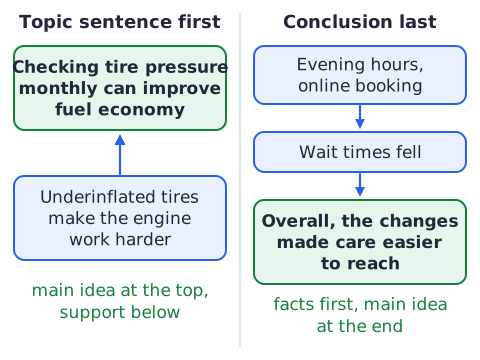
Many paragraphs open with their main claim and then support it. For example: "Checking tire pressure monthly can improve fuel economy. Underinflated tires create extra rolling resistance, and that resistance makes the engine work harder." The first sentence states the point; the second explains why. Confirm the later sentences really support the opener before choosing it.
Find the main idea when the conclusion comes last
Some passages build toward their point. They present facts first and end with a summary sentence, often signaled by words like therefore, as a result, or overall. Example: "The clinic added evening hours and online booking. Wait times fell. Overall, the changes made care easier to reach." The last sentence pulls the facts together into the main idea.
Find an implied main idea when none is directly stated
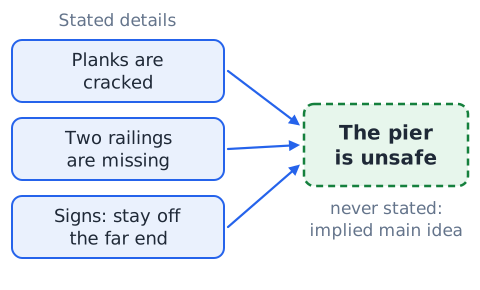
Sometimes no single sentence states the point. Consider: "The old pier's planks are cracked. Two railings are missing. Signs warn visitors to stay off the far end." No sentence says the pier is unsafe, but every detail points that way. To find an implied main idea, ask what conclusion all the details share, then pick the choice that states it without exaggerating.
Trace the passage’s central relationship
Many passages are organized around one relationship: cause and effect, problem and solution, before and after, or comparison. Identifying that relationship gives you the shape of the main idea. If a passage describes a delivery company switching to route-planning software and then reports faster deliveries, the main idea links the change to its result rather than describing either one alone.
Cause versus correlation in the main idea
A passage may report that two things happen together without proving that one causes the other. "Students who ate breakfast scored higher" describes a pattern, not necessarily a cause. If the passage is careful, the correct main idea will be careful too. Reject choices that turn "linked to" or "associated with" into "causes."
Notice qualifying language
Words such as may, often, some, usually, and in certain cases limit a claim. A passage saying a coating "can reduce rust in many conditions" does not say it prevents all rust. The best main-idea choice keeps the same strength as the passage. Choices with always, never, all, or only often go too far.
A contrast passage can have a balanced main idea
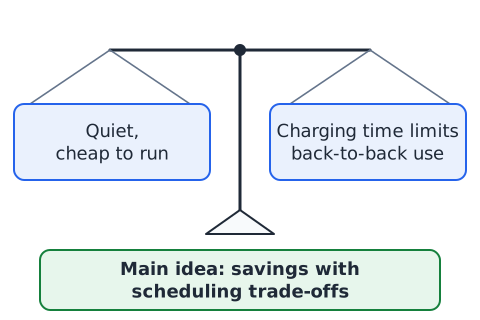
When a passage weighs two sides, the main idea may be the balance itself. For example, a paragraph might say that electric forklifts are quiet and cheap to run but need charging time that limits back-to-back use. The best summary keeps both sides: electric forklifts offer savings but bring scheduling trade-offs. A choice praising or condemning them alone is incomplete.
Process descriptions need an overall point
A paragraph listing steps, such as how to change an air filter, still has a main idea. It is usually the purpose or result of the process, not any single step. Ask why the steps are being described. "Following these steps keeps the system running efficiently" captures the whole; "remove the cover first" is only one detail.
Problem and solution passages
In this structure, the passage first describes a difficulty and then explains a response. The main idea usually connects the two: what was wrong and how it was addressed. If the only choice you like names the problem but not the fix, or the fix but not the problem, look again for an answer that covers both halves.
Generalization from examples: respect limits
A passage may give a few examples and then draw a modest conclusion. Two towns that added bike lanes and saw more cyclists support the idea that bike lanes can encourage cycling. They do not prove that every city will see the same result. Choose the answer that generalizes only as far as the examples allow.
Descriptive passages still have a focus
A passage that describes a place, object, or event is not just a pile of facts. The details are chosen to create one impression or make one point, such as how remote a weather station is or how crowded a market becomes at dawn. Ask what overall picture the details create, then pick the choice that names it.
A comparison may emphasize one meaningful difference
Some comparisons mention similarities but stress a single key difference. A paragraph could note that two water filters cost the same and fit the same faucets, then explain that only one removes lead. The similarities set the scene; the difference is the point. The main idea is that the filters differ mainly in what they remove.
How to read a paragraph in two passes
On the first pass, read the whole paragraph at a normal pace to get the general direction without stopping on every fact. Then form a quick one-sentence summary in your head. On the second pass, which may be just a glance, check that summary against the opening, any turning words such as however, and the final sentence before you compare the choices.
The five-step main-idea decision loop
Read the passage through once. Name the topic in a few words. State what the passage says about that topic in one sentence. Compare each choice to your sentence, removing those that are too broad, too narrow, reversed, or unsupported. Confirm the survivor by checking that every sentence fits under it.
Predict the message before comparing options
Looking at the choices first can plant ideas the passage never supports. Instead, form your own short prediction before reading the options. Then look for the choice closest to your prediction. If nothing matches, reread the passage instead of settling for the choice with the most familiar words.
The two-sentence audit for close choices
When two choices both seem right, test each against two specific sentences: the one that seems most central and the one that seems least related to it. The correct main idea must cover both. Often one of the close choices fits the central sentence but leaves the other one stranded, which shows it is too narrow.
A safe evidence check for scientific or technical prose
Technical passages can feel harder because of unfamiliar terms, but the logic is the same. Note what was studied or described, what was found, and how sure the author sounds. You do not need to understand every term. The main idea will connect the subject to the finding at the same level of certainty the author uses.
The least-assumption rule
When stuck between two answers, prefer the one that needs fewer unstated assumptions to be true. If one choice follows directly from the passage and another requires you to add a fact or a step the author never gave, the first is safer. The best answer should be defensible using the passage alone.
CAT and paper navigation are not interchangeable
On the computer-adaptive version of the ASVAB, you generally answer each question as it appears and cannot go back to change it later, so make a careful choice before moving on. A paper-and-pencil version allows you to skip and return within a subtest. Learn the rules of the format you will take, and practice accordingly. On a computer test, do not plan to "come back later," because that option may not exist.
Time management without reckless scanning
PC passages are short, so reading the whole passage is usually affordable and much safer than skimming for keywords. Save time by not rereading every word repeatedly and by using your prediction to filter choices quickly. If a question is taking much longer than others, make your best evidence-based choice and move on.
Trap: the copied phrase looks more accurate
A choice that repeats exact words from the passage can feel correct, but copying a phrase does not mean capturing the point. Often the copied phrase is a detail. A paraphrased choice that covers the whole passage is usually stronger than a word-for-word match of one sentence.
Trap: the most dramatic detail steals attention
A striking fact, such as a fire, a record number, or a surprising result, tends to stick in memory. But one vivid detail may only illustrate the main point. Ask whether the rest of the passage is about that detail or uses it as an example. Choose the idea that the whole passage supports, not the most memorable sentence.
Trap: turning possibility into certainty
If the passage says a method "may help" or "can reduce" a problem, the right answer will not say it "solves" or "eliminates" that problem. Compare the strength of the verbs. Choices that upgrade a possibility into a guarantee are claiming more than the passage supports.
Trap: treating an example as the whole subject
Writers often use one example to illustrate a broader point. If a paragraph about water conservation mentions low-flow showerheads as one example, a choice about showerheads alone misses the larger subject. Ask whether the example is the point or just one way of showing it.
Trap: imposing your viewpoint
You may agree or disagree with a passage, but your opinion does not change what it says. If a passage presents a neutral description of a new parking policy, a choice saying the policy is unfair adds a judgment the author never made. Stick to the author's position, even when you would argue it differently yourself.
Trap: confusing the main idea with the author’s purpose
The main idea is what the passage says; the purpose is why the author wrote it, such as to inform, explain, or persuade. "To describe a new training method" is a purpose. "The new training method shortened learning time" is a main idea. Read the question to see which one it asks for.
Trap: mixing up chronology and conclusion
A passage told in time order lists events first, then later, and finally. The last event mentioned is not automatically the main idea. Ask what the sequence shows overall, such as how a problem developed or how a plan succeeded. The point lies in the meaning of the sequence, not its final step.
Worked example 1: An umbrella idea from two supporting facts
Passage: "A community pool started offering lap swimming at 6 a.m. It also opened a shallow section for beginners on weekend afternoons. Both changes were meant to bring in residents who had not used the pool before."
Choices: A. The pool now opens only in the morning. B. Weekend beginners prefer shallow water. C. The pool changed its schedule to attract new swimmers. D. Lap swimming is the most popular pool activity.
Reasoning: The two facts are the early lap swim and the beginner section. The last sentence explains what links them: reaching new users. A is false, B and D add claims the passage never makes. Answer: C.
Worked example 2: Overly broad claims about safety
Passage: "A sawmill installed guards around its blades and required workers to wear cut-resistant gloves. Over the next year, reported hand injuries at the mill dropped."
Choices: A. Safety equipment prevents all workplace accidents. B. New protective steps at the mill were followed by fewer hand injuries. C. Sawmills are the most dangerous workplaces.
Reasoning: A and C stretch far beyond one mill and one type of injury. B stays within the passage's scope and its careful wording. Answer: B.
Worked example 3: A contrast word changes the message
Passage: "Gravel driveways are inexpensive to install. However, they need fresh gravel every few years and can be hard to clear of snow."
Choices: A. Gravel driveways are the cheapest choice overall. B. Gravel driveways cost little up front but require ongoing upkeep. C. Gravel driveways should be avoided.
Reasoning: "However" signals a turn. The point includes both the low starting cost and the later maintenance. A ignores the turn, and C adds a recommendation. Answer: B.
Worked example 4: Implied main idea through coordinated examples
Passage: "The trail map was last updated ten years ago. Two bridges shown on it have since washed out, and a new connector path is missing entirely. Rangers often redirect hikers who follow it."
Choices: A. The park needs more rangers. B. The trail map is out of date and can mislead hikers. C. Bridges in the park are poorly built.
Reasoning: No sentence says the map is unreliable, but every detail shows it. A and C focus on side issues. Answer: B.
Worked example 5: Avoid converting a trend into an absolute rule
Passage: "In a survey of commuters, most said they would ride the train more often if it ran every fifteen minutes. A smaller group said frequency would not change their habits."
Choices: A. Every commuter wants more frequent trains. B. More frequent service would likely appeal to many surveyed commuters. C. No commuter cares about train frequency.
Reasoning: "Most" is not "every," and a smaller group disagreed. A and C are absolute. Answer: B.
Worked example 6: A procedure united by its purpose
Passage: "Before closing for the night, cooks wipe down grills, label stored food with the date, and empty the grease traps. These tasks keep the kitchen ready and sanitary for the morning crew."
Choices: A. Grease traps must be emptied daily. B. A closing routine prepares a clean kitchen for the next shift. C. Morning cooks work harder than night cooks.
Reasoning: A is one step. The last sentence states the purpose that unites them all. Answer: B.
Worked example 7: A descriptive passage without persuasion
Passage: "The ranger station sits at the end of a twelve-mile dirt road. There is no cell signal, and supplies arrive by truck once a week. In winter, snow can block the road for days."
Choices: A. The ranger station is isolated and hard to reach. B. Rangers should be paid more. C. The road should be paved.
Reasoning: The passage only describes; it does not argue for anything. B and C add opinions. The details create one impression: remoteness. Answer: A.
Worked example 8: Evidence across the whole paragraph
Passage: "A parts supplier began texting customers when orders shipped. Calls asking about order status dropped by half. Staff then had more time to handle repair questions, and customer ratings improved."
Choices: A. Customers prefer texts to phone calls. B. Shipping notices reduced status calls and freed staff for other work. C. Repair questions are the most common call.
Reasoning: The chain runs from texts, to fewer calls, to more staff time, to better ratings. B covers the chain. A and C are not stated. Answer: B.
Worked example 9: Cause and effect with appropriate caution
Passage: "After a city lowered the speed limit on one avenue, the number of crashes there fell the following year. Officials said other changes, such as new crosswalk signals, may also have played a role."
Choices: A. Lower speed limits always prevent crashes. B. Crashes fell after the speed change, though other factors may have contributed. C. Crosswalk signals caused all of the improvement.
Reasoning: The passage is careful about cause. B keeps that caution; A and C claim certainty. Answer: B.
Worked example 10: Balanced comparison of two methods
Passage: "Painting a fence by brush takes longer but reaches tight corners well. Spraying is much faster, yet it wastes more paint and needs careful masking."
Choices: A. Spraying is the better method. B. Brushing and spraying each have advantages and drawbacks. C. Brushing wastes more paint than spraying.
Reasoning: The passage presents trade-offs without naming a winner. A picks a side, and C reverses a detail. Answer: B.
Guided exercise: compress before choosing
Shrink each passage into one sentence before checking the answer.
Passage 1: "A school replaced its paper sign-in sheets with badge scanners. Office staff no longer type names into a computer each afternoon, and attendance records are ready the same day." Summary: The scanners made attendance records faster and less work.
Passage 2: "Some hikers carry a paper map even with a phone. Batteries can die, and signals can drop in deep valleys." Summary: A paper map is a useful backup when phones may fail.
Guided exercise: choose between two tempting statements
Passage: "The food bank moved its distribution day from Tuesday to Saturday. Volunteers were easier to find on weekends, and more families who work weekdays were able to come."
Statement X: More volunteers are available on Saturdays. Statement Y: Moving to Saturday helped both staffing and family attendance.
Which is the main idea? Answer: Y. Statement X is true but covers only the volunteer half; Y covers both results of the change.
Quick review: seven main-idea checks
Is your answer a full statement, not just a topic? Does it cover every sentence? Is it no bigger than the passage? Is it no smaller than the passage? Does it keep the passage's direction instead of reversing it? Does it match the passage's level of certainty? Can it be defended without outside knowledge? A choice that passes all seven is the main idea.
Final transfer to unseen passages
On test day the passages will be new, but the method stays the same. Read the whole paragraph, name its topic, and state its point in your own sentence. Then eliminate choices that are too broad, too narrow, reversed, overstated, or unsupported. The answer that survives should sum up the entire passage at the strength the author used.
 English ▾