 ASVAB Camp
Objectives and exam framing
This lesson builds the force and balance skills that Mechanical Comprehension questions rely on. When you finish, you should be able to treat forces as vectors with size and direction, draw a free-body diagram, and apply Newton's three laws. You will add forces along a line and at right angles, split a slanted force into parts, and find torque about a pivot.
You will also solve lever, seesaw and beam support problems, handle friction and inclines, find rope and pulley tensions, and tell when an object will slide or tip. Many test items show a diagram, so you will practice reading one quickly and spotting the trap answers.
What a force actually is
A force is a push or a pull that one object exerts on another. A force can start something moving, stop it, speed it up, slow it down, change its direction, or change its shape. Every force has a size (magnitude) and a direction, and it always comes from an interaction between two objects.
The SI unit of force is the newton (N). One newton is the force that gives a 1 kg mass an acceleration of 1 m/s².
For a feel of the size, a medium apple weighs roughly 1 N.
Scalars versus vectors
A scalar has only a size: mass, time, temperature, distance and speed are scalars. Saying "5 kg" or "20 seconds" is complete.
A vector has both size and direction. Force, velocity, acceleration and displacement are vectors. "20 N" alone is incomplete; "20 N upward" or "20 N toward the east" is complete. On a diagram a vector is an arrow whose length shows magnitude and whose tip shows direction. Because direction matters, two 20 N forces can add to anywhere from 0 N to 40 N depending on how they point.
Contact forces and forces at a distance
Contact forces happen only where surfaces touch. Pushing a cart, the floor holding up a crate (the normal force), friction, tension in a rope, air resistance, and a spring pressing on a valve are all contact forces.
Some forces act at a distance without any touching. Gravity pulls a dropped wrench toward Earth through empty air. Magnetic forces pull a steel screw toward a magnet, and electric forces make a charged balloon cling to a wall. On the ASVAB, gravity is the distance force you will meet most often.
Mass, gravity, and weight
Mass is the amount of matter in an object, measured in kilograms. It does not change with location. Weight is the force of gravity on that mass, measured in newtons.
W is weight, m is mass and g is the gravitational field strength, about 9.8 m/s² near Earth's surface; tests often round it to 10 m/s².
Quick use: an 8 kg toolbox weighs
or about 80 N using
On the Moon the toolbox would weigh much less, but its mass would still be 8 kg.
Newton’s first law and inertia
Newton's first law says an object stays at rest, or keeps moving in a straight line at a constant speed, unless a net outside force acts on it. Objects do not need a force to keep moving; they need a force to change their motion.
That resistance to a change in velocity is called inertia, and it depends on mass. A loaded truck has far more inertia than a bicycle, so it is harder to start, stop or turn. When a car brakes hard, loose items on the seat keep going forward because nothing has yet pushed them to stop. Inertia is a property, not a force.
Newton’s second law
Newton's second law connects net force, mass and acceleration.
is the vector sum of all forces in newtons, m is mass in kilograms and a is acceleration in m/s². The acceleration points in the same direction as the net force.
Quick use: a 1,500 kg car has a net forward force of 3,000 N. Its acceleration is
Double the net force and the acceleration doubles; double the mass with the same force and the acceleration is cut in half.
Newton’s third law is not cancellation
Newton's third law says forces come in pairs. When object A pushes on object B, B pushes back on A with a force equal in size and opposite in direction.
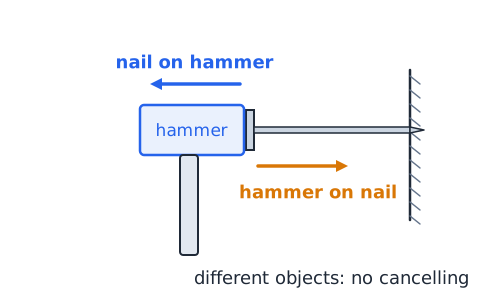
These pair forces never cancel each other, because they act on different objects. When a hammer hits a nail, the nail pushes back on the hammer just as hard, but only the force on the nail goes in the nail's free-body diagram. A swimmer pushes water backward and the water pushes the swimmer forward. To check balance, add only forces acting on one object.
Net force along one axis
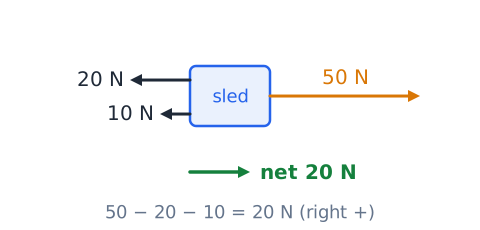
When all forces act along one line, choose a positive direction, give each force a sign, and add.
Quick use: a sled has a 50 N pull to the right and two drags to the left of 20 N and 10 N. Calling right positive:
The net force is 20 N to the right. If the answer is negative, the net force simply points in the direction you called negative.
Two-dimensional balance
When forces point in several directions, treat horizontal and vertical separately. An object is in translational equilibrium only if both sums are zero.
Example: a ring has 30 N pulling east, 30 N pulling west, 45 N pulling north and 45 N pulling south. Horizontal:
Vertical:
The ring is balanced. If any one sum is not zero, the object accelerates in that direction even if the other sum is zero.
Resolving a slanted force
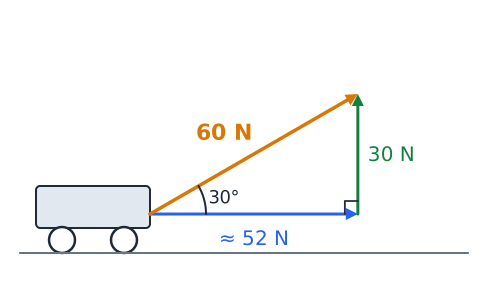
A force at an angle can be split into two perpendicular parts, called components. For a force F at angle above the horizontal:
Quick use: a worker pulls a wagon handle with 60 N at 30° above the ground. The horizontal part is 60 × cos 30° ≈ 52 N, which moves the wagon forward. The vertical part is 60 × sin 30° = 30 N, which lifts slightly and reduces the wagon's push on the ground. The components replace the original force; do not count both.
Perpendicular forces and Pythagoras
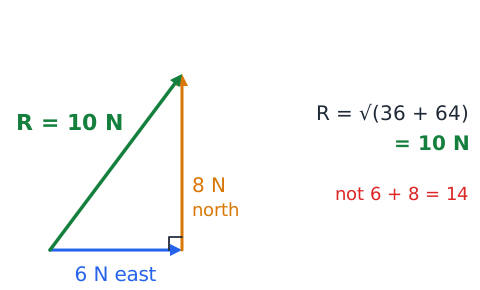
When two forces act at right angles, their combined effect, the resultant, is the hypotenuse of a right triangle.
Quick use: a boat is pushed 6 N east by wind and 8 N north by current.
The resultant is 10 N, pointing between north and east. It is always smaller than the simple sum (14 N) and larger than either force alone. Watch for the 3-4-5 and 6-8-10 patterns, which save time on the test.
What a free-body diagram includes
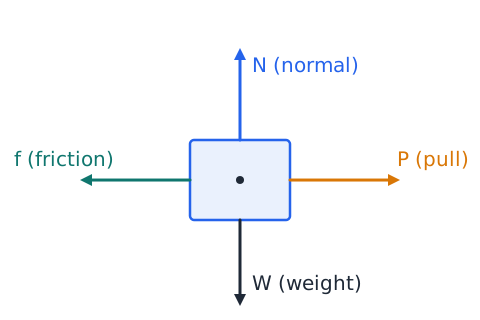
A free-body diagram (FBD) shows one object by itself, usually as a box or dot, with an arrow for every outside force acting on it. Each arrow starts on the object and points in the force's direction.
Typical arrows are weight straight down, normal force perpendicular to each contact surface, friction along the surface, tension along each rope, and any applied pushes or pulls. Leave out forces the object exerts on other things, and leave out velocity arrows. Label each force so you can write the x and y sums from the drawing.
A book resting on a level table
A 2 kg textbook rests on a flat table. Its free-body diagram has just two forces: weight down and the normal force from the table up.
The book does not accelerate, so the net vertical force is zero. The table must push up with
These two forces balance but are not a Newton's third law pair. The weight is Earth pulling on the book; its partner is the book pulling up on Earth.
Normal force is a direction, not a synonym for weight
The normal force is the push a surface exerts on an object touching it, and "normal" means perpendicular to the surface. Its size is whatever is needed to keep the object from sinking into the surface.
It equals the weight only in the simple case of a level surface with no other vertical forces. Press down on a book and the normal force grows larger than the weight. Lift partly on a suitcase handle and it gets smaller. On a ramp the normal force tilts with the surface and is smaller than the weight.
Tension in a light ideal rope
Tension is the pulling force carried by a rope, cable, chain or string. An ideal rope is massless and does not stretch, so the tension is the same all along it. A rope can only pull; it cannot push.
Example: a 12 kg bucket hangs at rest from a single vertical rope. Use
The rope pulls up on the bucket with 120 N, balancing its weight. If the bucket were lifted with an upward acceleration, the tension would have to be greater than 120 N.
Compression, support, and load path
A load path is the route a force takes from where it is applied down to the ground. Follow it piece by piece: a shelf pushes on brackets, the brackets pull on screws, the screws transfer the load to the wall stud, and the stud carries it to the floor and foundation.
Members that are pushed together, like table legs and columns, are in compression. Members that are pulled, like hanging rods and cables, are in tension. A weak link anywhere along the path, such as a loose screw, can fail even if every other part is strong.
Static versus kinetic equilibrium
Equilibrium means the net force (and net torque) on an object is zero, so its velocity does not change. There are two kinds.
Static equilibrium describes an object at rest that stays at rest: a parked truck, a bridge, a picture on a wall. Dynamic or kinetic equilibrium describes an object moving at a constant velocity in a straight line: a crate sliding steadily when the push exactly matches friction, or a jet cruising at constant speed and altitude. In both cases the forces are balanced; balance does not require that something be stationary.
Equilibrium is two conditions, not one
For a real object with size, such as a beam or door, balanced forces are not enough. The forces must also produce no overall turning. Full equilibrium needs both conditions:
The first stops the object from accelerating in any direction. The second, the sum of torques about any point, stops it from starting to rotate. A steering wheel turned by two hands pushing in opposite directions has zero net force but a nonzero torque, so it spins.
What torque measures
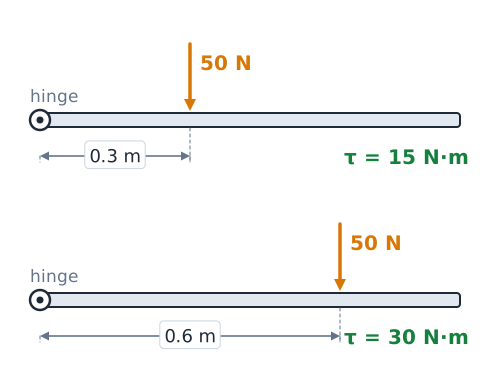
Torque, or moment, measures how strongly a force tends to rotate something about a pivot. When the force is perpendicular to the lever:
is torque in newton-meters (N·m), F is the force and d is the perpendicular distance from the pivot to the force's line of action, called the moment arm.
Quick use: pushing a gate with 50 N, 0.3 m from the hinge, gives
N·m. Push at 0.6 m instead and the same force makes 30 N·m. A force through the pivot has zero moment arm and zero torque.
The role of force angle in torque
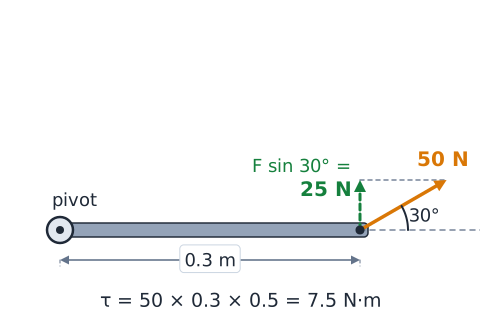
Only the part of a force perpendicular to the lever causes turning. If the force makes angle with the lever:
At 90°, sin is 1 and the torque is largest. At 0°, the force points straight along the lever toward or away from the pivot and the torque is zero.
Quick use: a 50 N pull, 0.3 m from a pivot, at 30° to the handle gives
N·m, only half of what a square pull would produce. That is why you pull a wrench at right angles.
Clockwise versus counterclockwise signs
Torques can turn an object in two directions, so they need signs. Pick one direction as positive, commonly counterclockwise, and make the other negative. Then add.
On a seesaw with a pivot in the middle, a child on the left side tends to turn the board counterclockwise, and a child on the right tends to turn it clockwise. If the counterclockwise total equals the clockwise total, the sum is zero and the board balances. Choose your positive direction once, before calculating, and keep it for the whole problem.
Balance a simple lever
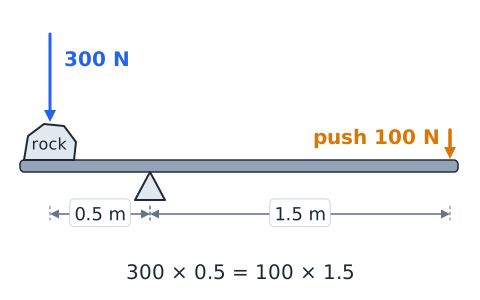
A lever balances when torques on each side of the fulcrum are equal.
Quick use: a 300 N rock sits 0.5 m from the fulcrum of a pry bar. How much push is needed 1.5 m from the fulcrum on the other side?
Three times the distance means one-third the force. The trade-off is that the long end must move three times farther than the rock rises.
Mechanical advantage and long handles
Mechanical advantage (MA) compares the output force of a tool with the input force you supply. For an ideal lever it equals the effort arm divided by the load arm. A long handle increases the effort arm, so a small push creates a large torque.
That is why a breaker bar loosens stuck lug nuts, why long-handled loppers cut thick branches, and why a door handle sits far from the hinges. The gain is not free: the work you do stays the same, so you must move your hand through a longer distance to get the larger force.
Identifying the pivot strategically
Torque can be added about any point when an object is in equilibrium, so choose the pivot that makes the math easiest. The best choice is usually a point where an unknown force acts, because that force then has zero moment arm and drops out of the equation.
For a beam on two supports, take torques about one support to find the reaction at the other support directly. For a ladder against a wall, take torques about the foot of the ladder to remove both the floor's normal force and friction. One clever pivot can turn a two-unknown problem into a one-step division.
Support reactions on a centered beam
When a single load sits exactly midway between two supports on a beam, symmetry splits it evenly.
Quick use: an 800 N motor rests at the center of a shelf held by two brackets. Each bracket pushes up with 400 N.
If the beam itself weighs 200 N, its own weight also acts at its center. Total load is 1,000 N, so each support carries 500 N. The supports together must always equal the total downward load.
Support reactions for an off-center load
When the load is not centered, the nearer support carries more. Take torques about one support to find the other:
a is the distance from the left support to the load and L is the span.
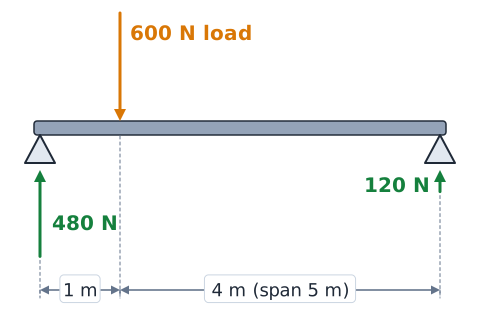
Quick use: a 600 N load sits 1 m from the left end of a 5 m beam.
The left support carries
Why equal opposite parallel forces can still turn
Two forces that are equal in size, opposite in direction and parallel but not on the same line form a couple. Their net force is zero, so the object's center does not accelerate. Their torques, however, add rather than cancel, so the object starts to spin.
Turning a faucet handle with thumb and finger, or a steering wheel with both hands, uses a couple. The torque equals one force times the perpendicular distance between the two lines of action. Equal and opposite forces mean equilibrium only if they act along the same line.
Center of mass and center of gravity
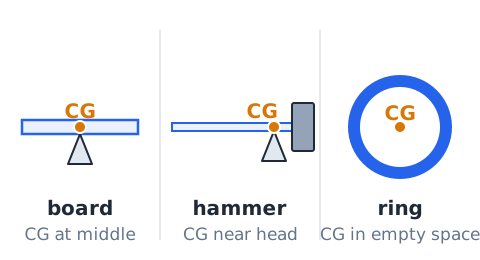
The center of mass is the average location of all the mass in an object; it is the balance point. In uniform gravity, the center of gravity is at the same spot, and you can treat the whole weight as acting there.
For a uniform rod or board, it is at the middle. For a hammer it is near the heavy head, which is why the hammer balances close to the head. The center of mass need not be inside the material: for a ring or horseshoe it lies in the empty space. Loading heavy items low on a cart lowers its center of gravity.
Stable, unstable, and neutral balance
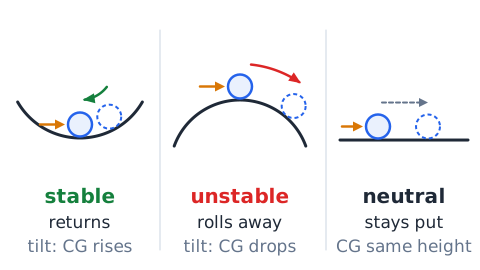
Stable equilibrium: when nudged, the object returns to where it was. A ball sitting in a bowl and a box resting on its wide face are stable, because tilting them raises the center of gravity.
Unstable equilibrium: a small nudge makes it move farther away. A pencil balanced on its point or a ball on top of a dome is unstable, because tilting lowers the center of gravity.
Neutral equilibrium: the object stays wherever it is moved. A ball on a level floor or a cylinder lying on its side is neutral, because its center of gravity stays at the same height. Wide bases and low centers of gravity resist tipping.
Tipping versus sliding
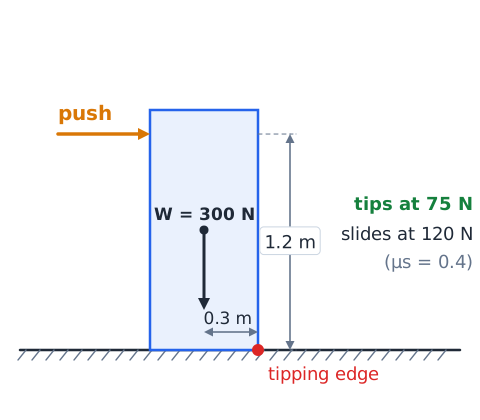
Push sideways on a tall cabinet and two things can happen: it slides, or it tips over its front bottom edge. Compare the two thresholds.
Sliding starts when the push exceeds maximum static friction, . Tipping starts when the push's torque about the tipping edge exceeds the weight's restoring torque: push × height > weight × half-width.
Example: a 300 N box, 0.3 m half-width, pushed at 1.2 m high. Tipping push =
If
sliding needs 120 N. The smaller value, 75 N, wins, so it tips first. Pushing lower makes sliding more likely.
What friction actually opposes
Friction acts along the contact surface and opposes the relative sliding, or the attempted sliding, between the two surfaces. It does not automatically oppose "motion" in every sense. When you walk, the ground pushes your shoe forward with friction, because your foot tries to slip backward.
Static friction adjusts to whatever is needed, up to a limit:
is the coefficient of static friction, a unitless number, and N is the normal force. Rougher pairings have larger coefficients.
Maximum static friction and a push
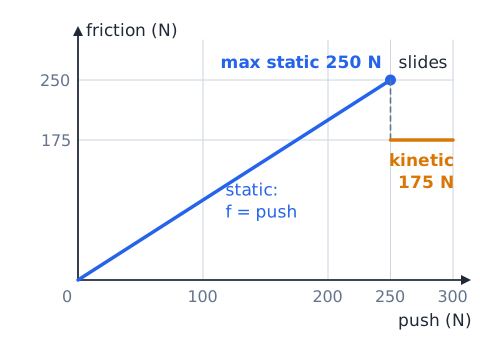
The largest static friction force available is . Below that limit, friction exactly matches the push and the object stays still.
Example: a crate with N = 500 N sits on a floor where
Push with 180 N and friction is 180 N; the crate does not move. Push with 250 N and you are right at the limit. Push with anything more and the crate breaks loose and starts sliding.
Kinetic friction is different from static friction
Once surfaces are sliding, kinetic friction takes over. For most pairings it is somewhat smaller than maximum static friction, which is why an object often jerks into motion and is easier to keep moving than to start.
Example: the same crate (N = 500 N) has
Kinetic friction is 175 N. If you keep pushing with 200 N, the net force is 25 N and the crate speeds up. Push with exactly 175 N and it slides at constant velocity.
Weight components on a slope
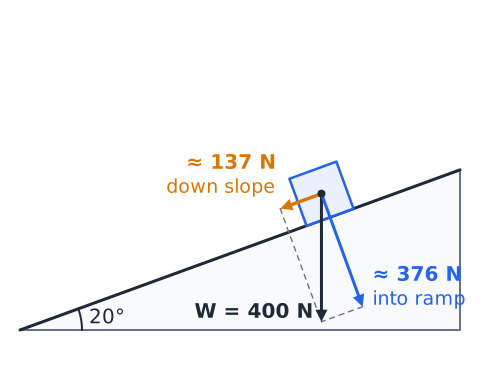
On a slope at angle , split the weight W into a part along the slope and a part into the slope.
The parallel part tries to slide the object downhill. The perpendicular part presses into the surface and, with no other forces, equals the normal force.
Quick use: a 400 N box on a 20° ramp has about 137 N pulling it down the slope and about 376 N pressing into the ramp.
Holding a block on a frictionless incline
On a frictionless incline, nothing resists sliding except what you supply. To hold a block still with a force pushing straight up the slope, that force must equal the downhill component of weight.
Example: a 300 N cart is held on a 40° frictionless ramp. The needed force is about 300 × 0.643 ≈ 193 N up the slope. The normal force is 300 × cos 40° ≈ 230 N. Notice that the holding force is less than the full weight; a ramp lets you support a heavy load with a smaller force.
Static friction keeping a block on a slope
A block can rest on a slope without help if static friction can supply the downhill component of weight.
The friction needed is . The maximum available is . Dividing shows the block holds when
Example: a 50 N block on a 20° slope with
Needed friction ≈ 17.1 N; available ≈ 23.5 N. Since tan 20° ≈ 0.36 is less than 0.5, it stays put. Steepen the slope until tan θ passes 0.5 and it slides.
A vertical hanging sign supported by two cables
A sign hangs from two vertical cables attached at equal distances from its center. The cables pull straight up, and the sign's weight pulls straight down through its center.
Because the setup is symmetric, the two cables share the load equally. A 160 N sign gives 80 N in each cable. If one cable were attached closer to the center of gravity, it would carry more of the weight, just as with a beam on two supports. Angling the cables changes the picture: then each cable must also pull sideways, and the tension rises.
Support forces in angled rope problems
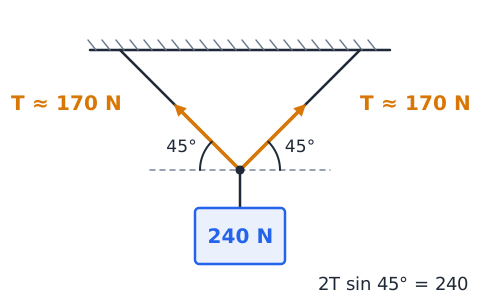
When a load hangs from two equal ropes, each at angle above the horizontal, only the vertical parts of the tensions hold up the weight.
Quick use: a 240 N load with each rope at 45° gives
The flatter the ropes, the smaller and the larger the tension. A nearly horizontal rope can carry a tension many times the load.
Pulley idealization and equilibrium
Textbook pulleys are idealized: the wheel has no friction and no mass, and the rope is massless and does not stretch. Under those assumptions, a single continuous rope has the same tension everywhere along its length, even as it bends around wheels.
For equilibrium problems, draw a free-body diagram of the load or of the movable pulley, count how many rope segments pull on it, and set their total upward pull equal to the weight. Real pulleys lose some force to friction, so the actual effort is a little larger than the ideal answer.
Fixed pulley versus movable pulley
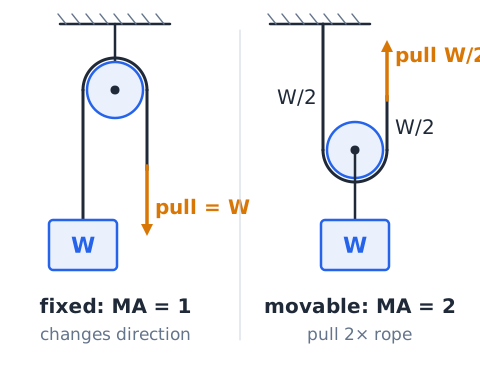
A fixed pulley is fastened to a support and does not move. It only changes the direction of the force, letting you pull down to raise a load. Mechanical advantage is 1, so you pull with a force equal to the load.
A movable pulley is attached to the load and rides up with it. Two rope segments hold it, each carrying half the load, so the ideal mechanical advantage is 2. You pull with half the force, but you must pull twice as much rope. Block and tackle systems combine pulleys to give more supporting segments.
Spring restoring force
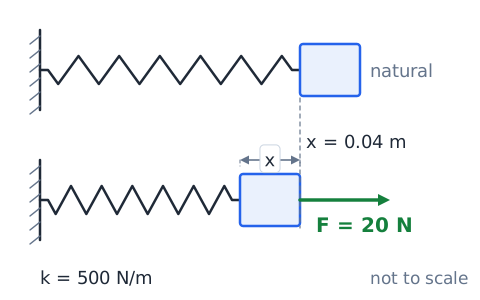
An ideal spring pushes or pulls back with a force proportional to how far it is stretched or compressed from its natural length. This is Hooke's law.
F is the restoring force in newtons, k is the spring constant in N/m and x is the stretch or compression in meters. The force points back toward the natural length.
Quick use: a spring with k = 500 N/m compressed 0.04 m pushes back with
Double the compression and the force doubles, as long as the spring is not overloaded.
Force and deformation are not always the same thing
A force can cause a large shape change in one object and almost none in another. A 50 N load stretches a rubber band a lot, a steel spring a little, and a steel bar hardly at all. The force is the same; the stiffness is different.
So you cannot judge the size of a force by how much something bends or stretches unless you know its stiffness. Also, deformation is not the same as acceleration: a clamped part can be squeezed hard yet not move, because the forces on it are balanced.
Gravity on different planets
Gravity depends on the mass and size of a planet or moon. On the Moon, gravity is about one-sixth as strong as on Earth; on Mars it is roughly 38 percent of Earth's; on Jupiter it is more than twice as strong.
An astronaut's mass stays the same everywhere, so the effort needed to start or stop her moving sideways stays the same. Her weight changes with the local gravity. A 90 kg astronaut weighs about 880 N on Earth but only about 150 N on the Moon.
Why a resting object can have many forces
An object sitting still can have many forces on it at once. Think of a ladder leaning on a wall: its weight pulls down, the floor pushes up, floor friction pushes toward the wall, and the wall pushes outward on the top. A person on the ladder adds more.
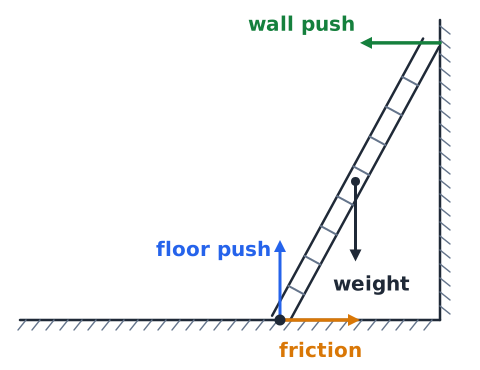
All these forces are real. The ladder stays put because their vector sum is zero and their torques also balance. "At rest" does not mean "no forces"; it means the forces cancel overall. Removing just one of them, such as floor friction on a slick floor, can let the ladder slip.
Identifying unbalanced forces in a diagram
To tell whether a diagram shows balanced forces, add opposite arrows in each direction. If the horizontal arrows have equal totals, and the vertical arrows have equal totals, the forces are balanced. If either direction is left over, the object accelerates that way.
Watch for arrows of different lengths, labels like 30 N against 45 N, and slanted arrows that hide a sideways component. Also check where the arrows act: equal forces on opposite sides of a long object may still turn it. Unbalanced forces always mean a change in velocity.
A car cruising at steady speed
A car cruises on a straight highway at a steady 60 mph. The engine and tires push it forward, while air drag and rolling resistance push back. The road pushes up and gravity pulls down.
Because the velocity is constant, the net force is zero: forward drive force exactly equals the total resisting force. The car does not need extra unbalanced force to keep going. If the driver presses the gas harder, the forward force exceeds the drag and the car speeds up until drag grows enough to match again.
Balanced forces at constant speed around a curve?
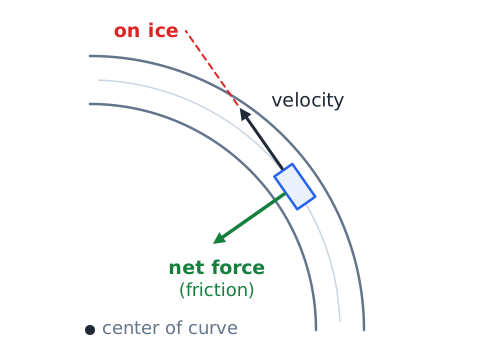
A car going around a curve at a constant 30 mph is not in equilibrium, even though the speedometer does not change. Velocity includes direction, and the direction is changing every moment.
Changing direction is a form of acceleration, so there must be a net force. That net force points toward the center of the curve and is supplied by friction between the tires and road. On ice, friction is too small, and the car continues in a straighter path than the road. Constant speed is not the same as constant velocity.
Force vectors versus motion arrows
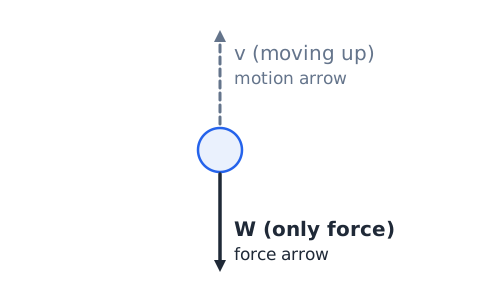
A force arrow shows a push or pull acting on an object. A velocity arrow shows which way the object is moving. They are different and do not have to point the same way.
A ball thrown straight up is still moving upward, yet the only force on it after release is gravity pointing down. A car braking moves forward while the net force points backward. In a free-body diagram, draw only forces; never add an arrow for "the force of motion." The net force points along the acceleration, not necessarily along the velocity.
Equilibrium and uniform rotation
An object can be in rotational equilibrium while it spins, as long as it spins at a constant rate. Zero net torque means no change in rotation, just as zero net force means no change in straight-line velocity.
A ceiling fan running at a steady speed has a motor torque that exactly matches the air drag torque, so the net torque is zero. If the motor is switched off, the drag torque is unbalanced and the fan slows down. If power is increased, the motor torque wins and the fan speeds up until drag catches up.
Elevator reading and apparent weight
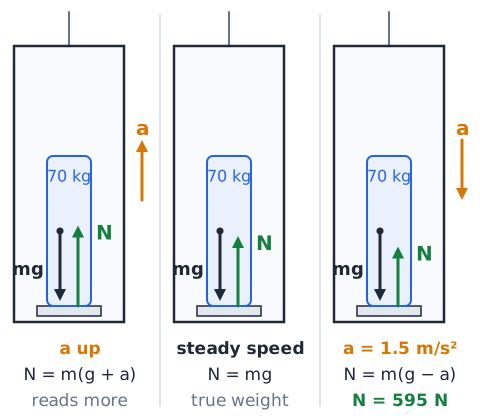
A bathroom scale reads the normal force pushing up on you, not your weight directly. In an elevator, that reading can change.
If the elevator accelerates upward, the floor must push harder than your weight, so the scale reads more:
If it accelerates downward, the scale reads less:
At constant speed, up or down, a = 0 and the reading equals your true weight. Example: a 70 kg rider in an elevator speeding up on the way down at 1.5 m/s², with
reads 595 N.
Free-body diagram checklist
Use the same routine for every free-body diagram. First, choose the single object you are studying and sketch it alone. Next, draw its weight from the center of gravity straight down. Then go around the outline: at each contact point add a normal force perpendicular to the surface and, if the surface is rough, a friction force along it. Add a tension arrow along every rope or cable pulling away from the object. Add any applied pushes or pulls. Last, choose axes, preferably along any slope, and check that nothing on the drawing is a force the object exerts on something else. Then write the force sums and, if needed, the torque sum.
Reasoning from a seesaw picture
On a seesaw picture, look at two things for each person: weight and distance from the pivot. The side with the larger weight-times-distance goes down.
A heavier adult close to the middle can balance a lighter child far out on the other end. If the picture shows two people of equal weight at equal distances, it balances. If a question asks where someone should sit to balance, divide the other side's torque by the person's weight. Ignore details like the seat colors or which person is taller.
The impact of applied force position
Where a force is applied matters as much as how big it is when rotation is involved. Push a door at the handle, 0.8 m from the hinges, with 20 N:
Push the same door 0.2 m from the hinges with the same 20 N:
The force near the hinge produces only one-quarter of the turning effect. To get the same 16 N·m that close in, you would need 80 N.
Beam forces: direction and moment arm
For a beam, sketch every force with its correct direction and note exactly where it acts. Loads like boxes, people and the beam's own weight usually push down. Supports such as posts, walls and hangers push up or pull up.
For each force, measure the moment arm from your chosen pivot to the force's line of action, at right angles. A force acting through the pivot contributes nothing. A force acting far from the pivot contributes a lot, even if it is small. Mixing up the direction of one force will flip its torque sign and ruin the answer.
Resultant force on a crate
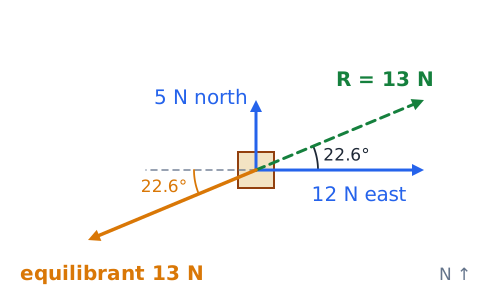
A crate is pulled 12 N east by one rope and 5 N north by another. The forces are perpendicular, so the resultant is
Its direction is about 22.6° north of east, found from
A third force of 13 N pointing the opposite way, 22.6° south of west, would hold the crate in equilibrium. That balancing force is called the equilibrant.
A practical equilibrium sequence for supports
For a beam, bracket or shelf, follow the same order every time. Draw the free-body diagram, including the member's own weight at its center if it is not negligible. Name every unknown, usually the support reactions. Pick a pivot at one unknown force and sum torques to solve for the other. Next, use the vertical force sum to find the remaining reaction. Use the horizontal sum if any forces are sideways. Finally, check: the reactions must add up to the total load, and each should have a sensible direction. A negative answer means the force points the other way.
Units and sensible rounding
Always carry units through a problem. Force is in newtons, mass in kilograms, distance in meters, and torque in newton-meters. Convert centimeters and millimeters to meters before computing torque: 40 cm is 0.40 m.
Do not confuse kilograms with newtons. A 10 kg object weighs about 98 N, or 100 N with
Round only at the end and keep the same number of significant figures as the given data. If a test's answer choices are far apart, a quick estimate with
often identifies the right one.
Worked example: two opposite pushes
Problem: a 25 kg cart is pushed 70 N to the right by one worker and 45 N to the left by another. Find the net force and acceleration.
Take right as positive:
Answer: 25 N to the right, giving an acceleration of 1 m/s² to the right. Adding the pushes to get 115 N would be wrong because they point opposite ways.
Worked example: pulley with two supporting segments
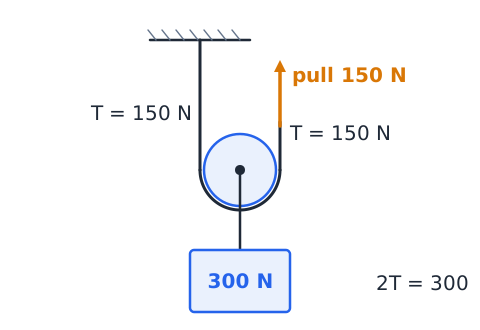
Problem: a 300 N engine part hangs from a movable pulley. One rope passes under the pulley, so two rope segments hold it up. Ignore friction and pulley weight. What pull is needed to hold it?
Each segment carries the same tension T, so
Answer: 150 N. The cost: to raise the part 1 m, you must pull 2 m of rope, since both segments shorten by 1 m.
Worked example: an off-center beam load
Problem: a 10 m bridge plank rests on supports at each end. A 500 N cart stops 3 m from the left end. Ignore the plank's weight. Find both reactions.
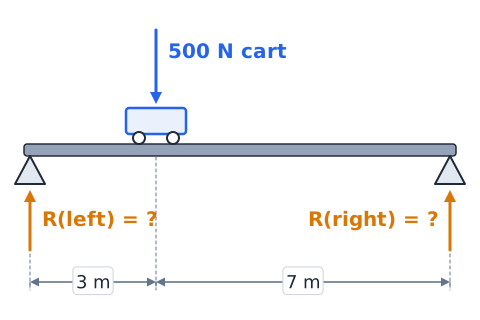
Take torques about the left support:
The vertical sum gives
Answer: 350 N left, 150 N right. The closer support carries more.
Worked example: static friction limit
Problem: a 60 kg crate rests on a warehouse floor with
Use
Will a 250 N push move it? What about 280 N?
The normal force equals the weight on level ground: N = 600 N.
A 250 N push is less than 270 N, so friction matches it at 250 N and the crate stays still. A 280 N push exceeds the limit, so the crate starts to slide.
Worked example: a sloped rope
Problem: a 150 N lamp hangs from the end of a light horizontal strut fixed to a wall. A rope runs from the strut's end up to the wall at 50° above horizontal. Find the rope tension and the push in the strut.
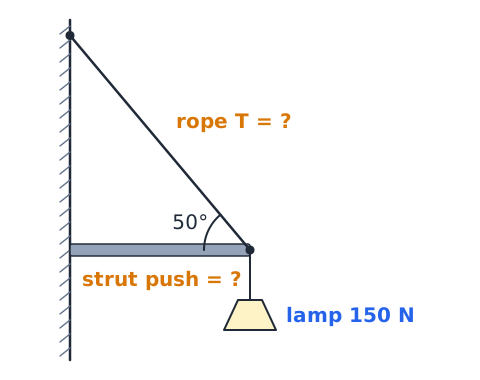
Only the rope can hold the lamp's weight vertically:
The rope's horizontal part,
pulls toward the wall, so the strut pushes outward with about 126 N. The strut is in compression.
Worked example: separate force and torque tests
Problem: a driver turns a steering wheel of radius 0.18 m by pushing up with 15 N on one side and down with 15 N on the other, each 0.18 m from the center.
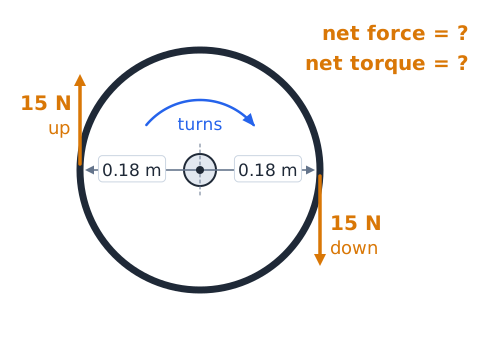
Force test: up 15 N and down 15 N give a net force of zero, so the wheel's center does not accelerate.
Torque test: both forces turn the wheel the same way.
Answer: zero net force, but 5.4 N·m of net torque, so the wheel turns. Both tests are needed.
ASVAB MC diagram-reading strategy
Mechanical Comprehension diagrams reward a calm, step-by-step look. First, read what the question asks: force, torque, tension, direction or which option takes less effort. Second, locate the pivot, supports and every arrow, and note any numbers on lengths. Third, sketch a quick free-body diagram in your head or on scratch paper.
Then predict the answer before reading choices. Use simple ratios: twice the distance means half the force, and two supporting rope segments mean half the tension. Eliminate answers with wrong units or directions. If two choices remain, check which one makes both force and torque balance. Estimation with
is usually precise enough.
Common distractor: adding all magnitudes
The trap: adding every force's magnitude no matter which way the arrows point. A crate with 35 N right and 10 N left is not under 45 N.
Why it is wrong: forces are vectors. Opposite forces subtract, and perpendicular forces combine with the Pythagorean theorem. Only forces pointing the same way add straight up.
The fix: before adding, assign a positive direction and give each force a sign. For forces at right angles, use the square root of the sum of squares. Test writers often put the plain sum of magnitudes among the choices because it is a common slip.
Common distractor: equal forces always mean equilibrium
The trap: assuming that equal and opposite forces always mean the object is in equilibrium.
Why it is wrong: two equal, opposite forces cancel only if they act along the same line. If they are offset, they form a couple and create torque, so the object rotates. Also, third-law pairs are equal and opposite but act on different objects, so they never cancel each other.
The fix: check the line of action of each force and confirm that the net torque is also zero before declaring equilibrium.
Common distractor: normal force always equals weight
The trap: setting the normal force equal to the weight in every problem.
Why it is wrong: the normal force is whatever the surface must supply to stop the object from passing through it. On a ramp it equals . If someone presses down on the object, it grows; if someone lifts partly or pulls up at an angle, it shrinks. In an accelerating elevator, it changes too.
The fix: draw the free-body diagram and find N from the force balance perpendicular to the surface. Only on level ground with no other vertical forces does N equal W.
Common distractor: friction at its maximum always
The trap: assuming static friction always equals .
Why it is wrong: is the maximum, not the actual value. Static friction only grows as large as needed to stop slipping. If you push a heavy desk with 20 N and it does not move, friction is 20 N, even if the limit is 200 N.
The fix: first find how much friction the situation needs to stay still. Compare that with . If needed is below the limit, friction equals the needed amount. Only when the need is larger does the object slide and kinetic friction apply.
Common distractor: zero net force implies rest
The trap: thinking that zero net force means an object must be at rest.
Why it is wrong: Newton's first law says zero net force means no change in velocity. An object already moving keeps moving in a straight line at constant speed. A hockey puck gliding on smooth ice and a car on cruise control on a level road both have zero net force while moving.
The fix: when net force is zero, answer "constant velocity," which includes being at rest as one special case. A nonzero net force is needed only to speed up, slow down or turn.
Guided challenge: force and moment in one diagram
A seesaw pivot is at the center. A 400 N adult sits 1.5 m left of the pivot, and a 300 N teen sits 2 m right.
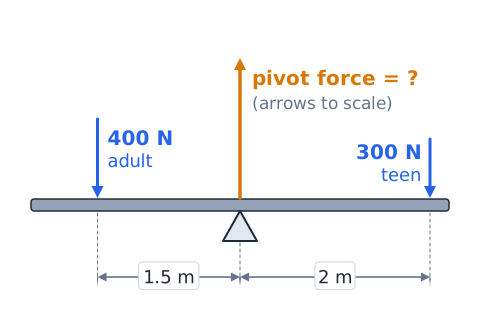
Prompt: is the board balanced? Answer: left torque is
N·m; right torque is
N·m. Yes, net torque is zero.
Prompt: what force does the pivot provide? Answer: the vertical forces must also balance, so the pivot pushes up with
Prompt: the teen slides to 1.8 m. Answer: right torque drops to 540 N·m, so the adult's side goes down.
Guided challenge: angle and rope tension
A 200 N load hangs from two equal ropes, each at the same angle above horizontal. Use
Prompt: ropes vertical, 90°. Answer: each carries half, 100 N.
Prompt: ropes at 30°. Answer: sin 30° = 0.5, so
equal to the full load.
Prompt: ropes at 15°. Answer: sin 15° ≈ 0.259, so T ≈ 386 N, almost twice the load.
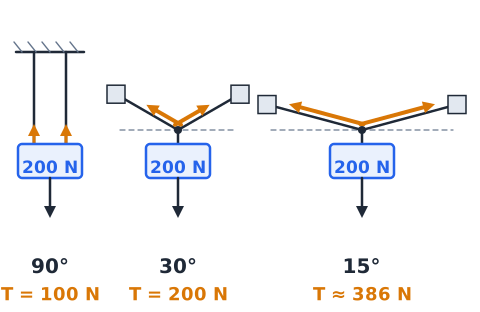
The pattern: lower angles demand much higher tension, which is why sagging cables are safer than tight ones.
Guided challenge: friction versus motion
A cabinet on a level floor has N = 300 N,
Prompt: maximum static friction? Answer:
Prompt: push of 100 N, cabinet at rest. Friction? Answer: 100 N, matching the push; no motion.
Prompt: push of 130 N. Answer: exceeds 120 N, so it slides. Kinetic friction is
so the net force is
N and it speeds up.
Prompt: once sliding, what push keeps a constant speed? Answer: 90 N, equal to kinetic friction.
Final summary: what to recall on test day
Forces are vectors measured in newtons; give direction as well as size. Weight is
and mass does not change with location. Newton's laws: no net force means constant velocity;
and action-reaction pairs act on different objects.
Add forces with signs on a line, use components for angles, and use for perpendicular forces. Equilibrium needs zero net force and zero net torque, with
Static friction can be anything up to ; kinetic friction is . On a slope, the downhill component is . For two equal ropes,
A movable pulley halves the needed pull, and springs follow
 English ▾