 ASVAB Camp
What you will learn
This lesson builds the foundation for Electronics Information. You will describe the charges on electrons and protons, explain why total charge is conserved, compare conductors and insulators, and explain charging by friction, contact and induction. You will define current and voltage and use these relations:
You will also convert milli, micro and kilo prefixes and place meters correctly.
Electricity begins with charged particles
Ordinary matter is built from atoms. Each atom has a small nucleus containing protons, which carry positive charge, and neutrons, which carry none. Electrons, which carry negative charge, occupy the space around the nucleus.
A proton and an electron carry charges of exactly the same size but opposite sign. Protons are locked inside the nucleus in everyday situations, while some electrons, especially in metals, can move from atom to atom. Almost every electrical effect in this course comes from electrons moving or being shifted.
Elementary charge and the coulomb
The smallest free charge found in ordinary matter is the elementary charge, the size of the charge on one proton or one electron:
The coulomb (C) is the SI unit of charge. Because e is so tiny, one coulomb equals the charge of about electrons. A charged object always holds a whole-number multiple of e.
Net positive, negative and neutral objects
An object's net charge depends on its balance of protons and electrons. Equal numbers mean it is neutral. Extra electrons give it a net negative charge. Missing electrons leave more protons than electrons, so it has a net positive charge.
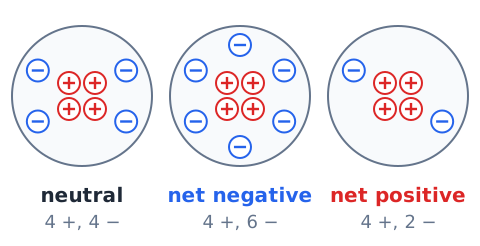
Notice that objects gain positive charge by losing electrons, not by gaining protons. Neutral does not mean empty of charge; it means the positive and negative amounts cancel.
Like charges repel; unlike charges attract
Two objects with the same kind of net charge push each other apart. Two objects with opposite charges pull toward each other. Two negatively charged balloons drift apart, while a negative balloon and a positive sweater cling together.
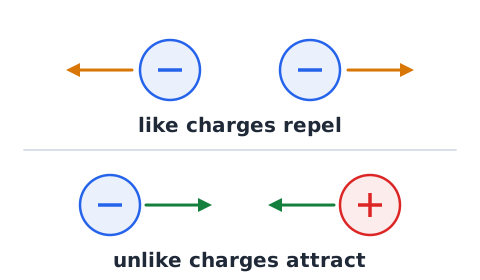
The force grows stronger as the charges get larger and weaker quickly as the distance between them increases. Charged objects never merge their charges away just by being near each other.
Charge conservation in charging events
Electric charge is conserved. In an isolated system, the total charge before an event equals the total after it. Charging moves charge from one place to another; it never creates or destroys it.
If a plastic comb picks up a certain amount of negative charge from your hair, your hair is left with an equal amount of positive charge. Adding the two together still gives the original total, which was zero if both started neutral.
Charging by friction
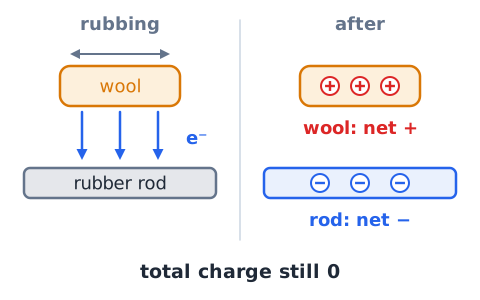
When two different materials are rubbed together, electrons can transfer from one surface to the other. Materials differ in how tightly they hold electrons, and the one with the stronger hold tends to gain them.
Rub a rubber rod with wool and the rod usually becomes negative while the wool becomes positive. Dragging socks across a carpet on a dry day works the same way, and the small zap at the doorknob is the stored charge leaving you. Dry air helps because moisture lets charge leak away.
Charging by contact and grounding
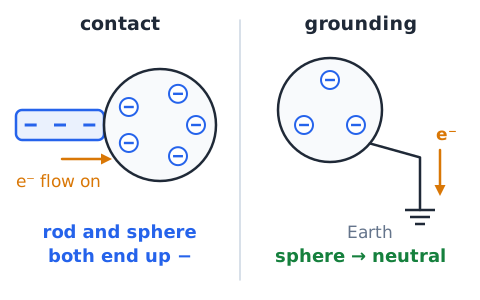
A charged object touching a neutral conductor shares some of its charge. Touch a negative rod to a neutral metal sphere, and some electrons flow onto the sphere, so both end up negative.
Grounding connects an object to Earth, a huge reservoir that can supply or accept electrons. A charged conductor that is grounded loses its excess charge, or receives what it lacks, until it is neutral. Grounding wires in buildings use this idea for safety.
Charging without contact: induction
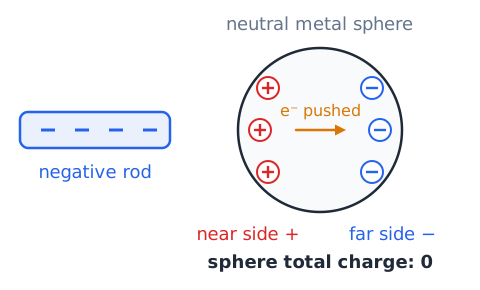
A charged object can rearrange charge in a nearby conductor without touching it. Bring a negative rod near a neutral metal sphere: the sphere's mobile electrons are pushed to the far side, leaving the near side positive. The sphere's total charge is still zero.
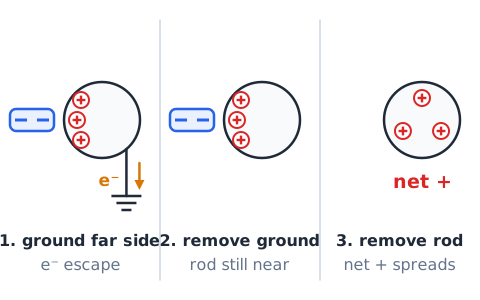
If the far side is grounded while the rod stays close, electrons escape to ground. Remove the ground, then the rod, and the sphere is left with a net positive charge. The same shifting explains why a charged comb can pick up neutral bits of paper: the near side of the paper becomes slightly opposite in charge and is attracted.
Electric fields predict forces
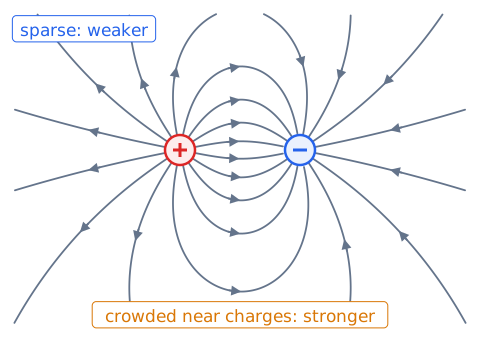
An electric field is the region around a charge where another charge would feel a force. Field lines point away from positive charges and toward negative ones. A positive test charge placed in the field is pushed along the lines; a negative charge is pushed the opposite way.
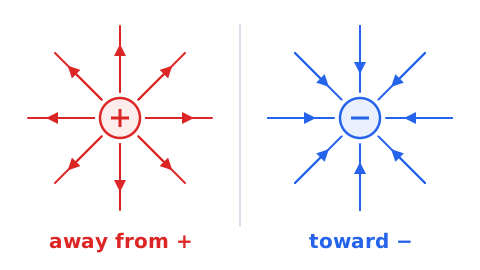
Where the lines crowd together, the field is stronger. The field lets you predict the force on any charge at a point without listing every source charge that produces it.
Conductors and insulators
A conductor contains charges that move easily. Metals such as copper and aluminum have loosely held outer electrons that drift through the material, which is why wiring is made of them. Salt water also conducts, using dissolved ions.
An insulator holds its electrons tightly, so charge hardly moves. Rubber, glass, dry wood and most plastics are insulators. That is why wire is coated in plastic. Insulators can still become charged by rubbing; the charge just stays where it was placed.
Semiconductors in context
Semiconductors, such as silicon and germanium, conduct better than insulators but far worse than metals. Their conductivity can be changed a great deal by temperature, light, or adding tiny amounts of other elements, a process called doping.
Doping can produce n-type material, with extra mobile electrons, or p-type material, with "holes" that act like moving positive charges. Joining these types makes diodes and transistors, the building blocks of modern electronics. Later lessons cover these devices in detail.
Static electricity versus current electricity
Static electricity is charge that builds up and stays on an object, usually an insulator, until it finds a path to escape. Balloon tricks and doorknob sparks are static effects. The charge sits still most of the time, then may discharge in a brief burst.
Current electricity is a continuing flow of charge through a conducting path, like the steady flow that lights a lamp. The underlying charges are the same; what differs is whether they stay put or keep moving around a circuit.
Current is a flow rate of charge
Electric current is how much charge passes a point each second:
I is current in amperes (A), Q is charge in coulombs, and t is time in seconds. One ampere means one coulomb passing each second. If 10 C passes in 5 s, the current is 2 A.
Current can vary during an interval
The formula
gives the average current over a time interval. In many devices the current does not stay steady. A camera flash or a motor starting up draws a large surge, then settles to a smaller value.
When the current changes, the average still equals total charge divided by total time, but it hides the peaks and dips. To find the current at a particular instant, you look at a short slice of time around that moment.
Reading charge versus time
On a graph with charge on the vertical axis and time on the horizontal axis, the slope equals current. A straight line means a steady current; a steeper line means a larger current; a flat section means no current during that time.
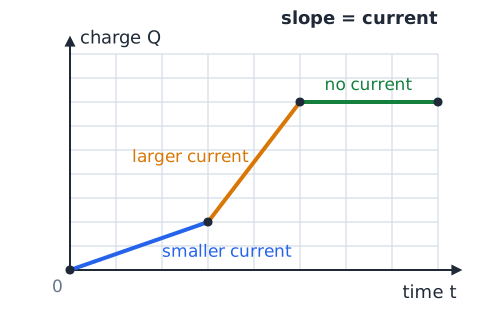
For an average over a longer stretch, take the total change in charge and divide by the total time. Do not simply average the slopes of separate pieces unless they last equally long.
Conventional current and electron drift
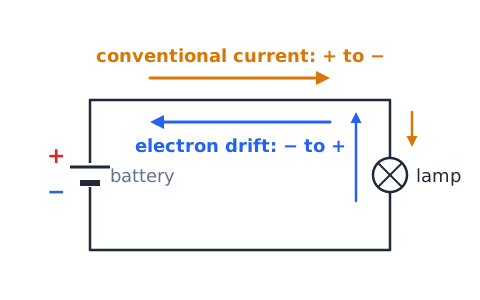
Conventional current is defined as the direction positive charge would flow: out of the positive terminal of a source, through the external circuit, and back into the negative terminal. This convention was set before electrons were discovered, and circuit diagrams still use it.
In metal wires, the moving carriers are actually electrons, which drift the opposite way, from negative to positive through the load. Both descriptions predict the same effects. Just be clear about which one a question asks for.
Electrons move slowly; energy transfer can begin promptly
Individual electrons in a wire drift slowly, often less than a millimeter per second in typical household currents. Yet a lamp lights almost instantly when you flip the switch.
The reason is that the wire is already full of mobile electrons. Closing the circuit sets up an electric field along the whole path very quickly, so electrons everywhere start drifting at nearly the same moment. Energy is delivered by that field, not by electrons racing from the switch to the lamp.
Closed path and sustained current
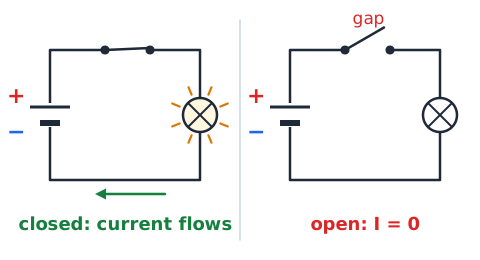
A steady current needs a complete, unbroken loop of conductors running from one terminal of the source, through the load, and back to the other terminal. This is a closed circuit.
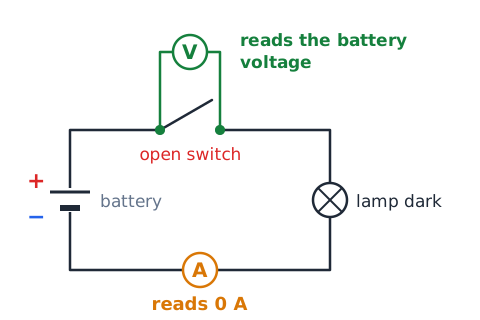
If any part of the loop is broken, as by an open switch, a burned-out filament or a loose wire, the circuit is open. Charge would pile up at the gap almost at once and stop moving, so the steady current falls to zero everywhere in that loop.
What a battery supplies
A battery does not supply electrons from an empty tank, and it does not store a fixed current. It uses chemical reactions to maintain a potential difference between its two terminals. That difference gives energy to charges that move through the external circuit.
The charges already present in the wires and the load are what flow. The battery is like a pump for energy per charge. Over time its chemicals are used up, and its ability to keep supplying energy runs down.
Potential difference as energy per charge
Voltage, or potential difference, is the energy transferred per unit of charge moved between two points:
V is in volts, E is energy in joules, and Q is charge in coulombs. One volt equals one joule per coulomb. A 1.5 V cell gives each coulomb that passes through it about 1.5 J of energy.
A single-point potential needs a reference
Voltage is always between two points. Saying a wire is at "5 volts" only means something if a reference point is agreed on, usually the circuit's ground or the negative battery terminal, which is called zero.
That is why a voltmeter has two leads. Change the reference and every potential value shifts, but the differences between points stay the same. Those differences are what drive current and transfer energy.
Distinguishing voltage, current and resistance
Voltage (V, in volts) is energy per charge between two points. Current (I, in amperes) is the rate of charge flow past a point. Resistance (R, in ohms, ) describes how strongly a component opposes current.
For many simple resistors the three are linked by Ohm's law:
A useful picture: voltage is the push, current is the flow that results, and resistance is the opposition.
Ohm’s law within a limited scope
Ohm's law, V = IR, holds well for "ohmic" components such as ordinary metal resistors kept at steady temperature. For these, doubling the voltage doubles the current, and the resistance stays constant.
Many components are not ohmic. A lamp filament's resistance climbs as it heats, and a diode lets current pass easily in one direction only. For them, V divided by I still gives a resistance value at that moment, but it changes with conditions.
Why higher voltage does not always mean more current
Current depends on both voltage and resistance. A 120 V lamp with high resistance can draw less current than a 12 V car starter motor with very low resistance.
Within one fixed ohmic resistor, more voltage does mean more current. Across different devices, you need to know the resistance too. Also, with no complete path, the current is zero no matter how large the voltage is.
Units at a glance
Charge Q is measured in coulombs (C). Current I is measured in amperes (A), where one ampere is one coulomb per second. Voltage V is measured in volts (V), where one volt is one joule per coulomb. Resistance R is measured in ohms (), where one ohm is one volt per ampere. Energy is measured in joules (J), and power in watts (W), where one watt is one joule per second.
Prefixes: milli, micro and kilo
Milli (m) means one thousandth, so 1 mA = 0.001 A. Micro () means one millionth, so 1 A = 0.000001 A. Kilo (k) means one thousand, so a 4.7 k resistor has 4,700 .
To convert milli to base units, divide by 1,000. For micro, divide by 1,000,000. For kilo, multiply by 1,000.
Ampere-hour is charge, not energy
Batteries are often labeled in ampere-hours (Ah) or milliampere-hours (mAh). An ampere-hour is a unit of charge: one ampere flowing for one hour. Since an hour has 3,600 s, 1 Ah equals 3,600 C.
It is not a measure of energy. To estimate energy you also need voltage. A 1.5 V cell and a 12 V battery with the same Ah rating move the same charge, but the 12 V battery delivers eight times as much energy.
Power, charge and voltage connect
Power is the rate of energy transfer. Combining the definitions of voltage and current gives a handy formula:
Power P is in watts, V in volts and I in amperes. A 6 V source pushing 0.5 A delivers 3 W, meaning 3 J each second.
Direct current versus alternating current
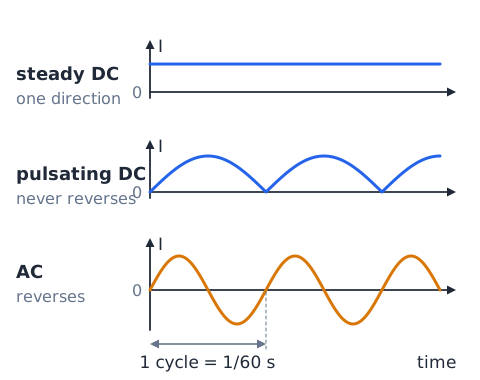
Direct current (DC) flows in one direction only. Batteries, solar cells and phone chargers' outputs supply DC. Its size can still vary, as in pulsating DC from a simple rectifier, but it never reverses.
Alternating current (AC) reverses direction periodically. Household outlets in the United States supply AC at 60 cycles per second (60 Hz), with a nominal voltage of about 120 V. AC is easy to step up or down with transformers, which makes it practical for power distribution over long lines.
A switch controls a path, not a charge reservoir
A switch does not contain charge or energy. It simply opens or closes a gap in the conducting path. When closed, it completes the loop so current can flow. When open, it breaks the loop and the steady current stops.
Opening a switch does not drain the battery or erase its voltage. The charges in the wires remain; they just stop flowing around the loop. Across the open switch, a potential difference can still be measured.
A simple source-load-loop diagram
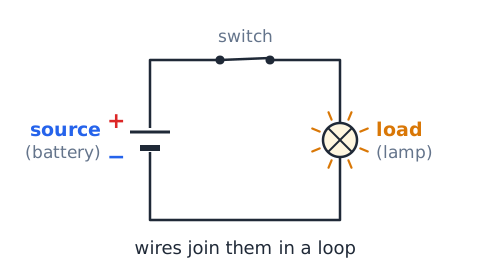
The simplest circuit has three parts: a source, such as a battery; a load, such as a lamp or resistor, that turns electrical energy into another form; and conductors that join them into a loop. A switch is often added in the loop.
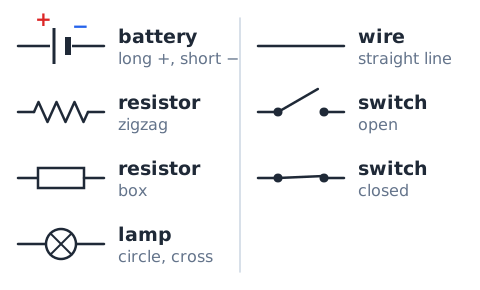
On a schematic, a battery is drawn as a long line (positive) and short line (negative). A resistor is a zigzag or box, and a lamp is a circle with a cross or loop inside. Straight lines are wires with negligible resistance.
Ammeter placement concept
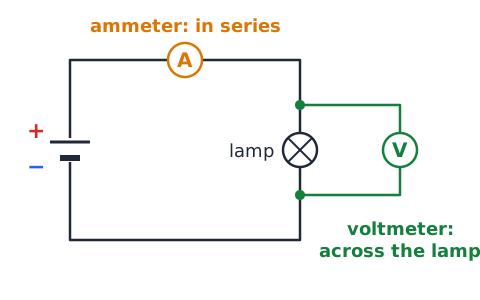
An ammeter measures current, so the current you want to measure must pass through it. That means placing it in series, inside the loop, by breaking the circuit and connecting the meter into the gap.
An ideal ammeter has nearly zero resistance, so it barely changes the circuit. Connecting an ammeter directly across a battery or a load (in parallel) creates a near short circuit and can blow the meter's fuse or damage the source.
Voltmeter placement concept
A voltmeter measures potential difference between two points, so its leads go across the component, in parallel with it. To read the voltage of a lamp, touch one lead to each side of the lamp without breaking the circuit.
An ideal voltmeter has very high resistance, so it draws almost no current and does not disturb the circuit. Placing it in series would block nearly all the current.
Meter units identify the physical quantity
The unit on a meter's display tells you what it is reading. A reading in A or mA is current from an ammeter setting. A reading in V or mV is potential difference from a voltmeter setting. A reading in or k is resistance from an ohmmeter setting, done with the circuit unpowered.
Positive and negative battery terminals
A battery's positive terminal, often marked plus and sometimes colored red, is at higher electric potential. The negative terminal, marked minus and often black, is at lower potential. The voltage rating is the difference between them.
In the external circuit, conventional current leaves the positive terminal, passes through the load, and returns to the negative terminal. Electrons drift the opposite way. Reversing a battery in a polarity-sensitive device can stop it working or damage it.
Battery voltage versus available capacity
Voltage and capacity are different ratings. Voltage tells how much energy each coulomb receives. Capacity, often in mAh or Ah, tells how much total charge the battery can deliver before it is considered empty.
AA and D cells both read about 1.5 V, but the D cell's larger capacity lets it run a flashlight much longer. Two batteries with equal capacity but different voltages store different total energy. A battery's voltage also sags somewhat as it nears depletion or delivers large currents.
Why the complete path matters
Charge flows steadily only around a closed loop. A single wire from the battery to a lamp, with no return path, lights nothing. A gap anywhere, whether at a switch, a broken solder joint or a loose connector, stops the current throughout that loop.
Troubleshooting often starts by tracing the path from the positive terminal through every component and back to the negative terminal to find the break.
A short circuit is not a normal load
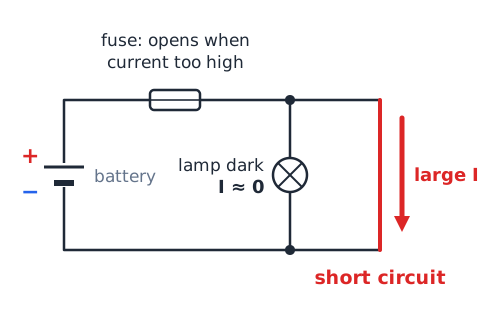
A short circuit is an unintended low-resistance path that lets current bypass the load. With almost no resistance, the current can become very large, heating wires, draining the source quickly and possibly starting a fire.
The load in the shorted branch receives little or no current, so a shorted lamp goes dark even as the wires heat up. Fuses and circuit breakers exist to open the circuit when current gets dangerously high.
Electric energy in a load
In a load, electrical energy is converted into other forms. A lamp produces light and heat, a heater produces heat, a motor produces motion and a speaker produces sound. The energy transferred equals the charge passed times the voltage across the load, and the rate is power, P = VI.
Avoid the water-pipe analogy trap
Water pipes help picture circuits: voltage is like pressure difference, current like flow rate, resistance like a narrow pipe. But the analogy has limits.
Wires do not empty out like pipes, and a broken wire does not leak charge onto the floor. Electrons are not used up in a lamp; energy is. The analogy also cannot explain induction or AC well. Rely on the definitions:
DC polarity and potential differences
In a DC circuit, polarity tells which side of a component is at higher potential. Across a resistor, the end where conventional current enters is more positive than the end where it leaves.
Meters show polarity too. If a digital voltmeter's leads are reversed, it displays a negative reading. That is not an error; it just means the red lead is at lower potential than the black lead.
Electric field versus potential difference
The electric field describes the force per unit charge at a point and has a direction. Potential difference describes the energy change per unit charge between two points and is a single number with no direction.
They are linked: a charge moving along the field direction moves toward lower potential. In a uniform field, a stronger field over the same distance gives a bigger voltage. A voltage source sets up a field in the wires, and that field pushes charges around the circuit.
Charge carriers are not always electrons
In metal wires, mobile electrons carry the current. In other materials the carriers differ. In salt water, battery electrolytes and the human body, positive and negative ions both move. In p-type semiconductors, holes act as moving positive charges.
Regardless of the carrier, current is measured as charge per second, and conventional direction is the direction positive charge would move.
Current continuity in a simple series path
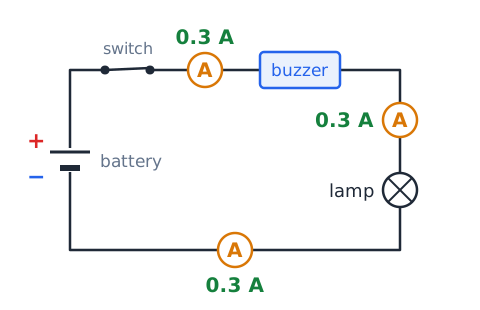
In a single loop with no branches, the current is the same at every point. Charge does not pile up or vanish in a steady circuit, so the amount passing one point each second equals the amount passing any other point.
The current entering a lamp equals the current leaving it. What the lamp uses is energy, which is why the potential is lower on its exit side. Current is not used up along the way.
Static discharge and circuit current
A static discharge, such as a spark from your finger to a doorknob, can involve thousands of volts, yet it transfers only a very small charge over a tiny fraction of a second. The total energy is small, so it usually stings rather than injures.
A circuit current, by contrast, is sustained as long as the loop stays closed and the source keeps supplying energy. Static discharges can still destroy sensitive electronic chips, which is why technicians wear grounded wrist straps.
Interpreting electronic labels safely
Device labels list ratings such as voltage, current and power. A charger labeled "Output 5 V, 2 A" supplies 5 V and can deliver up to 2 A; the device decides how much it actually draws.
Match the voltage rating closely, because too high a voltage can damage a device. A supply's current rating should equal or exceed what the device needs. Never exceed a cord's or fuse's rated current. Labels are design limits, not measurements of what flows at every moment.
Calculator-free calculation strategy
The ASVAB does not allow calculators, so set problems up to stay simple. Write the formula first, then plug in values with units, converting prefixes before calculating. For example, with 200 mA and 30 s:
Rearrange before substituting:
Look for easy factors and cancel zeros.
Estimate whether a value is plausible
After calculating, ask whether the size makes sense. A phone charger supplying 500 A, a flashlight cell rated 1,500 V, or a lamp current of 0.000001 A would all be suspicious. Common results run from milliamps to a few amps for small electronics. A wildly off answer usually means a missed prefix or an inverted formula.
Reading a simple diagram without hidden assumptions
Answer from what the diagram actually shows. Check whether each switch is drawn open or closed, where each meter is placed, and whether any branch exists. Do not assume a switch is closed, that a meter reads current when its symbol is V, or that wires have resistance unless stated.
Treat ideal meters and wires as ideal unless the question says otherwise. If information is missing, such as the resistance needed for Ohm's law, the right answer may be that the value cannot be found from what is given.
Electric shock hazards: a conceptual note
Electric shock happens when the body becomes part of a circuit, letting current pass through it. The harm depends mainly on the current, its path through the body and how long it lasts. Even modest currents through the chest can disturb the heart's rhythm.
Higher voltages can push dangerous current through skin, and wet skin lowers resistance. Treat any circuit as live until it is properly de-energized and verified. Ground-fault protection and insulation reduce risk. Repair work on mains wiring belongs to trained people following approved procedures.
How EI compares with General Science
General Science covers electricity briefly along with biology, chemistry and Earth science. The Electronics Information subtest goes deeper into circuits, components, units, measurements and practical electronic devices.
The core ideas in this lesson, charge, current, voltage, resistance and power, appear on both tests. EI questions are more likely to ask for a calculation, a meter placement, a unit or a circuit behavior.
Current from transferred charge
A steady 30 C of charge passes through a motor in 6 s. Find the current.
The current is 5 A.
Charge from current and time
A steady 0.5 A current runs through a lamp for 40 s. How much charge passes?
The charge is 20 C.
Time from charge and current
How long does a 3 A current take to move 90 C of charge?
It takes 30 seconds.
Milliampere conversion
A meter reads 750 mA. What is that in amperes?
Milli means one thousandth, so divide by 1,000. 750 divided by 1,000 is 0.75. The current is 0.75 A. Check: an answer smaller than the milliamp number is expected, because each amp holds 1,000 mA.
Microampere conversion
A sensor draws 40 microamperes. Express this in amperes.
Micro means one millionth, so divide by 1,000,000. 40 divided by 1,000,000 is 0.00004. The current is 0.00004 A, which can also be written as 4 times 10 to the negative 5 A.
Voltage from energy and charge
A source gives 54 J of energy to 6 C of charge. What is its voltage?
The potential difference is 9 V.
Energy from charge and voltage
How much energy is transferred when 4 C of charge moves through a 12 V potential difference?
The energy is 48 J, since each coulomb carries 12 J.
Voltage with a smaller energy transfer
In a small cell, 3 J of energy is transferred to every 2 C of charge. Find the voltage.
The answer, 1.5 V, matches a typical AA cell. Voltage and charge are different quantities, so it does not matter that 1.5 is smaller than 2.
Charge from energy and voltage
A 9 V battery transfers 36 J. How much charge passed?
The charge is 4 C.
Power from voltage and current
A 12 V car accessory draws 2.5 A. What power does it use?
Use P = VI. Multiply 12 V by 2.5 A to get 30 W. The accessory takes in 30 joules of electrical energy every second.
Energy from power and time
A 60 W lamp runs for 5 minutes. How much energy does it use?
Convert time first: 5 minutes is 300 s. Energy equals power times time, so 60 W times 300 s gives 18,000 J, which is 18 kJ.
Ohm’s law with a stated fixed resistor
A fixed 300 resistor has 6 V across it. Find the current.
That equals 20 mA. Doubling the voltage to 12 V would double the current.
Ampere-hours as charge
A battery is rated 2 Ah. How many coulombs is that?
One ampere-hour is 1 A for 3,600 s, which is 3,600 C. So 2 Ah is 2 times 3,600, or 7,200 C. This is charge, not energy; energy would also need the voltage.
Series-loop current reasoning
A battery, a switch, a buzzer and a lamp form one unbranched loop. With the switch closed, an ammeter between the battery and the buzzer reads 0.3 A. What would it read between the buzzer and the lamp, and after the lamp?
There is only one path, and charge does not build up in a steady circuit, so the current is 0.3 A at every point. The buzzer and lamp convert energy, not charge. If the switch opens, current drops to 0 A everywhere in the loop.
Practice: identify quantities
Prompt: A label reads 3.7 V. Which quantity? Answer: potential difference.
Prompt: A meter shows 120 mA. Which quantity? Answer: current.
Prompt: A battery is rated 2,500 mAh. Which quantity? Answer: charge capacity.
Prompt: A heater is marked 1,500 W. Which quantity? Answer: power, the rate of energy use.
Practice: describe conventional direction
Prompt: Which way does conventional current flow through a lamp connected to a battery? Answer: from the positive terminal, through the lamp, to the negative terminal.
Prompt: Which way do electrons drift in the same wire? Answer: the opposite way, from negative through the lamp to positive.
Prompt: Does choosing a direction convention change the brightness? Answer: No; both describe the same circuit.
Practice: distinguish voltage from current
Prompt: What does a 6 V rating tell you? Answer: each coulomb gets 6 J between the terminals.
Prompt: What does 2 A tell you? Answer: 2 C pass a point each second.
Prompt: A battery sits on a shelf unconnected. Is there voltage? Current? Answer: Voltage yes, current no.
Prompt: Which instrument measures each? Answer: voltmeter across, ammeter in series.
Practice: graph slope
Prompt: A charge-time line runs from (0 s, 0 C) to (5 s, 10 C). What is the current? Answer:
Prompt: What unit does the slope carry? Answer: coulombs per second, which is amperes.
Prompt: A flat segment means what? Answer: zero current then.
Practice: measurement on a diagram
Prompt: To measure current through a resistor, where does the ammeter go? Answer: in series with the resistor, in the same path.
Prompt: To measure voltage across the resistor? Answer: a voltmeter connected across its two ends, in parallel.
Prompt: What happens if an ammeter is placed across a battery? Answer: it acts as a near short, risking damage.
Prompt: Should resistance be measured on a live circuit? Answer: No; power it off first.
Practice: choose units and reasonability
Prompt: Energy per charge is measured in what unit? Answer: volts.
Prompt: A remote-control battery reads 3 kV. Reasonable? Answer: No; about 3 V is typical.
Prompt: A calculated LED current of 20 mA. Reasonable? Answer: Yes; small LEDs often run near that.
Prompt: Charge in what unit? Answer: coulombs.
Error check: current is not used up
Mistake: believing a lamp consumes current, so less flows out than in.
Why it is wrong: in a steady single loop, charge does not disappear or pile up, so current is equal everywhere.
Fix: say the lamp converts electrical energy into light and heat. Current in equals current out; it is the potential, not the current, that is lower after the lamp.
Error check: no current does not mean no voltage
Mistake: assuming zero current means zero voltage and therefore no danger.
Why it is wrong: an open switch stops current but the battery still has its terminal voltage, and a difference appears across the gap.
Fix: treat open circuits as possibly live. Measure voltage before touching anything.
Error check: direction conventions
Mistake: mixing conventional current with electron flow and getting the arrow backward.
Why it is wrong: the two run in opposite directions. Conventional current goes positive to negative through the load; electrons drift negative to positive.
Fix: read the question for which one it means. Unless electron flow is named, use conventional current.
Error check: voltage is not stored charge
Mistake: reading "9 V" as nine coulombs stored in the battery, or as a fixed current.
Why it is wrong: voltage is energy per coulomb between the terminals. Stored charge is the capacity, shown in Ah or mAh. Current depends on the load connected.
Fix: link volts to joules per coulomb, ampere-hours to charge, and current to what the circuit draws.
Memory map for test day
Charge Q is in coulombs; one electron carries about C. Like charges repel, unlike attract, and total charge is conserved. Conductors let charge move; insulators do not.
Conventional current runs positive to negative through the load. Ammeters go in series, voltmeters across. Milli divides by 1,000, micro by a million, kilo multiplies by 1,000. One Ah equals 3,600 C.
Self-check before moving on
Can you explain how an object becomes negatively or positively charged? Can you say why a charged rod attracts a neutral scrap of paper? Can you define the ampere and volt in coulombs and joules?
Can you convert 350 mA and 80 microamperes to amperes? Can you find current from a charge-time slope? Can you place an ammeter and a voltmeter correctly, explain why an open switch stops current but not voltage, and tell AC from DC? If any answer is shaky, revisit that section.
 English ▾