 ASVAB Camp
Lesson objective and exam scope
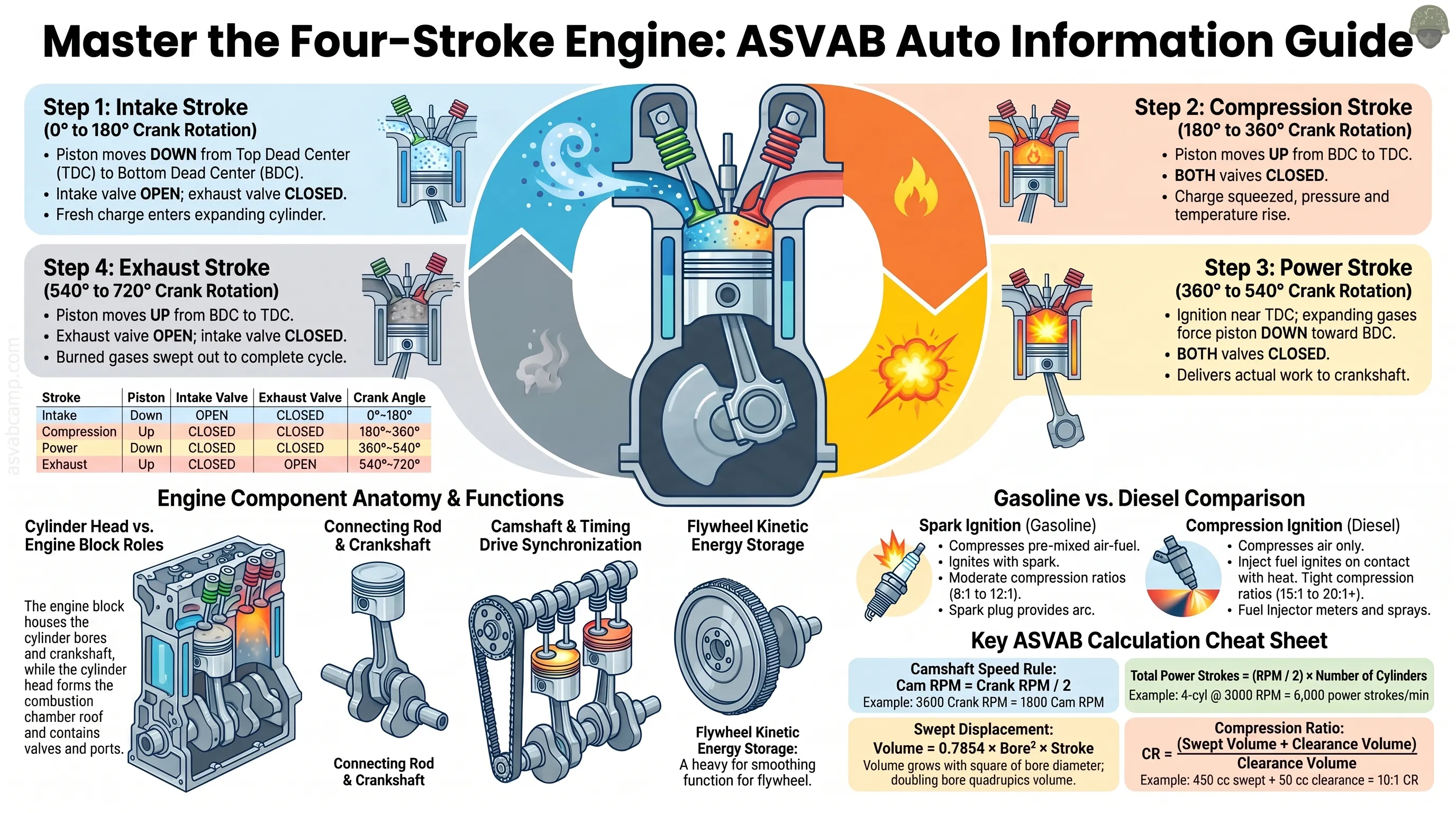
By the end of this lesson you should be able to walk through the four strokes of a piston engine in order and say what the piston and both valves are doing in each one. You will name the main moving parts, including the piston, connecting rod, crankshaft, camshaft, valves and flywheel, and state the job of each.
You will also explain how a gasoline engine lights its fuel with a spark while a diesel relies on the heat of compressed air. Finally, you will handle the short calculations the Auto Information test likes: bore and stroke, displacement, compression ratio, and crank-to-cam speed.
Internal combustion: start with energy flow
An engine is an energy converter. Fuel stores chemical energy in its molecular bonds. When that fuel burns with oxygen from the air, the stored energy is released as heat, and the hot gases expand and push hard on whatever confines them.
In an internal combustion engine, the burning happens inside the engine itself, in a sealed space above a piston. The expanding gas shoves the piston, and linkage turns that push into rotation of a shaft that can drive wheels, a pump or a generator.
Think of the chain as chemical energy, then heat, then gas pressure, then linear piston motion, then rotary motion. Much of the heat is lost to the cooling system and exhaust, so only part of the fuel's energy becomes useful work.
Understand what a four-stroke cycle means
A stroke is one trip of the piston from one end of its travel to the other, either up or down. A four-stroke engine needs four of these trips to finish one complete working cycle: intake, compression, power and exhaust.
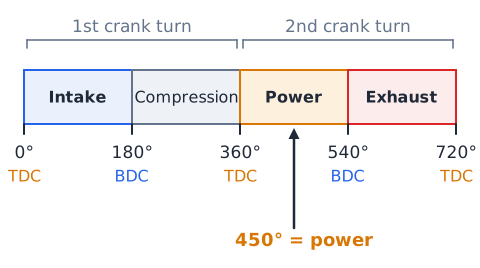
Each stroke turns the crankshaft half a revolution, or 180 degrees. Four strokes therefore take two full turns of the crank.
Only one of those four strokes, the power stroke, pushes on the crankshaft. The other three are housekeeping: pulling in a fresh charge, squeezing it, and clearing out the burned gas.
Recognize top dead center and bottom dead center
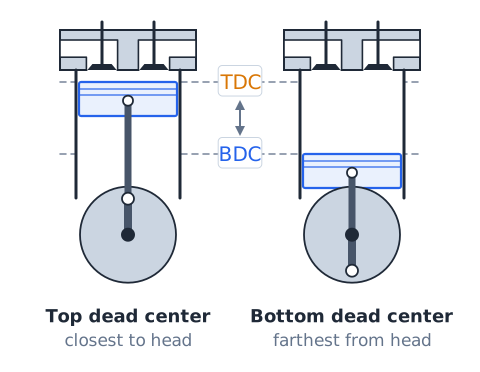
Top dead center (TDC) is the piston's highest point, where it sits closest to the cylinder head. Bottom dead center (BDC) is its lowest point, farthest from the head. At both spots the piston stops for an instant and reverses direction, which is why they are called dead centers.
Every stroke runs from one of these points to the other. For example, the intake stroke begins at TDC and ends at BDC, and the compression stroke carries the piston from BDC back up to TDC. Being able to place the piston at TDC or BDC is the starting point for naming any stroke on a diagram.
Label the cylinder, piston and combustion chamber
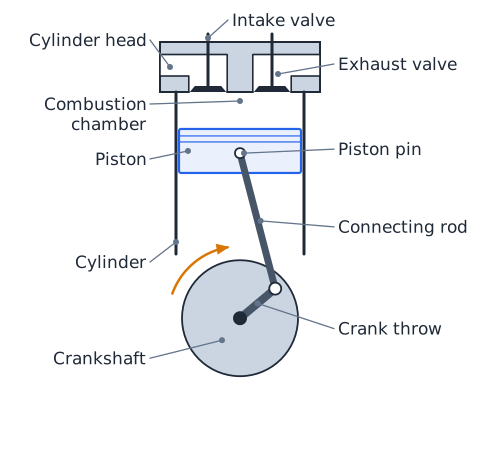
The cylinder is the round, smooth-walled bore machined into the engine block. Its walls guide the piston so it travels in a straight line.
The piston is a snug-fitting metal plug that slides up and down inside the cylinder. Rings around its sides seal against the wall.
The combustion chamber is the small space left between the top of the piston and the cylinder head when the piston is near TDC. This is where the fuel and air are squeezed and burned, so it is the place where combustion actually happens, not in the oil pan, radiator or exhaust pipe.
Identify the connecting rod and crankshaft
The connecting rod is the link between the piston and the crankshaft. Its small end pivots on a pin inside the piston, and its big end wraps around an offset journal on the crankshaft.
The crankshaft is the main output shaft of the engine. Its offset throws act like the pedal cranks on a bicycle: a straight push from the rod makes the shaft spin.
Together these two parts convert the piston's back-and-forth (reciprocating) motion into rotary motion. If a question asks which part ties piston movement to the turning crank, the answer is the connecting rod.
Trace the intake stroke
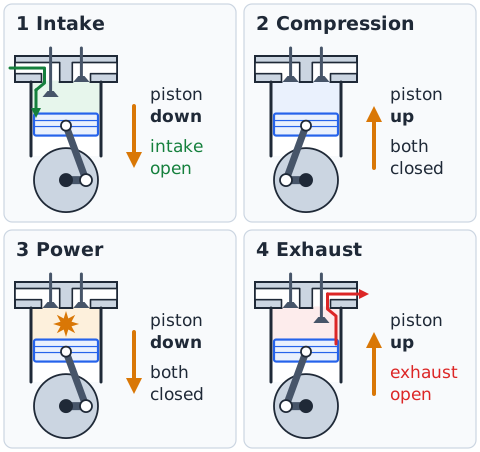
The intake stroke starts with the piston at TDC. As the crankshaft turns, it pulls the piston down toward BDC.
During this stroke the intake valve is open and the exhaust valve is closed. The descending piston enlarges the space above it, which lowers the pressure inside the cylinder. Outside air at higher pressure rushes in through the open intake valve to fill that space.
In a typical gasoline engine, the incoming charge is air mixed with fuel, or fuel is sprayed in shortly after. In a diesel, only air enters. Either way, the stroke ends at BDC with the cylinder full and ready to be compressed.
Trace the compression stroke
The compression stroke begins at BDC with a cylinder full of fresh charge. Now both valves are closed, so the gas has nowhere to escape.
The piston rises toward TDC and squeezes the trapped charge into the small combustion chamber. Packing the same gas into a much smaller volume raises both its pressure and its temperature. In a gasoline engine that heat is kept below the point where the fuel would light on its own. In a diesel the air gets hot enough to ignite fuel the moment it is injected.
Compressing the charge first is what lets the burn that follows push hard on the piston. The stroke ends with the piston at or near TDC, ready for ignition.
Trace the power stroke
The power stroke is the only one of the four strokes that delivers work to the crankshaft. It begins with the piston near top dead center and the compressed charge packed into the small combustion chamber. Both valves stay closed so the chamber remains sealed.
In a gasoline engine the spark plug fires just before or near TDC; in a diesel, fuel injected into the very hot air lights on its own. The burning mixture raises the gas temperature and pressure sharply, and that pressure drives the piston down toward bottom dead center.
The connecting rod passes the force to the crankshaft and turns it. As the piston nears BDC the push fades, and the next stroke, exhaust, follows.
Trace the exhaust stroke
After the power stroke drives the piston to BDC, the cylinder is full of hot, burned gas that must be removed. That is the job of the exhaust stroke.
The exhaust valve opens while the intake valve stays closed. The piston moves upward from BDC toward TDC and pushes the spent gas out through the exhaust port, much like a plunger emptying a syringe. The gas then travels into the exhaust manifold and the rest of the exhaust system.
So the quick test is: piston moving up with the exhaust valve open means exhaust stroke. When the piston reaches TDC, the cycle is ready to begin again with intake.
Memorize the ordered four-stroke sequence
The order never changes: intake, compression, power, exhaust. A popular memory aid is "suck, squeeze, bang, blow," which matches drawing in the charge, squeezing it, burning it and pushing it out.
The piston directions alternate: down on intake, up on compression, down on power, up on exhaust. Valve status follows a simple pattern too. Intake has only the intake valve open, exhaust has only the exhaust valve open, and both are closed during compression and power. If you know any one stroke, you can name the next three by stepping through the list.
Connect strokes to crankshaft angle
Because each stroke takes half a crankshaft turn, you can lay the cycle out on a 720 degree scale. Starting from TDC at the beginning of intake:
For example, a crank position of 450 degrees falls in the power stroke. Note that TDC occurs at both 0 and 360 degrees, which is why TDC alone does not tell you the stroke.
Why a crankshaft can rotate through non-power strokes
Only one stroke out of four actually pushes the crankshaft, yet the engine keeps turning smoothly through the other three. The reason is stored motion.
The power stroke gives the crankshaft, flywheel and other rotating parts a strong shove. These heavy spinning parts carry rotational kinetic energy, and that energy keeps them turning while the piston does the work of exhaust, intake and compression. Think of a merry-go-round: one good push keeps it spinning for a while even with no one pushing.
In multi-cylinder engines, other cylinders also fire while a given cylinder is on a non-power stroke, adding still more push to keep rotation steady.
What a flywheel does and does not do
A flywheel is a heavy disc bolted to the end of the crankshaft. Because it has a lot of mass spread out from its center, it resists changes in rotational speed. When a power stroke pushes the crank, the flywheel speeds up slightly and stores extra rotational kinetic energy. During the intake, compression and exhaust strokes, which take energy instead of giving it, the flywheel gives some of that energy back and keeps the crank turning.
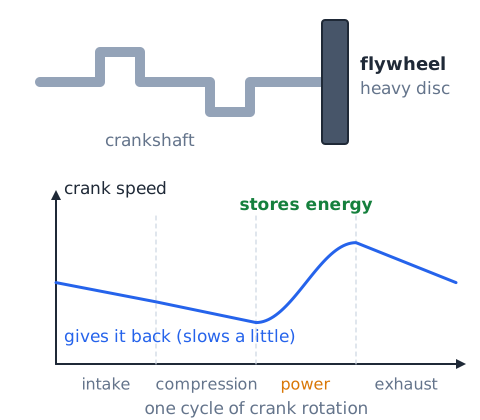
What it does not do: it does not create energy, burn fuel, operate valves or turn a non-power stroke into a power stroke. It only smooths out the speed between power pulses.
Recognize intake and exhaust valves
Most four-stroke engines have at least two poppet valves per cylinder, mounted in the cylinder head. Each valve looks like a mushroom: a round head that seals against a ring-shaped seat, and a long stem that is pushed to open it. A spring pulls it shut again.
The intake valve opens the cylinder to the intake passage so fresh air or air-fuel mixture can flow in. It is often the larger of the two because filling the cylinder well matters. The exhaust valve opens the cylinder to the exhaust passage so burned gas can leave.
In the simplified cycle, only the intake valve is open on the intake stroke, only the exhaust valve is open on the exhaust stroke, and both are closed for compression and power.
The camshaft operates the valves
A camshaft is a rotating shaft with egg-shaped lobes along it, one lobe for each valve. As a lobe turns, its raised part pushes against a follower, either directly or through lifters, pushrods and rocker arms, and opens the valve. When the lobe's high point rotates past, the valve spring closes the valve.
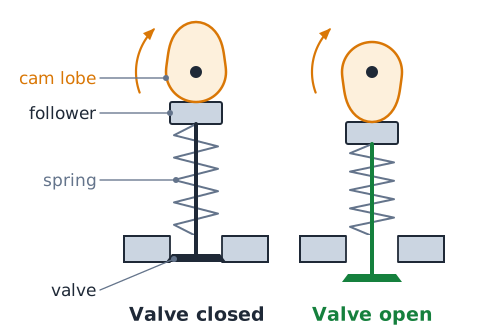
Each valve needs to open only once per complete cycle, and a cycle takes two crankshaft revolutions. So the camshaft is geared to turn once for every two turns of the crank:
For example, a crank turning at 3600 rpm drives the camshaft at 1800 rpm.
The timing drive keeps engine events synchronized
The valves must open and close at exactly the right piston positions. Since the crankshaft sets the piston position and the camshaft sets the valve position, the two shafts must stay locked together.
A timing belt, timing chain or set of timing gears links them. The drive is sized so the camshaft turns once for every two crankshaft turns, matching one valve event per four-stroke cycle.
If a belt slips a tooth or breaks, the valves fall out of step with the pistons. The engine may run poorly or not at all, and in some designs a piston can strike an open valve. The core purpose is synchronization, not carrying fuel or coolant.
Gasoline and diesel: different ignition principles
Gasoline and diesel engines both follow the four strokes, but they start combustion in different ways.
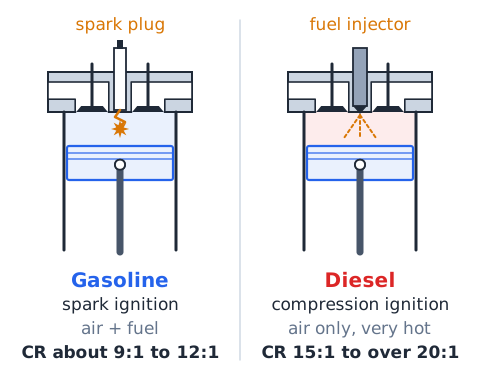
A gasoline engine uses spark ignition. It compresses a mixture of air and fuel to a moderate ratio, often around 9:1 to 12:1, and at the right moment the spark plug fires an electric arc that lights the mixture.
A diesel engine uses compression ignition. It draws in air only and squeezes it much harder, commonly 15:1 to over 20:1. Compressing air that much makes it very hot. Near the end of compression, fuel is sprayed into that hot air, and it ignites on its own with no spark plug needed.
Fuel delivery varies by engine design
Fuel can reach the cylinder in several ways. Older gasoline engines used a carburetor, which mixed fuel into the incoming air. Most modern gasoline engines use electronically controlled fuel injectors: in port injection, the injector sprays into the intake port just ahead of the intake valve, and in direct injection, it sprays straight into the combustion chamber.
A diesel engine always injects fuel directly into the cylinder, or into a small prechamber, at very high pressure near the end of the compression stroke. In every case the injector's job is the same: to meter the right amount of fuel and deliver it at the right time.
A spark plug is not an injector
Test questions often mix up these two parts, so keep their jobs separate.
A spark plug is an ignition part. It threads into the cylinder head with its tip in the combustion chamber. The ignition system sends it a high-voltage pulse, and an electric arc jumps the small gap between its electrodes, lighting the compressed charge. It adds no fuel.
A fuel injector is a fuel-delivery part. It is an electrically or mechanically opened valve with a fine nozzle that meters fuel and sprays it as a mist. It makes no spark.
A gasoline engine with injection has both parts. A diesel has injectors but no spark plugs.
Clarify combustion versus explosion language
People often say an engine runs on small explosions, but that wording is loose. In a healthy engine the charge burns rapidly and smoothly: a flame front starts at the spark or the injected spray and spreads across the chamber in a few thousandths of a second. That controlled burning builds pressure steadily against the piston.
A true sudden detonation, where pockets of mixture blow up all at once, is a fault called knock or pinging. It causes a metallic rattling sound, harsh pressure spikes and possible damage to pistons. So on a test, controlled combustion is the normal process, and detonation is a problem.
Bore is cylinder diameter
Bore is the inside diameter of the cylinder, measured straight across the circle the piston fits into. The word is also used for the cylinder opening itself, the smooth machined surface that guides the piston as it slides.
Bore is usually given in millimeters or inches. A small motorcycle engine might have a bore around 50 mm, while a large truck engine might be over 120 mm.
Bore matters because it sets the area of the piston top. A bigger bore gives the expanding gas more surface to push on and lets the engine fit larger valves. Remember that bore is a diameter, so when finding area you divide it by 2 to get the radius, or use the quarter-pi form of the circle formula.
Stroke length is travel distance
Stroke length is how far the piston travels from TDC to BDC. It is a straight-line distance, measured along the cylinder.
Stroke is set by the crankshaft. The distance between the main shaft center and the offset rod journal is called the crank throw, and the stroke equals twice that throw. A crank with a 40 mm throw, for example, gives an 80 mm stroke.
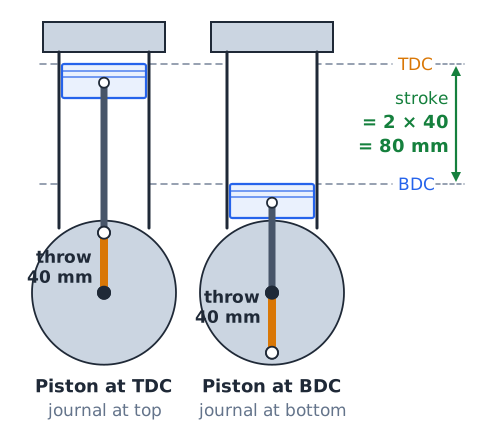
Do not mix up stroke length with "a stroke" as one step of the cycle. One names a distance; the other names a movement. Both ideas use the same word, so read each question carefully.
Calculate swept displacement per cylinder
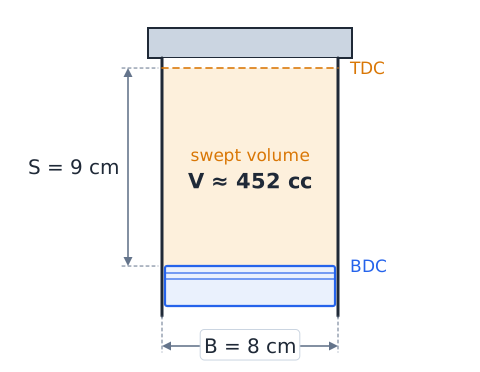
Swept displacement is the volume the piston sweeps through as it moves from TDC to BDC. It is a cylinder shape, so its volume is the piston area times the stroke.
Here B is the bore and S is the stroke, both in the same unit. If they are in centimeters, V comes out in cubic centimeters (cc).
Example: bore 8 cm, stroke 9 cm.
Total displacement and the number of cylinders
Engine size is quoted as total displacement: the swept volume of one cylinder multiplied by the number of cylinders.
Using the 452 cc cylinder from the previous example in a four-cylinder engine:
Since 1000 cc equals 1 liter, divide by 1000 to convert. Displacement measures pumping size, not horsepower; boost, rpm and design also affect output.
Compression ratio is a volume ratio
Compression ratio compares the cylinder volume with the piston at BDC to the volume with the piston at TDC.
Here is the swept volume and is the clearance volume left above the piston at TDC. With 450 cc swept and 50 cc clearance:
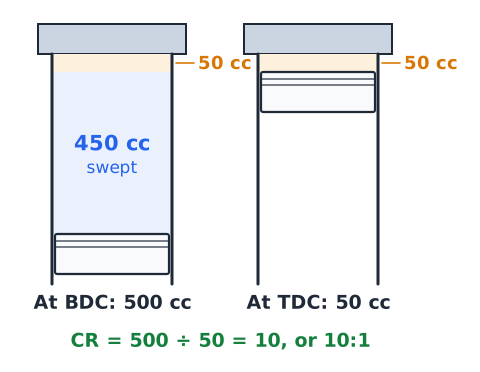
This is written 10:1. It has no units because it divides one volume by another.
Distinguish compression ratio from compression pressure
Compression ratio is a fixed geometric number. It comes from the shape and size of the cylinder and does not change from day to day.
Compression pressure is what a gauge reads in the cylinder at the top of the compression stroke, usually in psi. It depends on the ratio, but also on how well the rings and valves seal, engine speed during the test, temperature and altitude. Real gas also heats as it is squeezed, so a 10:1 engine can read somewhat more than the ten times atmospheric pressure that volume alone would suggest.
So a worn engine can keep its original ratio while showing low compression pressure.
Why cylinder sealing matters
Compression and power both depend on trapping gas above the piston. Any leak lets pressure escape that should be pushing on the piston.
Three main seals do this work. Piston rings press against the cylinder wall. Valves seat tightly against the head when closed. The head gasket seals the joint between the head and the block.
If rings wear, a valve does not seat, or a gasket fails, the engine loses compression. Symptoms include weak power, hard starting and rough running. That is why a compression or leak-down test is a common way to check the internal health of an engine.
The cylinder head and block have distinct roles
The engine block is the main body of the engine. It contains the cylinders, supports the crankshaft in its main bearings and usually has passages for coolant and oil.
The cylinder head bolts onto the top of the block and closes off the cylinders. It forms the roof of each combustion chamber and holds the intake and exhaust ports, the valves and, in a gasoline engine, the spark plugs. Many modern engines also mount the camshafts in the head.
A simple way to remember it: the block holds the parts that go up and down and around, and the head holds the parts that let gas in and out.
How a four-cylinder engine smooths delivery
A single-cylinder engine gets one power stroke every two crankshaft turns, so its output comes in strong, widely spaced pulses. That is why small one-cylinder engines feel shaky.
A four-cylinder engine arranges its cylinders so they fire at different times. Spreading four power strokes evenly over the 720 degree cycle means one cylinder fires every 180 degrees. As one power stroke ends, the next one begins, so there is almost always a cylinder pushing on the crankshaft.
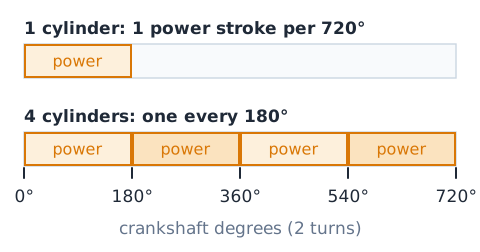
The result is steadier torque and less vibration. Engines with six or eight cylinders overlap their power strokes even more and run smoother still.
Count power events safely
Each cylinder of a four-stroke engine fires once every two crankshaft revolutions. That gives a reliable counting rule.
Here n is the number of cylinders. For a four-cylinder engine at 3000 rpm:
The most common mistake is forgetting to divide by 2. Doing so would double the answer. Check each step: first per cylinder, then multiply by the cylinder count.
Camshaft speed ratio calculation
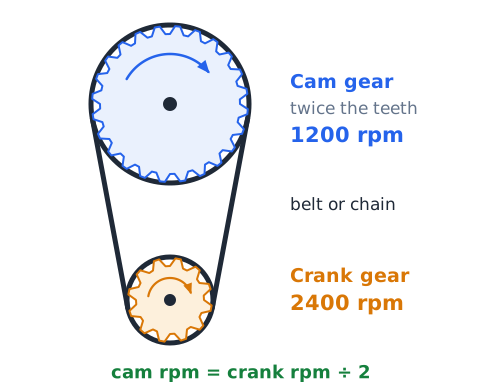
Each valve opens once per four-stroke cycle, and the cycle takes two crankshaft turns. So the camshaft must spin at half crankshaft speed, a 2:1 ratio.
If the crankshaft turns at 2400 rpm, the camshaft turns at 1200 rpm. Working backward, a cam at 900 rpm means the crank is at 1800 rpm. This is why a cam timing gear has twice as many teeth as the crank gear that drives it.
Valve overlap is a real-world refinement
Simple diagrams show each valve opening exactly at TDC or BDC. Real engines do not work that neatly, because gas has mass and takes time to start and stop flowing.
Designers open the intake valve a little before TDC at the end of the exhaust stroke and close the exhaust valve a little after TDC. For a few degrees of crank rotation both valves are partly open at once. This is called valve overlap. The outgoing exhaust helps pull fresh charge into the cylinder.
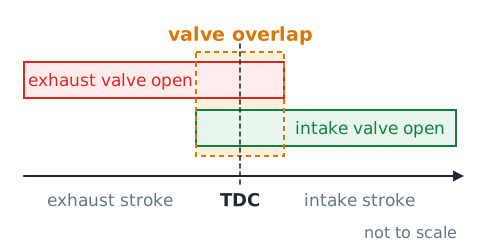
For the ASVAB, use the idealized pattern unless a question mentions overlap. Overlap is a refinement, not a change to the four-stroke order.
Torque is a turning effect
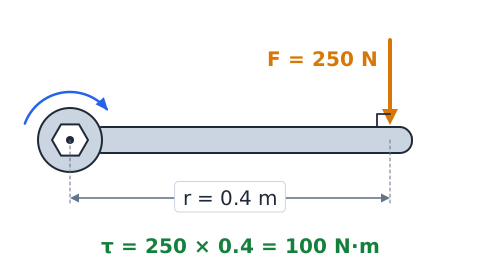
Torque is a twisting effort about an axis. It depends on how hard you push and how far from the center you push:
Here is torque in newton-meters (N·m), F is the force in newtons applied at right angles to the lever, and r is the lever arm in meters. In US units torque is given in pound-feet (lb-ft).
For example, a 250 N push on a wrench 0.4 m long gives 100 N·m. In an engine, gas pressure pushes the piston, the connecting rod pushes on the crank throw, and that offset from the crankshaft center turns the force into torque at the crankshaft.
Power depends on torque and rotational speed
Power is the rate of doing work. For a rotating shaft it depends on both torque and how fast the shaft turns. A handy form for engines is:
P is power in kilowatts, is torque in N·m and n is crankshaft speed in rpm. The 9549 comes from converting rpm to radians per second and watts to kilowatts.
For example, 300 N·m at 2000 rpm gives about 62.8 kW. If torque stays the same and rpm doubles, power doubles. That is why an engine can make high power at high rpm even when its torque is modest.
Two-stroke and four-stroke are not the same
A two-stroke engine completes its whole cycle in just two piston strokes, or one crankshaft revolution. It fires once every turn instead of once every two turns.
To do this, it combines jobs. As the piston nears BDC, exhaust gas leaves through ports in the cylinder wall while fresh charge enters. On the upstroke it compresses; on the downstroke it delivers power. Many small two-strokes use ports instead of poppet valves and mix oil into the fuel.
Two-strokes are light and simple, common in chainsaws and outboard motors. Four-strokes are cleaner and more fuel efficient, and they are the standard in cars and trucks.
Understand naturally aspirated and boosted intake
A naturally aspirated engine relies on atmospheric pressure alone to fill its cylinders. As the piston moves down on the intake stroke, it lowers the pressure in the cylinder, and the outside air, at about 14.7 psi at sea level, pushes in to fill the space. Friction in the intake path and short valve-open time mean the cylinder never quite fills completely.
A boosted engine uses a compressor to push air in above atmospheric pressure. Packing more air mass into the same cylinder lets the engine burn more fuel per cycle and make more power from the same displacement. The two common boosting devices are the supercharger, driven by the crankshaft, and the turbocharger.
What a turbocharger actually changes
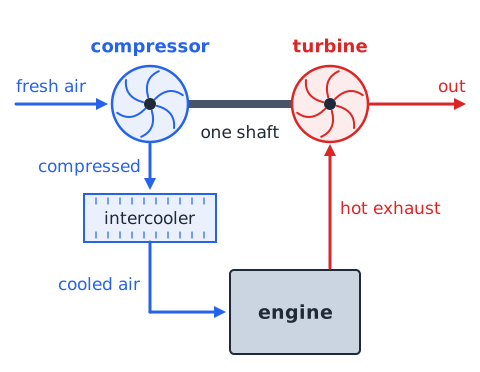
A turbocharger has two wheels on one shaft. The turbine wheel sits in the exhaust stream; hot exhaust gas flowing through it spins it, often at very high speed. The compressor wheel, on the same shaft, sits in the intake path and squeezes incoming air.
So the turbo's energy source is exhaust gas flowing through the turbine, not a belt from the crankshaft and not combustion inside the turbo. What changes is the density of the intake charge: more air per cycle, so more fuel can be burned. Compressing air heats it, so many turbo engines add an intercooler to cool the air before it enters the cylinders.
Cooling protects engine operation
Burning fuel creates far more heat than the engine turns into work. Without cooling, pistons, valves and the cylinder head would overheat, the oil would break down, and parts could warp or seize.
Most vehicle engines use liquid cooling. A water pump moves coolant through passages in the block and head, where it absorbs heat. The hot coolant flows to the radiator, where air passing through the fins carries the heat away. A thermostat holds coolant in the engine until it warms up, then opens to let it circulate.
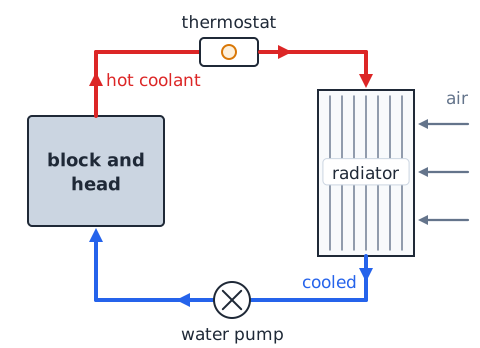
Small engines often use air cooling instead, with metal fins on the cylinder and a fan.
Lubrication limits friction and wear
Inside an engine, metal parts slide and spin against each other thousands of times a minute: pistons and rings in their bores, crankshaft journals in their bearings, cam lobes against followers. Without a lubricant, the surfaces would heat up, scuff and seize.
Motor oil forms a thin film that keeps these surfaces apart. In most engines an oil pump draws oil from the oil pan, pushes it through a filter and sends it through drilled passages to the bearings and other parts, after which it drains back to the pan. Besides reducing friction, oil carries away heat, helps the rings seal and holds dirt in suspension for the filter to trap.
Starter motor versus running-engine power
An engine cannot start itself, because it needs motion to draw in air and compress it before the first combustion can happen. The starter motor solves this. It is an electric motor powered by the battery. When you turn the key or press the start button, a small gear on the starter engages teeth on the rim of the flywheel and spins the crankshaft.
Once cylinders begin firing and combustion can keep the crankshaft turning, the starter disengages and shuts off. From then on, the energy that moves the vehicle comes from burning fuel, not from the battery. The starter only gets the cycle going.
The exhaust system is downstream of cylinders
The exhaust system begins where the exhaust valve releases spent gas from the cylinder. From there the gas flows through the exhaust manifold, which collects it from all the cylinders, then through the catalytic converter, the muffler and finally out the tailpipe.
These parts clean up and quiet the gas, but they do not make power. Combustion has already finished by the time gas reaches them. If a question asks where burning takes place, the answer is the combustion chamber, not the manifold or muffler. A clogged exhaust can still hurt performance, though, because the piston has to work harder to push gas out.
Fuel, air, compression and timed ignition all matter
For an engine to run well, four things must come together in each cylinder. There must be enough air, since its oxygen is needed to burn fuel. There must be the right amount of fuel for that air. The charge must be compressed so it burns quickly and pushes hard. And ignition must happen at the right moment, near the top of the compression stroke.
Take away any one and the engine fails or runs poorly. With no fuel, there is nothing to burn. A leaky valve or worn rings mean low compression and weak power. A spark that comes far too early or late wastes the push or fights the piston.
Different piston positions are different points in the cycle
The piston passes through the same physical spot four times per cycle, so position alone rarely tells you the stroke. TDC happens at the end of compression and again at the end of exhaust. BDC happens at the end of intake and again at the end of power.
To pin down the stroke, you need a second clue. Check which valve is open and which way the piston is moving. Piston at TDC with both valves closed and a compressed charge means the end of compression. Piston at TDC with the exhaust valve just closing means the end of exhaust. Without such clues, give both possibilities.
Read engine diagrams systematically
Engine diagrams on the test usually show a cylinder, piston, two valves and sometimes an arrow or spark. Use the same order of checks every time.
First, find the piston direction from the arrow. Second, check the valves: intake open, exhaust open or both closed. Third, look for extra hints such as a spark at the plug, a fuel spray, or shading that marks burning gas.
Then combine the clues. Down with intake open is intake. Up with both closed is compression. Down with both closed after a spark is power. Up with exhaust open is exhaust. This method beats guessing from one detail.
Mechanical cycle versus ideal Otto cycle
The four strokes you have traced, intake, compression, power and exhaust, describe what the piston and valves physically do. Engineers also use an idealized model called the Otto cycle to study gasoline-engine thermodynamics.
The ideal Otto cycle treats the gas as pure air, assumes compression and expansion happen with no heat loss, and pretends the fuel's heat is added instantly at constant volume when the piston is at TDC. Real engines do not match this exactly: burning takes time, heat escapes to the walls, valves open early or close late and gas leaks past rings. The ideal model is still useful because it shows that a higher compression ratio raises the theoretical efficiency.
Why maintenance topics sit beyond this lesson
This lesson focuses on how a four-stroke engine works: its parts, their motions and the simple math that describes them. It does not cover service procedures such as changing oil, gapping spark plugs, adjusting valve clearance, replacing a timing belt or reading diagnostic codes.
Those tasks build on what you have learned here. For example, you cannot understand why a broken timing belt can cause valves to hit pistons unless you know how the timing drive links the crank and cam. Learn the operating principles first; maintenance, troubleshooting and the fuel, ignition and emissions systems are covered in later lessons in this course.
Units and proportional thinking for engine math
Keep bore and stroke in the same units before multiplying. Centimeters give cubic centimeters, and 1000 cc equal 1 liter. Millimeters give cubic millimeters, so divide by 1000 to get cc.
Volume grows with the square of the bore but only in direct proportion to the stroke.
So doubling the bore makes each cylinder four times larger, while doubling the stroke only doubles it. Speed ratios work the same way: cam rpm is always half of crank rpm. Use proportions to check whether an answer is reasonable before choosing it.
Final four-stroke component map
Picture the engine from the bottom up. The crankshaft turns in the block and sends power to the flywheel, which smooths rotation between firing pulses. Connecting rods tie the crankshaft to the pistons. The pistons slide in the cylinder bores, sealed by rings.
Above them, the cylinder head closes each cylinder and forms the combustion chamber. Intake and exhaust valves in the head open and close under control of the camshaft. A timing belt, chain or gears keep the camshaft at half crankshaft speed.
Gasoline engines add a spark plug to light the charge. Diesels inject fuel into air that compression has made hot enough to ignite it.
Worked 1 — match arrow direction to stroke
Problem: A diagram shows the piston arrow pointing down. The intake valve is closed and the exhaust valve is closed. A burst symbol sits above the piston. Which stroke is this?
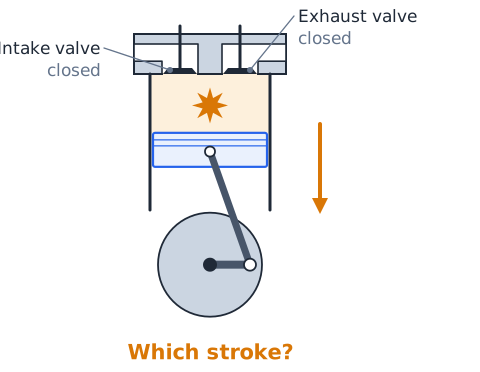
Step one: piston moving down means intake or power. Step two: the intake valve is closed, so it cannot be intake. Step three: the burst symbol confirms burning gas pushing down.
Answer: the power stroke.
Worked 2 — locate compression from two clues
Problem: A drawing shows the piston moving upward with both valves closed. Which stroke is it?
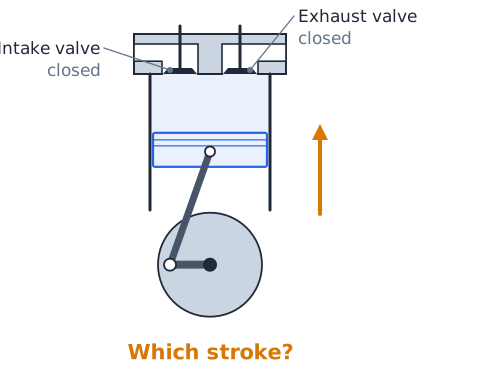
Step 1: Upward motion leaves two choices, compression or exhaust.
Step 2: On exhaust, the exhaust valve is open. Here both valves are closed, so exhaust is ruled out.
Answer: compression.
Worked 3 — calculate revolutions per cycle
Problem: How many crankshaft revolutions does a four-stroke engine need to finish 5 complete cycles?
Each cycle has four strokes of 180 degrees, which is 720 degrees, or 2 revolutions.
Answer: 10 crankshaft revolutions.
Worked 4 — find camshaft rpm
Problem: An engine on a test stand runs with its crankshaft at 3600 rpm. What is the camshaft speed?
The camshaft turns once per two crank turns.
Answer: the camshaft turns at 1800 rpm.
Worked 5 — count one-cylinder power events
Problem: A one-cylinder lawn mower engine runs at 2000 rpm. How many power strokes happen each minute?
One power stroke occurs every two revolutions.
Answer: 1000 power strokes per minute, or about 16.7 each second.
Worked 6 — count engine-wide firing events
Problem: A six-cylinder engine runs at 2400 rpm. How many power strokes occur per minute, and how far apart are they in crank degrees?
Per cylinder: 2400 divided by 2 is 1200. Multiply by six cylinders.
Spacing: 720 degrees divided by 6 is 120 degrees.
Answer: 7200 per minute, one every 120 degrees.
Worked 7 — simple total displacement
Problem: A V8 engine has a swept volume of 625 cc in each cylinder. What is its total displacement in liters?
Multiply by the number of cylinders.
Convert, using 1000 cc per liter: 5000 divided by 1000 is 5.0.
Answer: 5.0 liters.
Worked 8 — compression ratio with clearance
Problem: Swept volume is 400 cc and clearance volume is 50 cc. Find the compression ratio.
Answer: 9:1. Remember to add the clearance volume to the top before dividing.
Worked 9 — calculate volume from bore and stroke
Problem: Bore is 10 cm and stroke is 8 cm. Find the swept volume of one cylinder.
Answer: about 628 cc.
Worked 10 — double the bore
Problem: A cylinder has a 7 cm bore and 8 cm stroke. If the bore is doubled to 14 cm with the same stroke, how does the volume change?
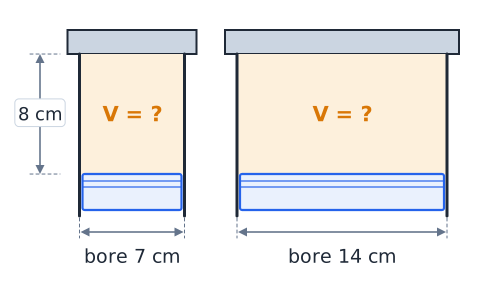
Original: 0.7854 times 49 times 8, about 308 cc. New: 0.7854 times 196 times 8, about 1232 cc.
Answer: the volume becomes four times larger, because bore is squared.
Worked 11 — choose the correct combustion component
Problem: A gasoline engine has fresh charge compressed at TDC, but it will not fire. Which part is responsible for lighting the charge: the fuel injector, the exhaust valve, the camshaft or the spark plug?
The injector supplies fuel, the exhaust valve releases gas, and the camshaft opens valves. None of them ignites anything.
Answer: the spark plug, which delivers the timed spark.
Worked 12 — compare spark and compression ignition
Problem: Engine X takes in air and fuel together and fires a spark near TDC. Engine Y takes in only air, compresses it to about 18:1, then sprays fuel into the cylinder. Which ignition type does each use?
Step 1: Engine X has a premixed charge lit by a spark, so it is spark ignition, the gasoline method.
Step 2: Engine Y relies on heat from strong compression to light injected fuel, so it is compression ignition, the diesel method.
Worked 13 — estimate crankshaft torque power
Problem: A crankshaft delivers 180 N·m at 3500 rpm. Estimate the power.
Step 1:
Step 2: Divide:
Answer: about 66 kW.
Worked 14 — resolve TDC ambiguity
Problem: A sketch shows a piston at TDC and nothing else. Which stroke is ending?
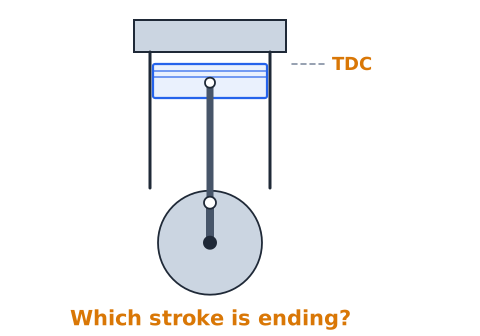
Step 1: The piston reaches TDC twice per cycle, at the end of compression and at the end of exhaust.
Step 2: The sketch alone cannot tell them apart. Look for more clues. If the exhaust valve is open or just closing and the intake valve is starting to open, exhaust is ending. If both valves are shut and the chamber holds a compressed charge, compression is ending.
Answer: either one, until valve or charge information is given.
Drill 1 — four-stroke matrix
Piston moving down, intake valve open. Which stroke? Answer: intake.
Piston moving up, both valves closed. Which stroke? Answer: compression.
Piston moving down, both valves closed after ignition. Answer: power.
Piston moving up, exhaust valve open. Answer: exhaust.
Which stroke comes right after power? Answer: exhaust.
Drill 2 — crank and cam speed
Crank at 3000 rpm. Cam speed? Answer: 1500 rpm.
Cam at 900 rpm. Crank speed? Answer: 1800 rpm.
Crank at 5000 rpm. Cam speed? Answer: 2500 rpm.
How many cam turns per four-stroke cycle? Answer: one.
Drill 3 — displacement math
Four cylinders at 400 cc each. Total? Answer: 1600 cc, or 1.6 L.
A 2.4 L six-cylinder engine. Volume per cylinder? Answer: 2400 divided by 6 is 400 cc.
Bore 6 cm, stroke 7 cm. Volume? Answer: about 198 cc.
Stroke doubles, bore same. Volume change? Answer: doubles.
Drill 4 — compression volume reasoning
Swept 360 cc, clearance 40 cc. Ratio? Answer: 400 divided by 40 is 10:1.
Ratio 8:1 with 60 cc clearance. Swept volume? Answer: total is 480 cc, so swept is 420 cc.
Clearance shrinks, swept same. Ratio? Answer: rises.
Drill 5 — part-function matching
Which part turns the piston's up-and-down motion into rotation? Answer: the connecting rod and crankshaft together; the rod is the link.
Which part opens the valves? Answer: the camshaft.
Which part lights the charge in a gasoline engine? Answer: the spark plug.
Which part smooths crank speed between power pulses? Answer: the flywheel.
Which part links crank and cam timing? Answer: the timing belt or chain.
Drill 6 — gasoline and diesel distinctions
What does a diesel draw in on the intake stroke? Answer: air only.
Which engine usually has the higher compression ratio? Answer: the diesel.
What lights the fuel in a diesel? Answer: the heat of strongly compressed air.
Does a diesel need spark plugs to run? Answer: no; it uses fuel injectors but no spark plugs.
What starts combustion in a gasoline engine? Answer: a spark from the spark plug near the end of compression.
Do both engines use the same four strokes? Answer: yes: intake, compression, power, exhaust.
ASVAB Auto Information problem strategy
Auto questions on the ASVAB are short, so success comes from quick, clear reasoning rather than long calculation.
For stroke questions, use two clues: which way the piston is moving and which valves are open. Down with intake open is intake; up with both closed is compression; down with both closed is power; up with exhaust open is exhaust. If a clue is missing, do not guess at a single stroke.
For part questions, ask what job is described, such as making a spark, delivering fuel, opening valves or storing rotation, and match the part to that job. Watch for distractors that name a real part with the wrong function.
For math, remember the anchors: two crank turns per cycle, cam at half crank speed, one power stroke per cylinder every two turns, and compression ratio equals total volume divided by clearance volume. Check units and whether an answer is reasonable before choosing.
Frequent mistakes and exam traps
Assuming TDC always means the start of power. TDC also ends the exhaust stroke. The fix is to check valves and charge before naming the stroke.
Forgetting the 2:1 rule. Students sometimes set camshaft speed equal to crank speed, or count one power stroke per revolution in a four-stroke engine. Both are wrong because the cycle takes two crank turns. Divide by 2.
Mixing up parts. The connecting rod links piston and crank; the camshaft runs the valves; the flywheel stores energy but does not create it.
Using the radius as bore. Bore is the diameter, so square it in the quarter-pi formula.
Leaving clearance volume out of the top of the compression ratio. The numerator is swept plus clearance.
Treating diesel like gasoline. A diesel has no spark plug for ignition; hot compressed air lights the injected fuel.
Quick review: engine parts and four strokes
The cycle runs intake, compression, power, exhaust. The piston goes down, up, down, up. Only the intake valve is open on intake, only the exhaust valve on exhaust, and both are closed on compression and power.
One cycle takes two crankshaft revolutions, or 720 degrees. The camshaft turns at half crank speed, and each cylinder fires once every two turns.
The connecting rod turns piston motion into crank rotation, the timing drive syncs crank and cam, and the flywheel carries the engine between power pulses. Gasoline engines use a spark plug; diesels rely on heat of compression. Combustion takes place in the chamber above the piston.
 English ▾