 ASVAB Camp
Learning objectives and test scope
In this lesson you will learn to sort a vehicle complaint into the right system before naming any part. You will separate no-crank from crank-no-start, link warning lamps to charging, cooling, lubrication, brake, tire and emissions systems, read basic electrical and stopping-distance math, and choose the safest, least intrusive next check. ASVAB Auto Information questions reward this careful reasoning.
Safety comes before diagnosis
Before you look for a cause, make the situation safe. Park on level ground, set the parking brake, and keep hands, hair and loose clothing away from belts and fans. Never open a hot radiator cap, and keep sparks and flames away from batteries, which can release hydrogen gas. If a symptom affects braking, steering or tires, stop driving and get qualified help rather than testing on the road.
The diagnostic reasoning chain
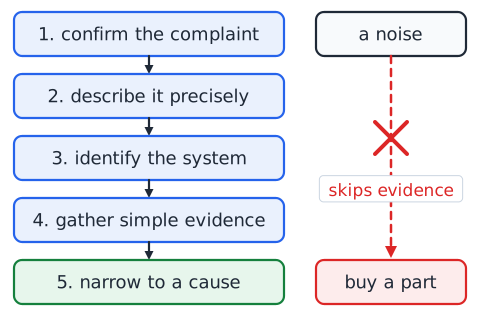
Good diagnosis follows a chain: confirm the complaint, describe it precisely, identify which system performs the affected job, gather simple evidence, and only then narrow toward a cause. Each link must support the next. Jumping straight from a noise to buying a part skips the evidence and often wastes money.
Describe a symptom precisely
A useful description answers when, where and how. Does the problem appear cold or hot, at idle or at speed, while braking or turning? Does it follow engine rpm or road speed? "It shakes" is vague; "the steering wheel shakes near 65 mph and smooths out at 75 mph" points toward a rotating wheel and tire.
No-crank and crank-no-start are different
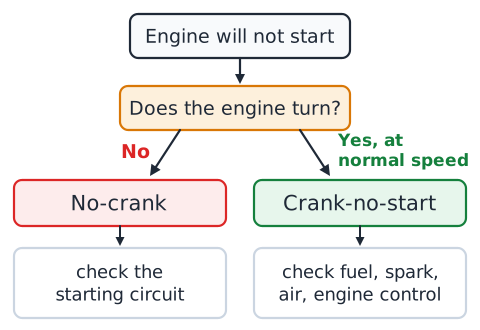
No-crank means the engine does not turn over when you try to start it. Crank-no-start means the starter spins the engine at normal speed, but the engine never begins running on its own. The first points to the starting circuit; the second points to fuel, spark, air or engine control.
Low battery charge versus failed starter
In a typical 12 V car, the battery supplies the energy the starter needs. A weakly charged battery often causes slow cranking, rapid clicking and dimming lights. A starter fault may give a single click or no sound while the lights stay bright. Because both patterns overlap, test battery voltage and connections before blaming the starter.
Why bright dashboard lamps prove little
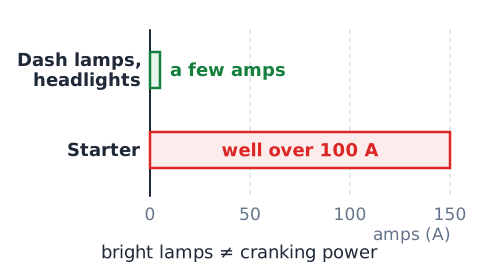
Dash lamps and headlights draw only a few amps, while a starter may draw well over 100 amps. A battery or cable can light bulbs brightly yet collapse under starter load. Bright lamps tell you the circuit has some power, not that it can deliver cranking current.
Corroded terminals and high resistance
White or green crust on battery posts, or a loose clamp, adds resistance to the circuit. Extra resistance limits the current that can reach the starter, so the engine may crank slowly or not at all even with a charged battery. Cleaning and tightening connections is a low-cost first step.
Starter-control interlocks
Many vehicles block the starter unless certain conditions are met: an automatic in Park or Neutral, a clutch pedal pressed on a manual, a recognized key, or the brake pedal applied for push-button start. A no-crank can come from one of these controls, not the starter itself.
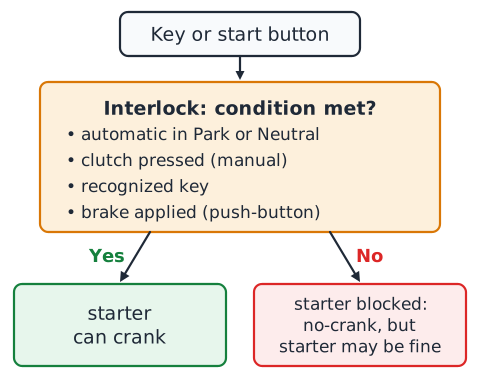
A crank-no-start decision tree
Once the engine cranks normally, ask what it needs to run: fuel, spark at the right time, enough air, and compression. Check whether the fuel system primes, whether the check-engine lamp or security light shows a message, and whether codes are stored. Each answer removes a branch before parts are considered.
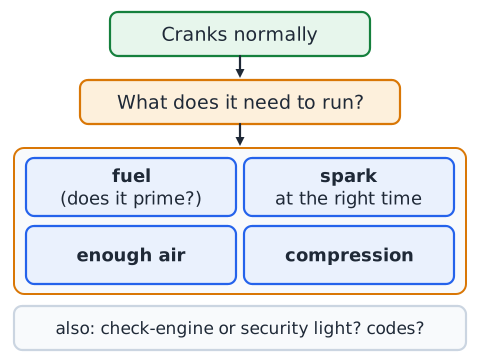
Fuel delivery is not fuel quantity alone
A gauge showing half a tank does not prove the engine is getting fuel. The pump must run, the filter must flow, pressure must be correct, and injectors must be commanded. Contaminated or wrong fuel can also prevent starting. Fuel must arrive in the right amount at the right pressure.
Ignition symptoms need controlled checks
Missing spark can cause crank-no-start or misfire, but ignition parts carry high voltage. Use proper testers and follow service procedures instead of improvised tests near the coils. A trouble code or misfire counter can narrow which cylinder is affected.
Charging and battery functions
The battery stores energy and supplies the big burst needed to crank the engine. Once the engine runs, the engine-driven alternator takes over: it powers lights, fans, computers and accessories, and it recharges the battery. A healthy running system usually shows roughly 13.5 to 14.7 V at the battery.
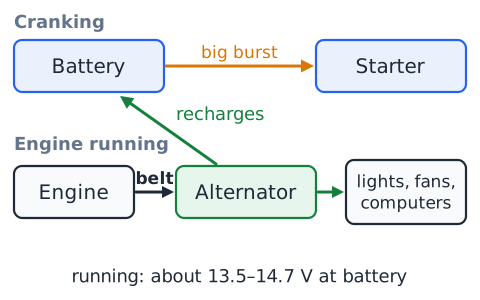
Battery warning icon interpretation
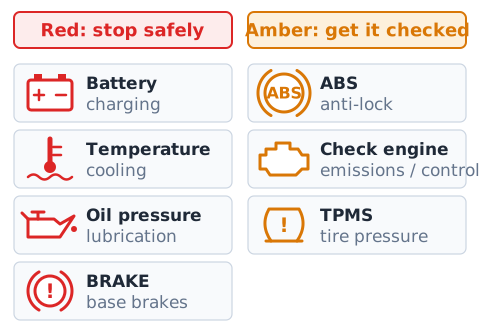
The battery-shaped lamp normally lights when the key is on and goes out once the engine runs. If it lights while driving, the charging system may not be keeping up. Causes include a slipping or broken belt, a failing alternator, a wiring fault or a poor connection. The icon flags the system, not a single part.
Separate charging measurement from a guess
Instead of guessing, measure. Compare battery voltage with the engine off, then with it running. If running voltage stays near resting voltage or drops as loads are switched on, the charging system needs testing. A load test or charging-system test confirms what a lamp only suggests.
Conceptual voltage under load
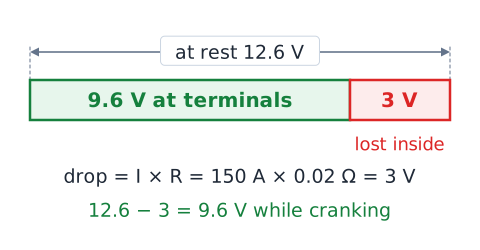
Every battery has a small internal resistance. When a large current flows, some voltage is lost inside the battery, so the voltage at its terminals falls.
Example: rest voltage 12.6 V, cranking current 150 A, internal resistance 0.02 . Drop is 3 V, so the terminals read about 9.6 V while cranking.
Worked resistance example
Ohm's law relates voltage V (volts), current I (amps) and resistance R (ohms).
A 12 V circuit carries 4 A. Its resistance is
Voltage drop across a bad connection
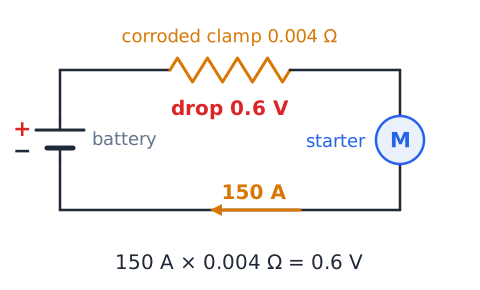
A dirty connection acts like a small resistor in series with the starter. The voltage it wastes is
With 150 A flowing through a 0.004 corroded clamp, the drop is 0.6 V, voltage the starter never receives.
Electrical power lost as heat
Power wasted in a resistance becomes heat:
Using 150 A and 0.004 :
That is why a bad terminal can feel hot after cranking.
Mechanical sound clues are evidence, not verdicts
A knock, squeal, grind or hum tells you something is moving abnormally, but many parts make similar sounds. Note whether the sound follows engine rpm, road speed, braking or steering. Use the sound to choose where to look, then confirm with inspection.
Belt squeal and charging complaints
A sharp squeal at startup or when accessories switch on often means a drive belt is slipping. Because the belt turns the alternator, slippage can also cause low charging voltage and a battery lamp. Inspect belt condition and tension with the engine off before going further.
Check Engine/MIL purpose
The check-engine lamp, called the malfunction indicator lamp or MIL, tells the driver that the engine computer has detected a fault affecting emissions or engine control. A steady lamp means have it checked soon. It points to a monitored area, not to a specific broken part.
OBD trouble code is a clue
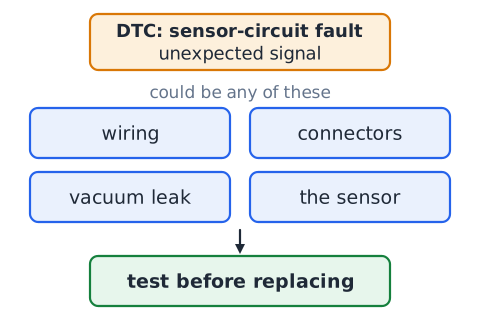
On-board diagnostics (OBD) stores a diagnostic trouble code (DTC) when a monitored value goes out of range. A code such as a sensor-circuit fault means the computer saw an unexpected signal. Wiring, connectors, a vacuum leak or the sensor could all be responsible, so the code starts testing rather than replacing it.
Stored, pending and permanent code terminology
A pending code means a fault was seen once but has not yet been confirmed, so the MIL may stay off. A stored or confirmed code means the fault repeated and usually lights the MIL. A permanent code cannot be erased with a scan tool; it clears only after the computer verifies the repair through its own tests.
Freeze-frame data preserve conditions
When a code sets, the computer saves a freeze-frame snapshot: engine speed, vehicle speed, coolant temperature, load and similar values at that moment. This shows whether the fault happened cold or hot, idling or cruising. Record freeze-frame data before clearing codes, because clearing usually erases it.
Readiness monitors are not fault repairs
Readiness monitors are self-tests the computer runs on systems such as the catalyst and evaporative system. Clearing codes resets them to incomplete, and they finish only after certain driving. A completed monitor means a test ran; it does not repair anything, and an erased lamp may come back.
Flashing warning and urgent symptoms
A flashing check-engine lamp usually signals a severe misfire that can overheat and damage the catalytic converter. Reduce load and have the vehicle checked promptly. Treat red warnings, burning smells, smoke, loud knocking or loss of brakes or steering as reasons to stop safely.
Overheating: temperature versus oil pressure
The temperature warning means the coolant is too hot; the oil-pressure warning means the lubrication system may not be feeding the engine. Both are serious. If temperature climbs or steam appears, pull over safely, shut down as the manual directs, and never open a hot pressure cap, since scalding coolant can spray out.
Coolant loss and visible leaks
Coolant is often green, orange, pink or blue and may smell sweet. Look for drips under the radiator, hoses, water pump or heater area, and check the overflow tank level only when cold. Coolant loss with no visible leak may mean an internal leak that needs professional testing.
Thermostat and circulation reasoning
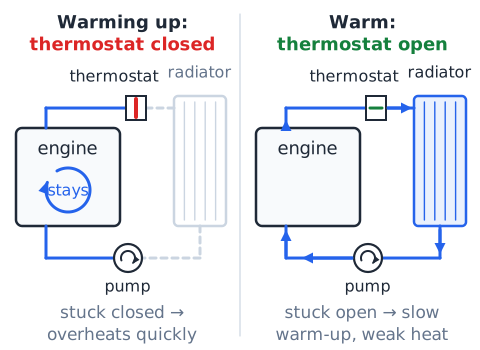
The thermostat stays closed while the engine warms, then opens so coolant flows to the radiator. Stuck closed, it can cause quick overheating; stuck open, the engine warms slowly and heater output is weak. A weak water pump or clogged radiator gives similar signs, so circulation must be checked.
Cooling fan operation depends on control strategy
Electric radiator fans run only when the computer or a switch calls for them, often based on coolant temperature or A/C use. A fan that is off is not automatically broken, and one may start without warning even with the key off. Keep hands clear of the fan area.
Oil warning is not an oil-change reminder
A maintenance reminder simply means service is due by time or mileage. A red oil-pressure lamp means pressure may be too low to protect bearings and other moving parts, which can be damaged within minutes. Stop safely, shut off the engine, check the oil level when it is safe, and get help.
Blue, white and black exhaust observations
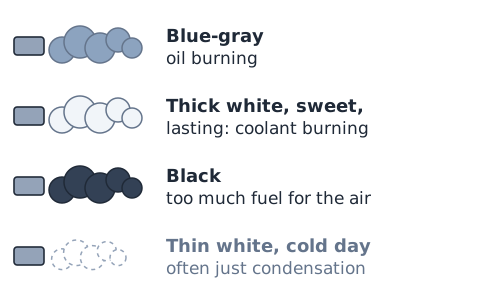
Blue-gray smoke suggests oil is burning in the cylinders. Thick white smoke that persists and smells sweet can mean coolant is entering combustion; thin white vapor on a cold morning is often just condensation. Black smoke suggests too much fuel for the available air. Color guides the search but does not name the part.
A/C or defrost condensation versus coolant leak
On a humid day the A/C pulls moisture from cabin air and drains clear, odorless water under the vehicle, usually near the passenger side of the firewall. That is normal. Coolant is colored, slightly slick and may smell sweet, and its reservoir level drops.
Brake pedal goes soft
A pedal that feels spongy or sinks toward the floor can mean air in the lines, a fluid leak or a hydraulic fault. Braking power may be badly reduced. Stop safely, do not keep driving to test it, and arrange qualified service or a tow.
Brake pedal vibration and ABS
During a hard stop on a slippery surface, the anti-lock brake system pulses pressure to keep wheels from locking, and the pedal buzzes or pulses. That is normal ABS action. A pulsing pedal during ordinary gentle stops is different and often points to uneven rotors.
Vehicle pulls while braking
If the vehicle pulls only when braking, one side is likely braking harder than the other. Possible causes include a sticking caliper, contaminated pads, a hose problem, or worn suspension parts. Uneven tire pressure can add to it. Inspect brakes first, with tires and suspension in view.
ABS warning versus base brake warning
An amber ABS lamp means the anti-lock function may be disabled, though normal braking usually remains. A red brake lamp can mean the parking brake is on, fluid is low, or the hydraulic system has a fault. If the red lamp stays on with the parking brake released, stop safely and have the brakes checked.
Brake grinding and wear clues
Many pads include a small metal tab that squeals when the pad is nearly worn out. A harsh grinding noise often means metal is rubbing on the rotor. Grinding needs prompt inspection, since braking power and the rotor are both at risk.
Steering effort changes
Steering that suddenly turns heavy may mean a lost power-assist belt, low hydraulic fluid, or an electric assist fault. Loose or wandering steering may mean worn joints. Either change affects control, so slow down, stop safely and have it checked rather than driving on.
Steering-wheel vibration by speed
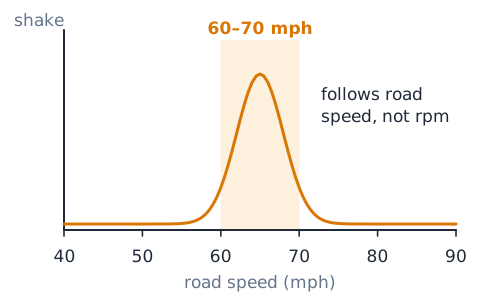
A shake that appears in a narrow speed band, such as 60 to 70 mph, and fades above or below it usually points to wheel or tire imbalance or an out-of-round tire. Because it follows road speed, not engine rpm, it is unlikely to be a misfire.
Pulling, alignment and tire pressure
A drift during steady cruising has several possible causes. Check simple items first: tire pressure on both sides, uneven tire wear, the slope of the road crown and a dragging brake. Only after those are ruled out should alignment be blamed.
Tire-pressure warning interpretation
The tire-pressure monitoring system (TPMS) lamp means one or more tires may be significantly underinflated. Check all tires with a gauge when cold and set them to the vehicle placard on the door jamb, not the sidewall maximum. TPMS warns but does not replace monthly gauge checks.
Tread, bulges and structural safety
A bulge in the sidewall, a deep cut or visible cords means the tire's structure is damaged and may fail suddenly. Do not drive on it or add pressure; take it out of service and use a spare or get help. Worn tread also reduces wet grip.
Hydroplaning and tread grip
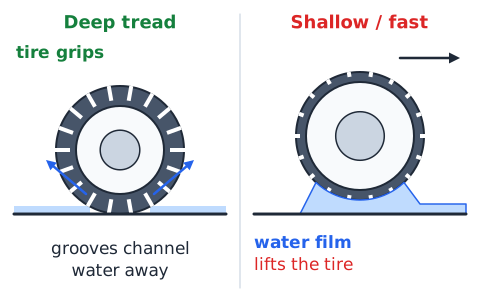
Tread grooves channel water away from the contact patch. When tread is shallow or speed is high, a film of water can lift the tire so it loses contact with the road. Slow down in heavy rain, avoid sudden steering and keep tires properly inflated.
Driveability under acceleration
Hesitation, stumbling or surging when you press the accelerator often involves fuel delivery, ignition or air metering, such as a weak pump, worn plugs or a dirty airflow sensor. If wheels and tires look normal, review codes and engine data before replacing anything.
Engine speed rises but vehicle barely accelerates
If the tachometer climbs but road speed barely rises, power is not reaching the wheels. On a manual this suggests clutch slip; on an automatic, transmission slip. Rule out other factors such as towing load before concluding.
Misfire versus vibration from the road
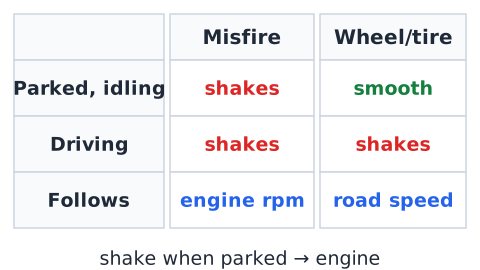
A misfire shakes the vehicle in step with engine rpm and can be felt even while parked. A wheel or tire problem varies with road speed and disappears when stopped. A rough idle at a standstill points to the engine, not the wheels.
Temperature-dependent problems
Some faults appear only cold, such as hard starting or rough idle until warm, while others appear only after heat soak. Note the outside temperature, how long the engine has run and the gauge reading. Heat and cold change resistance, clearances and fuel needs, so the timing is valuable evidence.
Intermittent faults and evidence preservation
A fault that comes and goes is hard to find after it disappears. Write down when it happens, save freeze-frame data, take photos or video, and avoid clearing codes or disconnecting the battery first. Preserved evidence lets a technician reproduce the problem.
Battery voltage is not a battery health certificate
A reading of 12.6 V shows the battery is charged, not that it can deliver high current. An aging battery may show good resting voltage yet fall sharply under starting load. A proper load or conductance test judges its real condition.
Simple reasoning: electrical source and load
Current drawn by a load equals its power divided by system voltage:
A 60 W lamp on a 12 V system draws
Diagnostic power comparison
Power equals voltage times current,
in watts.
A blower drawing 15 A at 12 V uses 180 W; a rear defroster drawing 20 A at 12 V uses 240 W. The defroster places the larger load on the charging system.
Distance, time and safe interpretation
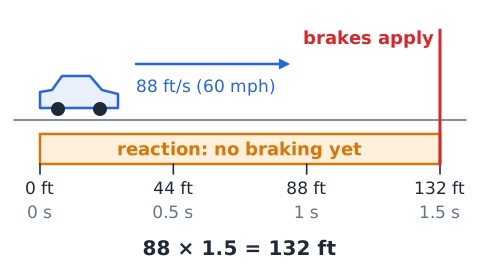
Distance traveled at steady speed:
At 60 mph (88 ft/s), a 1.5 s reaction delay covers
before the brakes even apply.
Road-speed-to-distance conversion
To change mph to feet per second, multiply by 5280 and divide by 3600:
In 3 s at that speed the vehicle travels
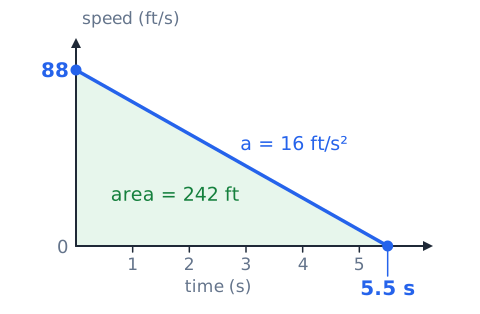
Simple deceleration illustration
Average deceleration is speed change divided by time:
A car slows from 88 ft/s to 0 in 5.5 s, so
Its stopping distance is
Speed comparison under constant deceleration
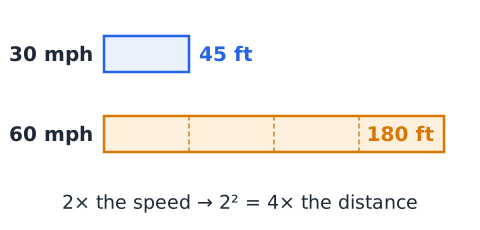
With the same deceleration, braking distance grows with the square of speed:
Doubling speed from 30 to 60 mph multiplies braking distance by
If a car needs 45 ft at 30 mph, it needs about 180 ft at 60 mph.
Wheel rotation and speed clues
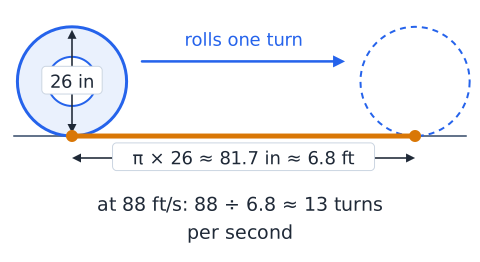
A tire 26 in tall has circumference
about 6.8 ft. At 60 mph (88 ft/s) it turns about
times per second. A vibration repeating at that rate points to a wheel or tire.
Diagnostic branching beats symptoms alone
Scenario: a pickup will not start. Symptom alone suggests many causes. Branch one asks whether the engine turns. It does, at normal speed, so the starting circuit is working. Branch two asks about fuel, spark and air. Each question cuts the list roughly in half.
Case: dashboard dims dramatically on crank
A driver turns the key; the dash lights fade almost to dark and the starter clicks. Analysis: voltage collapses under load, pointing to low charge, a weak battery or a poor cable connection. Test and clean those before suspecting the starter.
Case: low voltage while running and a battery icon
A sedan shows 12.1 V at the battery with the engine running, and the battery lamp is lit. Analysis: running voltage should be well above resting voltage, so the alternator is not charging properly. Next, inspect the belt, wiring and connections, then test the charging system.
Case: temperature rises in slow traffic
The gauge climbs in stop-and-go traffic but drops back at highway speed. Analysis: moving air cools the radiator at speed, so the fault appears when airflow depends on the fan. Check fan operation, coolant level and radiator fins.
Case: vibration begins only when braking
A minivan is smooth while cruising, but the steering wheel and pedal shake whenever the driver brakes normally from highway speed. Analysis: the timing ties the shake to braking, so uneven rotors or a caliper problem are leading suspects. Keep wheel bearings and tire condition in view, since they can add to the shake.
Case: apparent oil leak near the front
A dark wet area appears near the front of an engine. Analysis: oil, power steering fluid and transmission cooler lines can all leak there, and fluid can blow backward while driving. Clean the area, check each level, and trace the highest wet point before naming the leak.
Case: steering pull and low tire pressure
A hatchback drifts left, and the TPMS lamp is on. A gauge shows the left front tire at 22 psi while the placard calls for 35 psi. Analysis: set pressure first, then road test. If the pull disappears, alignment was never the problem.
Case: check-engine code for a sensor circuit
A scan shows a low-voltage code for a coolant temperature sensor circuit. Analysis: the computer saw an abnormal signal. Inspect the connector and wiring and check live data before deciding the sensor itself has failed.
Case: a dashboard light was reset
An owner erased codes so the check-engine lamp went out. Analysis: clearing removed freeze-frame data and reset readiness monitors, but the root cause may remain, and the lamp may return after more driving.
When to refer to a qualified technician
Refer the vehicle when the problem involves brakes, steering, airbags, fuel leaks, high-pressure systems, or tests needing special tools or lifts. Also refer when your simple checks are complete but the cause is still unknown. Knowing the limit of safe home checks is part of good diagnosis.
Hybrid and EV scope boundary
Hybrid and electric vehicles carry high-voltage batteries and cables, usually marked with orange insulation, that can deliver a lethal shock. This lesson covers conventional 12 V systems only. Do not touch orange cables or high-voltage parts; leave them to trained technicians using the manufacturer's procedures.
Practice decision rule: least intrusive first
Start with the checks that are quick, cheap and cannot cause new damage: look, listen, read the gauges and lamps, check fluid levels, measure tire pressure and battery voltage, and scan for codes. Disassembly and parts replacement come later. This order protects both the vehicle and the evidence.
Recall information is separate evidence
Manufacturers sometimes issue safety recalls for known defects. Checking recall status with the vehicle identification number (VIN) is useful, but a recall does not prove it caused your symptom. Treat it as one more clue.
Exam method: recognize system functions
Question: Which part recharges the battery while the engine runs? Answer: the alternator.
Question: What does ABS prevent? Answer: wheel lockup during hard braking.
Question: A red oil lamp signals what? Answer: low oil pressure, a lubrication emergency.
Question: What does TPMS warn about? Answer: underinflated tires.
Exam method: isolate the strongest next check
Question: Engine cranks normally but will not start. Next area? Answer: fuel, ignition and engine-control inputs.
Question: Starter clicks once, lights bright. Next step? Answer: test starting-circuit power, control and connections.
Question: Pull while cruising? Answer: tire pressure first.
Summary and self-check
Make the scene safe, describe the symptom precisely, and match it to the system that does that job. No-crank points to the starting circuit; crank-no-start points to fuel, spark, air or control. Lamps and codes flag areas to investigate, not failed parts. Self-check: can you explain why bright headlights do not prove a good battery, and why clearing codes is not a repair?
 English ▾