 ASVAB Camp
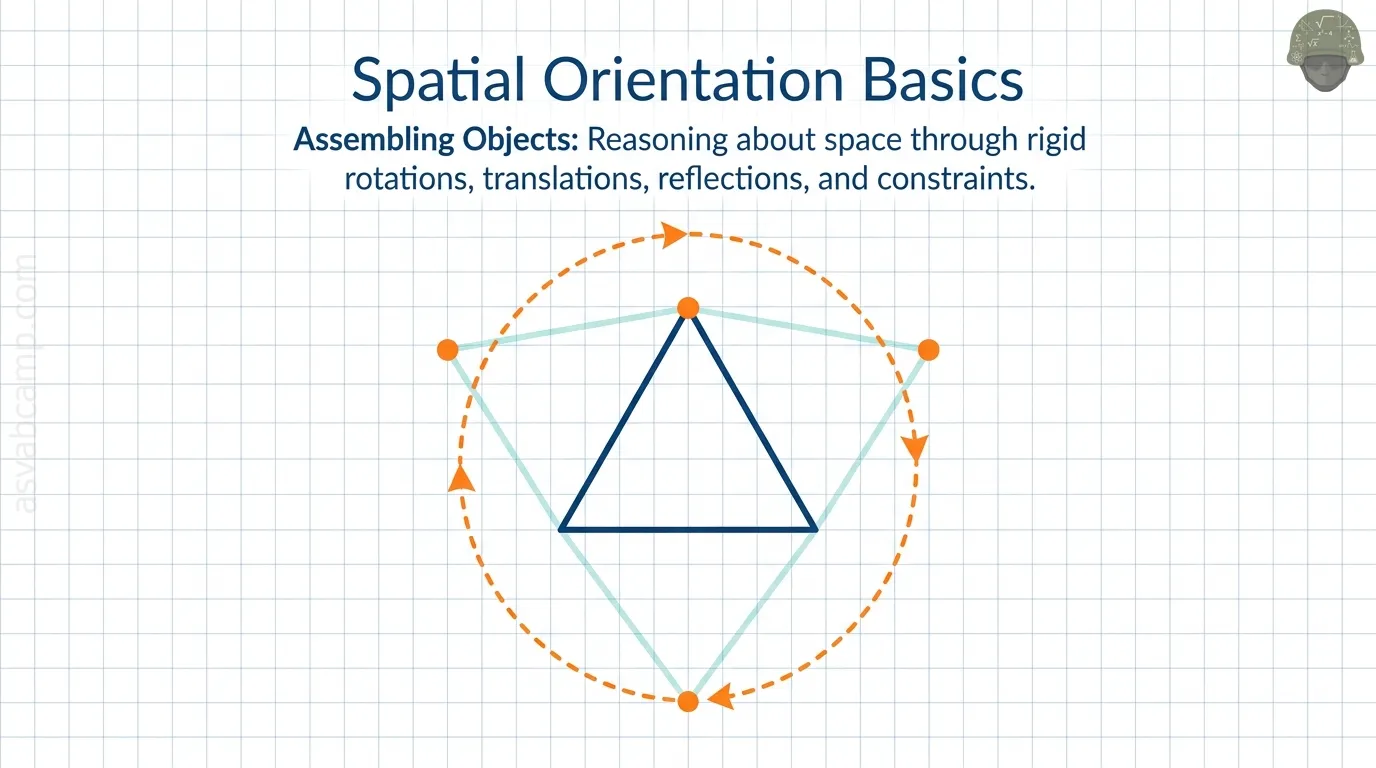
Mission: reason about space, not vocabulary
This lesson trains you to follow a flat shape as it moves on the page without losing track of which side is which. The point is reasoning, not memorizing terms. By the end you should be able to say exactly where a marked corner lands after a quarter-turn, a slide, or a flip.
To make each move checkable, we will label grid cells as , meaning row r and column c. A move then becomes a short rule you can test instead of a hunch.
What success looks like
You are on track when you can do five things reliably. Name the direction of a turn, clockwise or counterclockwise. Predict where a landmark ends up after a turn of , , or . Tell a mirror image apart from a rotated copy, even when the two look alike at a glance. Confirm that joined pieces meet at the right edges and marked points. Finally, reject any answer choice that adds, removes, stretches, or reshapes material. Each skill is used in the worked examples later in the lesson.
Why spatial skills matter for AO
The Assembling Objects subtest shows you separate parts and asks which choice shows them correctly put together. Some items give loose shapes that must fit into one outline. Others give parts with labeled points that a line must join. Either way, every wrong choice is built to look almost right: a piece is flipped, a point is moved, or a part has the wrong size. Clear spatial habits let you spot that one flaw quickly instead of staring at the whole picture.
Foundation versus later AO lessons
This lesson covers the building blocks: directions, the three basic motions (turn, slide, flip), grid notation, and the simplest joining rules. It deals mostly with one piece at a time or two pieces meeting along a single edge.
Later lessons apply these tools to full AO items, where three to five pieces must fill an outline, or where connection lines join labeled points on two shapes. Those lessons also work on speed. If a later item feels confusing, the cause is usually a gap in one of the basics taught here.
The fixed page frame
The page has directions that never change. Up is toward the top of the screen or sheet, down is toward the bottom, and left and right stay put no matter how a shape moves. Call this the page frame.
When you describe a move, describe it in the page frame first. For example, say the dot started at the upper left of the page and ended at the upper right. That sentence stays true even after you mentally turn the shape several times.
What the figure frame means
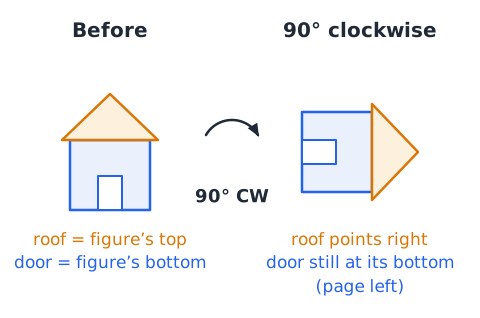
A shape also carries its own directions, which travel with it. If a house-shaped piece has a pointed roof, the roof is the figure's top, even when the piece is lying on its side. Call this the figure frame.
After a clockwise turn, the figure's top points toward the page's right. Most mistakes come from mixing the two frames, so always state which one you mean: the roof points right on the page, and the door is still at the figure's bottom.
Absolute and relative directions
An absolute direction is fixed by an outside reference, such as the page edges or the compass. A relative direction depends on which way something is facing. Left and right are relative: a soldier facing south has west on the right-hand side and east on the left.
In spatial items, treat page directions as absolute and a piece's own front, back, left, and right as relative. To convert, ask which way the piece faces now, then read off its sides.
Cardinal compass points
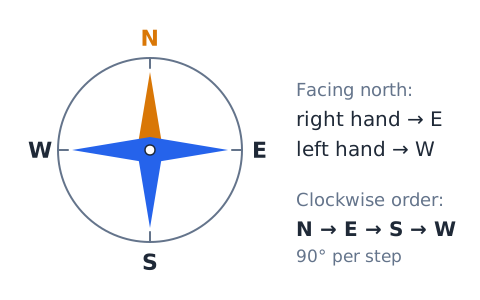
The figure shows a standard compass with north at the top, east at the right, south at the bottom, and west at the left. Facing north, your right hand points east and your left hand points west.
Going around clockwise, the order is north, east, south, west, and each step is a turn. This lets you work out relative directions quickly: facing east, your right is south; facing south, your right is west; facing west, your right is north.
Clockwise means the clock-hand direction
Clockwise is the way the hands of a wall clock sweep: from the top toward the right, then down to the bottom, then across to the left, and back to the top.
So an arrow pointing up, turned clockwise, now points right. Turned another clockwise, it points down. Some math books record clockwise turns as negative angles, so a quarter-turn clockwise may be written . On AO items you only need the direction and the size of the turn.
Counterclockwise is the opposite turn
Counterclockwise is the reverse sweep: from the top toward the left, then down to the bottom, then over to the right. An arrow pointing up, turned a quarter-turn counterclockwise, now points left.
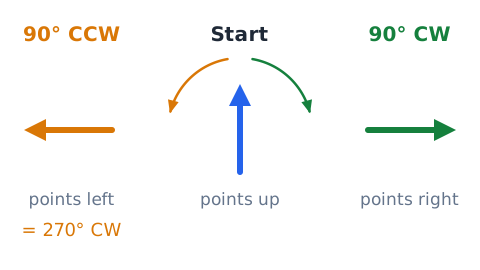
Because a full circle is , any counterclockwise turn equals a clockwise turn of the leftover amount:
Use whichever version is easier to picture.
Half-turns and full turns
A half-turn is . It gives the same result whether you go clockwise or counterclockwise, so the direction does not matter. Top swaps with bottom and left swaps with right at the same time.
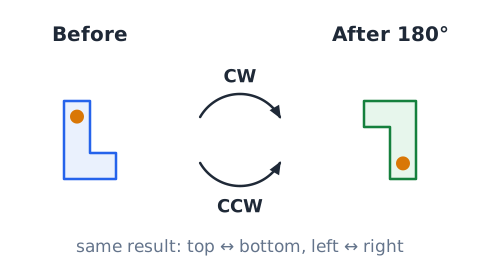
A full turn is and puts the shape back exactly where it began. Any larger turn can be cut down by subtracting full circles. For example, a clockwise turn of acts like a clockwise turn because
Rotation around a center
A rotation spins every point of a shape by the same angle about one fixed point, the center. The center itself does not move, and every other point keeps its distance from the center.
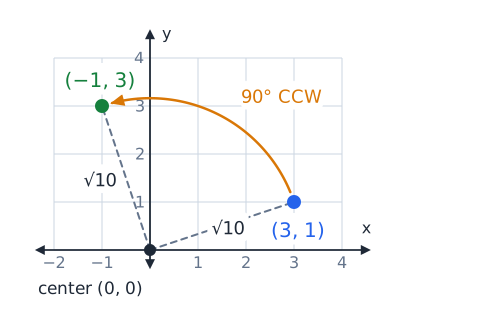
With the center at the origin, a quarter-turn counterclockwise follows the rule
So the point moves to . Both points are units from the origin, which confirms the distance was kept.
Translation: sliding without turning
A translation slides every point of a shape the same distance in the same direction. Nothing turns and nothing flips, so an arrow that pointed up still points up afterward. Only the location changes.
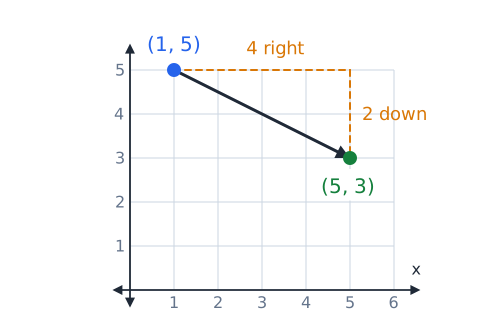
In coordinates, a slide of a units sideways and b units up or down is
Sliding 4 units right and 2 units down sends to . Every other point of the shape shifts by exactly the same amounts.
Reflection: flipping a figure
A reflection flips a shape over a line, called the mirror line. Each point lands the same distance from the line but on the opposite side, like an image in a mirror.
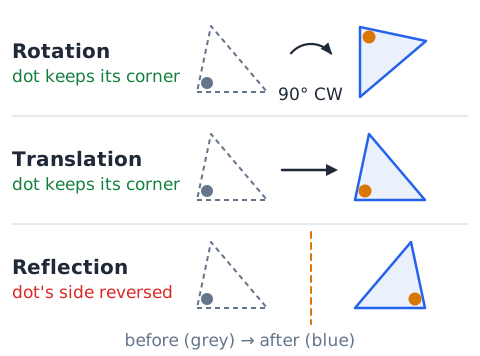
The figure shows the triangle with an orange feature in three rows, each comparing the original with its rotated, slid or reflected copy. In the rotation and translation rows, the orange feature keeps the same position relative to the rest of the triangle. Only in the mirror row does it switch sides. Flipping over the vertical axis follows the rule
Horizontal versus vertical mirror lines
A vertical mirror line swaps left and right but keeps top and bottom where they were:
A horizontal mirror line swaps top and bottom but keeps left and right:
Here is a useful fact. Flipping over one line and then over the other gives , which is a half-turn. Two flips across perpendicular lines cancel each other's mirror effect, so the result is a true rotation, not a mirror image.
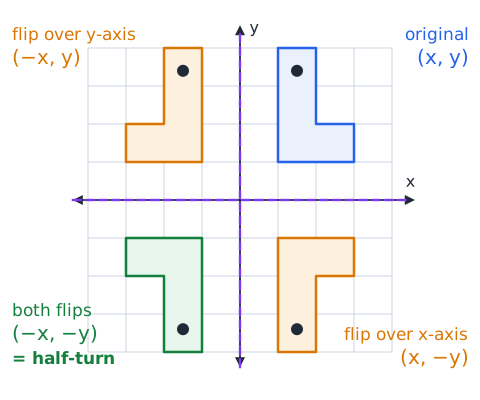
A transformation checklist
When you compare an answer choice with the original, run through four questions in order. First, are the size and shape unchanged? If not, reject the choice. Second, does the shape face the same way as before? If so, it was only slid, a translation. Third, if it faces a new way, do the landmarks keep their clockwise order? If they do, it was turned. Fourth, if the clockwise order is reversed, it was flipped. The checklist turns a fuzzy impression into a yes-or-no decision.
Reading a simple grid
On a square grid, number the rows from the top down and the columns from left to right. The cell in row r and column c is written .
On a 3 by 3 grid, the center cell is . The four corners are at top left, at top right, at bottom left, and at bottom right. If a shaded tile sits at , it is in the top row and the last column, which is the top-right corner.
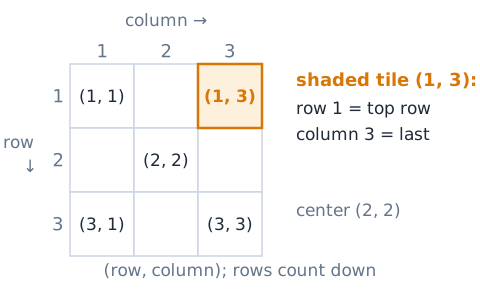
Grid coordinates are a notation, not a trick
Labels like are just a precise way to say where something is. They do not change the picture. What matters is agreeing on the convention.
Be careful when switching systems. With rows, the number grows as you move down the page. With ordinary graph coordinates, y grows as you move up. Both are fine, but mixing them in one problem causes errors. Before using any rule in this lesson, check which convention it uses.
How a tile position turns on a square grid
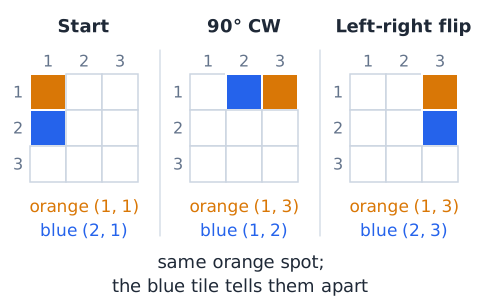
The figure shows a blue L-like pattern and the same pattern turned clockwise. The orange dotted tile starts in the top-left cell and ends in the top-right cell. On an n by n grid, a clockwise quarter-turn sends
With n = 3, goes to , matching the figure.
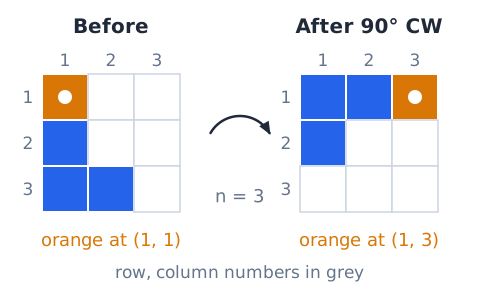
Counterclockwise grid mapping
A counterclockwise quarter-turn on an n by n grid follows a different rule:
On a 3 by 3 grid, the top-left cell moves to , the bottom-left corner. The top-right cell moves to , the top-left corner. As a check, apply the clockwise rule and then this one to any cell. You should get the starting cell back, because the two turns undo each other.
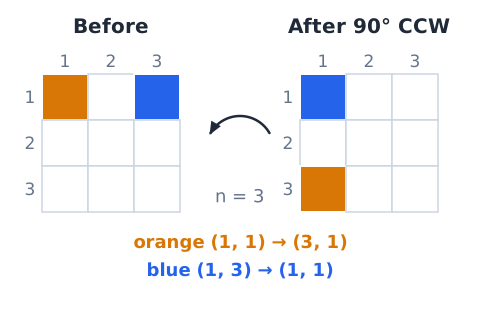
Half-turn mapping
A half-turn on an n by n grid flips both the row and the column:
On a 4 by 4 grid, the cell moves to . On a grid with an odd number of rows, the exact center cell maps to itself. On a 3 by 3 grid, for example, stays at .
Vertical and horizontal grid reflections
A left-right flip, using a vertical mirror line, keeps the row and reverses the column:
A top-bottom flip, using a horizontal mirror line, reverses the row:
Note that on a 3 by 3 grid, a left-right flip also sends to , the same as a clockwise turn. One tile cannot tell a flip from a turn. You need a second landmark.
What rigid motion preserves
Rotations, translations, and reflections are called rigid motions because they move a shape without bending it. All three keep side lengths, angle sizes, area, the number of parts, and the number and size of any holes or notches. Only the position, the facing direction, or both can change.
Rotations and translations also keep handedness, which is the clockwise order of landmarks. Reflections reverse it. That one difference is your main tool for catching a mirrored answer.
Handedness: clockwise order stays or reverses
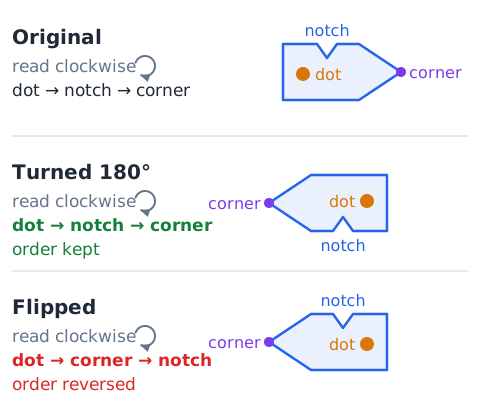
Label three distinct landmarks on a shape, such as a dot, a notch, and a sharp corner, and read them in clockwise order: dot, notch, corner.
After any rotation or slide, reading clockwise still gives dot, notch, corner, possibly starting at a different one. After a reflection, reading clockwise gives dot, corner, notch, the reversed order. Checking this order works even when the piece has been turned to an odd angle.
Symmetry can hide a turn
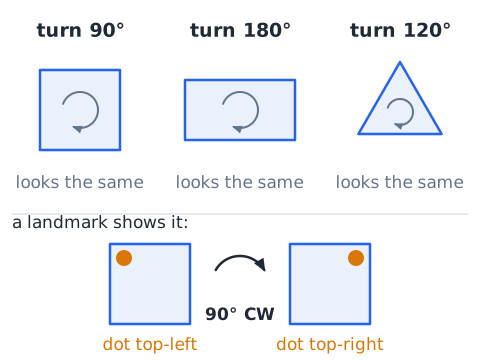
Some shapes look the same after certain turns. A plain square looks identical after a quarter-turn. A plain rectangle looks identical after a half-turn, and an equilateral triangle looks the same after a turn of .
For such shapes, the outline alone cannot tell you how far the piece turned. Look for a landmark that breaks the symmetry, such as a dot, a stripe, or a notch near one corner. If no landmark exists, any of those matching orientations is an acceptable answer.
A point, line, and corner as anchors
An anchor is a feature you can find again after a move. A point anchor is a dot or a labeled spot. A line anchor is a marked or unusually long edge. A corner anchor is a corner that stands out, such as the only sharp angle on a piece.
One anchor tells you where part of the shape went. Two anchors also tell you how far it turned and whether it was flipped. Pick two anchors that are far apart for the clearest check.
Telling an edge from a corner
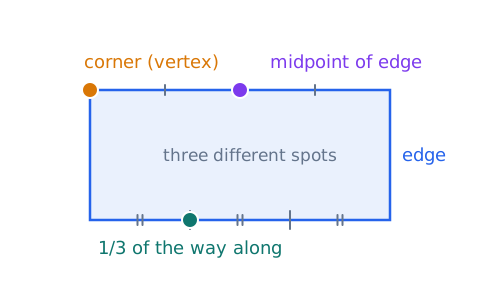
An edge is a straight side running between two corners. A corner, also called a vertex, is the spot where two edges meet.
The difference matters in joining items. A connection point drawn at the middle of an edge is not the same as one drawn at a corner, and a point one-third of the way along an edge is not the same as one at the midpoint. When checking a choice, confirm the point sits on the correct edge and at the correct spot along it.
The exterior boundary
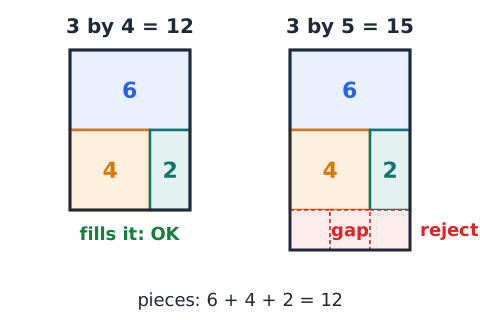
The exterior boundary is the outline of the finished figure. In shape-fitting items, the pieces must fill that outline completely, with no gaps and no overlaps.
This gives a fast area check. Suppose the pieces have areas of 6, 4, and 2 square units. Their total is 12 square units, so they can fill a 3 by 4 rectangle, whose area is also 12. They cannot fill a 3 by 5 rectangle of area 15. If the totals differ, the choice is wrong no matter how good it looks.
The interior seam
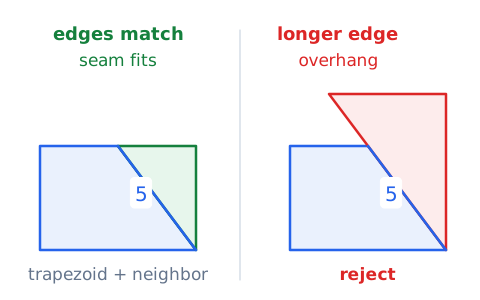
An interior seam is a line inside the finished figure where two pieces touch. Along a seam, the two edges must be the same length and must fit along their whole length.
For example, if a trapezoid has a slanted side 5 units long, the piece placed against that side needs a matching 5-unit edge with the same slant. A seam where one edge is longer than the other would leave a gap or an overhang. Checking seam lengths is a quick way to spot a piece in the wrong spot.
Connection points are constraints
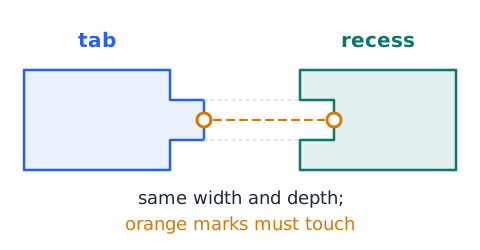
The figure shows two rigid parts, one blue and one teal. One part has a rectangular tab, and the other has a recess of exactly the same size. Marked points show where the two are meant to join.
Each marked point is a rule the finished figure must obey. The tab can only enter the recess if their widths and depths match, and the marked points must end up touching. A choice where the tab sits beside the recess, or where the marks do not meet, breaks the rule.
Orientation around a connector
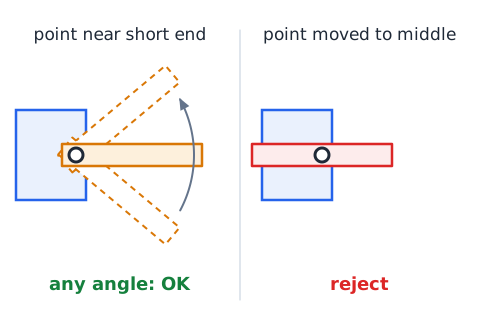
If two parts are joined at a single point, that point fixes where they meet but not the angle between them. The free part could swing around the point like a door on a hinge.
So a choice may show a part at a different angle from the starting picture and still be correct. What must stay fixed is where the connection point sits on each part. If the point was near the short end of a bar, it must still be near that short end, not the middle.
No stretching, shaving, or new holes
Every piece is rigid. It cannot be lengthened, squeezed, trimmed, or given a new hole. A rectangle twice as long as it is wide must still be twice as long as it is wide in every choice. If a choice shows it three times as long, that is a different piece.
Check proportions, the number of sides, and every cutout. A choice that adds a notch, fills one in, or rounds a sharp corner should be rejected right away.
Common distractor: swapped corners
A favorite trap moves a mark to the wrong corner while everything else looks fine. Track the mark with a rule. On a square tile, a quarter-turn clockwise sends the top-left corner to the top-right.
If the choice shows the mark at the bottom-left instead, the piece was turned counterclockwise or flipped, not turned clockwise as the other features suggest. One misplaced corner is enough to reject the choice.
Common distractor: reflection disguised as rotation
This distractor shows the piece turned to a new angle and also flipped. Because it faces a new way, it looks like an honest rotation.
To expose it, use handedness. Pick three landmarks and read their clockwise order on the original, then on the choice. If the order is the same, the choice may be a rotation. If the order is reversed, the piece was mirrored, and no amount of turning in the plane can produce it.
Common distractor: translation for a turn
Sometimes the correct answer requires a piece to turn so its edge can meet a neighbor. A distractor shows the piece slid into place but still facing its original way. The outline may even close, but the landmarks sit on the wrong sides.
The reverse also happens: a piece that only needs to slide appears turned. Always check whether the landmarks face the direction the fit requires, not just whether the piece is in the right place.
Common distractor: extra or missing material
Some choices change the amount of material. A piece might be missing, an extra small triangle might appear, or a notch might be filled in.
Count before you compare. Count the pieces in the problem and in the choice. Count notches, holes, and tabs. If the pieces have known areas, add them and compare with the area of the finished outline. Any mismatch in a count or in area rules out the choice, even if its outline looks neat.
Common distractor: correct pieces, wrong relative order
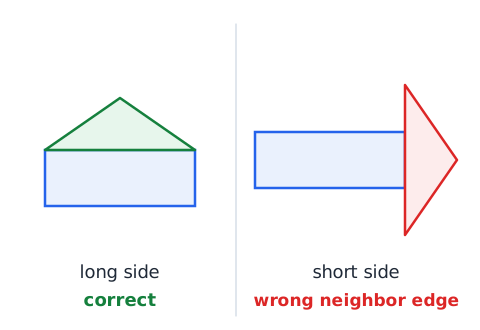
A tricky choice can use every piece at the right size and orientation, yet place them in the wrong arrangement. For example, a triangle that should touch the long side of a rectangle might be shown against the short side instead.
To catch this, check neighbors. For each piece, note which other piece it must touch and along which edge, using matching edge lengths as a guide. If a piece has the wrong neighbor or touches along the wrong edge, reject the choice.
Worked example: facing direction
Problem: You face west. You turn clockwise twice, then counterclockwise once. Which way do you face, and where does your right hand point?
Step 1: Net turn is two clockwise quarter-turns minus one, so one quarter-turn clockwise.
Step 2: Clockwise from west is north.
Answer: You face north, and your right hand points east.
Worked example: arrow with a top notch
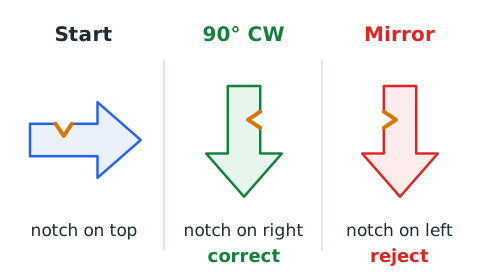
Problem: An arrow points to the right and has a small notch on its top edge. It is turned clockwise. Describe the result.
Step 1: A clockwise quarter-turn sends right to down, so the arrow now points down.
Step 2: The top edge moves to the right side, so the notch is now on the right.
Answer: The arrow points down with the notch on its right side. A choice showing the notch on the left is a mirror image and should be rejected.
Worked example: turning a marked corner
Problem: A square tile has a dot in its bottom-left corner. The tile is turned counterclockwise about its center. Where is the dot?
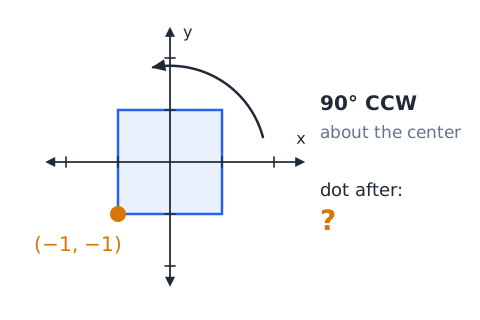
Step 1: Center the tile at the origin, so the dot is at .
Step 2: Apply
to get .
Answer: Positive x and negative y place the dot in the bottom-right corner.
Worked example: grid quarter-turn
Problem: On a 4 by 4 grid, a tile sits at . The grid turns clockwise. Where is the tile?
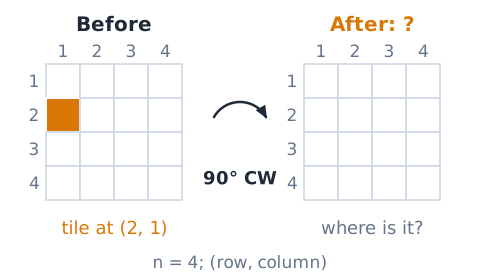
Step 1: Use
with n = 4.
Step 2: The new row is 1, and the new column is
Answer: , the top row, third column. The left edge has become the top edge.
Worked example: distinguishing a mirror
Problem: A flag has a vertical pole with a triangular flag at the top, pointing right. A choice shows the pole upright with the flag at the top, pointing left. Is it a rotation?
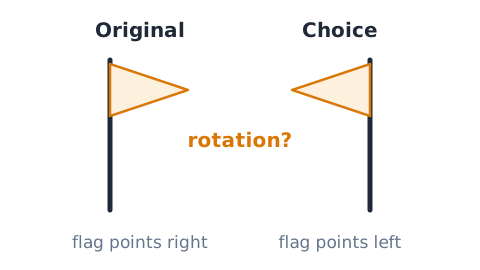
Step 1: The only turns that keep the pole vertical are and . A half-turn puts the flag at the bottom, so neither works.
Step 2: The flag switched sides while staying at the top, which is a left-right flip.
Answer: No. It is a reflection, so reject it.
Worked example: simple edge assembly
Problem: You have a 6 by 2 rectangle and a right triangle with legs of 6 and 3 units. They must join along matching edges. Which edges meet, and what is the total area?
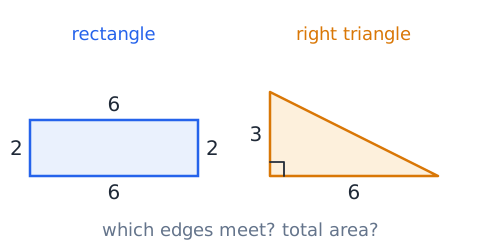
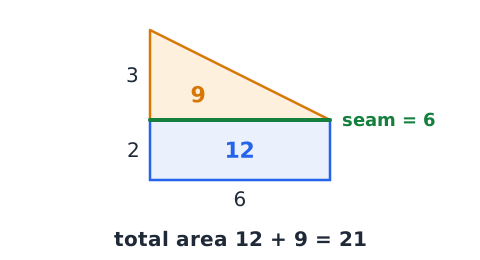
Step 1: The rectangle's edges are 6 and 2. The triangle's legs are 6 and 3. The only matching length is 6.
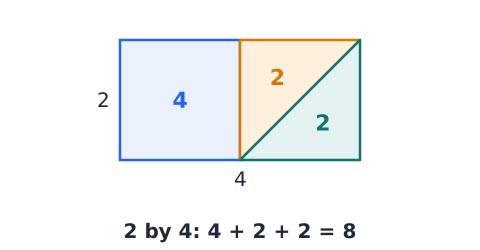
Step 2: Areas:
Answer: The 6-unit edges meet, and the total area is 21 square units.
Worked example: two-step move
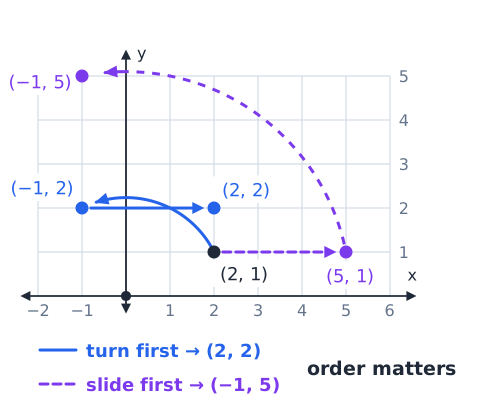
Problem: Turn the point a quarter-turn counterclockwise about the origin, then slide it 3 units right. Does the order matter?
Step 1: Turn first:
Then slide: .
Step 2: Slide first:
Then turn: .
Answer: Turning first gives , sliding first gives . The order matters, so follow the stated order.
Worked example: shape count
Problem: The pieces are one 2 by 2 square and two right triangles, each with legs of 2 and 2 units. Which finished outline is possible: a 2 by 4 rectangle, a 3 by 3 square, or a 2 by 5 rectangle?
Step 1: Total area is
square units.
Step 2: The 3 by 3 square has area 9, so reject it. The 2 by 5 rectangle has area 10, so reject that too.
Answer: The 2 by 4 rectangle, area 8. The two triangles join into a second 2 by 2 square.
Worked example: clockwise order
Problem: A triangle has red, blue, and green corners, reading clockwise in that order. Choice A reads blue, green, red clockwise. Choice B reads red, green, blue clockwise. Which could be a rotation?
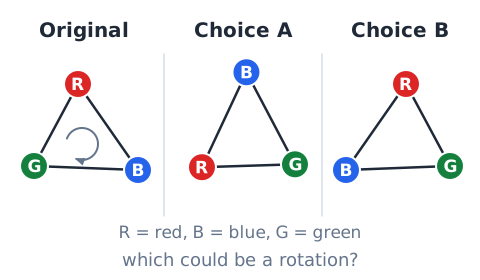
Step 1: Starting at a different color does not change a cycle, so blue, green, red is the same cycle as red, blue, green.
Step 2: Red, green, blue is the reversed cycle.
Answer: Choice A could be a rotation. Choice B is a mirror image.
A deliberate two-pass strategy
Use two quick passes instead of one long stare. In the first pass, look for errors you can see right away: the wrong number of pieces, a piece that is the wrong size, a missing notch, or an outline that cannot hold the total area. Cross those choices off.
In the second pass, compare only the choices that remain. Track two landmarks and check their clockwise order. The first pass is fast and often leaves just two choices, so the careful work in the second pass is short.
Use contrasting landmarks
Not every feature is a good landmark. A hole in the exact center of a square tells you nothing about rotation, because it stays in the center. A plain corner on a square looks like the other three.
Choose features that are unique and off-center: a notch near one end of an edge, the only sharp corner, a labeled point, or a colored stripe along one side. Two such landmarks far apart from each other give the clearest view of how the piece turned and whether it flipped.
Reduce complex motion into small turns
A long description of turns can always be reduced to one net turn. Count clockwise turns as positive and counterclockwise turns as negative, add them, and remove full circles of .
For example, clockwise, then clockwise, then counterclockwise gives
so the net move is a half-turn. Likewise, clockwise is easier to picture as counterclockwise.
Verify the image is a view, not a new object
A correct choice shows the same object, only moved. A wrong choice may look like a moved copy but actually be a different object with one feature changed.
Before you accept a choice, confirm that every feature of the original appears in it once, in a position consistent with a single turn, slide, or allowed join. In this course, treat a mirrored piece as a different object unless an item clearly states that flipping is allowed.
Time management without guesswork
Speed comes from method, not from rushing. Do not try to spin the whole picture in your head. Track one or two landmarks, apply a rule, and check the result. That usually takes a few seconds per choice.
If you are stuck, use the two-pass strategy to cut the choices down, then pick the best of what remains and move on. A choice made after solid elimination is an informed decision, not a guess, and it saves time for items you can solve fully.
Know the boundary of the formulas
The grid rules in this lesson assume a square n by n grid, rows numbered from the top, and turns about the grid's center in steps of . Outside those conditions they need adjustment.
For a grid with m rows and n columns, a clockwise quarter-turn produces a grid with n rows and m columns, and the rule becomes
The rules also do not cover turns such as or motion in three dimensions. In those cases, track landmarks by sight.
Practice: verbalize the move
Say each move out loud in page terms, then check the answer.
Prompt: A dot sits on the left edge of a tile, which is turned a quarter-turn clockwise. Answer: The dot is on the top edge.
Prompt: An arrow points down and is turned a half-turn. Answer: It points up.
Prompt: A notch on the right edge, flipped over a vertical mirror line. Answer: It is on the left edge.
Prompt: On a 4 by 4 grid, after a clockwise quarter-turn. Answer: .
Practice: compare two candidates
For each pair, find the one difference that decides the answer.
Prompt: The original reads star, circle, square clockwise. Choice A reads circle, square, star. Choice B reads circle, star, square. Answer: A keeps the cycle and B reverses it, so B is mirrored.
Prompt: The original has a 3-unit tab. Choice C shows a 3-unit tab, while choice D shows a 4-unit tab. Answer: D changed the size of the tab, so reject D.
Prompt: On a 4 by 4 grid, a tile at turns a quarter-turn counterclockwise. Answer: The tile moves to .
A final self-audit
Before you lock in an answer, take a few seconds for an audit. Does the choice have the same number of pieces, with the same sizes and cutouts? Does the total area match the outline? Do matching edges have equal lengths? Are the connection points at the right spots on each part? Do two landmarks keep their clockwise order? Is every move a single turn, slide, or allowed join? A yes to every question means the choice is very likely correct.
Lesson summary and next step
Keep the page frame fixed and let the figure frame travel with the shape. Clockwise follows a clock's hands, counterclockwise goes the other way, and a half-turn is the same in both directions. Rotations and slides keep the clockwise order of landmarks, while reflections reverse it. All rigid motions keep size, shape, and area.
On an n by n grid, a clockwise quarter-turn sends to . When joining parts, match edge lengths, connection points, and total area. Next, you will apply these tools to complete AO shape items.
 English ▾