ASVAB Camp Get the appGoogle Play
Full ASVAB

Full ASVAB Practice Form 9: Biology, Circuits and Friction

Form 9 leads with cells and basic biology and human body systems in General Science. Electronics items concentrate on Ohm's law and series and parallel circuits, Auto Information on transmission and drivetrain, and Mechanical Comprehension on forces, inclined planes, work and energy, and friction. The AFQT sections favor money problems, multi-step word problems, linear equations and supporting details.

  • 135 questions
  • 197 minutes
  • 10 subtests
  • Every answer explained
  1. Pick your answers. You can change them until you check.
  2. Check my answers scores the test by subtest and opens every explanation.
0 / 135 answered

General Science

15 questions · 12 min on the real test
Question 1 · GS · easy

Inside the nucleus of a eukaryotic cell, what is the dense region where parts of ribosomes are assembled?

Show the answer

Answer: D

Correct answer: Nucleolus. The nucleus is wrapped in the nuclear envelope and holds the cell's chromosomes. Within it sits the nucleolus, a dense region where ribosome parts are assembled before they leave through the nuclear pores.

  • A: The nuclear envelope is the double membrane surrounding the nucleus, not a region inside it.
  • B: A nucleoid is the region holding the DNA of a prokaryote, which has no nucleus at all.
  • C: A chromosome is a packaged DNA molecule carrying genes, not the site where ribosome parts are made.
  • D (correct): The nucleolus is the dense spot inside the nucleus where ribosome parts are put together.
Question 2 · GS · easy

A certain bacterium is 2 µm long. What is this length in meters?

Show the answer

Answer: D

Correct answer: 0.000002 m. Micro (µ) means one millionth, so 1 µm = 0.000001 m. Then 2 µm = 2 × 0.000001 m = 0.000002 m, which is the decimal point moved six places to the left.

  • A: This treats µ (micro, one millionth) as m (milli, one thousandth).
  • B: This multiplies by one million instead of dividing; micro makes a unit smaller, not larger.
  • C: This moves the decimal point only five places instead of six.
  • D (correct): Micro means one millionth, so 2 µm is 2 millionths of a meter, or 0.000002 m.
Question 3 · GS · easy

When a geologist rubs a mineral across an unglazed porcelain plate, what is being observed in this streak test?

Show the answer

Answer: C

Correct answer: The color of the mineral's powder. A streak test identifies a mineral by the color of its powder left on a porcelain plate. It is different from a scratch test for hardness, from luster, and from cleavage.

  • A: Resistance to scratching is hardness, which is tested on the Mohs scale, not by streak.
  • B: Light reflected from the surface is luster, a different property.
  • C (correct): A streak test shows the color the mineral leaves as a fine powder on the plate.
  • D: Breaking along flat surfaces is cleavage, not streak.
Question 4 · GS · easy

Which type of muscle tissue lines the walls of the stomach and blood vessels and works without conscious control?

Show the answer

Answer: D

Correct answer: Smooth muscle. Match location and control. Smooth muscle is involuntary and lines hollow organs such as the stomach, intestines, bladder and blood vessels, where it moves contents along or changes vessel width.

  • A: Skeletal muscle is attached to bones and is voluntary, so it does not form the walls of hollow organs.
  • B: Cardiac muscle is involuntary but is found only in the wall of the heart.
  • C: Nervous tissue carries signals; it does not contract to squeeze organ contents.
  • D (correct): Smooth muscle has no stripes, is involuntary and forms the walls of hollow organs and blood vessels.
Question 5 · GS · medium

Goats released on an island grew in number until the population leveled off near 650 animals for a decade. Which change would most likely lower the island's carrying capacity for goats?

Show the answer

Answer: A

Correct answer: Several years of drought that reduce plant growth. Carrying capacity is set by limiting resources such as food and water. A drought reduces plant growth, so the island can support fewer goats; the other changes either leave the limit unchanged or raise it.

  • A (correct): Less plant growth means less food, so the habitat can support fewer goats over the long term.
  • B: A burst of births changes the population size, not the number of goats the habitat can support.
  • C: Removing a competitor leaves more food for goats, which would raise carrying capacity, not lower it.
  • D: More shrubs mean more food, which would raise carrying capacity rather than lower it.
Question 6 · GS · medium

When chlorine gas is bubbled through a sodium bromide solution, this reaction occurs:

How is the reaction best classified?

Show the answer

Answer: D

Correct answer: Single displacement. Look at the shape of the equation: an element plus a compound gives a different element plus a different compound. Chlorine replaces bromine beside sodium, so this is single displacement.

  • A: Synthesis has several reactants joining into one product, but here two products form.
  • B: Decomposition starts from a single compound, but this reaction has two reactants.
  • C: Double displacement needs two compounds swapping partners; chlorine gas here is an element, not a compound.
  • D (correct): An element (chlorine) takes the place of another element (bromine) in a compound, which is the A + BC gives AC + B pattern.
Question 7 · GS · medium

A student notices that the tomato plants along a sunny fence ripen sooner than those beside a shady wall. Which statement is a hypothesis based on this observation?

Show the answer

Answer: C

Correct answer: More direct sunlight makes tomatoes ripen sooner. An observation records what happened, a hypothesis offers a testable explanation, and a prediction states a specific result that should follow if the hypothesis is right. Saying that more sunlight speeds ripening explains the pattern and can be tested, so it is the hypothesis.

  • A: This is an observation, a direct record of what happened.
  • B: This is another directly recorded observation, not a testable explanation.
  • C (correct): This proposes a testable explanation for what was seen, which is what a hypothesis is.
  • D: This is a prediction that would follow from a hypothesis, naming a specific checkable result.
Question 8 · GS · medium

A lab studies an infectious particle that consists of RNA inside a protein coat. It has no ribosomes and no cytoplasm, and it can copy itself only after entering a host cell. How should this particle be classified?

Show the answer

Answer: A

Correct answer: A virus, which is not a cell at all. Every true cell has a membrane, cytoplasm, DNA and ribosomes. This particle has no ribosomes or cytoplasm and must use a host cell's machinery to reproduce, so it is a virus, not a prokaryotic or eukaryotic cell.

  • A (correct): Genetic material in a protein coat with no ribosomes, cytoplasm or metabolism of its own is the description of a virus.
  • B: Prokaryotes are true cells with a membrane, cytoplasm and ribosomes; lacking a nucleus does not make something a prokaryote.
  • C: Bacteria have their own ribosomes and cytoplasm; this particle has neither, and antibiotics do not cure viral infections.
  • D: Every cell and virus carries genetic material; a eukaryote also needs a membrane-bound nucleus and organelles.
Question 9 · GS · medium

Over several evenings an observer watches the Moon's lit part grow from a thin sliver to a half-lit disk, called first quarter. If the pattern continues, which phase will the observer see next?

Show the answer

Answer: C

Correct answer: Waxing gibbous. The cycle runs new, waxing crescent, first quarter, waxing gibbous, full, waning gibbous, third quarter, waning crescent. Waxing means the visible lit portion is growing, so the phase right after first quarter is waxing gibbous.

  • A: A waning crescent comes late in the cycle, after third quarter, when the lit part is shrinking.
  • B: New moon begins the cycle; the lit part keeps growing after first quarter rather than vanishing.
  • C (correct): After first quarter the visible lit portion keeps increasing, so more than half but not all of the disk appears lit.
  • D: Third quarter is the half-lit phase that follows full moon, when the lit part is shrinking.
Question 10 · GS · medium

Cells in a human ovary start with 46 chromosomes and produce egg cells that each carry 23 chromosomes. Which process produces these egg cells?

Show the answer

Answer: C

Correct answer: Meiosis. Look for the clue that the chromosome number is cut in half, from 46 to 23. Halving the chromosome number to make egg or sperm cells is the job of meiosis, which takes place only in reproductive tissues.

  • A: Mitosis makes two identical daughter cells with the same chromosome number, used for growth and repair.
  • B: Binary fission is how prokaryotes such as bacteria split; human cells have a nucleus and do not divide this way.
  • C (correct): Meiosis occurs in reproductive tissue and produces cells with half the original chromosome number.
  • D: Cytokinesis only splits the cytoplasm at the end of division; it does not halve the chromosome number.
Question 11 · GS · medium

A wave makes 15 complete oscillations in 3 s. Its frequency is:

Show the answer

Answer: C

Correct answer: 5 Hz. Frequency counts how many complete cycles happen each second, so you divide the number of cycles by the elapsed time. Fifteen cycles in 3 s is 5 cycles per second, or 5 hertz. Dividing the other way,

3 ÷ 15 = 0.2 s

gives the period, the time for one cycle. Frequency and period are reciprocals, so if you get one you can always find the other.

  • A: The value 0.2 s would represent the period, not frequency in hertz.
  • B: Multiplying oscillations by seconds does not give frequency in cycles per second.
  • C (correct): Frequency = 15 cycles / 3 s = 5 Hz.
  • D: Three hertz mistakenly uses only the supplied time rather than cycles divided by time.
Question 12 · GS · hard

A 4 kg rifle, held loosely at rest, fires a 0.010 kg bullet forward at 400 m/s. Ignoring outside forces, what is the rifle's recoil velocity just after firing?

Show the answer

Answer: D

Correct answer: 1 m/s backward. Before firing, the total momentum is zero, so afterward the two momenta must cancel. The bullet carries 0.010 kg x 400

m/s = 4 kg

·m/s forward, so the rifle carries 4 kg·m/s backward: 4 / 4 kg = 1 m/s backward.

  • A: The size is right, but the rifle must move opposite to the bullet so the total momentum stays zero.
  • B: This gives the rifle the bullet's speed, ignoring that the rifle is 400 times more massive.
  • C: Conserving momentum means the total stays zero, not that each object stays still; the bullet's forward momentum must be balanced.
  • D (correct): The bullet's momentum is 0.010 x 400 = 4 kg·m/s forward, so the 4 kg rifle needs 4 kg·m/s backward, which is 1 m/s.
Question 13 · GS · hard

A small blood clot breaks loose from a vein deep in a person's calf and is carried along by normal blood flow. Where is it most likely to first become stuck in narrow vessels?

Show the answer

Answer: C

Correct answer: In the lungs, after passing through the right side of the heart. Trace the route: leg vein, inferior vena cava, right atrium, right ventricle, pulmonary artery, lungs. The pulmonary vessels branch into ever smaller vessels and capillaries, so the lungs are the first narrow vessels the clot meets.

  • A: Veins carry blood toward the heart, so the clot moves away from the calf, not back into its capillaries.
  • B: Blood from a leg vein reaches the right side of the heart and the lungs before it can return to the left side and the aorta.
  • C (correct): The clot travels up the vena cava to the right atrium and right ventricle, which pumps it into the pulmonary arteries that narrow inside the lungs.
  • D: Reaching the renal artery would require leaving the left ventricle through the aorta, which comes only after the lungs.
Question 14 · GS · hard

Huntington disease is autosomal dominant. A man who is heterozygous for it (Hh) and a woman who is hh have already had two children who inherited the condition. What is the chance that their next child inherits it?

Show the answer

Answer: A

Correct answer: 1/2. The cross is Hh × hh, so half the boxes are Hh and half are hh. Every fertilization is independent, so earlier children do not change the odds: each new child has a 1/2 chance of being Hh and affected.

  • A (correct): Each child independently receives either H or h from the father, so the chance stays 1/2 no matter how earlier children turned out.
  • B: This multiplies 1/2 for three births in a row, but the question asks only about the next child.
  • C: One-fourth is the chance of an affected child when two carriers of a recessive allele have children, not for this dominant cross.
  • D: Three-fourths is the dominant-phenotype share from Hh crossed with Hh; here the mother is hh.
Question 15 · GS · hard

A fictional element Rd has two natural isotopes, Rd-50 and Rd-52. Its average atomic mass is 51.5 u. Using the mass numbers as the isotope masses, what percentage of Rd atoms are Rd-52?

Show the answer

Answer: D

Correct answer: 75%. Let x be the fraction of Rd-52. Then

50(1 − x) + 52x = 51.5
so
50 + 2x = 51.5

and x = 0.75.

So 75 percent of the atoms are Rd-52. Check: 51.5 lies closer to 52, so the heavier isotope must be the more common one.

  • A: This is the share of Rd-50, the lighter isotope, not Rd-52.
  • B: Equal amounts would give an average of exactly 51 u, halfway between 50 and 52.
  • C: With 60 percent Rd-52 the average would be 0.4 × 50 + 0.6 × 52 = 51.2 u, not 51.5 u.
  • D (correct): Then 0.25 × 50 + 0.75 × 52 = 12.5 + 39 = 51.5 u, which matches the listed average.

Arithmetic Reasoning

15 questions · 55 min on the real test
Question 16 · AR · easy

A maintenance crew can strip the old paint from a ship's deck in 20 hours. How many hours will the crew need to strip 3/4 of the deck?

Show the answer

Answer: B

Correct answer: 15 hours. Time = work / rate. The rate is of the deck per hour, so

  • A: This is the time for the remaining 1/4 of the deck, not for 3/4 of it.
  • B (correct): At 1/20 of the deck per hour, 3/4 of the deck takes 3/4 divided by 1/20, or 15 hours.
  • C: This divides 20 by 3/4, which gives more time for less than the whole deck.
  • D: This divides 20 by 1/4, mixing up the part of the deck with the part left over.
Question 17 · AR · easy

An office printer prints 36 pages per minute. How many pages does it print in 12 minutes?

Show the answer

Answer: B

Correct answer: 432 pages. Pages per minute times minutes leaves pages:

pages.

  • A: This adds the rate and the time instead of multiplying them.
  • B (correct): A rate times time gives a total: 36 x 12 = 432 pages.
  • C: This divides 36 by 12, which would split a total, not build one from a rate.
  • D: This subtracts 12 from 36, which has no meaning in this story.
Question 18 · AR · easy

The daily high temperatures at a training camp for five days were 68, 74, 71, 77, and 70 degrees Fahrenheit. What was the mean high temperature?

Show the answer

Answer: D

Correct answer: 72 degrees. Add the values:

68 + 74 + 71 + 77 + 70 = 360

Divide by the number of days:

degrees
  • A: 71 is the middle value when the temperatures are put in order, which is the median, not the mean.
  • B: This divides the total of 360 by 4 instead of by the 5 days.
  • C: 72.5 is halfway between the lowest and highest readings, which ignores the three middle values.
  • D (correct): The five readings add to 360, and 360 divided by 5 is 72.
Question 19 · AR · easy

Which fraction is equivalent to ?

Show the answer

Answer: C

Correct answer: 12/28. An equivalent fraction comes from multiplying the numerator and denominator by the same number. Multiplying 3/7 by 4/4 gives 12/28.

  • A: The numerator was multiplied by 3 but the denominator only by 2, which changes the value.
  • B: Dividing 6/21 by 3 on top and bottom gives 2/7, not 3/7.
  • C (correct): Multiplying the top and bottom of 3/7 by 4 gives 12/28, so the value is unchanged.
  • D: The denominator was multiplied by 4 but the numerator by 5, so this equals more than 3/7.
Question 20 · AR · medium

A truck's odometer read 38,475 miles at the start of a deployment and 41,200 miles at the end. How many miles did the truck travel?

Show the answer

Answer: D

Correct answer: 2,725 miles. Count up from 38,475 to 41,200 in friendly steps: 25 to reach 38,500, 500 to reach 39,000, and 2,200 to reach 41,200.

Add the steps:

25 + 500 + 2,200 = 2,725

Check:

38,475 + 2,725 = 41,200
  • A: This forgets to borrow from the ten-thousands and thousands places, adding an extra 1,000.
  • B: This makes a borrowing slip across the zeros, adding an extra 100.
  • C: This miscounts the first step up to 38,500, which is 25, not 35.
  • D (correct): Count up: 38,475 to 38,500 is 25, to 39,000 is 500, and to 41,200 is 2,200; 25 + 500 + 2,200 = 2,725.
Question 21 · AR · medium

A craft store pays $32 for a set of paints and sells it for $44. What percent markup on cost does the store use?

Show the answer

Answer: D

Correct answer: 37.5%. Markup amount:

44 − 32 = $12

Markup percent is the markup divided by the cost:

12 ÷ 32 = 0.375 = 37.5%
  • A: This divides the $12 markup by the $44 selling price; markup percent is based on cost.
  • B: This is the dollar markup written as a percent, without dividing by the cost.
  • C: This is the selling price as a percent of cost (44 ÷ 32), not the markup added.
  • D (correct): The markup is 44 − 32 = $12, and 12 ÷ 32 = 0.375 = 37.5% of cost.
Question 22 · AR · medium

A mess-hall recipe for 6 servings of pancakes uses 2.25 cups of flour. The cook needs to make 20 servings. How many cups of flour are needed?

Show the answer

Answer: C

Correct answer: 7.5 cups. Flour per serving:

2.25 ÷ 6 = 0.375

cup.

For 20 servings:

20 × 0.375 = 7.5 cups

Check: 20 servings is a bit over 3 times 6, so a bit over 6.75 cups makes sense.

  • A: This triples the recipe to 18 servings instead of scaling to 20.
  • B: This is the flour for one serving, an intermediate value.
  • C (correct): Each serving uses 2.25 ÷ 6 = 0.375 cup, and 20 × 0.375 = 7.5 cups.
  • D: This adds the 14 extra servings to the cups of flour, mixing servings with cups.
Question 23 · AR · medium

A shop's annual budget for safety gear is $589. About 21 percent of it is spent on gloves. Which is the best estimate of the amount spent on gloves?

Show the answer

Answer: A

Correct answer: $120. Round to friendly numbers: 21 percent is about 20 percent, and $589 is about $600.

Ten percent of 600 is 60, so 20 percent is 120. The exact value,

is close to $120.

  • A (correct): Rounding to 20 percent of $600 gives $120, close to the exact amount of about $123.69.
  • B: This finds about 2 percent, moving the decimal point one place too many.
  • C: This is about 10 percent of $600, half the needed estimate.
  • D: This is about 50 percent of the budget, far more than 21 percent.
Question 24 · AR · medium

A highway patrol car traveling 70 mph is chasing a car that is 6 miles ahead and moving at 62 mph in the same direction. How far does the patrol car travel before it catches up?

Show the answer

Answer: C

Correct answer: 52.5 miles. The patrol car gains

70 − 62 = 8 miles

per hour, so it closes the 6-mile gap in

6 ÷ 8 = 0.75 hour

In that time it travels

70 × 0.75 = 52.5 miles
  • A: This is the distance the car ahead travels, 62 × 0.75, not the patrol car's distance.
  • B: This adds the 6-mile lead to the patrol car's distance a second time.
  • C (correct): The catch-up takes 0.75 hour, and 70 × 0.75 = 52.5 miles.
  • D: This adds the speeds to get 132 mph, which is the rule for vehicles approaching each other, not for a chase.
Question 25 · AR · medium

A part-time worker earns $19.80 per hour and works 4.95 hours on Saturday. How much does the worker earn that day?

Show the answer

Answer: A

Correct answer: $98.01. Estimate first:

so the pay is close to $100. Exactly,

and the factors have two decimal places each, four in all, giving 98.0100, or $98.01.

  • A (correct): 1980 times 495 is 980,100; with four decimal places in all, that is 98.0100, or $98.01.
  • B: This puts the decimal point one place too far left; an estimate of 20 times 5 = 100 shows the pay is near $100.
  • C: This puts the decimal point one place too far right; the estimate of about $100 rules it out.
  • D: This is 19.80 times 4.5, which misreads 4.95 hours as 4.5 hours.
Question 26 · AR · medium

A trainee must simplify 30 − 18 ÷ 3 + 2 × 4 by hand. Done correctly, what does the expression equal?

Show the answer

Answer: C

Correct answer: 32. Division and multiplication come first:

18 ÷ 3 = 6
and
2 × 4 = 8

Then add and subtract from left to right:

30 − 6 = 24
and
24 + 8 = 32
  • A: This works strictly left to right through every operation, ignoring that division and multiplication come first.
  • B: This adds 6 + 8 before subtracting, but addition and subtraction must be done left to right.
  • C (correct): Do the division and multiplication first (6 and 8), then work left to right: 30 − 6 + 8 = 32.
  • D: This adds the 6 instead of subtracting it.
Question 27 · AR · hard

A town survey reaches 1,440 households. Of these, 5/8 own at least one car. Of the households that own a car, 30% own two or more cars. How many households own exactly one car?

Show the answer

Answer: A

Correct answer: 630. Car owners:

(5/8) × 1,440 = 900

Two or more cars: 30% of 900 = 270. Exactly one car:

900 − 270 = 630

households.

The 30% applies to car owners only, not to every household surveyed.

  • A (correct): Car owners are 5/8 × 1,440 = 900; 30% of 900 is 270 with two or more cars, so 900 − 270 = 630 own exactly one.
  • B: This is the number of households with two or more cars, not exactly one.
  • C: This takes 70% of all 1,440 households, but the 30% applies only to the 900 car owners.
  • D: This finds 30% of all 1,440 households, applying the percent to the wrong group and answering the wrong target.
Question 28 · AR · hard

A sailor borrows $8,000 to buy a used car at 5.5% simple interest per year. The loan is repaid in full after 30 months. What is the total amount repaid?

Show the answer

Answer: A

Correct answer: $9,100. Convert time:

30 ÷ 12 = 2.5 years

Interest:

Total repaid: principal plus interest,

8,000 + 1,100 = $9,100
  • A (correct): Thirty months is 2.5 years; interest is 8,000 × 0.055 × 2.5 = $1,100, and 8,000 + 1,100 = $9,100.
  • B: This is only the interest; the total repaid also includes the $8,000 borrowed.
  • C: This uses 30 as the number of years; 30 months must be divided by 12 first.
  • D: This rounds 30 months up to 3 years; 30 months is 2.5 years.
Question 29 · AR · hard

A topographic map has a scale of 1:50,000, meaning 1 unit on the map equals 50,000 of the same units on the ground. Two hilltops are 7 centimeters apart on the map. What is the actual distance between them? (1 km = 100,000 cm)

Show the answer

Answer: A

Correct answer: 3.5 km. Multiply the map distance by the scale: 7 cm × 50,000 = 350,000 cm on the ground.

Convert to kilometers:

350,000 ÷ 100,000 = 3.5 km
  • A (correct): 7 × 50,000 = 350,000 cm on the ground, and 350,000 ÷ 100,000 = 3.5 km.
  • B: This divides 350,000 cm by 10,000 instead of 100,000 when converting to kilometers.
  • C: This divides 350,000 cm by 1,000,000, slipping a decimal place in the conversion.
  • D: This divides by 1,000 as if converting meters to kilometers, but the ground distance is in centimeters.
Question 30 · AR · hard

An empty 780-gallon tank is filled by an inlet pipe that adds 15 gallons per minute. After 20 minutes, a leak opens and loses 3 gallons per minute for the rest of the filling. How long after the start is the tank full?

Show the answer

Answer: A

Correct answer: 1 hour. First 20 minutes:

gallons

leaving

780 - 300 = 480 gallons

After the leak, the net rate is

15 - 3 = 12 gallons

per minute, so

minutes

Total:

20 + 40 = 60 minutes

or 1 hour.

  • A (correct): The first 20 minutes add 300 gallons; the other 480 gallons at a net 12 gallons per minute take 40 minutes, for 60 minutes in all.
  • B: This uses the net rate of 12 gallons per minute for the entire fill, though the leak starts only after 20 minutes.
  • C: This ignores the leak and divides 780 by the inlet rate of 15 alone.
  • D: This is only the time after the leak opens; the first 20 minutes must be added.

Word Knowledge

15 questions · 9 min on the real test
Question 31 · WK · easy

Asked where he had been all night, the teenager gave an EVASIVE reply and changed the subject.

EVASIVE most nearly means:

Show the answer

Answer: C

Correct answer: avoiding direct answers. Evasive means tending to avoid or dodge, especially questions. Brief and rude describe length and manners, not dodging, so avoiding direct answers is the precise match.

  • A: Frank means open and honest, which is the opposite of evasive.
  • B: A short answer can still be direct; evasive is about dodging, not about length.
  • C (correct): Evasive describes someone who dodges a question or slips around the point instead of answering it.
  • D: Rudeness adds hostility; an evasive person may be perfectly polite while still not answering.
Question 32 · WK · easy

The batteries were DEFECTIVE, so the store replaced the whole package at no charge.

In this sentence, DEFECTIVE most nearly means:

Show the answer

Answer: A

Correct answer: faulty. "So" links cause and effect: the free replacement shows something was wrong with the batteries. DEFECTIVE means faulty.

  • A (correct): A store replaces products free of charge when they do not work properly.
  • B: Price does not explain a free replacement; this adds a fact.
  • C: Weight would not lead a store to swap the package.
  • D: Being new is no reason to replace something; the replacement shows a problem.
Question 33 · WK · easy

Which word is closest in meaning to CONTINUOUS, as in "the cooling fan makes a continuous hum all night"?

Show the answer

Answer: B

Correct answer: unbroken. Continuous means without any break, while continual means repeated with breaks between. A hum that runs all night has no break, so the answer is unbroken.

  • A: This is the meaning of continual, which describes something that happens again and again with gaps between.
  • B (correct): Continuous means with no break at all, like a hum that never stops all night.
  • C: Occasional means happening now and then, far from a hum that runs all night.
  • D: Loud describes volume, while continuous describes how long the sound lasts without a gap.
Question 34 · WK · easy

The ferry will DEPART from the north dock at 6:15 a.m.

In this sentence, DEPART most nearly means:

Show the answer

Answer: B

Correct answer: leave. Depart means to go away or set out, as when a train departs the station. Leave matches; arrive and return are opposites, and travel is a related but broader idea.

  • A: This is the opposite of depart.
  • B (correct): Depart means to go away from a place, which is what leave means.
  • C: Travel is the journey itself; depart is only the act of setting out.
  • D: Returning means coming back, not going away.
Question 35 · WK · medium

The RELIEF crew arrived at midnight so the first shift could finally go home.

As used in this sentence, RELIEF most nearly means:

Show the answer

Answer: A

Correct answer: replacement. RELIEF is used before "crew," and the result "so the first shift could go home" shows one group taking over for another. Relief here means replacement.

  • A (correct): A relief crew takes over from workers on duty, which is why the first shift can go home.
  • B: Relief often means a feeling of ease, but a crew is people, not a feeling.
  • C: Relief can mean carving that stands out from a surface, an art sense with no link to shifts.
  • D: A celebration crew does not explain why the first shift may leave.
Question 36 · WK · medium

Only crew members with a yellow badge may enter the RESTRICTED area behind the hangar.

RESTRICTED most nearly means:

Show the answer

Answer: A

Correct answer: limited. The -ed form describes something that has had limits placed on it, while the -ive form describes the thing that imposes limits. The area is on the receiving end of a rule, so restricted means limited.

  • A (correct): Restricted describes what has been placed under limits; the area is limited to badge holders.
  • B: Limiting is the meaning of restrictive, the form that does the limiting; the area is not limiting anyone, it is being limited.
  • C: Restriction is a noun from the same family and cannot describe the area.
  • D: Abandoned means deserted; nothing suggests the area is unused, only that access is controlled.
Question 37 · WK · medium

The crew's heavy RELIANCE on GPS became a problem when the signal was lost.

In this sentence, RELIANCE most nearly means:

Show the answer

Answer: A

Correct answer: dependence. Undo the spelling change: reliance is rely plus -ance. The -ance ending forms a noun naming a state, so reliance is the state of depending on something. Dependence matches in meaning and class.

  • A (correct): Rely plus -ance (with y changing to i) is a noun naming the state of relying, which is dependence.
  • B: Rely is the verb base; the target is a noun after "heavy."
  • C: Reliable is an adjective meaning trustworthy, the wrong word class.
  • D: Independence means not relying on something, the opposite.
Question 38 · WK · medium

To control costs, the plant manager plans to CURTAIL overtime hours next quarter.

As used in this sentence, CURTAIL most nearly means:

Show the answer

Answer: B

Correct answer: reduce. Predict a plain paraphrase first: curtail means cut back. Reduce matches that meaning and degree, while eliminate goes too far, extend is an opposite, and schedule is only a related idea.

  • A: This overstates the word; curtailing overtime cuts it back, while eliminating it would end it completely.
  • B (correct): Curtail means to cut back or cut short, so reduce keeps the sentence's meaning: overtime is lowered, not removed.
  • C: This points the opposite way, adding hours instead of cutting them.
  • D: Planning when overtime happens is a related task, but it says nothing about having less of it.
Question 39 · WK · medium

Bright motion-sensor lights were installed around the warehouse to DETER thieves.

DETER most nearly means:

Show the answer

Answer: B

Correct answer: discourage. Ask what the lights are for: they make a break-in feel risky, so thieves decide not to try. DETER means to discourage or prevent by making something seem unwise; detect is a look-alike that misses that sense.

  • A: Lights cannot arrest anyone; this adds a story about police that the sentence does not give.
  • B (correct): Discourage fits: bright lights make thieves less willing to try breaking in.
  • C: Detect looks similar and the sensors do notice motion, but the purpose stated is keeping thieves away, not just spotting and following them.
  • D: Attract is the opposite of the purpose of security lighting.
Question 40 · WK · medium

Although the flight instructor's manner was BRUSQUE, she often stayed late to help students who were struggling.

In this sentence, BRUSQUE most nearly means:

Show the answer

Answer: B

Correct answer: abrupt and curt. Although signals a surprise: her manner seems unfriendly, yet she helps generously. Brusque therefore means abrupt and curt, not the kindness described in the second clause.

  • A: This describes her actions after the comma; the word although signals the manner is the opposite of that.
  • B (correct): Although sets up a contrast with her helpful actions, so her manner must seem short and unfriendly.
  • C: Staying late to help students contradicts laziness, and brusque concerns manner of speaking, not effort.
  • D: Nothing suggests nervousness; the contrast is between a cold manner and generous help.
Question 41 · WK · medium

Leaving the oil cap off after the oil change was an OVERSIGHT; the mechanic simply forgot to check before closing the hood. OVERSIGHT most nearly means?

Show the answer

Answer: D

Correct answer: Careless omission. Like overlook, oversight has an idiomatic sense: failing to notice something. The sentence says the mechanic simply forgot to check, so the oversight was a careless omission.

  • A: View from above takes over- as position and sight literally, a misleading literal guess.
  • B: Deliberate act clashes with the clue that the mechanic simply forgot.
  • C: Extra work reads over- as too much, which does not match forgetting a step.
  • D (correct): Oversight has an idiomatic meaning, like overlook: something missed by mistake, and the mechanic simply forgot.
Question 42 · WK · hard

The new medicine had ADVERSE effects on a few patients, who reported headaches and dizziness.

ADVERSE most nearly means:

Show the answer

Answer: A

Correct answer: harmful. The example clue, headaches and dizziness, shows the effects were bad. ADVERSE means harmful or unfavorable. Do not confuse it with averse (reluctant), and do not settle for unexpected, which only partly fits.

  • A (correct): Harmful fits: headaches and dizziness are unwanted, damaging effects.
  • B: Unwilling is the meaning of averse, a look-alike word; the sentence describes effects, not a person's attitude.
  • C: Beneficial is the opposite of what headaches and dizziness show.
  • D: Side effects may be surprising, but the clue stresses that they were bad, not that they were unforeseen.
Question 43 · WK · hard

Even when the engine failed over open water, the pilot handled the emergency with remarkable EQUANIMITY.

EQUANIMITY most nearly means:

Show the answer

Answer: B

Correct answer: calmness. Equi means equal or even, and anim means mind or spirit. Equanimity is an even, steady mind, which is calmness under stress, exactly what a pilot shows in an emergency.

  • A: Fairness is equitable, which shares equi but not anim, mind; the sentence is about the pilot's mood.
  • B (correct): Equi means equal or even and anim means mind, so equanimity is an even state of mind under pressure.
  • C: Rushing is not an even state of mind, and nothing in the word refers to speed.
  • D: Worry is the opposite of an even, steady mind.
Question 44 · WK · hard

The medic gave the vaccine as an INTRAMUSCULAR shot in the upper arm. INTRAMUSCULAR most nearly means?

Show the answer

Answer: C

Correct answer: Within a muscle. Intra- means within, and the base muscular refers to muscle. An intramuscular shot is given within a muscle, here the upper arm; do not confuse intra- with inter- (between).

  • A: Between muscles is the meaning of inter-, the one-letter trap; intra- means within.
  • B: Into a vein is the meaning of intravenous; the base here is muscle, not vein.
  • C (correct): Intra- means within, and muscular refers to muscle, so the shot goes into the muscle itself.
  • D: Beneath the skin describes a shallower shot and would call for a sub- word.
Question 45 · WK · hard

The platoon's main OBJECTIVE was to secure the bridge before dawn.

In this sentence, OBJECTIVE most nearly means:

Show the answer

Answer: D

Correct answer: goal. Words ending in -ive are usually adjectives, but some act as nouns, like detective. Here "main objective" is followed by what the platoon must do, so it is a noun meaning goal. The adjective sense, fair or unbiased, does not fit.

  • A: This is the adjective sense of objective, but here the word follows "main" and acts as a noun.
  • B: An object is a physical thing; the sentence names something the platoon aims to do.
  • C: An objection is a statement of disagreement, a different noun from the same base.
  • D (correct): Here objective is a noun naming the target of an effort, which is a goal.

Paragraph Comprehension

10 questions · 27 min on the real test
Question 46 · PC · easy

Two days before a holiday weekend, the baggage room under the airport terminal never slows down. Conveyor belts rattle nonstop as suitcases tumble out of the chutes faster than handlers can grab them. Carts piled with bags weave between one another, and drivers shout over the beeping of tow tractors backing up. Strollers, golf bags, and boxes tied with string crowd every open corner of the floor.

Which choice best states the main idea of the passage?

Show the answer

Answer: C

Correct answer: Before a holiday weekend, the baggage room is crowded, noisy, and hectic. A descriptive passage still has a focus. The rattling belts, weaving carts, shouting drivers and cluttered floor all create one impression: the room is extremely busy before the holiday, so the main idea names that impression.

  • A: The passage only describes the scene; it never recommends hiring, so this adds an opinion.
  • B: This repeats one detail and misses the overall picture the details create.
  • C (correct): Every detail, from the rattling belts to the crowded corners, builds one impression of a busy, packed space.
  • D: The passage does not judge travelers or say anything about how much they pack.
Question 47 · PC · easy

For three years the dispatch team worked out of a cramped trailer behind the station. The desks were pushed together so tightly that dispatchers bumped elbows, and anyone who needed the filing cabinet had to ask two people to stand up first. Last month the team finally moved into a large room on the station's second floor, where each desk has plenty of space around it.

As used in the passage, what does cramped most nearly mean?

Show the answer

Answer: D

Correct answer: too small for the people in it. The second sentence gives the clues: desks so close that elbows bumped, and people had to stand up to let someone reach a cabinet. The contrast with the new room that has plenty of space confirms it. Cramped means too small for the people in it.

  • A: A dispatch office may be noisy, but the clues are about lack of space, not sound or activity.
  • B: This is the sense of a muscle cramp; here cramped describes a trailer, not a body.
  • C: The age and condition of the trailer are never described; the details all concern crowding.
  • D (correct): Desks pushed together, bumped elbows and people standing up to let others pass all show there was not enough room.
Question 48 · PC · medium

At the Ridgeway plant, the first-floor assembly line builds door frames, whereas the second-floor line builds window frames. The first-floor crew works four 10-hour shifts each week. The second-floor crew, in contrast, works five 8-hour shifts. Both lines are inspected every Friday afternoon by the plant's quality manager.

According to the passage, which statement is true of the second-floor line?

Show the answer

Answer: C

Correct answer: Its crew works five 8-hour shifts each week. Use the contrast words to split the facts. The first floor builds door frames and works four 10-hour shifts; the second floor builds window frames and works five 8-hour shifts. Only the five 8-hour shifts belong to the second-floor line, and the inspection day is Friday.

  • A: "Whereas" separates the two lines; door frames belong to the first-floor line.
  • B: This schedule belongs to the first-floor crew; "in contrast" signals that the second floor is different.
  • C (correct): The passage says the second-floor crew, in contrast, works five 8-hour shifts.
  • D: Both lines are inspected on Friday afternoons, not Mondays.
Question 49 · PC · medium

A landscaping company is shopping for a pickup truck. According to the dealer's sheet, the Colt XL can tow 9,000 pounds and gets 19 miles per gallon on the highway. The Granite 2500 can tow 12,500 pounds and has a longer cargo bed. The sheet does not list the Granite's highway fuel mileage. The company's owner says the truck will often pull a trailer loaded with mowers.

Which statement makes a fair comparison based on the passage?

Show the answer

Answer: A

Correct answer: The Granite 2500 can tow 3,500 pounds more than the Colt XL. A fair comparison lines up the same feature on both sides. Towing capacity is given for both trucks, and

12,500 - 9,000 = 3,500 pounds

mileage is known for only one truck.

  • A (correct): Both towing ratings are given, and 12,500 - 9,000 = 3,500 pounds.
  • B: The Granite's mileage is not listed, so no mileage comparison can be made.
  • C: This weighs mileage on one side against towing on the other, which compares different dimensions.
  • D: The dimension is matched, but the subtraction is off; 12,500 - 9,000 is 3,500.
Question 50 · PC · medium

Campers at Fox Hollow State Park may keep a campfire burning in the steel fire rings as long as an adult remains at the campsite. Rangers remind visitors that a fire left alone, even for a few minutes, can spread if the wind picks up. The park also bans all fires on days when the posted fire danger is extreme. On Friday evening, the posted danger was moderate. The Nguyen family lit a fire after dinner, and around 9 p.m. both parents decided to walk to the lake to watch the stars while their children, ages 12 and 14, stayed at the site.

According to the park's rule, what should have happened before the parents left?

Show the answer

Answer: B

Correct answer: The fire should have been put out. As long as sets a condition that keeps a permission going: the fire may burn only while an adult remains at the campsite. Both adults were leaving and the children are 12 and 14, so no adult would remain. The permission ends, and the fire should be put out before they go.

  • A: A moderate rating only means fires are not banned that day; the adult-present rule still applies.
  • B (correct): The fire may burn only as long as an adult stays at the site; once both parents left, that condition ended, so the fire had to be put out.
  • C: Rechecking the rating would not satisfy the separate requirement that an adult stay at the campsite.
  • D: The rule says nothing about wind as a condition; this adds a requirement the passage does not state.
Question 51 · PC · medium

Many people pour used cooking oil down the kitchen drain without a second thought. Once it cools, however, the grease hardens inside the pipes and traps food scraps and other debris. Over time these clogs can push sewage back up into basements and force cities to spend heavily on cleanup. A better habit is simple: let the oil cool, pour it into a sealed container such as an old jar, and put it in the trash, or take it to a collection site if your town has one.

What is the writer's main purpose in this passage?

Show the answer

Answer: C

Correct answer: To warn readers about a common habit and suggest a safer way to dispose of oil. To find purpose, ask what the writer is doing. The passage names a common habit, explains the damage it causes, and ends by recommending a different way to get rid of the oil, so its purpose is to warn and advise.

  • A: The passage mentions sewers only as the place where grease causes clogs; it never describes how wastewater is treated.
  • B: The passage speaks of cleanup costs in general and names no city, date, or dollar figure.
  • C (correct): The writer describes the harm caused by pouring oil down drains and then gives a better method, which is a warning followed by advice.
  • D: The writer objects only to how oil is thrown away, not to cooking with it.
Question 52 · PC · medium

The harbor salvage team trains year-round at the base dive locker. Every diver on the team must log at least 10 hours of underwater practice each quarter, and the dive supervisor reviews the logs on the last Friday of the quarter. Petty Officer Vance transferred to the salvage team in January after two years on a ship's damage-control crew. He has already volunteered to help repair the locker's air compressor.

Which conclusion can be drawn about Vance?

Show the answer

Answer: C

Correct answer: Vance is required to log at least 10 hours of underwater practice each quarter. Join the general rule with the specific case. Every salvage-team diver must log 10 practice hours a quarter, and Vance is on the salvage team, so he is required to log them. Whether he has met the requirement, how he compares with other divers and why he volunteered are not stated.

  • A: The rule says what is required, not what Vance has actually done; his hours so far are not given.
  • B: The passage gives no information about when the other divers joined.
  • C (correct): The rule covers every diver on the team, and Vance is on the team, so the requirement applies to him.
  • D: The passage gives no reason for his volunteering, so this invents a motive.
Question 53 · PC · medium

When her front tire went flat on a county road, Dana pulled onto a level shoulder and turned on her hazard lights. First, she set the parking brake and placed a wheel wedge behind a rear tire. Next, she loosened each lug nut about half a turn while the flat was still on the ground. Then she raised the car with the jack, removed the lug nuts and the flat tire, and mounted the spare. Finally, she lowered the car and tightened the nuts fully in a star pattern.

What did Dana do immediately before she raised the car with the jack?

Show the answer

Answer: D

Correct answer: Partly loosened the lug nuts. Map the order: hazard lights, parking brake and wedge, loosen lug nuts, raise the car, remove the flat and mount the spare, lower the car and tighten. The step just ahead of raising the car is loosening the lug nuts.

  • A: This happened at the very start, several steps before the car was raised.
  • B: This came earlier, but loosening the lug nuts falls between it and raising the car.
  • C: This happened after the car was raised, not before.
  • D (correct): The word "Next" places loosening each lug nut about half a turn directly before "Then she raised the car."
Question 54 · PC · hard

Two years ago, Lakeside Regional Hospital began paying nursing assistants to train as licensed practical nurses while they kept working part-time. Of the 22 people who entered the program, 19 have finished and 17 still work at the hospital. Managers there credit the program with cutting the number of open nursing jobs nearly in half. For a mid-sized hospital struggling to fill night shifts, paying its own staff to train has proven a smart use of money.

Which statement best reflects the author's view?

Show the answer

Answer: B

Correct answer: The program has worked well for this particular hospital. Keep the author's view tied to the case discussed. The closing judgment names a specific kind of hospital and says the program proved a smart use of money there. Choices that turn this into advice for every hospital, a claim about colleges or the only possible solution are broader or stronger than the passage.

  • A: This stretches praise of one program into a rule for all hospitals, a scope error the passage does not support.
  • B (correct): The author's judgment, a smart use of money, is tied to Lakeside, a mid-sized hospital with a night-shift shortage, and stays within that case.
  • C: The passage never mentions colleges, so this assigns the author a view on an unrelated topic.
  • D: The word only makes this far stronger than the passage, which praises one approach without ruling out others.
Question 55 · PC · hard

Rescuers found the missing hiker just before dark on Sunday, sitting beside a small fire near Granite Lake. She had set out alone early Friday morning, planning a two-day loop. On Saturday afternoon, she twisted her ankle on a rocky slope and could no longer walk far. When she did not return Saturday night, her brother called the park rangers. By Sunday afternoon, a helicopter crew had spotted smoke rising from her fire and radioed its location to a ground team.

Which list gives the events in the order in which they actually happened?

Show the answer

Answer: B

The passage opens with the final outcome and then goes back in time. Rebuild the sequence from the time clues: Friday morning she set out, Saturday afternoon she was hurt, Saturday night her brother called the rangers, Sunday afternoon the helicopter spotted the smoke, and just before dark on Sunday she was found.

  • A: This follows the order of the sentences, but the passage opens with the outcome, which actually happened last.
  • B (correct): This follows the time clues: Friday morning, Saturday afternoon, Saturday night, Sunday afternoon and Sunday before dark.
  • C: The brother called Saturday night, after the ankle injury on Saturday afternoon, so these two events are reversed.
  • D: The helicopter search came on Sunday, after the brother's Saturday-night call had alerted the rangers.

Mathematics Knowledge

15 questions · 31 min on the real test
Question 56 · MK · easy

On a coordinate graph, what represents the solution of a system of two linear equations?

Show the answer

Answer: B

Correct answer: The point where the two lines intersect. Every point on a line is a solution of that line's equation, so a point that lies on both lines satisfies both equations. That point is where the two lines intersect.

  • A: The y-intercept lies on one line only, so it generally does not satisfy the other equation.
  • B (correct): Only the crossing point lies on both lines, so only it makes both equations true.
  • C: Slopes describe steepness and help classify the system, but they are not an ordered-pair solution.
  • D: These x-intercepts each belong to one line and are usually different points.
Question 57 · MK · easy

Any nonzero base raised to an exponent of zero follows one rule. Which number equals ?

Show the answer

Answer: C

Correct answer: 1. By the zero-exponent rule,

for any nonzero a. One way to see it:

and any nonzero number divided by itself is 1.

  • A: This confuses a zero exponent with multiplying by zero.
  • B: This treats a zero exponent as leaving the base unchanged.
  • C (correct): Any nonzero number raised to the zero power equals 1.
  • D: This is 18 to the power -1, not to the power 0.
Question 58 · MK · easy

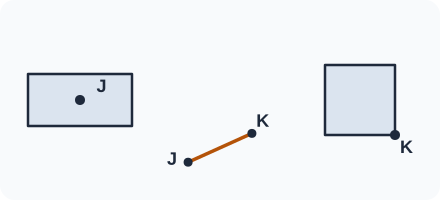
Which of these figures has a length that can be measured?

Show the answer

Answer: D

Correct answer: A segment. A segment is the part of a line between two endpoints, so it has a definite, measurable length. Lines and rays go on forever, and a point has no size at all.

  • A: A line extends forever in both directions, so it has no measurable length.
  • B: A ray has one endpoint but continues forever in the other direction.
  • C: A point marks a location only and has no size.
  • D (correct): A segment stops at two endpoints, so its length can be measured.
Question 59 · MK · easy

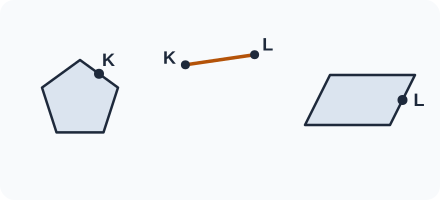
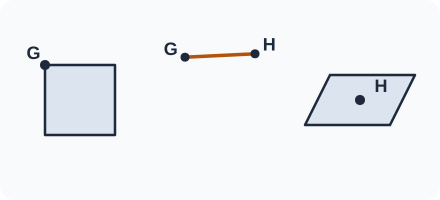
A teacher wants to split 45 pencils and also 30 erasers into equal piles of the same size, with none left over. Which pile size works for both?

Show the answer

Answer: C

Correct answer: 15. A common factor must divide both numbers with no remainder.

45 ÷ 15 = 3
and
30 ÷ 15 = 2

so 15 works.

  • A: 9 is a factor of 45, but 30 ÷ 9 leaves a remainder of 3.
  • B: 6 is a factor of 30, but 45 ÷ 6 leaves a remainder of 3.
  • C (correct): 45 = 15 × 3 and 30 = 15 × 2, so 15 divides both exactly.
  • D: 90 is a common multiple of 45 and 30, not a common factor.
Question 60 · MK · medium

A cylindrical water tank holds cubic feet and has a radius of 6 feet. How tall is the tank?

Show the answer

Answer: D

Correct answer: 8 feet. Write the volume formula and substitute what is known.

Divide both sides by 36 pi: h = 8 feet.

  • A: This divides by the radius 6 instead of the radius squared, 36.
  • B: This divides by 2 times the radius, 12, mixing in the circumference idea.
  • C: This squares the diameter, 12, giving 144, instead of squaring the radius.
  • D (correct): Dividing 288 pi by pi times 36 gives 8.
Question 61 · MK · medium

Each term of 2, −6, 18, ... is found by multiplying the previous one by the same number. Which value is in position 6?

Show the answer

Answer: C

Correct answer: −486. Find the ratio:

then

An odd power of a negative number is negative.

  • A: This drops the sign; −3 raised to the odd power 5 is negative.
  • B: This uses the exponent n = 6 instead of n − 1 = 5, which gives 2(−3)^6 = 1,458, the 7th term.
  • C (correct): Using gives 2 times −243, which is −486.
  • D: This treats the pattern as arithmetic with difference −8; the terms are multiplied by −3, not shifted by a fixed amount.
Question 62 · MK · medium

Eight less than four times a number is equal to the number plus 19. What is the number?

Show the answer

Answer: D

Correct answer: 9. Let n be the number. Eight less than four times a number is 4n − 8, so

4n − 8 = n + 19

Subtract n and add 8: 3n = 27, so n = 9. Check:

36 − 8 = 28
and
9 + 19 = 28
  • A: This is the value of 3n; the final step of dividing by 3 was skipped.
  • B: This comes from writing 4(n − 8), which means four times the difference, instead of 4n − 8.
  • C: This comes from writing 4n + 8, treating less than as addition.
  • D (correct): The equation 4n − 8 = n + 19 gives 3n = 27, so n = 9.
Question 63 · MK · medium

When

is solved and graphed, where is the boundary point and how is it marked?

Show the answer

Answer: A

Correct answer: At 4, with a closed circle. Subtract 2x and add 3: 3x ≤ 12, so x ≤ 4. Check the boundary: at x = 4 both sides equal 17, so 4 is a solution and gets a closed circle. Shade to the left.

  • A (correct): Solving gives 3x ≤ 12, so x ≤ 4; the ≤ sign includes 4, so the circle is filled.
  • B: The boundary is right, but an open circle is only for strict signs like < and >.
  • C: This subtracts 3 from 9 instead of adding 3 to both sides, giving 3x ≤ 6.
  • D: This is a sign slip; at x = −4 the two sides are −23 and 1, which are not equal.
Question 64 · MK · medium

Which number, substituted for x, makes the equation

a true statement?

Show the answer

Answer: A

Correct answer:

x = −7

Subtract 15 from both sides:

−4x = 28

Divide both sides by −4, keeping the sign:

x = −7

Check:

15 − 4(−7) = 15 + 28 = 43
  • A (correct): Subtracting 15 gives −4x = 28, and dividing by −4 gives x = −7.
  • B: This divides 28 by 4 but drops the negative sign of the coefficient −4.
  • C: This comes from adding 15 to 43 instead of subtracting it, then dividing by 4 without the sign.
  • D: This comes from adding 15 to 43 instead of subtracting it before dividing by −4.
Question 65 · MK · medium

In triangle XYZ, side XY = 13, side YZ = 8 and side XZ = 10. Which angle is the largest?

Show the answer

Answer: A

Correct answer: Angle Z. The largest angle lies opposite the longest side. The longest side is XY, and the vertex not on XY is Z, so angle Z is the largest.

  • A (correct): Angle Z is opposite XY, the longest side.
  • B: Angle X is opposite YZ, the shortest side, so it is the smallest angle.
  • C: Angle Y is opposite XZ, the middle side, so it is the middle-sized angle.
  • D: Angles are equal only when their opposite sides are equal, and YZ and XZ are not.
Question 66 · MK · medium

In kite ABCD, angles B and D are the two angles between unequal sides, so they are equal. Angle A measures 120 degrees and angle C measures 50 degrees. What is the measure of angle B?

Show the answer

Answer: B

Correct answer: 95 degrees. The four angles of any quadrilateral total 360 degrees. Angles B and D share what is left:

360 - 120 - 50 = 190 degrees

so each is

190 / 2 = 95 degrees
  • A: This is the combined measure of angles B and D; it still has to be split between the two equal angles.
  • B (correct): The two equal angles share 360 - 170 = 190 degrees, so each is 95 degrees.
  • C: This assumes angle B matches angle A, but in a kite the equal pair is the two angles between unequal sides.
  • D: This is 180 - 95, the supplement of the correct angle; kite angles are not supplementary in pairs like a parallelogram's.
Question 67 · MK · hard

Factor the numerator and the denominator of , then cancel common factors, with x not equal to 0 or 2. What remains?

Show the answer

Answer: C

Correct answer: (3(x + 2))/x. Factor the top completely:

Factor the bottom:

Cancel the common factor to get .

  • A: This cancels x + 2 as if it were in the bottom; the shared factor is x - 2.
  • B: This loses the common factor 3 that was pulled out of the top.
  • C (correct): Top factors to 3(x - 2)(x + 2), bottom to x(x - 2); cancel x - 2.
  • D: This also cancels the x in the bottom, but x is not a factor of the top.
Question 68 · MK · hard

A circular irrigation zone has its center at (-1, 2) on a field grid, and its edge passes through the point (4, 14). Each grid unit is 1 meter. What is the area of the zone?

Show the answer

Answer: A

Correct answer: 169π square meters. The radius is the distance from (-1, 2) to (4, 14). The changes are 5 and 12, a 5-12-13 triangle, so r = 13.

  • A (correct): The radius is the distance from the center to the edge point, 13, and pi times 13 squared is 169 pi.
  • B: This multiplies pi by the radius without squaring it.
  • C: This is 2 pi r, the circumference, which is a length, not an area.
  • D: This adds the changes 5 and 12 to get 17 as the radius instead of using the distance formula.
Question 69 · MK · hard

Triangle XYZ is drawn with all three vertices on a circle, and side XZ is a diameter 20 cm long. Side XY is 16 cm long. What is the area of triangle XYZ?

Show the answer

Answer: A

Correct answer: 96 square cm. An angle that stands on a diameter is a right angle, so angle Y is 90 degrees and XZ is the hypotenuse. The third side is the square root of

(400 - 256) = 12 cm

The legs are 16 and 12, so the area is one half times 16 times 12 = 96 square cm.

  • A (correct): Angle Y is 90 degrees, the missing leg is 12, and half of 16 times 12 is 96.
  • B: This uses the diameter, 20, as a leg; the diameter is the hypotenuse, so it is not a base-height pair with XY.
  • C: This multiplies the legs 16 and 12 but forgets the one half in the triangle area.
  • D: This assumes the two legs are equal at 16 cm; the Pythagorean relationship makes the other leg 12.
Question 70 · MK · hard

Evaluate the expression below.

What is its value?

Show the answer

Answer: D

Correct answer: −18. Powers first: in only the 2 is raised, so it equals −16. Then multiply and divide from left to right: (−3)

(−4) = 12
and
12 ÷ (−6) = −2

Finally

−16 + (−2) = −18
  • A: This treats −2⁴ as (−2)⁴ = 16; without parentheses only the 2 is raised to the power.
  • B: This gets −16 but makes 12 ÷ (−6) positive; unlike signs give a negative quotient.
  • C: This makes both mistakes: it squares the sign into +16 and makes the quotient +2.
  • D (correct): −2⁴ = −16 and (−3)(−4) ÷ (−6) = 12 ÷ (−6) = −2, so −16 + (−2) = −18.

Electronics Information

15 questions · 10 min on the real test
Question 71 · EI · easy

A technician wants to measure the current in just one branch of a powered parallel circuit. How should the ammeter be connected?

Show the answer

Answer: C

Correct answer: Open that branch and insert the meter so the branch current passes through it. An ammeter reads the current flowing through itself, so it must be in series with the path of interest. To read one branch, break that branch and insert the meter there; the main line would give the total instead.

  • A: The main line carries the total of all branch currents, not the current of the one branch.
  • B: An ammeter across the source shorts the supply rather than measuring any branch current.
  • C (correct): An ammeter must be in series with the path it measures, so the branch is broken and the meter completes it.
  • D: Placing a low-resistance ammeter across a branch is effectively a short across the rails and can blow the meter's fuse.
Question 72 · EI · easy

What are the nominal voltage and frequency of an ordinary wall outlet in a U.S. home?

Show the answer

Answer: B

Correct answer: 120 V at 60 Hz. Standard U.S. household outlets supply AC at a nominal 120 V RMS and 60 Hz. Larger appliances use 240 V circuits, and many other countries use about 230 V at 50 Hz.

  • A: The voltage is right, but the U.S. grid runs at 60 Hz, not 50 Hz.
  • B (correct): This is the standard U.S. pair for ordinary outlets; the 120 V is an RMS value.
  • C: This combination is common in many other countries, not in U.S. homes.
  • D: 12 V is the familiar DC car-system voltage, far below household outlet voltage.
Question 73 · EI · easy

Which term describes a single small piece of silicon that holds many transistors, diodes, and resistors wired together during manufacturing?

Show the answer

Answer: D

Correct answer: An integrated circuit. An integrated circuit puts many transistors, diodes, resistors, and sometimes capacitors on one piece of silicon. This saves space, lowers cost, and improves reliability.

  • A: A relay is a mechanical switch with a coil and moving contacts, not a silicon chip.
  • B: A bridge is an arrangement of four diodes for full-wave rectification, not a chip of many parts.
  • C: A P-N junction is a single boundary between p and n regions, the basis of one diode.
  • D (correct): An IC, or chip, combines many devices on one piece of silicon.
Question 74 · EI · easy

A loose wire connection inside a wall sparks repeatedly while the circuit current stays near normal. Which protective device is designed mainly to detect this kind of problem?

Show the answer

Answer: C

Correct answer: An arc-fault circuit interrupter (AFCI). Match the device to the hazard. Repeated sparking at a loose connection is arcing, and the AFCI is the device built to recognize arcing patterns in the current and open the circuit before a fire starts.

  • A: A fuse responds only to current above its rating, and this arcing happens at roughly normal current.
  • B: A GFCI looks for current leaking away to ground, not for the waveform pattern of sparking.
  • C (correct): An AFCI watches the current waveform for the patterns of dangerous arcing, mainly to prevent fires.
  • D: The grounding conductor gives fault current a path; it does not sense arcing.
Question 75 · EI · medium

A drill uses a motor whose field comes from an electromagnet. A technician reverses both the field current and the rotor current at the same time. What happens to the direction of rotation?

Show the answer

Answer: B

Correct answer: It stays the same. The force on a rotor wire depends on both the current direction and the field direction. Reversing one reverses the force; reversing both reverses it twice, leaving it unchanged. This is why a universal motor can run on AC, where both reverse together every half cycle.

  • A: Rotation reverses only when one of the two, field or rotor current, is reversed by itself.
  • B (correct): Reversing the field flips the force, and reversing the current flips it back, so the two changes cancel.
  • C: The force on each wire is still present at full strength; only its two causes have both flipped.
  • D: Reversing directions does not change the size of the field or current, so the force and speed are unchanged.
Question 76 · EI · medium

A copper motor winding reads 30 Ω when it is cold, at 20 degrees Celsius. After a long run it reads 36 Ω. Using

per degree Celsius and ignoring size changes, about what temperature has the winding reached?

Show the answer

Answer: B

Correct answer: 70 degrees Celsius. The fractional increase is

so

The winding warmed by 50 degrees, from 20 to about 70 degrees Celsius.

  • A: 50 degrees is the temperature rise; it must be added to the starting 20 degrees.
  • B (correct): The resistance rose by 6/30 = 0.2, and 0.2 divided by 0.004 is a 50 degree rise, so 20 + 50 = 70 degrees.
  • C: This divides the 6 Ω increase by 0.004 without first dividing by the 30 Ω starting value.
  • D: This adds the 6 Ω increase directly to the temperature, mixing ohms with degrees.
Question 77 · EI · medium

An ideal 12 V source drives 2 Ω, 4 Ω and 6 Ω resistors in series, in that order from the positive terminal. Measured from the negative terminal, what is the voltage at the node between the 4 Ω and 6 Ω resistors?

Show the answer

Answer: D

Correct answer: 6 V. Total resistance is 12 Ω, so the current is

A

The drops are 2 V, 4 V and 6 V.

Starting at 12 V and subtracting the first two drops leaves

V

which equals the 6 V still to be dropped across the last resistor.

  • A: This is the drop across the 4 Ω resistor, not the node voltage.
  • B: This is the node voltage after only the 2 Ω resistor.
  • C: This subtracts only the 4 Ω drop and forgets the drop across the 2 Ω resistor.
  • D (correct): The 2 Ω and 4 Ω resistors drop 2 V and 4 V, so 12 minus 6 leaves 6 V at that node.
Question 78 · EI · medium

An ideal 9 V battery drives a 220 Ω resistor and a 680 Ω resistor in series. What current flows?

Show the answer

Answer: A

Correct answer: 10 mA. Add the resistances:

Ω
then
A

which is 10 mA through both resistors.

  • A (correct): The total resistance is 900 Ω, and 9 V divided by 900 Ω is 0.01 A, or 10 mA.
  • B: This uses only the 220 Ω resistor instead of the total series resistance.
  • C: This uses only the 680 Ω resistor instead of the total series resistance.
  • D: This divides 9 by 90, a decimal slip when dividing by 900.
Question 79 · EI · medium

A 12 V battery, a fuse, a 4 Ω resistor and an 8 Ω resistor form a single series loop. The fuse blows, leaving a gap. What does a voltmeter read when connected across the 8 Ω resistor?

Show the answer

Answer: A

Correct answer: 0 V. A blown fuse opens the only path, so the current is zero everywhere in the loop. With I = 0, each resistor's drop is

V

The full 12 V appears across the gap in the fuse instead.

  • A (correct): With the loop open, no current flows, and V = IR gives zero drop across the resistor.
  • B: The full 12 V appears across the gap in the blown fuse, not across a resistor that carries no current.
  • C: 8 V would be this resistor's share only while current flows; with the fuse blown, current is zero.
  • D: 4 V is the normal drop on the 4 Ω resistor, and it also needs current to exist.
Question 80 · EI · medium

An engineer wants a core material for a coil that lets magnetic flux build up in it as easily as possible, so a small current gives a strong field. Which property should the material have in a high amount?

Show the answer

Answer: A

Correct answer: Permeability. Permeability measures how readily a material carries magnetic flux. A high-permeability core such as soft iron greatly multiplies the flux a coil produces, which is the same as giving the flux path low reluctance.

  • A (correct): Permeability describes how easily a material supports magnetic flux; soft iron's is hundreds to thousands of times that of air.
  • B: Reluctance is opposition to flux, so a good core path should have low reluctance, not high.
  • C: Hysteresis is the lag of magnetization behind the field; more of it means more energy lost each AC cycle.
  • D: Saturation is the limit where nearly all domains are aligned and extra current adds little flux; it is a limit, not a property to maximize.
Question 81 · EI · medium

Resistors of 4 Ω, 6 Ω and 12 Ω are connected in parallel, giving an equivalent of 2 Ω. The 4 Ω resistor then burns open. What is the new equivalent resistance?

Show the answer

Answer: A

Correct answer: 4 Ω. With the 4 Ω branch open, only 6 Ω and 12 Ω remain:

Ω

Fewer paths means a higher equivalent resistance, so 2 Ω rising to 4 Ω makes sense.

  • A (correct): The remaining 6 Ω and 12 Ω combine to 72 over 18, or 4 Ω.
  • B: This assumes nothing changes, but losing a path raises the equivalent resistance.
  • C: This adds the remaining two resistors as if they were in series.
  • D: This assumes the equivalent falls, but removing a branch always makes it rise.
Question 82 · EI · hard

A pump motor must deliver 2,160 W of mechanical power and is 90 percent efficient. It runs on 240 V. How much current does it draw from the supply?

Show the answer

Answer: B

Correct answer: 10 A. Required input:

W
  • A: This divides by the efficiency twice, overstating the input power.
  • B (correct): Input power is 2,160 W divided by 0.9, or 2,400 W, and 2,400 W divided by 240 V is 10 A.
  • C: This multiplies the output by the efficiency, which makes the input smaller than the output.
  • D: This uses the output power as the input and ignores the motor's losses.
Question 83 · EI · hard

A negatively charged rod approaches a neutral isolated metal sphere but never touches it. What must be true before any grounding?

Show the answer

Answer: C

Correct answer: The sphere’s mobile electrons redistribute, but its total charge remains zero. The negative rod repels free electrons in the metal, pushing them to the far side and leaving the near side positive; this is charging by induction. Because the sphere is isolated and nothing touches it, no charge enters or leaves, so its net charge stays zero. A lasting net charge appears only if the sphere is grounded while the rod is nearby.

  • A: Without contact or a conducting path, no charge transfer is required.
  • B: Positive nuclei do not migrate throughout the metal in this setting.
  • C (correct): Induction redistributes mobile charge without changing isolated sphere net charge.
  • D: Conservation of charge forbids creation here.
Question 84 · EI · hard

A schematic shows a lamp from the +9 V rail down to a ground symbol at the bottom left. Elsewhere, the battery's negative terminal goes to a second ground symbol at the bottom right, and its positive terminal feeds the +9 V rail. No wire is drawn between the two ground symbols. What happens to the lamp?

Show the answer

Answer: B

Correct answer: It lights, because every ground symbol in a drawing is the same node. Every ground symbol in one schematic is the same node, even when drawn apart. Current leaves the battery's positive terminal on the +9 V rail, passes through the lamp to ground, and returns through ground to the negative terminal, so the loop is complete and the lamp lights.

  • A: Ground is a reference node, not a load; current returns through it to the source.
  • B (correct): Ground symbols share one reference node, so the loop is complete from +9 V through the lamp back to the battery.
  • C: Ground symbols are connected by convention even when drawn far apart.
  • D: In a battery circuit, ground is just the chosen 0 V reference, with no need for an earth connection.
Question 85 · EI · hard

A lamp is rated 60 W at 120 V when its filament is hot. When the filament is cold, its resistance is only one sixteenth of its hot resistance. About how much current flows at the instant the lamp is switched on across 120 V?

Show the answer

Answer: A

Correct answer: 8 A. First find the hot resistance from the rating, then the cold resistance, then the current.

Because resistance rises as the filament heats, the current quickly falls toward its normal 0.5 A.

  • A (correct): The hot resistance is 120² / 60 = 240 ohms, so the cold value is 15 ohms, and 120 V divided by 15 ohms is 8 A.
  • B: This divides the hot current by 16 instead of multiplying, but a lower resistance gives a larger current.
  • C: This stops at the cold resistance of 15 ohms and labels the number as amperes.
  • D: This is the normal operating current using the hot resistance of 240 ohms, not the much lower cold resistance.

Auto Information

10 questions · 7 min on the real test
Question 86 · AI · easy

A luxury car with air suspension stays at the same ride height whether it is empty or fully loaded. What makes this possible?

Show the answer

Answer: C

Correct answer: A compressor and valves that add or release air in the air springs. An air spring is a rubber bellows filled with compressed air. A compressor and valves change the air amount to raise, lower or level the vehicle, keeping ride height constant under different loads. Dampers are still needed to control motion.

  • A: Shock absorbers, even gas-charged ones, control motion; they do not support the load or set ride height.
  • B: An anti-roll bar resists uneven left-right travel and does not raise the car.
  • C (correct): Adding air raises the support force and releasing it lowers it, so the system can level the car.
  • D: Leaf springs, however thick, flatten under load, which lowers the vehicle rather than keeping height constant.
Question 87 · AI · easy

A driver learns that the car's brake lights stay lit all the time, even with no foot on the pedal. Which part is the most likely cause?

Show the answer

Answer: A

Correct answer: The stop-lamp switch near the pedal arm. The brake lights are turned on by a switch near the brake pedal arm that closes the circuit when the pedal moves. If that switch fails or is out of adjustment, the lights can stay dark or stay on constantly.

  • A (correct): This switch closes the brake-light circuit when the pedal moves; a failed or misadjusted one can leave the lights stuck on.
  • B: The reservoir stores spare brake fluid and has no role in switching the brake lights on or off.
  • C: Wheel-speed sensors feed the ABS controller; they do not control the brake lights.
  • D: A torn booster diaphragm makes the pedal hard to push and may cause a hiss, but it does not keep the brake lights on.
Question 88 · AI · medium

Two fog lamps are wired in parallel on one relay-controlled branch with a shared fuse and a shared ground. Both lamps go dark at the same moment. What is the most likely cause?

Show the answer

Answer: B

Correct answer: A failure in a shared part such as the fuse, relay, switch or common ground. In a parallel branch, each lamp has its own path, so a failed bulb darkens only that lamp. When both go out together, the fault is in something they share: the fuse, the relay contacts or coil, the dash switch, the common feed wire or the shared ground.

  • A: Each bulb fails on its own; two failing at the exact same moment is very unlikely.
  • B (correct): Only a part both lamps depend on can darken both at once.
  • C: The lamps are wired in parallel, not in series, so one failed bulb darkens only its own lamp.
  • D: A charging failure drains the whole system gradually; it would not suddenly darken only the fog lamps while everything else works.
Question 89 · AI · medium

A flex-fuel test cell runs pure ethanol, with a stated stoichiometric air-fuel ratio of 9.0:1. How much air is needed to burn 35 g of ethanol at stoichiometric?

Show the answer

Answer: A

Correct answer: 315 g. Rearrange AFR = air mass / fuel mass and use the reference value the problem gives.

  • A (correct): Air mass equals AFR times fuel mass: 9.0 x 35 g = 315 g.
  • B: This uses the gasoline value of 14.7 instead of the stated 9.0 for ethanol.
  • C: This divides fuel mass by the ratio; the air mass must be much larger than the fuel mass.
  • D: This adds the ratio number to the fuel mass instead of multiplying.
Question 90 · AI · medium

An ideal 2.5:1 reduction gearbox receives 24 kW of power with 160 N·m of input torque. What output power and output torque does it deliver?

Show the answer

Answer: B

Correct answer: 24 kW of power, with torque raised to 400 N·m. Gears trade speed for torque but cannot add power, so an ideal gearbox puts out the same 24 kW it takes in.

Output torque =

160 × 2.5 = 400

N·m, while output speed drops by the same factor of 2.5.

  • A: This multiplies power by the ratio too, but gears cannot create power.
  • B (correct): Ideal gears keep power the same, and torque is multiplied by the ratio: 160 × 2.5 = 400 N·m.
  • C: This divides power by the ratio; in an ideal gearbox power is unchanged.
  • D: This divides torque by the ratio; a reduction raises torque while lowering speed.
Question 91 · AI · medium

When the driver presses the clutch pedal in a manual car, which part pushes on the pressure plate's diaphragm spring to release the clamping force?

Show the answer

Answer: C

Correct answer: The release (throwout) bearing. With the pedal up, the diaphragm spring in the pressure plate clamps the friction disc against the flywheel. Pressing the pedal moves the release, or throwout, bearing against that spring, which removes the clamping force and disconnects engine torque.

  • A: The starter drive gear engages the flywheel's ring gear only during cranking.
  • B: A synchronizer matches gear speeds inside the gearbox; it does not touch the clutch spring.
  • C (correct): The release bearing presses the diaphragm spring so the pressure plate stops squeezing the disc.
  • D: The disc facings are what get clamped; they do not push on the spring.
Question 92 · AI · medium

A tire placard lists the recommended cold pressure only as 240 kPa. Using 1 psi ≈ 6.895 kPa, about what pressure should the gauge read in psi?

Show the answer

Answer: C

Correct answer: About 35 psi. Since kPa = psi x 6.895, reverse it to get psi = kPa / 6.895.

  • A: This multiplies by 6.895, which is the direction for converting psi to kPa.
  • B: This simply drops a zero instead of dividing by the conversion factor 6.895.
  • C (correct): Going from kPa to psi means dividing: 240 / 6.895 is about 34.8, or about 35 psi.
  • D: This subtracts 6.895 from 240 instead of dividing by it.
Question 93 · AI · medium

After a repair, a technician tries to erase a permanent code with a scan tool, but the code remains. What will clear it?

Show the answer

Answer: D

Correct answer: The computer's own tests confirming the repair. A permanent code cannot be erased with a scan tool or by removing power. It clears itself only after the engine computer runs its own tests under the needed driving conditions and confirms that the fault is fixed.

  • A: Permanent codes are designed to survive power loss as well as scan-tool clearing.
  • B: No scan tool can erase a permanent code; that is what makes it permanent.
  • C: A part swap alone does not clear the code; the computer must still verify the repair.
  • D (correct): A permanent code clears only after the computer reruns its monitors and finds the fault gone.
Question 94 · AI · hard

An engine sketch shows the piston at BDC. The cylinder is full of hot, burned gas, the intake valve is closed and the exhaust valve is just beginning to open. Which stroke has just ended, and which stroke comes next?

Show the answer

Answer: C

Correct answer: Power has ended; exhaust comes next. BDC occurs at the end of intake and at the end of power, so position alone is not enough. Hot burned gas filling the cylinder shows the power stroke has just finished, and the exhaust valve opening confirms that the exhaust stroke is next.

  • A: Intake also ends at BDC, but the cylinder would hold fresh charge, and both valves would be closing for compression.
  • B: Compression ends at TDC, not BDC, with the piston at the top of the cylinder.
  • C (correct): Burned gas at BDC means the power stroke just drove the piston down, and the opening exhaust valve sets up the exhaust stroke.
  • D: Exhaust ends at TDC after the burned gas has been pushed out, not at BDC with the cylinder still full.
Question 95 · AI · hard

After a cold-morning start, a mechanic's gauge shows oil pressure far above normal, and the oil filter gasket blows out. The oil level is correct and the oil is the specified grade. Which fault best explains this?

Show the answer

Answer: B

Correct answer: A pressure relief valve stuck closed. A positive-displacement oil pump makes more pressure as oil gets thicker and rpm rises. The relief valve normally opens at a set limit to route the extra oil back. If it is stuck closed, pressure on a cold start can climb high enough to blow out a filter seal.

  • A: A clogged pickup starves the pump, which lowers oil pressure rather than raising it.
  • B (correct): If the relief valve cannot open, nothing limits pump pressure when cold, thick oil resists flow, so pressure can climb high enough to burst a filter seal.
  • C: A relief valve stuck open dumps oil back to the inlet and causes low pressure, not high pressure.
  • D: An open bypass lets oil skip the filter element, which eases flow; it does not raise pressure.

Shop Information

10 questions · 6 min on the real test
Question 96 · SI · easy

What is the main purpose of a bench vise?

Show the answer

Answer: B

Correct answer: To hold a workpiece steady while it is filed, sawed or fitted. A bench vise is mounted to a sturdy workbench and holds a workpiece still so it can be filed, sawed or fitted. It is a holding device, not a lifting or measuring tool.

  • A: A vise has no measuring scale; calipers or a rule do that.
  • B (correct): A bench vise is a holding device that secures work on the bench.
  • C: A vise is not a lifting device and should not be used to move loads.
  • D: Bending light wire is a job for pliers, not the main purpose of a vise.
Question 97 · SI · easy

During routine service on a hybrid car, a student sees a thick bright orange cable near the battery area. What should the student do?

Show the answer

Answer: C

Correct answer: Leave it alone; only trained technicians following the disabling procedure may work on it. Bright orange cables on hybrid and electric vehicles carry high voltage, often several hundred volts. Routine maintainers should not touch them; only trained technicians with insulated gloves and the maker's procedure should work on that system.

  • A: Disconnecting high-voltage cables without training and the maker's disabling procedure risks fatal shock.
  • B: A 12-volt test light is not suited to high-voltage systems, and probing them is work for trained technicians only.
  • C (correct): Orange cabling marks high-voltage parts that can cause fatal shock, so routine maintainers must not touch them.
  • D: Ordinary cotton gloves give no protection from several hundred volts.
Question 98 · SI · medium

On a baseline-dimensioned bracket, three hole centers are located at X = 18 mm, X = 45 mm and X = 92 mm from the same left datum edge. What is the center-to-center distance between the second and third holes?

Show the answer

Answer: C

Correct answer: 47 mm. Baseline dimensions all start at one datum, so the distance between two features is the difference of their coordinates:

92 − 45 = 47 mm
  • A: This is the spacing between the first and second holes (45 − 18).
  • B: This is the spacing between the first and third holes (92 − 18).
  • C (correct): Both values come from the same datum, so the spacing is 92 − 45 = 47 mm.
  • D: This adds the two coordinates instead of subtracting them.
Question 99 · SI · medium

A single air compressor measures 88 dB at a workstation. A second, identical compressor is started next to it, doubling the sound intensity at that spot. About what sound level should be expected now?

Show the answer

Answer: B

Correct answer: About 91 dB. Decibels are logarithmic. Doubling sound intensity adds about 3 dB, while a tenfold increase adds 10 dB.

  • A: This doubles the decibel number itself, but decibels are logarithmic, so doubling intensity does not double the dB value.
  • B (correct): Doubling the acoustic intensity adds about 3 dB, so 88 dB + 3 dB is about 91 dB.
  • C: Adding 10 dB corresponds to a tenfold increase in intensity, not a doubling.
  • D: Two identical sources produce more total sound intensity than one, so the level must rise above 88 dB.
Question 100 · SI · medium

An aluminum pump housing must have its cover removed often for service, and the internal threads in the housing are wearing out. Which fastening arrangement helps reduce wear on the housing threads?

Show the answer

Answer: B

Correct answer: Studs left installed in the housing, with nuts holding the cover. A stud is threaded into the housing and left in place. The cover is removed by unscrewing nuts from the exposed stud ends, so the housing threads are not worked each time the cover comes off.

  • A: Cap screws still thread in and out of the housing each service, so the wear continues.
  • B (correct): The studs stay put, and only the nuts are removed, so the housing's internal threads see little repeated wear.
  • C: Lock washers do not change how often the housing threads are engaged and removed, so the wear continues.
  • D: Adhesive resists loosening but does nothing to protect the housing threads from repeated removal and reinstallation.
Question 101 · SI · medium

A crew is squaring the corner of a deck frame. They measure 9 ft along one joist and 12 ft along the other, both from the corner. If the corner is truly square, what should the diagonal between those two points measure?

Show the answer

Answer: B

Correct answer: 15 ft. This is the 3-4-5 triangle scaled by 3. Using the Pythagorean theorem,

ft
  • A: This simply adds the two legs; the diagonal of a right triangle is always shorter than their sum.
  • B (correct): 9-12-15 is a 3-4-5 triangle multiplied by 3, so the diagonal is the square root of 225, which is 15 ft.
  • C: This averages the two legs instead of applying the Pythagorean theorem.
  • D: This adds the squares of the legs, 81 + 144, but forgets to take the square root.
Question 102 · SI · medium

A bookcase drawing is made at a scale of 1:8. A shelf on the drawing measures 2 1/2 inches. How long is the real shelf?

Show the answer

Answer: C

Correct answer: 20 inches. Real length = scale factor x drawing length.

  • A: This adds 8 to the drawing length instead of multiplying by the scale factor.
  • B: This divides by 8, shrinking the length; the real object is larger than the drawing.
  • C (correct): At 1:8, each drawing inch is 8 real inches, so 2 1/2 x 8 = 20 inches.
  • D: This multiplies only the whole number 2 by 8 and drops the extra 1/2 inch.
Question 103 · SI · medium

A steel bar is held in a lathe chuck. The drawing calls for its outside diameter to be reduced evenly along a 3-inch length. Which lathe operation does this describe?

Show the answer

Answer: A

Correct answer: Turning. Identify which surface changes. A smaller outside diameter along the length is straight turning; a flat, square end is facing; boring and reaming work inside a hole.

  • A (correct): Turning feeds the tool along the rotating bar to reduce its outside diameter evenly over a length.
  • B: Facing cuts the flat end of the bar square to its axis; it does not reduce the diameter along the length.
  • C: Boring enlarges or refines an existing hole on the inside, not the outside diameter.
  • D: Reaming lightly finishes an existing hole to size; it does not cut an outside diameter.
Question 104 · SI · hard

A technician heats two close-fitting copper tubes. The tubes never melt, but a filler that melts at about 1,300 °F is drawn into the narrow gap. Which process is this?

Show the answer

Answer: C

Correct answer: Brazing. Ask what melts. Only the filler melts, so it is soldering or brazing; the filler melts at about 1,300 °F, above the 840 °F boundary, so the process is brazing.

  • A: Soldering also uses capillary flow, but its filler melts at or below about 840 °F, not 1,300 °F.
  • B: Fusion welding melts the base metal, and here the tubes never melt.
  • C (correct): The base stays solid and the filler melts above 840 °F but below copper's melting point, which defines brazing.
  • D: Friction welding uses rubbing heat and pressure between the parts with no filler drawn into a gap.
Question 105 · SI · hard

A round steel tie rod 16 mm in diameter carries a steady 30,000 N pull. What is the average tensile stress in the rod, to the nearest MPa?

Show the answer

Answer: B

Correct answer: About 149 MPa. Stress is force divided by cross-sectional area. With a radius of 8 mm,

mm².

Always halve the diameter before squaring.

  • A: This comes from using the 16 mm diameter as the radius, which makes the area four times too large.
  • B (correct): The radius is 8 mm, so the area is about 201 mm² and 30,000 ÷ 201 is about 149 MPa.
  • C: This divides by 16 × 16 = 256 mm², the area of a square, and forgets the pi/4 factor for a circle.
  • D: This divides by the circumference (about 50 mm), which is a length, not the cross-sectional area.

Mechanical Comprehension

15 questions · 22 min on the real test
Question 106 · MC · easy

A hoist has an ideal mechanical advantage of 4, but tests show its actual mechanical advantage is only 3.4. What best explains the difference?

Show the answer

Answer: A

Correct answer: Friction and moving parts use up part of the effort. Actual mechanical advantage uses the effort really applied. Friction in the sheaves and rope, plus the weight of moving parts, raise that effort, so the AMA is always below the IMA in a real hoist.

  • A (correct): Some of the applied pull goes into overcoming bearing friction, rope bending and the weight of moving hardware, so the measured effort is larger than ideal.
  • B: A lighter load does not explain why each newton of effort lifts less than the ideal amount.
  • C: Both mechanical advantages are pure numbers without units, so units cannot explain the gap.
  • D: The ideal value comes from the segment count; a lower measured ratio comes from losses, not a different count.
Question 107 · MC · easy

A skater standing on ice pushes on a wall with a force of 40 N and glides backward. What force does the wall exert on the skater?

Show the answer

Answer: C

Correct answer: 40 N, pointing away from the wall. Newton's third law says forces come in equal and opposite pairs. The skater pushes the wall with 40 N, so the wall pushes the skater with 40 N in the opposite direction, away from the wall.

  • A: The pair forces are equal in size, so the wall's push is the full 40 N, not half of it.
  • B: Walls and floors can push; this push is a normal force and is what sends the skater backward.
  • C (correct): By Newton's third law, the wall pushes back on the skater with a force equal in size and opposite in direction.
  • D: The reaction force is opposite to the skater's push, so it points away from the wall, not toward it.
Question 108 · MC · easy

A 50 N force is applied at a right angle to a lid, 40 cm from its hinge. What torque does the force produce about the hinge?

Show the answer

Answer: C

Correct answer: 20 N·m. Convert the distance to meters first: 40 cm = 0.40 m. Then

N·m.

  • A: This uses 40 directly without converting centimeters to meters, making it 100 times too large.
  • B: This converts 40 cm to 0.04 m; there are 100 cm in a meter, so 40 cm is 0.40 m.
  • C (correct): Converting 40 cm to 0.40 m and multiplying by 50 N gives 20 N·m.
  • D: This divides the force by the distance instead of multiplying them.
Question 109 · MC · easy

A 2 kW space heater runs for 3 hours. How much electrical energy does it use?

Show the answer

Answer: C

Correct answer: 6 kWh. Energy used is E = Pt. With power in kilowatts and time in hours,

2 × 3 = 6

kWh.

  • A: This divides the time by the power instead of multiplying them.
  • B: Kilowatts measure power; an amount of energy is expressed in kilowatt-hours.
  • C (correct): Energy equals power times time: 2 kW × 3 h = 6 kWh.
  • D: Dividing power by time does not give energy; the two must be multiplied.
Question 110 · MC · medium

A plumber pushes at a right angle on a pipe wrench with 160 N at a point 35 cm from the center of the pipe. How much torque does the push apply to the pipe?

Show the answer

Answer: A

Correct answer: 56 N·m. Convert the moment arm to meters first: 35 cm = 0.35 m.

Torque = force × perpendicular distance =

160 × 0.35 = 56

N·m.

  • A (correct): Force times the moment arm in meters: 160 × 0.35 = 56 N·m.
  • B: This uses 35 cm as if it were 35 m; centimeters must be converted to meters before computing torque in N·m.
  • C: This divides the force by the distance; torque is force multiplied by the moment arm.
  • D: This treats 35 cm as 3.5 m, a factor-of-ten slip in the unit conversion.
Question 111 · MC · medium

A baseboard heater runs along the floor of a cold room with no fan. Within a while the whole room is warm, including the air near the ceiling. Which process mainly spreads the heat through the room?

Show the answer

Answer: B

Correct answer: Natural convection, as warmed air rises and cooler air sinks. In natural convection, a fluid warmed at a heat source becomes less dense and rises, while cooler fluid sinks to take its place. That circulating current carries heat from the floor-level heater throughout the room.

  • A: Air is a poor conductor; heat spreading through a whole room depends on the air moving.
  • B (correct): Air heated at the floor becomes less dense and rises while cooler air sinks to replace it, setting up a circulating current.
  • C: Forced convection needs a fan or pump; this heater has none, so the flow is driven by density differences.
  • D: Radiation from a low heater warms nearby surfaces, but it is the moving air that carries heat up to the ceiling.
Question 112 · MC · medium

A wedge is 2.5 cm thick at its back. When it is struck with a force of 180 N, it ideally produces 1,260 N of spreading force. How long is the wedge?

Show the answer

Answer: D

Correct answer: 17.5 cm. Find the IMA from the forces, then use

  • A: Seven is the IMA, a pure number; it still must be multiplied by the 2.5 cm thickness to give a length.
  • B: This adds the IMA to the thickness; IMA is length divided by thickness, so you multiply to get the length.
  • C: This divides the thickness by the IMA, giving a wedge thinner than it is thick, which cannot have IMA 7.
  • D (correct): The IMA is 1,260/180 = 7, and length equals IMA times thickness, so 7 times 2.5 cm = 17.5 cm.
Question 113 · MC · medium

A mechanic drags a heavy toolbox 8 m across a level shop floor at a steady speed, pulling horizontally with a constant 45 N force. How much heat does friction produce between the toolbox and the floor?

Show the answer

Answer: D

Correct answer: 360 J. Steady speed means zero net force, so kinetic friction equals the 45 N pull. The heat produced equals friction force times sliding distance: 45 N times 8 m = 360 J.

  • A: This assumes balanced forces mean no friction; steady speed only means friction exactly matches the 45 N pull.
  • B: This halves the work, as if the force averaged out; kinetic friction stays a constant 45 N the whole way.
  • C: This divides force by distance; heat from friction is force multiplied by sliding distance.
  • D (correct): At steady speed the pull balances kinetic friction, so friction is 45 N, and 45 N times 8 m gives 360 J of heat.
Question 114 · MC · medium

A 600 N rescue trainee rides a zip line that is 80 m long and ends 12 m lower than it starts. How much work does gravity do on the trainee during the ride?

Show the answer

Answer: D

Correct answer: +7,200 J. Work done by gravity depends only on the vertical displacement, not on the path length.

W = 600 N × 12 m = 7,200 J. It is positive because the force (down) and the vertical motion (down) point the same way.

  • A: This multiplies by the 80 m cable length, but gravity's work depends only on the vertical drop.
  • B: Gravity points down and the trainee moves down, so its work is positive, not negative.
  • C: This adds the cable length and the drop together; only the 12 m vertical change counts.
  • D (correct): Gravity's work is weight times vertical drop: 600 × 12 = 7,200 J, positive because the trainee moves downward.
Question 115 · MC · medium

A technician slowly stretches a 400 N/m spring from its natural length to an extension of 0.15 m. How much work does the technician do on the spring?

Show the answer

Answer: A

Correct answer: 4.5 J. The spring force rises from 0 to

N

so use the average force or the energy formula.

  • A (correct): The work equals the stored energy, one half times 400 times 0.15 squared, which is 4.5 J.
  • B: This multiplies the final 60 N force by the full 0.15 m, but the force grows from zero, so the average force is only half of 60 N.
  • C: This computes one half times k times x without squaring the extension, which does not give an energy.
  • D: This is the spring force in newtons at full stretch, k times x, not the work done.
Question 116 · MC · medium

A golf cart's velocity-time graph falls in a straight line from 12 m/s at t = 0 to 0 m/s at t = 6 s. How far does the cart travel while stopping?

Show the answer

Answer: B

Correct answer: 36 m. Displacement is the area under a velocity-time graph. Here the shape is a triangle with base 6 s and height 12 m/s.

The same result comes from average speed:

(12 + 0) ÷ 2 = 6 m/s
and
6 × 6 = 36 m
  • A: This uses the full rectangle, 12 × 6, as if the cart kept its starting speed the whole time.
  • B (correct): The area under the line is a triangle: ½ × 6 × 12 = 36 m.
  • C: This finds the slope, 12 ÷ 6, which is the size of the deceleration in m/s², not a distance.
  • D: This takes half of the triangle's area by halving twice.
Question 117 · MC · hard

A sealed hollow cube measures 0.5 m on each edge and has a mass of 30 kg. Floating upright in fresh water, how far below the surface is its bottom face?

Show the answer

Answer: C

Correct answer: 12 cm. Volume:

m³

Average density:

30 ÷ 0.125 = 240 kg

/m³, so the submerged fraction is 0.24.

Depth below surface: 0.24 × 0.5 m = 0.12 m = 12 cm.

  • A: This is the height of the cube above the waterline, not below it.
  • B: This divides the 0.03 m³ submerged volume by the 0.5 m edge instead of by the 0.25 m² face area.
  • C (correct): Its density is 30 ÷ 0.125 = 240 kg/m³, so 24% of the 0.5 m height, or 0.12 m, is underwater.
  • D: This reads the 0.24 submerged fraction as a depth in meters without multiplying by the 0.5 m height.
Question 118 · MC · hard

A positive-displacement pump keeps running after a hydraulic cylinder reaches the end of its stroke and can move no farther. In a correctly working circuit, what happens next?

Show the answer

Answer: D

Correct answer: Pressure climbs to the relief setting, and oil returns to tank through the relief valve. A positive-displacement pump delivers flow whatever the load. When the cylinder bottoms out, the flow has nowhere to go, so pressure rises until the relief valve opens and sends the oil back to the tank, protecting the circuit.

  • A: A positive-displacement pump traps and forces out a fixed volume each turn regardless of the load.
  • B: Blocked flow meets maximum resistance, so pressure rises rather than falls.
  • C: The cylinder is already at the end of its stroke, so no extra oil can enter it to move the piston.
  • D (correct): With the outlet blocked, the pump keeps forcing oil, pressure rises until the relief valve opens, and the oil goes back to the reservoir.
Question 119 · MC · hard

On dry pavement the tire-road friction coefficient is 0.8, but after rain it drops to 0.5. A car traveling 25 m/s brakes as hard as possible on the wet road without skidding. Using

g = 10 m/s²

what is its ideal stopping distance?

Show the answer

Answer: D

Correct answer: 62.5 m. Use the wet coefficient in the braking-distance relation.

  • A: This forgets the factor of 2 in the denominator.
  • B: This uses the speed without squaring it.
  • C: This uses the dry-road coefficient of 0.8 instead of the wet value.
  • D (correct): On the wet road, 25 squared divided by 2 times 0.5 times 10 is 625 divided by 10.
Question 120 · MC · hard

A double-start jack screw has a thread pitch of 2.5 mm and a handle radius of 0.40 m. It lifts a 9000 N load and is 30% efficient. About what actual effort is needed at the handle?

Show the answer

Answer: D

Correct answer: 59.7 N. Lead = 2 × 2.5 mm = 5 mm = 0.005 m.

Actual effort = 17.9 / 0.30 ≈ 59.7 N.

  • A: This is the ideal effort; a 30% efficient screw needs more force, not the ideal amount.
  • B: Multiplying the ideal effort by the efficiency lowers it, but friction always raises real effort.
  • C: This uses the 2.5 mm pitch as the lead, ignoring the second start and doubling the IMA.
  • D (correct): Lead is 5 mm, so IMA is about 503 and ideal effort about 17.9 N; dividing by 0.30 gives about 59.7 N.

Assembling Objects

15 questions · 18 min on the real test
Question 121 · AO · easy

The left box shows separate flat pieces. Which figure shows how the pieces look when they are fitted together?

Left box: 2 separate flat pieces: a four-sided piece (about 74% of the total area), a four-sided piece (about 26% of the total area).
Show the answer

Answer: C

Count the pieces first: every figure must use each piece exactly once, with nothing added. Then pick one distinctive piece, such as the largest one or one with a curved or sharply pointed edge, and look for it in each figure; pieces may be turned but never flipped over. A figure whose cut lines are in different places has pieces of different sizes and can be crossed out. Here the pieces fit together into a trapezoid.

  • A: This figure has 3 pieces, but the left box has 2. Every piece must be used once, and nothing may be added.
  • B: A cut is in a different place, so the pieces do not match: one piece here covers about 52% of the shape, but the matching piece in the left box covers about 74%.
  • C (correct): This trapezoid is made of exactly the 2 pieces in the left box, each only turned and slid into place.
  • D: A cut is in a different place, so the pieces do not match: one piece here covers about 17% of the shape, but the matching piece in the left box covers about 26%.
Question 122 · AO · easy

The left box shows two shapes, each with a lettered point, and a line with the same two letters on its ends. Which figure shows how the shapes connect when each end of the line is attached to the point with the same letter?

Left box: a pentagon with point K at the middle of a side, a parallelogram with point L at the middle of a short side, and a separate line with end K and end L.
Show the answer

Answer: C

Check one letter at a time. Point K is at the middle of a side of the pentagon, and point L is at the middle of a short side of the parallelogram. Cross out any figure where either end of the line lands somewhere else or where a shape has changed. The shapes may be turned, so find each point by its place on the shape (corner, middle of a side, center), not by up, down, left or right.

  • A: The line ends in the wrong place: it meets the parallelogram at the center, but point L is at the middle of a short side.
  • B: The line ends in the wrong place: it meets the pentagon at the center, but point K is at the middle of a side.
  • C (correct): The line joins the middle of a side of the pentagon to the middle of a short side of the parallelogram, the same spots as points K and L in the left box; turning a shape does not move a point on it.
  • D: The line ends in the wrong place: it meets the pentagon at a corner, but point K is at the middle of a side and it meets the parallelogram at a sharp corner, but point L is at the middle of a short side.
Question 123 · AO · easy

The left box shows two shapes, each with a lettered point, and a line with the same two letters on its ends. Which figure shows how the shapes connect when each end of the line is attached to the point with the same letter?

Left box: a square with point G at a corner, a parallelogram with point H at the center, and a separate line with end G and end H.
Show the answer

Answer: C

Check one letter at a time. Point G is at a corner of the square, and point H is at the center of the parallelogram. Cross out any figure where either end of the line lands somewhere else or where a shape has changed. The shapes may be turned, so find each point by its place on the shape (corner, middle of a side, center), not by up, down, left or right.

  • A: The line ends in the wrong place: it meets the square at the center, but point G is at a corner.
  • B: The line ends in the wrong place: it meets the parallelogram at the middle of a short side, but point H is at the center.
  • C (correct): The line joins a corner of the square to the center of the parallelogram, the same spots as points G and H in the left box; turning a shape does not move a point on it.
  • D: The line ends in the wrong place: it meets the square at the middle of a side, but point G is at a corner and it meets the parallelogram at the middle of a short side, but point H is at the center.
Question 124 · AO · easy

The left box shows separate flat pieces. Which figure shows how the pieces look when they are fitted together?

Left box: 3 separate flat pieces: a four-sided piece (about 47% of the total area), a four-sided piece (about 33% of the total area), a four-sided piece (about 20% of the total area).
Show the answer

Answer: A

Count the pieces first: every figure must use each piece exactly once, with nothing added. Then pick one distinctive piece, such as the largest one or one with a curved or sharply pointed edge, and look for it in each figure; pieces may be turned but never flipped over. A figure whose cut lines are in different places has pieces of different sizes and can be crossed out. Here the pieces fit together into a diamond.

  • A (correct): This diamond is made of exactly the 3 pieces in the left box, each only turned and slid into place.
  • B: A cut is in a different place, so the pieces do not match: one piece here covers about 28% of the shape, but the matching piece in the left box covers about 20%.
  • C: A cut is in a different place, so the pieces do not match: one piece here covers about 13% of the shape, but the matching piece in the left box covers about 20%.
  • D: This figure has 4 pieces, but the left box has 3. Every piece must be used once, and nothing may be added.
Question 125 · AO · medium

The left box shows two shapes, each with a lettered point, and a line with the same two letters on its ends. Which figure shows how the shapes connect when each end of the line is attached to the point with the same letter?

Left box: a house shape with point J at the middle of the bottom side, a parallelogram with point K at a wide corner, and a separate line with end J and end K.
Show the answer

Answer: C

Check one letter at a time. Point J is at the middle of the bottom side of the house shape, and point K is at a wide corner of the parallelogram. Cross out any figure where either end of the line lands somewhere else or where a shape has changed. The shapes may be turned, so find each point by its place on the shape (corner, middle of a side, center), not by up, down, left or right.

  • A: The line ends in the wrong place: it meets the parallelogram at the middle of a short side, but point K is at a wide corner.
  • B: The line ends in the wrong place: it meets the house shape at a corner where the roof meets a wall, but point J is at the middle of the bottom side.
  • C (correct): The line joins the middle of the bottom side of the house shape to a wide corner of the parallelogram, the same spots as points J and K in the left box; turning a shape does not move a point on it.
  • D: The line ends in the wrong place: it meets the house shape at the peak of the roof, but point J is at the middle of the bottom side.
Question 126 · AO · medium

The left box shows two shapes, each with a lettered point, and a line with the same two letters on its ends. Which figure shows how the shapes connect when each end of the line is attached to the point with the same letter?

Left box: a rectangle with point J at the center, a square with point K at a corner, and a separate line with end J and end K.
Show the answer

Answer: A

Check one letter at a time. Point J is at the center of the rectangle, and point K is at a corner of the square. Cross out any figure where either end of the line lands somewhere else or where a shape has changed. The shapes may be turned, so find each point by its place on the shape (corner, middle of a side, center), not by up, down, left or right.

  • A (correct): The line joins the center of the rectangle to a corner of the square, the same spots as points J and K in the left box; turning a shape does not move a point on it.
  • B: The line ends in the wrong place: it meets the rectangle at the middle of a short side, but point J is at the center.
  • C: The line ends in the wrong place: it meets the rectangle at a corner, but point J is at the center.
  • D: One of the shapes here is a parallelogram, but the left box has a rectangle. Joining parts never changes a shape.
Question 127 · AO · medium

The left box shows separate flat pieces. Which figure shows how the pieces look when they are fitted together?

Left box: 3 separate flat pieces: a four-sided piece (about 43% of the total area), a four-sided piece (about 39% of the total area), a four-sided piece (about 18% of the total area).
Show the answer

Answer: D

Count the pieces first: every figure must use each piece exactly once, with nothing added. Then pick one distinctive piece, such as the largest one or one with a curved or sharply pointed edge, and look for it in each figure; pieces may be turned but never flipped over. A figure whose cut lines are in different places has pieces of different sizes and can be crossed out. Here the pieces fit together into a parallelogram.

  • A: A cut is in a different place, so the pieces do not match: one piece here covers about 58% of the shape, but the matching piece in the left box covers about 43%.
  • B: This figure has 4 pieces, but the left box has 3. Every piece must be used once, and nothing may be added.
  • C: This figure is a trapezoid. The pieces in the left box do not have these shapes, so they cannot fill this outline without gaps or overlaps.
  • D (correct): This parallelogram is made of exactly the 3 pieces in the left box, each only turned and slid into place.
Question 128 · AO · medium

The left box shows separate flat pieces. Which figure shows how the pieces look when they are fitted together?

Left box: 3 separate flat pieces: a four-sided piece (about 39% of the total area), a four-sided piece (about 35% of the total area), a four-sided piece (about 25% of the total area).
Show the answer

Answer: C

Count the pieces first: every figure must use each piece exactly once, with nothing added. Then pick one distinctive piece, such as the largest one or one with a curved or sharply pointed edge, and look for it in each figure; pieces may be turned but never flipped over. A figure whose cut lines are in different places has pieces of different sizes and can be crossed out. Here the pieces fit together into a square.

  • A: This figure has 4 pieces, but the left box has 3. Every piece must be used once, and nothing may be added.
  • B: This figure is a rectangle. The pieces in the left box do not have these shapes, so they cannot fill this outline without gaps or overlaps.
  • C (correct): This square is made of exactly the 3 pieces in the left box, each only turned and slid into place.
  • D: A cut is in a different place, so the pieces do not match: one piece here covers about 62% of the shape, but the matching piece in the left box covers about 39%.
Question 129 · AO · medium

The left box shows two shapes, each with a lettered point, and a line with the same two letters on its ends. Which figure shows how the shapes connect when each end of the line is attached to the point with the same letter?

Left box: a half-circle with point R at the top of the curved side, a rectangle with point S at the middle of a long side, and a separate line with end R and end S.
Show the answer

Answer: D

Check one letter at a time. Point R is at the top of the curved side of the half-circle, and point S is at the middle of a long side of the rectangle. Cross out any figure where either end of the line lands somewhere else or where a shape has changed. The shapes may be turned, so find each point by its place on the shape (corner, middle of a side, center), not by up, down, left or right.

  • A: The line ends in the wrong place: it meets the rectangle at the middle of a short side, but point S is at the middle of a long side.
  • B: One of the shapes here is a parallelogram, but the left box has a rectangle. Joining parts never changes a shape.
  • C: The line ends in the wrong place: it meets the half-circle at the middle of the flat side, but point R is at the top of the curved side.
  • D (correct): The line joins the top of the curved side of the half-circle to the middle of a long side of the rectangle, the same spots as points R and S in the left box; turning a shape does not move a point on it.
Question 130 · AO · medium

The left box shows two shapes, each with a lettered point, and a line with the same two letters on its ends. Which figure shows how the shapes connect when each end of the line is attached to the point with the same letter?

Left box: a pentagon with point K at the center, a diamond with point L at a sharp corner, and a separate line with end K and end L.
Show the answer

Answer: C

Check one letter at a time. Point K is at the center of the pentagon, and point L is at a sharp corner of the diamond. Cross out any figure where either end of the line lands somewhere else or where a shape has changed. The shapes may be turned, so find each point by its place on the shape (corner, middle of a side, center), not by up, down, left or right.

  • A: One of the shapes here is a hexagon, but the left box has a pentagon. Joining parts never changes a shape.
  • B: The line ends in the wrong place: it meets the pentagon at a corner, but point K is at the center.
  • C (correct): The line joins the center of the pentagon to a sharp corner of the diamond, the same spots as points K and L in the left box; turning a shape does not move a point on it.
  • D: The line ends in the wrong place: it meets the diamond at a wide corner, but point L is at a sharp corner.
Question 131 · AO · medium

The left box shows separate flat pieces. Which figure shows how the pieces look when they are fitted together?

Left box: 3 separate flat pieces: a piece with a curved side (about 46% of the total area), a piece with a curved side (about 35% of the total area), a piece with a curved side (about 19% of the total area).
Show the answer

Answer: B

Count the pieces first: every figure must use each piece exactly once, with nothing added. Then pick one distinctive piece, such as the largest one or one with a curved or sharply pointed edge, and look for it in each figure; pieces may be turned but never flipped over. A figure whose cut lines are in different places has pieces of different sizes and can be crossed out. Here the pieces fit together into a circle.

  • A: A cut is in a different place, so the pieces do not match: one piece here covers about 54% of the shape, but the matching piece in the left box covers about 46%.
  • B (correct): This circle is made of exactly the 3 pieces in the left box, each only turned and slid into place.
  • C: This figure has 4 pieces, but the left box has 3. Every piece must be used once, and nothing may be added.
  • D: A cut is in a different place, so the pieces do not match: one piece here covers about 26% of the shape, but the matching piece in the left box covers about 35%.
Question 132 · AO · hard

The left box shows two shapes, each with a lettered point, and a line with the same two letters on its ends. Which figure shows how the shapes connect when each end of the line is attached to the point with the same letter?

Left box: a diamond with point R at the center, a pentagon with point S at the center, and a separate line with end R and end S.
Show the answer

Answer: A

Check one letter at a time. Point R is at the center of the diamond, and point S is at the center of the pentagon. Cross out any figure where either end of the line lands somewhere else or where a shape has changed. The shapes may be turned, so find each point by its place on the shape (corner, middle of a side, center), not by up, down, left or right.

  • A (correct): The line joins the center of the diamond to the center of the pentagon, the same spots as points R and S in the left box; turning a shape does not move a point on it.
  • B: The line ends in the wrong place: it meets the diamond at a wide corner, but point R is at the center.
  • C: The line ends in the wrong place: it meets the diamond at the middle of a side, but point R is at the center.
  • D: One of the shapes here is a hexagon, but the left box has a pentagon. Joining parts never changes a shape.
Question 133 · AO · hard

The left box shows two shapes, each with a lettered point, and a line with the same two letters on its ends. Which figure shows how the shapes connect when each end of the line is attached to the point with the same letter?

Left box: a diamond with point V at a wide corner, a trapezoid with point W at a corner of the short side, and a separate line with end V and end W.
Show the answer

Answer: A

Check one letter at a time. Point V is at a wide corner of the diamond, and point W is at a corner of the short side of the trapezoid. Cross out any figure where either end of the line lands somewhere else or where a shape has changed. The shapes may be turned, so find each point by its place on the shape (corner, middle of a side, center), not by up, down, left or right.

  • A (correct): The line joins a wide corner of the diamond to a corner of the short side of the trapezoid, the same spots as points V and W in the left box; turning a shape does not move a point on it.
  • B: The line ends in the wrong place: it meets the diamond at a sharp corner, but point V is at a wide corner and it meets the trapezoid at the middle of a slanted side, but point W is at a corner of the short side.
  • C: The line ends in the wrong place: it meets the trapezoid at the middle of the long side, but point W is at a corner of the short side.
  • D: The line ends in the wrong place: it meets the trapezoid at the middle of a slanted side, but point W is at a corner of the short side.
Question 134 · AO · hard

The left box shows separate flat pieces. Which figure shows how the pieces look when they are fitted together?

Left box: 4 separate flat pieces: a piece with a curved side (about 50% of the total area), a piece with a curved side (about 19% of the total area), a piece with a curved side (about 17% of the total area), a piece with a curved side (about 15% of the total area).
Show the answer

Answer: D

Count the pieces first: every figure must use each piece exactly once, with nothing added. Then pick one distinctive piece, such as the largest one or one with a curved or sharply pointed edge, and look for it in each figure; pieces may be turned but never flipped over. A figure whose cut lines are in different places has pieces of different sizes and can be crossed out. Here the pieces fit together into a circle.

  • A: This figure is a hexagon. The pieces in the left box do not have these shapes, so they cannot fill this outline without gaps or overlaps.
  • B: A cut is in a different place, so the pieces do not match: one piece here covers about 33% of the shape, but the matching piece in the left box covers about 19%.
  • C: A cut is in a different place, so the pieces do not match: one piece here covers about 42% of the shape, but the matching piece in the left box covers about 50%.
  • D (correct): This circle is made of exactly the 4 pieces in the left box, each only turned and slid into place.
Question 135 · AO · hard

The left box shows separate flat pieces. Which figure shows how the pieces look when they are fitted together?

Left box: 4 separate flat pieces: a piece with a curved side (about 30% of the total area), a piece with a curved side (about 28% of the total area), a piece with a curved side (about 27% of the total area), a 7-sided piece (about 15% of the total area).
Show the answer

Answer: D

Count the pieces first: every figure must use each piece exactly once, with nothing added. Then pick one distinctive piece, such as the largest one or one with a curved or sharply pointed edge, and look for it in each figure; pieces may be turned but never flipped over. A figure whose cut lines are in different places has pieces of different sizes and can be crossed out. Here the pieces fit together into a half-circle.

  • A: A cut is in a different place, so the pieces do not match: one piece here covers about 22% of the shape, but the matching piece in the left box covers about 15%.
  • B: This figure is a trapezoid. The pieces in the left box do not have these shapes, so they cannot fill this outline without gaps or overlaps.
  • C: A cut is in a different place, so the pieces do not match: one piece here covers about 44% of the shape, but the matching piece in the left box covers about 30%.
  • D (correct): This half-circle is made of exactly the 4 pieces in the left box, each only turned and slid into place.

Finished?

See your score by subtest, which questions you missed and the lesson to review for each one.

Some questions are unanswered

Unanswered questions count as wrong. You can go back and answer them, or check your answers now.

About this test

The layout follows the full ASVAB pattern: 135 questions, 197 minutes, ten subtests, with 15 questions in GS, AR, WK, MK, EI, MC and AO and 10 in PC, AI and SI. The difficulty spread is 34 easy, 67 medium and 34 hard. Drilling, Grinding and Shop Machines and Gears and Gear Trains are not covered.

Every question is original and used only on this form. Keep strict timing, then review explanations to close gaps. Results are practice accuracy, not official ASVAB or line scores.

Take it with you: the free app

The same 124 lessons, 6,516 questions and 82 timed practice tests on your phone, plus flashcards with spaced review and progress tracking. Free to download, and it works offline.

  • Works offline
  • Spaced-review flashcards
  • Progress for every subtest
  • Menus in 59 languages
ASVAB Camp appGoogle Play