ASVAB Camp Get the appGoogle Play
Full ASVAB

Full ASVAB Practice Form 2: Chemistry, AC/DC and Pulleys

Form 2 of the full ASVAB series spans every subtest: 135 questions with a 197-minute limit. Seven subtests contribute 15 questions each (GS, AR, WK, MK, EI, MC and AO), and three contribute 10 (PC, AI and SI). It holds 34 easy, 67 medium and 34 hard questions.

  • 135 questions
  • 197 minutes
  • 10 subtests
  • Every answer explained
  1. Pick your answers. You can change them until you check.
  2. Check my answers scores the test by subtest and opens every explanation.
0 / 135 answered

General Science

15 questions · 12 min on the real test
Question 1 · GS · easy

Which layer of the skin contains blood vessels, nerves, hair follicles and sweat glands?

Show the answer

Answer: A

Correct answer: Dermis. Skin has a thin outer epidermis without blood vessels and a thicker dermis below it. The dermis holds the blood vessels, nerves, hair follicles and glands, resting on a fatty subcutaneous layer.

  • A (correct): The dermis is the thicker layer under the epidermis that holds blood vessels, nerves, follicles and glands.
  • B: The epidermis is the thin outer layer and has no blood vessels; its surface cells are dead and full of keratin.
  • C: The subcutaneous layer lies under the skin and is mainly fat that insulates and stores energy.
  • D: Cartilage caps bone ends in joints; it is not a layer of the skin.
Question 2 · GS · easy

The ozone layer, which absorbs much of the Sun's incoming ultraviolet radiation, is located in which atmospheric layer?

Show the answer

Answer: B

Correct answer: Stratosphere. The troposphere is the lowest atmospheric layer and holds most weather. The stratosphere lies just above it and contains the ozone layer, which absorbs much of the incoming ultraviolet radiation.

  • A: The troposphere is the lowest layer, where most weather happens; the ozone layer lies above it.
  • B (correct): The stratosphere, directly above the troposphere, contains the ozone layer that absorbs much ultraviolet radiation.
  • C: The lithosphere is the rigid outer shell of solid Earth, not part of the atmosphere.
  • D: The hydrosphere is Earth's water, not a layer of the atmosphere.
Question 3 · GS · easy

Which of these processes is exothermic, giving off heat to its surroundings?

Show the answer

Answer: A

Correct answer: Logs burning in a campfire. An exothermic process releases energy and warms its surroundings. Burning wood gives off heat and light, while the cold pack, photosynthesis and heated limestone all take energy in.

  • A (correct): Combustion releases energy as heat and light, so the surroundings get warmer.
  • B: The cold pack feels cold because the process absorbs heat, which makes it endothermic.
  • C: Photosynthesis takes in light energy to build sugars, so it is endothermic.
  • D: This decomposition needs a steady input of heat, so it absorbs energy rather than releasing it.
Question 4 · GS · easy

Which type of animal tissue is specialized to contract and produce movement?

Show the answer

Answer: B

Correct answer: Muscle tissue. Animals have four main tissue types: epithelial tissue covers and lines, connective tissue supports and binds, muscle tissue contracts, and nervous tissue carries signals.

  • A: Epithelial tissue covers body surfaces and lines organs and cavities.
  • B (correct): Muscle tissue is made of cells that shorten, or contract, to produce movement.
  • C: Connective tissue, such as bone and tendon, supports and binds other tissues.
  • D: Nervous tissue carries signals; it can trigger contraction but does not contract itself.
Question 5 · GS · medium

Which event would most likely kill about the same percentage of a field-mouse population whether the mice were crowded or widely scattered?

Show the answer

Answer: B

Correct answer: A wildfire that sweeps across the entire field. A density-independent factor affects a population the same way no matter how crowded it is. A wildfire burns through the field whether there are few mice or many, while disease, predation and competition all intensify with crowding.

  • A: Contagious disease passes more easily when animals are crowded, so it is density-dependent.
  • B (correct): Fire kills mice regardless of how crowded they are, so it is a density-independent factor.
  • C: Predators focusing on abundant prey hit dense populations harder, a density-dependent effect.
  • D: Competition for food grows stronger as crowding increases, so it is density-dependent.
Question 6 · GS · medium

On a position versus time graph, an object's line is a straight line sloping downward. What is the object doing?

Show the answer

Answer: C

Correct answer: Moving at a constant velocity in the negative direction. On a position versus time graph, the slope equals the velocity. A straight line has a single slope, so the velocity is constant, and a downward slope means that velocity is negative.

  • A: A straight line has a constant slope, so the velocity is not changing; slowing down would show as a curve.
  • B: Rest appears as a flat, horizontal line, because the position does not change.
  • C (correct): The slope gives the velocity: a constant negative slope means a steady velocity in the negative direction.
  • D: Speeding up would make the slope get steeper, which would show as a curve, not a straight line.
Question 7 · GS · medium

Which of these elements needs the least energy to remove one of its outer electrons?

Show the answer

Answer: B

Correct answer: Rubidium. Ionization energy decreases going down a group and increases going left to right across a period. The element lowest and farthest left, rubidium, loses an electron most easily.

  • A: Lithium is in group 1, but it sits at the top, where outer electrons are close to the nucleus and harder to remove.
  • B (correct): Rubidium is low in group 1; its single outer electron is far from the nucleus, so its ionization energy is lowest.
  • C: Fluorine is at the upper right, where atoms hold their electrons tightly and ionization energy is high.
  • D: Neon is a noble gas with a full outer shell, so removing an electron takes a great deal of energy.
Question 8 · GS · medium

A student finds that a mineral sample has a mass of 15.2 g and a volume of 6.1 mL. Her calculator shows a density of 2.4918033 g/mL. How should she report the density?

Show the answer

Answer: C

Correct answer: 2.5 g/mL. A calculated value should not look more precise than the measurements used to make it. The mass has three significant figures and the volume has two, so the density is reported with two: 2.4918033 rounds to 2.5 g/mL.

  • A: Copying every calculator digit suggests far more precision than the measurements support.
  • B: This keeps three significant figures, but the volume measurement justifies only two.
  • C (correct): The volume, 6.1 mL, has only two significant figures, so the answer should be rounded to two significant figures.
  • D: This rounds to one significant figure, throwing away precision the data actually support.
Question 9 · GS · medium

In the reaction

which substance acts as a Brønsted–Lowry base, and why?

Show the answer

Answer: A

Correct answer: Ammonia, because it accepts a proton. Follow the hydrogen ion: loses one and becomes , while gains one and becomes . The proton donor is the acid and the proton acceptor is the base, so ammonia is the base.

  • A (correct): Ammonia gains a hydrogen ion to become ammonium, and a proton acceptor is a base.
  • B: Ammonia gains a hydrogen ion here; donating a proton would make it an acid.
  • C: Nitric acid loses its hydrogen ion to become nitrate, so it gives a proton rather than accepting one.
  • D: Nitric acid does donate a proton, but that makes it the acid in this reaction, not the base.
Question 10 · GS · medium

The Moon is at its first-quarter phase. What kind of tides should a coastal town generally expect around this time?

Show the answer

Answer: A

Correct answer: Neap tides, with a smaller difference between high and low tide. Near new and full Moon the Sun and Moon line up and produce spring tides with the largest range. Around the first- and third-quarter phases their effects are at right angles, giving neap tides with a smaller range.

  • A (correct): At quarter phases the Sun's and Moon's tidal pulls work at right angles, so the tidal range is smaller.
  • B: Spring tides occur near new and full Moon, when the Sun and Moon line up.
  • C: The Sun only partly offsets the Moon's effect; tides still rise and fall.
  • D: The word spring in spring tide has nothing to do with the season; it refers to a larger tidal range.
Question 11 · GS · medium

Methane burns in oxygen according to the unbalanced equation below. When it is correctly balanced with whole-number coefficients, what number replaces x, the count of O2 molecules that react with one CH4 molecule?

Show the answer

Answer: A

Correct answer: 2. Count oxygen atoms on the product side: CO2 has 2 and 2H2O has 2, for 4 in all. Each O2 molecule supplies 2 oxygen atoms, so

4 ÷ 2 = 2

molecules of O2 balance the equation. Carbon (1) and hydrogen (4) already match.

  • A (correct): The right side has 2 oxygen atoms in CO2 plus 2 in the two water molecules, a total of 4, which is two O2 molecules.
  • B: One O2 supplies only 2 oxygen atoms, but the products contain 4 oxygen atoms.
  • C: This counts the 4 oxygen atoms needed but forgets that each O2 molecule carries 2 of them.
  • D: Three O2 molecules would supply 6 oxygen atoms, more than the 4 found in the products.
Question 12 · GS · hard

A sealed steel canister used as a marker buoy has a mass of 2.4 kg and an outside volume of 3,000 cm³. Will it float in fresh water (about 1.0 g/cm³), and why?

Show the answer

Answer: A

Correct answer: It floats, because its average density is 0.8 g/cm³. Convert mass to grams: 2.4 kg = 2,400 g. Average density = 2,400 g ÷ 3,000 cm³ = 0.8 g/cm³.

Since 0.8 is less than 1.0, the canister floats, with about 80 percent of its volume below the waterline.

  • A (correct): 2.4 kg is 2,400 g, and 2,400 g ÷ 3,000 cm³ = 0.8 g/cm³, which is less than water's 1.0 g/cm³.
  • B: This divides volume by mass, 3,000 ÷ 2,400, which flips the density formula.
  • C: Steel alone is denser, but floating depends on the average density of the whole sealed canister, including the air inside.
  • D: This uses 240 g instead of 2,400 g, a slip in converting kilograms to grams.
Question 13 · GS · hard

A lab freezer display reads −4 °F. What is this temperature in kelvins?

Show the answer

Answer: D

Correct answer: 253.15 K. First convert to Celsius by reversing the Fahrenheit formula: °

C = (°F − 32) × 5/9 = (−4 − 32) × 5/9 = −36 × 5/9 = −20 °C

Then add 273.15:

K = −20 + 273.15 = 253.15

K.

  • A: This adds 273.15 directly to the Fahrenheit reading; the reading must first be converted to Celsius.
  • B: This uses +20 °C instead of −20 °C; a reading below 32 °F is below 0 °C.
  • C: This subtracts 32 but skips multiplying by 5/9, treating −36 Fahrenheit degrees as Celsius degrees.
  • D (correct): Converting gives −20 °C, and −20 + 273.15 = 253.15 K.
Question 14 · GS · hard

A survey of a plant population finds 30 RR, 50 Rr and 20 rr individuals. What is the frequency of the r allele?

Show the answer

Answer: D

Correct answer: 45 percent. There are 100 plants, so 200 gene copies. Each rr plant has two r alleles and each Rr plant has one.

  • A: This is the share of individuals that are rr, a genotype frequency rather than an allele frequency.
  • B: This is the frequency of the R allele, not the r allele.
  • C: This counts every plant carrying at least one r, instead of counting r alleles out of all gene copies.
  • D (correct): There are 90 r alleles out of 200 gene copies, which is 0.45.
Question 15 · GS · hard

A student claims that summer happens when Earth is closest to the Sun and winter when it is farthest away. Which observation most directly shows that this claim cannot be the main cause of seasons?

Show the answer

Answer: D

Correct answer: When it is summer in Australia, it is winter in Canada at the same time. If distance controlled seasons, the whole planet would have the same season at the same time. Opposite seasons in the two hemispheres on the same date show that the tilt of Earth's axis, which aims one hemisphere toward the Sun and the other away, is the main cause.

  • A: An oval orbit does change the distance a little, so this fact seems to support the claim rather than disprove it.
  • B: This describes a feature of the seasonal cycle but does not test whether distance causes it.
  • C: Polar cold comes from low sunlight angles and says nothing directly about Earth-Sun distance changes.
  • D (correct): Both hemispheres are the same distance from the Sun on any date, so distance cannot give them opposite seasons at once.

Arithmetic Reasoning

15 questions · 55 min on the real test
Question 16 · AR · easy

A bedroom floor is a rectangle 12 feet by 15 feet. How many square feet of carpet are needed to cover the floor?

Show the answer

Answer: A

Correct answer: 180 square feet. Carpet covers a surface, so find area:

square feet
  • A (correct): Carpet covers a surface, so use area: 12 x 15 = 180 square feet.
  • B: This is the perimeter, 2(12 + 15) = 54 feet, which measures the border, not the surface.
  • C: This adds the length and width instead of multiplying them.
  • D: This takes half of the area, as if the floor were a triangle.
Question 17 · AR · easy

Two airmen are washing a cargo plane. One can wash it alone in 2 hours, and the other can wash it alone in 3 hours. Working together, how long will it take them?

Show the answer

Answer: C

Correct answer: 1 hour 12 minutes. Add the rates:

per hour.

Invert:

hours

and 0.2 x 60 = 12 minutes, so 1 hour 12 minutes.

  • A: This averages the two times; the pair must be faster than the faster airman.
  • B: This adds the two times instead of adding the rates.
  • C (correct): Together they do 5/6 of the job per hour, so the time is 6/5 = 1.2 hours, and 0.2 hour is 12 minutes.
  • D: This reads 1.2 hours as 1 hour 20 minutes; 0.2 hour is 0.2 x 60 = 12 minutes.
Question 18 · AR · easy

A driver keeps a steady speed of 60 miles per hour. How many minutes does it take to drive 38 miles?

Show the answer

Answer: C

Correct answer: 38 minutes. 60 miles per hour is 60 miles in 60 minutes, or 1 mile per minute.

So 38 miles takes 38 minutes. Check: hour

minutes
  • A: This reads 38 divided by 60, about 0.63 hour, as 63 minutes.
  • B: This multiplies 38 by 60 instead of using the one-mile-per-minute pace.
  • C (correct): At 60 mph the car covers 1 mile each minute, so 38 miles takes 38 minutes.
  • D: This subtracts 38 from 60, which has no meaning as a time.
Question 19 · AR · easy

A coat of wet paint is 0.03 millimeter thick. When it dries, it shrinks to 0.4 of its wet thickness. How thick is the dry coat?

Show the answer

Answer: A

Correct answer: 0.012 mm. Multiply

then count decimal places: 0.03 has two and 0.4 has one, three in all. So

mm

which is less than 0.03 mm, as a shrinking coat should be.

  • A (correct): 3 times 4 is 12, and the factors have three decimal places in all, so the product is 0.012.
  • B: This places only two decimal places in the product instead of three.
  • C: This places four decimal places in the product; the factors have only three in total.
  • D: This divides 0.03 by 0.4 instead of multiplying, which would make the coat thicker than when it was wet.
Question 20 · AR · medium

A camping tent regularly priced at $75 is on sale for $60. What percent discount is being offered?

Show the answer

Answer: D

Correct answer: 20%. Find the amount saved: 75 minus 60 is $15.

Divide by the original price:

a 20 percent discount.

  • A: This divides the $15 savings by the sale price of $60 instead of the original price of $75.
  • B: This treats the $15 savings as the percent without dividing by the original price.
  • C: This is the sale price as a percent of the original price, not the percent taken off.
  • D (correct): The savings is $15, and 15 divided by the original price of 75 is 0.20, or 20 percent.
Question 21 · AR · medium

Gasoline costs $3.59 per gallon. A driver pumps 11.4 gallons. What is the cost, rounded to the nearest cent?

Show the answer

Answer: C

Correct answer: $40.93. Multiply price by gallons:

3.59 × 11.4 = 40.926

The thousandths digit is 6, so round the cents up: $40.93.

  • A: This drops the extra fraction of a cent instead of rounding; 40.926 rounds up to $40.93.
  • B: This prices only 11 gallons and leaves out the 0.4 gallon.
  • C (correct): 3.59 times 11.4 is 40.926, which rounds to $40.93.
  • D: The decimal point is misplaced; the cost is about $41, not about $410.
Question 22 · AR · medium

A unit's fitness score counts the run as 50 percent, push-ups as 25 percent, and sit-ups as 25 percent. A soldier scores 84 on the run, 92 on push-ups, and 64 on sit-ups. What is the fitness score?

Show the answer

Answer: D

Correct answer: 81. Multiply each score by its weight and add:

The weights total 100 percent, so no further division is needed.

  • A: 80 is the simple average of the three scores, which ignores that the run counts twice as much as each other event.
  • B: This puts the 50 percent weight on the push-up score instead of on the run.
  • C: 84 is just the run score; the other two events still count for half of the grade.
  • D (correct): Weighting gives 42 + 23 + 16, which is 81.
Question 23 · AR · medium

A student works two part-time jobs. One week she works 18 hours at a cafe for $15.50 per hour and 12 hours tutoring for $22.25 per hour. What is her total gross pay for the week?

Show the answer

Answer: A

Correct answer: $546.00. Find each job's pay separately and add:

18 × 15.50 = $279
and
12 × 22.25 = $267

Total:

279 + 267 = $546
  • A (correct): The cafe pays 18 × 15.50 = $279 and tutoring pays 12 × 22.25 = $267; 279 + 267 = $546.
  • B: This averages the two rates and multiplies by 30 hours, but she did not work equal hours at each rate.
  • C: This swaps the rates, paying the 18 cafe hours at the tutoring rate.
  • D: This pays all 30 hours at the sum of the two rates.
Question 24 · AR · medium

A unit supply clerk orders 9 pairs of work gloves at $19.85 per pair. No tax or shipping is charged. What is the total cost of the order?

Show the answer

Answer: D

Correct answer: $178.65. Estimate first:

9 × $20 = $180

so the answer must be a little under $180.

Exact:

9 × $19.85 = $178.65
  • A: This is about one-tenth of the right total; an estimate of 9 × $20 = $180 rules it out.
  • B: This misplaces the decimal point, giving ten times the true total.
  • C: This is the cost of 10 pairs, one more than was ordered.
  • D (correct): Nine pairs cost 9 × $19.85 = $178.65, which matches the estimate of about $180.
Question 25 · AR · medium

A crew lays 45 feet of pipe in 3 hours. Working at the same rate, how many feet of pipe can the crew lay in 7.5 hours?

Show the answer

Answer: A

Correct answer: 112.5 feet. Find the unit rate: 45 feet ÷ 3 hours = 15 feet per hour.

Scale it to 7.5 hours:

15 × 7.5 = 112.5 feet
  • A (correct): The rate is 45 ÷ 3 = 15 feet per hour, and 15 × 7.5 = 112.5 feet.
  • B: This uses 7 hours instead of 7.5, dropping the half hour.
  • C: This sets up the proportion upside down, computing 45 × 3 ÷ 7.5.
  • D: This adds 4.5 hours' worth as 4.5 feet instead of using the rate per hour.
Question 26 · AR · medium

The 6 members of a fire crew average 22 years of age. Four of them average 20 years. What is the average age of the other 2 members?

Show the answer

Answer: C

Correct answer: 26 years. Crew total:

years

Four members:

years

Other two:

years

so their average is

years
  • A: This assumes the other two are as far above 22 as the four are below it, ignoring the different group sizes.
  • B: 52 years is the combined age of the other two members; it still has to be divided by 2.
  • C (correct): The crew totals 132 years and the four total 80, leaving 52 years for 2 people, or 26 each.
  • D: 21 is the average of 22 and 20, which does not use the totals at all.
Question 27 · AR · hard

Two towns are 207 miles apart. Car A leaves the first town at 1:00 p.m. traveling 48 mph toward the second town. At 1:45 p.m., Car B leaves the second town traveling 60 mph toward Car A. At what time do the cars meet?

Show the answer

Answer: B

Correct answer: 3:20 p.m. By 1:45 p.m. Car A has driven

48 × 0.75 = 36 miles

leaving a 171-mile gap. Together the cars close

48 + 60 = 108 miles

per hour, so they need

171 ÷ 108 = 1

7/12 hours, which is 1 hour 35 minutes. That is 1 hour 35 minutes after 1:45 p.m., or 3:20 p.m.

  • A: This divides the full 207 miles by 108 mph as if both cars started at 1:00 p.m.
  • B (correct): The 171-mile gap left at 1:45 p.m. closes at 108 mph in 1 hour 35 minutes.
  • C: This finds the 1 hour 35 minutes correctly but counts it from Car A's 1:00 p.m. start.
  • D: This reads about 1.58 hours as 1 hour 58 minutes instead of 1 hour 35 minutes.
Question 28 · AR · hard

Each of 145 soldiers is issued 6 batteries. Batteries come only in packs of 24. What is the fewest number of packs that must be opened to issue all the batteries?

Show the answer

Answer: D

Correct answer: 37 packs. First find the total batteries:

145 × 6 = 870

Then divide by the pack size:

24 × 36 = 864
and
870 − 864 = 6

so 870 ÷ 24 is 36 remainder 6. The extra 6 batteries require one more pack, so 37 packs are needed.

  • A: 36 packs hold only 864 batteries, which leaves the issue 6 batteries short.
  • B: 6 is the remainder, the number of batteries needed from the last pack, not the number of packs.
  • C: This divides 145 soldiers by 24 and forgets that each soldier needs 6 batteries.
  • D (correct): 145 × 6 = 870, and 870 ÷ 24 is 36 remainder 6, so a 37th pack is needed for the last 6 batteries.
Question 29 · AR · hard

Of 800 applicants for a firefighter program, 35 percent passed the written test. Of those who passed the written test, 60 percent also passed the physical test. How many applicants passed both tests?

Show the answer

Answer: C

Correct answer: 168. First find the written-test passers:

The 60 percent applies to that new group:

applicants passed both.

  • A: This is only the number who passed the written test; the 60 percent step has not been applied.
  • B: This subtracts the percents to get 25 percent of 800; the second percent applies to the 280 who passed, not to all 800.
  • C (correct): 35 percent of 800 is 280, and 60 percent of 280 is 168.
  • D: This takes 60 percent of all 800 applicants instead of 60 percent of the 280 who passed the written test.
Question 30 · AR · hard

A convoy covers miles in minutes. What is its average speed in miles per hour?

Show the answer

Answer: B

Correct answer: 36 miles per hour. Change the time to hours:

hour
  • A: This is miles per minute (13 1/2 divided by 22 1/2); the minutes must first be changed to hours.
  • B (correct): 22 1/2 minutes is 3/8 hour, and 27/2 divided by 3/8 is 27/2 times 8/3 = 36.
  • C: This treats 22 1/2 minutes as half an hour, but half an hour is 30 minutes.
  • D: This multiplies the distance by the time in hours instead of dividing.

Word Knowledge

15 questions · 9 min on the real test
Question 31 · WK · easy

The DECEITFUL salesman claimed the used car had never been in an accident.

In this sentence, DECEITFUL most nearly means:

Show the answer

Answer: A

Correct answer: dishonest. Remove -ful to find deceit, meaning trickery or lying. Adding -ful makes an adjective meaning full of that quality, so deceitful means dishonest.

  • A (correct): Deceit is the act of misleading others, and -ful means full of, so a deceitful person is dishonest.
  • B: Truthful means honest, the opposite of full of deceit.
  • C: This is the noun base; the target is an adjective, so the base cannot replace it.
  • D: Careful shares the -ful ending but has a different base, care, so it means cautious.
Question 32 · WK · easy

The clerk copied the general's order VERBATIM, that is, without changing, adding or dropping a single word.

In this sentence, VERBATIM most nearly means:

Show the answer

Answer: A

Correct answer: exactly as written. "That is" introduces a definition: no word changed, added or dropped. The matching choice is exactly as written, so VERBATIM means word for word.

  • A (correct): Copying without changing, adding or dropping any word means copying it exactly as written.
  • B: A shortened version leaves words out or rewords them, which the sentence says the clerk did not do.
  • C: The clerk copied the order; nothing suggests it was read aloud.
  • D: Changing nothing at all shows great care, the opposite of carelessness.
Question 33 · WK · easy

In her EFFUSIVE thank-you note, the neighbor praised the volunteers for three full pages and called them heroes twice.

EFFUSIVE most nearly means:

Show the answer

Answer: C

Correct answer: gushing. Effusive means expressing feelings, especially thanks or praise, in an unrestrained, overflowing way. Gushing matches; insincere adds a judgment the word does not require.

  • A: Effusive praise can sometimes seem fake, but the word itself means overflowing with feeling, not dishonest.
  • B: Reserved means holding feelings back, the opposite of effusive.
  • C (correct): Effusive describes feelings poured out freely and warmly, which is what gushing means.
  • D: Effective shares the first letters but means producing results; it is a look-alike, not a synonym.
Question 34 · WK · easy

Every ten minutes, the weather station's antenna TRANSMITS a wind reading to the airport tower. TRANSMITS most nearly means?

Show the answer

Answer: A

Correct answer: Sends. Trans- means across, and the base mit means to send. An antenna that passes readings across to the tower sends them.

  • A (correct): Trans- means across, and mit means to send, so the antenna sends the reading across to the tower.
  • B: Receives is the other end of the process; the tower takes in what the antenna sends.
  • C: Translates shares trans- but means changing words into another language, not passing a signal along.
  • D: Deletes removes the reading, which reverses the idea of passing it along.
Question 35 · WK · medium

At the clinic, the nurse will ADMINISTER the flu vaccine to each soldier in the company before noon.

In this sentence, ADMINISTER most nearly means:

Show the answer

Answer: A

Correct answer: give. ADMINISTER comes after "will," so the answer must be a verb, which rules out manager. A nurse delivering a vaccine "to each soldier" is giving it, so ADMINISTER means give.

  • A (correct): ADMINISTER follows "will," so it is a verb, and giving the vaccine to each soldier is what the nurse does.
  • B: This is a noun related to administration, so it cannot fill a verb slot after "will."
  • C: Refusing the vaccine to everyone does not fit a clinic delivering shots by noon.
  • D: Storing vaccine does not deliver it "to each soldier," so it does not keep the meaning.
Question 36 · WK · medium

Through months of setbacks, the sergeant's UNWAVERING support kept the squad focused on passing the inspection. UNWAVERING most nearly means?

Show the answer

Answer: D

Correct answer: Steadfast. Split the word: un- (not) plus wavering (swaying back and forth or hesitating). Support that does not sway through months of setbacks is steadfast, which also fits the positive sentence.

  • A: Hesitant describes someone who wavers, the exact opposite of un- plus waver.
  • B: Unspoken shares the un- prefix but changes the base to speak; the support could be loud and still be steady.
  • C: Uneven shares un- but means varying in level or quality, which is the reverse of support that stayed the same for months.
  • D (correct): Un- means not and waver means to sway or hesitate, so support that never wavers is steadfast.
Question 37 · WK · medium

The town council studied the ECONOMIC effects of closing the shipyard, such as lost jobs and lower tax income.

ECONOMIC most nearly means:

Show the answer

Answer: B

Correct answer: financial. The examples in the sentence (jobs and tax income) are about money and trade, so economic means financial. Economical, by contrast, means thrifty or not wasteful.

  • A: Thrifty is the meaning of economical, a false friend that describes spending little.
  • B (correct): Economic means relating to money, jobs, and trade, matching lost jobs and lower tax income.
  • C: Harmless judges the effects as mild; economic only names the kind of effect, not how bad it is.
  • D: Environmental refers to nature and pollution, which the examples about jobs and taxes do not mention.
Question 38 · WK · medium

The old furnace was ERRATIC: some mornings the house was freezing and other mornings it was stifling, with no pattern anyone could find.

ERRATIC most nearly means:

Show the answer

Answer: A

Correct answer: unpredictable. Erratic means irregular and unpredictable. The colon introduces an explanation (freezing some days, stifling others, no pattern), which confirms the meaning; broken and mistaken are partly related traps.

  • A (correct): Erratic means irregular and inconsistent, with no pattern, exactly as the colon explains.
  • B: The furnace still runs, sometimes too hot, so completely broken overstates and changes the meaning.
  • C: Erratic shares letters with error, but it describes irregular behavior, not being wrong.
  • D: Steady is the opposite of performance that swings with no pattern.
Question 39 · WK · medium

The private RELUCTANTLY agreed to stand an extra watch on Saturday night.

In this sentence, RELUCTANTLY most nearly means:

Show the answer

Answer: A

Correct answer: unwillingly. Here -ly turns the adjective reluctant into an adverb telling how the private agreed. Reluctant means unwilling, so reluctantly means unwillingly.

  • A (correct): Reluctant means not wanting to, and -ly makes an adverb of manner, so the private agreed unwillingly.
  • B: This is the adjective base; the target tells how he agreed, so it must be an adverb.
  • C: Eagerly means with keen interest, the opposite manner.
  • D: Quietly describes volume, not willingness.
Question 40 · WK · medium

A MALFUNCTION in the radar forced the ship to return to port early.

MALFUNCTION most nearly means:

Show the answer

Answer: A

Correct answer: failure to work properly. Mal means badly. A malfunction is a failure of a device to work properly, serious enough here to send the ship back.

  • A (correct): Mal means badly, so a malfunction is equipment functioning badly, which is why the ship turned back.
  • B: An upgrade improves equipment on purpose; mal signals something going wrong.
  • C: A safety check is normal work, but mal means badly and points to a problem.
  • D: This is the opposite direction; the radar was failing, not gaining strength.
Question 41 · WK · medium

Experts confirmed that the pilot's logbook from 1944 was AUTHENTIC.

As used in this sentence, AUTHENTIC most nearly means:

Show the answer

Answer: B

Correct answer: genuine. Authentic means genuine, truly what it claims to be. Experts confirming the logbook points to genuine; ancient and detailed are associated qualities, and official means approved by an authority, not real.

  • A: An official document is issued by an authority, which is different from being real rather than fake.
  • B (correct): Authentic means real, not copied or faked, which genuine expresses.
  • C: Age is associated with old records, but a document can be old and still be a fake.
  • D: The amount of detail does not tell whether the logbook is real.
Question 42 · WK · hard

Before the meeting, the analyst handed out a short SYNOPSIS of the report.

SYNOPSIS most nearly means:

Show the answer

Answer: D

Correct answer: brief summary. Syn means together and opsis means view, so a synopsis presents the whole at once in brief. A synopsis of a report is a short summary of its main points.

  • A: This is synonym, a look-alike that shares syn but ends with a name root instead of a view root.
  • B: This is close to the opposite; a synopsis condenses rather than expands.
  • C: A table of contents lists sections, while a synopsis tells what the report says.
  • D (correct): Syn means together and opsis means view, so a synopsis gives a view of the whole report at once in short form.
Question 43 · WK · hard

The warning sign was far from CONSPICUOUS, so several drivers missed the exit.

CONSPICUOUS most nearly means:

Show the answer

Answer: B

Correct answer: noticeable. Define the word before applying the negation: CONSPICUOUS means easy to notice. Far from flips the sentence, so the sign was hard to see, but the word itself still means noticeable. Choosing hidden flips the word instead of the sentence.

  • A: Confusing could explain missed exits, but it is a guess about the sign's wording, not the meaning of the word.
  • B (correct): Noticeable is the word's own meaning; far from negates it, which is why drivers missed the sign.
  • C: Hidden describes how the sign actually was, after the negation; it is the opposite of the word itself.
  • D: Official is loosely related to road signs but does not mean easy to see.
Question 44 · WK · hard

The sailor grew INDIGNANT when he was blamed for a mistake made by another watch section.

INDIGNANT most nearly means:

Show the answer

Answer: A

Correct answer: angered by unfair treatment. Indignant describes anger provoked by unfairness. The sentence supports this, since the sailor is blamed for a mistake he did not make; lacking money and native to an area belong to the look-alikes indigent and indigenous, and shame is a feeling the context rules out.

  • A (correct): Indignant means angry because something seems unjust, which fits being blamed for someone else's mistake.
  • B: This defines indigent, a sound-alike word; nothing in the sentence concerns money.
  • C: This defines indigenous, another look-alike that starts with indig-.
  • D: He did not make the error, and indignant expresses anger at injustice, not shame.
Question 45 · WK · hard

By the final mile of the ruck march, the recruits' energy began to FLAG.

As used in this sentence, FLAG most nearly means:

Show the answer

Answer: A

Correct answer: weaken. FLAG is a verb with "energy" as its subject, and "the final mile of the ruck march" suggests fatigue. Flag here means weaken.

  • A (correct): As a verb, flag can mean to tire or droop, which fits energy near the end of a long march.
  • B: A flag waves, but energy does not wave; this mixes up the noun with the verb sense.
  • C: To flag down a vehicle means to signal, which does not fit energy as the subject.
  • D: Rise is close to the opposite; the final mile of a hard march wears people down.

Paragraph Comprehension

10 questions · 27 min on the real test
Question 46 · PC · easy

Building management has scheduled repairs to the main water line at Linden Court Apartments. Water will be shut off on Wednesday from 9:00 a.m. to 3:00 p.m., and residents should fill containers with drinking water before the shutoff begins. Tenants who want the plumber to inspect a leaky faucet while the crew is on site must submit a request to the front office by Monday at 5:00 p.m. Requests received after that will be handled at the next regular maintenance visit.

According to the passage, by what time must a tenant submit a request to have a leaky faucet inspected during the water line repairs?

Show the answer

Answer: B

This is a detail question, so find the sentence about faucet requests: they must be submitted "by Monday at 5:00 p.m." The word by marks the last allowed time. The Wednesday times describe the shutoff, which is true but answers a different question.

  • A: That is when the water shutoff begins, a different time given in the passage for a different purpose.
  • B (correct): The passage says requests must reach the front office by Monday at 5:00 p.m. to be handled while the crew is on site.
  • C: That is when the water comes back on, not the deadline for faucet requests.
  • D: Late requests go to the next regular visit; meeting that timing would miss the repair-day inspection the question asks about.
Question 47 · PC · easy

The new Riverside Commons park is nothing short of a gem. Its winding paths curl past gardens bursting with color, and a sparkling splash fountain draws delighted children from morning until dusk. Families spread out on the soft lawn, and the shaded benches along the water offer some of the loveliest views in the county. Anyone who has not yet visited is missing a true treasure.

Which choice best describes the tone of the passage?

Show the answer

Answer: D

Correct answer: Enthusiastic. Find the words that carry feeling. Gem, bursting with color, sparkling, delighted, loveliest and true treasure are all strongly positive, and no cautions or limits appear. That unrestrained praise marks an enthusiastic tone.

  • A: A matter-of-fact passage would list features in plain words; this one is full of emotional praise.
  • B: Mixed tone requires both praise and criticism, and the passage never names a single drawback.
  • C: Nothing in the passage questions or doubts the park; every detail is positive.
  • D (correct): Words such as gem, bursting, sparkling, delighted, loveliest and true treasure express strong, unqualified approval.
Question 48 · PC · medium

This year's canned-food drive at the Pinecrest fire station collected 2,300 cans, which was more than the station collected in last year's drive. Even so, it was not the largest drive in the county. The drive at Hollis High School brought in 3,100 cans, and the Main Street grocery store collected about 1,800. All of the food was delivered to the county food bank the week before Thanksgiving.

Which statement is supported by the passage?

Show the answer

Answer: C

Correct answer: The Pinecrest drive collected more cans this year than it did last year. Check what each comparison is measured against. Pinecrest's 2,300 cans is compared with its own total from last year and is higher. It is not compared favorably with the high school, which collected 3,100. Only the statement using the correct baseline is supported.

  • A: Being higher than last year is a different baseline; the high school drive collected 3,100 cans, more than Pinecrest.
  • B: This swaps the comparison: 3,100 cans at the high school is more than 2,300 at Pinecrest.
  • C (correct): The passage compares this year's 2,300 cans with the station's own total from last year and says this year's was higher.
  • D: The number 2,300 belongs to this year's drive; the passage does not give last year's total.
Question 49 · PC · medium

A county farm office surveyed 40 local corn farms. Farms that planted cover crops such as winter rye after the fall harvest reported higher average corn yields the next summer than farms that left their fields bare over the winter. The report added that many of the cover-crop farms sit on river bottomland, where the soil is deeper, and that several of them had recently upgraded their irrigation equipment.

Which conclusion is best supported by the passage?

Show the answer

Answer: B

Correct answer: Cover crops went along with higher yields, though other factors may also explain the gap. The survey found an association: farms with cover crops had higher yields. But the report notes that the same farms often had deeper soil and newer irrigation, so the survey cannot show which factor made the difference. The best answer states the association without claiming proven cause or inventing a size for the effect.

  • A: The survey shows only that the two things went together; deeper soil and better irrigation might also explain the difference.
  • B (correct): This keeps the link the survey found while respecting the other differences the report itself points out.
  • C: The passage never tests cover crops separately on bottomland, so this claim has no support.
  • D: The passage gives no percentage, so this invents a precise number.
Question 50 · PC · medium

A housing study in Ridgeport compared 120 apartment buildings. It found that buildings with on-site laundry rooms had fewer tenants move out each year than buildings without laundry rooms. The study also noted that the buildings with laundry rooms tended to be newer, were more likely to have a full-time manager living on site, and were more often located near bus lines.

Which statement does the study, as described, support?

Show the answer

Answer: A

Correct answer: On-site laundry rooms were linked with lower tenant turnover. The study reports a correlation: buildings with laundry rooms had lower turnover. Those buildings also differed in age, management and location, so any of these could play a part. Without words like "because" or "caused," the passage supports only the association.

  • A (correct): The study reports that the two went together, which is an association, and this choice claims nothing more.
  • B: The study shows only that the two occurred together; it never says laundry rooms caused tenants to stay.
  • C: This swaps in a different single cause; the study does not single out managers any more than laundry rooms.
  • D: Repairs are never mentioned; this invents a reason the study does not give.
Question 51 · PC · medium

At Fort Delmar, soldiers may sign out night-vision goggles from the company supply room only if their platoon leader has signed the request form. The supply sergeant also checks that each set of goggles has fresh batteries before handing it over, and he may hold back any set that needs repair. On Thursday afternoon, Private Kelly finished his night-navigation training class and brought his request form to the supply room. His platoon leader had been in meetings all day and had not yet signed it.

Based on the passage, what can be concluded about Private Kelly on Thursday afternoon?

Show the answer

Answer: D

Correct answer: He cannot sign out goggles until the platoon leader signs his form. Only if names a necessary condition: without the platoon leader's signature, no goggles can be signed out. Kelly's form was unsigned, so the requirement is not met. Note that even with a signature he would not be guaranteed goggles, because the sergeant may still hold back a set that needs repair.

  • A: The opening hours do not matter; the required signature is missing, so the rule blocks him.
  • B: The passage never makes the training class a condition, and finishing it does not replace the required signature.
  • C: The passage does not say the batteries were a problem; this invents a reason the text never gives.
  • D (correct): Only if makes the signature a requirement, and Kelly's form was still unsigned, so he cannot get goggles yet.
Question 52 · PC · medium

(1) The motor pool should require drivers to check tire pressure before every trip. (2) Last year, 18 of the 25 flat tires reported at the motor pool happened on vehicles whose tires were later found to be under-inflated. (3) This pattern suggests that low pressure makes tires flex and heat up more, leaving them more likely to fail on the road. (4) A pressure check takes less than two minutes per vehicle.

Which sentence mainly explains why the evidence supports the writer's claim?

Show the answer

Answer: A

Correct answer: Sentence 3. In a claim-evidence-reasoning passage, the claim states the position (sentence 1), the evidence gives facts or data (sentence 2), and the reasoning explains why the evidence supports the claim. Sentence 3, with the phrase This pattern suggests, does that explaining.

  • A (correct): Beginning with This pattern suggests, it connects the flat-tire data to the claim by explaining how low pressure leads to failures.
  • B: Sentence 2 supplies the numbers, which makes it evidence; it does not explain why those numbers matter.
  • C: Sentence 1 states the claim, the position the writer wants readers to accept.
  • D: Sentence 4 adds a practical point about cost in time; it does not link the data to the claim.
Question 53 · PC · medium

The used sedan on the lot looks clean and shiny from the outside. When the carpet in the trunk is lifted, though, a thin layer of dried mud lies underneath. The bolts that hold the front seats to the floor are coated with orange rust, even though the car is only four years old. A musty smell fills the cabin when the windows are closed, and moisture has fogged the inside of both headlight lenses.

Which statement best expresses the main idea of the passage?

Show the answer

Answer: D

Correct answer: Hidden clues suggest the car may have water damage despite its clean look. This passage has an implied main idea. Ask what conclusion all the details share: mud under the carpet, rust on new bolts, a musty smell and moisture in the lights all suggest water got inside. The best choice states that conclusion without going further than the clues allow.

  • A: These are two real details, but the choice skips the mud and the fogged lenses and never says what the clues add up to.
  • B: The details point toward water damage, but nothing proves a major flood or predicts a breakdown, so this exaggerates.
  • C: The passage describes one car, not dealers in general, and never says anyone hid anything.
  • D (correct): No sentence states this directly, but the mud, rust, musty smell and fogged lenses all point to water damage, and the choice does not claim more than the clues show.
Question 54 · PC · hard

Two contractors bid to insulate the base gym. Northfield Insulation proposed spray foam and promised that it "will cut the gym's heating bills by 40 percent." Delmar Builders proposed fiberglass batts and pointed to a nearby school it insulated last year; the school's records show its heating bill fell 18 percent the following winter. The base engineer noted that the gym is older than the school and has more air leaks around its doors and windows.

Which statement best compares the evidence each contractor offered?

Show the answer

Answer: B

Correct answer: Northfield offered a prediction, while Delmar pointed to a measured result at another building. Separate claims and forecasts from observed results. Northfield's figure is a promise using will, while Delmar's figure was recorded at a different building, so the fair comparison is a prediction versus a measured result elsewhere.

  • A: This treats Northfield's promise as a measured fact and compares it with a result from a different building.
  • B (correct): Northfield's 40 percent is a forecast in quotation marks, and Delmar's 18 percent comes from the school's actual records.
  • C: Only Delmar cited an earlier job; Northfield gave only a promise about the gym.
  • D: The 18 percent was measured at the school, and the engineer notes the gym is older and leakier, so the result cannot simply be carried over.
Question 55 · PC · hard

After two floods in five years, the city is building an earthen levee along the east bank of the river. Engineers say the levee will mitigate flooding in the low neighborhoods near the rail yard. They also caution that it was designed for typical spring high water; during a rare major storm, the river could still rise high enough to put water in some streets. The project should be finished by next fall.

As used in the passage, what does mitigate most nearly mean?

Show the answer

Answer: D

Correct answer: make less severe. The levee is built because of past floods, so it must help against flooding, which removes predict and make more frequent. The next sentence then says a major storm could still put water in some streets, so the levee cannot prevent floods completely. The meaning that fits both clues is make less severe.

  • A: This overstates the claim; the warning that water could still reach some streets shows flooding is not ruled out.
  • B: Nothing about forecasting appears; the levee is a physical barrier that acts on the water.
  • C: This reverses the purpose; the city is building the levee because of past floods, to reduce them.
  • D (correct): The engineers expect less flooding but warn that a major storm could still flood some streets, so the levee reduces the problem without removing it.

Mathematics Knowledge

15 questions · 31 min on the real test
Question 56 · MK · easy

A ship's watch must have no fewer than 18 crew members on duty. If n is the number on duty, which inequality states this rule?

Show the answer

Answer: D

Correct answer: n ≥ 18. No fewer than, at least and a minimum of all mean greater than or equal to. The number on duty can be 18 or any larger number, so n ≥ 18.

  • A: This leaves out exactly 18 crew members, which the rule allows.
  • B: This sets a maximum of 18, but the rule sets a minimum.
  • C: This describes fewer than 18, the opposite of what the rule requires.
  • D (correct): No fewer than 18 means 18 or more, so 18 itself is allowed.
Question 57 · MK · easy

A rectangular flag measures 5 feet by 3 feet. How many feet of trim are needed to go around its edge?

Show the answer

Answer: B

Correct answer: 16 feet. Trim follows the boundary, so find the perimeter: 2 times

(5 + 3) = 16 feet
  • A: This is the area value, 5 times 3; trim goes around the edge, so it needs perimeter.
  • B (correct): The perimeter is 2 times (5 + 3) = 16 feet.
  • C: This adds one length and one width but forgets the other two sides.
  • D: This doubles the area value instead of adding the four sides.
Question 58 · MK · easy

What is the constant term in ?

Show the answer

Answer: B

Correct answer: -12. A constant is a term with no variable. In , the only such term is , and the minus sign in front of it is part of the term.

  • A: This drops the sign; the sign in front of a term belongs to that term.
  • B (correct): The constant is the term with no variable, and its minus sign belongs to it.
  • C: This is the coefficient of x^2, not a constant term.
  • D: This is the coefficient of x, the number hidden in front of -x.
Question 59 · MK · easy

A number with more than two factors is called composite. Of the numbers 29, 31, 37 and 51, which one fits that description?

Show the answer

Answer: B

Correct answer: 51. A composite number has more than two factors. The digits of 51 add to 6, so 3 divides it:

51 = 3 × 17

The other choices have no factors besides 1 and themselves.

  • A: 29 has only the factors 1 and 29, so it is prime.
  • B (correct): 51 = 3 × 17, so it has factors other than 1 and itself.
  • C: 31 has only the factors 1 and 31, so it is prime.
  • D: 37 has only the factors 1 and 37, so it is prime.
Question 60 · MK · medium

The pattern 50, 3, 45, 6, 40, 9, ... weaves two sequences together. What is its 10th term?

Show the answer

Answer: C

Correct answer: 15. The odd positions count down by 5 (50, 45, 40, ...) and the even positions count up by 3 (3, 6, 9, ...). The 10th term is the 5th even-position term: 3, 6, 9, 12, 15. So the 10th term is 15.

  • A: This is the 4th even-position term, which is the 8th term of the pattern.
  • B: This is the 9th term, the 5th value in 50, 45, 40, ...
  • C (correct): The 10th position is the 5th term of 3, 6, 9, ..., which is 15.
  • D: This continues the falling sequence one step past 40, which is the 7th term.
Question 61 · MK · medium

What is ?

Show the answer

Answer: C

Correct answer: 2/3. Divide by multiplying by the reciprocal of the divisor:

Both numbers are negative, so the quotient is positive.

  • A: The size is right, but like signs give a positive quotient.
  • B: This multiplies by 9/10 instead of by its reciprocal, 10/9.
  • C (correct): 3/5 × 10/9 = 30/45 = 2/3, and two negatives give a positive quotient.
  • D: This is the reciprocal of the correct answer; it flips the first fraction instead of the divisor.
Question 62 · MK · medium

In triangle KLM, angle K is (x + 12)°, angle L is (2x - 6)° and angle M is (3x)°. What is the measure of the largest angle of triangle KLM?

Show the answer

Answer: D

Correct answer: 87°. Add the angles and set the sum to 180:

6x + 6 = 180

so 6x = 174 and x = 29. The angles are 41°, 52° and 87°, and the largest is 87°.

  • A: 29 is x, not an angle measure.
  • B: This sets the sum equal to 360 (x = 59), but a triangle's angles total 180°.
  • C: 52° is the (2x - 6)° angle, which is the middle-sized one.
  • D (correct): With x = 29 the angles are 41°, 52° and 87°, which total 180°.
Question 63 · MK · medium

A drone takes off from grid point (-3, 2) and flies in a straight line to grid point (2, 14). How many grid units long is its flight path?

Show the answer

Answer: C

Correct answer: 13 units. Horizontal change:

2 - (-3) = 5

Vertical change:

14 - 2 = 12
  • A: This adds the horizontal and vertical changes; the distance is the hypotenuse, not their sum.
  • B: This is the distance squared; the square root must still be taken.
  • C (correct): The changes are 5 and 12, a 5-12-13 right triangle, so the distance is 13.
  • D: This finds the x-change as 2 - 3 = -1, dropping the negative sign of -3; the x-change is 5.
Question 64 · MK · medium

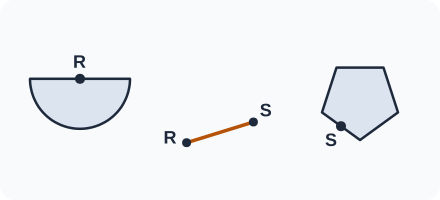
A rug is shaped like a semicircle whose straight edge is 12 feet long. How much floor does the rug cover?

Show the answer

Answer: D

Correct answer: 18π square feet. The straight edge is the diameter, so r = 6 feet. A semicircle covers half the full disk: one half of π(6)^2 = one half of 36π = 18π square feet.

  • A: This is the area of the whole circle; a semicircle is only half of it.
  • B: This uses 12 as the radius, giving 144π, and then halves it; the 12-foot edge is the diameter.
  • C: This is π times 6, the length of the curved edge, not the area inside.
  • D (correct): The radius is 6, and half of 36π is 18π square feet.
Question 65 · MK · medium

A submarine moves from 340 feet below sea level to 85 feet below sea level. Which describes the change in its position?

Show the answer

Answer: C

Correct answer: A rise of 255 feet. Depths below sea level are negative: start = −340, final = −85. Change = final − start =

−85 − (−340) = −85 + 340 = 255

A positive change is a rise of 255 feet.

  • A: The size is right, but moving from −340 to −85 is moving up toward the surface.
  • B: This adds 340 and 85 as if the sub crossed sea level; both positions are below the surface.
  • C (correct): Change = final − start = −85 − (−340) = 255, a positive change, so it rose.
  • D: This adds the depths and gets the direction wrong as well.
Question 66 · MK · medium

Lines AB and CD are perpendicular and meet at point E. Ray EF lies inside angle AEC and makes angle AEF measure 27°. What is the measure of angle FEC?

Show the answer

Answer: C

Correct answer: 63°. Perpendicular lines form 90° angles, so angle AEC = 90°. Angles AEF and FEC are adjacent and together make angle AEC, so angle FEC =

90 - 27 = 63

°.

  • A: This subtracts 27 from 180, but the two parts fill a right angle, not a straight line.
  • B: This adds 90 and 27 instead of subtracting the known part from the right angle.
  • C (correct): Angle AEC is a right angle, so the two adjacent parts total 90°: 90 - 27 = 63°.
  • D: Angle FEC would equal 27° only if EF bisected the right angle, and that is not given.
Question 67 · MK · hard

Which equation has no solution?

Show the answer

Answer: A

Correct answer:

4(x - 2) + 3 = 4x - 1

Simplify each side. An equation has no solution when the x terms cancel and a false statement remains. For

4(x − 2) + 3 = 4x − 1

the left side is 4x − 5, and subtracting 4x leaves

−5 = −1

which is never true.

  • A (correct): It simplifies to 4x − 5 = 4x − 1; subtracting 4x leaves −5 = −1, which is false.
  • B: It simplifies to 6x = 6x, which is always true, so every real number is a solution.
  • C: It simplifies to 5x − 5 = 4x − 5, which gives x = 0; zero is a valid single solution.
  • D: It simplifies to 6x − 3 = 5x − 2, which has exactly one solution, x = 1.
Question 68 · MK · hard

A rectangular lawn is 20 feet by 14 feet. A rectangular shed 6 feet by 4 feet and a circular flower bed with a diameter of 6 feet sit on the lawn without overlapping. How many square feet of grass remain?

Show the answer

Answer: D

Correct answer: 256 - 9π square feet. Lawn: 20 times 14 is 280. Shed: 6 times 4 is 24. The bed has radius 3, so its area is 9 pi.

  • A: This squares the diameter 6 instead of the radius 3, so the flower bed is counted four times too large.
  • B: This removes the flower bed but forgets to subtract the 24 square foot shed.
  • C: This subtracts the circle's circumference, 2 pi r, which is a length, not the area pi r squared.
  • D (correct): Subtract the shed (24) and the circle with radius 3 (9 pi) from the 280 square foot lawn.
Question 69 · MK · hard

What is written in scientific notation?

Show the answer

Answer: C

Correct answer: 2 × 10⁷. Multiply the top: 6 times 3 is 18 and

5 + (-2) = 3

so the top is . Divide by the bottom: 18 divided by 9 is 2, and

The result is , already in proper form.

  • A: This adds the bottom exponent instead of subtracting it: 3 + (-4) = -1.
  • B: This drops the minus sign on 10^-2, so the top exponent becomes 7 and 7 + 4 = 11.
  • C (correct): The top is 18 x 10^3; dividing gives 2 and an exponent of 3 - (-4) = 7.
  • D: This subtracts in the wrong order, taking -4 - 3 instead of 3 - (-4).
Question 70 · MK · hard

A rack holds 32 dumbbells, each weighing either 15 pounds or 25 pounds. The total weight is 600 pounds. How many more 15-pound dumbbells than 25-pound dumbbells are on the rack?

Show the answer

Answer: D

Correct answer: 8. Let a be the 15-pound count and b the 25-pound count:

a + b = 32
and
15a + 25b = 600

Multiply the first by 15:

15a + 15b = 480

Subtract: 10b = 120, so b = 12 and a = 20. The question asks for the difference:

20 − 12 = 8
  • A: This is the number of 25-pound dumbbells, not the difference the question asks for.
  • B: This is the number of 15-pound dumbbells, not how many more there are.
  • C: This is 600 divided by 25, which assumes every dumbbell weighs 25 pounds.
  • D (correct): There are 20 fifteen-pound and 12 twenty-five-pound dumbbells, so there are 8 more of the lighter ones.

Electronics Information

15 questions · 10 min on the real test
Question 71 · EI · easy

A schematic shows the standard diode symbol, a triangle pointing at a bar, with two small arrows pointing outward, away from it. What is this component?

Show the answer

Answer: A

Correct answer: A light-emitting diode. The basic diode symbol plus outward arrows means a light-emitting diode: the arrows show light coming out. Inward arrows would mean light coming in, as in a photodiode.

  • A (correct): Outward arrows show light leaving the device, which marks an LED.
  • B: A photodiode senses light, and its symbol has arrows pointing inward toward the diode, not outward.
  • C: A Zener diode is shown by bent tips on the bar, not by arrows.
  • D: A lamp is drawn as a circle with an X inside, not as a diode symbol.
Question 72 · EI · easy

An ideal battery drives two resistors in series. A third resistor is added to the same loop. What happens to the current?

Show the answer

Answer: C

Correct answer: It decreases. In series, grows with every resistor added. Since

and the source voltage is fixed, a larger total resistance means a smaller current.

  • A: This confuses series with parallel, where adding a path raises the total current.
  • B: The current depends on the total resistance, which has changed.
  • C (correct): The added resistor raises the total resistance, so the same voltage pushes less current.
  • D: Adding a resistor does not break the loop, so current still flows.
Question 73 · EI · easy

Which of these materials is classified as a semiconductor?

Show the answer

Answer: B

Correct answer: Germanium. Semiconductors such as silicon and germanium sit between conductors and insulators. Their conductivity can be raised precisely by doping, heat or light, which is what makes them useful for electronic devices.

  • A: Copper has many free electrons and carries current easily, so it is a conductor.
  • B (correct): Germanium, like silicon, conducts poorly when pure but can have its conductivity raised in a controlled way, which makes it a semiconductor.
  • C: Rubber has almost no free charge carriers and blocks current, so it is an insulator.
  • D: Aluminum is a metal with plenty of free electrons, so it is a conductor.
Question 74 · EI · easy

A multimeter shows a current of 0.035 A flowing through a small motor. What is this current in milliamperes?

Show the answer

Answer: D

Correct answer: 35 mA. One ampere equals 1,000 mA, so to change amperes to milliamperes multiply by 1,000: 0.035 times 1,000 is 35 mA. A smaller unit always needs a larger number.

  • A: This slips one decimal place; 0.035 A times 1,000 is 35, not 3.5.
  • B: This moves the decimal four places instead of three; 350 mA would be 0.35 A.
  • C: This divides by 1,000 instead of multiplying; going from amperes to the smaller milliampere unit must give a bigger number.
  • D (correct): Multiplying 0.035 A by 1,000 gives 35 mA.
Question 75 · EI · medium

A temperature sensor in an HVAC unit has 3 V across it and carries 12 mA. What is its resistance?

Show the answer

Answer: D

Correct answer: 250 Ω. Convert first: 12 mA = 0.012 A. Then use

  • A: This divides 3 by 12 without converting 12 mA to 0.012 A.
  • B: This divides 12 by 3, putting current over voltage and also skipping the conversion.
  • C: This divides current by voltage, 0.012 by 3, which gives conductance-type units, not ohms.
  • D (correct): Converting 12 mA to 0.012 A and dividing 3 V by 0.012 A gives 250 Ω.
Question 76 · EI · medium

A 25-turn coil with an area of 0.02 m^2 sits in a uniform 0.8 T field, with its face square to the field so the flux is as large as possible. In 0.1 s it is turned until the field lines run parallel to its face. What average emf is induced?

Show the answer

Answer: D

Correct answer: 4 V. Turning the coil changes the angle, so the flux changes. At the start

Wb per turn; edge-on the flux is 0, so

Wb.

  • A: This is the emf of a single turn; the change must be multiplied by all 25 turns.
  • B: This multiplies by the time instead of dividing by it; a faster change gives a larger emf, so time goes in the denominator.
  • C: Ending at zero flux does not mean zero emf; the emf depends on how much the flux changed, which here is the full 0.016 Wb per turn.
  • D (correct): Flux per turn falls from 0.016 Wb to 0, and V.
Question 77 · EI · medium

A technician is checking a de-energized, isolated resistor marked 220 kΩ. Her manual-range meter is set to the 2 kΩ resistance range, and the display shows OL. What should she do next?

Show the answer

Answer: B

Correct answer: Switch to a higher resistance range, such as 2 MΩ, and measure again. OL on a resistance setting means the value is larger than the range selected. A 220 kΩ resistor cannot be shown on a 2 kΩ range, so she should step up to a range above 220 kΩ, keeping the circuit de-energized and the part isolated.

  • A: OL only means the value is above the selected range; the resistor may be perfectly good.
  • B (correct): 220 kΩ is far above a 2 kΩ range, so a higher range is needed for a reading.
  • C: An ohmmeter supplies its own test current; power must stay off for a safe, valid reading.
  • D: Reversing leads does not matter for a plain resistor and does not fix an over-range reading.
Question 78 · EI · medium

What is the main historical reason that alternating current, rather than direct current, became the standard for power grids?

Show the answer

Answer: D

Correct answer: Transformers can easily step AC voltage up for transmission and back down. Line heating grows with the square of the current, so long-distance lines work best at very high voltage and low current. Transformers step AC voltage up for transmission and back down near homes, which is why AC won out for grids.

  • A: Both AC and DC can be deadly; safety was not what made AC the grid standard.
  • B: AC lines still lose energy as heat; that loss depends on the current flowing.
  • C: AC reverses direction periodically; one-direction flow describes DC.
  • D (correct): High transmission voltage means low current and much smaller heat loss, and transformers make that voltage changing simple with AC.
Question 79 · EI · medium

A drone battery is labeled 7.2 V and 2,500 mAh. About how much energy does it store?

Show the answer

Answer: C

Correct answer: 18 Wh. Stored energy is about volts times ampere-hours. Convert 2,500 mAh to 2.5 Ah, then

Wh.

  • A: This multiplies by 2,500 without first converting milliampere-hours to ampere-hours.
  • B: This divides the voltage by the capacity instead of multiplying them.
  • C (correct): Converting 2,500 mAh to 2.5 Ah and multiplying by 7.2 V gives 18 Wh.
  • D: This divides 2,500 by 7.2, which mixes up the units and the operation.
Question 80 · EI · medium

A hobbyist connects a red LED directly across a 9 V battery with nothing else in the circuit, and the LED flashes brightly and then goes dark for good. What is the most likely reason?

Show the answer

Answer: C

Correct answer: No series resistor limited the current, so the LED drew far too much. Once an LED's forward voltage is reached, a small increase in voltage causes a large jump in current. A 9 V battery is far above a red LED's roughly 2 V drop, so without a series resistor the current is excessive and the LED fails.

  • A: A reverse-biased LED simply blocks and stays dark; this LED flashed, so it was conducting in the forward direction.
  • B: A battery supplies DC; the problem is the size of the current, not the type of supply.
  • C (correct): Above its forward voltage an LED's current rises steeply, so without a current-limiting resistor it overheats and burns out.
  • D: Outward arrows mark a light emitter; inward arrows would mark a sensor such as a photodiode.
Question 81 · EI · medium

A small step-up transformer raises 24 V AC to 240 V AC. A load draws 0.5 A from the secondary. Treating the transformer as ideal, what current does the primary draw?

Show the answer

Answer: C

Correct answer: 5 A. In an ideal transformer, power in equals power out:

The side with the higher voltage has the lower current.

  • A: This scales the current the same way as voltage; in a step-up transformer the low-voltage side carries the higher current.
  • B: The current changes by the inverse of the voltage ratio; it does not stay the same on both sides.
  • C (correct): Output power is W, and A on the primary.
  • D: This multiplies by the ratio twice; a 10-to-1 voltage ratio changes current by a factor of 10, not 100.
Question 82 · EI · hard

On an oscilloscope, a technician measures 2.5 ms from one zero crossing of a sine wave to the very next zero crossing. What is the frequency of the wave?

Show the answer

Answer: C

Correct answer: 200 Hz. A sine wave crosses zero twice per cycle, so neighboring zero crossings are half a period apart. The period is

ms, and

Hz
  • A: This treats the 2.5 ms between neighboring zero crossings as a full period, but that span is only half a cycle.
  • B: This doubles the time twice, using a 10 ms period instead of 5 ms.
  • C (correct): Neighboring zero crossings are half a cycle apart, so the period is 5 ms and Hz.
  • D: This halves the time instead of doubling it, as if four zero crossings fit in each 2.5 ms.
Question 83 · EI · hard

An 8 Ω resistor and a 24 Ω resistor are connected in series across an ideal 48 V source. How much power does the 24 Ω resistor dissipate?

Show the answer

Answer: C

Correct answer: 54 W. Series resistances add:

8 + 24 = 32 Ω

so the loop current is

A through both parts. Then use

for the 24 Ω resistor.

Check: its drop is 1.5 times 24 = 36 V, and 36 times 1.5 is also 54 W.

  • A: This uses the full 48 V across the 24 Ω resistor, but in series that resistor gets only part of the supply voltage.
  • B: 72 W is the total power of the circuit, 48 V times 1.5 A, not the power in one resistor.
  • C (correct): The loop current is 48/32 = 1.5 A, and 1.5 squared times 24 gives 54 W.
  • D: 18 W is the power in the 8 Ω resistor, not the 24 Ω one.
Question 84 · EI · hard

A schematic shows a 12 V battery with two branches across it. One branch has lamps L1 and L2 in series; the other branch has lamp L3 alone. L3 lights normally, while L1 and L2 are both dark. An ideal voltmeter reads 0 V across L1 and 12 V across L2. Which fault explains every observation?

Show the answer

Answer: A

Correct answer: An open in L2. L3 lights, so the battery is fine and the problem is in the L1–L2 branch. Both lamps are dark, so that branch carries no current, which points to an open. With no current, the good lamp drops 0 V and the full 12 V appears across the break, so the open is at L2.

  • A (correct): With L2 open the series branch carries no current, L1 drops 0 V, and the full 12 V appears across the gap at L2.
  • B: If L1 were open, the full 12 V would appear across L1 and 0 V across L2, the reverse of the readings.
  • C: A short across L1 would leave L2 lit, and even brighter, with 12 V across it, but L2 is dark.
  • D: A dead battery could not keep L3 lit, and it could not put 12 V across L2.
Question 85 · EI · hard

A 2 Ω resistor and an 8 Ω resistor are connected in parallel across an ideal source, and together they dissipate 50 W. How much of that power does the 8 Ω resistor dissipate?

Show the answer

Answer: C

Correct answer: 10 W. Both branches share one voltage, so

makes power inversely proportional to resistance. The 2 Ω branch takes 4 times the power of the 8 Ω branch.

Split 50 W into 5 equal parts of 10 W: the 2 Ω resistor gets 40 W and the 8 Ω resistor gets 10 W.

  • A: This is the share of the 2 Ω resistor; in parallel the larger resistor dissipates less.
  • B: This splits the power equally, which only happens with equal resistors.
  • C (correct): With equal voltage, power is inversely proportional to resistance, so the 8 Ω resistor gets 1 part in 5 of 50 W.
  • D: This multiplies 50 W by 2/8 instead of by the 8 Ω branch’s actual share of 1/5.

Auto Information

10 questions · 7 min on the real test
Question 86 · AI · easy

Compared with a 20:1 steering ratio, a 12:1 steering ratio will:

Show the answer

Answer: B

Correct answer: feel quicker, needing less wheel rotation but more effort. Steering ratio is steering-wheel angle divided by road-wheel angle. At 12:1, each 12° of steering gives 1° at the tires, versus 20° at 20:1, so the lower ratio is quicker but needs more force.

  • A: This describes the higher 20:1 ratio, not the lower 12:1 ratio.
  • B (correct): A lower ratio turns the road wheels more per degree of steering, so it is quicker but heavier.
  • C: A lower ratio turns the road wheels more, not less, for the same steering input.
  • D: A quicker ratio actually raises the effort, so assist is still useful.
Question 87 · AI · easy

Why do the half-shafts of a front-wheel-drive car use constant-velocity joints instead of simple universal joints?

Show the answer

Answer: A

Correct answer: CV joints keep output speed steady even at the large angles of steered wheels. A simple universal joint at an angle makes its output speed rise and fall slightly during each turn, which is acceptable only at small angles. Front wheels steer through large angles while driving, so CV joints with balls or rollers in grooved races keep the speed smooth.

  • A (correct): A simple U-joint speeds up and slows down each turn at an angle; CV joints avoid this at large angles.
  • B: CV joints pass rotation through at the same ratio; the final drive provides reduction.
  • C: Allowing left and right wheels to turn at different speeds is the differential's job.
  • D: Disconnecting engine torque is the clutch's job.
Question 88 · AI · medium

Before heading down a long, steep grade in a loaded moving truck, a driver shifts to a lower gear. Why does this help the brakes?

Show the answer

Answer: A

Correct answer: Engine braking holds back the truck, so the service brakes are used less and stay cooler. Engine braking comes from the engine's internal resistance when the driver lifts off the throttle in gear, and a lower gear makes it stronger. Because it carries part of the slowing load on a long descent, the pads and rotors heat up less and are less likely to fade.

  • A (correct): A lower gear increases engine braking, sharing the work and leaving the friction brakes cooler and less prone to fade.
  • B: Gear choice does not change hydraulic line pressure or clamping force; that comes from the pedal, booster and master cylinder.
  • C: ABS acts only when a wheel nears lock; gear choice is about sharing the slowing work, not triggering ABS.
  • D: Engine braking adds to the service brakes but does not replace them; even on a steep grade the driver still brakes when needed.
Question 89 · AI · medium

A car travels at 25 m/s on tires with an outside diameter of 0.64 m. Assuming no slip, about how fast is each wheel turning?

Show the answer

Answer: C

Correct answer: About 746 rpm. Each revolution moves the car one circumference:

m

From v = Cn,

n = v / C = 25 / 2.01 = 12.4

rev/s.

Convert to rpm: 12.4 x 60 = about 746 rpm.

  • A: This is the rate in revolutions per second; it still needs to be multiplied by 60.
  • B: This divides speed by the diameter instead of the circumference, leaving out .
  • C (correct): C = (0.64) = 2.01 m, so n = 25 / 2.01 = 12.4 rev/s, and 12.4 x 60 = about 746 rpm.
  • D: This uses times the diameter, which gives twice the true circumference.
Question 90 · AI · medium

How does a planetary gearset in a conventional automatic transmission produce different ratios, such as reduction, direct drive or reverse?

Show the answer

Answer: B

Correct answer: By holding one member still, driving another and taking output from the third. A planetary set has a sun gear, planet gears on a carrier and an outer ring gear. Hydraulically applied clutches and bands decide which member is held, which is driven and which delivers output, and each combination gives a different ratio.

  • A: Sliding gears into mesh describes an old manual design, not a planetary set.
  • B (correct): Choosing which of the sun, carrier and ring is held, driven or output sets the ratio.
  • C: Variable pulleys belong to a CVT.
  • D: Two clutches for odd and even gears on separate input shafts describe a dual-clutch transmission.
Question 91 · AI · medium

A sedan cranks at normal speed but will not start. The fuel gauge reads half full, the check-engine lamp works at key-on, and the battery is fully charged. Which next step follows good diagnostic reasoning?

Show the answer

Answer: B

Correct answer: Check whether the fuel pump primes and scan for codes. Normal cranking clears the starting circuit, so the problem is in what the engine needs to run: fuel, spark, air and engine control. Listening for the pump to prime and reading stored codes are quick, noninvasive checks that eliminate branches before any part is replaced.

  • A: The starter is already spinning the engine at normal speed, so the starting circuit has done its job.
  • B (correct): A crank-no-start points to fuel, spark, air or engine control, and a gauge reading does not prove that fuel is actually being delivered under pressure.
  • C: Fuel quantity in the tank says nothing about whether the pump runs, the filter flows or the injectors are commanded.
  • D: The battery is already charged and cranking is normal, so charging it again gathers no new evidence.
Question 92 · AI · medium

Most gasoline engines control power by opening a throttle plate. How does a traditional diesel engine mainly control its power output?

Show the answer

Answer: D

Correct answer: By changing the amount of fuel injected. A gasoline engine controls power by controlling air with a throttle, then matching fuel to it. A traditional diesel does not throttle its air for power control; it varies power mainly by the quantity of fuel injected.

  • A: Diesels ignite fuel with compression heat and have no spark plugs for each power stroke.
  • B: A conventional diesel has a fixed compression ratio; it is not adjusted to control power.
  • C: Traditional diesels have no throttle plate for power control; that method belongs to gasoline engines.
  • D (correct): A traditional diesel takes in air freely and varies output mainly by injecting more or less fuel.
Question 93 · AI · medium

Why does a diesel engine need a much higher compression ratio than a typical gasoline engine?

Show the answer

Answer: C

Correct answer: Squeezing the air harder makes it hot enough to ignite the injected fuel. A diesel uses compression ignition. It compresses air alone, commonly 15:1 to over 20:1, which makes the air very hot, so fuel sprayed in near TDC lights on its own without a spark.

  • A: A diesel takes in air only on the intake stroke; its fuel is injected near the end of compression.
  • B: Diesels do not use spark plugs to ignite the fuel, so there is no spark to strengthen.
  • C (correct): A diesel has no spark plug, so strong compression must raise the air temperature high enough to light the fuel when it is sprayed in.
  • D: Compressing air heats it rather than cooling it, and that heat is exactly what a diesel relies on.
Question 94 · AI · hard

A soldier at a field site runs a 150 W radio charger from a fully charged 12 V, 100 Ah battery. To protect the battery, only half of its rated capacity will be used. In the ideal model, about how long can the charger run?

Show the answer

Answer: C

Correct answer: 4 h. Usable energy is half of

Wh, or 600 Wh. Running time is

h.

The same answer comes from current:

A
and

h.

  • A: This uses the full 100 Ah and forgets the half-capacity limit.
  • B: This is the charger's current in amperes, not a time in hours.
  • C (correct): The charger draws 150 / 12 = 12.5 A, half the capacity is 50 Ah, and 50 / 12.5 = 4 h.
  • D: This divides 50 Ah by 150 W, mixing up amperes and watts.
Question 95 · AI · hard

An older car keeps running hot, and its owner removes the thermostat, reasoning that coolant will now flow to the radiator all the time. What is the most likely result?

Show the answer

Answer: D

Correct answer: The engine may warm slowly and run too cool, while the real fault stays unfixed. Without a thermostat, coolant goes to the radiator even when the engine is cold, so it warms slowly, runs cool, gives weak cabin heat, and may lose fuel economy. Overheating is a symptom, so the real cause, such as a leak, weak pump, clogged radiator, or failed fan, still needs to be diagnosed.

  • A: A thermostat does not create heat; it only opens and closes a path, so removing it cannot remove a heat source.
  • B: If the real cause is a leak, weak pump, blocked radiator, or dead fan, that fault remains and overheating can return.
  • C: Coolant flow and oil pressure are separate circuits; the thermostat has no effect on the oil pump.
  • D (correct): With no thermostat the engine behaves like one with a stuck-open thermostat, and overheating is a symptom whose real cause has not been found.

Shop Information

10 questions · 6 min on the real test
Question 96 · SI · easy

A student has just tightened a new bit in a drill press chuck. What must be done before switching the machine on?

Show the answer

Answer: C

Correct answer: Remove the chuck key from the chuck. A chuck key left in the chuck becomes a projectile when the spindle starts. Always remove the key and any other setup tools before startup, then check the guard and clamping.

  • A: Loose gloves near a rotating chuck and bit create an entanglement hazard instead of preventing one.
  • B: Speed should match the bit and the material; the highest setting is not automatically correct or safer.
  • C (correct): A key left in the chuck can be flung out at high speed when the spindle starts turning.
  • D: Leaving the key in place is exactly the hazard: it can be thrown from the chuck at startup.
Question 97 · SI · easy

Why must oil and grease be kept off oxygen regulators and fittings used for torch work?

Show the answer

Answer: C

Correct answer: Oxygen makes oily material burn violently. Oxygen is an oxidizer, not ordinary shop air. In oxygen-rich conditions, oil or grease can ignite and burn violently, so oxygen equipment must be kept clean.

  • A: Corrosion is not the main reason; the danger is rapid, intense fire.
  • B: Grease does not usefully change flame temperature; it is a fire hazard in oxygen.
  • C (correct): Oxygen-rich conditions can greatly intensify combustion, so oil or grease can ignite with dangerous force.
  • D: Gauge accuracy is not the issue; oil and oxygen together create a serious ignition hazard.
Question 98 · SI · medium

The hook on the end of a good tape measure is riveted so it can move back and forth a small amount. What is the purpose of this movement?

Show the answer

Answer: B

Correct answer: It makes up for the hook's thickness on both inside and outside measurements. The hook moves out when pulled against an outside edge and in when pushed against an inside surface. The distance it moves equals the hook's thickness, so the reading starts from the true zero in both cases.

  • A: The play is designed into a sound tape; only a bent, loose or damaged hook calls for replacement.
  • B (correct): Sliding by exactly its own thickness keeps zero correct whether the hook is pulled against an edge or pushed against a wall.
  • C: Blade flexibility comes from the curved steel blade, not from the end hook's movement.
  • D: The units are printed on the blade; the hook's movement has nothing to do with the unit system.
Question 99 · SI · medium

While a technician threads a stainless steel nut onto a stainless steel bolt, resistance suddenly rises sharply and the threads begin to tear, even though the parts were clean and correctly matched. What is the most likely cause?

Show the answer

Answer: A

Correct answer: Galling between the stainless surfaces. Similar stainless steel parts can gall: their surfaces stick and tear under sliding pressure, causing rapid seizure. Since the parts were clean and correctly matched, galling is the best explanation, and the safe action is to stop rather than apply more force.

  • A (correct): Sliding stainless surfaces can adhere and tear, producing sudden seizure even with matched, clean threads.
  • B: Both parts are stainless steel, and galvanic corrosion develops over time, not during installation.
  • C: Low torque does not tear threads; the problem is rising resistance during installation.
  • D: Matched left-hand threads install normally, and nothing prevents stainless parts from having them.
Question 100 · SI · medium

A carpenter wants to check that the end of a board was cut at exactly 90 degrees to its edge. Which tool is designed for this check?

Show the answer

Answer: C

Correct answer: Combination square. A combination square checks 90-degree and 45-degree relationships and helps mark lines. Lock the head and blade and keep them clean before trusting the reading; the combination wrench is a turning tool despite the similar name.

  • A: Despite the similar name, a combination wrench turns nuts and bolts; it cannot check an angle.
  • B: A bar clamp holds wide work together and does not measure angles.
  • C (correct): A combination square checks 90-degree and 45-degree angles and is used for marking and layout.
  • D: A feeler gauge measures small clearances, not whether a corner is square.
Question 101 · SI · medium

A drawing lists a 5/16-inch drill. Using the exact conversion factor, what is this diameter in millimeters?

Show the answer

Answer: A

Correct answer: 7.9375 mm. Convert the fraction to a decimal, then multiply by 25.4 mm per inch:

5/16 = 0.3125 inch

and 0.3125 x 25.4 = 7.9375 mm.

  • A (correct): 5/16 inch is 0.3125 inch, and 0.3125 x 25.4 = 7.9375 mm exactly.
  • B: This uses 25 mm per inch instead of the exact 25.4 mm.
  • C: This multiplies by 2.54, which converts inches to centimeters, not millimeters.
  • D: This divides 25.4 by 0.3125 instead of multiplying.
Question 102 · SI · medium

On a drawing, a cutting-plane line is labeled A at both ends, with arrows at each end pointing the same way. What do the arrows show?

Show the answer

Answer: B

Correct answer: The direction from which the sectioned part is viewed. A cutting-plane line marks where an imaginary cut is taken, and its arrows tell which way you look at the exposed interior. The resulting view is labeled with the same letters, such as SECTION A-A.

  • A: The cutting plane is imaginary; it is a drafting device, not a shop cutting instruction.
  • B (correct): Cutting-plane arrows show the viewing direction for the matching SECTION A-A.
  • C: Assembly order is shown by assembly or exploded views and notes, not by cutting-plane arrows.
  • D: Hatch direction is a graphic convention in the section itself and is not set by these arrows.
Question 103 · SI · medium

A picture frame has outside dimensions of 18 inches by 24 inches. Ignoring miter waste, how many feet of molding are needed to go around the outside edge?

Show the answer

Answer: B

Correct answer: 7 feet. Perimeter of a rectangle = 2(L + W).

  • A: This adds length and width once (42 inches) instead of doubling the sum for all four sides.
  • B (correct): Perimeter = 2(18 + 24) = 84 inches, and 84 / 12 = 7 feet.
  • C: This uses the area, 18 x 24 = 432 square inches, divided by 12; area does not measure distance around.
  • D: 84 is the perimeter in inches; it must be divided by 12 to convert to feet.
Question 104 · SI · hard

A pump housing made of aluminum (2.7 g/cm³) has a mass of 1.35 kg. An identical housing is cast in steel (7.85 g/cm³). What is the mass of the steel housing?

Show the answer

Answer: C

Correct answer: 3.93 kg. Identical shape means identical volume. Volume = 1,350 g ÷ 2.7 g/cm³ = 500 cm³.

Steel mass = 7.85 g/cm³ × 500 cm³ = 3,925 g, or about 3.93 kg.

  • A: This flips the density ratio, multiplying by 2.7 ÷ 7.85, which wrongly makes the steel part lighter.
  • B: This is only the extra mass the steel version adds (5.15 g/cm³ × 500 cm³), not its total mass.
  • C (correct): The volume is 1,350 ÷ 2.7 = 500 cm³, and 500 × 7.85 = 3,925 g, about 3.93 kg.
  • D: This multiplies the aluminum mass by steel density, skipping the step of finding the volume first.
Question 105 · SI · hard

A 50 mm diameter bar turning at 600 rpm has a certain surface speed. A 75 mm diameter bar is to be turned at the same surface speed. What spindle speed is needed?

Show the answer

Answer: A

Correct answer: 400 rpm. From v = , equal surface speeds require

  • A (correct): Surface speed is proportional to D x N, so N = 50 x 600 / 75 = 400 rpm.
  • B: This increases rpm with diameter, but a larger diameter already moves faster at the edge, so rpm must go down.
  • C: Keeping the same rpm would raise the surface speed by a factor of 75/50 = 1.5.
  • D: This halves the speed, which would make the surface speed lower than the original.

Mechanical Comprehension

15 questions · 22 min on the real test
Question 106 · MC · easy

A 50 mm pulley and a 200 mm pulley are both keyed to the same shaft, which turns at 600 rpm. How fast does the 200 mm pulley turn?

Show the answer

Answer: B

Correct answer: 600 rpm. Pulleys keyed to the same shaft rotate as one piece, so each makes the same number of turns per minute: 600 rpm. Diameter only matters when a belt links two pulleys on different shafts; here it changes the rim speed, not the rpm.

  • A: This applies the belt-drive ratio 50/200, but that ratio only applies to pulleys connected by a belt, not to a shared shaft.
  • B (correct): Pulleys fixed to one shaft must turn together, so both turn at the shaft speed regardless of their diameters.
  • C: This applies the inverted ratio 200/50; diameter has no effect on the rpm of pulleys mounted on the same shaft.
  • D: There is no reason to halve the speed; a shared shaft gives every pulley on it exactly the same rpm.
Question 107 · MC · easy

A worker is lifting a load with a lever. The load and its distance from the fulcrum stay the same, but the worker moves her hands so the effort arm is twice as long. How does the ideal effort change?

Show the answer

Answer: A

Correct answer: It becomes half as large. The load's moment stays the same, so effort × effort arm must stay the same. Doubling the effort arm therefore cuts the needed effort in half; the hands simply move twice as far.

  • A (correct): The same moment supplied at twice the distance needs half the force.
  • B: This reverses the relationship; effort is inversely proportional to the effort arm.
  • C: Moving the hands farther from the fulcrum increases leverage, so the needed effort drops.
  • D: Effort varies directly with one over the arm length, not with its square, so doubling the arm halves it.
Question 108 · MC · easy

A solid aluminum block and a solid pine block have exactly the same outside dimensions. Both are held completely under the water of a swimming pool. How do the buoyant forces on them compare?

Show the answer

Answer: D

Correct answer: Both blocks receive the same buoyant force. By Archimedes' principle, the buoyant force equals the weight of the fluid displaced,

Both blocks are fully under and have the same volume, so they displace the same amount of water and get the same buoyant force. Their materials only decide what happens when they are let go.

  • A: This confuses the object's density with the fluid's; a heavier material does not displace more water.
  • B: Pine floats when released, but while both are held fully under they displace the same water and get equal lift.
  • C: Any object in water displaces some of it and feels an upward buoyant force.
  • D (correct): Equal outside volumes displace equal volumes of water, and the buoyant force depends only on the displaced water.
Question 109 · MC · easy

A plastic ruler clamped to a desk is plucked. It swings back and forth several times, each swing smaller than the last, until it stops. How is this motion damped?

Show the answer

Answer: B

Correct answer: Underdamped. Underdamped systems swing past equilibrium several times with shrinking amplitude. The ruler loses energy to air drag and internal heating each cycle, so its swings die out.

  • A: A critically damped system returns to rest as fast as possible without overshooting, so it would not swing back and forth.
  • B (correct): Light damping lets the system overshoot equilibrium repeatedly while the amplitude shrinks, exactly as the ruler does.
  • C: An overdamped system creeps slowly back to rest without swinging past equilibrium.
  • D: With no damping the swings would keep the same size; here they shrink, so energy is being removed.
Question 110 · MC · medium

A flexible test bladder contains 12.0 L of air at 150 kPa absolute. A press slowly squeezes it, with no change in temperature, until the absolute pressure reaches 360 kPa. What volume does the air now occupy?

Show the answer

Answer: D

Correct answer: 5.0 L. Boyle's law with absolute pressures:

The pressure rose 2.4 times, so the volume fell to 1/2.4 of its starting value.

  • A: This inverts the pressure ratio; raising the pressure must shrink the volume, not enlarge it.
  • B: This converts both pressures to gauge values first; Boyle's law requires absolute pressures.
  • C: This assumes the volume stays fixed; at constant temperature pressure and volume are inversely related.
  • D (correct): By Boyle's law, the new volume is 150 times 12.0 / 360 = 5.0 L; higher pressure means smaller volume.
Question 111 · MC · medium

In a simple train of three external gears on fixed shafts, a bolt falls into the middle gear and jams it so it cannot turn. The motor then tries to turn the input gear. What happens?

Show the answer

Answer: B

Correct answer: No gear can turn, and the teeth are heavily stressed. In an ordinary fixed-axis train, every gear meshed with a locked gear is also locked, because the teeth cannot slip past each other. The input and output cannot turn, and the stalled motor loads the teeth heavily, which can break them.

  • A: The output receives motion only through the middle gear; if it is jammed, nothing reaches the output.
  • B (correct): Interlocked teeth cannot slip, so a jammed gear locks every gear meshed with it.
  • C: The input meshes directly with the jammed gear, so it cannot turn either.
  • D: Teeth cannot slip to give a partial speed; a jammed gear stops the whole chain.
Question 112 · MC · medium

A 100 mm motor pulley turning 1,440 rpm drives a 300 mm pulley. On the same shaft as the 300 mm pulley, a 75 mm pulley drives a 225 mm pulley on a conveyor. Assuming no slip, how fast does the conveyor pulley turn?

Show the answer

Answer: D

Correct answer: 160 rpm. Work stage by stage. Stage one:

rpm

and the 75 mm pulley on that shaft also turns at 480 rpm.

Stage two:

rpm

The overall reduction is 3 times 3 = 9, and

1,440/9 = 160 rpm
  • A: This is only the intermediate shaft speed; the second belt stage reduces the speed by another factor of three.
  • B: This adds the two stage ratios (3 + 3 = 6); in a compound drive the stage ratios multiply to give 9.
  • C: This inverts both ratios, making a drive with larger driven pulleys speed up instead of slow down.
  • D (correct): Stage one gives 1,440 times 100/300 = 480 rpm, which the 75 mm pulley shares; stage two gives 480 times 75/225 = 160 rpm.
Question 113 · MC · medium

A 300 N box rides on top of a 200 N sled, and the box does not slip on the sled. A rope drags the sled across level snow, where the kinetic friction coefficient between sled and snow is 0.10. What is the friction force from the snow on the sled?

Show the answer

Answer: D

Correct answer: 50 N. Treat each contact separately. At the sled-snow contact, the normal force carries everything above it:

300 + 200 = 500 N

Kinetic friction there is

N
  • A: This uses only the sled weight; the box presses down through the sled, so its weight adds to the normal force on the snow.
  • B: This uses only the box weight; the snow must support the sled too.
  • C: The box not slipping on the sled is a separate contact; the sled itself is sliding on the snow, so kinetic friction acts there.
  • D (correct): The snow supports both the sled and the box, so the normal force is 500 N and friction is 0.10 × 500 = 50 N.
Question 114 · MC · medium

A screw jack has a single-start thread with a 4 mm lead and a handle radius of 0.20 m. Ignoring friction, about what effort at the handle lifts a 12,000 N load?

Show the answer

Answer: D

Correct answer: 38.2 N. In one turn the hand travels while the load moves one lead.

  • A: This uses the handle radius instead of the handle circle, , as the effort distance per turn.
  • B: This uses , half the circle, so the effort distance per turn is too short and the effort too large.
  • C: This converts 4 mm to 0.04 m instead of 0.004 m, making the lead ten times too large.
  • D (correct): The IMA is , and 12,000/314 is about 38.2 N.
Question 115 · MC · medium

A stone is dropped from rest into a deep well and hits the water 2.5 s later. Using

g = 9.8 m/s²

and ignoring air resistance and the time for the sound to return, how far does the stone fall?

Show the answer

Answer: D

Correct answer: About 30.6 m. For a drop from rest,

  • A: This is the speed reached after 2.5 s, 9.8 × 2.5, in m/s, not the distance fallen.
  • B: This leaves out the one-half in d = ½gt².
  • C: This forgets to square the time, computing ½ × 9.8 × 2.5.
  • D (correct): The drop is ½ × 9.8 × 2.5² = 4.9 × 6.25 ≈ 30.6 m.
Question 116 · MC · medium

A shop scale uses a spring. A 45 N weight stretches the spring 3 cm. Assuming the spring stays within its normal range, what weight would stretch it 5 cm?

Show the answer

Answer: D

Correct answer: 75 N. By Hooke's law, force is proportional to stretch. The spring constant is k = 45 N ÷ 0.03 m = 1,500 N/m.

For a 0.05 m stretch,

F = 1,500 × 0.05 = 75 N

As a ratio check:

45 × 5/3 = 75 N
  • A: This flips the ratio (45 × 3/5); a larger stretch needs a larger force, not a smaller one.
  • B: This adds 2 N for the extra 2 cm instead of scaling the force in proportion to the stretch.
  • C: This multiplies 45 by 5 as if 45 N produced only 1 cm of stretch.
  • D (correct): Force grows in proportion to stretch: 5 cm is 5/3 of 3 cm, and 45 × 5/3 = 75 N.
Question 117 · MC · hard

A camp cook has 3 kg of lemonade (treat it as water, c = 4,200 J/(kg·K)) at 25°C. Ice at 0°C is added, just enough that all of it melts and the lemonade ends at 0°C, in an insulated cooler. Use L_f = 334,000 J/kg. About how much ice is needed?

Show the answer

Answer: C

Correct answer: About 0.94 kg. Heat lost by the lemonade equals heat gained by the melting ice.

So

kg
  • A: This divides by the latent heat of vaporization; melting ice uses the latent heat of fusion.
  • B: This uses 298 K as the temperature change; a drop from 25°C to 0°C is a change of only 25 K.
  • C (correct): Cooling the lemonade releases 3 × 4,200 × 25 = 315,000 J, which melts 315,000 ÷ 334,000 ≈ 0.94 kg of ice.
  • D: This divides the latent heat by the heat released, flipping the ratio.
Question 118 · MC · hard

A soldier drags a loaded supply sled across level snow at a steady speed. The sled and load weigh 460 N. The rope pulls with 100 N at 37 degrees above horizontal. Use sin 37° ≈ 0.60 and cos 37° ≈ 0.80. What is the kinetic friction coefficient between sled and snow?

Show the answer

Answer: B

Correct answer: 0.20. Split the pull: horizontal part

N

upward part

N

Steady speed means friction equals 80 N, and the normal force is

460 − 60 = 400 N
  • A: This divides 80 N by the full 460 N weight, ignoring that the rope lifts 60 N and lowers the normal force.
  • B (correct): The forward pull 80 N equals friction, and the normal force is 460 − 60 = 400 N, so 80 ÷ 400 = 0.20.
  • C: This uses the whole 100 N rope tension as friction; only the 80 N horizontal component balances friction.
  • D: This adds the 60 N rope component to the weight; an upward pull reduces the normal force instead.
Question 119 · MC · hard

A 25 kg hand truck starts from rest on a level floor. A worker pushes it 5 m with a steady 160 N horizontal force while friction resists with 70 N. What is the hand truck's speed at the end of the 5 m?

Show the answer

Answer: D

Correct answer: 6 m/s. Push:

160 × 5 = 800 J

Friction:

−70 × 5 = −350 J

Net work = 450 J.

By the work-energy theorem, starting from rest:

So

and
v = 6 m/s
  • A: This uses only the 800 J done by the push and ignores the negative work of friction.
  • B: This drops the one-half in the kinetic energy formula, solving 450 = 25v².
  • C: This stops at v² = 36 and forgets to take the square root.
  • D (correct): Net work is 450 J, so 450 = ½ × 25 × v², giving v² = 36 and v = 6 m/s.
Question 120 · MC · hard

A car passes a parked patrol vehicle at a steady 20 m/s. At that same instant the patrol vehicle starts from rest and accelerates at a steady 2.5 m/s² in the same direction. How long does the patrol vehicle take to catch the car, and how far has it traveled by then?

Show the answer

Answer: C

Correct answer: 16 s and 320 m. They meet when their positions match: car

patrol

Setting

gives
t = 20 ÷ 1.25 = 16 s

Distance:

20 × 16 = 320

m (check:

1.25 × 256 = 320 m

).

  • A: At 8 s the two speeds are equal, but the car is still ahead; equal velocity is not the same as meeting.
  • B: This is where the patrol vehicle is when the speeds match, while the car is already at 160 m.
  • C (correct): Setting 20t = 1.25t² gives t = 16 s, and both vehicles are then 20 × 16 = 320 m from the start.
  • D: The time is right, but 640 m multiplies the final speed of 40 m/s by the time instead of using the average speed.

Assembling Objects

15 questions · 18 min on the real test
Question 121 · AO · easy

The left box shows separate flat pieces. Which figure shows how the pieces look when they are fitted together?

Left box: 3 separate flat pieces: a four-sided piece (about 40% of the total area), a four-sided piece (about 37% of the total area), a triangle (about 24% of the total area).
Show the answer

Answer: A

Count the pieces first: every figure must use each piece exactly once, with nothing added. Then pick one distinctive piece, such as the largest one or one with a curved or sharply pointed edge, and look for it in each figure; pieces may be turned but never flipped over. A figure whose cut lines are in different places has pieces of different sizes and can be crossed out. Here the pieces fit together into a right triangle.

  • A (correct): This right triangle is made of exactly the 3 pieces in the left box, each only turned and slid into place.
  • B: A cut is in a different place, so the pieces do not match: one piece here covers about 61% of the shape, but the matching piece in the left box covers about 40%.
  • C: This figure has 4 pieces, but the left box has 3. Every piece must be used once, and nothing may be added.
  • D: This figure is a triangle. The pieces in the left box do not have these shapes, so they cannot fill this outline without gaps or overlaps.
Question 122 · AO · easy

The left box shows separate flat pieces. Which figure shows how the pieces look when they are fitted together?

Left box: 2 separate flat pieces: a six-sided piece (about 82% of the total area), a four-sided piece (about 18% of the total area).
Show the answer

Answer: B

Count the pieces first: every figure must use each piece exactly once, with nothing added. Then pick one distinctive piece, such as the largest one or one with a curved or sharply pointed edge, and look for it in each figure; pieces may be turned but never flipped over. A figure whose cut lines are in different places has pieces of different sizes and can be crossed out. Here the pieces fit together into a hexagon.

  • A: A cut is in a different place, so the pieces do not match: one piece here covers about 44% of the shape, but the matching piece in the left box covers about 18%.
  • B (correct): This hexagon is made of exactly the 2 pieces in the left box, each only turned and slid into place.
  • C: This figure has 3 pieces, but the left box has 2. Every piece must be used once, and nothing may be added.
  • D: This figure is a pentagon. The pieces in the left box do not have these shapes, so they cannot fill this outline without gaps or overlaps.
Question 123 · AO · easy

The left box shows two shapes, each with a lettered point, and a line with the same two letters on its ends. Which figure shows how the shapes connect when each end of the line is attached to the point with the same letter?

Left box: a rectangle with point G at a corner, a half-circle with point H at a corner of the flat side, and a separate line with end G and end H.
Show the answer

Answer: D

Check one letter at a time. Point G is at a corner of the rectangle, and point H is at a corner of the flat side of the half-circle. Cross out any figure where either end of the line lands somewhere else or where a shape has changed. The shapes may be turned, so find each point by its place on the shape (corner, middle of a side, center), not by up, down, left or right.

  • A: The line ends in the wrong place: it meets the rectangle at the center, but point G is at a corner and it meets the half-circle at the middle of the flat side, but point H is at a corner of the flat side.
  • B: The line ends in the wrong place: it meets the rectangle at the middle of a long side, but point G is at a corner.
  • C: The line ends in the wrong place: it meets the half-circle at the top of the curved side, but point H is at a corner of the flat side.
  • D (correct): The line joins a corner of the rectangle to a corner of the flat side of the half-circle, the same spots as points G and H in the left box; turning a shape does not move a point on it.
Question 124 · AO · easy

The left box shows two shapes, each with a lettered point, and a line with the same two letters on its ends. Which figure shows how the shapes connect when each end of the line is attached to the point with the same letter?

Left box: a right triangle with point G at the sharpest corner, a pentagon with point H at the center, and a separate line with end G and end H.
Show the answer

Answer: C

Check one letter at a time. Point G is at the sharpest corner of the right triangle, and point H is at the center of the pentagon. Cross out any figure where either end of the line lands somewhere else or where a shape has changed. The shapes may be turned, so find each point by its place on the shape (corner, middle of a side, center), not by up, down, left or right.

  • A: The line ends in the wrong place: it meets the right triangle at the middle of the longer leg, but point G is at the sharpest corner.
  • B: The line ends in the wrong place: it meets the right triangle at the middle of the shorter leg, but point G is at the sharpest corner and it meets the pentagon at a corner, but point H is at the center.
  • C (correct): The line joins the sharpest corner of the right triangle to the center of the pentagon, the same spots as points G and H in the left box; turning a shape does not move a point on it.
  • D: The line ends in the wrong place: it meets the right triangle at the right-angle corner, but point G is at the sharpest corner.
Question 125 · AO · medium

The left box shows two shapes, each with a lettered point, and a line with the same two letters on its ends. Which figure shows how the shapes connect when each end of the line is attached to the point with the same letter?

Left box: a diamond with point E at the middle of a side, a rectangle with point F at the center, and a separate line with end E and end F.
Show the answer

Answer: C

Check one letter at a time. Point E is at the middle of a side of the diamond, and point F is at the center of the rectangle. Cross out any figure where either end of the line lands somewhere else or where a shape has changed. The shapes may be turned, so find each point by its place on the shape (corner, middle of a side, center), not by up, down, left or right.

  • A: The line ends in the wrong place: it meets the rectangle at the middle of a long side, but point F is at the center.
  • B: The line ends in the wrong place: it meets the diamond at a wide corner, but point E is at the middle of a side.
  • C (correct): The line joins the middle of a side of the diamond to the center of the rectangle, the same spots as points E and F in the left box; turning a shape does not move a point on it.
  • D: One of the shapes here is a square, but the left box has a diamond. Joining parts never changes a shape.
Question 126 · AO · medium

The left box shows two shapes, each with a lettered point, and a line with the same two letters on its ends. Which figure shows how the shapes connect when each end of the line is attached to the point with the same letter?

Left box: a half-circle with point R at the middle of the flat side, a pentagon with point S at the middle of a side, and a separate line with end R and end S.
Show the answer

Answer: B

Check one letter at a time. Point R is at the middle of the flat side of the half-circle, and point S is at the middle of a side of the pentagon. Cross out any figure where either end of the line lands somewhere else or where a shape has changed. The shapes may be turned, so find each point by its place on the shape (corner, middle of a side, center), not by up, down, left or right.

  • A: The line ends in the wrong place: it meets the pentagon at the center, but point S is at the middle of a side.
  • B (correct): The line joins the middle of the flat side of the half-circle to the middle of a side of the pentagon, the same spots as points R and S in the left box; turning a shape does not move a point on it.
  • C: The line ends in the wrong place: it meets the half-circle at the top of the curved side, but point R is at the middle of the flat side.
  • D: One of the shapes here is a hexagon, but the left box has a pentagon. Joining parts never changes a shape.
Question 127 · AO · medium

The left box shows separate flat pieces. Which figure shows how the pieces look when they are fitted together?

Left box: 3 separate flat pieces: a piece with a curved side (about 50% of the total area), a piece with a curved side (about 31% of the total area), a piece with a curved side (about 19% of the total area).
Show the answer

Answer: A

Count the pieces first: every figure must use each piece exactly once, with nothing added. Then pick one distinctive piece, such as the largest one or one with a curved or sharply pointed edge, and look for it in each figure; pieces may be turned but never flipped over. A figure whose cut lines are in different places has pieces of different sizes and can be crossed out. Here the pieces fit together into a half-circle.

  • A (correct): This half-circle is made of exactly the 3 pieces in the left box, each only turned and slid into place.
  • B: This figure has 4 pieces, but the left box has 3. Every piece must be used once, and nothing may be added.
  • C: This figure is a trapezoid. The pieces in the left box do not have these shapes, so they cannot fill this outline without gaps or overlaps.
  • D: A cut is in a different place, so the pieces do not match: one piece here covers about 59% of the shape, but the matching piece in the left box covers about 50%.
Question 128 · AO · medium

The left box shows separate flat pieces. Which figure shows how the pieces look when they are fitted together?

Left box: 3 separate flat pieces: a four-sided piece (about 49% of the total area), a four-sided piece (about 39% of the total area), a four-sided piece (about 12% of the total area).
Show the answer

Answer: A

Count the pieces first: every figure must use each piece exactly once, with nothing added. Then pick one distinctive piece, such as the largest one or one with a curved or sharply pointed edge, and look for it in each figure; pieces may be turned but never flipped over. A figure whose cut lines are in different places has pieces of different sizes and can be crossed out. Here the pieces fit together into a rectangle.

  • A (correct): This rectangle is made of exactly the 3 pieces in the left box, each only turned and slid into place.
  • B: A cut is in a different place, so the pieces do not match: one piece here covers about 24% of the shape, but the matching piece in the left box covers about 12%.
  • C: This figure has 4 pieces, but the left box has 3. Every piece must be used once, and nothing may be added.
  • D: This figure is a parallelogram. The pieces in the left box do not have these shapes, so they cannot fill this outline without gaps or overlaps.
Question 129 · AO · medium

The left box shows separate flat pieces. Which figure shows how the pieces look when they are fitted together?

Left box: 3 separate flat pieces: a five-sided piece (about 43% of the total area), a five-sided piece (about 38% of the total area), a four-sided piece (about 19% of the total area).
Show the answer

Answer: D

Count the pieces first: every figure must use each piece exactly once, with nothing added. Then pick one distinctive piece, such as the largest one or one with a curved or sharply pointed edge, and look for it in each figure; pieces may be turned but never flipped over. A figure whose cut lines are in different places has pieces of different sizes and can be crossed out. Here the pieces fit together into a hexagon.

  • A: A cut is in a different place, so the pieces do not match: one piece here covers about 24% of the shape, but the matching piece in the left box covers about 38%.
  • B: This figure has 4 pieces, but the left box has 3. Every piece must be used once, and nothing may be added.
  • C: This figure is a circle. The pieces in the left box do not have these shapes, so they cannot fill this outline without gaps or overlaps.
  • D (correct): This hexagon is made of exactly the 3 pieces in the left box, each only turned and slid into place.
Question 130 · AO · medium

The left box shows two shapes, each with a lettered point, and a line with the same two letters on its ends. Which figure shows how the shapes connect when each end of the line is attached to the point with the same letter?

Left box: a pentagon with point G at a corner, a rectangle with point H at the center, and a separate line with end G and end H.
Show the answer

Answer: D

Check one letter at a time. Point G is at a corner of the pentagon, and point H is at the center of the rectangle. Cross out any figure where either end of the line lands somewhere else or where a shape has changed. The shapes may be turned, so find each point by its place on the shape (corner, middle of a side, center), not by up, down, left or right.

  • A: The line ends in the wrong place: it meets the pentagon at the center, but point G is at a corner.
  • B: The line ends in the wrong place: it meets the rectangle at the middle of a long side, but point H is at the center.
  • C: One of the shapes here is a parallelogram, but the left box has a rectangle. Joining parts never changes a shape.
  • D (correct): The line joins a corner of the pentagon to the center of the rectangle, the same spots as points G and H in the left box; turning a shape does not move a point on it.
Question 131 · AO · medium

The left box shows two shapes, each with a lettered point, and a line with the same two letters on its ends. Which figure shows how the shapes connect when each end of the line is attached to the point with the same letter?

Left box: a right triangle with point E at the middle of the shorter leg, a parallelogram with point F at the middle of a short side, and a separate line with end E and end F.
Show the answer

Answer: C

Check one letter at a time. Point E is at the middle of the shorter leg of the right triangle, and point F is at the middle of a short side of the parallelogram. Cross out any figure where either end of the line lands somewhere else or where a shape has changed. The shapes may be turned, so find each point by its place on the shape (corner, middle of a side, center), not by up, down, left or right.

  • A: The line ends in the wrong place: it meets the right triangle at the sharpest corner, but point E is at the middle of the shorter leg.
  • B: The line ends in the wrong place: it meets the parallelogram at the middle of a long side, but point F is at the middle of a short side.
  • C (correct): The line joins the middle of the shorter leg of the right triangle to the middle of a short side of the parallelogram, the same spots as points E and F in the left box; turning a shape does not move a point on it.
  • D: One of the shapes here is a rectangle, but the left box has a parallelogram. Joining parts never changes a shape.
Question 132 · AO · hard

The left box shows two shapes, each with a lettered point, and a line with the same two letters on its ends. Which figure shows how the shapes connect when each end of the line is attached to the point with the same letter?

Left box: a diamond with point J at the middle of a side, a square with point K at the middle of a side, and a separate line with end J and end K.
Show the answer

Answer: B

Check one letter at a time. Point J is at the middle of a side of the diamond, and point K is at the middle of a side of the square. Cross out any figure where either end of the line lands somewhere else or where a shape has changed. The shapes may be turned, so find each point by its place on the shape (corner, middle of a side, center), not by up, down, left or right.

  • A: The line ends in the wrong place: it meets the diamond at a wide corner, but point J is at the middle of a side and it meets the square at a corner, but point K is at the middle of a side.
  • B (correct): The line joins the middle of a side of the diamond to the middle of a side of the square, the same spots as points J and K in the left box; turning a shape does not move a point on it.
  • C: The line ends in the wrong place: it meets the diamond at a wide corner, but point J is at the middle of a side.
  • D: The line ends in the wrong place: it meets the square at the center, but point K is at the middle of a side.
Question 133 · AO · hard

The left box shows separate flat pieces. Which figure shows how the pieces look when they are fitted together?

Left box: 4 separate flat pieces: a four-sided piece (about 30% of the total area), a five-sided piece (about 29% of the total area), a five-sided piece (about 23% of the total area), a four-sided piece (about 18% of the total area).
Show the answer

Answer: B

Count the pieces first: every figure must use each piece exactly once, with nothing added. Then pick one distinctive piece, such as the largest one or one with a curved or sharply pointed edge, and look for it in each figure; pieces may be turned but never flipped over. A figure whose cut lines are in different places has pieces of different sizes and can be crossed out. Here the pieces fit together into a hexagon.

  • A: A cut is in a different place, so the pieces do not match: one piece here covers about 42% of the shape, but the matching piece in the left box covers about 30%.
  • B (correct): This hexagon is made of exactly the 4 pieces in the left box, each only turned and slid into place.
  • C: This figure is a circle. The pieces in the left box do not have these shapes, so they cannot fill this outline without gaps or overlaps.
  • D: A cut is in a different place, so the pieces do not match: one piece here covers about 40% of the shape, but the matching piece in the left box covers about 30%.
Question 134 · AO · hard

The left box shows separate flat pieces. Which figure shows how the pieces look when they are fitted together?

Left box: 4 separate flat pieces: a four-sided piece (about 29% of the total area), a five-sided piece (about 25% of the total area), a triangle (about 24% of the total area), a four-sided piece (about 22% of the total area).
Show the answer

Answer: B

Count the pieces first: every figure must use each piece exactly once, with nothing added. Then pick one distinctive piece, such as the largest one or one with a curved or sharply pointed edge, and look for it in each figure; pieces may be turned but never flipped over. A figure whose cut lines are in different places has pieces of different sizes and can be crossed out. Here the pieces fit together into a square.

  • A: This figure is a rectangle. The pieces in the left box do not have these shapes, so they cannot fill this outline without gaps or overlaps.
  • B (correct): This square is made of exactly the 4 pieces in the left box, each only turned and slid into place.
  • C: A cut is in a different place, so the pieces do not match: one piece here covers about 45% of the shape, but the matching piece in the left box covers about 29%.
  • D: A cut is in a different place, so the pieces do not match: one piece here covers about 55% of the shape, but the matching piece in the left box covers about 29%.
Question 135 · AO · hard

The left box shows two shapes, each with a lettered point, and a line with the same two letters on its ends. Which figure shows how the shapes connect when each end of the line is attached to the point with the same letter?

Left box: a triangle with point G at a corner, a pentagon with point H at the middle of a side, and a separate line with end G and end H.
Show the answer

Answer: C

Check one letter at a time. Point G is at a corner of the triangle, and point H is at the middle of a side of the pentagon. Cross out any figure where either end of the line lands somewhere else or where a shape has changed. The shapes may be turned, so find each point by its place on the shape (corner, middle of a side, center), not by up, down, left or right.

  • A: The line ends in the wrong place: it meets the triangle at the center, but point G is at a corner.
  • B: One of the shapes here is a hexagon, but the left box has a pentagon. Joining parts never changes a shape.
  • C (correct): The line joins a corner of the triangle to the middle of a side of the pentagon, the same spots as points G and H in the left box; turning a shape does not move a point on it.
  • D: The line ends in the wrong place: it meets the triangle at the middle of a side, but point G is at a corner.

Finished?

See your score by subtest, which questions you missed and the lesson to review for each one.

Some questions are unanswered

Unanswered questions count as wrong. You can go back and answer them, or check your answers now.

About this test

This form tilts toward matter and the periodic table, chemical reactions, earth science, resistance and conductors, AC and DC, semiconductors, transmissions and drivetrains, pulleys and friction. Math and verbal emphasis falls on decimals, percentages, signed numbers, suffixes and cause and effect. Maintenance Tools and Service Basics is the one lesson it leaves out.

Questions are original and never repeated across practice tests. Simulate test day as closely as you can, then use the explanations to rebuild weak areas. The scores shown are practice accuracy and should not be treated as official ASVAB results.

Take it with you: the free app

The same 124 lessons, 6,516 questions and 82 timed practice tests on your phone, plus flashcards with spaced review and progress tracking. Free to download, and it works offline.

  • Works offline
  • Spaced-review flashcards
  • Progress for every subtest
  • Menus in 59 languages
ASVAB Camp appGoogle Play