ASVAB Camp Get the appGoogle Play
Diagnostic

ASVAB Diagnostic: Find Your Strong and Weak Subtests

Not sure where to start? The ASVAB Diagnostic samples every subtest in a single 75-minute sitting. It has 60 questions, six each from General Science, Arithmetic Reasoning, Word Knowledge, Paragraph Comprehension, Mathematics Knowledge, Electronics Information, Auto Information, Shop Information, Mechanical Comprehension and Assembling Objects. The difficulty is split evenly: 20 easy, 20 medium and 20 hard.

  • 60 questions
  • 75 minutes
  • 10 subtests
  • Every answer explained
  1. Pick your answers. You can change them until you check.
  2. Check my answers scores the test by subtest and opens every explanation.
0 / 60 answered

General Science

6 questions · 8 min on the real test
Question 1 · GS · easy

What does a light-year measure?

Show the answer

Answer: C

Correct answer: Distance light travels in one year. Despite the word year, a light-year measures length, not time, about 9.5 trillion kilometers or 5.9 trillion miles. Astronomers use it because star distances in ordinary units become unmanageably large; the nearest star beyond the Sun is roughly 4.2 light-years away. The trap is the word year, which suggests time, but it only tells you how long light needs to cover that distance.

  • A: A light-year does not measure energy.
  • B: An orbital year is a time interval, not a light-year distance.
  • C (correct): Light-year is a length unit defined from light travel.
  • D: Rotational speed is not what light-year denotes.
Question 2 · GS · easy

Which property of an object ordinarily remains the same when moved from Earth to the Moon?

Show the answer

Answer: D

Correct answer: Its mass in kilograms. Mass measures how much matter an object contains and how strongly it resists changes in motion, so it depends only on the object itself. Weight is the gravitational force on that mass, W = mg, and changes with location. On the Moon, g is about one-sixth of Earth's, so a 60 kg astronaut still has 60 kg of mass but weighs only about one-sixth as many newtons. Confusing mass with weight is the usual mistake.

  • A: Gravitational acceleration differs between Earth and Moon.
  • B: Weight depends on the local gravitational field.
  • C: Support force can change with gravity and conditions.
  • D (correct): The object’s intrinsic mass remains the same.
Question 3 · GS · medium

Which claim about Earth’s rotation and orbit is correct?

Show the answer

Answer: B

Correct answer: Rotation gives the day–night cycle; revolution with axial tilt produces annual seasons. Earth spins once about every 24 hours, carrying each location into and out of sunlight. Its axis stays tilted about 23.5° as it orbits, so each hemisphere alternately leans toward the Sun, getting more direct rays and longer days. A tempting error is blaming seasons on distance, but Earth is actually closest to the Sun in early January, during Northern Hemisphere winter.

  • A: The day-night cycle is primarily from rotation.
  • B (correct): Rotation produces the daily light-dark rhythm; tilt during Earth’s annual orbit drives seasons.
  • C: Day and night do come from rotation, but seasons come from axial tilt, not changes in Earth–Sun distance; Earth is nearest the Sun in early January.
  • D: Earth rotates about an axis tilted relative to its orbital plane.
Question 4 · GS · medium

A stone has a mass of 84 g. When it is lowered into a graduated cylinder, the water level rises from 25 mL to 55 mL. What is the density of the stone?

Show the answer

Answer: C

Correct answer: 2.8 g/mL. The stone's volume equals the rise in water level:

55 - 25 = 30 mL

Then density is mass divided by volume:

  • A: This divides the volume by the mass, which flips the density formula.
  • B: This divides the mass by the starting water level of 25 mL instead of by the volume the stone displaced.
  • C (correct): The stone's volume is 55 - 25 = 30 mL, and 84 g divided by 30 mL is 2.8 g/mL.
  • D: This divides the mass by the final water level of 55 mL instead of by the change in level.
Question 5 · GS · hard

A plastic block measures 8 cm by 5 cm by 2.5 cm and has a mass of 70 g. Water has a density of about 1 g/cm³. What is the block's density, and will it float in water?

Show the answer

Answer: A

Correct answer: 0.7 g/cm³; it floats. First find the volume, then divide mass by volume.

Since 0.7 g/cm³ is less than water's 1 g/cm³, the block floats.

  • A (correct): The volume is 100 cm³, so the density is 70 ÷ 100 = 0.7 g/cm³, which is less than water's.
  • B: This uses a volume of 10 cm³, but 8 × 5 × 2.5 is actually 100 cm³.
  • C: This divides volume by mass instead of mass by volume; the units would come out as cm³ per gram.
  • D: The density is right, but an object less dense than water floats rather than sinks.
Question 6 · GS · hard

Someone confuses fat digestion roles. Which sequence is scientifically most accurate?

Show the answer

Answer: C

Correct answer: Liver makes bile, gallbladder stores it, and bile aids enzymes acting on fat in the small intestine. Fat digestion is a relay with separate jobs. The liver produces bile continuously, the gallbladder stores and concentrates it, and after a fatty meal bile flows into the small intestine. There bile salts emulsify fat into small droplets so pancreatic lipase can split it into fatty acids and glycerol, which are then absorbed. The most common confusion is crediting the gallbladder with making bile.

  • A: The gallbladder mainly stores bile, the stomach does not store it, and most fat absorption occurs in the small intestine.
  • B: Kidneys form urine; the bile pathway involves liver, gallbladder and small intestine, and bile emulsifies rather than digests fat.
  • C (correct): This keeps the distinct production, storage, emulsification and enzyme roles in the right organs.
  • D: Insulin regulates blood glucose and is not a digestive enzyme.

Arithmetic Reasoning

6 questions · 8 min on the real test
Question 7 · AR · easy

A postal clerk can sort a truckload of mail in 2 hours, and a trainee can sort the same load in 6 hours. Working together, how long will it take them to sort the load?

Show the answer

Answer: A

Correct answer: 1.5 hours. Add the rates:

of the load per hour.

Invert to get the time:

hours
  • A (correct): Together they sort 1/2 + 1/6 = 2/3 of the load per hour, so the time is 3/2 = 1.5 hours.
  • B: This averages the two times; together they must beat the faster clerk's 2 hours.
  • C: This adds the two times instead of adding the rates.
  • D: This stops at the combined rate of 2/3 load per hour and forgets to invert it.
Question 8 · AR · easy

What is ?

Show the answer

Answer: A

Correct answer: 3/5. Multiply numerators and denominators, canceling first: 2 and 10 share a factor of 2, and 9 and 3 share a factor of 3.

  • A (correct): Multiplying across gives 18/30, which simplifies to 3/5 (or cancel first: 1/1 times 3/5).
  • B: This adds the numerators and the denominators, which is not how fractions are multiplied.
  • C: This flips the second fraction, which is the step for division, not multiplication.
  • D: This is the sum of the fractions (47/30), not the product.
Question 9 · AR · medium

A courier drives 117 miles in 2 hours 15 minutes. What is the courier's average speed?

Show the answer

Answer: C

Correct answer: 52 mph. Convert the time: 15 minutes is

15/60 = 0.25 hour

so the trip takes 2.25 hours.

Then

mph
  • A: This divides by 2 hours and ignores the extra 15 minutes.
  • B: This treats 15 minutes as half an hour, dividing by 2.5 hours instead of 2.25 hours.
  • C (correct): 2 hours 15 minutes is 2.25 hours, and 117 divided by 2.25 is 52.
  • D: This multiplies distance by time; speed comes from dividing distance by time.
Question 10 · AR · medium

On a qualification range, 5 soldiers score 40, 3 soldiers score 45, and 2 soldiers score 50. What is the average score of the 10 soldiers?

Show the answer

Answer: B

Correct answer: 43.5. Each count acts as a weight:

Divide by the total count:

  • A: 45 is the average of the three different scores, ignoring how many soldiers earned each.
  • B (correct): The weighted total is 200 + 135 + 100 = 435, and 435 divided by 10 is 43.5.
  • C: This divides the total of 435 by the 3 score levels instead of by the 10 soldiers.
  • D: This matches the counts with the wrong scores, giving the most weight to 50 instead of 40.
Question 11 · AR · hard

An aircraft mechanic earns $24.80 per hour, with time-and-a-half for hours over 40 in a week. This week the mechanic worked 9.5 hours each day, Monday through Friday. What is the mechanic's gross pay for the week?

Show the answer

Answer: C

Correct answer: $1,271.00. Total hours:

5 × 9.5 = 47.5

so 7.5 hours are overtime. Overtime rate:

1.5 × 24.80 = $37.20

Gross pay is $1,271.00.

  • A: This pays all 47.5 hours at the regular $24.80 rate and leaves out the overtime premium.
  • B: This pays every one of the 47.5 hours at the $37.20 overtime rate; only the 7.5 hours beyond 40 earn it.
  • C (correct): The week has 47.5 hours: 40 × 24.80 = $992 regular pay plus 7.5 × 37.20 = $279 overtime pay, for $1,271.
  • D: This pays the extra hours at only half the regular rate ($12.40) instead of one and a half times it ($37.20).
Question 12 · AR · hard

The price of a generator part was cut 10 percent. Later the reduced price was raised 20 percent, and the part now costs $162. What was the price before both changes?

Show the answer

Answer: D

Correct answer: $150. Multiply the change factors:

so the final price is 108 percent of the original.

Original:

dollars

Check: 150 times 0.90 is 135, and 135 times 1.20 is 162.

  • A: This combines the changes into a net 10 percent increase and divides by 1.10; successive percents must be multiplied, not added.
  • B: This takes 10 percent off $162 instead of undoing both changes by division.
  • C: This undoes only the 20 percent increase and ignores the earlier 10 percent cut.
  • D (correct): The changes multiply to 0.90 times 1.20, or 1.08, and 162 divided by 1.08 is 150.

Word Knowledge

6 questions · 8 min on the real test
Question 13 · WK · easy

On the long flight over the ocean, the NAVIGATOR kept checking the plane's position.

In this sentence, NAVIGATOR most nearly means:

Show the answer

Answer: C

Correct answer: route planner. Cover -or to find navigate, to plan and steer a course. The ending -or names the doer of the action, so a navigator is the person who plans the route.

  • A: This noun names the activity of steering a course, not the person who does it.
  • B: A passenger rides along without directing the trip, unlike someone who navigates.
  • C (correct): The base navigate means plan and direct a course, and -or names the person who does it.
  • D: A ship is the vessel, not the person who works out its course.
Question 14 · WK · easy

On clear nights, the lighthouse beam is VISIBLE from twenty miles out at sea.

VISIBLE most nearly means:

Show the answer

Answer: C

Correct answer: able to be seen. Vis means see and the suffix -ible means able to be. A beam that is visible can be seen, here from twenty miles away.

  • A: This is audible; it uses aud, hear, instead of vis, see.
  • B: A bright beam helps, but visible names whether it can be seen, not how strong it is.
  • C (correct): Vis means see and -ible means able to be, so visible means able to be seen.
  • D: This is invisible, the opposite meaning created by the negative prefix in-.
Question 15 · WK · medium

At a crowded town meeting, neighbors DENOUNCED the plan to close the clinic, calling it reckless and unfair.

In this sentence, DENOUNCED most nearly means:

Show the answer

Answer: C

Correct answer: condemned. The words "reckless and unfair" give the word a strongly negative tone. Of the choices, only condemned carries that charge, so DENOUNCED means condemned.

  • A: This is the opposite; supporters would not call the plan reckless.
  • B: This look-alike word means made known; the neighbors were attacking the plan, not reporting it.
  • C (correct): Calling a plan reckless and unfair in public is strong criticism, which is condemning it.
  • D: This is too neutral; "reckless and unfair" shows a strongly negative stance.
Question 16 · WK · medium

The new hardware store UNDERCUT its rival by selling the same cordless drill for $10 less. UNDERCUT most nearly means?

Show the answer

Answer: A

Correct answer: Priced below. Under- here means less than, and the clue is that the store sold the same drill for $10 less. To undercut a rival is to sell for a lower price, or price below it.

  • A (correct): Under- means less than, so to undercut a rival is to offer the same goods at a lower price.
  • B: Overcharged means charging too much, the reverse direction of under-.
  • C: Copied fits selling the same drill but misses the key fact of the $10 lower price.
  • D: Cut beneath is a literal guess about position, but the sentence is about price.
Question 17 · WK · hard

With two backup generators on site, the chance of a total power failure during the event is REMOTE.

REMOTE most nearly means:

Show the answer

Answer: B

Correct answer: slight. REMOTE has several senses: far away, operated from a distance, or small. Applied to a chance, and with two backup generators as the clue, the sentence calls for small, so slight is the best match.

  • A: Isolated fits the place sense of remote, as in a remote cabin, but a chance cannot be cut off from others; this is the wrong sense.
  • B (correct): Slight fits the sentence sense: with two backups, the chance of failure is small.
  • C: Certain is the opposite of what two backup generators suggest.
  • D: Remote control is a familiar phrase, but controlled does not describe the size of a chance.
Question 18 · WK · hard

Through the radio static, the pilot DISTINCTLY heard the tower order her to circle the field once more.

DISTINCTLY most nearly means:

Show the answer

Answer: B

Correct answer: clearly. Distinctly is an -ly adverb telling how she heard. Distinguish means to tell apart, and something heard distinctly is easy to make out. Distinctive (characteristic) is a family member with a different meaning.

  • A: This is built from distinctive, meaning typical and easy to recognize, not how well something was heard.
  • B (correct): Distinctly is the adverb meaning clearly, which tells how the pilot heard the order despite the static.
  • C: Faintly is the opposite of hearing an order clearly.
  • D: Differently draws on the idea of telling things apart, but the sentence is about how plainly she heard.

Paragraph Comprehension

6 questions · 8 min on the real test
Question 19 · PC · easy

The Benton County landfill accepts household trash and yard waste from county residents at no charge. Residents must show a driver's license or a utility bill with a county address at the gate. Tires, paint, and car batteries are accepted only on the second Saturday of each month, during the household hazardous waste collection. Commercial haulers are charged by weight and must use the scale entrance on Mill Road.

According to the passage, when may a resident drop off an old car battery?

Show the answer

Answer: C

Correct answer: The second Saturday of every month. Find the sentence that names car batteries: they are accepted "only on the second Saturday of each month." The words "only on" limit the rule, so an answer that drops or widens that limit is wrong.

  • A: The free, any-day rule covers trash and yard waste; it drops the only-on condition that applies to batteries.
  • B: The Mill Road entrance is for commercial haulers, a detail that does not answer when a resident may bring a battery.
  • C (correct): The passage says car batteries are accepted only on the second Saturday of each month, during the hazardous waste collection.
  • D: This widens the condition; batteries are accepted on the second Saturday only, not every Saturday.
Question 20 · PC · easy

Private Jamal Reyes had never used a compass in the dark. When the land navigation course opened at 2100, he clicked on his red-lens flashlight, checked his first bearing and stepped into the pine woods. Twice he walked into thick brush and had to back out, counting his paces again from the last trail marker. Just before midnight, his light caught the orange stake of his final point. He punched his scorecard, let out a long breath and headed back toward the trucks.

What is the author mainly doing in this passage?

Show the answer

Answer: C

Correct answer: Telling a story about one soldier's night on a navigation course. A narrative follows specific people through events in time, while a process passage gives steps that apply to any case. Here a named private moves from 2100 to just before midnight, meeting obstacles and finishing, so the passage tells a story.

  • A: No general instructions are given; the compass and flashlight details describe what one soldier did, not steps any reader should follow.
  • B: The passage contains no judgment or should statement about the training; it only recounts one soldier's night.
  • C (correct): The passage follows a particular person through events in time, from the start of the course to the final point, which is narration.
  • D: Daytime navigation is never mentioned, so nothing is being set side by side.
Question 21 · PC · medium

For each of the past four years, the Marlow County animal shelter has built one new outdoor dog run each spring. Each run has been paid for entirely with the money raised at the shelter's annual pancake breakfast, which brings in about the same amount every year. This year's breakfast was held last month and raised roughly the usual total. The shelter's director says it has no other money set aside for construction.

Which prediction is best supported by the passage?

Show the answer

Answer: B

Correct answer: The shelter will probably build one more dog run this spring. A sound prediction continues the pattern within its stated limits. The shelter has added one run a year using breakfast money, this year's breakfast raised the usual amount, and there are no other funds. So the safest prediction is one more run, not several and not a larger project.

  • A: The usual breakfast total has paid for only one run each year, and there are no other construction funds.
  • B (correct): The pattern of one run per year, paid for by a breakfast that raised its usual amount, supports exactly one more run, stated with suitable caution.
  • C: Nothing in the passage mentions a new building, and the limited budget makes such a project unsupported.
  • D: The breakfast just raised its usual amount and funds the runs; nothing suggests it will end.
Question 22 · PC · medium

The motor pool keeps two kinds of stock. Large items such as engines and transmissions are ordered only when a vehicle needs one. Consumables, on the other hand, are kept on the shelves at all times: wiper blades, oil filters, brake pads, headlight bulbs and spark plugs. Because these parts wear out or get used up during normal service, the clerk reorders them every month.

As used in the passage, what does consumables most nearly mean?

Show the answer

Answer: A

Correct answer: parts that are used up and must be replaced often. The list of examples, wiper blades, filters, brake pads, bulbs and spark plugs, shows the category: small parts that wear out. The last sentence confirms they get used up during normal service, and on the other hand separates them from big parts ordered as needed. So consumables are parts that are used up and must be replaced often.

  • A (correct): The examples are all items that wear out in normal use, and the last sentence says they get used up and are reordered monthly.
  • B: This is a familiar sense of things that are consumed, but every example is a vehicle part, not food.
  • C: This describes engines and transmissions, which on the other hand sets apart from consumables.
  • D: Wiper blades and bulbs are installed in vehicles, not used as tools; this names a related idea, not the meaning.
Question 23 · PC · hard

Last spring, the housing office on an Army post set a goal of completing every routine repair request within three days. To get there, it hired two more technicians and began letting residents file requests online instead of by phone. By the end of the summer, the average wait for a routine repair had fallen from six days to four. The office now plans to add a weekend shift, which managers say should close the remaining gap by next spring.

Which statement is best supported by the passage?

Show the answer

Answer: D

Correct answer: The office shortened the average wait but had not yet met its goal. Separate the objective (three days) from the outcome (an average of four days). The outcome shows improvement but falls short of the objective, and the weekend shift is a plan, not a result. Only the statement that keeps both facts in view is supported.

  • A: The goal was three days, but the average wait reached only four, so the passage treats the goal as not yet met.
  • B: The weekend shift is only planned; this treats a proposal as a completed fix.
  • C: The office made two changes at once, and the passage never says which one mattered more.
  • D (correct): The wait fell from six days to four, which is progress, yet still short of the three-day target the office set.
Question 24 · PC · hard

In September, two Army recruiting offices in the same district scheduled applicants for the ASVAB. The Dayton office, which has three recruiters, scheduled 60 applicants. The Akron office, which also has three recruiters, scheduled 80. The district commander posted both totals at the monthly meeting and asked each office to explain its numbers. Neither office had any recruiters on leave during the month.

Which statement correctly compares the two offices?

Show the answer

Answer: D

Correct answer: Dayton scheduled 25 percent fewer applicants than Akron. Find the gap, then divide by the subject after than. The gap is

80 - 60 = 20

Compared with Akron, Dayton had

20/80 = 25 percent

fewer; compared with Dayton, Akron had 20/60, about 33 percent more.

  • A: This divides the gap of 20 by Dayton's 60, but a fewer-than comparison with Akron must use Akron's 80 as the base.
  • B: This divides 20 by Akron's 80; a more-than-Dayton comparison uses Dayton's 60 as the base, giving about 33 percent.
  • C: This treats the gap of 20 applicants as a percent without dividing by any base.
  • D (correct): The gap is 80 - 60 = 20 applicants, and 20 out of Akron's 80 is 25 percent.

Mathematics Knowledge

6 questions · 8 min on the real test
Question 25 · MK · easy

Where is the point (0, -5) located on the coordinate plane?

Show the answer

Answer: D

Correct answer: On the y-axis. The first number, 0, means do not move left or right. The second, -5, means move 5 units down. The point lies on the y-axis and belongs to no quadrant.

  • A: Quadrant III needs both coordinates negative; a zero coordinate puts a point on an axis, not in a quadrant.
  • B: Quadrant IV needs a positive x-coordinate, but here x is 0.
  • C: Points on the x-axis have y equal to 0; this point has x equal to 0 instead.
  • D (correct): An x-coordinate of 0 means no movement left or right, so the point sits on the y-axis, 5 units below the origin.
Question 26 · MK · easy

Which of the following is an equation rather than an expression?

Show the answer

Answer: B

Correct answer:

5y − 8 = 12

An equation states that two expressions are equal, so it must contain an equals sign. Only

5y − 8 = 12

does, and solving it gives y = 4. The others are expressions that can only be simplified or evaluated.

  • A: This has no equals sign; it can be simplified or evaluated but not solved.
  • B (correct): It contains an equals sign, so it claims two quantities are equal and can be solved (y = 4).
  • C: This has no equals sign; it simplifies to 5x but there is nothing to solve.
  • D: This has no equals sign; it can be expanded to 7n − 7 but not solved.
Question 27 · MK · medium

Graphing

y = −2x + 1
and
y = x − 8

together shows a single crossing. Where is it located?

Show the answer

Answer: C

Correct answer: (3, −5). At the crossing point both lines have the same y, so set

−2x + 1 = x − 8
then
−3x = −9

and x = 3. Substitute:

y = 3 − 8 = −5

The lines meet at (3, −5).

  • A: This swaps the coordinates; the x-value must come first in an ordered pair.
  • B: This drops the negative sign on y; 3 − 8 equals −5, not 5.
  • C (correct): x = 3 gives y = −5 on both lines: −6 + 1 = −5 and 3 − 8 = −5.
  • D: This comes from a sign slip when solving −3x = −9; the point lies on the first line but not on y = x − 8.
Question 28 · MK · medium

A lab cylinder with an inside radius of 4 cm holds some water. When a metal bolt is dropped in and fully covered, the water level rises by 5 cm. What is the volume of the bolt?

Show the answer

Answer: D

Correct answer: 80π cubic centimeters. The bolt's volume equals the volume of water pushed up, a cylinder of radius 4 cm and height 5 cm.

  • A: This uses 2 pi r times the rise, which is curved side area, not volume.
  • B: This uses the diameter 8 instead of the radius 4.
  • C: This multiplies pi by the radius without squaring it.
  • D (correct): The raised water is a cylinder of radius 4 and height 5: 16 pi times 5 is 80 pi.
Question 29 · MK · hard

An auditorium has 25 rows. The first row has 18 seats, and each row after that has 2 more seats than the row in front of it. How many seats are there in all?

Show the answer

Answer: B

Correct answer: 1,050. The rows form an arithmetic sequence with

and d = 2. The last row has

18 + 24(2) = 66

seats. The total is

seats.

  • A: This finds the last row with 25 steps instead of 24, giving 68 seats, so the total is too large.
  • B (correct): The last row has 66 seats, and 25 rows averaging (18 + 66)/2 = 42 seats give 1,050.
  • C: This multiplies 25 by the sum of the first and last rows but forgets to divide by 2.
  • D: This is the number of seats in the last row, not the total for all rows.
Question 30 · MK · hard

If x and y are integers and the product xy is odd, which of the following must be true?

Show the answer

Answer: B

Correct answer: x + y is even. A product is odd only if every factor is odd, so x and y are both odd. Odd plus odd is even, so x + y must be even.

  • A: Both numbers must be odd, and the sum of two odd numbers is even, not odd.
  • B (correct): An odd product means both x and y are odd, and odd plus odd is even.
  • C: If x were even, the product xy would be even; x must be odd.
  • D: xy is odd, so adding 1 gives an even number.

Electronics Information

6 questions · 8 min on the real test
Question 31 · EI · easy

A winch motor runs from a 48 V DC supply and draws 4.5 A. What is its electrical input power?

Show the answer

Answer: D

Correct answer: 216 W. Electrical input power is

The shaft output will be somewhat less because of heating and friction.

  • A: This adds volts and amperes, which cannot be combined by addition.
  • B: This slips a decimal place, as if the current were 45 A.
  • C: This divides voltage by current instead of multiplying.
  • D (correct): Multiplying 48 V by 4.5 A gives 216 W.
Question 32 · EI · easy

A signed current graph shows a flat horizontal line at −5 A for the whole time shown. How should this current be classified?

Show the answer

Answer: A

Correct answer: Steady DC flowing in the negative direction. Look for a change of sign, not the sign itself. The line stays at −5 A without crossing zero or changing size, so it is steady DC that happens to flow in the negative direction.

  • A (correct): The value never changes sign or size, so it is steady DC in the direction chosen as negative.
  • B: A negative reading is a real 5 A current flowing the other way around the circuit.
  • C: Pulsating DC rises and falls in size; this line is perfectly flat.
  • D: Being negative only means the opposite direction; AC must cross from one sign to the other.
Question 33 · EI · medium

An ultrasonic parts cleaner in a maintenance shop drives its transducer at 40 kHz. How long does one complete cycle of that drive signal take?

Show the answer

Answer: B

Correct answer: 25 µs. Convert 40 kHz to 40,000 Hz and take the reciprocal:

s

Since 1 µs is s, that is 25 µs.

  • A: This mismatches the prefixes; 25 ms is the period of a 40 Hz signal, not 40 kHz.
  • B (correct): s = 0.000025 s, which is 25 µs.
  • C: This slips a decimal place; 2.5 µs would be the period of a 400 kHz signal.
  • D: This slips a decimal place the other way; 250 µs is the period of a 4 kHz signal.
Question 34 · EI · medium

A series loop contains resistors of 8 Ω, 12 Ω and 20 Ω. The 8 Ω resistor drops 4 V. What is the source voltage?

Show the answer

Answer: C

Correct answer: 20 V. Find the shared current from the known drop:

A

Total resistance is

Ω
so
V

Check: drops of 4 V, 6 V and 10 V add to 20 V.

  • A: This assumes every resistor drops 4 V, but unequal resistors have unequal drops.
  • B: This multiplies the 4 V drop by the total resistance instead of using the current.
  • C (correct): The current is 4 V over 8 Ω, or 0.5 A, and 0.5 A times the 40 Ω total is 20 V.
  • D: This is only the drop across the 20 Ω resistor, not the whole source.
Question 35 · EI · hard

A piece of equipment is unplugged but has a backup battery and a capacitor. Which claim is most accurate?

Show the answer

Answer: D

Correct answer: The unit may still hold energy; qualified procedures must confirm it is de-energized. Pulling the plug removes only one energy source. A backup battery is a second source that can keep circuits live, and a capacitor stores charge that may remain for minutes or longer. That is why lockout/tagout procedures require isolating every source, discharging stored energy, and then testing with a verified meter before touching anything. Assuming unplugged means safe is one of the most common causes of shock during repair work.

  • A: Capacitor discharge depends on the circuitry; many capacitors hold charge for a long time.
  • B: The battery and charged capacitor contradict this assertion.
  • C: A battery is another source of electrical energy, not a safety guarantee.
  • D (correct): Unplugging one input does not remove all stored and alternative electrical sources.
Question 36 · EI · hard

A graph shows 0–10 C of charge during the first 2 s and another 6 C during the next 3 s. What is the average current for the full 5 s?

Show the answer

Answer: D

Correct answer: 3.2 A. Average current over a whole interval is total charge divided by total time, not the average of the separate rates. Add the charge, 10 C plus 6 C gives 16 C, and the time, 2 s plus 3 s gives 5 s, then divide to get 3.2 A. Averaging 5 A and 2 A gives 3.5 A, which is wrong because the two intervals last different lengths of time.

  • A: 5 A is only the first-interval rate ().
  • B: 5.3 A comes from dividing the total 16 C by only the last 3 s interval.
  • C: 2 A is only the second-interval rate ().
  • D (correct): Total charge = 16 C over 5 s, so average I = 3.2 A.

Auto Information

6 questions · 8 min on the real test
Question 37 · AI · easy

Which list gives the four strokes of a four-stroke engine in the correct order, starting with intake?

Show the answer

Answer: B

Correct answer: Intake, compression, power, exhaust. A four-stroke engine completes one power cycle in two crankshaft revolutions. On intake, the piston moves down and draws in air and fuel. On compression, it moves up and squeezes the mixture. On power, the burning mixture forces the piston down. On exhaust, the piston moves up and pushes out burned gases. Each step needs the one before it, so the mixture must be compressed before ignition.

  • A: The charge must be compressed before it is burned, so compression comes before power.
  • B (correct): This matches the fixed sequence: draw in the charge, squeeze it, burn it, then push it out.
  • C: Exhaust clears burned gas, so it can only follow the power stroke.
  • D: Burned gas is pushed out after the power stroke, not before it.
Question 38 · AI · easy

What does a diode do in an electrical circuit?

Show the answer

Answer: A

Correct answer: Lets current pass in one direction and blocks it in the other. A diode is a one-way valve for current. In an alternator, a bridge of diodes steers both halves of the AC wave the same way to make DC, and it also stops the battery from pushing current back through the stator when the engine is off.

  • A (correct): A diode acts like a one-way check valve for current.
  • B: That describes an ordinary wire; a diode blocks reverse current.
  • C: That describes a fuse, a protective device.
  • D: Storing energy is the battery's job.
Question 39 · AI · medium

In a four-stroke engine running at 3000 rpm, how fast does the camshaft turn?

Show the answer

Answer: B

Correct answer: 1500 rpm. One four-stroke cycle takes two crankshaft revolutions (720 degrees), and the camshaft turns once per cycle. So cam speed is half crank speed: 3000 divided by 2 is 1500 rpm. That is why a cam signal tells the ECM which stroke each cylinder is in.

  • A: This would be true only if the cam turned at crankshaft speed; it turns once for every two crank revolutions.
  • B (correct): The camshaft turns at half crankshaft speed, once per four-stroke cycle, so 3000 divided by 2 gives 1500 rpm.
  • C: This doubles the crank speed; the camshaft actually turns more slowly than the crankshaft.
  • D: This divides by 4, as if there were one cam turn per stroke; there is one cam turn per complete four-stroke cycle.
Question 40 · AI · medium

A tire's sidewall shows a UTQG traction grade of AA. What does that grade actually tell the buyer?

Show the answer

Answer: D

Correct answer: It rated in the top class in straight-line braking tests on wet pavement. UTQG traction grades, from highest to lowest AA, A, B and C, come from straight-line braking tests on wet pavement. An AA grade is useful information, but it does not describe cornering, hydroplaning resistance, snow grip or tread life.

  • A: Snow and ice performance is not part of the UTQG traction test at all.
  • B: The test does not measure cornering or hydroplaning, so the grade says nothing about them.
  • C: Tread life is shown by the separate treadwear number, not by the traction letter.
  • D (correct): The traction grade comes only from wet, straight-line braking tests, and AA is the highest class.
Question 41 · AI · hard

A gearbox in a 3:1 ratio receives 180 N·m at 2,700 rpm and is 92 percent efficient. What are its output torque and output speed?

Show the answer

Answer: D

Correct answer: 496.8 N·m at 900 rpm. Output torque = input torque × ratio × efficiency =

180 × 3 × 0.92 = 496.8

N·m.

Output speed =

2,700 ÷ 3 = 900 rpm

Efficiency applies only to torque or power, never to speed.

  • A: The torque is right, but efficiency was also applied to speed; gear teeth do not slip, so speed is 900 rpm.
  • B: This is the ideal torque; it leaves out the 92 percent efficiency.
  • C: This divides torque and multiplies speed, the opposite of what a reduction does.
  • D (correct): Torque: 180 × 3 × 0.92 = 496.8 N·m. Speed follows the ratio alone: 2,700 ÷ 3 = 900 rpm.
Question 42 · AI · hard

The day after a shop replaced the coolant in a sedan, the owner notices that the heater blows cold air at idle, the temperature gauge jumps up and down erratically, and bubbles rise in the coolant reservoir. There are no drips under the car. What is the most likely cause?

Show the answer

Answer: B

Correct answer: Air trapped in the cooling system after the refill. The symptoms began right after the coolant was replaced. Air trapped at high points such as the heater core and near the temperature sensor carries heat poorly, so the heater blows cold and the gauge reads erratically. The fix is to fill and bleed the system using the manufacturer's procedure.

  • A: A stuck-open thermostat makes the gauge read steadily low; it does not cause bubbling or a jumping gauge right after a coolant change.
  • B (correct): Air pockets near the heater core and sensor cause cold heat and odd gauge readings, and the timing right after a coolant service fits this.
  • C: The oil pump is part of the lubrication system and has nothing to do with heater output or coolant bubbles.
  • D: Oil viscosity does not affect cabin heat or the coolant temperature reading this way.

Shop Information

6 questions · 8 min on the real test
Question 43 · SI · easy

A carpenter installing a door frame must make sure the side post stands truly vertical. Which term describes that condition?

Show the answer

Answer: C

Correct answer: Plumb. Plumb is vertical and level is horizontal, both measured against gravity. Square and parallel describe how parts relate to each other, not how they relate to the true vertical.

  • A: Level means truly horizontal relative to gravity, which applies to the head of the frame, not the upright post.
  • B: Parallel describes two lines that keep the same direction; it does not say anything about gravity.
  • C (correct): Plumb means truly vertical relative to gravity.
  • D: Square means two parts meet at 90 degrees to each other; a post can be square to a crooked header without being vertical.
Question 44 · SI · easy

On a lathe, a single-point tool mounted on a bar reaches into an existing hole and cuts the inside diameter to enlarge it. What is this operation called?

Show the answer

Answer: C

Correct answer: Boring. A single tool cutting the inside diameter of a hole that already exists is boring. Facing works on the end surface, and turning works on the outside diameter.

  • A: Facing cuts across the end of the work to make a flat end surface.
  • B: Tapping makes internal screw threads; it does not simply enlarge the diameter.
  • C (correct): Boring enlarges or refines an existing hole with a single-point tool on a bar.
  • D: Knurling presses a grip pattern onto an outside surface rather than cutting an inside diameter.
Question 45 · SI · medium

A digital height gauge is checked against a 25.00-mm reference block five times. It reads 25.12, 25.12, 25.13, 25.12 and 25.12 mm. Which description best fits this instrument?

Show the answer

Answer: B

Correct answer: Precise but not accurate. The readings agree closely with each other, so the gauge is precise (repeatable). But they are all about 0.12 mm above the known 25.00-mm value, so it is not accurate. A consistent offset like this points to a systematic error that needs checking or calibration.

  • A: This reverses the terms: the readings are tightly grouped (precise) but consistently off the reference (inaccurate).
  • B (correct): The readings repeat within 0.01 mm, yet all sit about 0.12 mm above the true 25.00 mm.
  • C: Close agreement among readings does not make them correct; they all miss the reference by about 0.12 mm.
  • D: Resolution is only the display increment; showing hundredths does not prove closeness to the true value.
Question 46 · SI · medium

A triple-start lead screw has a pitch of 0.8 mm. How far does its nut ideally travel in 5 complete turns?

Show the answer

Answer: C

Correct answer: 12 mm. For a multiple-start thread, lead equals the number of starts times the pitch:

mm

per turn. Over 5 turns the travel is

  • A: This uses the 0.8-mm pitch as the travel per turn, which is only true for a single-start thread.
  • B: This is the lead for one turn; it was not multiplied by the 5 turns.
  • C (correct): Lead is 3 x 0.8 = 2.4 mm per turn, and 5 turns give 12 mm.
  • D: This adds the number of starts to the pitch (3 + 0.8) instead of multiplying them.
Question 47 · SI · hard

A bolt must be tightened to 40 N·m using a wrench whose handle length from the bolt axis is 32 cm. What perpendicular force at the end of the handle produces that torque?

Show the answer

Answer: D

Correct answer: 125 N. Torque = force x perpendicular arm, so force = torque / arm. Convert the arm first: 32 cm = 0.32 m.

  • A: This divides by 32 without converting centimeters to meters.
  • B: This multiplies torque by arm length; force is torque divided by arm length.
  • C: This multiplies 40 by 32; torque must be divided by the arm, in meters.
  • D (correct): Convert 32 cm to 0.32 m, then force = torque / arm = 40 / 0.32 = 125 N.
Question 48 · SI · hard

A nut sits on a long stud that sticks out well past it. A box-end wrench cannot drop over the stud, and there is not enough room above the stud for a deep socket and ratchet. Which tool is the best choice?

Show the answer

Answer: A

Correct answer: Correct-size open-end wrench placed on the nut from the side. The stud blocks any ring or socket from coming down over the nut, and there is no room for a deep socket. An open-end wrench reaches the nut from the side; size it closely and seat the jaws fully on the flats.

  • A (correct): An open-end jaw slides onto the nut flats from the side, so neither the stud nor the overhead space blocks it.
  • B: A shallow socket would bottom out on the long stud before it reached the nut, extension or not.
  • C: Any closed ring still has to pass over the end of the long stud, which it cannot do here.
  • D: Locking pliers can scar and round the nut and are not a substitute for a wrench on a hex fastener.

Mechanical Comprehension

6 questions · 8 min on the real test
Question 49 · MC · easy

A block and tackle has six rope segments directly supporting the lower block. Ignoring friction and block weight, what effort holds a 1,320 N load steady?

Show the answer

Answer: A

Correct answer: 220 N. In the ideal model the rope tension is the same in every segment, so

N
  • A (correct): Each of the six segments carries an equal share, so effort = 1,320 / 6 = 220 N.
  • B: This is the effort for a single fixed pulley; six supporting segments share the load.
  • C: This divides by 5, missing one of the six supporting segments.
  • D: This multiplies the load by the segment count instead of dividing.
Question 50 · MC · easy

A spring is fixed to a wall on its left end. A block attached to its right end is pulled to the right, stretching the spring. Which way does the spring pull on the block?

Show the answer

Answer: C

Correct answer: To the left, back toward the wall. A spring's restoring force always points back toward its natural length. Stretching it to the right makes it pull the block to the left, toward the wall, which is what the minus sign in

expresses.

  • A: This is the direction of the displacement; the spring force points opposite to it.
  • B: A spring at its natural length exerts no force, but a stretched one resists with a force of kx.
  • C (correct): A stretched spring always pulls back toward its natural length, which here means toward the wall.
  • D: The spring lies horizontally, so its force acts along its own length, not downward.
Question 51 · MC · medium

Three ropes pull on a steel tow ring lying flat on a deck: 75 N east, 45 N west and 40 N north. A fourth rope is added so that the ring stays in equilibrium. What force must the fourth rope supply?

Show the answer

Answer: D

Correct answer: 50 N, pointing between south and west. Combine the existing forces by direction. East-west:

75 − 45 = 30

N east. North-south: 40 N north. These are perpendicular, so the resultant is

N

pointing between north and east.

The balancing force must be equal in size and opposite in direction: 50 N pointing between south and west.

  • A: This is the resultant of the three ropes; the fourth rope must cancel it, so it points the opposite way.
  • B: This adds 30 N and 40 N directly; perpendicular forces combine with the Pythagorean theorem.
  • C: This adds every magnitude, ignoring that the east and west pulls partly cancel and that north is at a right angle.
  • D (correct): The other ropes add to 50 N toward the northeast, so the fourth rope must pull 50 N the opposite way.
Question 52 · MC · medium

After a brake line is replaced, a car's brake pedal feels soft and spongy and sinks farther than normal before the brakes grab. What is the most likely cause?

Show the answer

Answer: D

Correct answer: Air trapped in the brake lines. Brake hydraulics rely on fluid that barely compresses, which gives a firm pedal. Opening a line can let air in, and because air squeezes easily, pressing the pedal compresses the bubbles first, so the pedal feels spongy and braking is weaker until the lines are bled.

  • A: Barely compressible fluid is what makes a healthy pedal feel firm, not spongy.
  • B: Larger wheel pistons are the normal design for multiplying force; they do not cause a spongy feel.
  • C: A relief setting limits maximum pressure; it would not make the pedal feel soft at light pressure.
  • D (correct): Air compresses easily, so pedal travel is used squeezing the air bubbles instead of moving the wheel pistons.
Question 53 · MC · hard

A ramp rises 0.9 m over a horizontal run of 1.2 m. Moving a 1200 N load up it takes a measured push of 900 N along the slope. What is the ramp's efficiency?

Show the answer

Answer: B

Correct answer: 80%. Slope length:

m

so IMA = 1.5 / 0.9 ≈ 1.67. AMA = 1200 / 900 ≈ 1.33. Efficiency =

1.33 / 1.67 = 0.80

or 80%.

  • A: This uses the 1.2 m run instead of the 1.5 m slope length when finding the IMA.
  • B (correct): Slope length is 1.5 m, so IMA is 1.5/0.9, about 1.67; AMA is 1200/900, about 1.33; 1.33 divided by 1.67 is 80%.
  • C: Dividing the effort by the load gives the inverse of AMA, not the efficiency.
  • D: Dividing IMA by AMA flips the ratio and gives an impossible value above 100%.
Question 54 · MC · hard

A hydraulic jack has a small piston of area 0.0025 m² and a large piston of area 0.1 m². It must lift an 8,000 N load. What force is needed on the small piston, and how far does the load rise when the small piston is pushed down 20 cm?

Show the answer

Answer: D

Correct answer: 200 N; the load rises 0.5 cm. Area ratio:

0.1 ÷ 0.0025 = 40

Equal pressure means the input force is

8,000 ÷ 40 = 200 N

The fluid volume moved is the same on both sides, so the large piston moves 20 cm ÷ 40 = 0.5 cm.

  • A: This multiplies the load by the area ratio instead of dividing it.
  • B: This assumes both pistons move the same distance, which would create energy.
  • C: The force is right, but this multiplies the distance by 40; the large piston moves less, not more.
  • D (correct): The area ratio is 40, so the force is 8,000 ÷ 40 = 200 N and the load moves 20 ÷ 40 = 0.5 cm.

Assembling Objects

6 questions · 8 min on the real test
Question 55 · AO · easy

The left box shows separate flat pieces. Which figure shows how the pieces look when they are fitted together?

Left box: 2 separate flat pieces: a four-sided piece (about 72% of the total area), a triangle (about 28% of the total area).
Show the answer

Answer: C

Count the pieces first: every figure must use each piece exactly once, with nothing added. Then pick one distinctive piece, such as the largest one or one with a curved or sharply pointed edge, and look for it in each figure; pieces may be turned but never flipped over. A figure whose cut lines are in different places has pieces of different sizes and can be crossed out. Here the pieces fit together into a right triangle.

  • A: This figure is a triangle. The pieces in the left box do not have these shapes, so they cannot fill this outline without gaps or overlaps.
  • B: This figure has 3 pieces, but the left box has 2. Every piece must be used once, and nothing may be added.
  • C (correct): This right triangle is made of exactly the 2 pieces in the left box, each only turned and slid into place.
  • D: A cut is in a different place, so the pieces do not match: one piece here covers about 54% of the shape, but the matching piece in the left box covers about 72%.
Question 56 · AO · easy

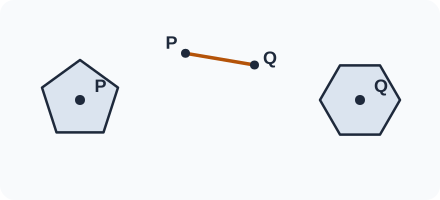
The left box shows two shapes, each with a lettered point, and a line with the same two letters on its ends. Which figure shows how the shapes connect when each end of the line is attached to the point with the same letter?

Left box: a pentagon with point P at the center, a hexagon with point Q at the center, and a separate line with end P and end Q.
Show the answer

Answer: C

Check one letter at a time. Point P is at the center of the pentagon, and point Q is at the center of the hexagon. Cross out any figure where either end of the line lands somewhere else or where a shape has changed. The shapes may be turned, so find each point by its place on the shape (corner, middle of a side, center), not by up, down, left or right.

  • A: The line ends in the wrong place: it meets the pentagon at the middle of a side, but point P is at the center and it meets the hexagon at a corner, but point Q is at the center.
  • B: The line ends in the wrong place: it meets the pentagon at the middle of a side, but point P is at the center.
  • C (correct): The line joins the center of the pentagon to the center of the hexagon, the same spots as points P and Q in the left box; turning a shape does not move a point on it.
  • D: The line ends in the wrong place: it meets the pentagon at a corner, but point P is at the center.
Question 57 · AO · medium

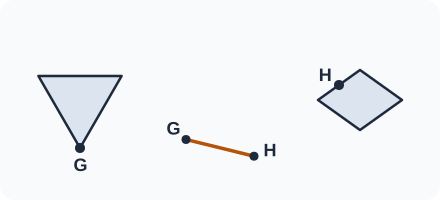
The left box shows two shapes, each with a lettered point, and a line with the same two letters on its ends. Which figure shows how the shapes connect when each end of the line is attached to the point with the same letter?

Left box: a triangle with point G at a corner, a diamond with point H at the middle of a side, and a separate line with end G and end H.
Show the answer

Answer: A

Check one letter at a time. Point G is at a corner of the triangle, and point H is at the middle of a side of the diamond. Cross out any figure where either end of the line lands somewhere else or where a shape has changed. The shapes may be turned, so find each point by its place on the shape (corner, middle of a side, center), not by up, down, left or right.

  • A (correct): The line joins a corner of the triangle to the middle of a side of the diamond, the same spots as points G and H in the left box; turning a shape does not move a point on it.
  • B: One of the shapes here is a square, but the left box has a diamond. Joining parts never changes a shape.
  • C: The line ends in the wrong place: it meets the triangle at the center, but point G is at a corner.
  • D: The line ends in the wrong place: it meets the diamond at a wide corner, but point H is at the middle of a side.
Question 58 · AO · medium

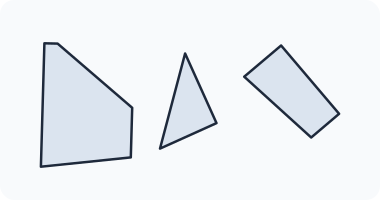
The left box shows separate flat pieces. Which figure shows how the pieces look when they are fitted together?

Left box: 3 separate flat pieces: a five-sided piece (about 57% of the total area), a four-sided piece (about 27% of the total area), a triangle (about 17% of the total area).
Show the answer

Answer: B

Count the pieces first: every figure must use each piece exactly once, with nothing added. Then pick one distinctive piece, such as the largest one or one with a curved or sharply pointed edge, and look for it in each figure; pieces may be turned but never flipped over. A figure whose cut lines are in different places has pieces of different sizes and can be crossed out. Here the pieces fit together into a rectangle.

  • A: This figure has 4 pieces, but the left box has 3. Every piece must be used once, and nothing may be added.
  • B (correct): This rectangle is made of exactly the 3 pieces in the left box, each only turned and slid into place.
  • C: A cut is in a different place, so the pieces do not match: one piece here covers about 42% of the shape, but the matching piece in the left box covers about 57%.
  • D: This figure is a square. The pieces in the left box do not have these shapes, so they cannot fill this outline without gaps or overlaps.
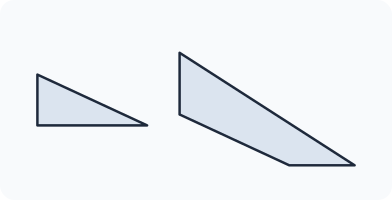
Question 59 · AO · hard

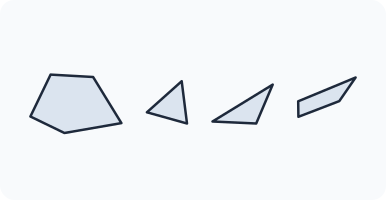
The left box shows separate flat pieces. Which figure shows how the pieces look when they are fitted together?

Left box: 4 separate flat pieces: a five-sided piece (about 59% of the total area), a triangle (about 14% of the total area), a triangle (about 14% of the total area), a four-sided piece (about 13% of the total area).
Show the answer

Answer: B

Count the pieces first: every figure must use each piece exactly once, with nothing added. Then pick one distinctive piece, such as the largest one or one with a curved or sharply pointed edge, and look for it in each figure; pieces may be turned but never flipped over. A figure whose cut lines are in different places has pieces of different sizes and can be crossed out. Here the pieces fit together into a right triangle.

  • A: A cut is in a different place, so the pieces do not match: one piece here covers about 45% of the shape, but the matching piece in the left box covers about 59%.
  • B (correct): This right triangle is made of exactly the 4 pieces in the left box, each only turned and slid into place.
  • C: This figure is a triangle. The pieces in the left box do not have these shapes, so they cannot fill this outline without gaps or overlaps.
  • D: A cut is in a different place, so the pieces do not match: one piece here covers about 37% of the shape, but the matching piece in the left box covers about 59%.
Question 60 · AO · hard

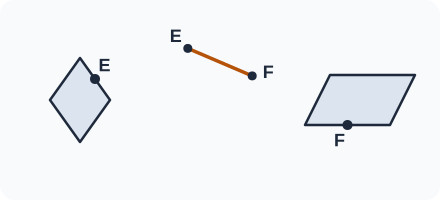
The left box shows two shapes, each with a lettered point, and a line with the same two letters on its ends. Which figure shows how the shapes connect when each end of the line is attached to the point with the same letter?

Left box: a diamond with point E at the middle of a side, a parallelogram with point F at the middle of a long side, and a separate line with end E and end F.
Show the answer

Answer: A

Check one letter at a time. Point E is at the middle of a side of the diamond, and point F is at the middle of a long side of the parallelogram. Cross out any figure where either end of the line lands somewhere else or where a shape has changed. The shapes may be turned, so find each point by its place on the shape (corner, middle of a side, center), not by up, down, left or right.

  • A (correct): The line joins the middle of a side of the diamond to the middle of a long side of the parallelogram, the same spots as points E and F in the left box; turning a shape does not move a point on it.
  • B: One of the shapes here is a rectangle, but the left box has a parallelogram. Joining parts never changes a shape.
  • C: The line ends in the wrong place: it meets the parallelogram at a sharp corner, but point F is at the middle of a long side.
  • D: The line ends in the wrong place: it meets the parallelogram at a wide corner, but point F is at the middle of a long side.

Finished?

See your score by subtest, which questions you missed and the lesson to review for each one.

Some questions are unanswered

Unanswered questions count as wrong. You can go back and answer them, or check your answers now.

About this test

Because it is a quick survey, it touches 59 lessons and leaves 49 others for later forms. Featured topics include AC and DC, fractions, percentages, averages and linear equations, while lessons such as Ohm's Law, Ecology, Brake Systems, Gears and Gear Trains and Mental Rotation are not tested here.

The questions are original and do not repeat in any other practice test. Work through it timed, then read the explanations and note which subtests gave you trouble; those are the lessons to open first. Your accuracy is a practice measure, not an ASVAB or AFQT score.

Take it with you: the free app

The same 124 lessons, 6,516 questions and 82 timed practice tests on your phone, plus flashcards with spaced review and progress tracking. Free to download, and it works offline.

  • Works offline
  • Spaced-review flashcards
  • Progress for every subtest
  • Menus in 59 languages
ASVAB Camp appGoogle Play