ASVAB Camp Get the appGoogle Play
Diagnostic

ASVAB Diagnostic 2: A Second Check Across Every Subtest

ASVAB Diagnostic 2 is the follow-up check. Take it after some study to see how your profile has shifted. Like the first diagnostic, it covers all ten subtests with six questions each, 60 in total, and allows 75 minutes. Twenty questions are easy, twenty medium and twenty hard.

  • 60 questions
  • 75 minutes
  • 10 subtests
  • Every answer explained
  1. Pick your answers. You can change them until you check.
  2. Check my answers scores the test by subtest and opens every explanation.
0 / 60 answered

General Science

6 questions · 8 min on the real test
Question 1 · GS · easy

Which of these is a chemical change?

Show the answer

Answer: A

Correct answer: An iron gate slowly rusting. A chemical change produces a new substance. Rusting turns iron metal into iron oxide, a different material, while melting, dissolving and splitting leave the substance the same.

  • A (correct): Rust is a new substance formed when iron reacts with oxygen and water, so this is a chemical change.
  • B: Melting is a change of state; the liquid is still water, so the change is physical.
  • C: Splitting changes only the size and shape of the wood; it is still wood, so the change is physical.
  • D: Dissolving spreads sugar molecules through the liquid without making a new substance, so it is physical.
Question 2 · GS · easy

Which statement best describes a catalyst?

Show the answer

Answer: A

Correct answer: It speeds up a reaction without being used up. A catalyst provides a reaction pathway with lower activation energy, so the reaction goes faster. It is regenerated by the end and does not change the final amount of product.

  • A (correct): A catalyst opens a lower-energy pathway and is regenerated at the end, so it can be reused.
  • B: A catalyst changes only how fast equilibrium or completion is reached, not the final yield.
  • C: A catalyst may take part in intermediate steps but is regenerated, so it is not consumed overall.
  • D: This is backward; a catalyst lowers the activation energy barrier.
Question 3 · GS · medium

A rock undergoes high heat and pressure and recrystallizes without melting. What process occurred?

Show the answer

Answer: D

Correct answer: Metamorphism. Meta- means change and morph means form: metamorphic rock is existing rock transformed while staying solid. Heat and pressure let atoms rearrange into new minerals or line up into bands, as when shale becomes slate or limestone becomes marble. The key distinction is melting: if the rock had melted and then cooled, the result would be igneous. Erosion and deposition move material at the surface rather than changing it internally.

  • A: Erosion transports material.
  • B: Evaporation changes liquid water into vapor.
  • C: Deposition drops transported sediment.
  • D (correct): Metamorphism alters minerals and textures while the rock remains solid.
Question 4 · GS · medium

A 2 kg book rests on a level table, and a student presses straight down on it with 5 N. Using

g = 10 m/s²

what is the normal force from the table on the book?

Show the answer

Answer: C

Correct answer: 25 N upward. The book is at rest, so the upward normal force must equal the total downward force. Weight is

2 × 10 = 20 N

plus the 5 N push gives 25 N upward.

  • A: This balances only the hand's push and leaves out the book's weight.
  • B: This balances only the weight and ignores the student's extra 5 N downward push.
  • C (correct): The table must balance both the 20 N weight and the 5 N push, so it pushes up with 25 N.
  • D: This subtracts the push instead of adding it, but the push is downward like the weight.
Question 5 · GS · hard

An introduced freshwater fish spreads but researchers have not measured its impact on native species or ecosystems. Which label is safest from the information given?

Show the answer

Answer: A

Correct answer: It is nonnative and spreading; invasive harm is not yet established in the prompt. Scientists use precise labels. An introduced, or nonnative, species is one brought outside its natural range by people, and spreading shows it has become established. Calling it invasive also requires evidence of harm to native species, ecosystems or the economy. Because impacts have not been measured, the careful conclusion stops short of invasive while noting the risk. Absence of evidence is not evidence of harmlessness, so claims of never or cannot also overreach.

  • A (correct): The information establishes introduction and spread, but not harm.
  • B: Lack of measured impact does not prove permanent harmlessness.
  • C: Spreading species may affect community dynamics; an unmeasured impact is not proof of no impact.
  • D: Keystone status requires evidence of an outsized effect on community structure, not just spread.
Question 6 · GS · hard

A spinal withdrawal reflex activates a skeletal muscle before a person reports feeling pain. What explanation best accounts for the order?

Show the answer

Answer: C

Correct answer: A spinal circuit triggers a rapid motor response while sensory signals also travel to the brain. A withdrawal reflex uses a short pathway: a sensory neuron carries the signal into the spinal cord, an interneuron relays it, and a motor neuron activates the muscle. Because this loop never has to reach the brain, it is faster than conscious perception. The same sensory input is also sent up the spinal cord to the brain, which is why pain is felt a moment later. Assuming the brain must decide every movement is the common misconception.

  • A: Bile supports digestion and is not a neural processing signal.
  • B: Muscles carry out commands; detection and processing are done by receptors and neural circuits, not by the muscle itself.
  • C (correct): Reflex circuits can start movement through the spinal cord without waiting for conscious pain perception.
  • D: The heart circulates blood but does not substitute for reflex neural pathways.

Arithmetic Reasoning

6 questions · 8 min on the real test
Question 7 · AR · easy

Which decimal is equal to ?

Show the answer

Answer: C

Correct answer: 0.875. A fraction bar means divide the numerator by the denominator:

  • A: This just writes the digits 7 and 8 after the decimal point instead of dividing.
  • B: This divides 8 by 7, flipping the fraction; 7/8 is less than 1.
  • C (correct): A fraction means division, and 7 divided by 8 is 0.875.
  • D: This is the value of 5/8, not 7/8.
Question 8 · AR · easy

A server earns tips of $38, $52, $45, and $61 over four shifts. What is the mean tip amount per shift?

Show the answer

Answer: D

Correct answer: $49.00. Add the tips:

38 + 52 + 45 + 61 = 196 dollars

Divide by the 4 shifts: $196 divided by 4 is $49.00.

  • A: $196.00 is the total of the four shifts, not the mean.
  • B: This divides the $196 total by 3 instead of by the 4 shifts.
  • C: $49.50 is halfway between the smallest and largest tips, which ignores the other two shifts.
  • D (correct): The tips add to $196, and $196 divided by 4 shifts is $49.00.
Question 9 · AR · medium

A car salesperson earns a base pay of $450 per week plus an 8% commission on sales. This week the salesperson sold $7,250 worth of accessories and service plans. What is the total pay for the week?

Show the answer

Answer: A

Correct answer: $1,030. Commission:

0.08 × 7,250 = $580

Total pay: base plus commission,

450 + 580 = $1,030
  • A (correct): The commission is 0.08 × 7,250 = $580, and adding the $450 base gives $1,030.
  • B: This is the commission alone; the base pay must be added to it.
  • C: This uses 0.8 instead of 0.08 for 8%, giving a commission of $5,800 before adding the base.
  • D: This adds the base pay to the total sales instead of to the commission earned on the sales.
Question 10 · AR · medium

A 4-inch by 6-inch photo is enlarged so that its 6-inch side becomes 15 inches. How long does the 4-inch side become?

Show the answer

Answer: D

Correct answer: 10 inches. The scale factor is new length over original length:

Every side is multiplied by 2.5, so the 4-inch side becomes

4 × 2.5 = 10 inches
  • A: This adds 9 inches to each side, but an enlargement multiplies every length by the same factor.
  • B: This divides 4 by the scale factor 2.5 instead of multiplying.
  • C: This uses the upside-down factor 6/4 on the 15-inch side, mixing up the matching sides.
  • D (correct): The scale factor is 15 ÷ 6 = 2.5, and 4 × 2.5 = 10 inches.
Question 11 · AR · hard

A road crew paints a center stripe 0.15 meter wide along 2.4 kilometers of road. What area does the stripe cover? (1 kilometer = 1,000 meters)

Show the answer

Answer: A

Correct answer: 360 square meters. Put both lengths in meters:

m

Area is length times width:

square meters

Estimate:

and

so 360 fits between them.

  • A (correct): 2.4 km is 2,400 m, and 2,400 times 0.15 is 360 square meters.
  • B: This multiplies 2.4 by 0.15 without converting kilometers to meters, mixing units.
  • C: This converts kilometers to meters by multiplying by 100 instead of 1,000.
  • D: This places the decimal point one place too far right; 2,400 times 15 hundredths is 36,000 hundredths, which is 360.
Question 12 · AR · hard

A jogger leaves a trailhead running 5 mph. Thirty minutes later, a cyclist leaves the same trailhead on the same path riding 13 mph. How far apart are they 1 hour after the cyclist starts?

Show the answer

Answer: D

Correct answer: 5.5 miles. One hour after the cyclist starts, she has gone

13 × 1 = 13 miles

The jogger has then run for 1.5 hours, covering

5 × 1.5 = 7.5 miles

They are

13 − 7.5 = 5.5 miles

apart, with the cyclist ahead.

  • A: This uses the 8 mph difference for 1 hour but ignores the jogger's 2.5-mile head start.
  • B: This adds the jogger's 2.5-mile head start to the gap instead of subtracting it.
  • C: This adds the two distances as if they had traveled in opposite directions.
  • D (correct): The cyclist is at 13 miles and the jogger is at 7.5 miles, so they are 5.5 miles apart.

Word Knowledge

6 questions · 8 min on the real test
Question 13 · WK · easy

The library keeps its NONFICTION books, such as histories and biographies, on the second floor. NONFICTION most nearly means?

Show the answer

Answer: D

Correct answer: Based on fact. Non- places something outside a category in a neutral way, and fiction means invented stories. Writing outside that category is based on fact.

  • A: Badly written is a judgment of quality; non- simply places the book outside the fiction category.
  • B: Made-up stories describes fiction, ignoring the non- prefix.
  • C: Very short is about length, which neither the prefix nor the base mentions.
  • D (correct): Non- means not belonging to a category, so nonfiction is writing that is not invented, or based on fact.
Question 14 · WK · easy

The FLAMBOYANT bandleader wore a gold sequined jacket and twirled his baton high over his head between songs.

As used here, FLAMBOYANT most nearly means:

Show the answer

Answer: A

Correct answer: showy. Flamboyant means boldly showy and eager to draw attention, such as a performer in a sequined cape. Showy matches both the meaning and the degree; elegant is a related word but too restrained.

  • A (correct): Flamboyant describes a bold, attention-grabbing style, which is what showy means.
  • B: Flamboyant looks like flame, but the word describes a flashy style, not heat or fire.
  • C: Elegant suggests quiet, refined grace, while flamboyant is loud and eye-catching; the degree and tone differ.
  • D: Modest means plain and unassuming, the opposite of a flamboyant style.
Question 15 · WK · medium

The new commander hoped to EFFECT a change in the unit's safety record within six months.

EFFECT most nearly means:

Show the answer

Answer: B

Correct answer: bring about. Effect follows "to" here, so it is a verb, not the usual noun meaning result. The verb effect means to bring about. Affect, meaning to influence, is the look-alike trap.

  • A: Influence is the meaning of affect, the verb most often confused with effect; to affect a change would mean to alter a change already happening.
  • B (correct): As a verb, effect means to cause something to happen, so effect a change means bring about a change.
  • C: Result is the meaning of effect as a noun, but here effect follows to, so it is a verb.
  • D: Prevent means stop from happening, the opposite of causing a change.
Question 16 · WK · medium

Soldiers at the remote outpost faced real HARDSHIP during the long winter.

In this sentence, HARDSHIP most nearly means:

Show the answer

Answer: D

Correct answer: suffering. Hard plus -ship gives a noun naming a hard state or condition. In the sentence it describes a difficult winter, so suffering is the closest noun. The -ship ending has nothing to do with boats.

  • A: This is a lookalike built with -ness; it names firmness, not a time of trouble.
  • B: Leadership shares the -ship ending but has a different base and names the role of leading.
  • C: This treats -ship as a boat, a false reading of the noun ending.
  • D (correct): The ending -ship forms a noun of state, and hardship is a state of difficulty, which is suffering.
Question 17 · WK · hard

The stranded hikers built a CRUDE shelter from branches, a torn tarp, and a few strips of duct tape.

CRUDE most nearly means:

Show the answer

Answer: C

Correct answer: roughly made. Crude has several senses: unrefined (crude oil), vulgar (crude jokes), and roughly made. The materials listed (branches, torn tarp, tape) point to rough construction; temporary is a likely fact about the shelter but not the word's meaning.

  • A: Crude can mean offensive when describing jokes or language, but that sense does not fit a shelter.
  • B: Crude oil is a familiar phrase, but here the word describes how the shelter was made, not what it contains.
  • C (correct): Crude here means simple and roughly put together, which fits a shelter made of branches, a torn tarp, and tape.
  • D: The shelter probably is temporary, but crude describes its rough construction, not how long it will last.
Question 18 · WK · hard

The manager warned that anyone who clocks in late will have their pay DOCKED.

As used in this sentence, DOCKED most nearly means:

Show the answer

Answer: C

Correct answer: reduced. DOCKED is a verb acting on "pay," and "warned" plus "clocks in late" signal a penalty. Dock pay means reduce it; the pier sense is the familiar trap, and "delayed" changes the event.

  • A: Mooring at a pier is the boat sense of dock, which cannot apply to pay.
  • B: Late pay is a real worry, but docking pay means taking money off, not paying it later.
  • C (correct): To dock pay is to cut part of it as a penalty, which fits a warning about lateness.
  • D: Depositing pay is the normal outcome, not a penalty the manager would warn about.

Paragraph Comprehension

6 questions · 8 min on the real test
Question 19 · PC · easy

The dining facility on Camp Ridley rolled out a new menu this month. Sergeant First Class Dana Ellis, who manages the facility, calls the new food "restaurant quality." The menu adds three hot entrees at dinner, a salad bar at lunch and an omelet station on weekend mornings. Hours are unchanged, and meal card prices remain the same. Soldiers with dietary needs can request special meals by speaking with the shift cook at least one day in advance.

Whose opinion is expressed by the phrase restaurant quality?

Show the answer

Answer: A

Correct answer: the manager of the dining facility. Credit each opinion to the person who holds it. The words restaurant quality are in quotation marks after "Sergeant First Class Dana Ellis, who manages the facility, calls the new food," so the praise belongs to the manager, not to the author, who reports facts plainly.

  • A (correct): The phrase appears in quotation marks right after "calls the new food," with Sergeant Ellis as the speaker.
  • B: The author only reports the quote; the author's own sentences list menu items and hours without praise.
  • C: No diners are quoted or described as giving an opinion.
  • D: No commander appears in the passage, so this credits the view to someone the text never mentions.
Question 20 · PC · easy

The base tool room lends power tools to members of the auto hobby shop. Tools must be returned by closing time on the day they are checked out. The one exception is for members who have reserved a lift bay for an overnight job; they may keep their tools until 9 a.m. the next day. Anyone who returns a tool late loses borrowing privileges for two weeks.

According to the passage, who may keep a tool past closing time?

Show the answer

Answer: C

Correct answer: A member who has reserved a lift bay for an overnight job. The passage states a general rule (return tools by closing time) and then a single exception: members with a reserved lift bay for an overnight job may keep tools until 9 a.m. the next morning.

  • A: The time of checkout does not create an exception; the rule says tools are due back by closing that day.
  • B: The passage says nothing about a good record earning extra time; the only exception is the overnight lift-bay reservation.
  • C (correct): The passage names this as the one exception to the closing-time rule.
  • D: Losing privileges is the penalty for a late return, not a reason to keep a tool longer.
Question 21 · PC · medium

When Lieutenant Park took over the motor pool, she asked the shift leaders to change how they wrote their weekly reports. Their earlier reports had been verbose, often running ten pages and repeating the same points several times. The new ones are concise, rarely more than a single page, and she says she now finishes reading them in minutes and has more time to visit the shop floor.

As used in the passage, what does verbose most nearly mean?

Show the answer

Answer: B

Correct answer: using more words than needed. Contrast sets a boundary on meaning. The earlier reports ran ten pages and repeated points, while the new ones are concise, under a page. Since concise means brief, verbose must point the other way: using too many words.

  • A: This is the meaning of concise, the word the passage sets up as the opposite of verbose.
  • B (correct): Ten pages that repeat the same points, contrasted with concise one-page reports, show that verbose means wordy.
  • C: Verbose looks like verbal, but the reports were written documents; this is a look-alike guess, not the meaning.
  • D: The passage criticizes the length and repetition of the reports, not their accuracy.
Question 22 · PC · medium

Patients at the Pine Valley clinic often wait more than an hour past their appointment times. A review by the clinic's staff found that most of the delay happens at the front desk, where new patients spend twenty minutes or more filling out paper forms that are then typed into the computer by hand. Doctors, the review noted, usually see patients within ten minutes once they reach an exam room. Even so, the clinic's board has voted to hire a third doctor to cut the waits.

Which statement best compares the board's plan with the problem described in the review?

Show the answer

Answer: C

Correct answer: The plan adds a doctor, but the review traces most of the delay to front-desk paperwork. Line up the problem's cause with the proposed fix. The review places most of the delay at front-desk paperwork and says doctors move quickly, but the board's fix adds a doctor. The plan and the identified cause do not match.

  • A: The review blames paperwork at the front desk, not a shortage of doctors, so the plan does not match the stated cause.
  • B: The board has only voted to hire; no result is reported, so this treats a plan as an outcome.
  • C (correct): The review says doctors see patients quickly and that paperwork causes most of the wait, so the fix targets a different part of the visit.
  • D: The review says the opposite, noting that doctors usually see patients within ten minutes.
Question 23 · PC · hard

The Hendersons' new thermostat follows a few simple rules. If no one walks past the hallway motion sensor for two hours, the thermostat lowers the heat to 62 degrees. The heat also drops to 62 degrees every night at 11 p.m. When the front door is unlocked with the keypad, the thermostat raises the house back to 68 degrees within twenty minutes.

Which statement is supported by the passage?

Show the answer

Answer: C

Correct answer: Unlocking the front door with the keypad causes the house to be warmed back to 68 degrees. Keep each if-then rule in its stated direction. The passage says unlocking with the keypad leads to the house returning to 68 degrees, which the keyed choice restates. Reversing the motion-sensor rule fails because the 11 p.m. setback also produces 62 degrees, and adding "only" claims more than the passage says.

  • A: This reverses the first rule; the heat also drops to 62 degrees every night at 11 p.m., whether or not anyone has moved past the sensor.
  • B: The passage says the keypad brings the house back to 68 degrees, but it never says this is the only way the house reaches 68 degrees.
  • C (correct): This keeps the stated condition and result in the same direction: keypad unlock leads to the house returning to 68 degrees.
  • D: The passage sets the waiting period at two hours, not one, so the number is changed.
Question 24 · PC · hard

When the Blue Ridge Canal opened in 1838, mule-drawn boats carried coal and grain along its forty miles of water. Within twenty years, a railroad line was built beside it, and trains moved freight faster and in every season. By 1890 the canal carried almost no cargo, and in 1924 a flood broke its walls and ended boat traffic for good. For decades the channel sat overgrown. In the 1970s, the state turned the old towpath into a gravel trail, and today more than half a million cyclists, joggers, and walkers use it each year.

Which statement best expresses the main idea of the passage?

Show the answer

Answer: D

Correct answer: The canal changed from a busy freight route to a popular place for recreation. In a passage told in time order, ask what the sequence shows overall. The canal began as a freight route, lost its cargo to the railroad, fell into disuse, and became a popular trail. A purpose statement and the final event are both traps; the main idea is the overall change.

  • A: This states the author's purpose, not the main idea; it says why the passage was written but not what it says about the canal.
  • B: This is the final event in the time order, but the last step of a sequence is not automatically its main point.
  • C: The passage discusses one canal and one railroad line; a nationwide claim is too broad.
  • D (correct): This states what the whole sequence shows: the canal's role shifted over time from carrying cargo to serving trail users.

Mathematics Knowledge

6 questions · 8 min on the real test
Question 25 · MK · easy

A clerk totals two shipments with the expression . After combining like terms, what is the simplified result?

Show the answer

Answer: B

Correct answer: 2k + 12. Group like terms:

and

The result is . Terms with k and constant terms cannot be merged.

  • A: This combines the k terms with the constants, which are not like terms.
  • B (correct): The k terms give 6k - 4k = 2k and the constants give 3 + 9 = 12.
  • C: This adds 4k instead of subtracting it; the minus sign belongs to 4k.
  • D: This subtracts 9 from 3, but the 9 is being added.
Question 26 · MK · easy

What number must be added to −23 to get a sum of 0?

Show the answer

Answer: A

Correct answer: 23. A number plus its opposite equals zero. The opposite of −23 is 23, so

−23 + 23 = 0
  • A (correct): 23 is the opposite of −23, and a number plus its opposite is zero.
  • B: −23 + (−23) = −46, not 0.
  • C: Adding 0 leaves −23 unchanged.
  • D: −23 + 46 = 23, which overshoots zero by 23.
Question 27 · MK · medium

A carpenter's calculation gives a brace length of inches. How is this length written in simplest radical form?

Show the answer

Answer: B

Correct answer: 7√2. Find the largest perfect-square factor of 98, which is 49:

Check:

  • A: This swaps the parts: it takes 2 outside and leaves 7 inside, which equals the root of 28.
  • B (correct): 98 = 49 x 2, and the root of 49 is 7, leaving root 2.
  • C: This pulls out 49 itself instead of its square root, 7.
  • D: This takes out 7 but then leaves 14 inside; 7 root 14 equals the root of 686.
Question 28 · MK · medium

A triangular pennant is isosceles, and each of its two base angles is double the angle at its tip. What is the measure of each base angle?

Show the answer

Answer: B

Correct answer: 72°. Let the vertex angle be v, so each base angle is 2v. The angles total 180°:

v + 2v + 2v = 180

so 5v = 180 and v = 36. Each base angle is 2(36) = 72°.

  • A: 36° is the vertex angle, not a base angle.
  • B (correct): With v = 36°, each base angle is 72°, and 36 + 72 + 72 = 180.
  • C: This counts only one base angle (v + 2v = 180), forgetting that there are two.
  • D: 60° would make the triangle equilateral, where base angles equal the vertex angle.
Question 29 · MK · hard

Two lines intersect at point O. A pair of vertical angles measure (5x + 4)° and (7x - 20)°. A ray from O bisects one of the two other angles at the intersection. What is the measure of each half of that bisected angle?

Show the answer

Answer: A

Correct answer: 58°. Vertical angles are equal:

5x + 4 = 7x - 20

so 2x = 24 and x = 12, making each vertical angle 64°. The other two angles each form a linear pair with a 64° angle, so they measure

180 - 64 = 116

°. The bisector splits 116° into two halves of 58°.

  • A (correct): The neighboring angle is 180 - 64 = 116°, and the bisector cuts it into two 58° halves.
  • B: This halves the 64° angle, but the bisected angle is one of the other two angles, which measure 116°.
  • C: 116° is the whole angle being bisected; the question asks for each half.
  • D: 64° is the measure of each given vertical angle, not of a half of the neighboring angle.
Question 30 · MK · hard

Which inequality is the solution of

Show the answer

Answer: C

Correct answer:

x ≤ -8/5

Multiply both sides by the LCD, 6, a positive number, so the sign stays:

2(2 − x) ≥ 3(x + 4)

Distribute:

4 − 2x ≥ 3x + 12

Add 2x and subtract 12:

−8 ≥ 5x

Divide by 5:

x ≤ −8/5

Check

x = −2

(2 + 2)/3 ≈ 1.33 and

(−2 + 4)/2 = 1

and 1.33 ≥ 1 is true.

  • A: This reverses the sign, but the only division is by positive 5 after moving the x terms right.
  • B: This writes 2(2 − x) as 4 + 2x, losing the negative sign on x.
  • C (correct): Multiplying by 6 gives 2(2 − x) ≥ 3(x + 4), so 4 − 2x ≥ 3x + 12, −8 ≥ 5x and x ≤ −8/5.
  • D: This multiplies each numerator by its own denominator, writing 3(2 − x) ≥ 2(x + 4).

Electronics Information

6 questions · 8 min on the real test
Question 31 · EI · easy

A GFCI primarily detects which electrical condition?

Show the answer

Answer: B

Correct answer: An imbalance between monitored outgoing and returning currents. A GFCI passes the hot and neutral conductors through a sensing coil. Normally the current out equals the current back, their magnetic effects cancel, and the coil senses nothing. If some current leaks to ground, for example through a person, the return is short, and when the difference reaches about 5 mA the device trips. It does not measure voltage or temperature, and it is not an overcurrent device: a breaker or fuse still handles overloads and shorts.

  • A: Current imbalance sensing does not directly measure insulation temperature.
  • B (correct): Leakage outside the expected return path can produce a differential current.
  • C: A GFCI is not a precision voltage regulator or voltage meter.
  • D: A line-to-line fault may not cause the differential imbalance a GFCI detects.
Question 32 · EI · easy

Which quantity is measured in amperes?

Show the answer

Answer: B

Correct answer: The rate at which charge flows past a point. The ampere is the unit of current. One ampere means one coulomb of charge passes a point every second, so it measures a rate of charge flow.

  • A: That describes potential difference, which is measured in volts.
  • B (correct): An ampere is one coulomb of charge passing a point each second, which is the definition of current.
  • C: That describes resistance, which is measured in ohms.
  • D: That describes power, which is measured in watts.
Question 33 · EI · medium

An ideal 45 V source drives a 20 Ω resistor and a 70 Ω resistor in series. What is the voltage drop across the 70 Ω resistor?

Show the answer

Answer: C

Correct answer: 35 V. Use the voltage-divider relationship with a total of 90 Ω.

Check: the 20 Ω resistor drops 10 V, and

35 + 10 = 45 V
  • A: This is the drop across the 20 Ω resistor, not the 70 Ω resistor.
  • B: A series resistor shares the source voltage; it does not receive all of it.
  • C (correct): The 70 Ω resistor is 70/90 of the total, and 45 × 70/90 = 35 V.
  • D: This splits the voltage evenly, which only applies to equal resistors.
Question 34 · EI · medium

What is the correct placement of an ideal ammeter to measure current through one lamp?

Show the answer

Answer: B

Correct answer: In series with the lamp. To measure current, the current must actually flow through the meter, so you break the circuit and insert the ammeter in the same path as the lamp. An ideal ammeter has almost zero resistance, so it does not change the current. That same low resistance is why connecting an ammeter across a battery or a component creates a near short circuit, which can damage the meter or the source.

  • A: Ammeter across the source can produce a short circuit.
  • B (correct): Series connection carries the same branch current through the meter.
  • C: Disconnected instruments cannot read branch current.
  • D: A meter across the lamp bypasses it instead of carrying the lamp current.
Question 35 · EI · hard

A purely resistive 8 Ω load receives 16 V RMS sine-wave AC. What is its average dissipation?

Show the answer

Answer: B

Correct answer: 32 W. For a resistive load, average power can be found from RMS voltage alone using P = V² ÷ R, so 16² = 256 and

256 ÷ 8 = 32 W

The current-based route agrees:

16 ÷ 8 = 2

A RMS, and 16 V × 2 A = 32 W. RMS values are defined so these DC-style formulas give the true average power. Adding an extra factor of two is a mistake that applies only when starting from peak values.

  • A: That omits the current factor.
  • B (correct): Power is Vrms squared divided by resistance: 256/8 = 32 W.
  • C: This doubles the correct RMS-based average power.
  • D: Two amperes is the RMS current, not the power.
Question 36 · EI · hard

A motor runs from 48 V and draws 10 A. Its shaft delivers 3 N·m of torque at 1200 rpm. What is its efficiency?

Show the answer

Answer: A

Correct answer: About 79 percent. Input:

W

Speed:

rad/s.

The efficiency is about 79 percent.

  • A (correct): Converting 1200 rpm to about 125.7 rad/s gives 377 W of output, and 377 ÷ 480 is about 0.79.
  • B: This divides input by output; efficiency can never exceed 100 percent.
  • C: This is the fraction of input lost, not the fraction delivered as useful output.
  • D: This multiplies torque by rpm without converting to radians per second.

Auto Information

6 questions · 8 min on the real test
Question 37 · AI · easy

A driver notices the battery-shaped warning lamp light up while cruising on the highway. What does this lamp most likely indicate?

Show the answer

Answer: C

Correct answer: The charging system may not be keeping up. The battery lamp normally goes out once the engine runs, because the alternator takes over. If it lights while driving, the charging system (belt, alternator, wiring or connections) may not be supplying enough current. It identifies a system to test, not a single failed part.

  • A: The lamp flags a charging-system problem, not the age of the battery.
  • B: Oil pressure has its own red oil-can lamp; the battery icon concerns electrical charging.
  • C (correct): With the engine running the alternator should supply the electrical load; the lamp warns that charging may have dropped out.
  • D: The lamp warns that charging may be insufficient, not that a long trip has overfilled the battery.
Question 38 · AI · easy

In a conventional rear-wheel-drive car with a lengthwise front engine, which part receives power directly from the transmission output?

Show the answer

Answer: B

Correct answer: The propeller shaft (driveshaft). Place the part in the power path: engine, clutch or torque converter, transmission, driveshaft, final drive and differential, axle shafts, wheels. In a rear-drive layout the driveshaft carries power from the transmission back to the rear axle.

  • A: The flywheel is bolted to the crankshaft and sits ahead of the transmission, not after it.
  • B (correct): The driveshaft runs from the back of the transmission to the rear axle, so it is the next link after the gearbox.
  • C: A torque converter sits between the engine and the transmission input, before the gearbox.
  • D: The hubs and bearings are at the very end of the chain, after the differential and axle shafts.
Question 39 · AI · medium

A driver of a car with an automatic transmission turns the key. There is no click and no cranking, and the dash lights stay fully bright. The shift lever is resting in Drive. What should be checked first?

Show the answer

Answer: B

Correct answer: Shift to Park or Neutral, since the safety interlock blocks starting in gear. The start request passes through safety interlocks before reaching the starter relay or solenoid. On an automatic, the park or neutral switch blocks starting in gear. With no click and bright lights, the simplest likely cause is the interlock, so shift to Park or Neutral and try again before testing parts.

  • A: A battery too weak to spin the starter would make the lights dim or cause clicking; bright lights argue against it.
  • B (correct): Bright lights mean the battery is fine, and a lever left in Drive keeps the neutral safety switch from passing the start request.
  • C: Fuel delivery matters only after the engine cranks; here it does not turn at all.
  • D: The alternator plays no part in cranking; the starter and its control circuit do.
Question 40 · AI · medium

On a port-injected V6, a metal pipe runs along the intake manifold with all six injectors plugged into it. What is the main function of this part?

Show the answer

Answer: D

Correct answer: It holds pressurized fuel and feeds it to each injector. The part described is the fuel rail. Its job is distribution: it holds fuel at system pressure and supplies each injector, while the injectors decide how much fuel actually enters each cylinder.

  • A: Metering is done by each injector's pulse width; the pipe only supplies fuel to them.
  • B: Burned gases leave through the exhaust manifold; this pipe carries fresh, pressurized fuel.
  • C: The pump is normally at or in the tank; the pipe at the engine receives fuel that is already pressurized.
  • D (correct): This describes the fuel rail, which distributes pressurized fuel to every injector connected to it.
Question 41 · AI · hard

A tire carries a normal force of 3,600 N on a road where

In a curve the driver brakes so the tire must supply 2,400 N of braking force and 1,800 N of cornering force at the same time. Using the friction-budget model, what happens?

Show the answer

Answer: C

Correct answer: The combined demand of 3,000 N exceeds the 2,700 N limit, so the tire loses grip. The grip limit is

N

Because 3,000 N is greater than 2,700 N, the tire cannot supply both forces and will lose grip and skid.

  • A: Braking and cornering draw on one shared budget; they must be combined, not checked one at a time.
  • B: The forces act at right angles, so they combine as a square root of squares, not by simple addition.
  • C (correct): Limit: 0.75 x 3,600 = 2,700 N. Combined demand: N, which is more than the limit.
  • D: Subtracting the two forces has no physical meaning here; they must be combined vectorially.
Question 42 · AI · hard

A customer's older pickup wanders on the highway, and the steering wheel moves a lot before the front wheels respond. What is the best first approach to finding the cause?

Show the answer

Answer: D

Free play is steering-wheel motion before the road wheels respond, and excess play causes wander. Worn tie rod ends, a worn idler or pitman arm, loose gear mounts, worn ball joints or a loose wheel bearing can each add slack, so the technician checks all of them.

  • A: Free play can come from many joints; assuming the gear is the only source may waste money and miss the real wear.
  • B: Alignment sets angles but cannot take looseness out of worn joints.
  • C: Low fluid causes whine and heavy or jerky steering, not slack between the wheel and tires.
  • D (correct): Free play rarely has a single source, so tie rod ends, idler and pitman arms, gear mounts, ball joints and wheel bearings must all be inspected.

Shop Information

6 questions · 8 min on the real test
Question 43 · SI · easy

A machinist has just tightened a workpiece in a lathe chuck. What must be removed from the chuck before the lathe is switched on?

Show the answer

Answer: B

Correct answer: The chuck key. The chuck key is only for tightening or loosening the jaws. Leaving it in place when the spindle starts can turn it into a projectile, so removing it is a basic check before every start.

  • A: Guards protect the operator from rotating parts; removing one makes the setup less safe.
  • B (correct): A key left in the chuck can be flung out when the spindle starts, so it must always be removed first.
  • C: The cutting tool belongs in the tool post, not in the chuck, and is needed to do the work.
  • D: The workpiece was just secured on purpose; it is what the lathe will turn.
Question 44 · SI · easy

After an oil change at home, what should be done with the drained engine oil?

Show the answer

Answer: B

Correct answer: Seal it in a container and take it to a recycling site that accepts used oil. Used engine oil carries metals and other contaminants. Keep it unmixed, seal it in a container and take it to a place that accepts used oil for recycling.

  • A: Used oil contains metals and contaminants and must never go into a drain, no matter how much water follows it.
  • B (correct): Used oil is recyclable when kept clean and delivered to a collection point such as a recycling center or parts store.
  • C: Mixing used oil with antifreeze or solvents can make it impossible to recycle.
  • D: Spreading used oil on the ground contaminates soil and water.
Question 45 · SI · medium

A long boring bar sticks far out of its holder. During the cut it squeals, and the bore shows a regular wavy pattern. Which term best describes this problem?

Show the answer

Answer: A

Correct answer: Chatter. A boring bar acts like a diving board: the farther it extends from its holder, the more easily it bends and vibrates. When the cutting forces match that natural vibration, the tool bounces in and out of the cut, producing a high-pitched noise and evenly spaced marks on the surface. The usual fixes are reducing overhang, using a stiffer bar, or changing speed and feed. Runout is a different problem: an off-center rotation causes an uneven cut, not the noise and wavy pattern of chatter.

  • A (correct): Chatter is self-excited vibration, often heard as noise and seen as a patterned finish; long overhang encourages it.
  • B: Runout means rotation is off the intended axis; it is not mainly identified by squealing and a wave pattern.
  • C: Burrs are raised edges left at a hole's entrance or exit, not a vibration pattern inside the bore.
  • D: Glazing describes a dulled abrasive wheel surface, not vibration of a cutting tool.
Question 46 · SI · medium

A plastic float block has a mass of 45 g and a volume of 50 cm³. Water is about 1.0 g/cm³. What is the block's specific gravity, and will it float?

Show the answer

Answer: C

Correct answer: 0.9; it floats. Find density first: 45 g ÷ 50 cm³ = 0.9 g/cm³. Divide by water's 1.0 g/cm³ to get SG = 0.9, a pure number. Because it is less than 1, the block floats.

  • A: The number is right, but specific gravity is a ratio and carries no units such as grams.
  • B: This divides volume by mass instead of mass by volume, flipping the ratio.
  • C (correct): Density is 45 ÷ 50 = 0.9 g/cm³, so SG = 0.9 with no units, and a value below 1 means it floats.
  • D: The SG is right, but a value below 1 means the block is less dense than water, so it floats.
Question 47 · SI · hard

A bolt head is marked 5/8 inch. A technician converts this to 15.875 mm and notices a 16 mm wrench in the drawer. Which conclusion is soundest?

Show the answer

Answer: C

Correct answer: The 16 mm wrench is 0.125 mm oversize, so use a 5/8-inch wrench and confirm a full fit. Convert:

mm

so a 16 mm wrench is 0.125 mm larger. Near sizes can still round a fastener, so choose the 5/8-inch wrench and check that it seats fully.

  • A: A small difference can still let the jaw slip and round the corners of the head.
  • B: A 15 mm opening is smaller than 15.875 mm and would not fit over the head at all.
  • C (correct): The sizes are close but not identical, and the lesson says fit, not arithmetic closeness, decides the tool.
  • D: A conversion describes length only; it does not prove that a differently labeled tool will engage safely.
Question 48 · SI · hard

Three parts are stacked end to end. Their lengths are 25.0 ± 0.1 mm, 40.0 +0.2/−0.0 mm and 15.0 ± 0.05 mm. What is the worst-case maximum overall length?

Show the answer

Answer: D

Correct answer: 80.35 mm. For a simple worst-case stack, add the largest allowed size of each part. Upper limits are 25.1 mm, 40.2 mm and 15.05 mm.

25.1 + 40.2 + 15.05 = 80.35 mm
  • A: This adds only the nominal sizes and ignores the allowed variation.
  • B: This is the worst-case minimum, found by adding the smallest limits.
  • C: This treats the +0.2/−0.0 tolerance as ±0.1, inventing a symmetric value the drawing does not give.
  • D (correct): Adding each upper limit gives 25.1 + 40.2 + 15.05 = 80.35 mm.

Mechanical Comprehension

6 questions · 8 min on the real test
Question 49 · MC · easy

A satellite orbiting far above the atmosphere is warmed by the Sun. By which method does the Sun's energy reach it?

Show the answer

Answer: B

Correct answer: Radiation. Space between the Sun and the satellite is nearly a vacuum, so no material can carry heat by contact or by flowing. Only radiation, which needs no medium, can deliver the energy.

  • A: Conduction requires direct contact through a material, and there is no material linking the Sun to the satellite.
  • B (correct): Radiation travels as electromagnetic waves and is the only one of the three mechanisms that can cross empty space.
  • C: Convection needs a moving fluid to carry the energy, and space is essentially a vacuum.
  • D: Compression is not a heat transfer mechanism; the three mechanisms are conduction, convection and radiation.
Question 50 · MC · easy

Clocks and machine-tool feeds often use gears rather than smooth friction wheels. What is the main reason?

Show the answer

Answer: A

Correct answer: Interlocking teeth keep an exact speed ratio without slipping. Gear teeth interlock, giving positive transmission: the speed relationship is fixed by the tooth counts and cannot drift through slipping. That exact timing is why clocks and machine tools use gears.

  • A (correct): Each driver tooth pushes one tooth space of the driven gear, so the ratio is fixed by the tooth counts and does not drift with load.
  • B: Gears require precise mounting and lubrication, so this is not a reason to choose them.
  • C: Interlocking teeth cannot slip, which is why overload can break gear teeth; slipping protection belongs to friction drives.
  • D: Gears, especially spur gears, can be noisy at speed, so quietness is not their main advantage here.
Question 51 · MC · medium

A 6 m plank rests on supports at both ends. A 900 N crate sits 2 m from the left end. Ignoring the plank's weight, how much force does the left support provide?

Show the answer

Answer: B

Correct answer: 600 N. Take torques about the left support:

so the right support is 300 N. The supports must total 900 N, so the left support is

900 − 300 = 600 N
  • A: This is the torque 900 × 2 in N·m, not a support force.
  • B (correct): Torques about the left end give the right support 900 × 2 ÷ 6 = 300 N, so the left carries 900 − 300 = 600 N.
  • C: This is the right support's force; the left support is closer to the crate and carries more.
  • D: This splits the load evenly, which is only true when the crate is centered.
Question 52 · MC · medium

A double-start screw has a pitch of 1.25 mm. How far does it advance along its axis in 8 full turns?

Show the answer

Answer: A

Correct answer: 20 mm. Lead = pitch × starts = 1.25 mm × 2 = 2.5 mm per turn. In 8 turns the screw advances

8 × 2.5 = 20 mm
  • A (correct): Lead is 2 times 1.25, or 2.5 mm, and 8 turns times 2.5 mm is 20 mm.
  • B: This doubles the travel a second time; the lead is 2.5 mm, not 5 mm.
  • C: Using the pitch alone ignores the second start and gives half the true travel.
  • D: Dividing the turns by the lead instead of multiplying gives the wrong result.
Question 53 · MC · hard

A lever has a 1.0 m effort arm and a 0.25 m load arm and is 80 percent efficient. What actual effort is needed to lift a 600 N load?

Show the answer

Answer: B

Correct answer: 187.5 N. IMA

so the ideal effort is

N

The actual mechanical advantage is

so the real effort is

N
  • A: This divides the load itself by 0.80 and forgets the lever's mechanical advantage of 4.
  • B (correct): The ideal effort is 600 divided by 4, or 150 N; with 80 percent efficiency the real effort is 150 divided by 0.80, or 187.5 N.
  • C: This is the ideal effort for a frictionless lever and leaves out the 80 percent efficiency.
  • D: This multiplies the ideal effort by 0.80; friction makes the real effort larger, not smaller.
Question 54 · MC · hard

A metal part weighs 60 N in air. Hanging fully under fresh water from a spring scale, it reads 45 N. Using

g = 10 m/s²

what is the density of the metal?

Show the answer

Answer: D

Correct answer: 4,000 kg/m³. Buoyant force =

60 − 45 = 15 N

so the displaced volume is

m³

Mass =

60 ÷ 10 = 6 kg

and density =

6 ÷ 0.0015 = 4,000 kg

/m³.

  • A: This divides the underwater reading by the weight in air, giving a density that would float.
  • B: This divides the underwater reading, not the true weight, by the buoyant force.
  • C: This divides the weight in air by the reading in water instead of by the buoyant force.
  • D (correct): Buoyancy is 15 N, so the volume is 0.0015 m³; the mass is 6 kg, and 6 ÷ 0.0015 = 4,000 kg/m³.

Assembling Objects

6 questions · 8 min on the real test
Question 55 · AO · easy

The left box shows separate flat pieces. Which figure shows how the pieces look when they are fitted together?

Left box: 3 separate flat pieces: a four-sided piece (about 44% of the total area), a four-sided piece (about 36% of the total area), a four-sided piece (about 20% of the total area).
Show the answer

Answer: B

Count the pieces first: every figure must use each piece exactly once, with nothing added. Then pick one distinctive piece, such as the largest one or one with a curved or sharply pointed edge, and look for it in each figure; pieces may be turned but never flipped over. A figure whose cut lines are in different places has pieces of different sizes and can be crossed out. Here the pieces fit together into a diamond.

  • A: A cut is in a different place, so the pieces do not match: one piece here covers about 27% of the shape, but the matching piece in the left box covers about 20%.
  • B (correct): This diamond is made of exactly the 3 pieces in the left box, each only turned and slid into place.
  • C: A cut is in a different place, so the pieces do not match: one piece here covers about 44% of the shape, but the matching piece in the left box covers about 36%.
  • D: This figure has 4 pieces, but the left box has 3. Every piece must be used once, and nothing may be added.
Question 56 · AO · easy

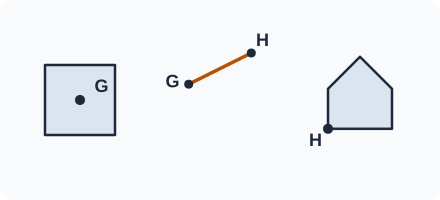
The left box shows two shapes, each with a lettered point, and a line with the same two letters on its ends. Which figure shows how the shapes connect when each end of the line is attached to the point with the same letter?

Left box: a square with point G at the center, a house shape with point H at a bottom corner, and a separate line with end G and end H.
Show the answer

Answer: D

Check one letter at a time. Point G is at the center of the square, and point H is at a bottom corner of the house shape. Cross out any figure where either end of the line lands somewhere else or where a shape has changed. The shapes may be turned, so find each point by its place on the shape (corner, middle of a side, center), not by up, down, left or right.

  • A: The line ends in the wrong place: it meets the house shape at the middle of a wall, but point H is at a bottom corner.
  • B: The line ends in the wrong place: it meets the square at the middle of a side, but point G is at the center and it meets the house shape at the middle of the bottom side, but point H is at a bottom corner.
  • C: The line ends in the wrong place: it meets the square at the middle of a side, but point G is at the center.
  • D (correct): The line joins the center of the square to a bottom corner of the house shape, the same spots as points G and H in the left box; turning a shape does not move a point on it.
Question 57 · AO · medium

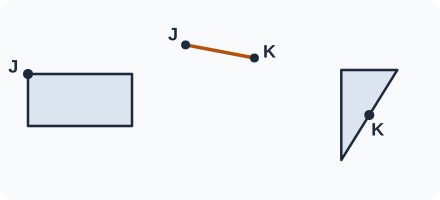
The left box shows two shapes, each with a lettered point, and a line with the same two letters on its ends. Which figure shows how the shapes connect when each end of the line is attached to the point with the same letter?

Left box: a rectangle with point J at a corner, a right triangle with point K at the middle of the slanted side, and a separate line with end J and end K.
Show the answer

Answer: C

Check one letter at a time. Point J is at a corner of the rectangle, and point K is at the middle of the slanted side of the right triangle. Cross out any figure where either end of the line lands somewhere else or where a shape has changed. The shapes may be turned, so find each point by its place on the shape (corner, middle of a side, center), not by up, down, left or right.

  • A: The line ends in the wrong place: it meets the right triangle at the middle of the longer leg, but point K is at the middle of the slanted side.
  • B: One of the shapes here is a square, but the left box has a rectangle. Joining parts never changes a shape.
  • C (correct): The line joins a corner of the rectangle to the middle of the slanted side of the right triangle, the same spots as points J and K in the left box; turning a shape does not move a point on it.
  • D: The line ends in the wrong place: it meets the right triangle at the middle of the shorter leg, but point K is at the middle of the slanted side.
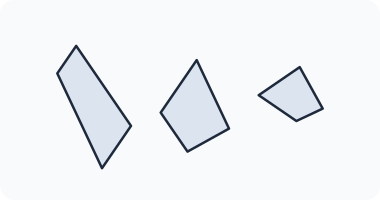
Question 58 · AO · medium

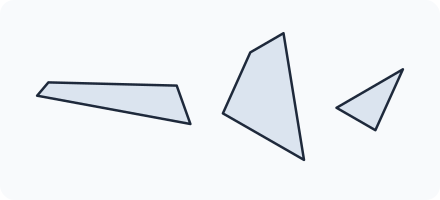
The left box shows separate flat pieces. Which figure shows how the pieces look when they are fitted together?

Left box: 3 separate flat pieces: a four-sided piece (about 51% of the total area), a four-sided piece (about 34% of the total area), a triangle (about 14% of the total area).
Show the answer

Answer: C

Count the pieces first: every figure must use each piece exactly once, with nothing added. Then pick one distinctive piece, such as the largest one or one with a curved or sharply pointed edge, and look for it in each figure; pieces may be turned but never flipped over. A figure whose cut lines are in different places has pieces of different sizes and can be crossed out. Here the pieces fit together into a triangle.

  • A: A cut is in a different place, so the pieces do not match: one piece here covers about 31% of the shape, but the matching piece in the left box covers about 14%.
  • B: A cut is in a different place, so the pieces do not match: one piece here covers about 22% of the shape, but the matching piece in the left box covers about 14%.
  • C (correct): This triangle is made of exactly the 3 pieces in the left box, each only turned and slid into place.
  • D: This figure has 4 pieces, but the left box has 3. Every piece must be used once, and nothing may be added.
Question 59 · AO · hard

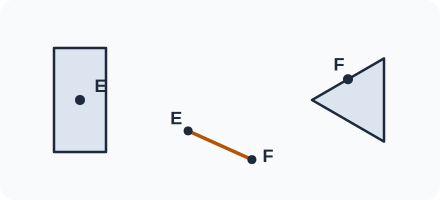
The left box shows two shapes, each with a lettered point, and a line with the same two letters on its ends. Which figure shows how the shapes connect when each end of the line is attached to the point with the same letter?

Left box: a rectangle with point E at the center, a triangle with point F at the middle of a side, and a separate line with end E and end F.
Show the answer

Answer: C

Check one letter at a time. Point E is at the center of the rectangle, and point F is at the middle of a side of the triangle. Cross out any figure where either end of the line lands somewhere else or where a shape has changed. The shapes may be turned, so find each point by its place on the shape (corner, middle of a side, center), not by up, down, left or right.

  • A: The line ends in the wrong place: it meets the rectangle at the middle of a short side, but point E is at the center.
  • B: One of the shapes here is a square, but the left box has a rectangle. Joining parts never changes a shape.
  • C (correct): The line joins the center of the rectangle to the middle of a side of the triangle, the same spots as points E and F in the left box; turning a shape does not move a point on it.
  • D: The line ends in the wrong place: it meets the triangle at a corner, but point F is at the middle of a side.
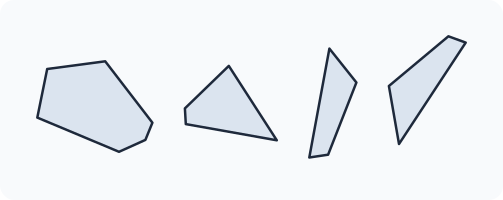
Question 60 · AO · hard

The left box shows separate flat pieces. Which figure shows how the pieces look when they are fitted together?

Left box: 4 separate flat pieces: a six-sided piece (about 43% of the total area), a four-sided piece (about 22% of the total area), a four-sided piece (about 20% of the total area), a four-sided piece (about 16% of the total area).
Show the answer

Answer: D

Count the pieces first: every figure must use each piece exactly once, with nothing added. Then pick one distinctive piece, such as the largest one or one with a curved or sharply pointed edge, and look for it in each figure; pieces may be turned but never flipped over. A figure whose cut lines are in different places has pieces of different sizes and can be crossed out. Here the pieces fit together into a hexagon.

  • A: A cut is in a different place, so the pieces do not match: one piece here covers about 36% of the shape, but the matching piece in the left box covers about 43%.
  • B: This figure is a circle. The pieces in the left box do not have these shapes, so they cannot fill this outline without gaps or overlaps.
  • C: A cut is in a different place, so the pieces do not match: one piece here covers about 52% of the shape, but the matching piece in the left box covers about 43%.
  • D (correct): This hexagon is made of exactly the 4 pieces in the left box, each only turned and slid into place.

Finished?

See your score by subtest, which questions you missed and the lesson to review for each one.

Some questions are unanswered

Unanswered questions count as wrong. You can go back and answer them, or check your answers now.

About this test

It samples a different set of lessons than Diagnostic 1. Here the math emphasis is on fractions, decimals, ratios, signed numbers, inequalities and triangles, and the technical sections include Ohm's Law, Series Circuits, Tires and Wheels, Hand Tools and Mental Rotation. Forty-eight lessons are left out, among them Engine Fundamentals, Astronomy, Pulleys and Block-and-Tackle Systems, and Speed and Visual Scanning.

All questions are original and none overlaps with another practice test, so comparing the two diagnostics gives an honest picture. Keep the timer on, review every explanation, and plan your next lessons around the weakest subtests. The result is practice accuracy only.

Take it with you: the free app

The same 124 lessons, 6,516 questions and 82 timed practice tests on your phone, plus flashcards with spaced review and progress tracking. Free to download, and it works offline.

  • Works offline
  • Spaced-review flashcards
  • Progress for every subtest
  • Menus in 59 languages
ASVAB Camp appGoogle Play