ASVAB Camp Get the appGoogle Play
AO · Practice test

Assembling Objects Practice Test 3 for the ASVAB

Test 3 in the Assembling Objects set targets two habits that separate quick solvers from slow ones: picturing the edges you cannot see, and building a whole shape from scattered parts. You get 15 questions and 18 minutes, the same frame as the other AO forms.

  • 15 questions
  • 18 minutes
  • Every answer explained
  1. Pick your answers. You can change them until you check.
  2. Check my answers scores the test by subtest and opens every explanation.
0 / 15 answered

Assembling Objects

15 questions · 18 min on the real test
Question 1 · AO · easy

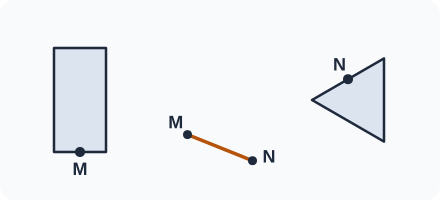
The left box shows two shapes, each with a lettered point, and a line with the same two letters on its ends. Which figure shows how the shapes connect when each end of the line is attached to the point with the same letter?
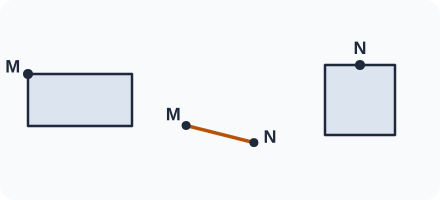
Left box: a rectangle with point M at a corner, a square with point N at the middle of a side, and a separate line with end M and end N.
Show the answer

Answer: A

Check one letter at a time. Point M is at a corner of the rectangle, and point N is at the middle of a side of the square. Cross out any figure where either end of the line lands somewhere else or where a shape has changed. The shapes may be turned, so find each point by its place on the shape (corner, middle of a side, center), not by up, down, left or right.

  • A (correct): The line joins a corner of the rectangle to the middle of a side of the square, the same spots as points M and N in the left box; turning a shape does not move a point on it.
  • B: The line ends in the wrong place: it meets the square at a corner, but point N is at the middle of a side.
  • C: The line ends in the wrong place: it meets the rectangle at the center, but point M is at a corner.
  • D: The line ends in the wrong place: it meets the rectangle at the middle of a short side, but point M is at a corner and it meets the square at the center, but point N is at the middle of a side.
Question 2 · AO · easy

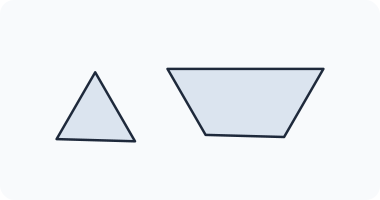
The left box shows separate flat pieces. Which figure shows how the pieces look when they are fitted together?

Left box: 2 separate flat pieces: a four-sided piece (about 75% of the total area), a triangle (about 25% of the total area).
Show the answer

Answer: A

Count the pieces first: every figure must use each piece exactly once, with nothing added. Then pick one distinctive piece, such as the largest one or one with a curved or sharply pointed edge, and look for it in each figure; pieces may be turned but never flipped over. A figure whose cut lines are in different places has pieces of different sizes and can be crossed out. Here the pieces fit together into a triangle.

  • A (correct): This triangle is made of exactly the 2 pieces in the left box, each only turned and slid into place.
  • B: A cut is in a different place, so the pieces do not match: one piece here covers about 47% of the shape, but the matching piece in the left box covers about 25%.
  • C: This figure is a right triangle. The pieces in the left box do not have these shapes, so they cannot fill this outline without gaps or overlaps.
  • D: This figure has 3 pieces, but the left box has 2. Every piece must be used once, and nothing may be added.
Question 3 · AO · easy

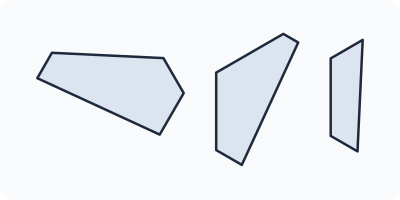
The left box shows separate flat pieces. Which figure shows how the pieces look when they are fitted together?

Left box: 3 separate flat pieces: a five-sided piece (about 45% of the total area), a five-sided piece (about 37% of the total area), a four-sided piece (about 18% of the total area).
Show the answer

Answer: B

Count the pieces first: every figure must use each piece exactly once, with nothing added. Then pick one distinctive piece, such as the largest one or one with a curved or sharply pointed edge, and look for it in each figure; pieces may be turned but never flipped over. A figure whose cut lines are in different places has pieces of different sizes and can be crossed out. Here the pieces fit together into a hexagon.

  • A: This figure is a circle. The pieces in the left box do not have these shapes, so they cannot fill this outline without gaps or overlaps.
  • B (correct): This hexagon is made of exactly the 3 pieces in the left box, each only turned and slid into place.
  • C: A cut is in a different place, so the pieces do not match: one piece here covers about 53% of the shape, but the matching piece in the left box covers about 45%.
  • D: This figure has 4 pieces, but the left box has 3. Every piece must be used once, and nothing may be added.
Question 4 · AO · easy

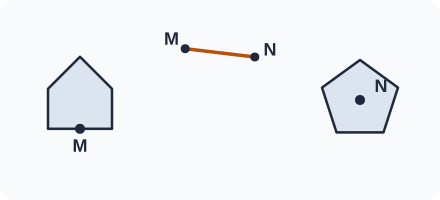
The left box shows two shapes, each with a lettered point, and a line with the same two letters on its ends. Which figure shows how the shapes connect when each end of the line is attached to the point with the same letter?

Left box: a house shape with point M at the middle of the bottom side, a pentagon with point N at the center, and a separate line with end M and end N.
Show the answer

Answer: C

Check one letter at a time. Point M is at the middle of the bottom side of the house shape, and point N is at the center of the pentagon. Cross out any figure where either end of the line lands somewhere else or where a shape has changed. The shapes may be turned, so find each point by its place on the shape (corner, middle of a side, center), not by up, down, left or right.

  • A: The line ends in the wrong place: it meets the house shape at the peak of the roof, but point M is at the middle of the bottom side.
  • B: The line ends in the wrong place: it meets the house shape at a corner where the roof meets a wall, but point M is at the middle of the bottom side and it meets the pentagon at a corner, but point N is at the center.
  • C (correct): The line joins the middle of the bottom side of the house shape to the center of the pentagon, the same spots as points M and N in the left box; turning a shape does not move a point on it.
  • D: The line ends in the wrong place: it meets the pentagon at the middle of a side, but point N is at the center.
Question 5 · AO · medium

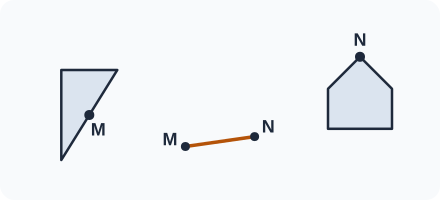
The left box shows two shapes, each with a lettered point, and a line with the same two letters on its ends. Which figure shows how the shapes connect when each end of the line is attached to the point with the same letter?

Left box: a right triangle with point M at the middle of the slanted side, a house shape with point N at the peak of the roof, and a separate line with end M and end N.
Show the answer

Answer: B

Check one letter at a time. Point M is at the middle of the slanted side of the right triangle, and point N is at the peak of the roof of the house shape. Cross out any figure where either end of the line lands somewhere else or where a shape has changed. The shapes may be turned, so find each point by its place on the shape (corner, middle of a side, center), not by up, down, left or right.

  • A: The line ends in the wrong place: it meets the right triangle at the right-angle corner, but point M is at the middle of the slanted side and it meets the house shape at a corner where the roof meets a wall, but point N is at the peak of the roof.
  • B (correct): The line joins the middle of the slanted side of the right triangle to the peak of the roof of the house shape, the same spots as points M and N in the left box; turning a shape does not move a point on it.
  • C: The line ends in the wrong place: it meets the right triangle at the middle of the shorter leg, but point M is at the middle of the slanted side.
  • D: The line ends in the wrong place: it meets the right triangle at the middle of the longer leg, but point M is at the middle of the slanted side.
Question 6 · AO · medium

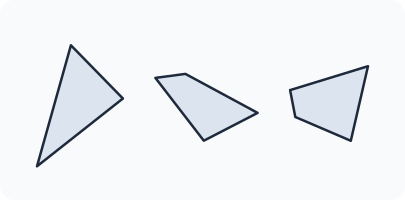
The left box shows separate flat pieces. Which figure shows how the pieces look when they are fitted together?

Left box: 3 separate flat pieces: a triangle (about 38% of the total area), a four-sided piece (about 32% of the total area), a four-sided piece (about 29% of the total area).
Show the answer

Answer: C

Count the pieces first: every figure must use each piece exactly once, with nothing added. Then pick one distinctive piece, such as the largest one or one with a curved or sharply pointed edge, and look for it in each figure; pieces may be turned but never flipped over. A figure whose cut lines are in different places has pieces of different sizes and can be crossed out. Here the pieces fit together into a triangle.

  • A: A cut is in a different place, so the pieces do not match: one piece here covers about 19% of the shape, but the matching piece in the left box covers about 29%.
  • B: This figure is a right triangle. The pieces in the left box do not have these shapes, so they cannot fill this outline without gaps or overlaps.
  • C (correct): This triangle is made of exactly the 3 pieces in the left box, each only turned and slid into place.
  • D: This figure has 4 pieces, but the left box has 3. Every piece must be used once, and nothing may be added.
Question 7 · AO · medium

The left box shows two shapes, each with a lettered point, and a line with the same two letters on its ends. Which figure shows how the shapes connect when each end of the line is attached to the point with the same letter?

Left box: a rectangle with point M at the middle of a short side, a triangle with point N at the middle of a side, and a separate line with end M and end N.
Show the answer

Answer: A

Check one letter at a time. Point M is at the middle of a short side of the rectangle, and point N is at the middle of a side of the triangle. Cross out any figure where either end of the line lands somewhere else or where a shape has changed. The shapes may be turned, so find each point by its place on the shape (corner, middle of a side, center), not by up, down, left or right.

  • A (correct): The line joins the middle of a short side of the rectangle to the middle of a side of the triangle, the same spots as points M and N in the left box; turning a shape does not move a point on it.
  • B: One of the shapes here is a parallelogram, but the left box has a rectangle. Joining parts never changes a shape.
  • C: The line ends in the wrong place: it meets the rectangle at a corner, but point M is at the middle of a short side.
  • D: The line ends in the wrong place: it meets the rectangle at the middle of a long side, but point M is at the middle of a short side.
Question 8 · AO · medium

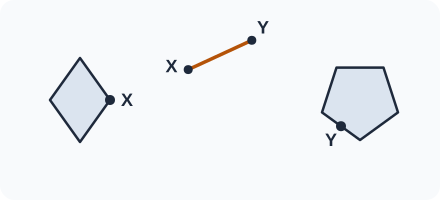
The left box shows two shapes, each with a lettered point, and a line with the same two letters on its ends. Which figure shows how the shapes connect when each end of the line is attached to the point with the same letter?

Left box: a diamond with point X at a wide corner, a pentagon with point Y at the middle of a side, and a separate line with end X and end Y.
Show the answer

Answer: B

Check one letter at a time. Point X is at a wide corner of the diamond, and point Y is at the middle of a side of the pentagon. Cross out any figure where either end of the line lands somewhere else or where a shape has changed. The shapes may be turned, so find each point by its place on the shape (corner, middle of a side, center), not by up, down, left or right.

  • A: The line ends in the wrong place: it meets the diamond at the middle of a side, but point X is at a wide corner.
  • B (correct): The line joins a wide corner of the diamond to the middle of a side of the pentagon, the same spots as points X and Y in the left box; turning a shape does not move a point on it.
  • C: One of the shapes here is a hexagon, but the left box has a pentagon. Joining parts never changes a shape.
  • D: The line ends in the wrong place: it meets the pentagon at a corner, but point Y is at the middle of a side.
Question 9 · AO · medium

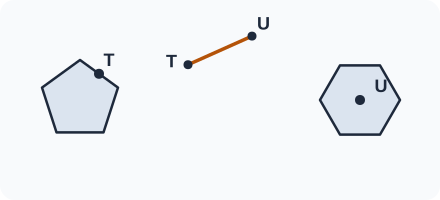
The left box shows two shapes, each with a lettered point, and a line with the same two letters on its ends. Which figure shows how the shapes connect when each end of the line is attached to the point with the same letter?

Left box: a pentagon with point T at the middle of a side, a hexagon with point U at the center, and a separate line with end T and end U.
Show the answer

Answer: D

Check one letter at a time. Point T is at the middle of a side of the pentagon, and point U is at the center of the hexagon. Cross out any figure where either end of the line lands somewhere else or where a shape has changed. The shapes may be turned, so find each point by its place on the shape (corner, middle of a side, center), not by up, down, left or right.

  • A: The line ends in the wrong place: it meets the hexagon at the middle of a side, but point U is at the center.
  • B: The line ends in the wrong place: it meets the pentagon at a corner, but point T is at the middle of a side.
  • C: The line ends in the wrong place: it meets the pentagon at the center, but point T is at the middle of a side and it meets the hexagon at a corner, but point U is at the center.
  • D (correct): The line joins the middle of a side of the pentagon to the center of the hexagon, the same spots as points T and U in the left box; turning a shape does not move a point on it.
Question 10 · AO · medium

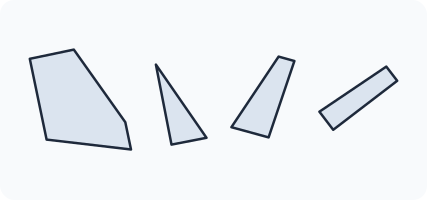
The left box shows separate flat pieces. Which figure shows how the pieces look when they are fitted together?

Left box: 3 separate flat pieces: a four-sided piece (about 48% of the total area), a four-sided piece (about 35% of the total area), a four-sided piece (about 17% of the total area).
Show the answer

Answer: A

Count the pieces first: every figure must use each piece exactly once, with nothing added. Then pick one distinctive piece, such as the largest one or one with a curved or sharply pointed edge, and look for it in each figure; pieces may be turned but never flipped over. A figure whose cut lines are in different places has pieces of different sizes and can be crossed out. Here the pieces fit together into a rectangle.

  • A (correct): This rectangle is made of exactly the 3 pieces in the left box, each only turned and slid into place.
  • B: This figure has 4 pieces, but the left box has 3. Every piece must be used once, and nothing may be added.
  • C: A cut is in a different place, so the pieces do not match: one piece here covers about 66% of the shape, but the matching piece in the left box covers about 48%.
  • D: This figure is a square. The pieces in the left box do not have these shapes, so they cannot fill this outline without gaps or overlaps.
Question 11 · AO · medium

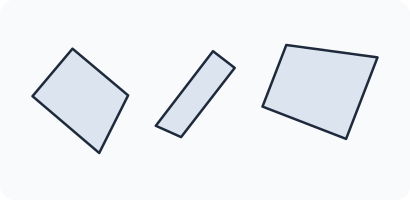
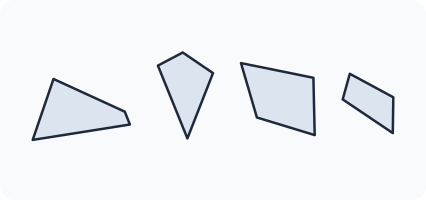
The left box shows separate flat pieces. Which figure shows how the pieces look when they are fitted together?

Left box: 3 separate flat pieces: a four-sided piece (about 43% of the total area), a four-sided piece (about 37% of the total area), a four-sided piece (about 21% of the total area).
Show the answer

Answer: A

Count the pieces first: every figure must use each piece exactly once, with nothing added. Then pick one distinctive piece, such as the largest one or one with a curved or sharply pointed edge, and look for it in each figure; pieces may be turned but never flipped over. A figure whose cut lines are in different places has pieces of different sizes and can be crossed out. Here the pieces fit together into a diamond.

  • A (correct): This diamond is made of exactly the 3 pieces in the left box, each only turned and slid into place.
  • B: This figure has 4 pieces, but the left box has 3. Every piece must be used once, and nothing may be added.
  • C: A cut is in a different place, so the pieces do not match: one piece here covers about 53% of the shape, but the matching piece in the left box covers about 43%.
  • D: This figure is a square. The pieces in the left box do not have these shapes, so they cannot fill this outline without gaps or overlaps.
Question 12 · AO · hard

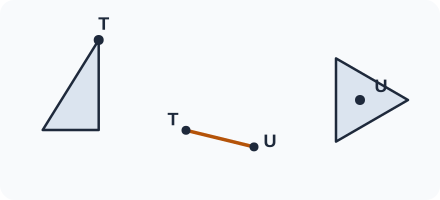
The left box shows two shapes, each with a lettered point, and a line with the same two letters on its ends. Which figure shows how the shapes connect when each end of the line is attached to the point with the same letter?

Left box: a right triangle with point T at the sharpest corner, a triangle with point U at the center, and a separate line with end T and end U.
Show the answer

Answer: D

Check one letter at a time. Point T is at the sharpest corner of the right triangle, and point U is at the center of the triangle. Cross out any figure where either end of the line lands somewhere else or where a shape has changed. The shapes may be turned, so find each point by its place on the shape (corner, middle of a side, center), not by up, down, left or right.

  • A: The line ends in the wrong place: it meets the right triangle at the middle of the slanted side, but point T is at the sharpest corner.
  • B: The line ends in the wrong place: it meets the right triangle at the middle of the shorter leg, but point T is at the sharpest corner and it meets the triangle at a corner, but point U is at the center.
  • C: The line ends in the wrong place: it meets the triangle at a corner, but point U is at the center.
  • D (correct): The line joins the sharpest corner of the right triangle to the center of the triangle, the same spots as points T and U in the left box; turning a shape does not move a point on it.
Question 13 · AO · hard

The left box shows separate flat pieces. Which figure shows how the pieces look when they are fitted together?

Left box: 4 separate flat pieces: a five-sided piece (about 54% of the total area), a four-sided piece (about 19% of the total area), a four-sided piece (about 14% of the total area), a triangle (about 13% of the total area).
Show the answer

Answer: A

Count the pieces first: every figure must use each piece exactly once, with nothing added. Then pick one distinctive piece, such as the largest one or one with a curved or sharply pointed edge, and look for it in each figure; pieces may be turned but never flipped over. A figure whose cut lines are in different places has pieces of different sizes and can be crossed out. Here the pieces fit together into a rectangle.

  • A (correct): This rectangle is made of exactly the 4 pieces in the left box, each only turned and slid into place.
  • B: This figure is a square. The pieces in the left box do not have these shapes, so they cannot fill this outline without gaps or overlaps.
  • C: A cut is in a different place, so the pieces do not match: one piece here covers about 47% of the shape, but the matching piece in the left box covers about 54%.
  • D: A cut is in a different place, so the pieces do not match: one piece here covers about 39% of the shape, but the matching piece in the left box covers about 54%.
Question 14 · AO · hard

The left box shows separate flat pieces. Which figure shows how the pieces look when they are fitted together?

Left box: 4 separate flat pieces: a four-sided piece (about 33% of the total area), a four-sided piece (about 30% of the total area), a four-sided piece (about 22% of the total area), a four-sided piece (about 15% of the total area).
Show the answer

Answer: A

Count the pieces first: every figure must use each piece exactly once, with nothing added. Then pick one distinctive piece, such as the largest one or one with a curved or sharply pointed edge, and look for it in each figure; pieces may be turned but never flipped over. A figure whose cut lines are in different places has pieces of different sizes and can be crossed out. Here the pieces fit together into a trapezoid.

  • A (correct): This trapezoid is made of exactly the 4 pieces in the left box, each only turned and slid into place.
  • B: This figure is a half-circle. The pieces in the left box do not have these shapes, so they cannot fill this outline without gaps or overlaps.
  • C: A cut is in a different place, so the pieces do not match: one piece here covers about 23% of the shape, but the matching piece in the left box covers about 30%.
  • D: A cut is in a different place, so the pieces do not match: one piece here covers about 47% of the shape, but the matching piece in the left box covers about 33%.
Question 15 · AO · hard

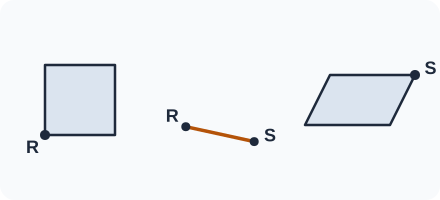
The left box shows two shapes, each with a lettered point, and a line with the same two letters on its ends. Which figure shows how the shapes connect when each end of the line is attached to the point with the same letter?

Left box: a square with point R at a corner, a parallelogram with point S at a sharp corner, and a separate line with end R and end S.
Show the answer

Answer: A

Check one letter at a time. Point R is at a corner of the square, and point S is at a sharp corner of the parallelogram. Cross out any figure where either end of the line lands somewhere else or where a shape has changed. The shapes may be turned, so find each point by its place on the shape (corner, middle of a side, center), not by up, down, left or right.

  • A (correct): The line joins a corner of the square to a sharp corner of the parallelogram, the same spots as points R and S in the left box; turning a shape does not move a point on it.
  • B: The line ends in the wrong place: it meets the parallelogram at the center, but point S is at a sharp corner.
  • C: One of the shapes here is a rectangle, but the left box has a square. Joining parts never changes a shape.
  • D: The line ends in the wrong place: it meets the square at the center, but point R is at a corner.

Finished?

See your score by subtest, which questions you missed and the lesson to review for each one.

Some questions are unanswered

Unanswered questions count as wrong. You can go back and answer them, or check your answers now.

About this test

The item pool still spans all eight lessons, including spatial orientation, connection points, mental rotation, speed and visual scanning, distractor elimination and mixed AO strategy. What sets this form apart is how often occlusion and part-to-whole assembly decide the right answer. Difficulty runs 4 easy, 7 medium and 4 hard, and none of these puzzles is reused in another practice test.

For a realistic run, sit at a desk, start the clock and avoid going back to pondered items until the end. When time is up, go through each explanation, especially the hard items, and note which lesson each miss points to. The score shown is your practice accuracy on this form; it is not an AO standard score or an AFQT result.

Take it with you: the free app

The same 124 lessons, 6,516 questions and 82 timed practice tests on your phone, plus flashcards with spaced review and progress tracking. Free to download, and it works offline.

  • Works offline
  • Spaced-review flashcards
  • Progress for every subtest
  • Menus in 59 languages
ASVAB Camp appGoogle Play