ASVAB Camp Get the appGoogle Play
AO · Practice test

ASVAB Assembling Objects Practice Test 2

Form 2 of the Assembling Objects practice series keeps the familiar format of 15 questions in 18 minutes, but the answer choices lean on close look-alikes. Many items come down to distractor elimination: two options look right until you check which way a tab faces or where a line meets its dot.

  • 15 questions
  • 18 minutes
  • Every answer explained
  1. Pick your answers. You can change them until you check.
  2. Check my answers scores the test by subtest and opens every explanation.
0 / 15 answered

Assembling Objects

15 questions · 18 min on the real test
Question 1 · AO · easy

The left box shows separate flat pieces. Which figure shows how the pieces look when they are fitted together?
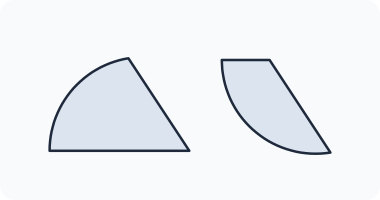
Left box: 2 separate flat pieces: a piece with a curved side (about 60% of the total area), a piece with a curved side (about 40% of the total area).
Show the answer

Answer: D

Count the pieces first: every figure must use each piece exactly once, with nothing added. Then pick one distinctive piece, such as the largest one or one with a curved or sharply pointed edge, and look for it in each figure; pieces may be turned but never flipped over. A figure whose cut lines are in different places has pieces of different sizes and can be crossed out. Here the pieces fit together into a half-circle.

  • A: This figure has 3 pieces, but the left box has 2. Every piece must be used once, and nothing may be added.
  • B: A cut is in a different place, so the pieces do not match: one piece here covers about 52% of the shape, but the matching piece in the left box covers about 60%.
  • C: This figure is a trapezoid. The pieces in the left box do not have these shapes, so they cannot fill this outline without gaps or overlaps.
  • D (correct): This half-circle is made of exactly the 2 pieces in the left box, each only turned and slid into place.
Question 2 · AO · easy

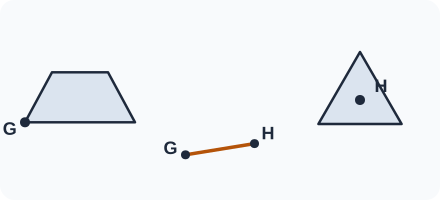
The left box shows two shapes, each with a lettered point, and a line with the same two letters on its ends. Which figure shows how the shapes connect when each end of the line is attached to the point with the same letter?

Left box: a trapezoid with point G at a corner of the long side, a triangle with point H at the center, and a separate line with end G and end H.
Show the answer

Answer: C

Check one letter at a time. Point G is at a corner of the long side of the trapezoid, and point H is at the center of the triangle. Cross out any figure where either end of the line lands somewhere else or where a shape has changed. The shapes may be turned, so find each point by its place on the shape (corner, middle of a side, center), not by up, down, left or right.

  • A: The line ends in the wrong place: it meets the trapezoid at a corner of the short side, but point G is at a corner of the long side and it meets the triangle at the middle of a side, but point H is at the center.
  • B: The line ends in the wrong place: it meets the trapezoid at a corner of the short side, but point G is at a corner of the long side.
  • C (correct): The line joins a corner of the long side of the trapezoid to the center of the triangle, the same spots as points G and H in the left box; turning a shape does not move a point on it.
  • D: The line ends in the wrong place: it meets the triangle at the middle of a side, but point H is at the center.
Question 3 · AO · easy

The left box shows separate flat pieces. Which figure shows how the pieces look when they are fitted together?

Left box: 2 separate flat pieces: a four-sided piece (about 76% of the total area), a four-sided piece (about 24% of the total area).
Show the answer

Answer: C

Count the pieces first: every figure must use each piece exactly once, with nothing added. Then pick one distinctive piece, such as the largest one or one with a curved or sharply pointed edge, and look for it in each figure; pieces may be turned but never flipped over. A figure whose cut lines are in different places has pieces of different sizes and can be crossed out. Here the pieces fit together into a parallelogram.

  • A: This figure has 3 pieces, but the left box has 2. Every piece must be used once, and nothing may be added.
  • B: This figure is a rectangle. The pieces in the left box do not have these shapes, so they cannot fill this outline without gaps or overlaps.
  • C (correct): This parallelogram is made of exactly the 2 pieces in the left box, each only turned and slid into place.
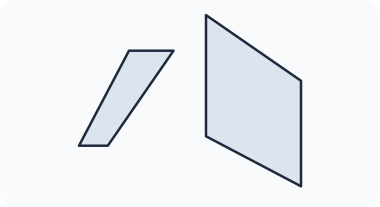
  • D: A cut is in a different place, so the pieces do not match: one piece here covers about 41% of the shape, but the matching piece in the left box covers about 24%.
Question 4 · AO · easy

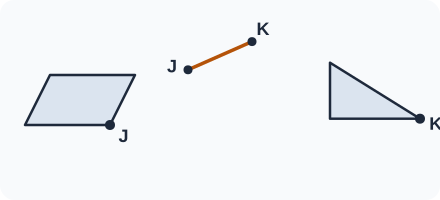
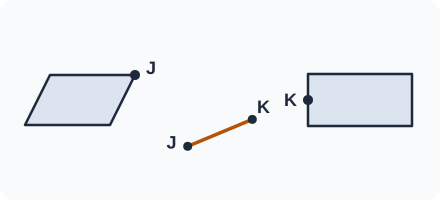
The left box shows two shapes, each with a lettered point, and a line with the same two letters on its ends. Which figure shows how the shapes connect when each end of the line is attached to the point with the same letter?

Left box: a parallelogram with point J at a wide corner, a right triangle with point K at the sharpest corner, and a separate line with end J and end K.
Show the answer

Answer: D

Check one letter at a time. Point J is at a wide corner of the parallelogram, and point K is at the sharpest corner of the right triangle. Cross out any figure where either end of the line lands somewhere else or where a shape has changed. The shapes may be turned, so find each point by its place on the shape (corner, middle of a side, center), not by up, down, left or right.

  • A: The line ends in the wrong place: it meets the right triangle at the right-angle corner, but point K is at the sharpest corner.
  • B: The line ends in the wrong place: it meets the parallelogram at the middle of a long side, but point J is at a wide corner and it meets the right triangle at the middle of the shorter leg, but point K is at the sharpest corner.
  • C: The line ends in the wrong place: it meets the right triangle at the middle of the longer leg, but point K is at the sharpest corner.
  • D (correct): The line joins a wide corner of the parallelogram to the sharpest corner of the right triangle, the same spots as points J and K in the left box; turning a shape does not move a point on it.
Question 5 · AO · medium

The left box shows separate flat pieces. Which figure shows how the pieces look when they are fitted together?

Left box: 3 separate flat pieces: a four-sided piece (about 53% of the total area), a four-sided piece (about 28% of the total area), a triangle (about 19% of the total area).
Show the answer

Answer: C

Count the pieces first: every figure must use each piece exactly once, with nothing added. Then pick one distinctive piece, such as the largest one or one with a curved or sharply pointed edge, and look for it in each figure; pieces may be turned but never flipped over. A figure whose cut lines are in different places has pieces of different sizes and can be crossed out. Here the pieces fit together into a right triangle.

  • A: This figure has 4 pieces, but the left box has 3. Every piece must be used once, and nothing may be added.
  • B: A cut is in a different place, so the pieces do not match: one piece here covers about 43% of the shape, but the matching piece in the left box covers about 53%.
  • C (correct): This right triangle is made of exactly the 3 pieces in the left box, each only turned and slid into place.
  • D: This figure is a triangle. The pieces in the left box do not have these shapes, so they cannot fill this outline without gaps or overlaps.
Question 6 · AO · medium

The left box shows two shapes, each with a lettered point, and a line with the same two letters on its ends. Which figure shows how the shapes connect when each end of the line is attached to the point with the same letter?

Left box: a parallelogram with point J at a sharp corner, a rectangle with point K at the middle of a short side, and a separate line with end J and end K.
Show the answer

Answer: C

Check one letter at a time. Point J is at a sharp corner of the parallelogram, and point K is at the middle of a short side of the rectangle. Cross out any figure where either end of the line lands somewhere else or where a shape has changed. The shapes may be turned, so find each point by its place on the shape (corner, middle of a side, center), not by up, down, left or right.

  • A: The line ends in the wrong place: it meets the parallelogram at the middle of a short side, but point J is at a sharp corner.
  • B: The line ends in the wrong place: it meets the parallelogram at the middle of a long side, but point J is at a sharp corner and it meets the rectangle at the middle of a long side, but point K is at the middle of a short side.
  • C (correct): The line joins a sharp corner of the parallelogram to the middle of a short side of the rectangle, the same spots as points J and K in the left box; turning a shape does not move a point on it.
  • D: The line ends in the wrong place: it meets the parallelogram at a wide corner, but point J is at a sharp corner.
Question 7 · AO · medium

The left box shows two shapes, each with a lettered point, and a line with the same two letters on its ends. Which figure shows how the shapes connect when each end of the line is attached to the point with the same letter?

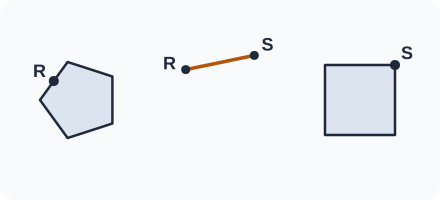
Left box: a pentagon with point R at the middle of a side, a square with point S at a corner, and a separate line with end R and end S.
Show the answer

Answer: B

Check one letter at a time. Point R is at the middle of a side of the pentagon, and point S is at a corner of the square. Cross out any figure where either end of the line lands somewhere else or where a shape has changed. The shapes may be turned, so find each point by its place on the shape (corner, middle of a side, center), not by up, down, left or right.

  • A: The line ends in the wrong place: it meets the square at the middle of a side, but point S is at a corner.
  • B (correct): The line joins the middle of a side of the pentagon to a corner of the square, the same spots as points R and S in the left box; turning a shape does not move a point on it.
  • C: One of the shapes here is a hexagon, but the left box has a pentagon. Joining parts never changes a shape.
  • D: The line ends in the wrong place: it meets the pentagon at the center, but point R is at the middle of a side.
Question 8 · AO · medium

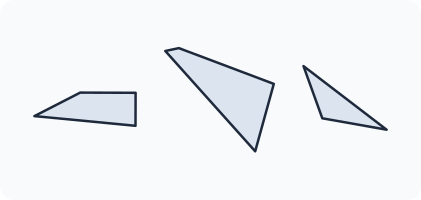
The left box shows separate flat pieces. Which figure shows how the pieces look when they are fitted together?

Left box: 3 separate flat pieces: a five-sided piece (about 53% of the total area), a five-sided piece (about 26% of the total area), a four-sided piece (about 20% of the total area).
Show the answer

Answer: D

Count the pieces first: every figure must use each piece exactly once, with nothing added. Then pick one distinctive piece, such as the largest one or one with a curved or sharply pointed edge, and look for it in each figure; pieces may be turned but never flipped over. A figure whose cut lines are in different places has pieces of different sizes and can be crossed out. Here the pieces fit together into a hexagon.

  • A: This figure has 4 pieces, but the left box has 3. Every piece must be used once, and nothing may be added.
  • B: A cut is in a different place, so the pieces do not match: one piece here covers about 65% of the shape, but the matching piece in the left box covers about 53%.
  • C: This figure is a pentagon. The pieces in the left box do not have these shapes, so they cannot fill this outline without gaps or overlaps.
  • D (correct): This hexagon is made of exactly the 3 pieces in the left box, each only turned and slid into place.
Question 9 · AO · medium

The left box shows two shapes, each with a lettered point, and a line with the same two letters on its ends. Which figure shows how the shapes connect when each end of the line is attached to the point with the same letter?

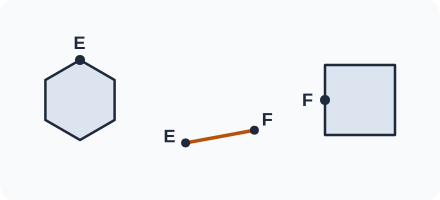
Left box: a hexagon with point E at a corner, a square with point F at the middle of a side, and a separate line with end E and end F.
Show the answer

Answer: B

Check one letter at a time. Point E is at a corner of the hexagon, and point F is at the middle of a side of the square. Cross out any figure where either end of the line lands somewhere else or where a shape has changed. The shapes may be turned, so find each point by its place on the shape (corner, middle of a side, center), not by up, down, left or right.

  • A: The line ends in the wrong place: it meets the square at a corner, but point F is at the middle of a side.
  • B (correct): The line joins a corner of the hexagon to the middle of a side of the square, the same spots as points E and F in the left box; turning a shape does not move a point on it.
  • C: The line ends in the wrong place: it meets the square at the center, but point F is at the middle of a side.
  • D: One of the shapes here is a diamond, but the left box has a square. Joining parts never changes a shape.
Question 10 · AO · medium

The left box shows two shapes, each with a lettered point, and a line with the same two letters on its ends. Which figure shows how the shapes connect when each end of the line is attached to the point with the same letter?

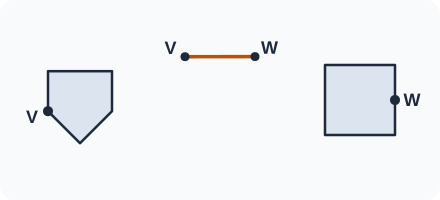
Left box: a house shape with point V at a corner where the roof meets a wall, a square with point W at the middle of a side, and a separate line with end V and end W.
Show the answer

Answer: B

Check one letter at a time. Point V is at a corner where the roof meets a wall of the house shape, and point W is at the middle of a side of the square. Cross out any figure where either end of the line lands somewhere else or where a shape has changed. The shapes may be turned, so find each point by its place on the shape (corner, middle of a side, center), not by up, down, left or right.

  • A: The line ends in the wrong place: it meets the house shape at the peak of the roof, but point V is at a corner where the roof meets a wall.
  • B (correct): The line joins a corner where the roof meets a wall of the house shape to the middle of a side of the square, the same spots as points V and W in the left box; turning a shape does not move a point on it.
  • C: One of the shapes here is a diamond, but the left box has a square. Joining parts never changes a shape.
  • D: The line ends in the wrong place: it meets the house shape at the middle of a wall, but point V is at a corner where the roof meets a wall.
Question 11 · AO · medium

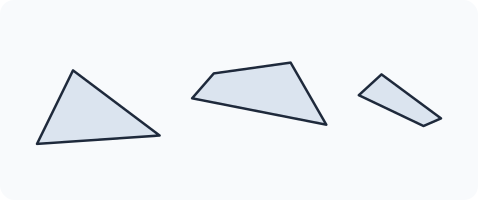
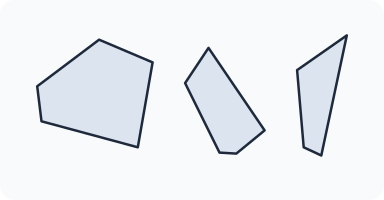
The left box shows separate flat pieces. Which figure shows how the pieces look when they are fitted together?

Left box: 3 separate flat pieces: a four-sided piece (about 43% of the total area), a triangle (about 41% of the total area), a four-sided piece (about 16% of the total area).
Show the answer

Answer: D

Count the pieces first: every figure must use each piece exactly once, with nothing added. Then pick one distinctive piece, such as the largest one or one with a curved or sharply pointed edge, and look for it in each figure; pieces may be turned but never flipped over. A figure whose cut lines are in different places has pieces of different sizes and can be crossed out. Here the pieces fit together into a triangle.

  • A: This figure has 4 pieces, but the left box has 3. Every piece must be used once, and nothing may be added.
  • B: A cut is in a different place, so the pieces do not match: one piece here covers about 68% of the shape, but the matching piece in the left box covers about 43%.
  • C: This figure is a right triangle. The pieces in the left box do not have these shapes, so they cannot fill this outline without gaps or overlaps.
  • D (correct): This triangle is made of exactly the 3 pieces in the left box, each only turned and slid into place.
Question 12 · AO · hard

The left box shows two shapes, each with a lettered point, and a line with the same two letters on its ends. Which figure shows how the shapes connect when each end of the line is attached to the point with the same letter?

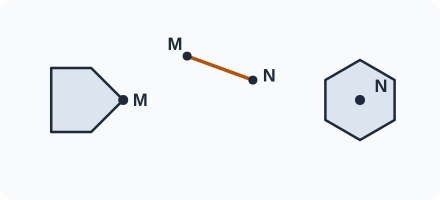
Left box: a house shape with point M at the peak of the roof, a hexagon with point N at the center, and a separate line with end M and end N.
Show the answer

Answer: C

Check one letter at a time. Point M is at the peak of the roof of the house shape, and point N is at the center of the hexagon. Cross out any figure where either end of the line lands somewhere else or where a shape has changed. The shapes may be turned, so find each point by its place on the shape (corner, middle of a side, center), not by up, down, left or right.

  • A: The line ends in the wrong place: it meets the house shape at the middle of a wall, but point M is at the peak of the roof.
  • B: The line ends in the wrong place: it meets the house shape at a corner where the roof meets a wall, but point M is at the peak of the roof.
  • C (correct): The line joins the peak of the roof of the house shape to the center of the hexagon, the same spots as points M and N in the left box; turning a shape does not move a point on it.
  • D: One of the shapes here is a pentagon, but the left box has a hexagon. Joining parts never changes a shape.
Question 13 · AO · hard

The left box shows separate flat pieces. Which figure shows how the pieces look when they are fitted together?

Left box: 4 separate flat pieces: a five-sided piece (about 29% of the total area), a triangle (about 25% of the total area), a four-sided piece (about 23% of the total area), a four-sided piece (about 22% of the total area).
Show the answer

Answer: B

Count the pieces first: every figure must use each piece exactly once, with nothing added. Then pick one distinctive piece, such as the largest one or one with a curved or sharply pointed edge, and look for it in each figure; pieces may be turned but never flipped over. A figure whose cut lines are in different places has pieces of different sizes and can be crossed out. Here the pieces fit together into a square.

  • A: This figure is a rectangle. The pieces in the left box do not have these shapes, so they cannot fill this outline without gaps or overlaps.
  • B (correct): This square is made of exactly the 4 pieces in the left box, each only turned and slid into place.
  • C: A cut is in a different place, so the pieces do not match: one piece here covers about 49% of the shape, but the matching piece in the left box covers about 29%.
  • D: A cut is in a different place, so the pieces do not match: one piece here covers about 40% of the shape, but the matching piece in the left box covers about 29%.
Question 14 · AO · hard

The left box shows two shapes, each with a lettered point, and a line with the same two letters on its ends. Which figure shows how the shapes connect when each end of the line is attached to the point with the same letter?

Left box: a diamond with point M at a wide corner, a square with point N at a corner, and a separate line with end M and end N.
Show the answer

Answer: B

Check one letter at a time. Point M is at a wide corner of the diamond, and point N is at a corner of the square. Cross out any figure where either end of the line lands somewhere else or where a shape has changed. The shapes may be turned, so find each point by its place on the shape (corner, middle of a side, center), not by up, down, left or right.

  • A: The line ends in the wrong place: it meets the diamond at the center, but point M is at a wide corner.
  • B (correct): The line joins a wide corner of the diamond to a corner of the square, the same spots as points M and N in the left box; turning a shape does not move a point on it.
  • C: One of the shapes here is a rectangle, but the left box has a square. Joining parts never changes a shape.
  • D: The line ends in the wrong place: it meets the diamond at the middle of a side, but point M is at a wide corner.
Question 15 · AO · hard

The left box shows separate flat pieces. Which figure shows how the pieces look when they are fitted together?

Left box: 4 separate flat pieces: a piece with a curved side (about 31% of the total area), a piece with a curved side (about 27% of the total area), a piece with a curved side (about 25% of the total area), a piece with a curved side (about 17% of the total area).
Show the answer

Answer: D

Count the pieces first: every figure must use each piece exactly once, with nothing added. Then pick one distinctive piece, such as the largest one or one with a curved or sharply pointed edge, and look for it in each figure; pieces may be turned but never flipped over. A figure whose cut lines are in different places has pieces of different sizes and can be crossed out. Here the pieces fit together into a circle.

  • A: A cut is in a different place, so the pieces do not match: one piece here covers about 48% of the shape, but the matching piece in the left box covers about 31%.
  • B: A cut is in a different place, so the pieces do not match: one piece here covers about 17% of the shape, but the matching piece in the left box covers about 25%.
  • C: This figure is a hexagon. The pieces in the left box do not have these shapes, so they cannot fill this outline without gaps or overlaps.
  • D (correct): This circle is made of exactly the 4 pieces in the left box, each only turned and slid into place.
Finished?

See your score by subtest, which questions you missed and the lesson to review for each one.

Some questions are unanswered

Unanswered questions count as wrong. You can go back and answer them, or check your answers now.

About this test

Every one of the eight AO lessons is represented. Beyond distractor work, you will rotate shapes mentally, match labeled connection points, rebuild a figure from its parts and reason about edges that are hidden from view. The difficulty spread is 4 easy, 7 medium and 4 hard. All 15 puzzles are original practice questions written for this form alone, so nothing repeats from Test 1 or any later test.

Start the timer only when you can give it your full attention. When you finish, sort your misses: did you misread a connection, flip a piece, or fall for a near match? The explanations show the reasoning step by step. Remember that the percentage you see measures practice accuracy, not an official subtest or line score.

Take it with you: the free app

The same 124 lessons, 6,516 questions and 82 timed practice tests on your phone, plus flashcards with spaced review and progress tracking. Free to download, and it works offline.

  • Works offline
  • Spaced-review flashcards
  • Progress for every subtest
  • Menus in 59 languages
ASVAB Camp appGoogle Play